

Blog
Practical writing on materials informatics, AI in R&D, and putting lab data to work.
Data Governance vs Data Management for Materials R&D
Data management is the day-to-day work of collecting, storing, integrating, securing, cleaning, and delivering data. Data governance is the set of decisions that determines who can use data, which standards apply, how quality gets judged, and who answers for it. Materials R&D needs both. A record can sit in storage in perfect condition and still tell you nothing useful.
Table of Contents
- Why Data Governance vs. Data Management Matters in Materials R&D
- Quick Summary of Data Governance and Data Management
- Real-World Scenario in the Lab
- Why Both Disciplines Matter
- Data Management as the Technical Layer
- Data Governance as the Policy Layer
- Where Rules Meet Workflows
- A Repository Is Not the Same as a Governed One
- Applying the Mental Model
- Questions Each Discipline Answers
- How Success Gets Measured
- Failure Modes Under Real Pressure
- Detailed Comparison of Purpose, Ownership, and Failure Modes
- Where Responsibilities Overlap
- Diagnosing the Gap Slowing Your Team
- Scaling a Polymer Formulation from Bench to Pilot Plant
- Moving ELN Results into a Shared Analytics Environment
- Training a Predictive Model on Failed Experiments
- Sharing Supplier Additive Data Under Confidentiality Terms
- Protecting Formulations and Manufacturing Parameters
- Quick Look at Each Scenario
- Start with Owners and Vocabulary
- Connect Rules to Daily Workflows
- Verify Security Claims Against Frameworks
- Making the Foundation Work for Everyone
- Start with Fragmented Records
- Move to Governance When Results Disagree
- Weigh Three Factors Before Deciding
- Guidance by Role
- Where a Platform Fits
- Does a Small Lab Need Formal Governance?
- How Do You Tell a Management Problem from a Governance Problem?
- Does Governance Slow Scientists Down?
- Can Software Handle Governance on Its Own?
- Management Makes Data Available, Governance Makes It Trustworthy
Why Data Governance vs. Data Management Matters in Materials R&D
Materials R&D pulls data from spreadsheets, electronic lab notebooks, and instruments, and those sources rarely agree on format. Keeping the data safe is a management job. Deciding whether anyone should trust it is a governance job.
Quick Summary of Data Governance and Data Management
Management asks where the data lives and whether you can get it back. Governance asks who may use it and under what rules. The table below gives the short version before we go deeper.
| Aspect | Data Management | Data Governance |
|---|---|---|
| Core question | Where is the data, and can we retrieve it? | Who may use it, and under which rules? |
| Typical owner | Data engineers and IT teams | Data stewards and R&D leaders |
| Output | Clean, secured, delivered datasets | Quality thresholds, naming conventions, access policies |
| R&D failure example | Spectroscopy files lost after a migration | Glass transition temperatures reported in different units |
If you only remember one thing from the table, make it this: the two columns answer different questions, and a working R&D team needs answers to both.
Real-World Scenario in the Lab
Picture a formulation chemist uploading a viscosity result. The file saves without any error. But the record leaves out the test temperature and the measurement method, so six months later nobody can compare it with anything else.
A stored record is not the same as a usable one. Management keeps the file safe. Governance makes sure someone can read what it means.
Governance rules that would catch this usually look like:
- Required metadata fields for test temperature and units
- One standard measurement method for each property
- Upload blocked until the mandatory fields are filled in
Why Both Disciplines Matter
Management without governance gives you tidy folders full of inconsistent meaning. Governance without management stays on paper, because rules are hard to enforce when storage is a mess. Put together, the data becomes both reachable and trustworthy.
The sections ahead take apart each discipline's purpose, owners, and common failure points. Whether you run experiments at a single bench or lead an enterprise R&D group, the distinction shapes how you spend your time. Day-to-day lab work and long-term research value both depend on getting it right.

Teams in materials R&D often use "data governance" and "data management" as if they mean the same thing. They don't, and mixing them up leads to muddled budgets and unclear responsibilities. A simple way to separate them is to ask one question first: is this work about the plumbing, or about the rules?
Data Management as the Technical Layer
Data management is the day-to-day work of getting results from the place where they're created to the place where someone needs them. In a materials R&D group, that usually means:
- Ingesting results from spreadsheets, electronic lab notebooks, and instruments
- Bringing those sources together into one searchable environment
- Storing and backing up files so nothing gets lost during a system migration
- Applying security controls such as encryption and role-based access
- Delivering clean datasets to analysts and predictive models
This layer is easy to measure. Uptime, backup success rates, and ingestion error rates tell you quickly whether it's working.
Data Governance as the Policy Layer
Data governance defines the rules that the technical layer has to follow. These rules tend to fall into a few familiar categories:
- Naming conventions for samples and projects
- Data ownership, with one named person accountable for each critical dataset
- Quality thresholds, such as which fields must be filled in before a record is saved
- Retention periods and access rules
- Audit requirements that show who changed what, and when
Governance writes the rulebook, but management refereeing the game. A rule nobody enforces is just a document sitting in a shared drive.
Where Rules Meet Workflows
Governance only has an effect when management workflows actually enforce it. Take a spectroscopy file uploaded directly from an instrument. If the platform won't complete the upload until the test method field is filled in, the policy is working. If the field can be skipped, the rule exists on paper only.
A Repository Is Not the Same as a Governed One
A well-built repository stores data safely and retrieves it quickly. That's management doing its job well.
A governed repository, though, also tells you who owns each dataset, which units apply, and whether a given value is reliable enough to support a decision. Two repositories can look identical on the surface, yet only one produces results you can trust. That gap is where many R&D teams quietly lose months.
Applying the Mental Model
When you're looking at a problem in your lab or across an enterprise R&D function, two questions help sort it out:
- Can we get the data back, and can we trust the plumbing?
- Is this data allowed to be used, and does it mean what we think it means?
The first question belongs to management. The second belongs to governance.
| Situation | Primary Discipline | Typical Fix |
|---|---|---|
| Instrument exports keep failing to sync | Management | Fix ingestion pipelines and monitoring |
| Two teams report different values for the same sample | Governance | Agree on units and a single source of record |
| Backups are running but nobody can find old files | Management | Improve indexing and search |
| Nobody knows who can approve a dataset for modeling | Governance | Assign clear ownership |
Use this split when you plan budgets, assign roles, or review a failed upload at the bench. Starting with the right discipline saves a lot of back-and-forth.
Management keeps data reachable, while governance keeps it meaningful in practice.
Data governance and data management can look nearly identical on paper. Both appear on the same org charts, both deal with files and records, and both show up in the same vendor slides. The difference becomes clear only when something breaks.
Questions Each Discipline Answers
Management asks whether a result can be found and recovered. Governance asks whether it can be trusted, and who is allowed to act on it.
That split shapes everything else. Data engineers, IT teams, and platform administrators usually run management. Data stewards, R&D leaders, and policy owners usually hold governance.
How Success Gets Measured
Management success is easy to count: uptime, backup completeness, and ingestion error rates. Governance success is harder to count. It shows up as agreed definitions, reconciled values, and audits that pass without a scramble.
A management team can report green dashboards while the business is still arguing about what the numbers mean.
Failure Modes Under Real Pressure
A management failure is loud. Suppose a batch of spectroscopy files disappears after a storage migration. Work stops until someone restores them, and everyone knows within the hour.
A governance failure is quieter. Two teams report the same glass transition temperature in different units, and neither record looks wrong on its own. The conflict surfaces only when a model or a formulation decision depends on both.
Management failures announce themselves. Governance failures hide inside plausible-looking records until they matter.
Detailed Comparison of Purpose, Ownership, and Failure Modes
The table below places the two disciplines side by side. Read across a row, and you'll notice that the same dataset can pass one test while failing the other.
| Criteria | Data Management | Data Governance | Materials R&D Example |
|---|---|---|---|
| Central question | Can the result be found and recovered? | Can it be trusted, and who may act on it? | A spectra folder opens in seconds, but nobody can say which sample ID it belongs to. |
| Typical owners | Data engineers, IT teams, platform administrators | Data stewards, R&D leaders, policy owners | Engineers maintain the instrument server; a formulation lead signs off on unit standards. |
| Key metrics | Uptime, backup completeness, ingestion error rate | Agreed definitions, reconciled values, audit pass rate | Tg is logged in °C by one lab and in K by another. |
| Characteristic failure mode | Files lost after migration, broken pipelines | Conflicting units, undefined fields, no reconciliation rule | A viscosity file uploads cleanly but has no test temperature attached. |
The pattern holds across the table. Management keeps data accessible, and governance keeps it meaningful. A polymer team can have excellent storage and still make a bad call if the test conditions were never recorded.
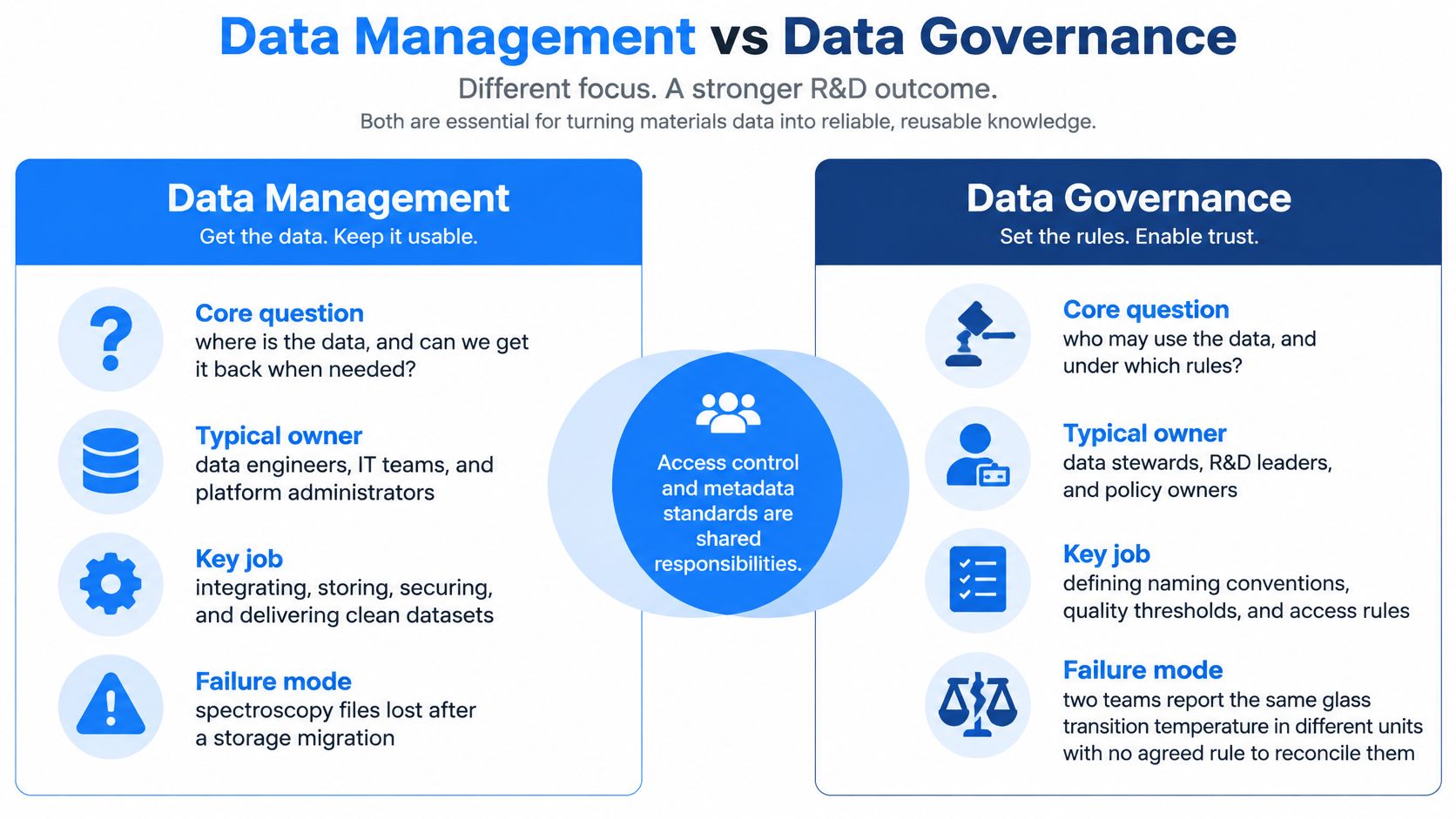
The chart below summarizes the same contrast.
Where Responsibilities Overlap
Access control and metadata standards sit in both camps. Governance decides who may see a dataset and which fields every record must carry. Management then configures the permissions and enforces those required fields.
Policy approval and system configuration are where the two split apart. A steward can approve a unit standard in one meeting, but an engineer still has to make the platform reject any record that breaks it.
Diagnosing the Gap Slowing Your Team
Start with the symptom, not the org chart. Ask three questions:
- Can people find the data they need within a reasonable time?
- When two sources disagree, does anyone know which one wins?
- Can someone say who approved this dataset for use?
If the answer to the first question is no, management is your first priority. If the first is yes but the second or third is no, governance is the bottleneck.
In a polymer team, a missing test temperature is a governance gap even when the file uploads cleanly. Fixing storage alone won't catch it. Teams that go after the right problem first avoid months of infrastructure work that never touches the real issue.

Definitions only go so far. The difference between data governance and data management becomes obvious when work crosses a boundary, such as one team handing results to another or a lab bench handing off to a plant floor. The four scenarios below show which discipline is breaking down in each case, and why.
Scaling a Polymer Formulation from Bench to Pilot Plant
A formulation that performs well in a 50-gram batch can behave differently in a 50-kilogram reactor. The data trail has to make the same trip.
Scale-up records tend to scatter across notebooks, spreadsheets, and pilot logs. On one project, viscosity readings from the flask were recorded at room temperature, while the pilot readings were taken at process temperature. Nobody noticed until the numbers were compared side by side.
- Management gap: Pilot logs sit on a local drive that the process team cannot access.
- Governance gap: Nobody agreed whether mixing speed is recorded in rpm or as shear rate.
This one is a both problem. Moving the files to a shared drive won't reconcile the units, and agreeing on units won't help if nobody can open the files.
Moving ELN Results into a Shared Analytics Environment
Electronic lab notebook (ELN) entries carry rich context, but they are rarely structured for analytics. The gap shows up quickly once someone tries to move them into a shared environment.
Transfer failures are usually management problems: a connector breaks, an export format doesn't match what the analytics tool expects, or timestamps go missing. These issues are frustrating but visible, and the fix is mostly technical.
Transfer tools move the data, but only governance decides which entries count as validated results.
This scenario leans toward management, but governance still determines what the analytics environment should trust.
Training a Predictive Model on Failed Experiments
Failed experiments are often the most informative records a materials team owns. They are also the ones most likely to be missing a test temperature or sample ID.
- Management gap: Pipelines only ingest successful runs, so failures never reach the training set.
- Governance gap: Nobody defined which failure reasons count as valid negative results.
A model trained on incomplete history learns the wrong patterns. Standardized failure codes let it learn why an experiment failed, not just that it did. Labeling rules, in other words, matter as much as the pipeline itself.
Sharing Supplier Additive Data Under Confidentiality Terms
Supplier data arrives with its own units, naming conventions, and usage limits. Without a shared rule, two partners may read the same additive grade in different ways.
The core problem here is governance: who may see the data, for how long, and under which agreement. Encrypted transfers and role-based folders are necessary, but they cannot enforce a contract on their own.
Protecting Formulations and Manufacturing Parameters
These scenarios make one thing clear. Governance is more than a compliance exercise. Proprietary formulations, failed-experiment histories, and manufacturing parameters are often a company's most valuable intellectual property.
A leaked customer record creates a privacy problem. A leaked formulation can erase a competitive advantage.
Quick Look at Each Scenario
| Scenario | Primary Gap |
|---|---|
| Bench-to-pilot scale-up | Both |
| ELN transfer to analytics | Mostly management |
| Predictive model on failed runs | Mostly governance |
| Supplier data sharing | Mostly governance |
Across all four cases, management problems announce themselves. Governance problems hide inside records that look fine right up until a decision depends on them.
Teams comparing data governance vs data management usually want to know where to start. A governed foundation takes shape gradually, and the order you build it in matters more than most people expect.

Start with Owners and Vocabulary
Begin by naming a single accountable owner for each critical experimental dataset. That person settles what the data means and decides who is allowed to change it.
Next, agree on controlled vocabularies for properties, units, and test methods. Once those are settled, set access rules around roles and project membership.
Connect Rules to Daily Workflows
A rule that lives only in a policy document rarely changes behavior. Management tools are what carry governance into the lab. Centralized platforms, automated metadata capture, and lineage tracking all do this job.
Lineage tracking earns its keep at audit time. It shows how a reported value was derived, one step at a time.
A practical setup might look like this:
- A metadata form blocks upload until test temperature and units are filled in.
- Automated capture pulls instrument settings into each record without manual retyping.
- Lineage links every reported value back to its raw spectra and calculation.
Verify Security Claims Against Frameworks
Platform security features can support governance, but they should never be taken on faith. Encryption, role-based access, and isolated project environments each cover part of the picture.
Map each control against recognized frameworks such as ISO 27001, SOC 2, GDPR, and CCPA. Then confirm that vendor claims match your own policies, not just the marketing sheet.
Polymerize lists end-to-end encryption, role-based access, and isolated data environments among its controls. Your team should still test those controls against its own requirements.
Making the Foundation Work for Everyone
The goal is a foundation scientists can use without friction and auditors can defend without a scramble. Governance and management both matter here, and neither can stand in for the other.
Scientists should find the data quickly, and auditors should be able to trust how it was made.
Before you roll anything out, check these items:
- Each critical dataset has a named owner who can approve changes.
- Units and test methods appear in a shared dictionary that everyone can search.
- Access rules match project membership, and they are reviewed when people change teams.
- Vendor security claims are mapped to your own policies in writing.
Start small with one high-value project, then extend the same rules across the group. Early wins make it far easier to bring scientists along. That approach keeps the foundation accessible as it grows, and it keeps the audit trail intact.
Most leaders eventually ask whether to fix data governance or data management first. That framing skips the real issue. The better question is which problem is slowing your team down today.
Start with Fragmented Records
If spreadsheets and siloed instruments run your lab, management has to come first. Governance rules need something consistent to govern, and until the data lives in one place, there's nothing stable to write rules about.
Centralizing first also gives your team a shared baseline. Skip it, and every policy turns into an argument about which file is the right one.
Move to Governance When Results Disagree
Some teams already centralize their data but still get different numbers from the same formulation. That's the point where governance becomes the priority. The same goes for projects where nobody can say who owns a dataset, or where AI models are trained on records no one fully trusts.
Storage tells you where the data is. Governance tells you whether it deserves a decision.
Weigh Three Factors Before Deciding
Three factors shape the answer for most organizations. Score each one candidly before you commit budget, because optimism tends to inflate the picture.
- Data estate maturity: How consistent are your records across sites?
- Value of proprietary knowledge: What would a leaked formulation actually cost you?
- AI ambition: Are you building models that will guide the next experiment cycle?
Guidance by Role
Who is asking also matters. The answer usually depends on where each leader feels the pain.
| Role | Where the Pain Shows Up | Sensible First Move |
|---|---|---|
| CTO | Architecture and system integration | Set the management baseline |
| VP of R&D | Inconsistent results at the bench | Define governance for key datasets |
| Digital transformation team | Competing priorities across sites | Run both tracks in parallel |
CTOs tend to think in terms of architecture, so the management baseline is usually their starting point. VPs of R&D, on the other hand, feel governance gaps most sharply at the bench, where a missing unit or an undefined sample ID shows up mid-experiment.
Digital transformation teams can often run both tracks at once, as long as each track has a named owner in writing. Without that, both tend to stall quietly.
Where a Platform Fits
Polymerize can carry the management side. Polymerize Connect pulls spreadsheets, ELNs, and siloed files into one secure environment, which is often the quickest way out of fragmentation.
A platform speeds up both disciplines, but it cannot decide what your data should mean.
Governance decisions, however, stay with your people. Owners, vocabularies, and approval rules still need real agreement among humans, and no software will settle that for you.
Start with one high-value project and apply the same rules there first. Early wins make it much easier to bring scientists along.
Does a Small Lab Need Formal Governance?
Not necessarily. You don't need a governance council or a thick policy binder to run a small group well. Still, a few written rules pay off quickly. Even a three-person team benefits from agreeing on units, sample naming, and who is allowed to change shared records.
Next step: Name one owner for each critical dataset and agree on units and test methods in a shared, searchable document.
How Do You Tell a Management Problem from a Governance Problem?
Start with two questions. Can people find the data, and do they trust it? If they can't locate it, you have a management problem. If they find it easily but argue about what it means, you have a governance problem.
If the question is "where is it?", start with management. If it's "what does it mean?", start with governance.
The two disciplines fail in different ways and need different owners:
| Data Management | Data Governance | |
|---|---|---|
| Core question | Where is the data, and how is it stored? | What does the data mean, and who decides? |
| Typical owner | Lab technicians, data engineers | Principal investigators, data owners |
| Day-to-day work | Storage, file naming, instrument exports, backups | Definitions, approval rules, quality thresholds |
| Typical failure | A result can't be retrieved | Two teams report different values for the same property |
| Healthy outcome | Anyone finds the right file in minutes | Everyone reads a result the same way |
Next step: Log the last three disputed results and label each one as a retrieval issue or a definition issue.
Does Governance Slow Scientists Down?
It can, when rules get in the way of the work instead of supporting it. Overly rigid policies tend to push people back toward personal spreadsheets, which is exactly the chaos governance was meant to prevent.
Good governance adds friction only where mistakes are genuinely costly. A missing test temperature on a result that will feed a predictive model is a good example. A missing comment on a sample label that nobody will ever query is not.
Next step: Limit mandatory fields to the handful that change how a result is interpreted, then review the list at least every quarter.
Can Software Handle Governance on Its Own?
Software can enforce a lot, including required fields, role-based access, and locked approved records. What it cannot do is decide what a validated result means for your team. That judgment still belongs to the people accountable for the data.
Next step: Write down who can approve a rule change before you configure any tool.
Management Makes Data Available, Governance Makes It Trustworthy
Management makes data available. Governance makes it trustworthy, explainable, and safe to scale. Begin with the question that causes the most pain this week, then build outward from there.
Polymerize helps materials teams bring scattered experiment records into one secure environment, giving both disciplines a solid base to work from. Explore how Polymerize supports governed materials data