

If a colleague can download your experiment files but can't tell whether the measurements are comparable, have you shared usable data? A materials data facility should help researchers answer that question, not merely give them somewhere to upload spreadsheets.
For materials R&D teams, the difficult work starts with context: what was made, how it was processed, how it was tested, and who may reuse the result. Storage matters, but metadata quality, scientific provenance, and access governance determine whether another scientist can use the evidence responsibly.
Table of Contents
Core Capabilities of the Materials Data Facility at a Glance
The Materials Data Facility (MDF) is research data infrastructure for materials science, designed to publish, preserve, and discover datasets that might otherwise remain inside individual laboratories. Its re3data repository record dates the facility to 2016, describes its origins as a NIST-funded pilot, and identifies it as the first pilot community of the National Data Service.
The design brings together publication, where researchers deposit and share datasets, and discovery, where users find data across distributed sources. These functions solve different problems: preserving your own measurements doesn't automatically make someone else's measurements discoverable.
Say a laboratory wants to release microscopy images alongside mechanical-test results. Publication preserves the collection, ingestion handles the files, metadata describes the samples and methods, and discovery helps another researcher locate relevant evidence without knowing the originating laboratory.
What each capability contributes
A 2017 MDF project presentation reported publication of 7 terabytes across 31 datasets, contributed by 11 institutions and 94 authors, plus automated capture and indexing of approximately 1 million records from 16 data sources. Those historical figures describe different activities, so indexed records shouldn't be mistaken for deposited datasets.
MDF core capabilities, users and scale references
| Capability | What It Does | Who Uses It | Scale Reference |
|---|---|---|---|
| Publication and preservation | Deposit and persist datasets for sharing | Researchers publishing with papers | Dataset publication across contributing institutions |
| Data ingestion | Move files into the facility, including bulk transfers | Groups with terabyte-scale collections | Terabyte-scale publication demonstrated |
| Metadata capture | Attach descriptive records for discovery | Data stewards and curators | Automated indexing across external sources |
| Search and discovery | Index records for cross-dataset queries | Scientists looking for prior results | Unified search; query volume not established here |
| Programmatic API | Provide machine-readable access | ML engineers and automated pipelines | Programmatic access; request limits not established here |
Start with the row that matches your bottleneck. A group struggling to move instrument files needs a different evaluation from a group that already stores everything but can't search by processing conditions.
Evaluation rule: Treat an unpublished service limit as unknown. Ask about transfer constraints, API limits, preservation commitments, and support before designing a dependent workflow.
Why Materials Data Needs Infrastructure, Not Just Storage
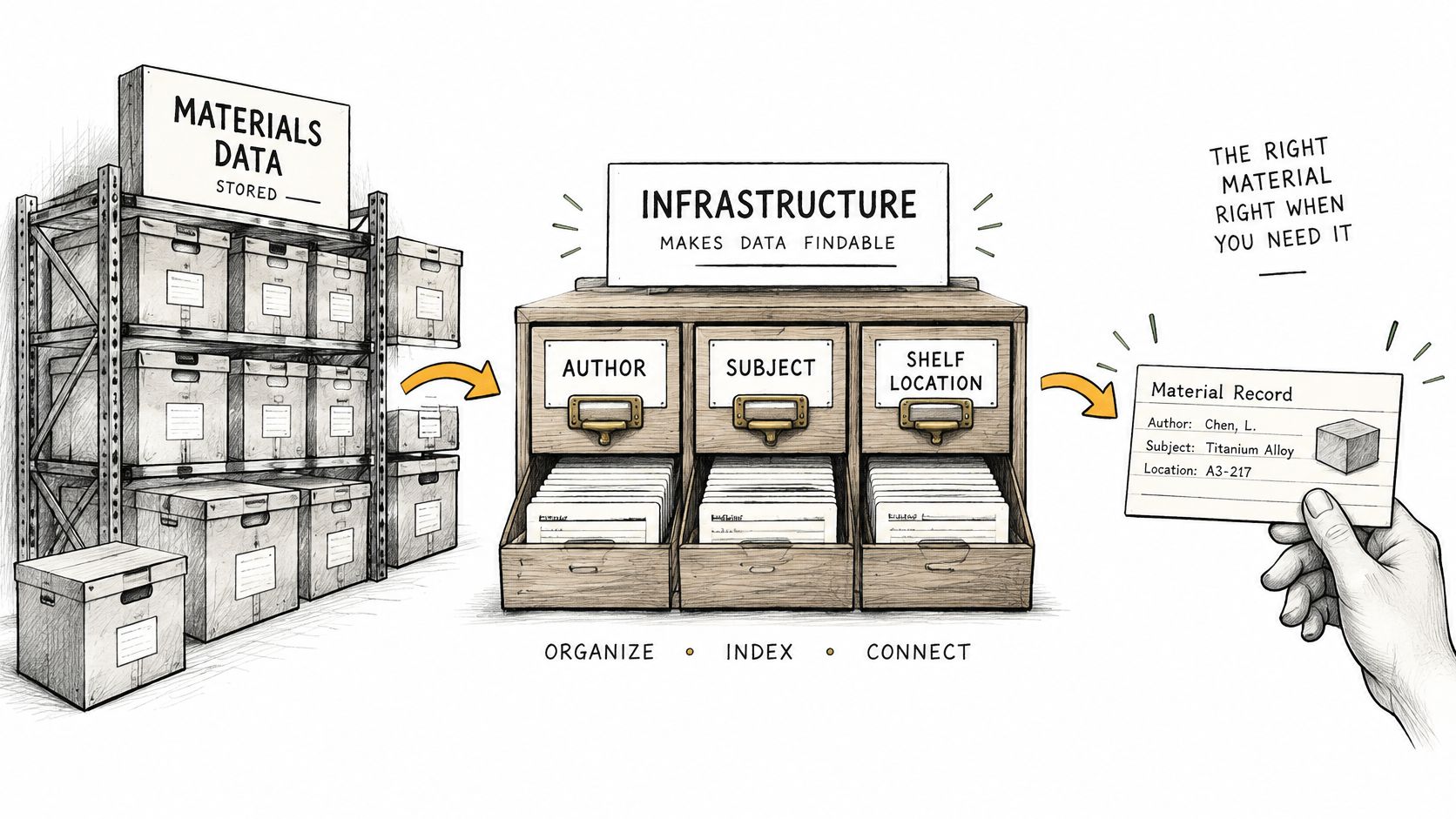
A file archive resembles a warehouse holding labeled boxes. An interoperability layer resembles a library catalog: it records enough about each item that someone can find it without opening every container.
Materials research needs the catalog, but with scientific context attached. Tensile-strength results measured at different strain rates may not support the same comparison. Polymer-viscosity measurements taken at different temperatures may look similar in a spreadsheet while describing different behavior.
The distinction between holding files and organizing reusable evidence is illustrated below.
Record the conditions behind the property
A useful record should carry material identity, composition, processing history, measurement method, units, uncertainty, instrument conditions, and ownership. Think of these as the instructions for interpreting a result, not administrative decoration.
The NIST Materials Data Repository, established under the Materials Genome Initiative, offers a useful architectural reference: it accepts files in any format, adds descriptive metadata, supports persistent identifiers and federation, and provides a web-accessible API. This is a related infrastructure example, not another name for MDF.
For a formulation scientist, the practical distinction is straightforward. Finding a viscosity file answers where the measurement is stored; finding its temperature, shear conditions, and sample history helps determine whether it belongs in the comparison.
- Identity establishes the subject. Connect the measurement to a specific material or sample, not merely a convenient filename.
- Method establishes comparability. Record how the property was measured and which conditions could change its interpretation.
- Uncertainty establishes limits. Preserve reported measurement uncertainty, and distinguish missing uncertainty from negligible uncertainty.
- Ownership establishes permitted action. Make it clear who can authorize sharing, correction, or reuse.
The Argonne Leadership Computing Facility's MDF catalog listed 89 publications for 2023. That publication activity demonstrates a research context for the infrastructure, but it doesn't tell a scientist whether any particular measurement fits their experiment.
The real benchmark is reuse quality, not storage volume: can a scientist locate a prior result by composition, process window, and test method, then decide whether to reproduce it or exclude it?
How Ingestion, Metadata and Search Work Together
A useful ingestion pipeline preserves evidence while making it easier to interpret. Each transformation should leave a trace, so a scientist can distinguish an instrument observation from a cleaned value or model prediction.
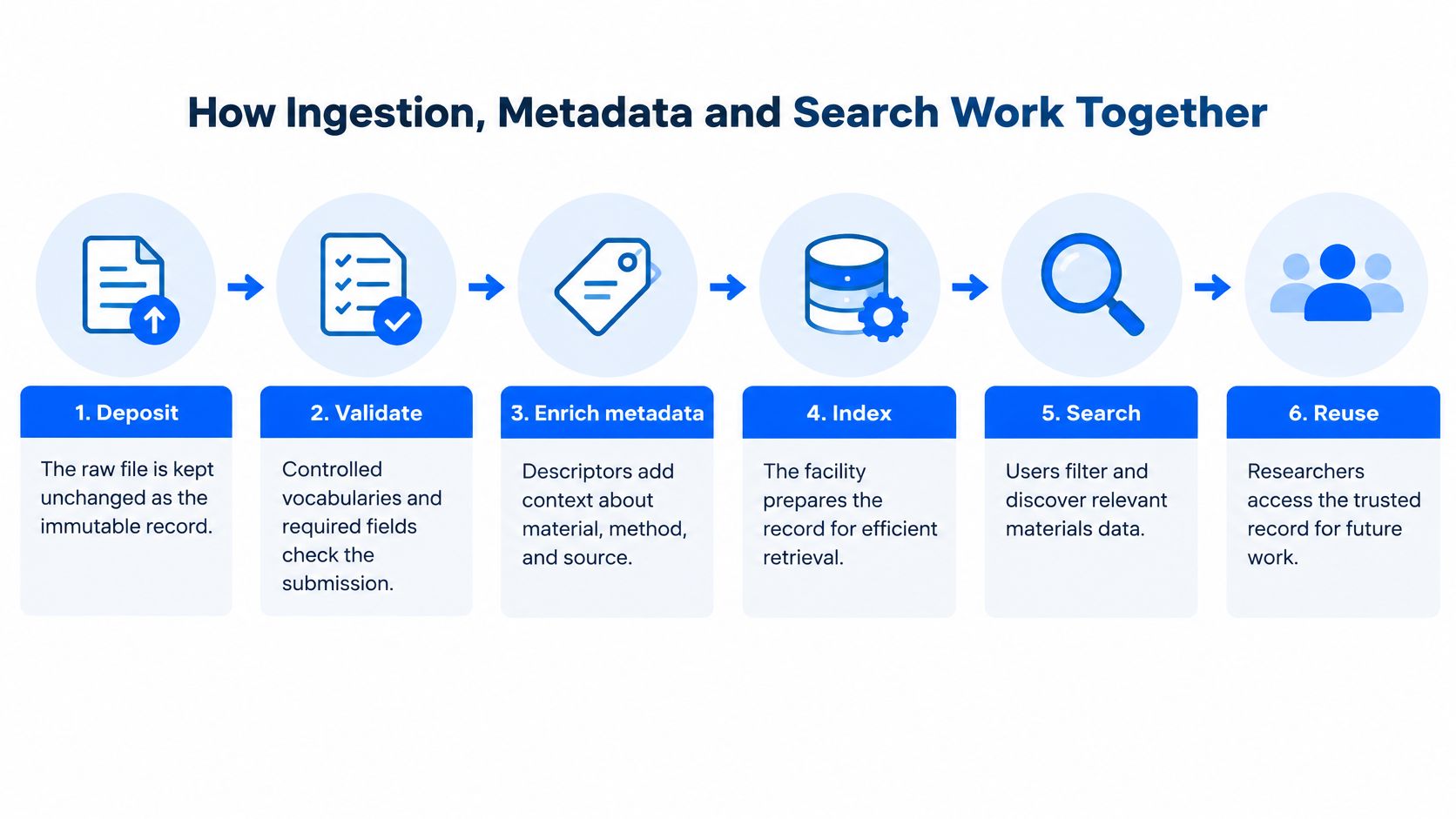
The diagram gives the discovery-and-reuse view of that workflow.
From untouched files to usable records
The following is a recommended implementation pattern, not a claim that every repository performs every operation automatically.
Deposit the evidence. Preserve the submitted raw file unchanged. Without an immutable original, a later reviewer can't separate instrument output from subsequent editing.
Validate the submission. Check required fields, accepted vocabulary, and unit declarations before release. A missing test method should produce a visible warning rather than an apparently complete record.
Normalize with a version history. Convert compatible units and structure values for comparison while retaining their original representations. Keep reported uncertainty separate from any confidence score calculated during processing.
Identify and connect. Give records stable identifiers and link samples, raw files, derived features, predictions, and corrections. Without those connections, teams can accidentally treat a revised result as a new independent experiment.
Index scientific fields. Make composition, cure conditions, batch, and test temperature available for filtering. Searching filenames alone won't reliably recover those relationships.
Serve records to tools. Let authorized scripts retrieve structured results and their provenance. A reproducible query should be saved alongside the analysis that used it.
The Materials Project API documentation provides a public example of structured scientific access, including queries by material identifiers and properties. For formulation R&D, the design lesson is to expose meaningful experimental entities rather than make every experiment an opaque attachment.
A unit mismatch caught before modeling
Suppose a polymer team filters tests conducted at a specified temperature and cure schedule. Its script retrieves matching records and finds entries expressed in different viscosity units.
The pipeline should convert compatible units into a normalized field, preserve the submitted values, and record the conversion. It should not assume that matching units also mean matching measurement protocols.
For a broader introduction to moving collections into structured workflows, archive ingestion explained by Contesimal provides useful background. Materials teams still need domain-specific validation on top of that general ingestion process.
The accompanying video offers another way to approach the topic.
For your pilot, test validation and metadata completeness deliberately. Successful file transfer proves the files arrived, not that the records are ready for scientific reuse.
How Researchers Find, Access and Contribute Data
Use a materials data facility as a source of candidate evidence, not as an automatic stamp of experimental suitability. A downloadable record still needs a scientific review before you use it to support a formulation decision.
Find and assess existing results
Start with the scientific question. Search by composition, property, or measurement method where those filters are available, then narrow by contributor or date. If the interface offers only broader search, inspect dataset descriptions before downloading entire collections.
Inspect completeness before analysis. Check units, uncertainty, instrument settings, and sample history. Mark absent information in your working assessment so it doesn't disappear during cleaning.
Compare protocols, not just values. Confirm that sample preparation, conditioning, and testing procedures support your intended comparison. Equal numbers aren't necessarily equivalent evidence.
Choose a reproducible access path. Download the original files for exploratory work, or use the documented API for repeatable retrieval. Save the dataset version, selection criteria, and retrieval details with your analysis.
Prepare a contribution someone else can interpret
Write a readme before uploading. Define each column, unit, abbreviation, missing-value marker, and relationship between files. Include enough guidance that a researcher outside your laboratory can use the collection.
Map fields to the submission template. Use the facility's accepted terms and distinguish unknown, not measured, and not applicable where supported. An unexplained blank forces the next user to guess.
Select the supported transfer method. Use the submission interface or documented transfer tooling appropriate to the collection. For large instrument outputs, test a representative transfer before committing the full archive.
Review the published representation. Check the generated metadata, file associations, contributor details, and identifier. Automated extraction is a starting point, not a substitute for the depositor's approval.
Cite the persistent identifier. Put the dataset citation in the associated paper and retain it in internal records. This connects the scientific claim to the evidence readers should inspect.
- Reproduction checks. Inspect an earlier procedure before allocating laboratory time to repeat it.
- Community benchmarking. Evaluate a model against an explicitly selected external collection.
- Domain screening. Flag candidates whose chemistry or processing conditions fall outside the training evidence.
- Scientist onboarding. Let new colleagues trace the experiments behind an accepted formulation choice.
- Name the authority. Record the owning group, institution, or company and the person authorized to approve release.
- Classify before migration. Tag legacy collections as public-ready, review-required, or internal-only.
- Prioritize useful collections. Curate datasets tied to active decisions before attempting a complete historical cleanup.
- Fund continuity. Assign a retention owner and a correction process that survives the originating project.
- Define the decision. Select a question about a formulation, processing choice, or property comparison, and time the existing search.
- Split public and internal work. Prepare an approved dataset for community sharing while keeping a proprietary experimental stream inside the organization.
- Confirm the public path. Check identifier availability, citation requirements, and how incomplete metadata will appear.
- Test internal controls. Verify that authorized users can retrieve the evidence and unauthorized users can't.
- Attempt actual reuse. Filter relevant tests, retrieve them through an API or export, and document whether the results support the intended comparison.
- Decide from the outcome. Compare elapsed time and unresolved scientific questions with the starting workflow before expanding spending.
Before release: Confirm licensing and access terms, then obtain approval for sensitive, proprietary, or unpublished material before transfer.
A strong submission also makes responsibility visible. Name a contact who can answer methodological questions and explain how corrections will be communicated, especially if the original investigator leaves the project.
Materials Data Facility Compared With Enterprise Data Backbones
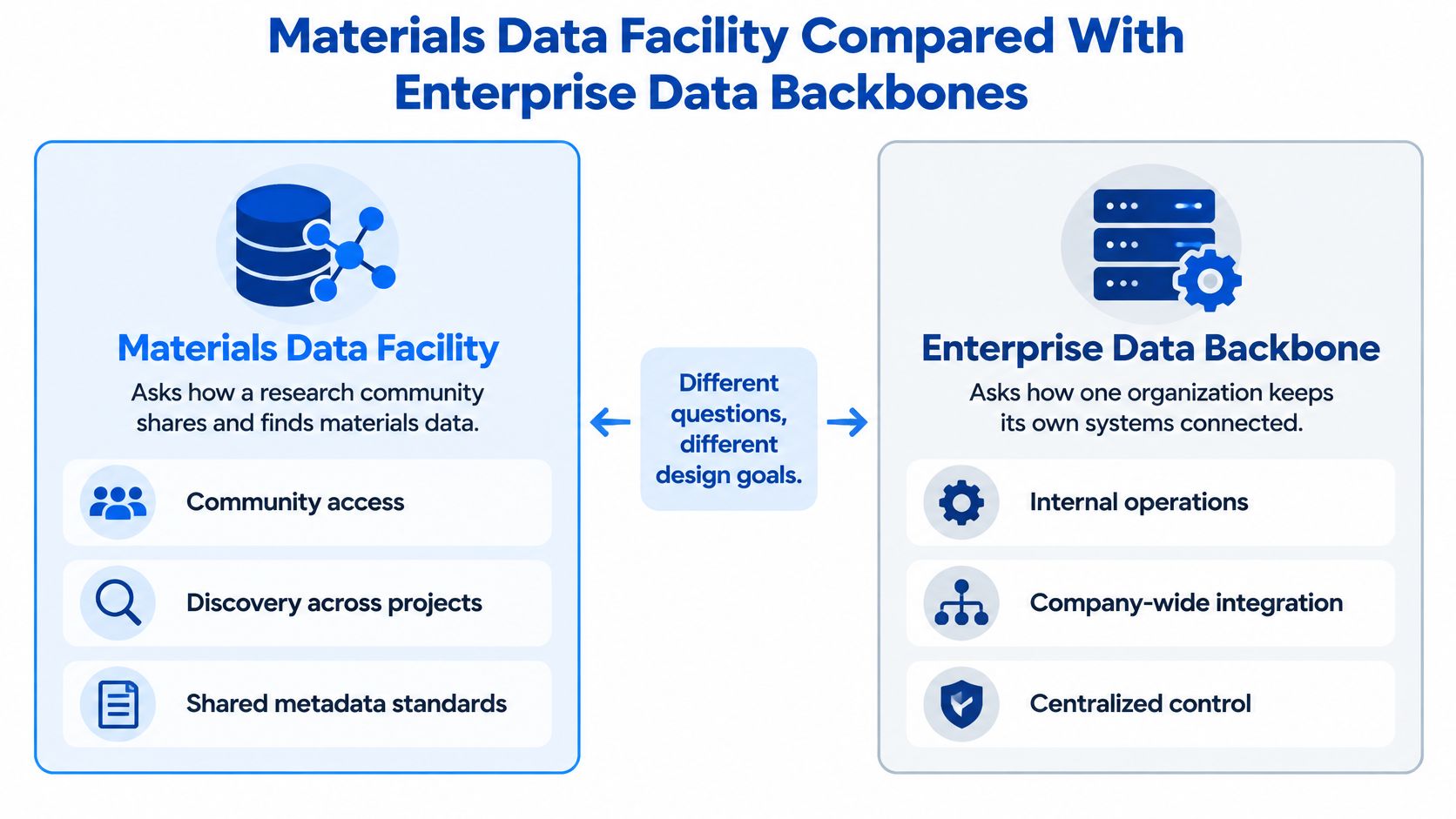
A community facility and an enterprise data backbone answer different questions. The facility asks how a research community can share and find evidence; the enterprise backbone asks how an organization can keep its working experiments connected and protected.
The distinction is about purpose, not a universal winner. A public benchmark and an unreleased commercial formulation belong under different operating rules.
Compare the operating requirements
Materials Data Facility vs enterprise data backbone
| Dimension | Materials Data Facility | Enterprise Data Backbone |
|---|---|---|
| Primary purpose | Publish, preserve, and discover shared materials research | Connect an organization's working R&D records |
| Typical contributors | Research groups and institutions | Internal scientists, laboratories, and engineering teams |
| Data sources | Contributed datasets and indexed records | Spreadsheets, ELNs, instrument exports, and internal databases |
| Access model | Check dataset terms and service documentation | Require permissions matched to organizational roles |
| Security certifications | Not established by the repository sources cited here | Verify certificates, scope, and applicable services |
| Privacy compliance | Not established by the repository sources cited here | Assess legal obligations and contractual commitments |
| Proprietary data handling | Confirm suitability before depositing restricted material | Specify internal boundaries and release approvals |
| Modeling layer | Programmatic access for downstream tools | Connect approved records to analytics or modeling tools |
For purpose and contributors, choose the community facility when the intended audience extends beyond your company. For data sources, choose an internal backbone when scientists need connections between active projects, laboratory systems, and manufacturing records.
For access, certifications, and compliance, don't substitute a feature checklist for due diligence. Ask who can see a formulation, who can export it, how access is revoked, and which services fall within any claimed certification.
Keep the release boundary explicit
A multi-institutional materials-data infrastructure study identifies the experimental context needed for reuse and discusses the gap between available materials data and industrial needs. Undocumented corporate archives are particularly relevant: public discovery tools can't reveal formulation knowledge that an organization hasn't prepared for sharing.
An enterprise backbone therefore shouldn't be evaluated as a replacement for public evidence. Its role is to organize the internal experimental context and control how selected information moves outward.
Use shared infrastructure to publish and borrow research evidence. Use an internal system to manage working knowledge, and connect the two through a reviewed release process rather than an unrestricted synchronization.
Integration Patterns and Practical Use Cases for R&D
Suppose a formulation team wants to assemble a training collection, but its candidate results are split between old spreadsheets and a public repository. The immediate task isn't choosing a model. It's deciding which records can be joined without losing their meaning.
Choose an integration pattern according to the decision the team needs to make.
Integration patterns, requirements and risks
| Pattern | Best For | What It Needs | Watch For |
|---|---|---|---|
| Publish with a paper | Releasing evidence alongside a journal article | Persistent identifier and full metadata template | Missing units or uncertainty fields |
| API pull for model training | Training models on filtered shared data | Stable identifiers and query filters | Mixing non-comparable test conditions |
| Lab write-back | Recording new experimental outcomes | Provenance fields and versioned records | Overwriting earlier raw observations |
| Enterprise mirror of a public subset | Sharing selected results externally | Release review and access controls | Exposing unreleased IP |
Match the connection to the scientific gain
Publishing with a paper supports independent inspection. For example, a team releasing coating-performance results should bundle the measurement files with the formulation descriptors it has permission to disclose and the procedures needed to interpret them.
An API pull supports repeatable selection. A modeling engineer can save a query and its returned identifiers, making it possible to inspect which community records entered a training collection rather than relying on a manually assembled folder.
Lab write-back connects predictions with subsequent evidence. When a scientist tests a suggested formulation, record the measured outcome as a new observation linked to the recommendation, not as a replacement for the predicted value.
An enterprise mirror supports selective disclosure. Export an approved release package into an external-facing location, while retaining restricted ingredients, supplier information, or process details internally.
These patterns support distinct R&D tasks:
A successful integration preserves the reason records belong together, not just the ability to move them between systems.
Before connecting databases, define join keys for materials, samples, batches, and experiments. Document allowed unit conversions and exclusion rules, then test them on awkward records rather than only clean examples.
Who Pays and Who Governs the Data
Hosting is only part of the bill. Budget separately for curation, access administration, integration maintenance, and long-term stewardship, then measure the work during a pilot rather than assuming software removes it.
The FAIRmat infrastructure project combines a central portal with metadata schemas and ontologies while aiming to minimize researcher burden. Reducing that burden still requires organizations to assign responsibility.
Make ownership actionable
Give scientists practical incentives: easier retrieval, fewer repeated explanations, and recognition for well-documented contributions. Avoid making every researcher invent a metadata template or interpret access policy independently.
The global materials informatics market was valued at USD 134.6 million in 2023, according to Grand View Research. That's context for commercial interest, not evidence that a particular purchase will solve your laboratory's data problems.
Choose the First Dataset and Access Path
Start with a question your team needs answered, not a migration target. Choose a bounded collection and measure how long it currently takes a scientist to reach a defensible answer.
Run a timed reuse pilot
Finish with a named owner, a retention rule, and the specific field or permission that blocked reuse. If the pilot can't identify those, a larger upload will only make the uncertainty harder to manage.
Polymerize offers Connect to organize fragmented materials R&D records into a centralized data backbone, with Labs supporting property prediction and formulation analysis. Visit Polymerize to discuss a bounded pilot using your spreadsheets or ELN exports, with explicit access rules and a reviewed path for sharing suitable results.
Put your R&D data to work
See how materials teams use Polymerize to plan fewer experiments and reach target properties faster.