

The most popular advice on SOC 2 is to download a short checklist, write the policies, and call an auditor. That advice creates audit risk. A policy binder can look complete while nobody can prove who reviewed access, when a backup was restored, or how an exception was closed.
A useful SOC 2 compliance checklist works differently. It is a continuous operating model that names the control, the owner, the system that records it, and the dated evidence an auditor will sample. For materials R&D teams, that model must reach beyond the core application into ELNs, spreadsheets, laboratory integrations, subprocessors, and AI tools that touch formulations.
Table of Contents
Trust Services Criteria on the Checklist
Start with the criteria before you write a single policy. The AICPA 2017 Trust Services Criteria with revised points of focus issued in 2022 sets out five Trust Services Criteria, which are security, availability, processing integrity, confidentiality, and privacy. Security is the required baseline. You select the other four only where your services, contracts, and risks make them relevant.
| Criterion | In scope when | Document | Typical evidence |
|---|---|---|---|
| Security | Always; required baseline | Boundary, access, change, incident response, vulnerability management | Access reviews, joiner-mover-leaver tickets, scan reports, incident logs |
| Availability | Uptime or recovery is a commitment or lab teams depend on the system | Targets, backups, business continuity | Backup-restore tests, continuity exercise records, incident timelines |
| Processing integrity | Outputs or transformations must be complete, valid, and accurate | Processing objectives and change control | Change approvals, error-handling records, reconciliation samples |
| Confidentiality | Proprietary formulations, experimental data, or other confidential data are handled | Classification, encryption, disposal, subprocessors | Encryption settings, access logs, data-flow diagram, vendor agreements |
| Privacy | Personal data is collected, used, retained, or disclosed | Notice, consent, retention, rights requests | Privacy notice, consent records, retention schedule, rights-request log |
How a materials R&D team should choose
Say your platform stores proprietary formulations, experimental records, and model outputs. Security plus confidentiality is the usual starting pair because unauthorized access and disclosure are your central risks. Add availability if scientists depend on the system during active projects and downtime would block laboratory work or breach an uptime commitment.
Add processing integrity when calculations, imports, or transformations must be complete and accurate, for example when ELN results feed a formulation record. Add privacy when you process personal data belonging to scientists, customers, or study contacts. Don't tick a criterion because a template includes it. Tick it because a contract, a service, or a real risk requires it, and because you can produce evidence this quarter.
What every selected criterion needs on the page
For each criterion in scope, record four things in your SOC 2 compliance checklist. First, define the system boundary, the services covered, and the data inside that boundary. Second, name a control owner who is responsible for operation, not just authorship. Third, list the specific evidence expected. Fourth, keep that evidence dated and traceable to the person who performed the work.
The boundary work is where generic checklists fail materials teams. Name production applications, databases, cloud infrastructure, integrations, personnel, and subprocessors explicitly. If an integration moves formulation data to an external testing partner, it belongs in scope or needs a documented reason why it doesn't.
Under security, your control set should cover governance and risk activities, not only technical settings.
- Access reviews: Scheduled reviews of who can reach formulations, experimental data, and production systems.
- Change management: Request, approval, testing, and deployment records for application changes.
- Incident response: Detection, triage, escalation, and closure records.
- Vendor oversight: Due diligence and monitoring for subprocessors and hosting providers.
- Vulnerability management and resilience: Scans, remediation, backup procedures, and business-continuity testing.
Practical rule: If a control has no named owner and no dated evidence, it is a statement of intent, not a control.
Finally, prepare the system description against AICPA description criteria so it matches the boundary you've declared. Connect each asset and risk to a preventive or detective control. A checklist that only lists policy titles gives an auditor nothing to test.
Type I or Type II and the Evidence Calendar
Decide the report type before you draft policies, because the answer changes your calendar. The table below puts the two examinations side by side so you can choose based on what buyers will accept and what evidence you can sustain.
| Report | What is tested | Observation window | Evidence burden | Best fit |
|---|---|---|---|---|
| Type I | Design and implementation at one specified date | A point in time; no operating period | Policies, configuration, and implementation proof on that date | A first report or a buyer who accepts a design snapshot |
| Type II | Design plus operating effectiveness | Commonly 3 to 12 months; Microsoft uses 1 Oct to 30 Sep | Recurring samples, exceptions, and remediation across the whole window | Enterprise buyers of R&D platforms who want sustained control |
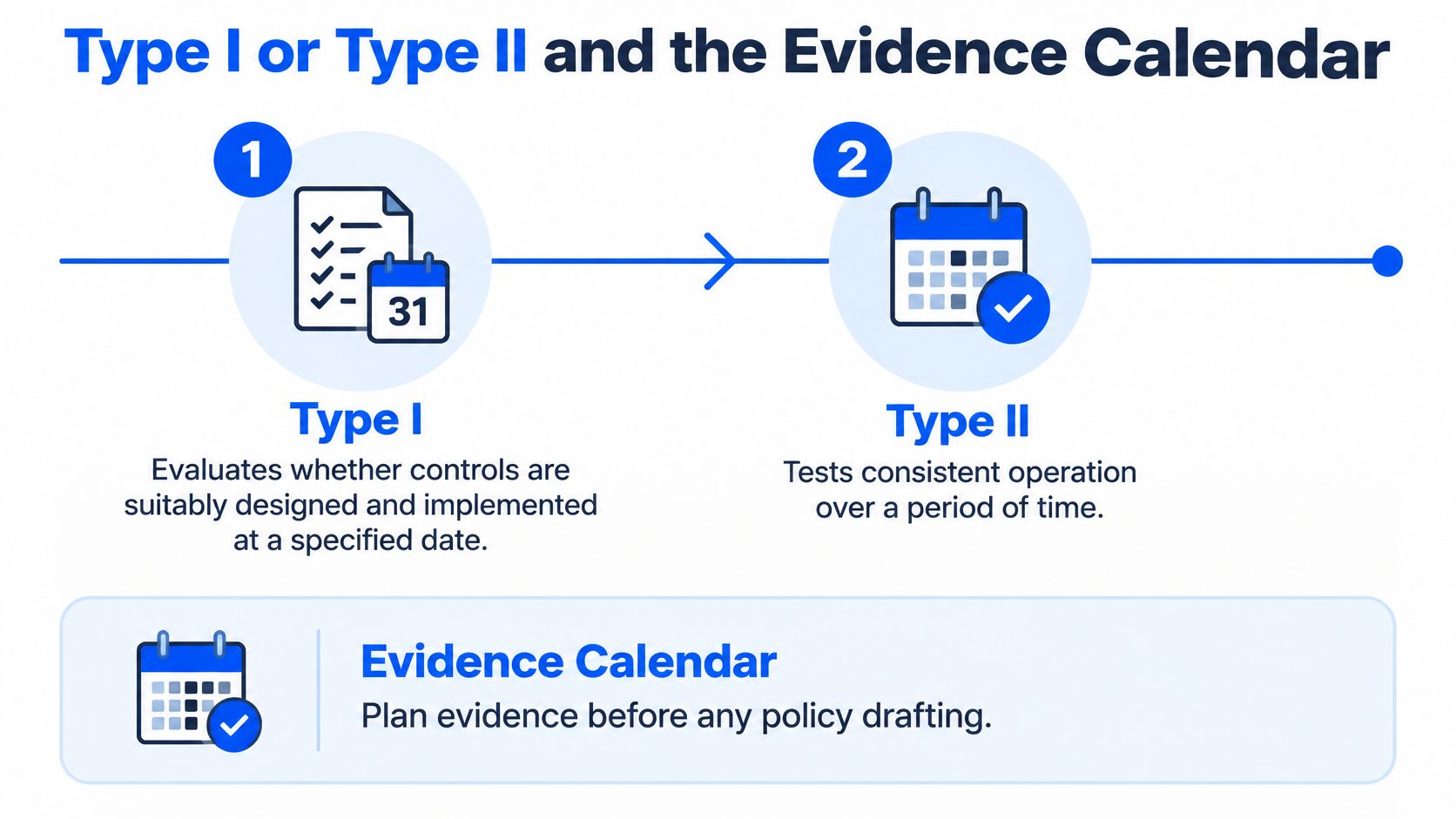
A Type I report evaluates whether controls are suitably designed and implemented at a specified date. It doesn't assess how consistently those controls operated over time. A Type II report adds operating-effectiveness testing across a defined period, so recurring execution and exception tracking become checklist items.
The visual below summarizes that distinction and why the calendar matters as much as the control design.
A calendar you can copy
Microsoft provides a clear illustration. Microsoft's SOC 2 Type 2 documentation describes examinations covering a rolling 12-month period, with annual examinations for October 1 through September 30 and the audit beginning after that performance period ends. Many first-time Type II teams start with a shorter window, then move to twelve months once the cadence holds.
Build your own calendar around monthly, quarterly, and annual work.
- Monthly: User-access recertification for production and laboratory data, plus vulnerability-scan review and remediation tracking.
- Quarterly: Backup-restoration tests, critical-vendor reassessment, and incident-trend review with documented follow-up.
- Annually: Security training, business-continuity testing, policy review, and management sign-off.
Each record should preserve who performed the activity, when it occurred, what population was tested, and how exceptions were remediated. If your workspace tools capture approvals and administrative actions automatically, reviewing resources such as AgentStack workspace audit logs can help you think through what a usable log should retain, including actor, timestamp, and action.
The short video below walks through the Type I and Type II distinction in plain terms before you commit to a window.
Teams sometimes ask for a bridge letter between completed reports. A bridge letter can explain the gap, but it doesn't replace continuous control operation or a new examination. Enterprise buyers evaluating AI-enabled R&D systems treat Type II as the useful artifact because it demonstrates sustained operation rather than a one-time snapshot. If your calendar can't produce samples in month one and month nine, you aren't ready to open the window yet.
How to Prepare the Examination in Eight Moves
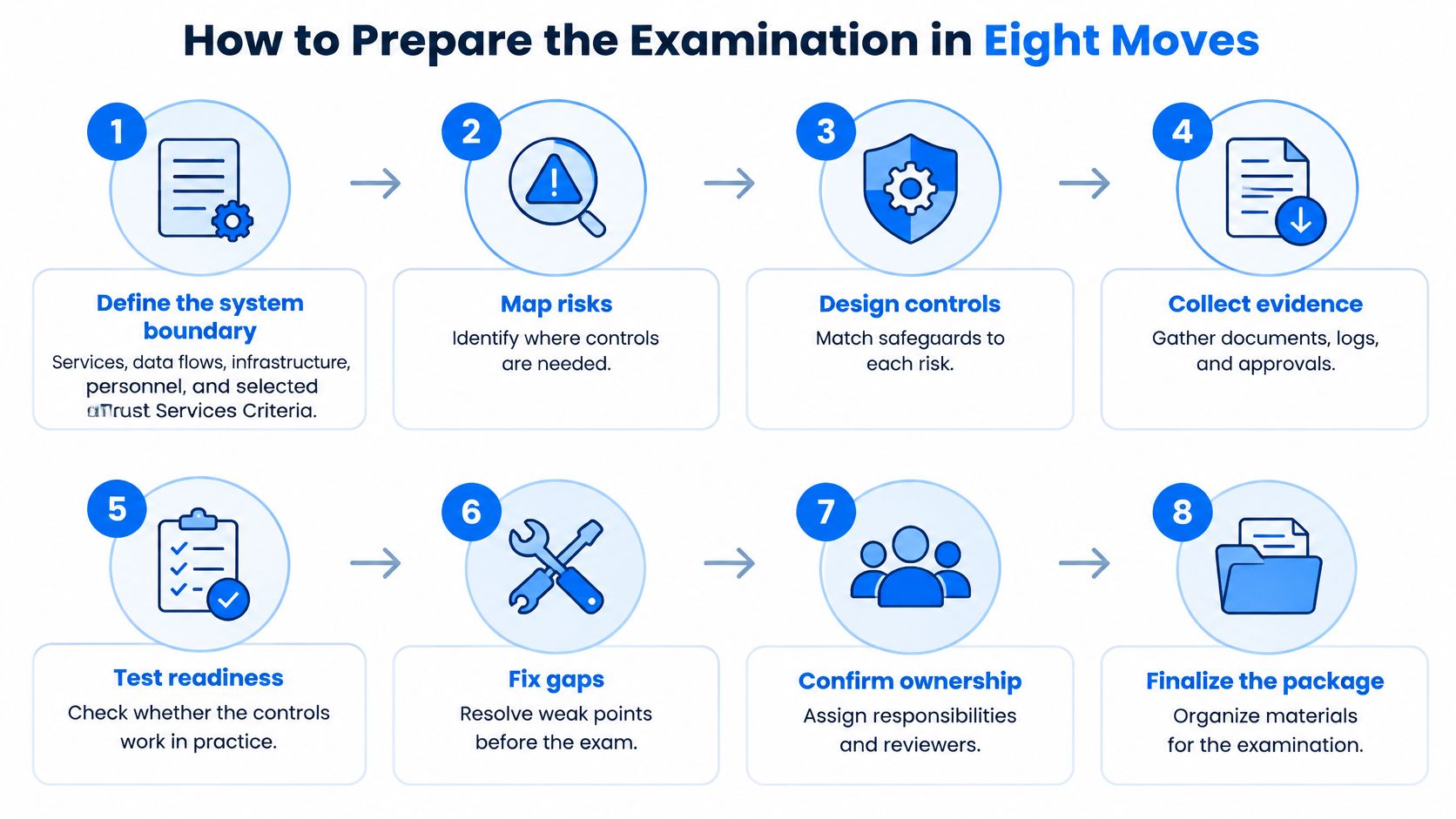
Preparation works as numbered operating work, not as a policy-writing project. Follow the sequence in order. Skipping to policies before you know the boundary and risks produces documents that auditors can't tie to live systems.
The process overview below shows the eight moves as a single flow from scope to independent testing.
The eight moves
- Define the system boundary. Name services, data flows, infrastructure, personnel, and selected Trust Services Criteria.
- Map risks to control objectives. Include laboratory data access and confidentiality of proprietary formulations as explicit risks.
- Document policies and procedures. For each one, record the owner, frequency, and evidence requirement.
- Implement technical and administrative controls. Configure identity, logging, change, backup, and vendor controls in the systems people use.
- Run a readiness assessment. Test whether controls are designed correctly and can produce evidence before fieldwork.
- Remediate design gaps. Fix missing approvals, unclear ownership, and incomplete populations before the observation window opens.
- Collect operating evidence throughout the Type II period. Don't reconstruct samples at the end.
- Engage an independent CPA firm. The firm tests design and operating effectiveness against your system description and assertions.
For the readiness assessment, NIST Special Publication 800-53 Rev. 5 offers a useful assessment model. It calls for an assessment plan that identifies controls, scope, procedures, and evidence, then evaluates whether controls are implemented correctly, operating as intended, and meeting stated requirements. Use that logic even though SOC 2 is a separate examination.
Build the control-to-evidence matrix
Your working artifact is a control-to-evidence matrix. For every control, specify the system of record, sample population, reviewer, approval timestamp, retention period, and exception-handling path. That one table prevents the common failure where a policy exists but consistent operation can't be proved.
For a materials R&D platform, include rows teams often miss.
- Laboratory data access: ELN and spreadsheet access, including who approved access to formulation projects.
- Third-party hosting: Cloud and subprocessor controls, agreements, and current reports.
- Model or application change approval: Who approved the change, what testing ran, and how rollback would work.
- Backup restoration: Test result, data set restored, timing, and reviewer sign-off.
- Vulnerability remediation and incident response: Finding, owner, due date, closure evidence, and escalation record.
Policies that must arrive with evidence rows
Your SOC 2 compliance checklist needs a compact policy set, written as short working templates. Include an information security policy, access control and joiner-mover-leaver procedure, change management standard, incident response plan, vendor management procedure, backup and restore procedure, data classification and retention standard, and acceptable-use policy. Each template names the control owner, review frequency, and record that proves it ran.
Because SOC 2 is an assertion-based examination, your system description must accurately match the production environment and services customers receive. If production changed but the description didn't, the matrix will expose that gap.
Refuse any control row that has a policy but no system of record. You will not be able to sample it later.
Control Areas That Produce Exam Exceptions
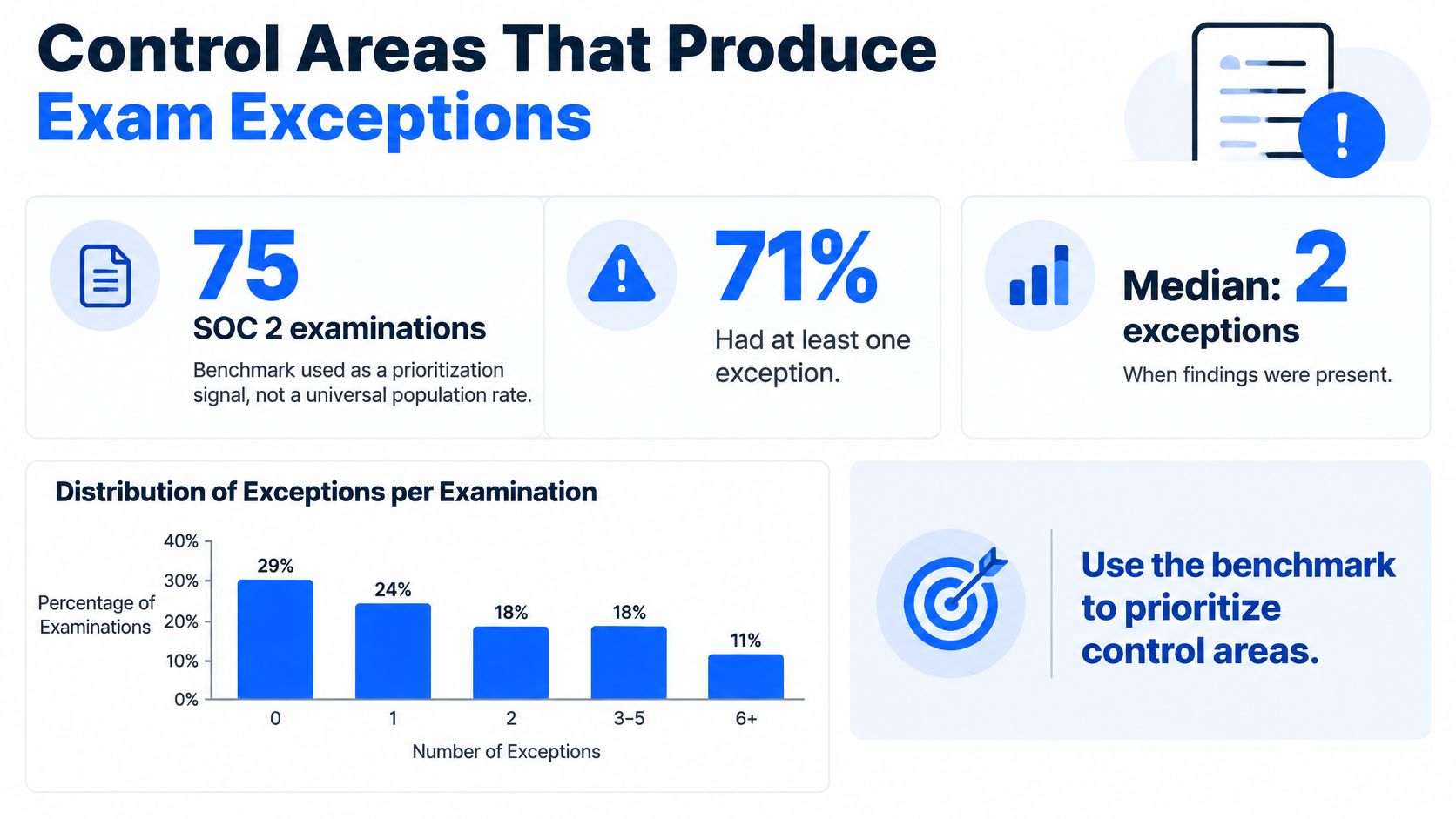
Exceptions are normal, and pretending otherwise wastes remediation time. The Lazarus Alliance 2026 SOC 2 audit benchmark report analyzed 75 SOC 2 examinations and reported that 71% had at least one exception, with a median of two exceptions when findings occurred. Treat those figures as a prioritization signal for where to spend remediation hours.
Access control and user provisioning, change management, and logging, monitoring, and alerting are among the most common areas for exceptions in SOC 2 examinations. Give those three your earliest pre-audit testing.
The callout below highlights the findings to prioritize first.
| Finding area | Frequency in exams | Pre-audit check |
|---|---|---|
| At least one exception | 71% | Do not assume a clean first exam; budget time to remediate |
| Median exceptions when findings occur | 2 | Track each exception to a named remediation owner |
| Access control and user provisioning | Frequently reported | Reconcile identities to HR, check joiner-mover-leaver tickets, and review privileged access |
| Change management | Frequently reported | Sample production changes from request through test, approval, deploy, and rollback |
| Logging, monitoring, and alerting | Frequently reported | Confirm alert triage, escalation, and closure records |
Run this pre-audit test before fieldwork
Start with identities. Reconcile every active identity against HR and contractor records, then verify joiner, mover, and leaver tickets for a sample across the whole period. Inspect privileged-access approvals and periodic reviews, paying attention to administrators who can export formulation data or change production settings.
Next, sample production changes end to end. Each sampled change should show request, risk assessment, testing, approval, deployment, and rollback evidence where applicable. A merged pull request with no approval context or test record is a finding waiting to happen.
Then confirm monitoring works in practice. Pick alerts from different months and trace triage, escalation, ticket creation, and closure. Review critical-vendor due diligence and current SOC reports, and reconcile the system description to live architecture, subprocessors, and data flows.
Pitfalls behind the numbers
Most exceptions come from operational proof missing behind written policies. Other repeat causes are incomplete samples over the Type II period, stale system descriptions, absent vendor evidence, and access reviews not performed on schedule. The control may exist, yet the evidence fails to cover the population or the dates the auditor samples.
A control without records works like a lab notebook with no dated entries: the work may have happened, but nobody can verify it. Automated capture from identity, cloud, ticketing, code-deployment, logging, and vendor-management systems can reduce manual sampling risk, and it only helps when it preserves immutable timestamps, reviewer identity, approval context, and exception resolution. A folder of screenshots without that context still fails a sample, because the auditor cannot tell who reviewed what or whether the exception was ever closed.
AI and Vendor Risks a Standard List Misses
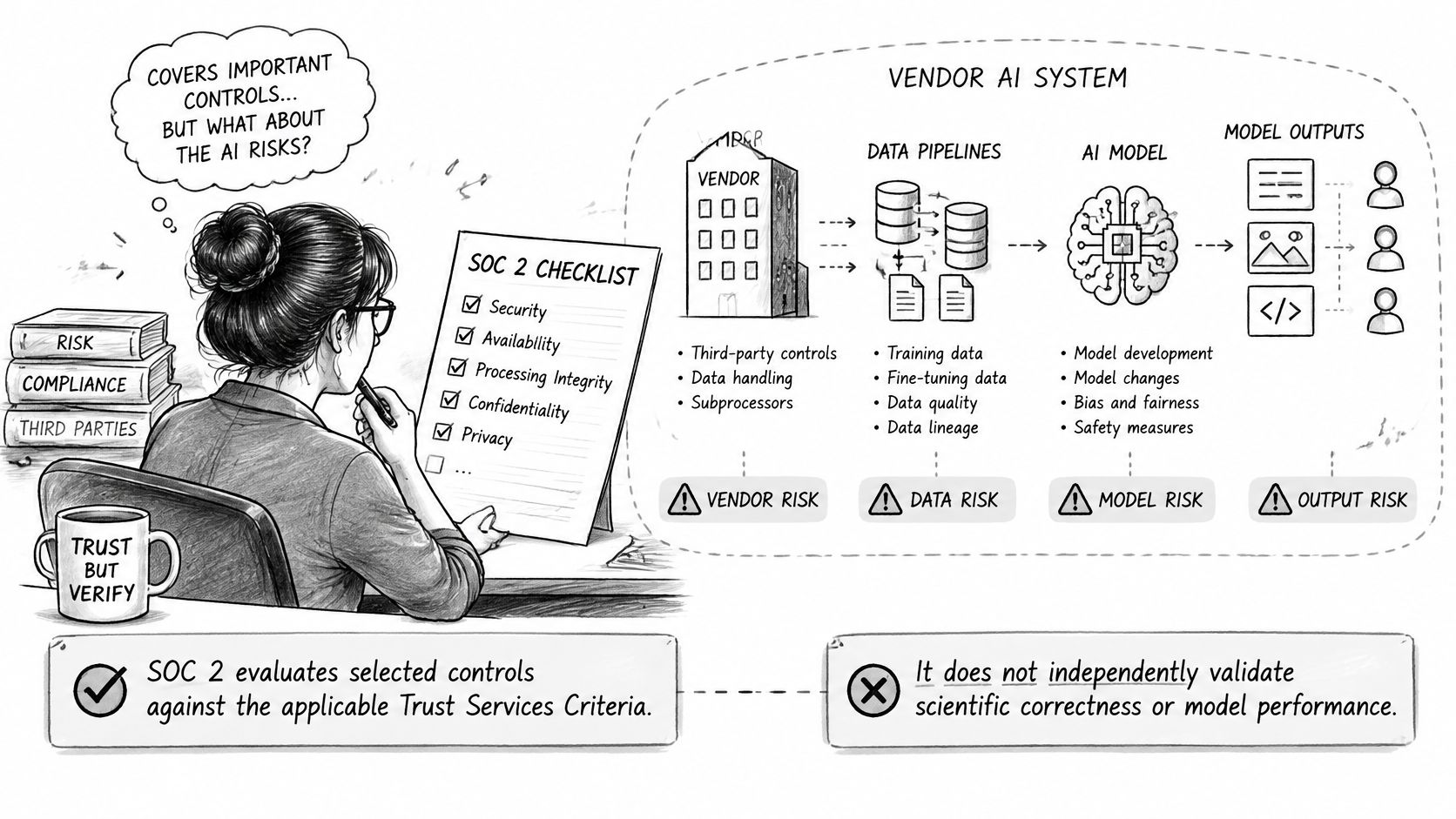
Does a SOC 2 report certify that an AI system's outputs are accurate, explainable, or safe? It does not. The examination tests selected controls against the Trust Services Criteria and says nothing about scientific correctness, model performance, causal claims, or freedom from hallucination.
Treat that limit as a boundary to state plainly to R&D leaders. A building inspection confirms the locks, wiring, and fire exits; it never vouches for the experiment running inside the lab. Confidentiality controls work the same way. They can protect a proprietary formulation without proving that an AI recommendation is chemically valid or reproducible.
The image below reflects the review work behind that distinction: checking vendor and AI risk instead of treating a model as ordinary software.
Why a software-only list lags
Third parties now sit inside a large share of reported breaches, and incidents involving AI models and applications are rising alongside them. That pattern moves vendor and AI evidence from a side review into the core of the checklist.
For materials R&D, third parties aren't abstract. They include cloud hosting, ELN providers, model APIs, external prototyping partners, and testing laboratories. If any of them receive formulations or experimental results, your checklist needs vendor evidence that matches the actual data flow, so each party's access is reviewed and documented before data moves.
A short policy list creates audit risk here, because auditors sample the population you declared. Anything left out of scope is evidence you will never produce.
AI evidence to add
Add evidence specific to AI instead of repeating your general access list.
- Model and dataset inventory: Model name, version, owner, training and inference data sources, and approved use.
- Least-privilege access: Separate access for training data, production inference, prompts, and administrative settings.
- Human approval: A named approver before a recommendation changes a formulation experiment or releases a result.
- Prompt and output logging: Logs where customer or laboratory data appears, with retention and access limits.
- Vendor and API review: Security review, data-use terms, subprocessor status, and change notification.
- Change monitoring and disclosure: Model change records, incident escalation, retention rules, and customer disclosure of limits.
A narrow application boundary can look clean while laboratory systems, spreadsheets, ELNs, external prototyping networks, and privileged access sit outside the description. That clean report misleads buyers and leaves real exposure untested. Run the checklist as a continuous evidence model: every place formulations, prompts, or results travel is a place that should generate records an auditor can sample.
Scope accuracy beats a shorter checklist. A control you omitted cannot fail in the report, but it can still fail in production.
Freeze Scope Checklist Before the Window
Freeze scope before you open a Type II observation window or trust a vendor report. The AICPA audit and assurance topic page reflects 2025 implementation guidance placing greater emphasis on clearly describing the system boundary, including covered services, infrastructure, software, people, procedures, and data. That emphasis matters because an AI-native R&D platform rarely lives in one application.
Tick every line below. If you can't tick one, fix it before the window starts.
- Ownership is named. Each in-scope control in your SOC 2 compliance checklist has an owner, system of record, review frequency, and exception path.
- The description matches production. It includes laboratory systems, spreadsheets, ELNs, cloud services, subprocessors, and external prototyping partners, not only the core application.
- Criteria decisions are written. Security plus every optional criterion driven by contracts or risk is marked in or out with a reason.
- Recurring work is booked. The first access recertification is scheduled and the first quarterly backup-restoration test is booked.
- AI controls are assigned. Model and dataset inventory, human approval for consequential recommendations, and prompt and output logging have owners wherever AI touches formulation work. If your developers use coding agents inside that environment, review the risks of AI coding agents as part of access and change planning.
- A sample can be produced now. You can produce three months of operating evidence on request before the CPA firm is engaged.
What to ask when you're the buyer
If you're choosing an AI platform for formulations, ask for the system description, criteria in scope, observation period, and latest SOC 2 report, not a policy PDF. Check whether the report is Type I, a design snapshot, or Type II, which requires evidence that controls operated over a period. Ask which subprocessors and laboratory integrations the boundary covers.
At Polymerize, we hold ISO 27001, ISO 27017, ISO 27018 and SOC 2 certifications. We follow industry security standards, regularly conduct security audits and application testing, and provide the reports to customers. Our contact form accepts security whitepaper and security audit report requests, along with general inquiries, technical support, partnership requests, feedback, and case study requests.
Don't shorten the checklist by deleting operational context. Remove a row only after you've confirmed its evidence source and recorded why the risk is out of scope. For teams protecting proprietary formulations and experimental data, scope accuracy and repeatable evidence generation are worth more than a generic policy repository.
If you're evaluating an AI platform for materials R&D, ask for evidence that matches the scope you've just frozen, including criteria, subprocessors, and the latest report. Visit Polymerize to explore our AI-native platform for polymer and materials development and to request our security documentation for your vendor review.
Put your R&D data to work
See how materials teams use Polymerize to plan fewer experiments and reach target properties faster.