

A NIST-sponsored analysis by RTI International estimated that role based access control generated approximately $6.1 billion in net economic benefits to industry, measured in 2009 dollars, according to NIST's role based access control project summary. That's a striking number, but it needs careful reading. It mainly captures faster administration and less waiting for access, not the value of a formulation library that never leaked. For materials R&D leaders, that distinction matters. The practical case for role based access control benefits starts with time you can measure, then extends to risk you can contain.
Table of Contents
- Least Privilege Limits What a Login Can Reach
- Separation of Duties Blocks the Solo Sensitive Act
- What This Means for Formulation IP
Benefits of Role Based Access Control at a Glance
Six benefits recur across role based access control rollouts in R&D settings. The evidence behind each one is uneven, and the table below separates what has been measured from what you will have to measure yourself.
| Benefit | What changes | Published figure | R&D example |
|---|---|---|---|
| Least privilege | Each role holds only the permissions its job needs | No dollar total published. Measure by excess permissions removed | Formulation scientist reads records but cannot release production recipes |
| Faster provisioning | Access follows role membership, not per-application edits | A per-employee annual saving, quantified in a NIST-commissioned economic assessment | New chemist gets lab, notebook and data access on day one |
| Separation of duties | No single role can both create and approve a release | No dollar total published. Measure by conflicting pairs blocked | One person cannot change a controlled formulation and authorize its production use |
| Audit evidence | Central role definitions show who could access what | No dollar total published. Measure by review hours saved | Quality auditor traces each access to a job function |
| Administration savings | Fewer manual permission edits across systems | Aggregate savings across U.S. organizations in the same assessment | Administrator updates one role when a team reorganizes |
| Breach exposure | A compromised login reaches fewer systems | No dollar total published. Measure by systems reachable per account | A stolen login cannot pull the full formulation library |
What the Published Figures Actually Prove
The per-employee saving comes from faster access administration and less downtime while workers waited for permissions. The aggregate figure reflects more efficient maintenance of access-control policies across U.S. organizations. The NIST-commissioned assessment also estimated that the benefits of the research and standardization effort exceeded its cost by a wide margin.
Those gains are real, and they are narrow. They count tickets closed faster, administrators editing one role instead of many accounts, and new hires starting work sooner. They leave out the breach that never happened, the trade secret that stayed inside a project team, and the failed audit a client never saw. They also leave out the other side of the ledger: someone has to design the roles, map the permissions, and maintain both as teams reorganize.
Read the totals this way: the published money proves administrative payback. It doesn't price the intellectual property you protected, and it arrives before you subtract what role design costs.
Who Feels Each Benefit in the Lab
A formulation scientist feels provisioning speed first. She joins a project on Monday and can open the experiment history she needs without filing separate requests for the electronic lab notebook, the data platform, and the shared drive. A laboratory operator feels least privilege as a boundary that rarely blocks routine work but stops him from editing a released method by mistake.
A quality reviewer feels audit evidence when a customer asks who could approve a scale-up batch: she pulls a role definition instead of reconstructing access from old tickets. A data steward feels administration savings during a reorganization, because moving a team means changing role membership once. An external collaborator feels the limit most clearly, seeing the joint project data he was invited to work on and nothing from the adjacent program using similar chemistry.
The security benefit sits underneath all of this. If a login is stolen, the attacker inherits a job-shaped slice of access rather than a person's accumulated grants from three previous teams. A smaller slice is harder to turn into a full formulation download.
RBAC pays back first in administrative time. The security gains ride on the same role structure, and both have to be weighed against the effort of building it.
What Role Based Access Control Is and How It Works
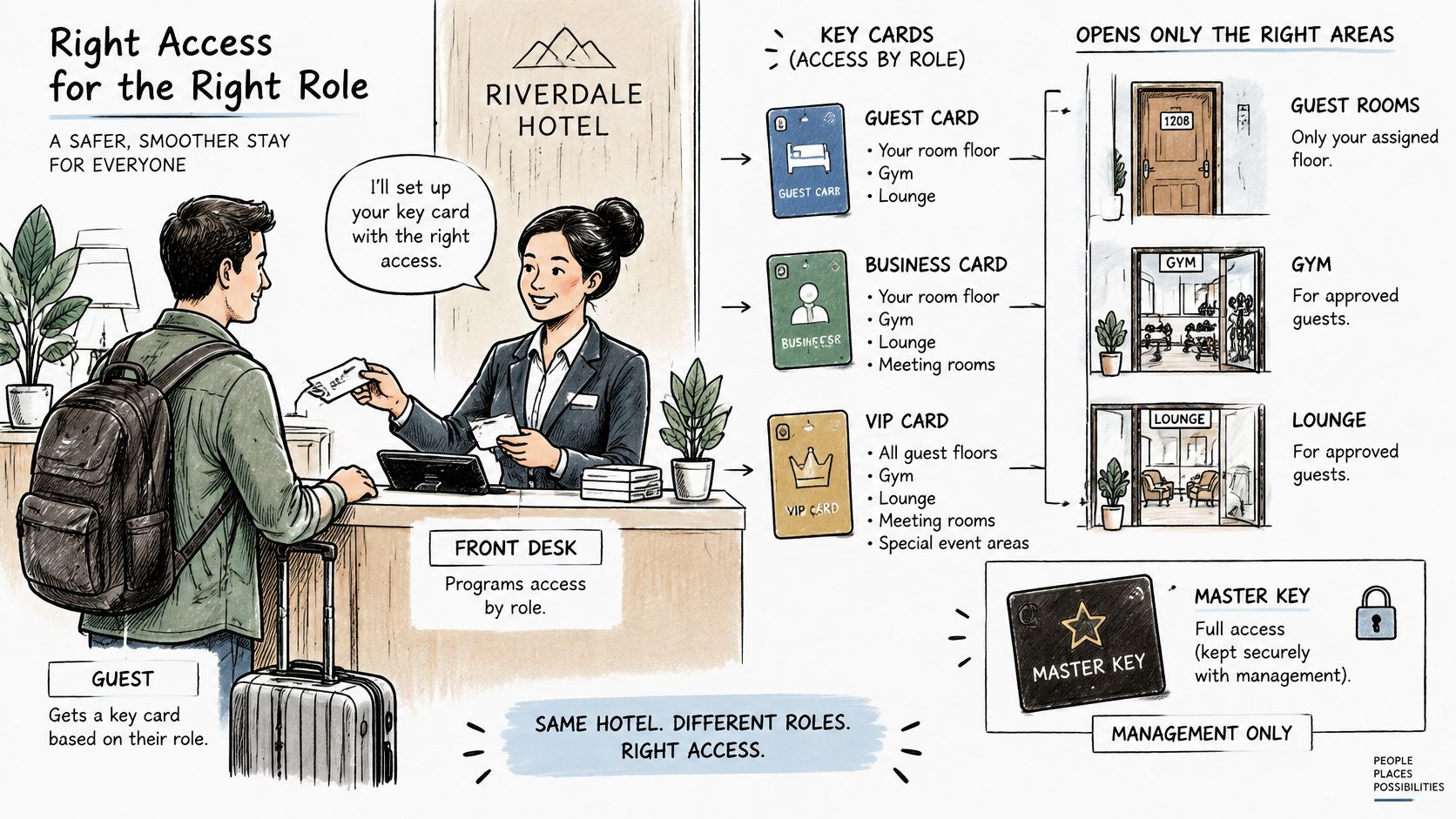
A hotel doesn't cut a new master key for every guest. It programs a key card for one room, for the length of one stay, and deactivates it at checkout. Housekeeping gets a different card. Maintenance gets another. Nobody needs to know the guest's name to know what the card should open.
RBAC works the same way for software. The card is a role. The doors are permissions.
The image below uses that hotel logic to show the mechanism before we add lab detail.
The Problem With Per Person Permissions
Without roles, every application keeps its own list. A chemist joins, and someone grants access in the notebook, the inventory system, the analytics tool, the document store, and the project workspace. Each grant is a separate decision, often made by a different person, with no record of why the last chemist got a slightly different set.
When that chemist moves to another team, the reverse process rarely happens completely. Old access stays. After two moves, her account reflects her career history, not her current job.
Roles, Then People
A role names a job function, such as formulation scientist, laboratory operator, quality reviewer, or administrator, and holds the permissions that job needs. A person is then assigned to the role. Change the job, and you change the membership. You don't rebuild the permission list.
Permissions attach to roles, and people attach to roles.
Role hierarchies keep this tidy. A senior scientist role can inherit what a scientist role already has, then add approval rights, instead of duplicating every read and write permission. The model also has a shared standard behind it. The ANSI/INCITS 359-2004 RBAC standard was approved on February 11, 2004, which gives your team, your auditors, and your vendors the same vocabulary for core roles, hierarchies, and separation of duty.
Say a new formulation chemist starts on a coatings program. You assign the scientist role once. She can read experiment records, create new entries, and view approved model outputs. She can't release a recipe to production, manage user accounts, or export the full project archive. If she later needs instrument access, you add the operator role for that instrument group rather than editing six systems.
The same logic applies beyond the lab, including to secure contractor access in manufacturing from Nutmeg Technologies, where temporary workers need narrow, time-bound entry rather than broad plant credentials. Before you evaluate any tool, do the paper exercise first. List your current job functions and the permissions each one really needs. That list is your first role catalogue.
How Least Privilege Protects Intellectual Property
The diagram below contrasts scattered per-person grants with access routed through defined roles.
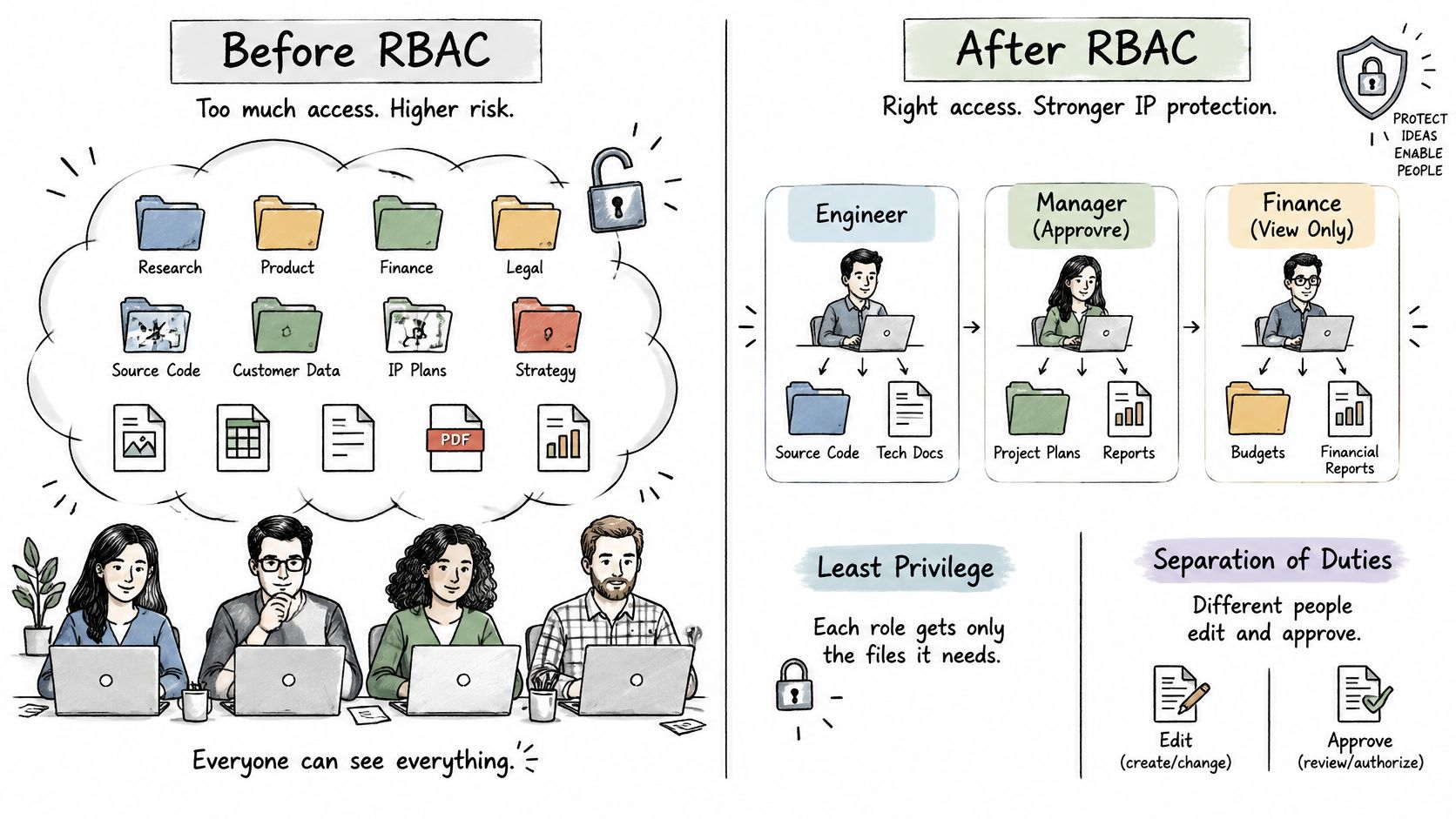
Two controls do most of the protective work. Least privilege gives each role only the permissions its job requires. Separation of duties prevents one person from holding every permission needed to complete a sensitive transaction alone.
Least Privilege Limits What a Login Can Reach
Take a formulation scientist working on a new resin. Her role includes reading prior experiments, writing new results, and viewing approved model outputs. It doesn't include production administration, user management, or bulk export. If she needs one of those, someone grants it separately and can explain why.
If her password is stolen, the attacker gets that same narrow set. He can damage one project area, but he can't release a recipe to the plant, create a new administrator account, or pull the entire formulation archive in one action. The control didn't stop the theft. It reduced what the theft was worth.
That mechanism is explicit in NIST's RBAC models by Sandhu and colleagues, which identify least privilege, separation of duties, and data abstraction as security principles and note that denying unnecessary transactions prevents those privileges from being used to circumvent organizational policy. In plain terms, a permission a role doesn't have can't be misused by anyone holding that role.
Separation of Duties Blocks the Solo Sensitive Act
Least privilege answers the question, how much can this person reach. Separation of duties answers a different one, can this person finish a risky act alone.
A scientist role might create a formulation change. A quality or production role approves its release. Neither role alone can alter a controlled recipe and authorize its use on the line. An insider who wants to push an untested change into production now needs a second person, a second account, or a visible exception. All three leave evidence.
This short video walks through the basic role and permission relationship behind those controls.
What This Means for Formulation IP
Proprietary formulations, experiment history, and scale-up data are the assets competitors would pay for and the records regulators may ask you to defend. Under a role model, external collaborators are excluded by default because no role they've been assigned includes those libraries. You add them to a named project role, for a named purpose, instead of opening a shared drive and hoping nobody browses sideways.
The audit value follows from the same design. When access is challenged, you don't argue that a person was probably trustworthy. You show the role definition, the assignment date, and the separation constraint that kept creation and approval apart.
Start your review with the three conflict pairs most likely to create solo risk:
- Create versus approve: the person who drafts a record, change, or release shouldn't be the only approver.
- Change formulation versus authorize production: editing a controlled recipe and releasing it for manufacturing belong in different roles.
- Export data versus audit the export: the person who can bulk export formulations shouldn't control the log that proves what left.
If one account holds both sides of any pair, you've found your highest priority fix.
How Roles Speed Up Onboarding and Cut Admin Costs
Onboarding is where administrators feel RBAC first, because the work changes from many small edits to one governed assignment. The process below is the routine to standardize across your notebook, data platform, and connected lab systems.
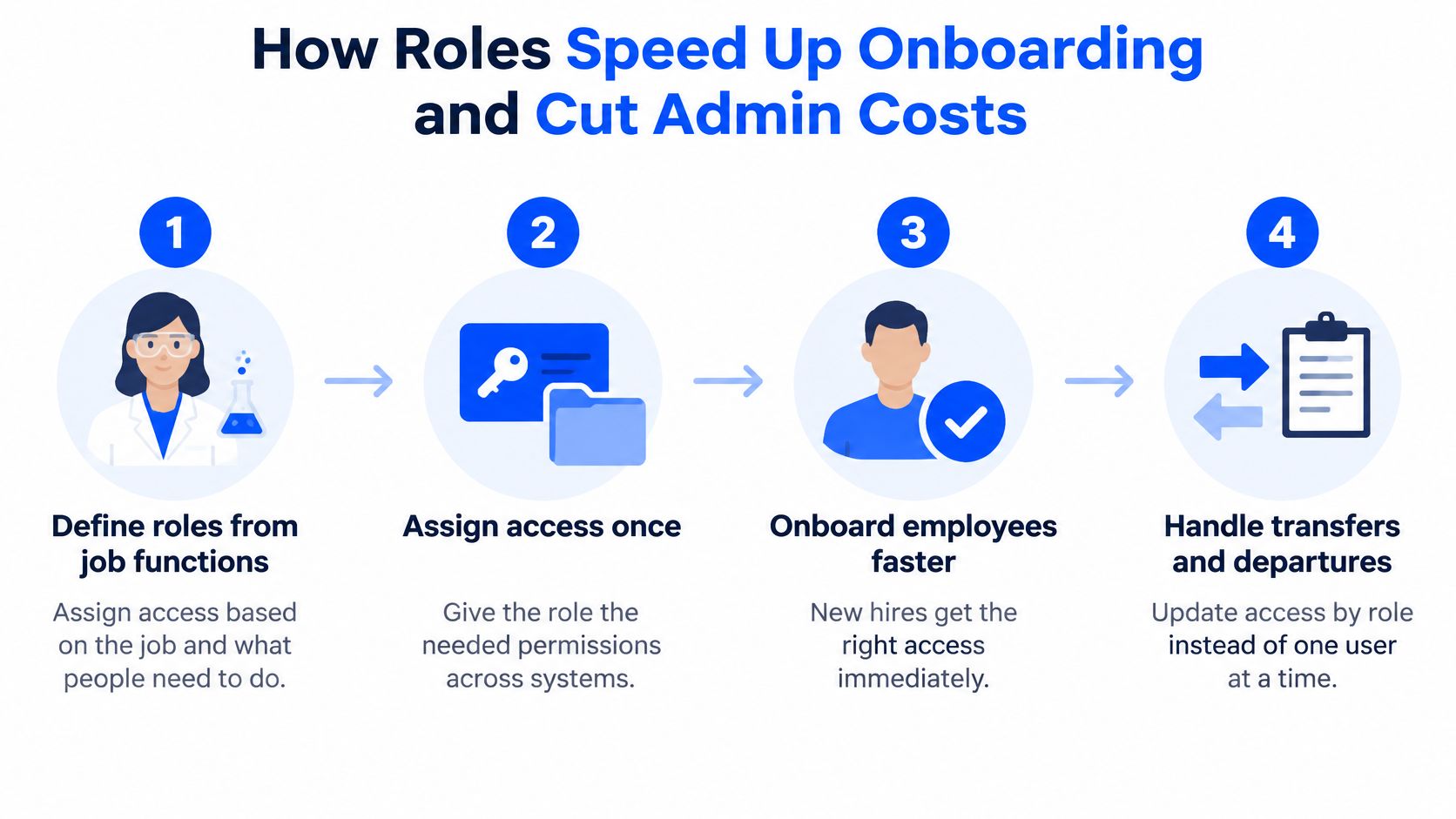
The Six Step Routine
- Define roles from job functions. Start with scientist, laboratory operator, quality engineer, data steward, administrator, and external collaborator. Name roles after jobs people recognize, not after software modules, so a hiring manager can choose correctly without asking IT.
- Map each role to its minimum permissions. For every connected system, write what the role can read, write, approve, and export. This is slow work the first time, but it's the step that makes every later hire fast and consistent.
- Assign the new hire to a role on day one. The manager requests a role, not a pile of application grants. The chemist gets a coherent set at once, and the administrator handles one ticket instead of chasing five system owners.
- Use hierarchies for shared permissions. Let a senior scientist inherit the scientist baseline and add approval rights. Inheritance keeps the catalogue small, and a policy change to the baseline reaches everyone who depends on it.
- Change membership on transfer, then confirm removal. Add the new role, remove the old one, and verify the removal took effect. The common slip is keeping the old role just in case, which is how access accumulates over years.
- Remove membership at offboarding and check for direct grants. Role removal should end access, but old one-off grants can survive outside the role. Search for them explicitly, or your clean process will sit on top of a messy residue.
Why the Routine Costs Less to Run
NIST describes this model in its RBAC publication on features and motivations as permissions associated with roles and users assigned to roles based on responsibilities and qualifications, so onboarding, transfers, and offboarding are handled by changing role membership rather than editing permissions across every resource. NIST identifies simplified management, lower-cost security administration, and extensibility as core advantages, along with updating roles without individually revising every user's privileges.
If a transfer still produces five tickets, you haven't moved permissions into roles yet. You've only renamed the old process.
Central definitions also make audits less theatrical. A reviewer checks whether the quality engineer role should include batch release, once, instead of sampling twenty individual accounts and finding four variants. Policy changes apply uniformly because there's one place to change them.
After a month of disciplined use, you should see a simple pattern. A new hire becomes productive through one assignment, a transfer closes with the old role visibly removed, and an administrator can explain any person's access by naming their roles. If you can't say that yet, the problem is usually step 2 or step 5, not effort.
Where Role Based Access Control Falls Short for R&D
Roles fit stable jobs well. R&D work isn't stable in the same way. A scientist's job title may not change for three years, while her projects, sites, collaborators, and data sensitivity change every quarter. That gap is where role-only designs start to strain.
| Model | Strength | Main cost | Best fit |
|---|---|---|---|
| RBAC | Simple to audit and scales with stable job functions | Role explosion as projects multiply | Stable baseline permissions |
| ABAC | Expresses project, site, confidentiality and experiment phase | Higher implementation and maintenance complexity | Context-dependent R&D decisions |
| Hybrid (roles plus attributes and expiry dates) | Baseline roles with contextual limits | Requires an explicit design boundary | Cross-functional R&D with external collaborators |
Two Failure Modes to Avoid
The first is role explosion. A team creates a role for one project, then a variant for one site, then a variant for a joint-development partner. Within a year, nobody can say how two similar roles differ, and administrators assign the broader one to avoid blocking work.
The second is the opposite error. To keep the catalogue small, a team makes the scientist role broad enough for every project. The catalogue looks clean, but every scientist can now reach formulation libraries they have no reason to open. You've traded visible complexity for invisible exposure.
The Three Layer Split That Works in Practice
Use roles for stable baseline permissions, such as creating experiments or reviewing quality records. Use attribute rules for boundaries that change with context, such as project membership, site, confidentiality level, instrument status, supplier relationship, and experiment phase. Use time-limited approvals for external collaborators and joint-development partners, with an expiry date set when access is granted.
This boundary follows the distinction in NIST's RBAC features and motivations publication, where RBAC is defined around permissions assigned to organizational roles, with role hierarchies, constraints, and sessions as central mechanisms, while NIST's ABAC guidance notes richer attributes come at the cost of greater implementation and maintenance complexity. Attributes add expressive power. They also add policy you must test, explain, and maintain.
Audit trails decide whether the hybrid stays usable. A reviewer should be able to answer why a scientist could open a dataset on a given date, from the role, the project attribute, and the approval record. If the answer requires reading a long policy chain, your design is already too clever.
Settle three questions before rollout:
- Belongs in a role: does everyone with this job need it, across projects?
- Depends on an attribute: does it change by project, site, confidentiality, or experiment phase?
- Needs an expiry date: is it for a collaborator, supplier, or temporary assignment?
That boundary is the design question to settle before rollout, not after the first access complaint.
Metrics That Prove the Benefit and Expose the Cost
RBAC is often sold as if the benefit were automatic and the cost were a one-time configuration task. Neither is true in a multi-site R&D organization. Designing roles, cleaning identity data, fixing legacy integrations, reviewing exceptions, and running access certifications all consume skilled time. The benefit has to be measured against that work, or you're funding a catalogue, not a control.
| Metric | What it reveals | How to calculate | Good direction |
|---|---|---|---|
| Median access-provisioning time | How quickly new staff become productive | Hours from request to granted access, median | Lower |
| Permissions granted through roles | Share of access governed centrally | Role-based grants divided by total grants | Higher |
| Stale-access rate | Leftover access after moves or exits | Stale grants divided by total grants | Lower |
| Exception volume | How often roles fail to fit the work | Exceptions logged per quarter | Lower |
| Quarterly review effort | Cost of operating access certifications | Staff hours per access review | Lower |
| Time to revoke after reassignment | Length of the exposure window | Hours between role change and revocation | Lower |
Read the Cost Side Honestly
NIST's implementation material, summarized in its RBAC economic and deployment report, warns that RBAC has an upfront and steep economic impact, may require modifications to legacy applications, and depends on scarce expertise, and it describes deployment across dozens of security systems, tens of thousands of user definitions, and millions of authorizations as potentially very difficult, with exceptions still necessary.
That warning changes how you should budget. The expensive part isn't switching on roles in one modern platform. It's reconciling a legacy lab system that only understands local accounts, a plant system with its own groups, and identity records where the same contractor appears twice. Cost grows with systems and sites, so record your baseline per system and per site, not as one global average that hides the worst integration.
How to Interpret the Six Numbers
Provisioning time is your productivity measure. If the median doesn't fall, managers may be requesting roles and then filing side tickets for the missing pieces. Permissions granted through roles is your governance measure. If it stays low, most access still bypasses the design you paid to build.
Stale-access rate and time to revoke are your exposure measures. A rising stale rate after a reorganization means transfers are adding roles without removing old ones. Exception volume is your fit measure. The same exception repeated every quarter isn't an exception anymore. It's a missing role or a missing attribute rule. Quarterly review effort is your operating cost. If it doesn't fall as role coverage rises, reviewers are probably checking people one by one instead of checking role definitions.
A large role catalogue is not proof of governance. A team can have hundreds of roles and still grant most access directly.
Record all six baselines before rollout, from ticket timestamps, grant logs, HR move dates, and review timesheets. Without a baseline, the first six months will produce anecdotes about faster onboarding and complaints about blocked access, with no way to tell which effect is larger.
Pilot Your Role Design Before You Commit
Start with a role matrix on paper. List each job function, its baseline permissions, and the permissions that need an attribute rule or an expiry date. Then record your baseline for provisioning time, role-based grant share, stale-access rate, exception volume, review effort, and revocation time before anything changes.
Choose one active formulation program with internal scientists and one external collaborator, and run it through the matrix for four weeks. Score each candidate platform on the same test. Can it express baseline roles alongside project limits, log who accessed what in a way a reviewer can explain, set expiry dates for external partners, and restrict who may create accounts and change roles? In our setup, accounts for a team are created and managed by the account owner or administrators of the user's organization, and Polymerize Connect offers granular permission layers, real-time activity tracking and automated role-based workflows, with security that includes end-to-end encryption, role-based access, and isolated data environments.
Reject any option that can't pass the collaborator test before access is granted. Set a review date at the end of the first quarter and compare pilot results with your baseline. If stale access and revocation time haven't improved, fix the matrix before adding more roles.
Bring your role matrix and baseline numbers, and test whether your next platform can enforce them without side tickets or permanent collaborator access. Visit Polymerize to see how granular permissions, real-time activity tracking, and role-based workflows protect formulation IP while your scientists keep moving.
Put your R&D data to work
See how materials teams use Polymerize to plan fewer experiments and reach target properties faster.