

The most common advice on ISO 27001 SOC 2 mapping is to download a crosswalk, match the control labels, and reuse the evidence. That's a useful starting point, but it skips the question that matters most: does the evidence cover the system, people, and period you're assessing?
A shared control library saves work only when its rows point to real operations. For a materials R&D platform, that means checking the path from laboratory upload to formulation storage, model execution, and customer export, not accepting the badges on a security page.
Table of Contents
- Keep policies connected to implementation
- Review suppliers against their actual responsibilities
- Preserve the deployment decision trail
Control-Level Crosswalk at a Glance
ISO 27001:2022 Annex A to SOC 2 crosswalk by control area
| Control area | ISO 27001:2022 Annex A | SOC 2 criteria | Typical evidence |
|---|---|---|---|
| Access control and least privilege | A.5.15, A.5.18, A.8.2 | CC6.1, CC6.2, CC6.3 | Role matrix, quarterly access review export |
| Identity and authentication | A.5.16, A.5.17, A.8.5 | CC6.1, CC6.2 | SSO configuration, MFA enforcement report |
| Logging and monitoring | A.8.15, A.8.16 | CC7.2 | Log retention settings, alert rules, sampled alert tickets |
| Cryptography | A.8.24 | CC6.1, CC6.7 | Encryption-at-rest and in-transit configuration, key rotation records |
| Vulnerability management | A.8.8 | CC7.1 | Scan reports, remediation tickets with dates |
| Change management | A.8.32 | CC8.1 | Pull request approvals, deployment logs |
| Secure development | A.8.25, A.8.26, A.8.28 | CC8.1, CC7.1 | SDLC standard, code review samples |
| Incident management | A.5.24, A.5.25, A.5.26 | CC7.3, CC7.4, CC7.5 | Incident register, post-incident reviews |
| Supplier and cloud oversight | A.5.19, A.5.21, A.5.22, A.5.23 | CC9.2 | Vendor register, annual vendor assessments, provider SOC reports |
| Business continuity and backup | A.5.29, A.5.30, A.8.13, A.8.14 | A1.2, A1.3 | Restore test records, continuity exercise reports |
| Risk assessment and treatment | Clauses 6.1.2 and 6.1.3 | CC3.1, CC3.2 | Risk register, treatment plan, Statement of Applicability |
| Governance and monitoring | Clauses 5.2, 5.3, 9.1, 9.2, 9.3, 10.2 | CC1.2, CC1.3, CC4.1, CC4.2 | Signed policies, management review minutes, internal audit reports |
| Records and privacy | A.5.33, A.5.34 | C1.1, P-series where selected | Retention schedule, PII handling records |
A row identifies potential shared evidence, not equivalent requirements. The ISO auditing practices note on the Statement of Applicability explains the risk-based selection of controls: Annex A isn't a mandatory implementation checklist, and the Statement of Applicability (SoA) must document applicability and implementation decisions.
The table uses the applicable Annex A edition named in its header. SOC references distinguish the Common Criteria, CC1 through CC9, from selected Availability, Confidentiality, and Privacy criteria. A privacy reference doesn't establish complete privacy coverage, and a recovery artifact doesn't imply that Availability was included in the examination.
Read each row as an evidence relationship
A row counts as mapped only when it names the system boundary, accountable owner, test date, and source artifact. Add the relevant assessment period and the exact control wording before assigning coverage.
For a secondary comparison when building your library, Foo Guard's SOC 2 crosswalk can help identify candidate relationships. Keep your own implementation narrative alongside any published mapping so reviewers can distinguish a suggested connection from a tested control.
Worked access and recovery rows
Say your policy requires quarterly access reviews. An export supporting A.5.18, A.8.2, CC6.2, and CC6.3 should identify the production accounts reviewed, their privileges, the reviewer, the review date, and resulting removals. An identity-provider export alone won't establish completeness if database administrators can authenticate separately.
For A.8.13 and A1.3, a dated restore test should identify the backup, target environment, recovery procedure, validation results, and approving owner. A successful backup-job notification proves that a job ran, not that scientists can recover usable experimental records.
This crosswalk is indicative. Check every relationship against the applicable ISO edition, selected SOC categories, and the auditor's actual control wording before sharing it as assurance evidence.
Why Certificates and Reports Are Not Interchangeable Proof
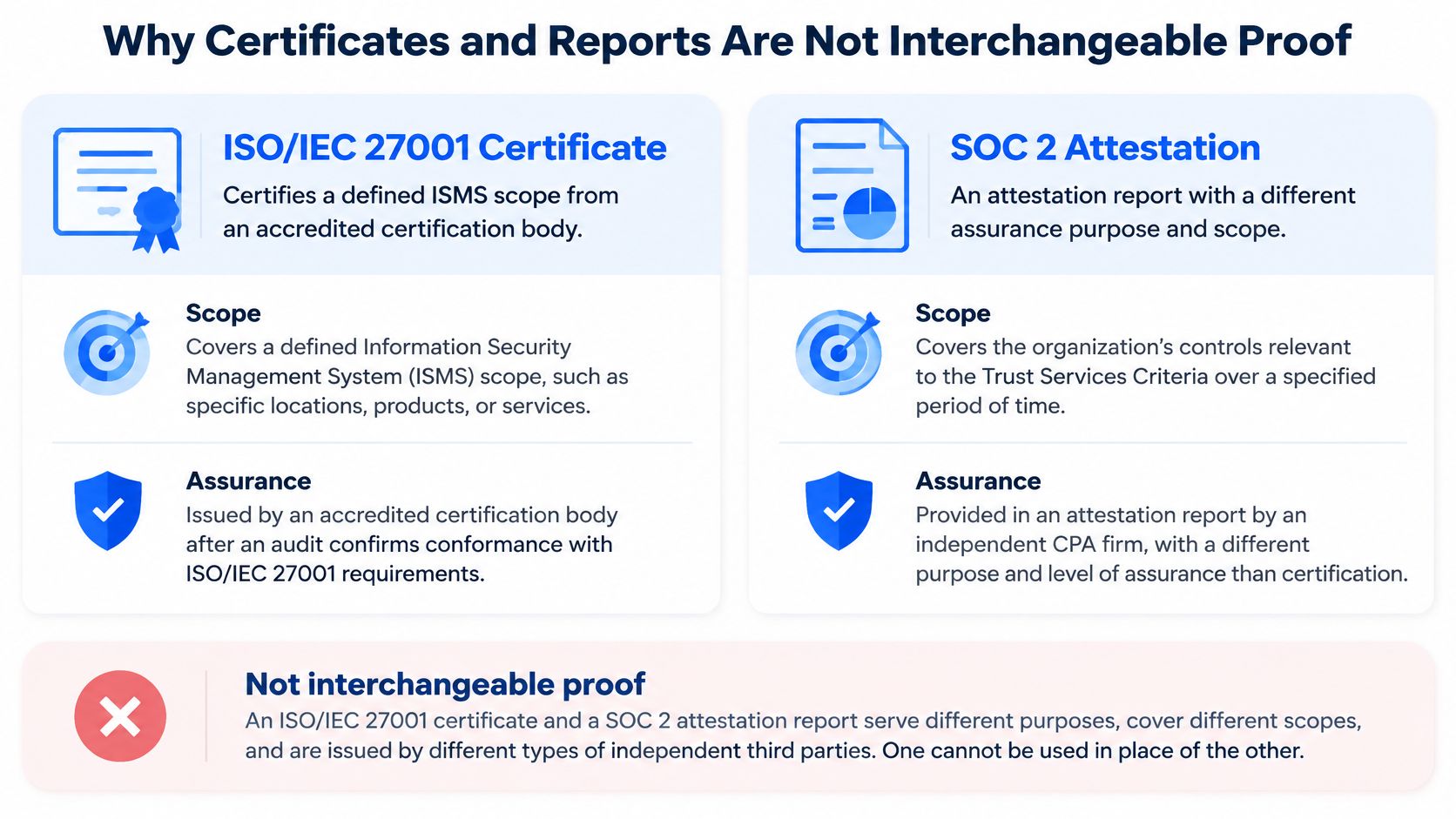
An ISO/IEC 27001 certificate establishes certification of a defined information security management system. A SOC 2 report provides an auditor's opinion about a defined system against selected criteria. Neither automatically establishes the other's requirements.
The distinction between management-system certification and service-organization attestation is reflected in the ISO/IEC 27001 overview; it also records that the 2022 edition reorganized Annex A into 93 controls across four themes. Edition control matters because an older control identifier may no longer describe the requirement your mapping claims to address.
ISO 27001 and SOC 2 compared on the points that affect mapping
| Dimension | ISO/IEC 27001 | SOC 2 |
|---|---|---|
| Output | Certificate from an accredited certification body when accredited certification is sought | Attestation report with auditor opinion |
| Scope definition | ISMS scope statement | System description of defined services and infrastructure |
| Control basis | ISMS requirements and reference controls selected through the SoA | AICPA Trust Services Criteria, with Security required |
| Assessment period | Certification audit, followed by surveillance and periodic recertification | Type 1 at a stated date; Type 2 over a stated observation period |
| Evidence focus | Operation and effectiveness of the ISMS, including risk treatment and management review | Design and implementation; Type 2 also tests operating effectiveness over the period |
| Exceptions | Nonconformities classified as major or minor | Test deviations, their context, and any effect on the opinion |
The comparison below summarizes why the deliverables answer different assurance questions.
Describe assurance precisely
Security is the required SOC category; Availability, Processing Integrity, Confidentiality, and Privacy are selected according to the engagement, as the AICPA Trust Services Criteria explain. Don't infer that an encryption control means Confidentiality was examined, or that an AI workflow was assessed for Processing Integrity.
A Type 1 report addresses design at a particular date. A Type 2 report adds evidence about operation during the specified period. Neither should be described just as a SOC certificate.
Use precise procurement language: an ISO/IEC 27001 certificate for a named scope, plus a SOC 2 Type 2 report covering Security over the stated period. The phrase SOC 2 and ISO compliant omits the information a reviewer needs.
A certificate can be valid and still cover the wrong service for your purchase.
Matil's guide to assessing vendor trust with ISO 27001 provides useful context for evaluating the certificate rather than treating it as a universal approval.
For materials R&D, ask whether the assessed service includes model execution, laboratory integrations, and export paths. Establish where experimental data is stored, which subprocessors handle it, and how the vendor segregates customer intellectual property. Those answers determine whether the assurance is relevant to your intended use.
Role-Based Access and Identity Controls for Software Vendors
A role named scientist tells an auditor little. The useful record shows whether that role can read another project's formulations, export experimental results, change sharing settings, or administer a model workspace.
Start with permissions that match actual work, then make approvals and removals observable.
Build access around job functions
Define functional roles. Separate platform administrator, scientist, data steward, auditor, and support engineer permissions. Have the application owner approve the role matrix, including API access and service identities, so the matrix describes more than the user interface.
Make restricted access the default. Require a named business reason and expiry for production-data access. Support engineers should receive approved, time-limited access rather than permanent visibility into customer formulations.
Centralize authentication. Use an identity provider such as Microsoft Entra ID or Okta for staff SSO and MFA. Require phishing-resistant authentication for privileged users, and inventory local accounts that bypass the identity provider.
Connect employment changes to access changes. HR should initiate departure and role-change events; IT should execute account changes; application owners should confirm downstream removal. Disable departing users promptly, revoke active sessions and tokens, and reapprove permissions after a role change.
The trade-off is administrative friction. Narrow roles take more work to maintain than a broad researcher role, but broad permissions push the review burden onto managers who may not understand every application entitlement.
Avoid creating a separate role for every unusual request. Use a stable role catalogue with documented exceptions, expiry dates, and an owner who can remove the exception.
Prove that permissions stay appropriate
Review the complete account population. Set a documented cadence for ordinary and privileged access, with more frequent scrutiny for elevated accounts. Retain the source export, reviewer identity, decisions, and removal tickets, not just a checked task in a compliance platform.
Control emergency access. Store break-glass credentials in a vault, alert on use, and require prompt independent review. Test whether emergency access still works without turning the account into an unmonitored alternative login.
Test tenant isolation below the interface. Engineering should verify authorization at API and data-access layers. Include negative tests showing that a user or service identity from another tenant cannot retrieve formulation records by changing an object identifier.
- Assess relevant exposure. A laboratory connector that handles raw experimental records needs different scrutiny from a scheduling application.
- Inspect assurance boundaries. Check provider reports against the purchased service, relevant locations, and the period under review.
- Assign inherited obligations. Translate complementary user-entity controls into internal tasks, such as configuring access restrictions or reviewing provider alerts.
- Track changes. Reassess critical suppliers at renewal and when services, subprocessors, or data flows change.
- Select applicable criteria. Identify the CC1, CC2, CC4, and CC5 criteria and relevant points of focus addressed by the system's controls.
- Identify the producing process. Match each control to the ISMS clause and owner that generate the relevant evidence.
- Collect dated operation. Retain policy approvals, management decisions, internal audit reports, training records, and corrective-action updates from the assessment window.
- Label requirement types. Mark clause requirements separately from Annex A controls so reviewers don't treat a technical configuration sample as proof of management-system conformity.
- Define the assessment population. Separate production from development, then include supporting identity systems, cloud providers, subprocessors, laboratory integrations, and customer-facing interfaces. Document excluded components and the reason.
- Test operation across the period. Obtain dated access reviews, ticket samples, CI/CD approvals, vulnerability remediation records, and restore results. Don't replace historical operation with screenshots captured during audit preparation.
- Reuse only qualifying artifacts. Attach both framework references when the artifact supports both requirements. Supplement it when the periods, populations, objectives, or testing methods differ.
- Service coverage. Confirm that the scope or system description covers the production environment, APIs, and stores that will hold your experimental data. Check whether laboratory connectors and model-processing services are included or separately assessed.
- Period relevance. Verify that the SOC reporting period is relevant to your assessment. Request a bridge letter for an intervening gap, but treat it as a management representation, not an extension of the auditor's testing.
- Relevant exceptions. Examine access, encryption, and incident-response deviations for effects on your data. Obtain remediation evidence rather than assuming that a vendor's planned action closes an exception.
- Provider dependencies. Establish whether cloud providers and subprocessors are included or carved out. For excluded providers, obtain relevant assurance and verify who implements the remaining customer-side controls.
- Traceable mapping. Require row-level confidence, named artifacts, and unresolved gaps. A control label without its supporting record is a claim awaiting verification.
The role matrix supports A.5.15, A.8.2, and CC6.1 through CC6.3, but it primarily describes design. Review exports and resolved access tickets demonstrate operation; tenant-isolation test results demonstrate a different control and need their own evidence relationship.
Assign owners at the artifact level. IT owns identity configuration, application owners approve entitlements, engineering owns authorization tests, and security reviews exceptions. Compliance can coordinate collection, but shouldn't approve access it doesn't understand.
For each review, preserve enough information to reconstruct the population. Record the application, environment, extraction time, filters, and excluded account types. Otherwise, a neat review sheet can conceal an unreviewed population of database accounts, automation tokens, or external collaborators.
Logging, Monitoring and Encryption Controls to Implement
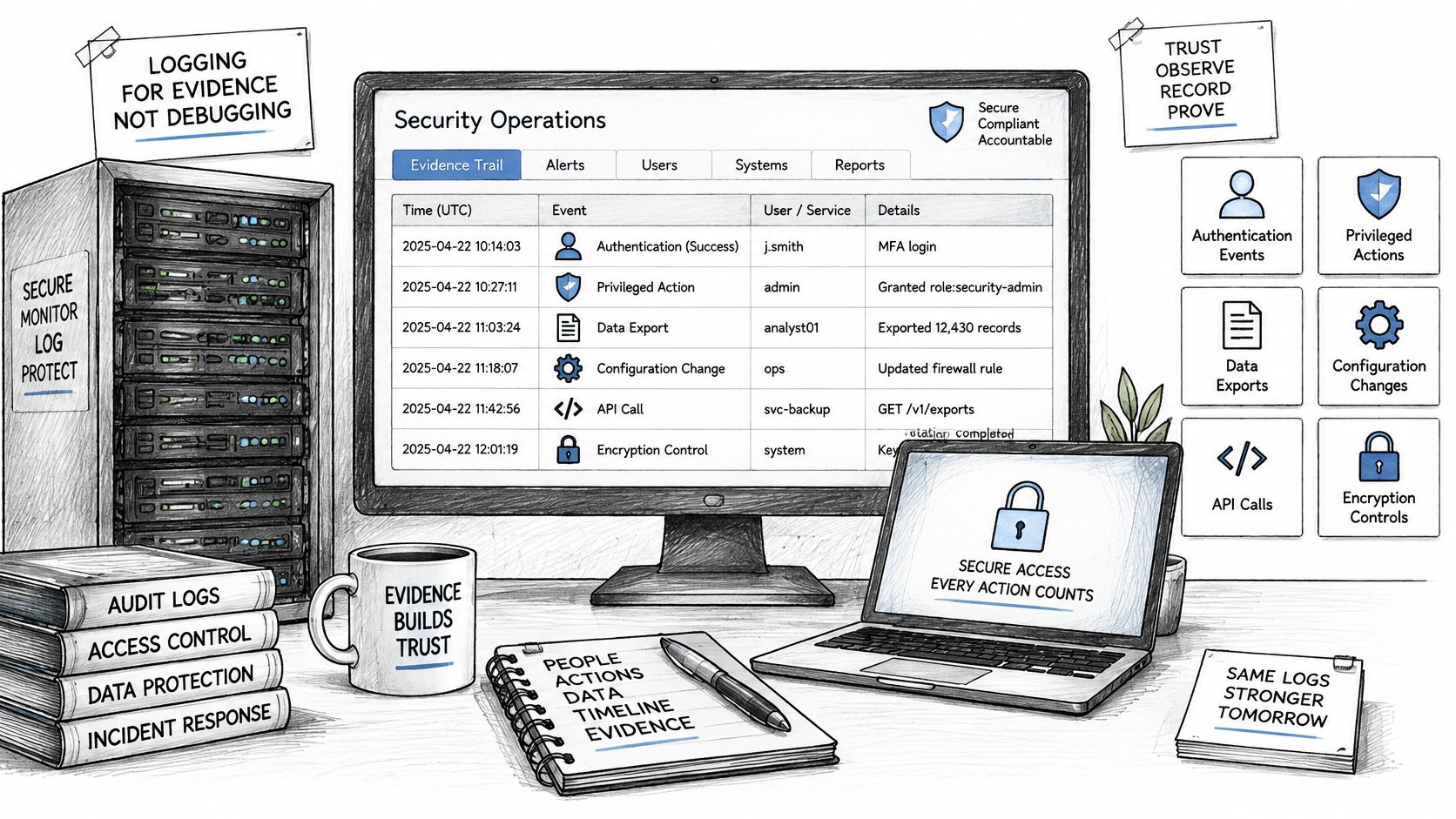
Logs must support investigation and assurance, not just debugging. Capture authentication events, privileged actions, data exports, configuration changes, relevant API activity, and administrative access with synchronized timestamps and stable actor identifiers.
The illustration below shows the separation between operational systems, monitoring, and evidence collection.
Design records that investigators can use
A useful export event identifies the actor, tenant, dataset, action, outcome, and correlation identifier. Don't log formulation contents, secrets, or full request bodies merely to make evidence look complete. Security telemetry can become another sensitive data store.
Use CloudTrail for supported AWS administrative events, application audit logs for tenant actions, and a platform such as Microsoft Sentinel or Splunk to correlate activity. Infrastructure logs won't explain which scientist exported a formulation if the application records every request under a shared service identity.
Retain evidence for the assessment window and a documented operational buffer, subject to privacy and contractual constraints. Send logs to a separate security account or protected immutable storage, and restrict deletion independently from production administration.
| Detection case | Useful context | Evidence of response |
|---|---|---|
| Bulk formulation export | Tenant, actor, dataset, destination | Triage ticket with business validation |
| Repeated authentication failure | Account, source context, outcome | Investigation and containment decision |
| Unfamiliar geographic access | Identity, device, session context | Reviewer disposition |
| Encryption-key change | Key identifier, actor, affected service | Approved change or incident record |
Tune these rules against legitimate laboratory workflows. Instrument imports and scheduled integrations can generate unusual activity; suppressing every noisy alert, however, removes the evidence that monitoring detects exceptions.
Separate encryption settings from key governance
For transport, prefer TLS 1.3 and retain TLS 1.2 only where needed under your approved security baseline. For storage, use AES-256 or an approved equivalent through a managed service such as AWS KMS or Azure Key Vault. These are implementation choices, not universal settings mandated by either framework.
Document who can administer keys, who can decrypt data, how rotation works, and what triggers emergency replacement. A managed key service reduces operational burden, but it doesn't establish that every database, snapshot, export, and temporary processing store uses the intended key policy.
For additional context on the control relationship, use the accompanying video.
A sampled evidence package should connect a dated event export to an alert ticket and the analyst's disposition. Add configuration snapshots for storage encryption, transport enforcement, key access, and rotation settings. A screenshot without its resource identifier and capture date is difficult to test.
Map logging and monitoring to A.8.15, A.8.16, and CC7.2. Map cryptography to A.8.24 and the relevant CC6.7 control wording, keeping key-management evidence distinct from proof of encrypted transport.
Policies, Vendor Oversight and Change Management Routines
Policies, supplier reviews, and deployment approvals fail for different reasons. Policies become stale, supplier assessments overlook inherited responsibilities, and deployment records lose their connection to approved changes.
Give each routine an operational owner and a record that demonstrates the decision, not merely the existence of a process.
Keep policies connected to implementation
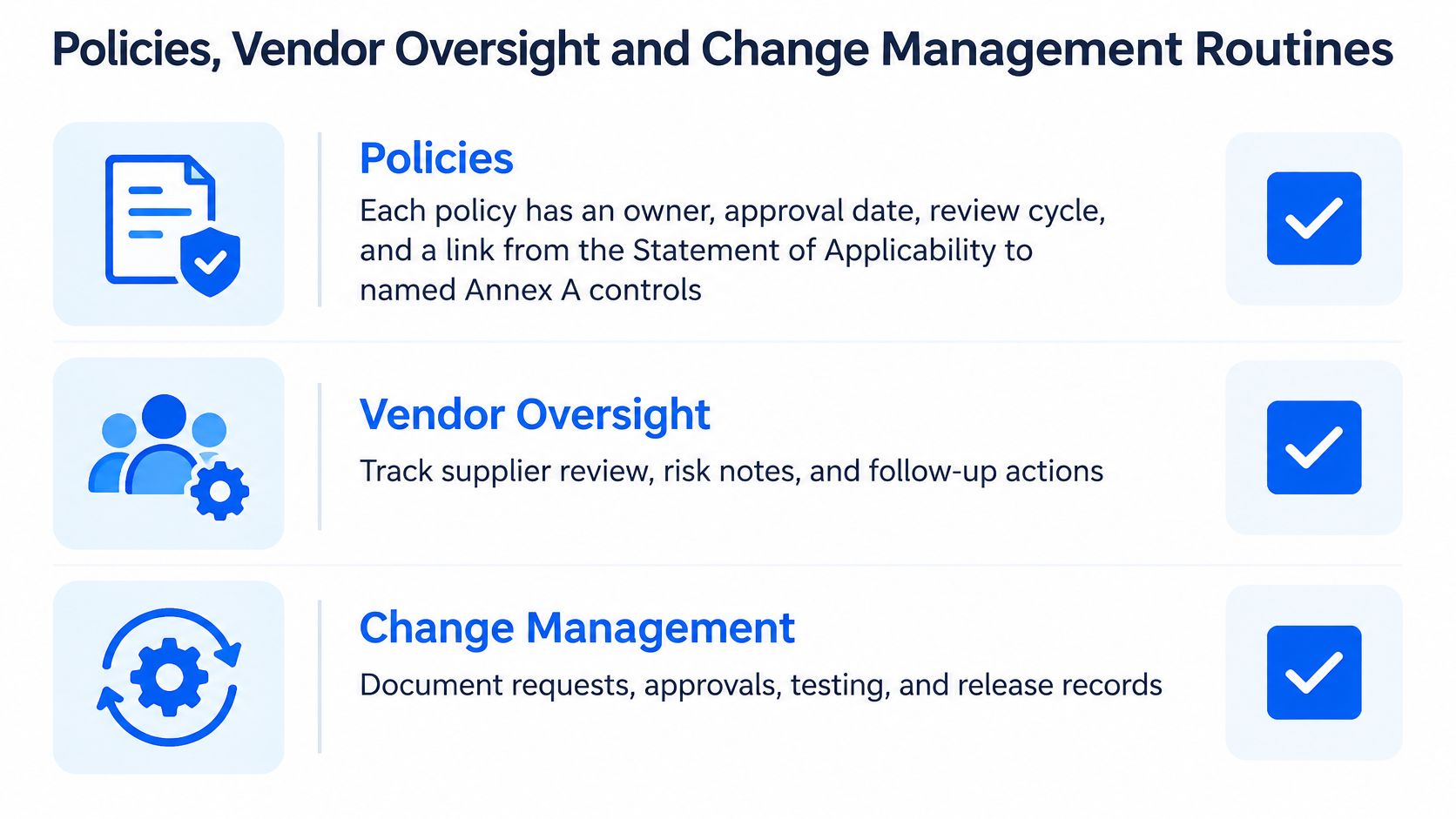
The policy owner maintains the content; an authorized manager approves it; affected staff receive the relevant instructions. Record the approval date, review cycle, version history, and the SoA controls the policy supports.
A policy requiring peer review isn't evidence that engineers performed peer review. Auditors can sample the policy approval to assess governance, then sample pull requests to assess execution. Keep those evidence types separate in the library.
Use the following checklist to organize the recurring work.
Review suppliers against their actual responsibilities
Procurement should maintain the vendor register with security and service owners. Record data handled, processing locations, subprocessors, contractual security terms, service criticality, and the person responsible for follow-up.
The register and assessments support A.5.19, A.5.21, A.5.22, A.5.23, and CC9.2. Contractual security commitments also belong under A.5.20; cloud-service acquisition, use, management, and exit need the specific attention of A.5.23.
Collecting provider reports is the easy part. The substantive evidence is the reviewer's assessment of what the report covers, which exceptions matter, and which responsibilities remain with your team.
Preserve the deployment decision trail
Use a traceable flow: request → review and testing → approval → deployment → logging → post-deployment validation. GitHub or GitLab can preserve code-review evidence, while Jira or an equivalent ticketing system records purpose, risk, and release authorization.
Require peer approval for production changes and separate developer and approver responsibilities where feasible. For emergency changes, retain the urgency, authorization, implementation record, and retrospective review rather than pretending the normal workflow occurred.
AI pipelines need model version records, training-data lineage, evaluation results, and rollback instructions. A configuration-only change to a model endpoint can alter customer-data processing without a conventional application release.
A.8.32 and CC8.1 should point to those release artifacts. For a sampled deployment, the release owner should be able to trace the running version back to its approved request and demonstrate what happened when post-deployment checks failed.
Governance and Monitoring Criteria Mapped to ISMS Clauses
Technical controls don't establish who oversees the program, evaluates deficiencies, or funds corrective action. Those relationships belong in the management-system part of the crosswalk, with ISO clauses clearly distinguished from Annex A controls.
Treat the following links as supporting relationships. A policy approval alone doesn't establish board oversight, and attendance at training doesn't establish competence for every security responsibility.
| ISO ISMS clause | SOC 2 criteria typically supported | Evidence to examine |
|---|---|---|
| 5.2, information security policy; 5.3, roles and authorities | CC1.2, CC1.3 | Approved policy, oversight charter, responsibility assignments |
| 7.2, competence | CC1.4 | Role requirements, training and competence evaluations |
| 7.4, communication; 7.5, documented information | CC2.1, CC2.2 | Communication records, controlled documents, information-quality checks |
| 9.1, monitoring and measurement; 9.2, internal audit | CC4.1, CC4.2 | Monitoring results, audit program, findings and follow-up |
| 9.3, management review | CC1.2, CC4.2 | Review inputs, decisions, assigned actions |
| 10.2, nonconformity and corrective action | CC4.2, CC5.3 | Cause analysis, corrective actions, effectiveness checks |
Map decisions, not meeting titles
Management review minutes should show what leaders considered and decided. A calendar invitation proves scheduling; an attendance record proves participation; neither establishes that management addressed deteriorating control performance or accepted a residual risk.
Practical rule: Map the decision and its follow-through, not just the document containing it.
Use this procedure to prepare the governance evidence:
The internal audit lead should preserve audit scope, independence, findings, and follow-up. Management owns corrective-action decisions; control owners implement them; an appropriate reviewer checks effectiveness before closure. Closing a ticket without that final check leaves the underlying governance claim unsupported.
Audit Evidence Checklist and Reusable Templates
A defensible crosswalk is evidence-centered and scope-specific, not a checklist of similar labels. ISACA's guidance on the ISO/IEC 27001 transition supports connecting control implementation, operational testing, and reconciled assessment boundaries.
Build the matrix with requirement identifier, control objective, risk addressed, implementation narrative, accountable owner, systems in scope, testing frequency, evidence artifact, exception status, and mapping confidence. Add artifact capture date, period covered, tester, test method, and result so an evidence collector can distinguish an available file from sufficient evidence.
Establish an evidence collection schedule
The cycles below are a recommended operating schedule, not frequencies universally imposed by either framework. Adjust them to risk, commitments, and approved control wording.
Evidence artifacts with framework references and refresh cycles
| Evidence artifact | ISO 27001 reference | SOC 2 reference | Refresh cycle |
|---|---|---|---|
| Quarterly user access review export | A.5.18, A.8.2 | CC6.2, CC6.3 | Quarterly |
| Privileged account access review export | A.5.18, A.8.2 | CC6.2, CC6.3 | Monthly |
| MFA enforcement report | A.5.17, A.8.5 | CC6.1 | Monthly |
| Log retention settings and sampled alert tickets | A.8.15, A.8.16 | CC7.2 | Monthly sample |
| Encryption configuration snapshot and key rotation record | A.8.24 | CC6.7 | Quarterly |
| Penetration test report and remediation tickets | A.8.8 | CC7.1 | Annually and after major change |
| Change approval samples | A.8.32 | CC8.1 | Per release, sampled monthly |
| Vendor risk assessments and provider reports | A.5.19, A.5.22 | CC9.2 | Annually and at renewal |
| Restore test results | A.8.13, A.5.30 | A1.3 | Semi-annually |
| Incident tabletop records | A.5.24, A.5.26 | CC7.4, CC7.5 | Annually |
| Statement of Applicability and version history | Clause 6 and SoA | CC3.2 scope reference | On each change |
The SoA reference is contextual support for risk assessment, not a substitute for SOC testing. Likewise, the existence of a penetration test report doesn't establish that the owner remediated its findings.
Reconcile boundaries before sampling
A spreadsheet works when owners maintain it consistently. A GRC platform can automate collection and reminders, but someone still needs to validate population completeness and interpret exceptions.
Use a reusable template with a header naming framework versions, system scope, assessment periods, and the mapping approver. Put each control and its evidence relationship in a separate row, then add a footer for open exceptions, remediation owners, target dates, and dated risk acceptances.
Define mapping confidence explicitly. Use supported for tested evidence covering the intended relationship, partial where supplemental evidence is needed, and unmapped where no adequate relationship exists. Don't turn those labels into a coverage percentage that obscures a critical gap.
Confirm Scope Before You Accept Either Report
Accept assurance because it addresses your requirements, not because a vendor presents a polished trust page. Before procurement approval, have the security reviewer and service owner make a documented decision against these checks.
Make partial acceptance explicit
I would treat any material failure as partial evidence, even if every other answer is satisfactory. Several unanswered checks strengthen the case for escalation, but a missing tenant-isolation boundary alone can justify withholding approval.
Record the residual exposure, compensating controls, decision owner, and conditions for reconsideration. Risk acceptance should describe what your organization is accepting, not state that the vendor has certificates.
This week, take the opening crosswalk and reconcile it against your intended deployment. Ask the vendor for the matching artifacts before the procurement decision, starting with the data paths and permissions that could expose your formulation IP.
Polymerize offers an AI-native materials R&D platform that brings experimental data together and supports AI-guided formulation development. Visit Polymerize to discuss your workflows and request security documentation aligned with the systems, integrations, and data boundaries your team needs to assess.
Put your R&D data to work
See how materials teams use Polymerize to plan fewer experiments and reach target properties faster.