

You already know the situation. A formulation misses viscosity target, so the team nudges binder level. The next batch looks better, but drying time gets worse. Then process temperature changes, and the previous conclusion falls apart. After a few weeks, the lab has a notebook full of one-variable tweaks and no reliable map of what drives performance.
That's where design of experiments earns its place in R&D. If you've been searching for what is Design of Experiments in R&D, the useful answer isn't “a statistics method.” It's a disciplined way to learn how a material or process behaves when several variables move at once, under the same constraints you deal with every day in polymers and chemicals work: limited samples, long cure cycles, destructive testing, and pressure to make fewer, smarter runs.
Table of Contents
From Guesswork to Insight The Case for DOE in R&D
A formulation team is three weeks into a resin screening program. One chemist raises cure temperature and sees better hardness. Another adjusts catalyst level on the next batch and loses pot life. A third changes both, along with mix time, and gets a result no one can explain with confidence. That is usually the point where trial-and-error stops being productive.
Many R&D groups begin with OVAT, or one-variable-at-a-time testing, because it matches how people troubleshoot at the bench. Change temperature. Hold the rest constant. Then change filler loading. Then mixing speed. That approach can help with basic screening, but polymers and chemical formulations rarely respond in isolated, linear ways.
In compounding, adhesives, coatings, and formulated products, factors interact under process conditions that are often hard to hold perfectly still. A filler level that looks acceptable at one melt temperature can drive viscosity or dispersion problems at another. A surfactant that improves wetting at one binder-to-solvent ratio can weaken film formation somewhere else. OVAT can produce a few good batches. It does not reliably show why they were good, or whether the result will hold up when the process shifts.
Design of Experiments, or DOE, is a structured way to plan, run, analyze, and interpret experiments so a team can learn from several variables at the same time. The useful answer to the question "what is design of experiments in R&D" is not "a statistics method." It is a decision tool for learning which inputs matter, where they matter, and which combinations are worth scaling.
That distinction matters in lab practice. R&D teams are rarely short on ideas. They are short on material, instrument time, operator capacity, and patience for ambiguous results.
Why lab teams move to DOE
Teams adopt DOE when informal experimentation stops answering the fundamental question. The question is usually not whether factor A changed the response in one batch. It is whether the team can make a sound process or formulation decision before the next pilot run, customer sample, or scale-up trial.
DOE improves that decision quality in a few concrete ways:
- It reduces false confidence: A single strong batch can be noise, operator effect, or raw material variation.
- It tests combinations on purpose: That matters in materials systems where performance depends on balance, not isolated ingredients.
- It produces a usable model: Even a simple model can narrow the next round of work and cut dead-end experiments.
The practical value is strongest when experiments are expensive or slow. That includes long cure cycles, aging studies, extrusion trials, reactor campaigns, and any program with limited specialty raw materials. In those settings, each run has to answer more than one question.
Some teams resist DOE, assuming it is too academic for a fast-paced lab environment. I usually see the opposite. Once a project reaches five or six active variables, skipping DOE often creates more work, not less. The team spends extra weeks explaining contradictions that were built into the test plan from the start.
Practical rule: DOE earns its keep when the cost of a weak conclusion exceeds the cost of planning the experiment properly.
Modern AI platforms make that trade-off even more favorable. They do not replace DOE fundamentals. They help teams choose factors, flag gaps in coverage, prioritize the next experiment, and connect historical formulation data with current lab work. For polymer and chemicals R&D, that matters because the main bottleneck is often not running experiments. It is deciding which experiment deserves the next drum of resin, reactor slot, or day on the line.
Why DOE Uncovers More Than Just Main Effects
A formulation team adjusts catalyst level and sees cure improve. Then it raises oven temperature on the next batch and gets a different answer than expected. In polymer and chemical systems, that is normal. Performance often depends on factors acting together, not one at a time.
DOE matters here because it exposes those combined effects. A single-factor approach can tell you whether more catalyst tends to help on average. It usually cannot tell you whether catalyst only helps inside a specific temperature range, or whether the benefit disappears once viscosity crosses a mixing threshold. Those are the relationships that decide whether a formulation is forgiving or fragile in real production.

Main effects are only the first layer
Main effects still matter. They show the average direction and magnitude of each factor across the study space, which is useful for screening and for dropping weak variables before the next round. In practice, though, materials programs rarely fail because a team misunderstood one factor in isolation. They fail because the team missed how two or three factors shift together.
That pattern shows up constantly in the lab:
- Resin and cure schedule: A resin may look tolerant at one ramp rate and become brittle at another.
- Filler loading and dispersant: Extra filler can improve stiffness in one dispersant window and destroy processability in another.
- Shear history and solids: Viscosity, particle breakup, and final appearance often depend on the combination.
These are not statistical curiosities. They are process reality.
Why interactions matter in materials R&D
In small-molecule synthesis, polymer processing, coatings, adhesives, and filled systems, the chemistry and the process are coupled. A change in temperature can alter reaction rate, viscosity, dispersion quality, and side reactions at the same time. A change in mixing speed can affect air entrainment, particle wet-out, and local heat generation. If the experiment plan treats each variable as independent, the conclusions can look cleaner than the actual system is.
That is one reason teams get surprised at pilot scale. The lab may have identified a promising formulation, but only under a narrow set of handling conditions that no one recognized as important. Once batch size, heat transfer, residence time, or raw material lot shifts, the hidden interaction shows up as gelation, poor surface quality, unstable torque, or a property miss.
I have seen this with reactive formulations that looked stable on the bench and then tightened their processing window dramatically in larger equipment. The chemistry did not suddenly change. The interaction between formulation and process finally became visible.
A DOE that finds little or no interaction still gives a useful answer. It means the operating space may be simpler to control than expected.
That result has real value. It can justify a wider raw-material acceptance range, a simpler control strategy, or a faster handoff to manufacturing.
Modern AI tools make this part of DOE more practical, especially in materials programs with sparse data and expensive runs. They can surface likely interaction candidates from prior formulation history, suggest where the model is still blind, and help teams choose the next experiment when resin, reactor time, or analyst capacity is limited. The statistics still need sound experimental design. The advantage is speed and better prioritization under real lab constraints.
The point is not just to estimate effects. It is to learn which combinations define the process window, which ones create risk, and which ones are safe enough to scale.
Choosing the Right DOE Design for Your R&D Goal
A lab has one reactor day left this week, limited resin, and six factors that might explain why viscosity drifted outside spec. Choosing the design is not a statistical formality. It determines whether the team learns enough to make a decision or spends the week generating noise.
That is the standard I use. Pick the DOE that fits the decision, the material constraints, and the cost of being wrong.
If the project is still broad and the team is sorting through many plausible causes, use a design that screens efficiently. If the chemistry is mostly understood and the question is where to set the process, use a design that supports optimization. If interaction risk is high and the factor count is still small, a fuller design often earns its keep because it gives a cleaner picture of the system.
Match the design to the decision
Here is the practical version I use with formulation and process teams.
Screening designs fit early-stage work. Use them when you have a long list of candidate ingredients, additives, mixing conditions, cure settings, or handling variables and need to identify which ones deserve attention. In polymers and formulated chemicals, this is often the right first step because raw materials, prep time, and analytical capacity are limited. The goal is not to map the whole response surface. The goal is to stop wasting runs on weak factors.
Full factorial designs fit smaller, high-value questions where interaction visibility matters. In a 2-level full factorial, the run count scales as 2^n, so three factors require 8 runs and four factors require 16 runs. That is still realistic for a focused study on, say, catalyst level, temperature, and residence time, or resin grade, filler loading, and drying conditions. Once the factor count grows, the matrix gets expensive fast.
Fractional factorial designs are often the right compromise for real R&D labs. You give up some interpretability because certain effects are confounded, but you keep the study executable. That trade-off is acceptable when material is scarce or each run ties up a compounder, reactor, or test method for half a day. It is a poor choice only when the team has not thought through which interactions it can afford to blur.
Response surface methodology belongs later, after the important factors are known. It helps locate a better operating region, quantify curvature, and refine setpoints. In practice, teams move from “what matters?” to “where should we run?” That difference matters because optimization designs are expensive if half the factors should have been eliminated earlier.
Comparison of Common DOE Design Types
| Design Type | Primary Goal | Best For... | Typical Number of Factors |
|---|---|---|---|
| Screening design | Identify the few factors that matter most | Early-stage projects with many plausible variables | Many |
| Full factorial | Estimate main effects and interactions thoroughly | Small, focused factor sets where interaction visibility matters | Few |
| Fractional factorial | Learn efficiently under resource constraints | Labs that need interaction insight but can't afford a full matrix | Moderate to many |
| Response surface methodology | Optimize settings and explore curvature | Late-stage tuning after key factors are known | Few, selected variables |
A few selection rules hold up in practice.
- Use screening first when uncertainty is high: Do not spend optimization-level effort on a factor list that still includes guesses, habits, and legacy variables.
- Use full factorial when the factor count is low and the question matters: The extra runs often pay back through clearer interpretation and fewer follow-up studies.
- Use fractional designs with intent: Before approving the matrix, decide which aliases are acceptable and which would create too much ambiguity for the decision at hand.
- Use response surface methods only after factor reduction: Otherwise the team burns runs modeling curvature in variables that should have been dropped.
Modern AI platforms can improve this choice. They do not replace DOE logic, but they can help teams narrow candidate factors from prior formulation history, flag combinations that are likely infeasible, and suggest where another run would reduce uncertainty most. That is especially useful in materials R&D, where experiments are slow, assay queues are real, and failed batches consume more than time.
The wrong DOE design usually produces a plausible answer to the wrong question.
For polymers and chemicals R&D, the best design is the one the lab can execute cleanly, with realistic factor ranges, available material, stable measurement methods, and a model structure that matches the decision the team needs to make.
A Practical DOE Workflow for Materials Scientists
A good DOE workflow looks less like a statistics lesson and more like a disciplined project plan. The mechanics matter, but the judgment calls matter more. In materials work, poor decisions usually happen before the first run starts.
Start with a response worth optimizing
The first step is defining a question that can survive contact with the lab. “Make it better” is not a DOE objective. “Improve adhesion while keeping drying time workable” is closer. In polymer systems, that might be modulus, peel strength, haze, melt flow, cure time, or dimensional stability. Pick responses the team can measure reliably.
Then choose factors and levels that are both meaningful and feasible. If the range is too narrow, you may not see anything. If it's too wide, half the matrix may produce unusable batches. For polymers and formulations, realistic levels are often constrained by solubility, processing limits, safety, raw material availability, and downstream testing requirements.
A practical workflow usually follows this sequence:
- Define the objective: State the decision the DOE needs to support.
- Select responses: Use measurable outputs that connect to product or process value.
- Choose factors and ranges: Include only variables the team can control and execute credibly.
- Pick the design: Match the structure to the stage of the project and available resources.
Execution discipline matters more than most teams expect
Once the matrix is set, execution becomes the difference between insight and confusion. A core technical principle in R&D DOE is randomization, which neutralizes unknown noise variables. Combined with replication, which increases the precision of effect estimates, it helps the team attribute output changes to controlled inputs rather than drift, as described in Mabion's DOE guidance for research settings.
That matters in real labs because noise has many forms:
- Day effects: Humidity, operator differences, reagent age, and equipment warm-up.
- Batch effects: A resin lot or filler lot isn't always as stable as the spec sheet suggests.
- Measurement effects: Destructive tests, sample conditioning, and prep variation all add scatter.
After the runs, analysis should answer three questions. Which factors matter. Which interactions matter. Which settings appear operationally useful rather than statistically interesting only.
Don't hand a DOE to software and accept the first model output. Check whether the result matches chemistry, processing reality, and known failure modes.
The final step is deciding what to do next. Sometimes the answer is optimization. Sometimes it's a confirmation run. Sometimes it's admitting the selected ranges were wrong and redesigning the study. That's normal. DOE is a learning loop, not a one-shot ritual.
DOE in Action Examples from Polymer and Formulation R&D
The hardest part of DOE in materials R&D usually isn't the statistics. It's fitting a sound design into the reality of the lab. Sample availability is limited. Cure cycles are slow. Some responses can only be measured destructively. In those settings, DOE is most useful when it's built around constraints rather than applied as a generic checklist, which aligns with JMP's discussion of DOE under practical execution limits.
Polymer composite development
Take a composite development project where the team wants better stiffness and impact balance without pushing cost too far. The obvious variables might include filler type, filler concentration, and processing temperature. A full matrix may be unrealistic if each condition requires compounding, molding, conditioning, and mechanical testing.
A fractional factorial approach is often the better first move. It gives the team a structured screen of the major variables while respecting limited machine time and sample throughput. In practice, that means choosing a design that can separate likely high-value effects from low-value noise, then following with a tighter round on the variables that matter most.
What works in this situation is operational discipline. Keep compounding conditions tightly recorded. Predefine how failed parts will be handled in the analysis. Align test sequencing so destructive measurements don't create accidental bias. What doesn't work is adding every interesting factor into the first design. Teams do that when they fear missing something, and they usually end up with a study that is too large to execute cleanly.
Coating and formulation work
A second common case is a coating or adhesive formulation where the team is balancing adhesion, drying behavior, and application feel. Suppose surfactant level and binder concentration look like the likely drivers, but the system may not respond linearly. In that case, a response surface design is often more useful than another simple screening matrix.
This kind of work benefits from staged learning. Start broad enough to find direction, then narrow into a useful region. If drying time requires downstream processing before measurement, don't pretend you can run an ideal textbook design in one block. Build the DOE around queue time, oven capacity, and test availability.
The practical outcome of both examples is the same. The team learns from fewer, better-targeted runs. It avoids false confidence from isolated tweaks. And it gets to a formulation window that can be tested for stability instead of just peak performance.
In constrained labs, the best DOE is the one people can run exactly as planned.
Common DOE Mistakes and How to Avoid Them
Most DOE failures don't come from obscure statistics. They come from ordinary planning errors that look harmless at the start and become expensive later.
The anti-patterns that waste runs
Too many factors in the first design. Teams often include every variable anyone mentions. That creates an experiment the lab can't execute well and the team can't interpret confidently.
Do this instead: Start with the factors you can control, justify, and vary safely.
Factor levels that are too narrow. The response barely changes, and the team concludes nothing matters.
Do this instead: Choose levels far enough apart to reveal a signal, but still inside physically workable territory.
Factor levels that are too wide. Half the conditions produce unstable dispersions, off-spec cure, phase separation, or obvious process failure.
Do this instead: Set bounds using pre-work, chemistry knowledge, and process limits, not optimism.
Ignoring curvature. Teams treat the system as linear when the useful region is curved. That leads to poor optimization decisions.
Do this instead: If the chemistry suggests nonlinearity, plan a follow-up design that can test for it instead of forcing a straight-line interpretation.
Confusing statistical significance with engineering value. A factor can be statistically detectable and still operationally irrelevant.
Do this instead: Judge effects against product targets, manufacturing tolerance, and economic consequence.
Treating run order as an afterthought. In materials labs, operator changes, ambient shifts, and equipment drift can distort conclusions.
Do this instead: Randomize where possible, and block thoughtfully when lab logistics require structure.
A final mistake is cultural. Some teams use DOE only after informal trial-and-error has already consumed most of the budget. That's backwards. DOE works best before the notebook fills with disconnected tweaks.
If the team can't explain why each factor and each level is in the design, it isn't ready to run the DOE.
The Next Frontier Integrating DOE with AI Platforms
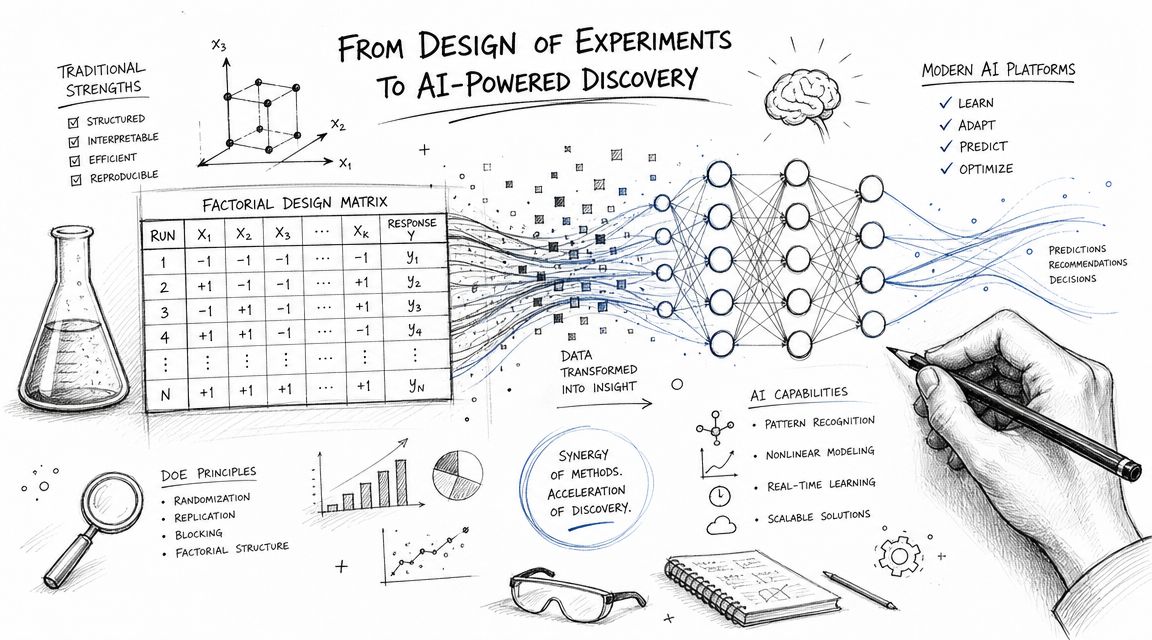
Classical DOE still does the essential job. It gives you causal structure, interaction screening, and defensible experimental logic. But there's a point where the design space gets too large, historical data starts to matter, and a fixed experiment plan becomes less efficient than an adaptive one.
Where classical DOE ends and adaptive learning begins
A useful modern view is that AI doesn't replace DOE. It extends it. Industry discussions increasingly frame DOE as essential for causal inference, while AI can complement it when the design space is too large for exhaustive coverage, using historical data and model uncertainty to guide next-best-experiment selection, as described in Georgia Tech's discussion of modern DOE workflows.
That hybrid model fits materials R&D well:
- DOE gives structure: It establishes clean comparisons and interpretable factor effects.
- AI uses history: It finds patterns across old batches, prior formulations, and related experiments.
- Adaptive selection improves pacing: Instead of committing to every run upfront, teams can choose the most informative next run.
For engineers trying to connect rigorous experimentation with broader decision-making, Flaex.ai's guide for engineering problem-solving is a useful companion read because it frames how structured methods support better technical choices under uncertainty.
In practice, a platform such as Polymerize is highly applicable. It unifies experimental data from fragmented lab systems, then uses domain-specific models to help scientists identify plausible factors, evaluate formulation trade-offs, and plan the next experiment with more context than a spreadsheet can provide.
If your team is still optimizing polymers, chemicals, or formulations by isolated trial and error, it's worth looking at how Polymerize supports DOE-driven and AI-guided materials R&D in one workflow, from experimental data organization to next-experiment planning and scale-up decisions.
Put your R&D data to work
See how materials teams use Polymerize to plan fewer experiments and reach target properties faster.