


You're in a review meeting with a sustainability target on one screen and a launch timeline on the other. Procurement is asking for safer inputs, compliance wants cleaner documentation, and the lab still needs a formulation that works at scale. That's the setting where green chemistry applications matter, because the question isn't whether a chemistry route sounds greener, it's whether the route survives cost, performance, and scale-up.
The field has clearly moved beyond a niche idea. The global green chemicals market was estimated at USD 120.51 billion in 2025 and is projected to reach USD 270.13 billion by 2033, with a 10.7% CAGR from 2026 to 2033, while packaging accounted for 26.3% of revenue share in 2025 and North America was the largest regional market in that year (Grand View Research). That market backdrop matters because it tells you green chemistry is now part of industrial planning, not just sustainability reporting.
What often gets missed is that the best applications are measurable. In industrial settings, the useful questions are simple. Which input changes reduce hazard? Which formulation changes lower waste? Which process changes cut energy without breaking quality? That's the lens I'll use here, with a focus on polymers, coatings, and formulations, not just the usual pharma examples.
Table of Contents
- Polymers that trade less toxicity for usable performance
- Coatings that remove the solvent problem instead of hiding it
- Newer materials routes need a techno-economic filter
- Days 1 to 30 focus on the baseline
- Days 31 to 60 focus on the comparison
- Days 61 to 90 focus on the scale-up gate
Why Green Chemistry Applications Matter to Modern R&D
A formulation team can make a coating pass performance tests and still leave manufacturing with a solvent burden, a waste problem, and a difficult scale-up path. That tension is why green chemistry applications matter to modern R&D. They give teams a way to make chemistry decisions with the plant floor in mind, not just the benchtop.
Green chemistry is the practical operating system underneath those decisions. The 12 Principles of Green Chemistry are not a slogan, they are design rules that push chemists toward safer inputs, fewer auxiliaries, better atom economy, and lower-energy routes. In a plant setting, that changes the question from “Is this material green?” to “Which step creates waste, hazard, or energy load, and what can be removed?”
From compliance pressure to commercial differentiation
The strongest reason to pay attention is that the market is already rewarding these choices. A business case that lowers hazardous waste and improves process efficiency is easier to defend than a broad sustainability claim with no operating data behind it. The EPA-linked industrial analysis in the brief shows that in the U.S. drug industry, green chemistry adoption reduced volatile organic compounds by 50% between 2004 and 2013, and chemical waste released to air, land, and water fell by 7% over the same period. Those are the kinds of outcomes that matter to operations teams because they map to real process changes.
Practical rule: If a green chemistry proposal cannot name the hazardous input, the waste stream, or the energy load it changes, it is still an idea, not an implementation plan.
The same industrial dataset also shows how this work is being managed in practice. Analysts cited in the brief found that 61% of manufacturers used water-usage metrics, 56% used carbon-footprint metrics, 67% used PMI, and 48% used the E-factor. That points to a field that is being run through KPI dashboards, not broad intent statements.
For polymers and coatings, that shift is especially important. A route that cuts solvent losses, reduces cure energy, or lowers off-spec batches can change both the environmental profile and the economics of a platform. AI-driven R&D systems fit here because they can rank candidate routes, compare process trade-offs, and keep the team focused on the metrics that matter most, such as yield, PMI, solvent intensity, and separation burden.
A useful mental model for R&D teams
Green chemistry works like a filter applied to every experiment. Does this route reduce hazard? Does it reduce steps? Does it reduce separations? Does it preserve performance? If the answer is no, the route is probably not ready for scale.
That mindset separates a compliance project from a design platform. It also explains why the conversation has moved beyond the usual pharma-and-solvent focus. In polymers, coatings, and formulations, green chemistry is not only about safer materials. It is about choosing routes that survive techno-economic review, meet regulatory pressure, and still deliver the properties the customer expects.
The Core Principles Translated into Working Levers
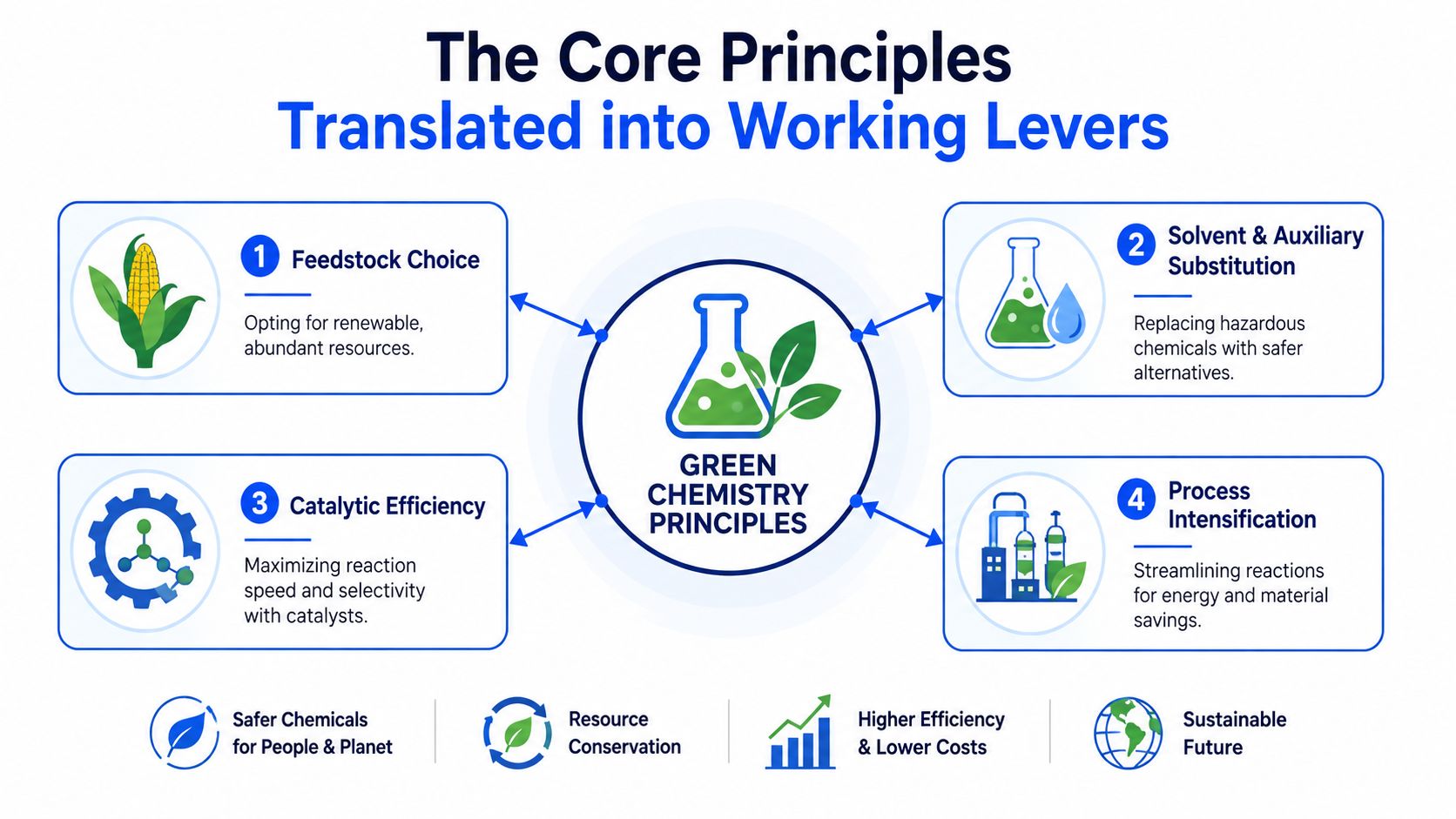
The 12 Principles can feel abstract when they are read as a list. In the lab and on the plant floor, they usually collapse into four working levers, feedstock choice, solvent and auxiliary substitution, catalytic efficiency, and process intensification. That translation matters because operators do not fix “green chemistry” in the abstract. They change one lever at a time, then check whether the process still meets spec.
From principles to shop-floor choices
A kitchen analogy helps. The recipe matters, but so do the ingredients, the amount of added water or oil, the tools on the counter, and whether the meal can be finished in one pan instead of three. In chemistry, feedstock is the ingredient, solvents and auxiliaries are the extra liquids and additives, catalysts are the accelerators that help the reaction happen cleanly, and process intensification is the equivalent of fewer transfers, fewer heat-up cycles, and less cleanup.
The ACS framework explicitly targets auxiliary substances such as solvents for minimization under the 12 Principles (ACS principles). That is why solvent work often gets attention first. Solvents are not the only source of risk or waste, but they are often a high-mass, high-exposure, high-separation-cost part of batch processing.
The four levers in practice
The useful distinction is between a principle and an application. “Use safer solvents” is a principle-level directive. Choosing a waterborne coating, a recyclable solvent system, or a solvent-free reactive extrusion route is an application-level decision.
A project team usually makes progress faster when it argues about mass balance, hazard profile, and recovery cost instead of debating whether a route feels sustainable.
The ACS industrial data set compiled about 75 solvents and broader thermodynamic and safety parameters for about 300 first- and second-generation feedstocks. That matters because green process selection is increasingly judged by measurable properties, not just chemistry intuition. Teams can compare candidates before pilot scale, then rank them by toxicity, recyclability, and process fit.
A practical vocabulary helps here.
- Feedstock choice means asking whether a renewable or lower-impact input can meet the same spec.
- Solvent and auxiliary substitution means removing or replacing the materials that do not become part of the product.
- Catalytic efficiency means getting more desired product from less reagent burden.
- Process intensification means doing the same chemistry with fewer steps, less energy, and smaller equipment.
That is the language a formulation review should use. It keeps the conversation tied to what a chemist can change, and it gives R&D teams a clearer way to judge whether a route will survive scale-up, economics, and product-performance checks.
Solvent Substitution and Process Intensification as Highest-Leverage Moves
A batch looks clean on a process flow diagram, then the solvent bill shows up and changes the conversation. In polymers, coatings, and formulation-heavy manufacturing, solvent choice and process design often move the outcome faster than a headline feedstock swap, because auxiliaries can dominate the mass balance and every extra gallon has to be recovered, separated, treated, or disposed of.
Why solvents deserve the first look
Solvent substitution is one of the most direct ways to apply the green chemistry principles to real plant decisions. The principle is simple enough to explain on the shop floor. If a volatile organic solvent can be replaced with a lower-toxicity or recyclable option, the process can reduce worker exposure, lower VOC burden, and make downstream separation less demanding.
The industrial record in the brief shows why process teams keep returning to this lever. In the U.S. drug industry, green chemistry adoption cut VOC use by 50% between 2004 and 2013, with chemical waste to air, land, and water down 7% over the same period (Springer analysis cited in the brief). That result should not be copied as a guarantee for every coating line or polymer plant. The useful point is narrower. When solvent burden is large, changing the solvent system can produce a measurable drop in exposure, emissions, and handling load.
Process intensification changes the geometry of the problem
Process intensification works from a different angle. Instead of asking only what the chemistry is made from, it asks how much vessel volume, heat input, residence time, and transfer handling the route demands. Flow chemistry, mechanochemistry, and reactive extrusion are all ways to compress the route, which can shrink footprint, shorten waiting time between steps, and reduce the material in transit.
A practical screen before pilot scale helps keep the choice grounded.
- Check the mass balance first. If solvent use or separation work dominates, start there.
- Check the thermal burden next. If heating and cooling drive the energy bill, intensification may matter more than a feedstock change.
- Check recovery and exposure. If solvent recovery or operator exposure drives cost, substitution is usually the stronger move.
- Check whether the route needs a catalyst rather than more reagent. Catalysis can improve selectivity and cut waste, provided the catalyst is stable and affordable.
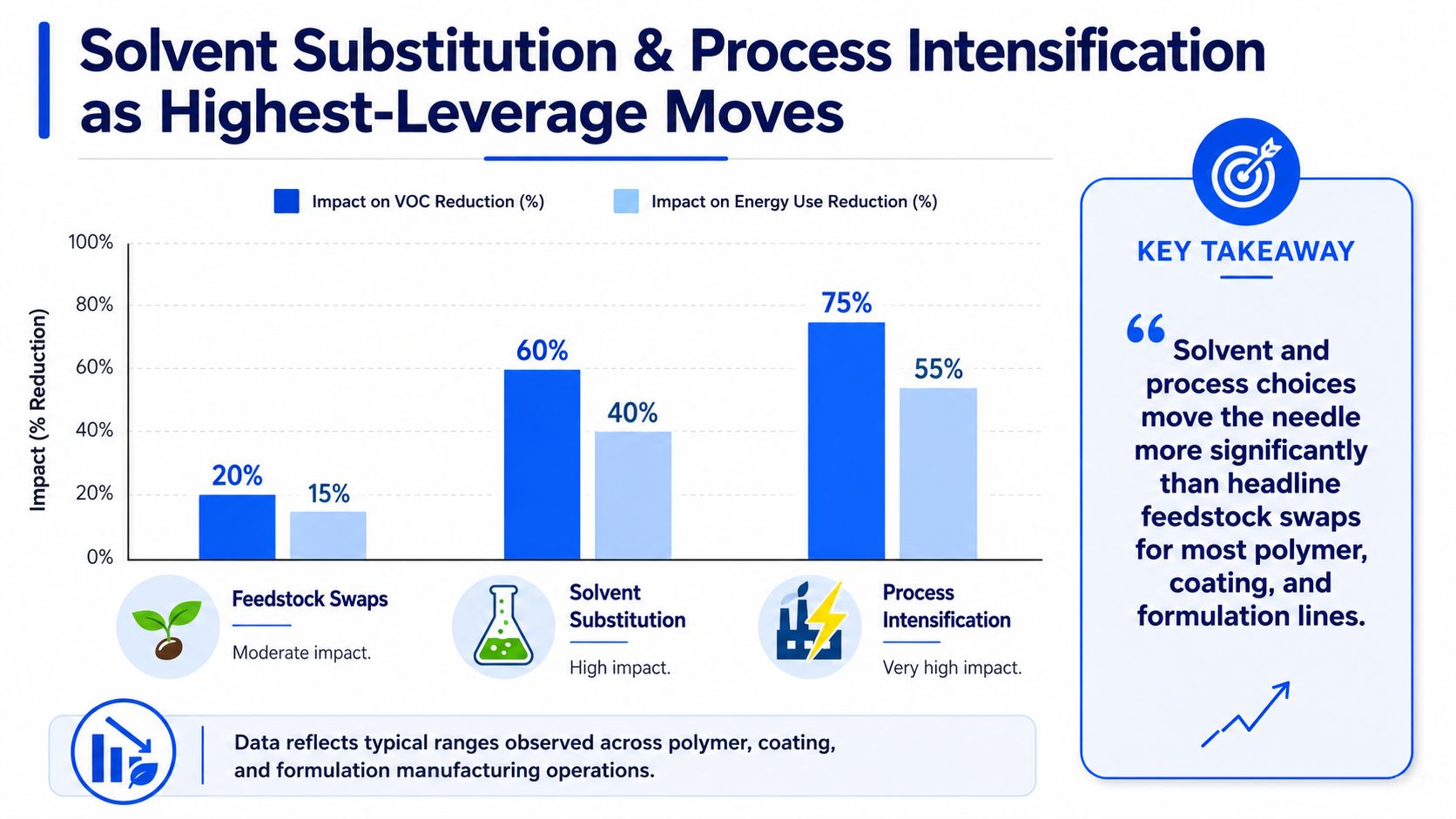
The point of the industrial data set is not to make this a philosophical debate. It gives process teams a way to compare candidates on hazard profile, lifecycle safety, and energy demand before scale-up. That is the kind of checkpoint that matters in high-volume manufacturing, where a route has to survive not only a lab test, but also the cost model, the recovery train, and the exposure review.
Industry Applications in Polymers, Coatings, and Formulations
The most useful green chemistry applications in materials R&D are the ones that solve a specific trade-off. In polymers, the trade-off is often between performance and end-of-life impact. In coatings, it's usually performance versus VOC burden. In formulations, it's stability, cost, and processability against a safer chemistry profile.
Polymers that trade less toxicity for usable performance
Bio-based and recycled-content polymers are often discussed as if the feedstock change alone makes the material better. That's too simple. The better question is whether the new polymer route preserves mechanical behavior, processing window, and supply reliability while improving the overall footprint.
Recent literature points to greener chemistry being applied beyond pharma into coatings, microplastic extraction, waste recycling, and algal biorefinery routes for bioplastics and food supplements (Nature Scientific Reports article cited in the brief). The important nuance is that “green” does not automatically mean circular or low-impact. Techno-economic evaluation has to sit beside the chemistry, because a material that looks clean on paper may still fail on feedstock access, cost, or end-of-life handling.
Coatings that remove the solvent problem instead of hiding it
Waterborne and powder coatings are among the clearest examples of a green chemistry application that changes the waste profile without asking users to accept a vague sustainability premium. The lever here is solvent and auxiliary substitution. The trade-off resolved is direct, a reduction in VOC-generating ingredients while keeping the required film properties.
Formulation teams often get tripped up at this point. They assume that removing solvent means removing performance. In practice, that's only true if the resin architecture, cure mechanism, or dispersion strategy isn't redesigned with the new system in mind. The chemistry has to be rebuilt, not patched.
Decision checkpoint: If a coating reformulation still needs repeated solvent cleanup to hit viscosity or application behavior, the route probably hasn't been simplified enough to count as a real green chemistry shift.
Newer materials routes need a techno-economic filter
Microplastic-replacement formulations and algae-derived feedstocks are promising, but they need the same discipline as any other advanced materials platform. Ask three questions before scale-up. Can the input be sourced consistently? Can the process run without hidden separation penalties? Can the end-of-life pathway be validated?
That last question matters more than many teams expect. A material can be bio-based and still create recovery problems. A coating can be low-VOC and still have a difficult disposal route. Green chemistry applications work best when teams treat performance, recovery, and end-of-life as one design problem rather than three separate approvals.
Environmental and Economic Benefits with Measurable Benchmarks
Executives usually want green chemistry framed in business language, not only environmental language. The practical translation is straightforward. Connect hazard reduction, waste avoidance, and measurement discipline to margin protection, then show where the process gets simpler and where it stays expensive.
The global green chemicals market is being estimated at USD 120.51 billion in 2025 and projected to reach USD 270.13 billion by 2033 with a 10.7% CAGR. That points to widening demand, not a niche experiment, and it helps explain why practical applications are attracting attention. Packaging accounts for 26.3% of revenue share in 2025, and North America is the largest regional market that year, so commercial activity is already concentrated in use cases that can be deployed on real production lines, not only in lab discussions (Grand View Research).
What teams already measure
The most mature manufacturers are not waiting for a perfect sustainability score. They track PMI, E-factor, water-use metrics, and carbon-footprint metrics, because those indicators show where cost and environmental load sit in the process (Springer analysis cited in the brief). That is the right posture. A formulation that lowers PMI but raises recovery cost can still fail economically, so the KPI set has to be balanced like a control panel, not a single gauge.
For polymers and coatings, the same logic applies at the plant level. Solvent cutback can reduce VOC handling, but if it pushes viscosity out of range or drives extra cleaning cycles, the apparent environmental gain gets eaten by operating cost. The useful question is not whether the chemistry sounds greener. It is whether one or more process steps become simpler, cheaper, or less risky to run.
How to read benefit claims without getting fooled
A lot of green content sounds persuasive because it uses broad language. That is not enough. The useful claims tie a chemistry change to a measurable outcome, then make the boundary conditions clear. Solvent substitution may lower VOCs and simplify separation, but it still needs a compatibility check for resin stability, cure behavior, and downstream purification.
One useful adjacent read is green 3D printing insights from American Additive, which shows how sustainability conversations in advanced manufacturing also depend on process choices and material selection rather than slogans. The point is not that every platform works the same way. The point is that the same rule applies across formulations, measure the process, not just the intent.
Benchmark mindset: If a proposal cannot show which KPI improves, which trade-off worsens, and which step gets simpler, it is not ready for a leadership deck.
That is the clearest economic benefit. Good green chemistry reduces hidden process cost. It removes waste that would otherwise need to be handled, and it trims complexity that slows scale-up.
Regulatory Drivers and KPIs That Move the Needle
A chemistry project can look efficient in the lab and still create headaches at the plant if it ignores the rules that govern substance choice, reporting, and traceability. The practical move is to translate regulation into process decisions, then into numbers the team can watch. That keeps the discussion on what the plant can control, which substances enter the recipe, how much waste is generated, and how clearly the supply chain can be documented.
Match the driver to the metric
Each external pressure should map to a KPI the plant can measure without guesswork. EPA TSCA pushes teams to reduce use of listed hazardous substances and to tighten reporting for new chemicals. REACH raises the cost of poor substance transparency, so teams need visibility into substances of very high concern and into composition across the supply chain. ESG disclosure and Scope 3 reporting reward teams that can show environmental footprint reduction with evidence, not estimates.
The useful metrics are straightforward, and they work like the gauges on a control panel.
- PMI tells you how much material goes into making the product.
- E-factor tells you how much waste is created relative to output.
- Carbon footprint gives you a climate lens on the route.
- Water use matters when cleaning, dilution, or cooling load is part of the process.
Those metrics already show up in industrial decision-making, which is why they make better kickoff targets than broad sustainability language. Springer analysis cited in the brief supports that kind of metric-first framing.
A kickoff checklist that keeps projects grounded
Before a project starts, four questions keep the work tied to plant reality.
- Which substances are sensitive under current or likely future rules?
- Which KPI will prove the route is cleaner, safer, or simpler?
- Which data source will support the KPI during scale-up?
- Which team owns the reporting burden if the route changes?
That checklist keeps compliance, operations, and R&D aligned. It also prevents a familiar failure mode, where a team optimizes one metric and later finds that the documentation cannot support the story. A route that looks good on paper but cannot be audited is not finished.
Common Barriers and How AI-Driven R&D Platforms Address Them
Most green chemistry programs don't stall because scientists don't understand the chemistry. They stall because the data is fragmented, the scale-up risk feels high, or the best feedstock is too hard to source reliably. Those are decision problems, not just chemistry problems.
The real blockers are usually operational
Bio-based feedstock availability and cost can interrupt a clean idea before it ever reaches pilot. Solvent swaps can change solubility, stability, or curing behavior in ways that don't show up until scale. Fragmented data makes it hard to see which experiments drove the improvement, so teams repeat work or pick the wrong next test.
That's where AI-driven R&D platforms can help, if they're built as a system of intelligence rather than a shiny dashboard. Polymerize, for example, unifies fragmented experimental data across spreadsheets, ELNs, and silos into a centralized data backbone, then layers predictive models that surface candidate rankings, confidence scores, and historical precedents. Used well, that kind of workflow helps teams compare options faster and plan the next best experiment instead of guessing.
Why the data layer matters more than the model layer
The model is only as good as the data sitting under it. If a formulation team has results scattered across notebooks, old spreadsheets, and separate instrument exports, no amount of algorithmic polish will fix the missing context. True gain comes when the platform makes historical experiments searchable and comparable enough to support a defensible decision.
For teams looking at the broader infrastructure side of AI tools, reliable GPU hosting options are a useful reference point for understanding how compute support can affect deployment choices. In practice, the chemistry team cares less about infrastructure branding and more about whether predictions arrive fast enough to matter during project review.
The best AI use case in green chemistry is not “replace scientists.” It's “reduce the number of blind experiments between a promising idea and a validated route.”
That's the payoff. When the experimental record is organized, the candidate list gets shorter, the rationale gets clearer, and the team can push on the highest-risk questions first.
A 90-Day Starting Plan for Adopting Green Chemistry Applications
Start with one product line, not the entire portfolio. Pick the route where solvent burden, waste burden, or compliance pressure is easiest to see, then baseline the four KPIs that matter most to your process. If you try to reform everything at once, you'll get a noisy result and no credible story for leadership.
Days 1 to 30 focus on the baseline
Build a route map for the chosen product. Capture PMI, E-factor, water use, and carbon footprint for the current process, even if some values are approximate at first. Then identify one substitution target, either a solvent, an auxiliary, or a feedstock, and define the performance constraint it must preserve.
Days 31 to 60 focus on the comparison
Run a small substitution campaign using the best available predictive tools or digital R&D workflow. Don't chase perfect chemistry, chase a tighter decision set. Compare the original route against the candidate on process simplicity, hazard profile, and recovery burden.
Days 61 to 90 focus on the scale-up gate
Choose the route that improves the KPI set without creating a new operational headache. If the candidate improves PMI but increases separation complexity, document that clearly. If it lowers hazard and waste at the cost of unstable supply, bring that trade-off to leadership with the sourcing risk attached.
A clean 90-day plan looks like this:
- Baseline first: define the current process metrics and the source of each number.
- Change one lever: feedstock, solvent, or process architecture.
- Test with evidence: use measured outcomes, not optimistic language.
- Gate scale-up: approve only routes that improve the KPI set and stay manufacturable.
That's the commercial version of green chemistry. It treats sustainability as part of process excellence, not as a side project.
If you're ready to turn green chemistry applications into a repeatable R&D workflow, Polymerize can help centralize experimental data, rank candidate formulations with explainable models, and support faster scale-up decisions. Visit Polymerize to see how a materials R&D system of intelligence can fit into your next polymer, coating, or formulation program.
Put your R&D data to work
See how materials teams use Polymerize to plan fewer experiments and reach target properties faster.