



You've got a promising formulation, a pile of CSVs, a few manual pipetting stations, and one recurring problem. The samples do not fail in a dramatic way, they fail, one inconsistent batch at a time, and by the time anyone notices, the data trail is messy enough that no one fully trusts the result. That's the point where laboratory automation starts to matter, not as a flashy robot, but as a way to make the lab's work reproducible, traceable, and easier to scale.
Table of Contents
- The Working Definition of Laboratory Automation
- Hardware handles the physical work
- Software runs the recipe
- Data systems preserve the memory
- Decision support turns records into guidance
- A workflow is only automated where the handoff is clean
- Precision matters even before scale
- Where the integration tax shows up
- Faster work, less variation, fewer touchpoints
- Why reproducibility matters most
- The labor shift is real
- A practical sequence that doesn't waste a quarter
- The common traps are predictable
- A 90-day starting checklist
- ROI arrives in stages
- Compliance is part of ROI, not separate from it
- The best business case is operational, not aspirational
The Working Definition of Laboratory Automation
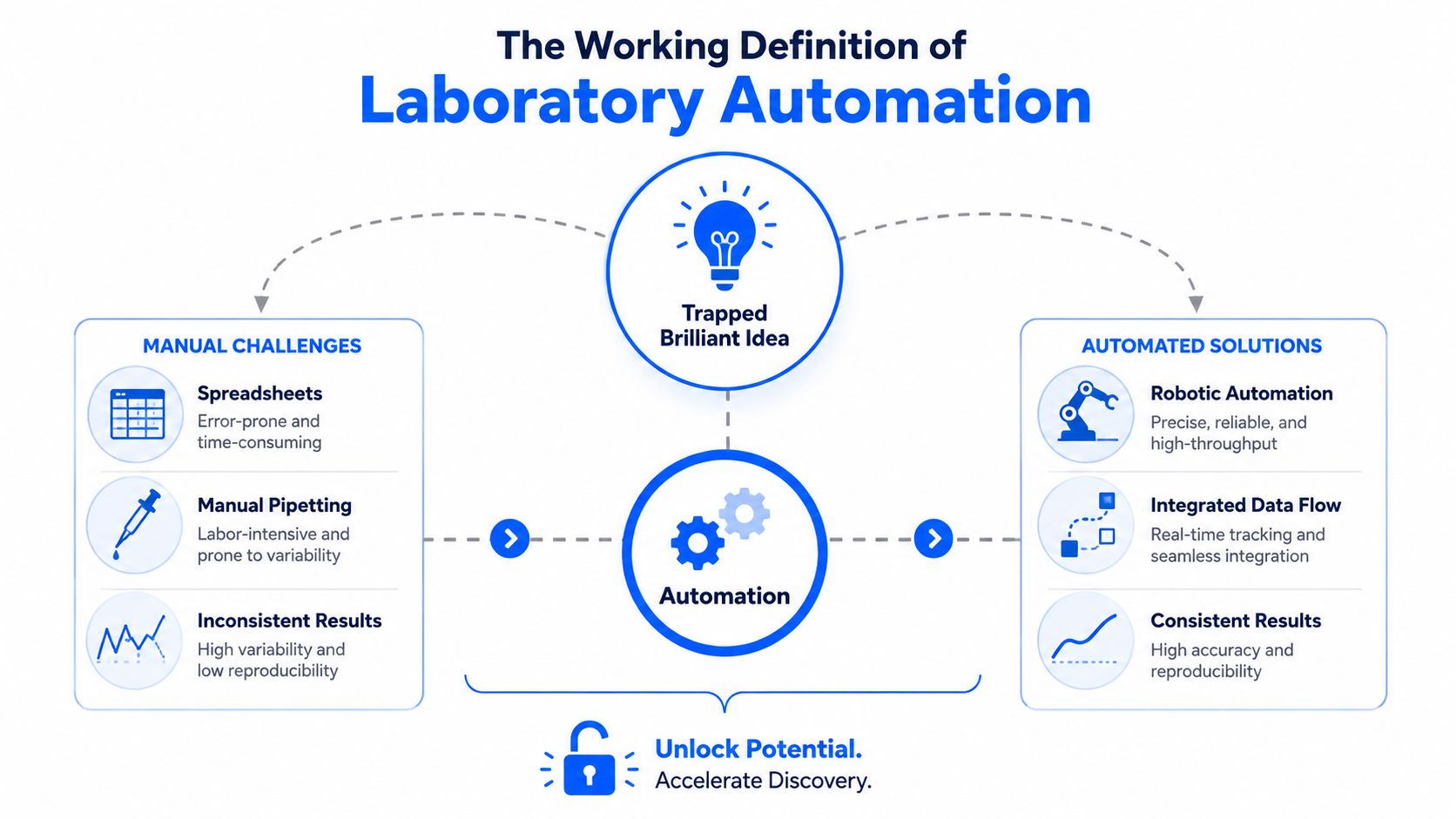
A formulation scientist can lose half a day to a workflow that looks simple on paper. A sample list lives in one spreadsheet, prep notes live in another, the pipetting is manual, and the characterization results come back with naming mismatches that someone has to untangle later. By the end of the week, the lab has data, but not always confidence in the data.
Laboratory automation is the system that reduces that friction. In clinical and high-throughput settings, it means an end-to-end setup that connects robotics, liquid handling, software, and information systems so the pre-analytical, analytical, and post-analytical parts of the workflow run with minimal human touch. In total laboratory automation, all three stages are integrated as one system, while subtotal automation leaves one or more stages outside the loop source definition.
For materials R&D, the same idea maps cleanly onto formulation, processing, characterization, and data review. A robotic arm by itself is not automation in the full sense. A liquid handler that can prep samples, a scheduler that knows what should run next, an ELN that preserves context, and a data backbone that keeps everything linked, that's the system.
Practical rule: if the instrument can move liquid but the experiment still lives in disconnected files, you've bought hardware, not a workflow.
That distinction matters more in 2026 because automation has moved from niche equipment to a broad platform category. Independent market estimates place the sector at about USD 6.58 billion to USD 8.27 billion in 2025/2026, with projections ranging from roughly USD 8.62 billion by 2031 to USD 18.39 billion by 2033 market overview. The market direction matters less than what it signals, which is that automation is now a foundation for labs that need to move faster without sacrificing traceability.
If you want a concise adjacent read on the broader idea of process automation, the benefits of process automation overview is a useful complement, especially for teams trying to connect lab workflow redesign with operational discipline.
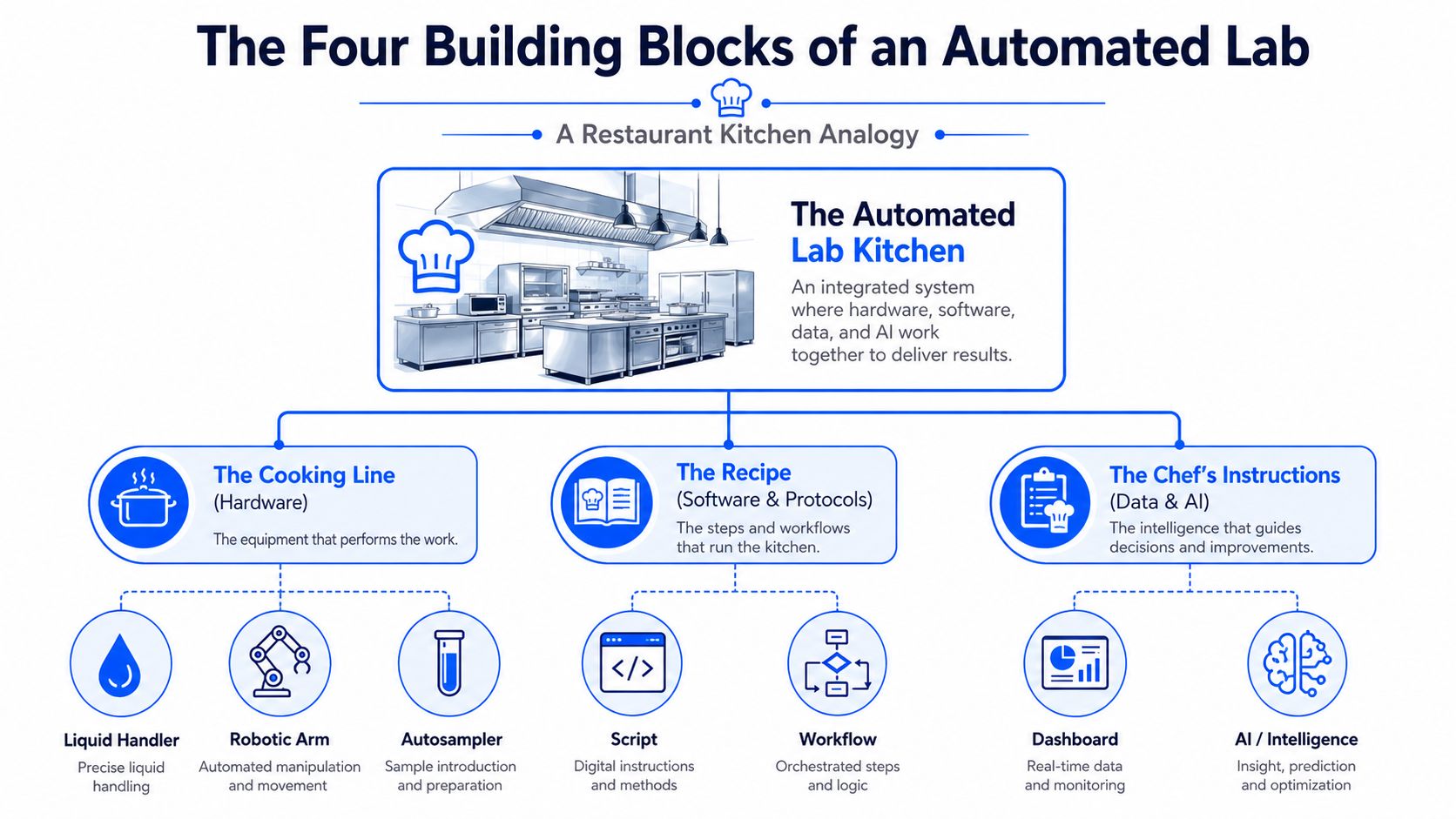
The Four Building Blocks of Every Automated Lab
A lab can have good robots and still run badly. The failure usually shows up in the gaps, a sample label that never reaches the instrument, a method that lives only in one scientist's head, or results that cannot be traced back to the original formulation. Automated labs work only when the physical tools, the software logic, the recordkeeping layer, and the decision layer all fit together.
Hardware handles the physical work
Hardware is the part people can see on the bench. In a lab, that means liquid handlers, autosamplers, robotic arms, plate readers, reactors, extruders, and characterization tools. These devices draw attention because they move, sound like something is happening, and are easy to point to in a demo.
Their value is practical. They reduce repetitive manual motion and make execution more repeatable. A liquid-handling workstation such as the Biomek 3000 supports interchangeable pipette tools across 1 to 20 µL, 5 to 200 µL, and 50 to 1000 µL, with specified precision of ≤5% CV at the low end, as shown in the technical benchmark cited above. That kind of consistency matters whenever a small volume error can alter a polymer screen, a catalyst prep, or a formulation trial.
Software runs the recipe
Software is the part that tells the hardware what to do next. It schedules work, translates protocols into machine steps, and keeps instruments from improvising. Without it, the hardware is just a set of expensive tools that still depends on people to decide every handoff.
This layer includes workflow orchestration, instrument control, and protocol management. It decides whether a sample queue is processed in the right order, whether a run pauses for a missing reagent, and whether the lab can repeat the same method next week without rewriting the script. For many teams, the gain starts here, because software creates the operating logic the hardware follows.
Data systems preserve the memory
The record layer is where labs either gain trust or lose it. LIMS tracks samples, ELN captures the experimental context, and the integration between them keeps the record honest. If the sample ID in the ELN does not match the sample ID in the instrument output, the lab has traceability problems even if the robot never missed a step.
That matters for reproducibility and scale-up. A formulation that looks promising in a small screen is far more useful if the team can reconstruct exactly how it was made, what materials went in, and which instrument settings produced the result. Clean data plumbing also makes later AI work possible, because models need records that stay tied to the experiment instead of drifting into disconnected files.
The strongest automation programs do not just move samples faster. They make the experiment easier to find, audit, and reuse later.
Decision support turns records into guidance
The fourth layer sits above the workflow and turns history into guidance. Dashboards, analytics, and AI models look across runs and help teams choose the next experiment more intelligently. Many groups spend more on visible robotics than on this layer, even though the highest long-term value often comes from the invisible parts that connect systems and keep data usable.
In materials R&D, that usually means the system of intelligence is only as good as the data feeding it. If the data backbone is clean, the lab can compare formulations, spot drift in process conditions, and build a more reliable path toward scale-up. If it is fragmented, the automation still moves, but the knowledge never accumulates.
How Robotics, LIMS, ELN, and Orchestration Fit Together
A materials R&D workflow usually starts before any physical instrument moves. A scientist records the formulation in the ELN, the LIMS assigns the sample and barcode, and the orchestrator converts the method into steps each device can execute. Then the liquid handler prepares the batch, the reactor or extruder processes it, and the characterization tools send the outputs back into the same record.
That chain only works if each system owns its part of the job clearly. When one handoff is vague, people begin filling gaps by hand, and the workflow stops behaving like a system.
A workflow is only automated where the handoff is clean
If the ELN captures the formulation but the LIMS never receives the metadata, people end up retyping fields. If the instrument writes files but nothing parses them into a common structure, the data team inherits a pile of manual cleanup. If the robot runs correctly but the downstream report cannot reconcile the run with the original design intent, the workflow still has a human bottleneck.
The point is to remove avoidable manual steps and leave humans with judgment calls, exceptions, and method development. Orchestration software does that work because it sits between intent and execution, checking that each system gets the right instruction at the right moment.
Precision matters even before scale
Microvolume handling is one of the easiest places to see why orchestration is more than a convenience feature. The Biomek 3000 benchmark cited above shows how automation can maintain specified precision across small ranges. In polymer blends, surfactant screening, additive packages, or catalyst prep, those small deviations can change the shape of a result enough to blur the difference between a real signal and noise.
A chemist can usually spot a bad transfer after the fact. A workflow manager has to prevent it before the sample ever leaves the rack.
Where the integration tax shows up
The hidden cost is rarely the robot itself. It is APIs, file formats, barcode conventions, validation work, and vendor lock-in. One vendor's smooth demo can turn into a month of middleware work once the lab asks a simple question, “Can this system talk to our existing data stack without manual export?”
That is also where the System of Intelligence layer starts to matter. If robotics, LIMS, ELN, and orchestration are the body of the automated lab, the intelligence layer is the record-keeper and interpreter above it. It does not move samples, but it makes sure every movement can be traced, compared, and reused later, which is what supports reproducibility, scale-up, and later AI use.
| Workflow Stage | Automation Component | What It Owns |
|---|---|---|
| Experiment design | ELN | Formulation context, method notes, rationale |
| Sample tracking | LIMS | Sample IDs, barcodes, chain of custody |
| Execution | Liquid handler, robot, reactor, autosampler | Physical prep and processing |
| Coordination | Orchestration software | Sequencing, exceptions, instrument commands |
| Reporting | Analytics, dashboards, AI layer | Interpretation, trends, next-step suggestions |
Measurable Benefits for Materials R&D Teams
Materials leaders usually ask a simple question first, “What changes if we automate this?” The clearest answer is that automation improves the economics of repeatable work, but only when the full workflow is designed as one system. The strongest evidence comes from operating performance, not from market hype.
Faster work, less variation, fewer touchpoints
One economic evaluation of total laboratory automation reported that turnaround time improved, the long tail of slow cases shrank, and overall turnaround-time variability dropped after adoption operating benchmark. The same study also reported a large improvement in weighted tube-touch moments, a proxy for staff safety.
Another review found that discrete manual processing steps were reduced sharply and the testing footprint was smaller, while automating blood-culture diagnostics cut overall turnaround time further operating benchmark. Those are clinical numbers, but the logic carries over to materials labs. Less manual handling means fewer transcription mistakes, fewer sample swaps, and less time spent cleaning up preventable variance.
A formulation lab feels this quickly. If a technician is moving powders, solvents, and vials between benches, every extra touch is another chance to introduce drift that never shows up in the method log.
Why reproducibility matters most
In formulation and scale-up work, reproducibility is not a comfort metric. It is the difference between a result you can scale and a result you cannot defend. If a screening campaign produces noisy outputs, the downstream team wastes reactor time trying to chase ghosts.
That is where the deeper value of automation shows up. The visible robot matters, but the hidden data plumbing matters just as much, because reproducibility depends on knowing exactly what happened to each sample, in what order, under which conditions, and with which method version. Without that record, the team may get faster runs, but it will not get trustworthy comparisons.
Rule of thumb: if the experiment is cheap but the interpretation is expensive, automation pays for itself in cleaner decisions, not just faster runs.
The labor shift is real
Automation does not erase people from the process. It shifts their work. Manual pipetting falls, but staff still need to manage exceptions, instrument uptime, data quality, validation, and method changes. Decision-aid papers frame adoption as a workflow redesign problem instead of a robot purchase for that reason.
For materials teams, that means the business case should include integration effort, training, and change management. If you only budget for the device, the rollout looks cheaper than it is. If you budget for the whole system, the case becomes more honest and much easier to defend. The same is true for AI-readiness, because clean, structured, traceable data is what lets later models compare runs without guessing what the lab meant.
Where AI and Systems of Intelligence Plug In
Automation executes. Systems of Intelligence decide what should happen next.
That distinction matters because the most valuable lab stack in 2026 is often layered. Hardware generates measurements, software runs the protocol, and the intelligence layer makes the data usable for the next experiment. In a materials program, that means the system is no longer just moving liquids or tracking samples. It's learning from prior runs and helping the team decide which formulation to test next.
Execution is not the same as interpretation
A robot can follow a script perfectly and still leave the team with unhelpful data if the outputs are fragmented. Intelligence layers sit above the instruments, ingest data from spreadsheets, ELNs, and instrument files, and present it in a form that can drive decisions. That's where a platform like Polymerize fits as one option in the market, with Polymerize Connect for unifying fragmented experimental data into a centralized backbone and Polymerize Labs for applying domain models that predict properties and optimize formulations.
The practical value here is not magic. It's that the lab stops treating data capture as an afterthought. When data is structured well enough to reuse, AI becomes useful because the inputs are comparable from run to run.
Why this changes the lab economics
A lab that can search its own experimental history, compare batches consistently, and predict likely outcomes before wet work doesn't just move faster. It makes fewer blind bets. That matters in polymers, chemicals, and advanced materials, where one wrong branch can send a project back to the bench for another cycle of trial and error.
The newer definition of automation is broader for exactly that reason. It now includes robotics, computer vision, AI, and integrated software that can run more of the experimental loop end to end automation framing. The visible robot is still useful, but the invisible data plumbing is what makes the system AI-ready.
If the data can't be reused, the lab is still doing manual science with faster equipment.
Implementation Guidance and Common Pitfalls
The easiest way to derail an automation effort is to start with hardware instead of friction. A mid-sized lab usually gets further by choosing one workflow that hurts every week, mapping the data path first, and only then deciding which devices and software belong in the stack.
A practical sequence that doesn't waste a quarter
- Pilot one workflow. Pick the prep step, assay, or characterization loop with the most manual pain and the clearest repeat pattern.
- Build the data backbone first. Make sure sample IDs, metadata, and output formats can move cleanly between ELN, LIMS, and instruments.
- Validate against existing results. Compare the automated workflow with historical runs so the team can see whether the new process is stable enough to trust.
- Scale to adjacent workflows. Once the first loop works, extend to neighboring methods instead of jumping to a lab-wide rollout.
Each phase needs a finish line. If the pilot never defines one, the team confuses motion for progress.
The common traps are predictable
Buying robots before data is ready creates a shiny bottleneck. Underestimating validation turns a promising pilot into a slow audit exercise. Ignoring change management leaves scientists working around the system instead of with it. Treating integration as a one-time project is another classic mistake, because lab stacks evolve and the connections need ongoing care.
A useful mindset shift is to treat the automated lab like infrastructure, not a one-off purchase. The instrument may be capital equipment, but the asset is the repeatable workflow around it.
A 90-day starting checklist
- Map one high-friction workflow end to end. Include every manual handoff, re-entry point, and exception path.
- Name the owner for each system. Someone owns the ELN, someone owns the LIMS, and someone owns the orchestration logic.
- Define the data fields that must survive every handoff. If they can't be traced, they'll be lost later.
- Choose a single pilot success metric. Make it operational, not abstract, so leadership can judge it plainly.
Enterprise ROI, Compliance, and Real-World Examples
Leadership usually wants two answers before green-lighting automation, what does it return, and what does it take to keep running safely? The honest answer is that ROI shows up in layers. Some gains arrive quickly, some only after the team changes how it works, and some compound over time as the lab learns from its own history.
ROI arrives in stages
In the near term, automation cuts obvious waste. Teams spend less time on repetitive prep, fewer experiments fail for preventable reasons, and turnaround gets easier to predict. Over the longer term, the value shifts toward cumulative learning, reusable data, and faster scale-up from lab to production.
Polymerize reports customer outcomes that include up to 50% fewer failed experiments within three months and faster lab-to-production scale-up. Those outcomes are specific to the platform and should be read as a product result, not a universal guarantee. Still, they illustrate the kind of business outcome that becomes possible when data, prediction, and workflow execution are connected.
Compliance is part of ROI, not separate from it
Automation projects also succeed or fail on trust. Enterprise teams need role-based access, audit trails, and security controls that fit regulated work. Polymerize states that it provides ISO 27001 and SOC 2 controls, plus GDPR and CCPA alignment for IP protection and access control. Those controls matter because a fast workflow that can't satisfy security review won't survive procurement, no matter how good the science looks.
The hidden cost on the enterprise side is validation. If the system can't prove what happened, when it happened, and who approved it, the lab inherits a traceability problem. That's especially true when multiple departments, external partners, or contract labs touch the same project.
The best business case is operational, not aspirational
If you're building the case internally, use the language of fewer failed runs, shorter handoff cycles, cleaner data, and faster scale-up. Those are the outcomes finance and operations teams can understand. The more abstract pitch, innovation, AI, transformation, usually lands better after the workflow has already proven itself.
If you're evaluating what laboratory automation should look like in your materials or chemistry lab, Polymerize is worth a serious look as a System of Intelligence layer for structured data, prediction, and experiment planning. Visit Polymerize to see how connected data and explainable models can support reproducibility, scale-up, and AI-ready workflows.
Put your R&D data to work
See how materials teams use Polymerize to plan fewer experiments and reach target properties faster.