

A formulation team gets almost everything right. Performance targets are met. Processing looks stable. Early customer feedback is promising. Then a late-stage safety review raises a toxicity concern, and the program slows to a crawl while scientists scramble to answer questions they should've tackled months earlier.
That pattern is common in materials R&D because teams often treat toxicity assessment as a gate at the end instead of a design variable at the start. When safety knowledge arrives late, every earlier decision becomes harder to defend. Raw material choices, additive packages, process conditions, and intended use scenarios all need to be revisited under pressure.
The better approach is to build toxicity assessment into the development workflow from the first screen onward. That doesn't mean every project needs a full regulatory dossier on day one. It means using structured risk thinking, modern test methods, predictive models, and organized data so scientists can make practical decisions earlier, with less rework and fewer blind spots.
Table of Contents
- Why toxicity is only one part of the decision
- The four-step framework in plain language
- Where the framework becomes useful for R&D
- Why animal studies mattered and still matter
- What modern methods add
- How to compare methods in an R&D setting
- Why fragmented data breaks good science
- What a centralized system changes
- The link to actionable exposure limits
Introduction The High Cost of Late Stage Surprises
Late-stage toxicity surprises are expensive, but the damage isn't only financial. They distort scientific priorities. Teams stop asking, “Is this the best material?” and start asking, “How fast can we explain this signal to management, customers, and regulators?”
In materials development, that usually happens when safety work is disconnected from formulation work. One group optimizes performance. Another group checks compliance later. A third group tries to reconstruct exposure scenarios after the design has already hardened. By then, the central question is no longer scientific discovery. It's damage control.
A seasoned toxicologist looks at the same situation differently. The first question isn't whether a material is “safe” or “unsafe.” The first question is what kind of harm is plausible, under what conditions, at what exposure, for which users, and with how much confidence. That mindset changes the entire workflow.
The hidden cost is decision latency
When safety information comes in fragments, teams lose time in ways dashboards rarely show:
- Formulators re-run work because an ingredient that looked acceptable for performance now needs substitution.
- Process teams revisit manufacturing assumptions because particle form, release potential, or residual content may alter exposure.
- Regulatory staff rebuild the story from scattered reports, spreadsheets, and supplier documents.
- Program leaders delay portfolio choices because they can't compare candidate materials on a shared risk basis.
Practical rule: The earlier a team frames toxicity assessment as a decision tool, the less often it has to use it as a rescue tool.
That's why modern toxicity assessment matters to R&D leaders, not just regulatory specialists. It gives scientists a structured way to move from hazard clues to actionable decisions: which candidates to drop, which to redesign, which to test next, and which use cases to constrain before the project accumulates avoidable risk.
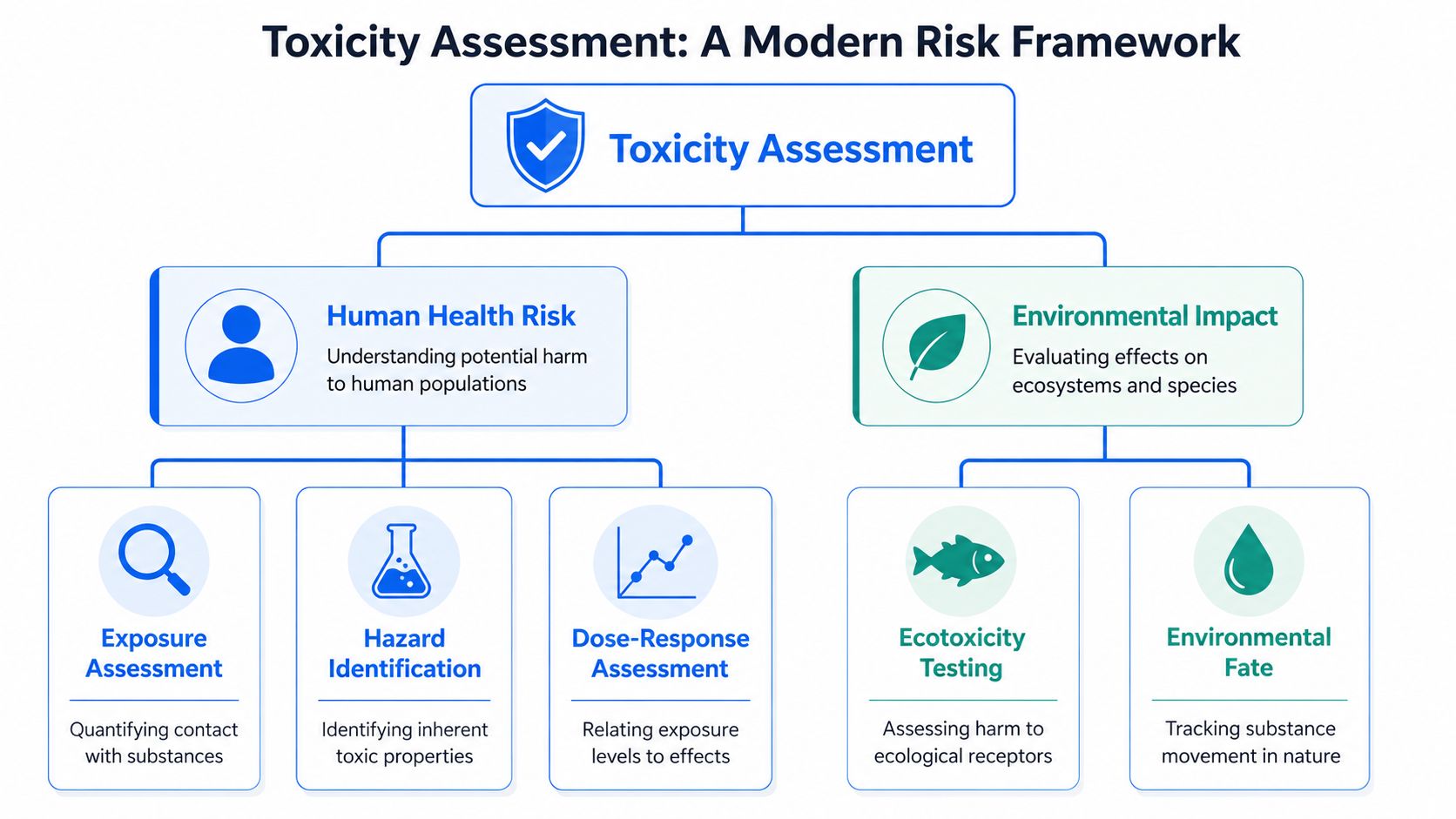
What Is Toxicity Assessment A Modern Risk Framework
A team approves a promising material for scale-up because the early hazard readout looks quiet. Six months later, the problem is no longer the assay result itself. The problem is that nobody asked the full question: quiet for whom, at what dose, in which form, during which stage of the product lifecycle?
That is the core of toxicity assessment. It links biological effects to exposure, use conditions, and decision context. The field moved toward that discipline as premarket safety evaluation became a formal expectation in the United States, a shift described in the National Academies discussion of risk assessment foundations.
Why toxicity is only one part of the decision
For materials R&D, hazard and risk serve different jobs.
Hazard asks whether a substance is capable of causing harm. Risk asks how likely that harm is under real conditions of use. A sharp blade is hazardous by nature. Whether it creates risk depends on whether it is exposed, shielded, handled often, or built into a closed system. Materials assessment works the same way. A concerning biological signal matters, but it does not answer an R&D question until dose and exposure are part of the picture.
That distinction sounds simple. In practice, it is where many development programs lose time.
A material can show a hazard in a screening assay and still be acceptable for one application because exposure is negligible. The same material may be a poor choice for another application because inhalation, dermal contact, migration, or environmental release changes the exposure picture. The assessment has to fit the use case, not just the substance name.
The four-step framework in plain language
The standard risk framework is still useful because it turns scattered safety information into a sequence of practical decisions.
Hazard identification
Scientists ask what kind of harm is biologically plausible. Could the material irritate skin or lungs, affect reproduction, damage DNA, disrupt endocrine signaling, or trigger organ toxicity? Early answers may come from published data, analog materials, in vitro tests, or computational predictions.Dose-response analysis
Next comes the relationship between amount and effect. At what level does concern begin to appear, and how steeply does it rise? For R&D, this step helps separate a theoretical hazard from a threshold that may or may not matter for the intended application.Exposure assessment
This is often the most underestimated step. Exposure changes with particle size, physical form, volatility, residual monomer content, processing temperature, abrasion, disposal route, and user behavior. A material in a sealed component creates a different exposure profile than the same chemistry in a spray, powder, or wearable coating.Risk characterization
Finally, scientists combine the evidence into a judgment that supports action. The useful output is not a vague label. It is a decision such as: proceed with controls, limit the use case, collect one more dataset before scale-up, or redesign the material now.
Where the framework becomes useful for R&D
An R&D leader rarely needs a lecture on toxicology terms. The primary need is a way to choose between candidates under uncertainty.
That is why modern toxicity assessment should be treated as a decision framework, not a reporting exercise. If one candidate has stronger hazard signals but negligible exposure in the intended design, while another looks cleaner on paper but has higher release potential during processing, the better option is not obvious until both sides are evaluated together. Good assessment makes those tradeoffs visible early enough to act on them.
Regulatory practice reflects the same logic. The ReachLex regulatory provisions are a useful reference because they show how substance assessment is organized into hazard review, exposure evaluation, and chemical safety reporting.
Here is the practical takeaway. Hazard data starts the conversation. Risk assessment shapes the decision. And in modern materials development, the teams that move fastest are usually the ones that can connect those two steps quickly, compare options on a shared basis, and turn fragmented evidence into a clear next action.
The Methodologies Toolbox From Animals to Algorithms
A materials team has three candidate formulations on the bench, one week before a go or no-go meeting. One has a clean structural profile but little biological data. One has a few cell assay signals that may or may not matter in use. One looks acceptable in a standard screen but could behave very differently once metabolism and exposure enter the picture. That is the practical setting for method choice in toxicology. The question is not which test sounds most advanced. The question is which method reduces uncertainty enough to support the next R&D decision.
Why animal studies mattered and still matter
Animal studies became central to safety evaluation because they let scientists observe effects across organs, time, and interacting biological systems. If you need to understand absorption, distribution, metabolism, excretion, or effects that emerge only after multiple tissues respond together, whole-organism studies can still answer questions that simpler systems cannot.
That matters for materials development. A polymer additive, impurity, or degradation product can appear quiet in an isolated assay yet behave differently once it is processed by the body, moves into a target tissue, or interacts with other stressors.
Still, animal studies are a poor front-end filter for modern R&D. They are slow, expensive, and hard to apply across dozens of formulation variants. By the time results arrive, the chemistry may already be locked in. For an R&D leader trying to compare candidates early, that timing problem is often the main limitation.
What modern methods add
The 3Rs framework, replacement, reduction, and refinement, pushed the field toward methods that are faster, more targeted, and easier to scale. That shift did not happen overnight. It built over decades, alongside the growth of toxicology databases and screening programs. A historical review reported rising 3Rs-related publication activity, identified 438 toxicology and pharmacology publications citing the 3Rs by 2011, and described how databases such as ToxRefDB and ToxCast helped move toxicology toward larger, more structured, and more model-ready datasets, as summarized in this historical review of the 3Rs and toxicology databases.
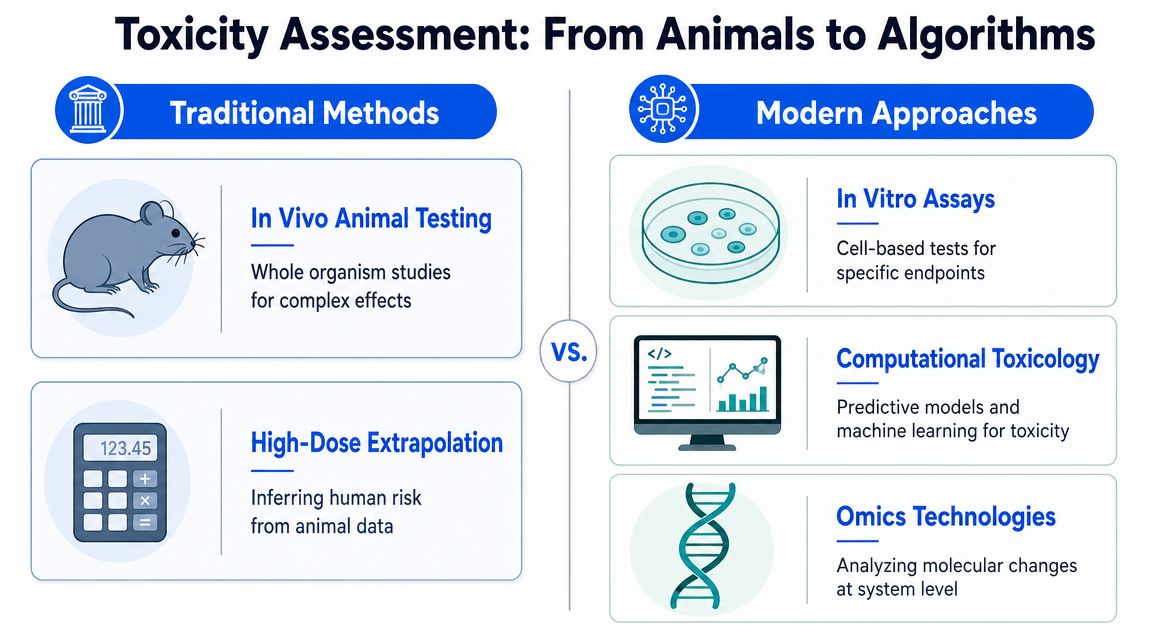
For materials teams, the modern toolbox usually falls into three working categories.
In vitro assays
These tests use cells, tissues, or biochemical systems to measure specific biological responses. They are useful for rapid screening, mechanism checks, and comparing many candidates under the same conditions. If a new coating ingredient triggers oxidative stress, membrane damage, or receptor activity, in vitro work can surface that signal early.In silico models
These models use structure, analog data, physicochemical properties, or learned patterns from prior datasets to predict toxicity-relevant behavior. They are often the earliest filter available, sometimes before synthesis is complete. That makes them valuable for ranking options, flagging likely liabilities, and deciding where experimental work will have the highest return.Integrated data systems
Toxicity assessment becomes much more useful when assay outputs, exposure assumptions, formulation context, and prior evidence sit in one place. Otherwise, teams end up comparing disconnected facts. A centralized system makes it easier to ask the core question for R&D: which candidate has the best safety profile for the intended use, given what we know now?
How to compare methods in an R&D setting
A simple comparison helps.
| Method type | Best use in R&D | Main strength | Main limitation |
|---|---|---|---|
| Animal studies | Later-stage confirmation and system-level questions | Captures complex organism responses | Slow and harder to scale across many candidates |
| In vitro methods | Early hazard screening and mechanistic testing | Fast and targeted | Doesn't automatically tell you real-world safe exposure |
| In silico methods | Early prioritization and gap filling | Can screen before synthesis or before full test programs | Output quality depends on data quality and model fit |
Confusion usually starts when teams treat these methods as substitutes. In practice, they work more like tools in a staged manufacturing line. Computational models help sort what deserves attention first. In vitro assays test whether the predicted concern shows up in a biological system. Resource-heavy studies are most useful when they answer a remaining question that would change a business or design decision.
That sequence is how you move from hazard data to action faster. You are not collecting tests for their own sake. You are building enough evidence to choose between candidates, redesign earlier, or justify the next investment with fewer late-stage surprises.
Good toxicology strategy asks for the next data point that changes a decision.
That also means method selection needs analytical discipline. If your team is comparing assay outputs, model predictions, and candidate rankings, a disciplined statistical analysis process helps keep the comparison tied to clear assumptions, fit-for-purpose endpoints, and interpretations that will hold up when project decisions get harder.
Connecting the Dots with Adverse Outcome Pathways
A major reason modern toxicity assessment is becoming more useful to R&D is that it's less of a black box than it used to be. Scientists don't just ask whether a test turns positive. They ask how a molecular interaction could plausibly lead to a harmful outcome.
That's the value of an Adverse Outcome Pathway, or AOP. It acts like a biological map linking an early interaction to a later health effect.
A visual makes the concept easier to grasp.
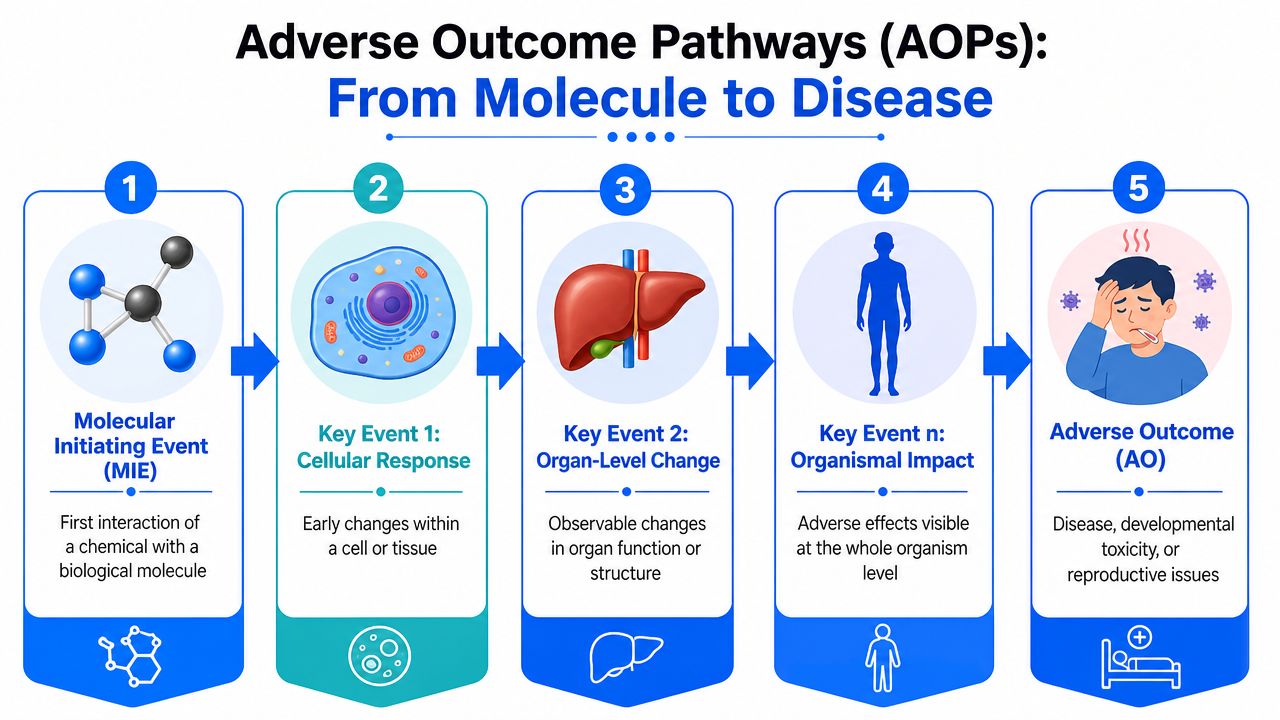
A domino model for biological causation
Think of an AOP as a row of dominos.
The first domino is the molecular initiating event. A chemical binds to a receptor, disrupts a protein, or interferes with a cellular process. That doesn't yet tell you the whole story. It only tells you where the chain may begin.
The next dominos are key events. A cell changes its signaling. A tissue responds. An organ's function shifts. If enough linked events occur in the right sequence and at sufficient intensity, the last domino falls. That final step is the adverse outcome, such as developmental toxicity, reproductive harm, or another organism-level effect.
This short explainer helps many teams visualize that sequence:
Why AOPs matter in day-to-day decisions
For a formulation scientist, the practical value is straightforward. If a rapid assay tells you a candidate triggers an early key event associated with a concerning pathway, that result is more useful when you can place it inside a credible causal chain.
That helps in several ways:
- Screening becomes mechanistic rather than purely descriptive.
- Follow-up testing becomes more targeted because scientists can test the next most informative key event.
- Substitution decisions improve because teams can compare not just hazard flags, but likely biological pathways.
- Model building gets stronger because machine learning systems perform better when features reflect biology, not just broad correlations.
AOP thinking also helps teams avoid overreacting to weak signals. Not every molecular interaction becomes an adverse outcome. Some effects are transient, adaptive, or irrelevant at realistic exposure levels. The pathway view encourages scientists to ask whether the signal is connected, persistent, and plausible under actual use conditions.
When teams understand the pathway, they stop treating every positive assay as equally meaningful.
That mindset is especially useful in materials R&D, where subtle changes in chemistry, impurities, particle characteristics, or processing aids can alter biological interactions in ways that aren't obvious from a single endpoint test.
Integrating Predictive AI into the Toxicity Workflow
Once a team starts generating assay results, exposure estimates, formulation metadata, and mechanistic clues, another problem appears. The bottleneck isn't only testing. It's interpretation. Scientists need a way to sort options quickly without pretending every early prediction is final truth.
That's where predictive AI becomes useful. In a good toxicity workflow, AI doesn't replace judgment. It acts like a virtual screening layer that helps scientists decide where to spend scarce experimental effort.
AI as a virtual screening layer
A modern tiered model already points in this direction. Toxicity assessment is increasingly built around a framework in which high-throughput in vitro assays, in vitro-to-in vivo extrapolation (IVIVE) pharmacokinetic modeling, and exposure modeling are combined in a first tier to calculate a margin of exposure, helping sort chemicals before moving into slower in vivo work and later refining point-of-departure estimates with short-term animal studies and better exposure data, as described in this tiered toxicity-testing framework.
AI fits naturally into that first tier.
A predictive model can help an R&D team ask questions like these before a full test campaign:
- Which candidate structures resemble substances with known concern?
- Which formulation options are least likely to trigger a given pathway?
- Which materials should go straight to bench testing, and which should be deprioritized?
- Where are the biggest data gaps that matter for the decision at hand?
For example, if a team is evaluating several monomer or additive choices, an AI model can rank them by expected concern based on structure, prior assay data, and analog patterns. That doesn't eliminate testing. It narrows the field so wet-lab work focuses on the most decision-relevant candidates.
Why explainability matters
R&D leaders shouldn't trust a toxicity model just because it produces a neat score. In regulated settings, scientists need to know why a prediction was made, what the model saw as similar, and where confidence is weaker.
That's why explainable AI matters more here than in many other industrial applications. A black-box ranking may be acceptable for a loose internal brainstorming step. It's much less useful when a team needs to defend candidate selection, justify extra testing, or explain a redesign decision to regulators, customers, or internal safety committees.
Strong toxicity AI usually gives at least some combination of:
- Feature relevance, showing which structural or assay inputs drove the output
- Analog context, showing similar substances or prior observations
- Confidence signals, highlighting where predictions are more or less reliable
- Mechanistic alignment, connecting model output to pathway logic where possible
A practical operating model for R&D teams
The most effective teams use AI in a staged way.
First, they screen broadly and cheaply. Then they test selectively. Then they update the model and decision logic based on what they learn. This creates a feedback loop where each round of experimentation improves the next round of prioritization.
A practical workflow often looks like this:
Start with candidate inventory
Pull together structures, composition details, process conditions, intended uses, and likely exposure routes.Run an early predictive pass
Use computational models to flag likely issues, likely analogs, and obvious low-priority candidates.Pair predictions with exposure thinking
A hazard signal means something very different for a fully bound polymer article than for a volatile processing additive or a worker-facing intermediate.Use targeted assays to resolve uncertainty
Test the questions most likely to change the go, no-go, or redesign decision.Feed results back into the system
Every measured result should sharpen the next cycle rather than disappear into a report archive.
What AI changes most is speed of learning. It helps teams move from “test everything slowly” to “test what matters next.” For materials R&D, that's a major shift because safer design rarely comes from a single heroic study. It comes from many earlier, smarter filtering decisions.
From Data Silos to a Centralized Intelligence System
Many organizations already have enough toxicity-relevant information to make better decisions. They just can't access it coherently. One dataset sits in an ELN. Supplier hazard details live in a PDF. Exposure assumptions are buried in slides. Legacy assay results are saved in spreadsheets with inconsistent naming. The science isn't absent. It's fragmented.
That fragmentation hurts toxicity assessment more than many leaders realize because safety decisions depend on connections. A cell-based result has limited value if it isn't linked to concentration units, formulation context, physical form, use scenario, and prior analog information.
Why fragmented data breaks good science
Teams often think the core challenge is generating more hazard data. In practice, the harder problem is making existing data interoperable enough to support action.
A major unresolved issue in modern toxicity assessment is translating in vitro pathway data into real-world exposure limits. Foundational risk-assessment literature points to three linked needs: pathway-based in vitro assays, computational extrapolation models, and pharmacokinetic tools that convert active assay concentrations into human exposures. It also notes that exposure estimates may require refinement using inputs such as physical-chemical properties, release rates, formulation data, indoor-use profiling, and biomonitoring, yet these inputs are rarely integrated in a way that answers the practical question of how to turn a positive toxicity signal into an actionable limit, as discussed in this analysis of in vitro to risk extrapolation challenges.
That is a data architecture problem as much as a toxicology problem.
What a centralized system changes
A centralized intelligence layer does more than store files. It creates relationships between data types that normally live apart.
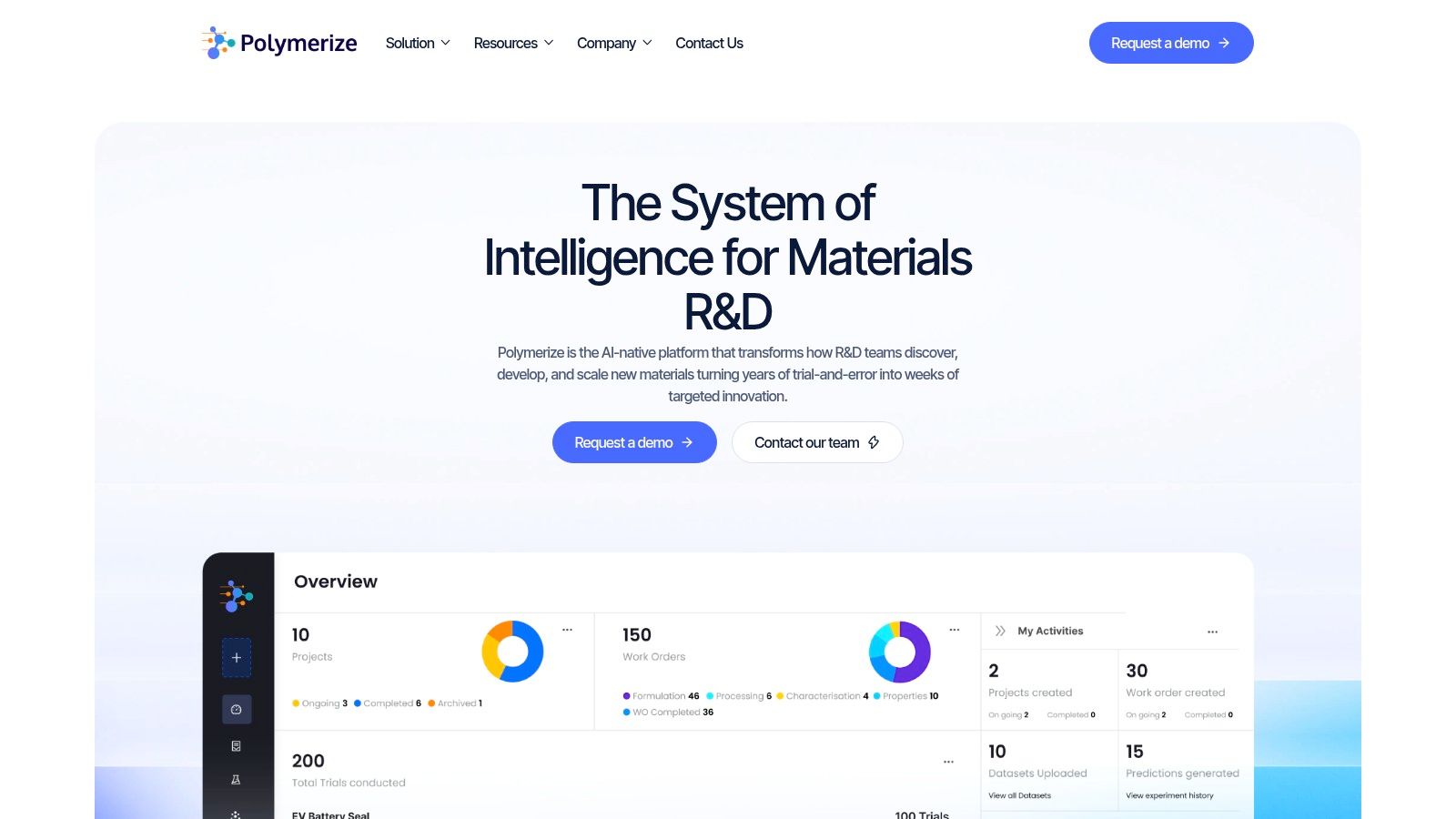
When that structure is in place, teams can do things that are nearly impossible in a fragmented environment:
Trace safety outcomes back to composition
Scientists can see whether a concern tracks with a monomer choice, impurity profile, additive family, or process condition.Compare candidates on a shared basis
Instead of debating isolated reports, teams can line up formulations, exposure assumptions, and test outcomes in one decision view.Train better predictive models
AI improves when inputs are standardized, contextualized, and historically grounded.Preserve institutional memory
The reasoning behind an old material rejection or redesign no longer disappears when staff change roles.
The link to actionable exposure limits
The strategic importance of centralized data becomes clear. The field doesn't just need more hazard flags. It needs a way to turn those signals into use conditions, guardrails, and safer design choices.
For a materials company, that might mean answering questions like:
| Business question | Data connection required |
|---|---|
| Can we keep this additive if the use case changes? | Hazard data linked to exposure scenario and release potential |
| Is this reformulation safer, or just different? | Side-by-side composition, assay, and performance history |
| What should we test next? | Uncertainty mapping across model output, assay gaps, and intended use |
| Can we define a practical internal limit? | Assay activity linked to pharmacokinetics and realistic exposure assumptions |
Centralized data turns toxicity assessment from a reporting task into a decision system.
That's the prize. Not a prettier dashboard. A faster path from scattered evidence to a defensible R&D action.
Conclusion Designing Safer Materials from Day One
The old model treated toxicity assessment as something you did after invention. The emerging model treats it as part of invention itself. That shift changes the pace and quality of materials R&D because teams don't wait until the end to discover whether a safety issue was designed in from the start.
Safer by design is an operating choice
When safety work starts early, scientists can use it to guide material selection, formulation boundaries, and test prioritization. A hazard signal becomes a prompt for redesign, exposure control, or narrower intended use. It doesn't have to become a late-stage crisis.
This approach also fits the broader move toward model-driven assessment. For chemicals with sparse conventional toxicology data, the U.S. EPA's Database-Calibrated Assessment Process (DCAP) converts benchmark-based dose-response outputs into calibrated toxicity values by using authoritative chemicals in ToxValDB to identify the percentile of estimated human doses that best matches expert-selected points of departure, then applying a lower uncertainty limit to generate a chronic oral dose intended to be without appreciable lifetime non-cancer risk. It's a strong example of how computational models and authoritative databases are reshaping safety assessment, as described in this overview of the Database-Calibrated Assessment Process.
The lesson for R&D leaders is broader than any one method. Better safety decisions come from integrating evidence, not waiting for perfect evidence.
What the strongest teams do differently
The most capable organizations tend to make a few consistent choices:
- They define decision tiers early so not every candidate gets the same level of testing.
- They combine hazard and exposure thinking instead of treating them as separate tracks.
- They use predictive tools to prioritize, not to overclaim certainty.
- They organize data so each experiment improves future decisions, not just the current project.
That combination is what makes toxicity assessment a speed advantage rather than a drag on innovation. Safer materials don't come only from stricter review. They come from better upstream choices, clearer mechanistic reasoning, and data systems that make knowledge reusable.
For a sharp R&D leader, the core question isn't whether toxicity assessment belongs in innovation. It already does. Instead, the question is whether your current workflow lets scientists act on safety insight early enough to matter.
If your team is trying to connect formulation data, toxicity signals, and predictive models into one usable workflow, Polymerize is built for that challenge. It gives materials R&D organizations an AI-native system for unifying experimental data, structuring it for analysis, and applying explainable models so scientists can make faster, safer development decisions from the start.
Put your R&D data to work
See how materials teams use Polymerize to plan fewer experiments and reach target properties faster.