

Your materials team probably already has good scientists, capable lab infrastructure, and no shortage of ideas. What it often lacks is continuity. Formulation history sits in spreadsheets. Test data lives in instrument exports. Scale-up notes are buried in slide decks. A promising polymer system moves from bench to pilot, and suddenly the team is reconstructing context that should have been available from day one.
That's the point where R&D management software stops being a software category and starts becoming an operating model.
For enterprise materials science teams, the problem isn't only project tracking. It's connecting formulation logic, experimental history, decision records, maturity assessments, and scale-up learning in one system that people can use. Done well, that changes how teams choose experiments, govern portfolios, and reduce avoidable failure.
Table of Contents
- Formulation management that captures intent
- Experimentation workflows that support decisions
- A data backbone that survives scale-up
- Integration matters more than feature volume
- AI-readiness has to be practical
- Security and scale are procurement issues and operating issues
- Adhesives and formulation-heavy development
- Specialty chemicals and lab-to-plant transfer
- Advanced materials and historical knowledge reuse
The Challenge of Modern Materials R&D
A formulation chemist updates a solids ratio after a failed trial. The rheology data sits in an instrument export. Pilot notes live in a separate spreadsheet. By the time the project reaches a gate review, the team is debating which version of the experiment record is correct instead of deciding what to do next.
That pattern is common in enterprise materials science. It slows programs in ways general R&D commentary often misses. In formulation and process-heavy work, small context changes can alter performance, reproducibility, and scale-up risk. Resin grade, addition order, shear history, cure temperature, humidity, and operator observations all matter. If those details are scattered across tools and file shares, teams lose more than efficiency. They lose the chain of evidence that explains why an experiment worked, failed, or failed only after transfer to pilot.
Spreadsheets, isolated ELNs, and email handoffs can document activity. They rarely preserve decision-grade context across the full path from bench experiment to plant trial. That gap is where failed experiments multiply, historical knowledge disappears, and teams rerun work they already paid for.
Practical rule: If scientists need to ask three people where the latest experimental context lives, the problem is not only data capture. It is operating discipline.
The pressure to fix this is growing. Analysts and software vendors tracking the R&D management software market point to sustained demand for better coordination, traceability, and portfolio visibility across research organizations. For materials leaders, the issue is not category growth. It is execution pressure. Teams are expected to reduce failed iterations, document development choices well enough for audit and transfer, and surface risk earlier, before a promising formulation becomes an expensive scale-up surprise.
Why materials programs stall
Some bottlenecks come from the science itself. Many come from how the work is recorded, reviewed, and handed off.
- Fragmented experiment records make side-by-side comparison difficult across formulation variants, test methods, and projects.
- Missing decision history causes teams to revisit approaches that were already screened out under slightly different conditions.
- Weak links between lab work and program reviews leave leadership without a clear view of technical readiness, resource use, and commercial risk.
- Breaks between lab and scale-up records force pilot and manufacturing teams to reconstruct process knowledge from incomplete notes.
For enterprise materials teams, these are not minor workflow annoyances. They directly affect cycle time, reproducibility, and the quality of scale-up decisions. A CTO evaluating R&D management software should judge it against those realities. The fundamental question is whether the organization can keep doing formulation science, experimentation, and transfer on disconnected systems without paying for the same mistakes twice.
What Is R&D Management Software Really
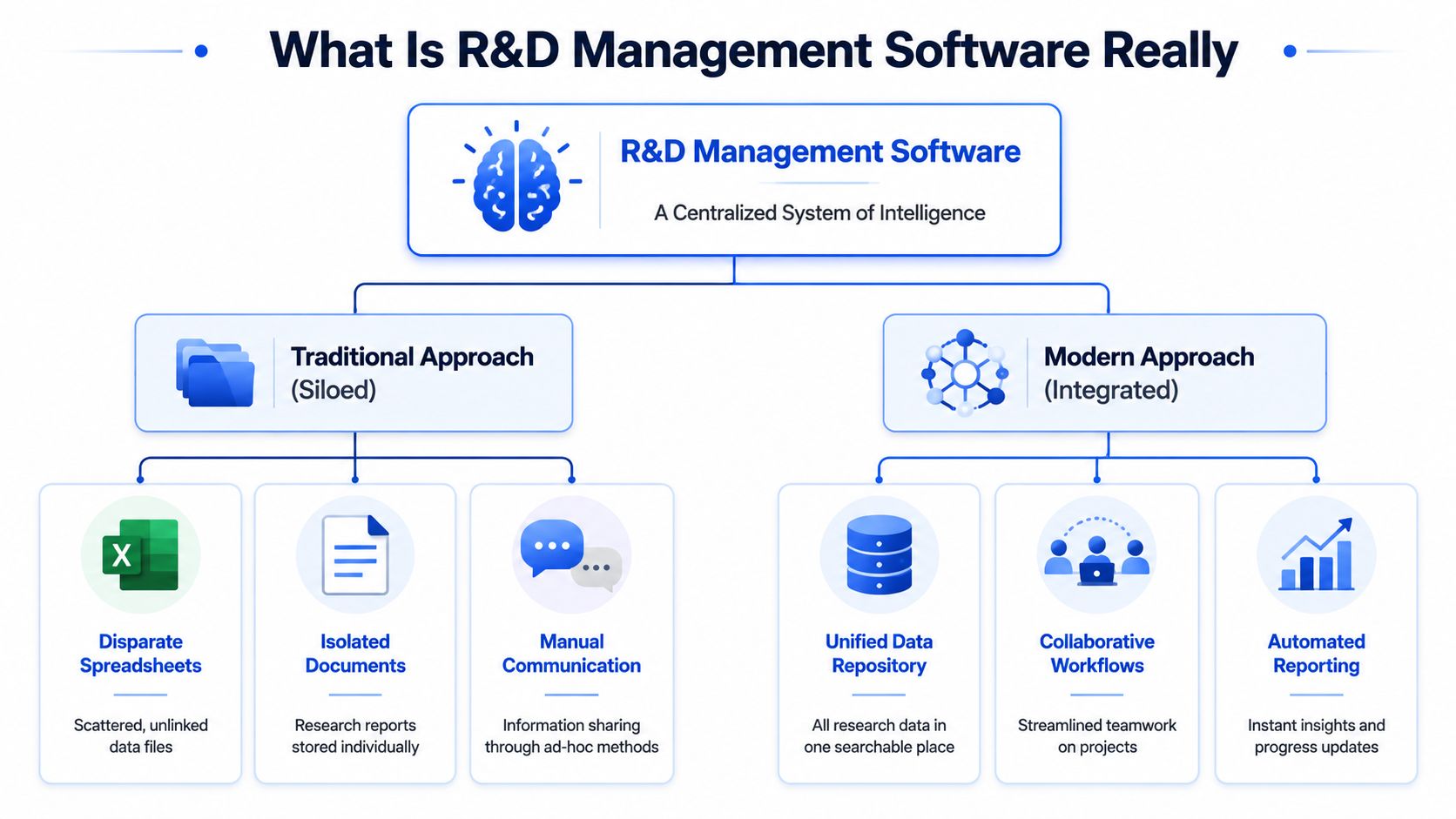
A CTO usually sees the problem in one meeting. The formulation team presents promising lab data. Process development raises concerns about reproducibility. Quality asks where the latest method version lives. Program management cannot tie any of it back to the portfolio review without manual cleanup. That is the operating gap R&D management software is meant to close for enterprise materials teams.
Why siloed tools break in materials work
Enterprise teams rarely start from zero. They already have ELNs, LIMS, spreadsheets, shared drives, and project systems. Each one serves a purpose. The failure happens between them.
An ELN can record observations from a bench run. A spreadsheet can track composition ranges and test results. Jira Align can organize development work. A portfolio system can summarize investment priorities. None of those tools, on their own, preserve the chain from formulation change to test outcome to gate decision to scale-up risk.
Materials R&D depends on that chain. A resin ratio change, a mixing order adjustment, or a different curing profile can alter performance in ways that only make sense when the experiment record, formulation history, and program context stay connected. If those records sit in separate systems, teams spend time reconciling files instead of deciding what to test next. They also lose the decision history needed to avoid repeating failed paths under a new project name.
What the modern system does
A strong platform gives materials organizations a shared operating model for science, development, and governance. It connects technical records with business decisions so the same dataset can support bench work, portfolio review, tech transfer, and audit preparation.
In practice, the software needs to handle four jobs at once:
| Capability | What it connects | Why it matters in materials R&D |
|---|---|---|
| Data unification | Experiments, formulations, external references, project records | Preserves scientific context across iterations and teams |
| Workflow control | Stage gates, approvals, milestones, maturity checks | Forces explicit decisions before risk carries into scale-up |
| Cross-functional access | Lab, process, product, quality, leadership | Reduces information loss during handoffs |
| Decision support | Search, comparison, dashboards, model-ready data | Improves experiment selection and program prioritization |
The trade-off is straightforward. Standard project software is easier to deploy, but it rarely fits formulation science without heavy workarounds. A lab-first tool may capture experimental detail well, but still leave project leaders and manufacturing teams outside the system. Materials organizations need both depth and connection.
A practical test works better than a vendor demo script. If a scientist changes a formulation ratio, can the platform preserve the prior version, tie the change to measured results, expose the update to the project lead, and reflect the implication in program reporting without manual re-entry? If the answer is no, the company still has a tool stack, not an R&D management system.
Software becomes strategic when it improves experiment choice, not just recordkeeping.
For materials teams, that is also the foundation for AI readiness. Models are useful only when formulation data, test conditions, outcomes, and decision history are structured well enough to compare like with like. Without that base, AI produces noise faster. With it, teams can reduce duplicate experiments, identify dead ends earlier, and carry stronger evidence into scale-up.
Core Features for Materials Innovation
A materials platform earns its place when it helps a team answer a hard question under time pressure. Which formulation is still worth funding, what changed between two test rounds, and what evidence is strong enough to carry into pilot. If the software cannot answer those questions with context, scientists still end up rebuilding the story by hand.
Formulation management that captures intent
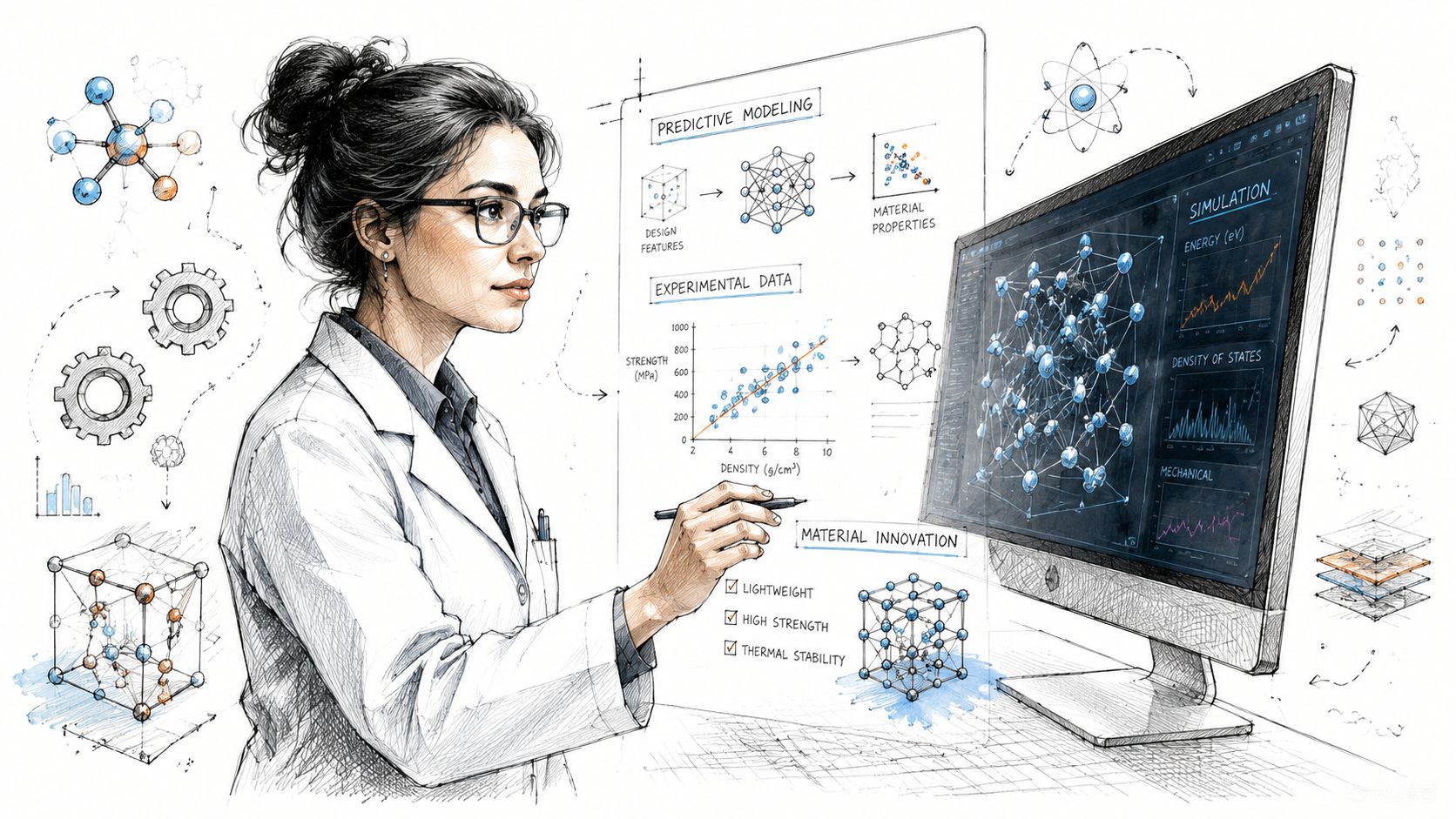
Formulation work creates branching histories fast. A team may adjust resin ratios, replace a dispersant, change mixing order, and tighten a cure window, all within a few weeks. Each change affects cost, manufacturability, and performance in different ways. Generic project tools can record that work happened. They rarely preserve the scientific reasoning behind it.
That gap matters in enterprise materials R&D because the same formulation often gets revisited months later by a different scientist, product team, or scale-up engineer. The system should store composition history, variant relationships, target properties, decision rationale, and links to the test data that justified the change. Without that chain, teams cannot tell whether a result came from a deliberate hypothesis or from uncontrolled variation.
One materials-focused option, Polymerize, fits the category well. Its platform is described as a centralized data foundation for materials R&D that unifies fragmented experimental records and supports explainable model-driven workflows. That is the kind of architecture large materials organizations should evaluate, whether they choose that platform or another.
Experimentation workflows that support decisions
The best systems do more than replace paper notebooks with digital forms. They structure experiments so scientists can compare runs, spot deviations, and decide what to test next without stitching together spreadsheets, slide decks, and email threads.
An effective stack should support change history and phase-gate control as native parts of the workflow. Best-practice guidance for R&D project management highlights the value of recording requirement changes, budget and resource shifts, deadline changes, and the reasons behind them, while embedding gate criteria and maturity assessment directly in workflows through change documentation and phase-gate control in R&D management. For materials teams, that matters most when a promising lab result reaches pilot and hidden assumptions start surfacing.
Prioritize these three capabilities:
- Versioned experimental records that show how a protocol, composition, or test method changed over time.
- Embedded gate criteria that force explicit review of technical risk, evidence quality, and readiness for transfer.
- Comparable maturity views that let portfolio leaders assess unlike programs with a consistent frame, even when one project is a coating and another is a battery material.
Field advice: If gate reviews happen in PowerPoint and experimental history lives in another system, weak programs keep advancing because no one sees the full evidence in one place.
A data backbone that survives scale-up
Scale-up exposes every break in the system. Lab teams usually know the unwritten details behind a successful experiment. Pilot and process teams do not. They need batch lineage, process tolerances, raw material context, deviations, and the rationale for previous decisions, all tied to the development record.
Software should carry that continuity from bench to plant. At minimum, it should support:
- Traceable lineage from formulation concept to experiment series to transfer package.
- Searchable context so engineers can retrieve conditions, rationale, and exceptions, not just final results.
- Auditability that supports internal review, knowledge reuse, and regulated documentation requirements.
In materials science, the data backbone is the operating layer for scale-up. When it is weak, teams repeat failed experiments, misread pilot results, and lose time rebuilding knowledge that already exists somewhere in the organization.
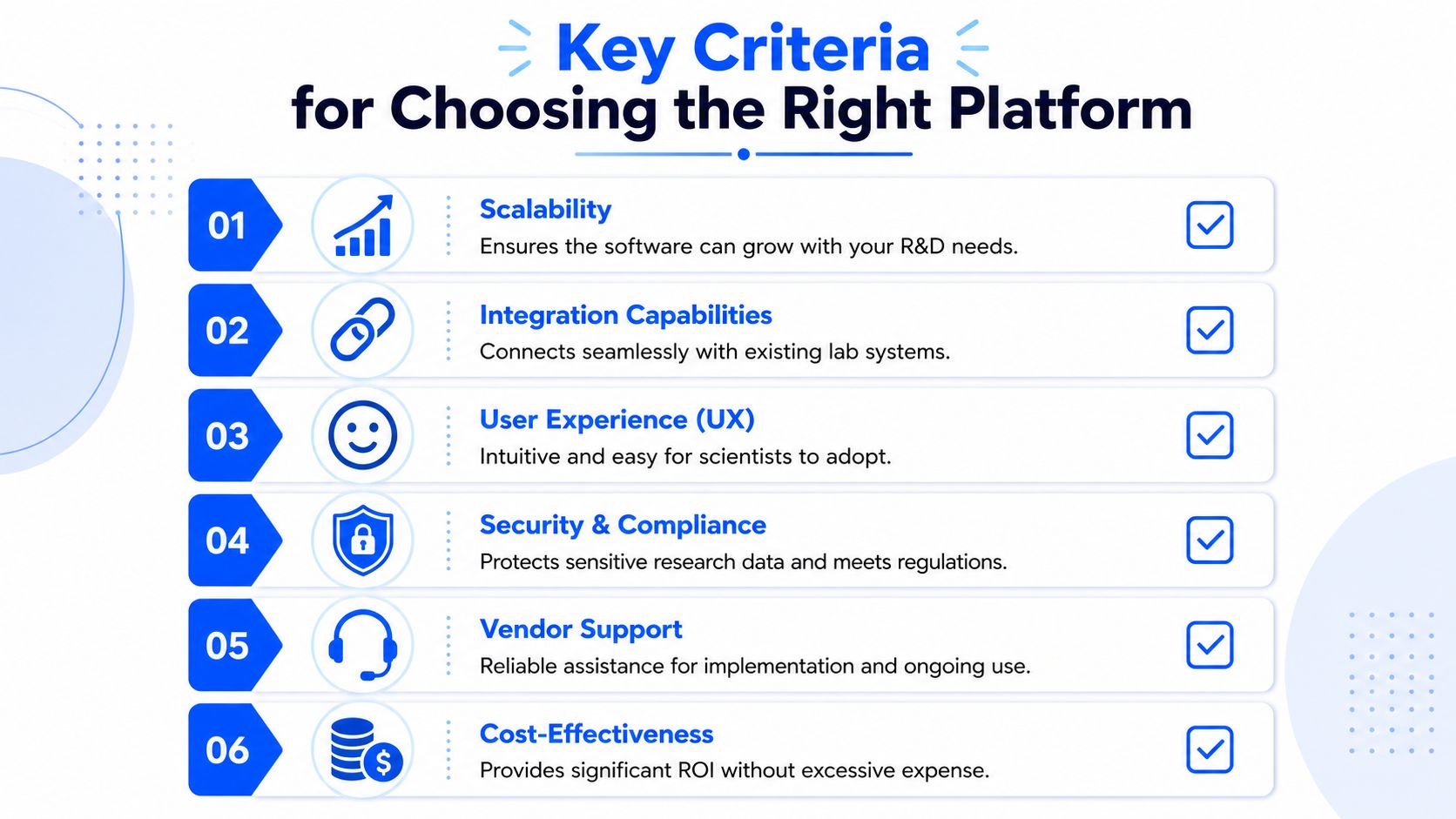
Key Criteria for Choosing the Right Platform
Most R&D software selections fail before implementation begins. The team buys on demos, broad promises, or a familiar interface, then discovers the platform can't handle the actual complexity of materials work.
Integration matters more than feature volume
The first question shouldn't be, “How many modules does this platform have?” It should be, “Can this platform sit in the middle of our existing environment without creating more manual work?”
Materials organizations rarely start from zero. They already have instruments, shared repositories, ERP links, quality systems, and often a patchwork of historical research records. A platform that can't interoperate cleanly turns into another destination where people must re-enter data.
Use this screening lens during procurement:
| Evaluation area | What to ask |
|---|---|
| Instrument and system connectivity | Can we ingest lab outputs and link them to project objects without manual cleanup? |
| Workflow flexibility | Can the system reflect our formulation, testing, and stage review process without heavy custom code? |
| Search and retrieval | Can scientists find prior work by composition, condition, property, and project context? |
A team will tolerate a less polished interface for a while. It won't tolerate duplicate entry forever.
AI-readiness has to be practical
Many vendors claim AI support. That phrase is almost meaningless unless the platform structures data in a way that models can use. In materials science, AI-readiness means the system captures variables, conditions, outcomes, and lineage in a consistent format. It also means model outputs must be interpretable enough for scientists to trust.
A CTO should press on three issues:
- Structured inputs so formulations and experiment conditions aren't trapped in free text.
- Explainability so the team can understand why a recommendation appears.
- Operational fit so model suggestions can be reviewed inside the normal R&D workflow.
If the AI layer sits outside daily work, adoption will collapse. Scientists won't trust a recommendation they can't trace back to chemistry, process history, or prior evidence.
Buying “AI-enabled” software without checking data structure is like buying a reactor without checking temperature control. The label sounds right. The operation fails later.
Security and scale are procurement issues and operating issues
Materials IP isn't generic enterprise data. It includes formulations, test methods, know-how, supplier interactions, and commercialization decisions. That makes security, permissions, and auditability part of the operating model, not just the security review.
Look for practical enterprise controls:
- Role-based access that reflects lab, project, partner, and leadership permissions.
- Audit trails that show who changed what and when.
- Deployment scalability so a pilot doesn't become a dead-end architecture.
The final buyer mistake is choosing a platform that works for one enthusiastic team but breaks when adjacent groups join. If adhesives, coatings, and process development all need separate workarounds, the platform won't become a shared system. It will become another silo with better branding.
Targeted Use Cases and ROI for Materials Teams
The ROI case for R&D management software is strongest when it is tied to specific workflow failures, not abstract innovation goals. Materials leaders usually win internal support when they show how the platform removes rework, improves transfer, or preserves hard-won knowledge.
Adhesives and formulation-heavy development
An adhesives team might be balancing bond strength, cure behavior, viscosity, substrate compatibility, and sustainability constraints at the same time. In that environment, dozens of closely related formulations can accumulate quickly. Without structured versioning and searchable context, scientists end up repeating blends that are functionally similar to earlier work.
A connected system helps by linking each formulation variant to test conditions, observed properties, and decision history. The business value comes from faster narrowing of the candidate space and fewer blind iterations.
Specialty chemicals and lab-to-plant transfer
A specialty chemicals group often struggles less with ideation than with transfer. The lab reaches a promising result, but pilot teams receive an incomplete picture of process sensitivity, raw material differences, or prior deviations. Scale-up then becomes a partial rediscovery exercise.
That's where unified records, gate criteria, and cross-functional access matter. Teams can review what changed, what failed, and what assumptions were accepted at each handoff. For organizations building the internal case for wider digital maturity, broader IT enablement also matters. A useful outside perspective is IT Cloud Global for small business success, especially for leaders thinking about how support models influence adoption and operational continuity across technical teams.
Advanced materials and historical knowledge reuse
Advanced materials groups often hold years of dispersed data that no one can search properly. That creates a hidden cost. Valuable negative results remain invisible, earlier characterization work gets overlooked, and teams miss correlations that were already present in historical records.
Three use cases repeatedly justify investment:
- Recovering prior knowledge from legacy spreadsheets, reports, and isolated repositories.
- Comparing programs consistently when multiple material classes compete for funding.
- Supporting portfolio decisions with current technical context instead of static status slides.
The ROI is usually visible in cycle quality before it is visible in finance. Teams choose experiments with better justification. Managers spot weak projects earlier. Process groups receive cleaner transfer packages. That's what durable return looks like in materials R&D.
Your Implementation Roadmap and Success Metrics
Digital transformation fails when companies try to digitize everything at once. Materials teams do better with a phased deployment that starts where pain is high and scientific value is visible.
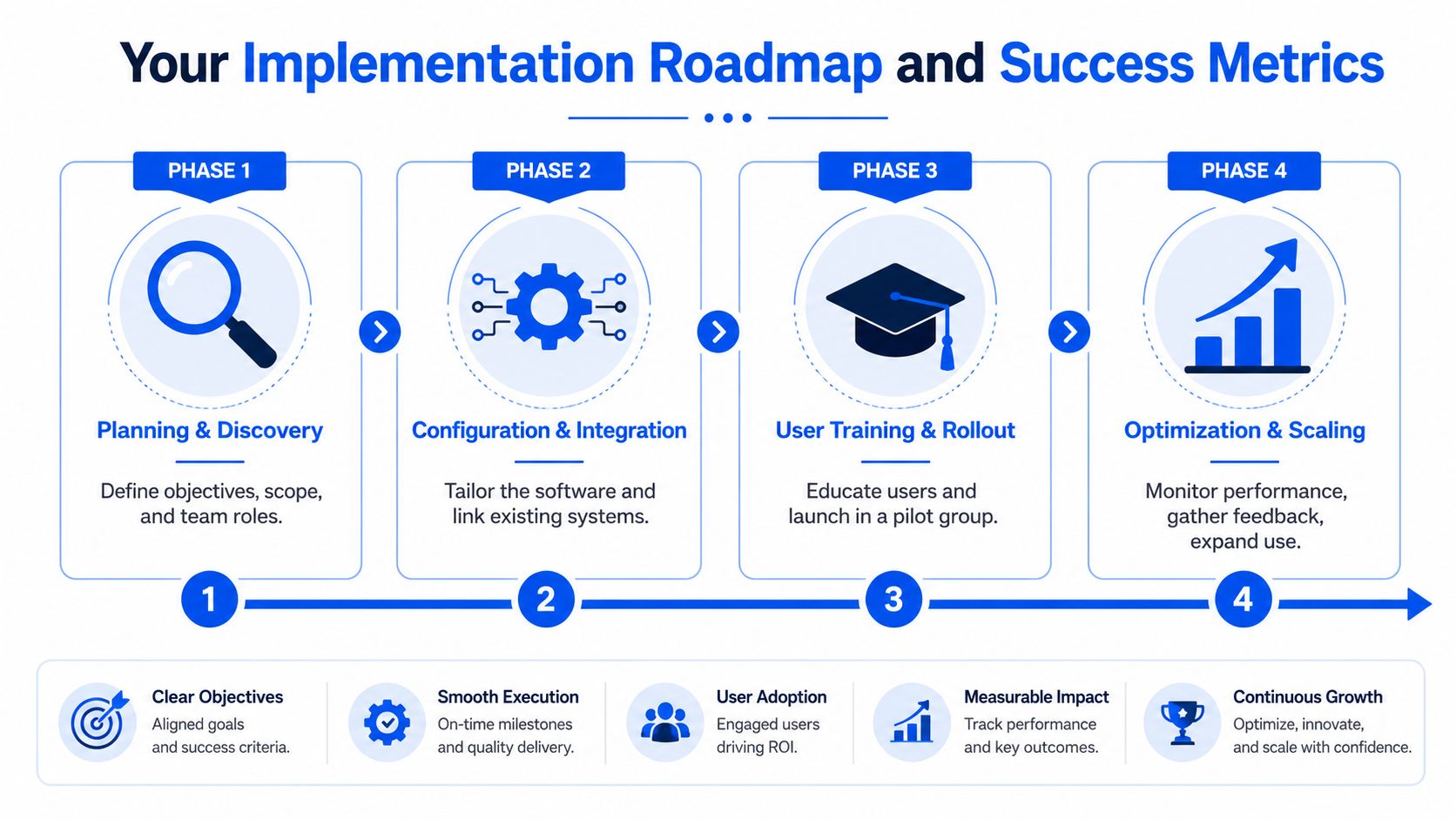
Phase one and phase two
Start with a pilot that has real complexity but manageable scope. A formulation program with frequent iteration and a motivated team usually works well. Avoid selecting the cleanest project in the portfolio. Choose one where fragmented data is already causing visible friction.
Then standardize the minimum viable structure. Define experiment objects, formulation fields, project states, gate criteria, and decision logs. Keep the first version tight. If you attempt to encode every edge case immediately, the rollout will stall.
A practical rollout sequence looks like this:
- Pilot one high-friction program where better traceability can change decisions quickly.
- Configure common data structures so adjacent teams can reuse rather than reinvent.
- Train around real workflows instead of generic feature tours.
- Expand to linked teams such as process, quality, or product management once the core lab flow is stable.
Teams adopt faster when the first win is “I found the prior experiment in seconds,” not “leadership now has a new dashboard.”
Phase three and the metrics that matter
At scale, the goal is to create a connected operating environment across lab, project, and portfolio layers. That means governance must mature alongside usage. Gate reviews should reference live records. Portfolio discussions should include current technical evidence. Historical data should be retrievable without side requests and local file hunts.
Measure outcomes that reflect R&D performance, not software vanity metrics. Useful success metrics include:
Time to next best experiment
Tracks how quickly a scientist can move from result review to a justified follow-up run.Reduction in failed batches or failed experimental paths
Assesses whether the system is helping teams avoid avoidable repetition and immature scale-up moves.Percentage of projects meeting stage-gate criteria
Shows whether governance is becoming more consistent and evidence-based.Reuse of historical records in active projects
Indicates whether the knowledge base is becoming operational rather than archival.
If those measures improve, adoption will follow. Scientists keep using systems that save them time and improve judgment.
The Future of R&D Is a Connected System
The future of materials innovation won't be defined by who owns the most data. It will be defined by who can connect data, decisions, and execution across the full development path.
Over the past 50+ years, R&D management has increased its productivity, and the shift from manual experimentation to software-guided work has helped scientists surface causal drivers with confidence, turning years of trial-and-error into weeks of targeted innovation, as reflected in the verified historical analysis provided above. For enterprise materials teams, that shift is already underway. The question is whether your systems support it.
Connected R&D management software changes the operating logic of the organization. It gives scientists cleaner context, gives managers earlier visibility, and gives leadership a more reliable basis for investment decisions. In materials science, where formulation nuance and scale-up risk can make or break a program, that isn't a nice-to-have. It is infrastructure for better judgment.
If your team is evaluating how to unify fragmented materials data, build an AI-ready foundation, and support formulation-to-scale workflows in one environment, Polymerize is one option to review. It is built for polymers, chemicals, and advanced materials teams that need a centralized data backbone and explainable, model-supported experimentation rather than another disconnected lab tool.
Put your R&D data to work
See how materials teams use Polymerize to plan fewer experiments and reach target properties faster.