

Your lab is probably producing more data than it can use.
A formulation chemist records composition ranges in a spreadsheet. Instrument outputs land on local PCs with file names that only make sense to the person who ran the test. A scientist keeps critical context in a paper notebook or in free-form notes inside an ELN. Another team member prepares a scale-up package and realizes nobody can easily answer a basic question: which exact sample version produced the result everyone is citing?
That's usually when people start searching for a LIMS system definition. They don't need a dictionary entry. They need a way to stop losing time to data silos, inconsistent records, and testing workflows that depend too much on tribal knowledge.
For a modern materials R&D organization, a LIMS isn't just sample software. It's the operational data layer that makes experimental work traceable, repeatable, and eventually usable for analytics and AI.
Table of Contents
- A governed system for the full sample lifecycle
- Why the generic definition falls short for materials science
- Sample management and chain of custody
- Workflow automation and method control
- Data management and instrument connectivity
- Reporting and analytics
- Architecture choices that affect day-to-day use
- Better speed where R&D actually loses time
- Higher-quality data for modeling and decision-making
- Less rework during transfer and scale-up
- A more credible compliance posture
- Why AI projects fail without a strong operational data layer
- What the integration path usually looks like
- From archive to active knowledge asset
- Start with the lab's real operating model
- Questions worth asking vendors early
- Treat implementation as change management
The Data Chaos in Modern Materials R&D
A materials lab can look digitally mature on the surface and still run on fragments.
One team tracks incoming resin lots in Excel. Another stores rheology data on a shared drive. Spectroscopy files stay attached to instrument software. Processing conditions sit in slide decks. The scientist who understands how those pieces connect can reconstruct the story. Everyone else sees disconnected records.
That problem gets worse as projects move from early screening into scale-up. In materials R&D, one “sample” is rarely just one thing. It may be a formulation, a batch, a set of processing conditions, a coupon, and a chain of downstream tests. If those links break, the lab loses more than convenience. It loses confidence in the result.
Where the confusion usually starts
Most labs don't fail because people are careless. They struggle because the operating model grew faster than the data model.
Common failure points look familiar:
- Spreadsheet drift: Different groups use different column names, units, and file templates.
- Instrument silos: Raw data lives where the instrument created it, not where the project team needs it.
- Version ambiguity: Teams can't quickly tell which formulation revision went through which test method.
- Missing context: A result exists, but the preparation history or operator notes sit somewhere else.
- Scale-up friction: Process teams ask for traceable evidence, and R&D has to assemble it manually.
Practical rule: If your team has to ask “which file is the real one?” more than once a week, you don't have a data problem alone. You have a workflow problem.
In that setting, a LIMS becomes less of an IT purchase and more of a lab operating decision. It creates a controlled system for sample records, test workflows, and associated data so the lab can work from a shared source of truth.
For materials organizations, that matters twice. First, it reduces operational drag today. Second, it creates the structured foundation you'll need if you want to use historical experiment data for modeling, formulation optimization, or AI-driven experiment planning later.
What Is a LIMS A Central Hub for Lab Operations
A formulation scientist submits a new polymer blend for testing. By the end of the week, that one request has turned into intake records, prep notes, instrument outputs, approvals, and several versions of a result summary. If those pieces are stored in different places, the lab can complete the work and still struggle to answer a basic question later. What exactly happened to this sample, and can we trust the record?
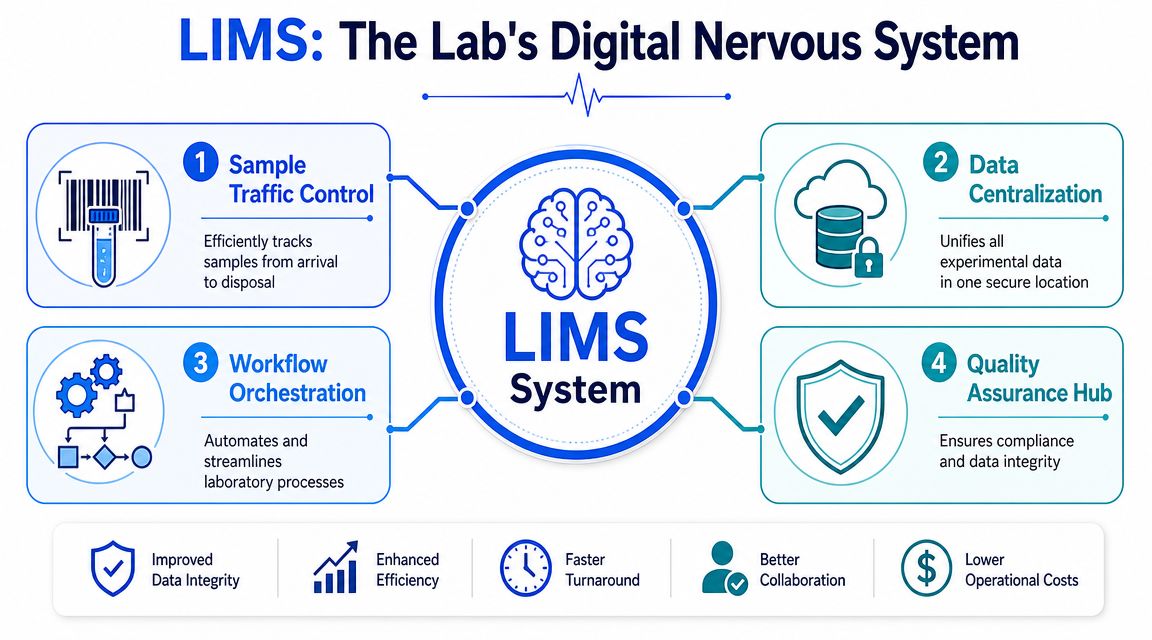
A laboratory information management system, or LIMS, is the software that keeps that record intact. It manages sample records, test workflows, status changes, results, and the connections between them in a controlled digital system. The term started with sample management, and over time it expanded into broader lab informatics, as described in the Laboratory Information Management System overview.
A LIMS is the lab's central control layer. It coordinates how information moves across people, instruments, methods, and approvals so the work can be traced from request to final result.
A governed system for the full sample lifecycle
A sample enters the lab and begins a chain of events. It must be registered, assigned the right tests, routed through the correct method, linked to the resulting data, reviewed, and preserved as part of the lab record.
A LIMS handles that chain with rules and structure. It records identity, tracks status, assigns work, captures context, and maintains traceability. Air traffic control is a useful comparison here. Many moving parts can operate at once, but each one needs clear routing, timing, and a reliable record.
In materials R&D, the word “sample” covers more than a vial with a barcode. It may refer to:
- A formulation batch: A new adhesive blend with a specific component ratio
- A processed specimen: A molded bar prepared under defined temperature and pressure conditions
- A stability set: Replicates exposed to heat, humidity, or chemicals over time
- A test article: A film, coating panel, or composite coupon assigned to multiple characterization methods
That distinction matters. Materials labs rarely deal with isolated test items. They deal with families of related records, such as a formulation that becomes a batch, then a specimen set, then multiple test results. A useful LIMS preserves those relationships instead of flattening everything into disconnected entries.
Why the generic definition falls short for materials science
A narrow definition of LIMS usually stops at sample login, barcode tracking, and compliance. Those functions matter, but they do not capture what a materials R&D group needs.
A materials team needs the system to preserve context. A tensile value without formulation details, processing conditions, specimen geometry, and method version is only a number. A degradation result without exposure conditions and timepoint structure is hard to compare across programs. In other words, the record has to carry the scientific story, not just the final measurement.
That is why LIMS matters beyond lab administration. It creates structured, queryable records that can support trend analysis, formulation comparison, and later use in AI systems. For organizations building an informatics stack around advanced analytics or platforms such as Polymerize, the LIMS often serves as the operational data layer that makes those downstream tools useful.
In practical terms, a LIMS should help an R&D leader answer questions like these:
- What exactly is this material or specimen?
- How was it prepared, processed, and tested?
- Which method and workflow version was used?
- Who reviewed the result and approved it?
- Which files, observations, and outcomes belong to the same record?
A strong LIMS preserves the chain linking sample identity, process history, test execution, and reported outcome.
For a modern materials lab, that is the definition that holds up in practice. A LIMS is the central operational system that manages sample-linked workflows and creates the structured, traceable data foundation required for reliable lab execution, analytics, and AI.
The Core Features and Architecture of a Modern LIMS
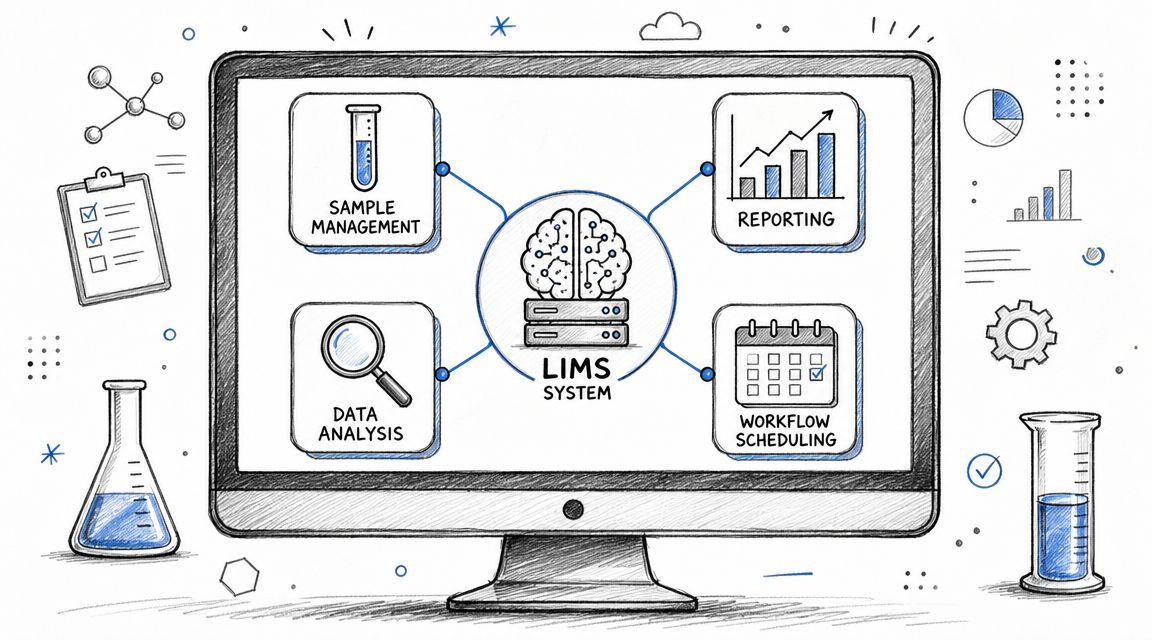
A modern LIMS is easiest to understand when you break it into functional pillars. According to Danaher's definition of LIMS, the core technical functions are sample management, workflow automation, data management, and reporting/analytics, and those functions help standardize data capture while supporting regulatory controls such as GLP and FDA 21 CFR Part 11.
Sample management and chain of custody
This is the foundation. The system assigns identity to samples and keeps that identity intact as samples move through storage, preparation, testing, and archiving.
In materials R&D, that often means linking parent and child records. A master formulation may generate multiple batches. Each batch may produce several specimen types. Each specimen may go through a distinct test queue. If those links live only in people's heads, the lab can't scale cleanly.
Workflow automation and method control
A LIMS also acts as a workflow engine. It helps labs enforce consistent routing, task sequences, approvals, and status changes.
That's important when a material must follow the same characterization path every time. If your polymer screening process requires sample registration, conditioning, rheology, thermal analysis, and mechanical testing in a set order, the LIMS can encode that logic so staff don't improvise around it.
Data management and instrument connectivity
Labs generate heterogeneous data. Some results are simple numeric values. Others come from instrument files, parsed outputs, attachments, or calculated summaries.
A useful LIMS provides structure around that mix. It ties analytical outputs back to sample records and makes the data retrievable in context. Many implementations succeed or fail at this stage. If the LIMS can't connect cleanly to the systems scientists use, people drift back to side spreadsheets.
Design advice: In a materials lab, don't evaluate “data capture” as one requirement. Separate raw files, parsed results, calculated values, metadata, and derived properties. They behave differently.
Reporting and analytics
Reporting sounds administrative until you need to compare data across campaigns, sites, or time periods.
At minimum, the LIMS should support standard result review and output generation. In stronger implementations, it also becomes the structured source for trend analysis, method performance review, and downstream analytics.
Architecture choices that affect day-to-day use
Deployment matters because it shapes how the system integrates and who maintains it. Cloud-based and on-premise models are typically evaluated.
A simple comparison helps:
| Architecture choice | What it usually means for the lab | Best fit |
|---|---|---|
| Cloud-based LIMS | Faster deployment, vendor-managed updates, easier remote access | Labs that want lower internal IT overhead |
| On-premise LIMS | Greater internal control over hosting and infrastructure | Organizations with strict internal hosting requirements |
| Hybrid model | Some systems or data flows remain local while the platform connects outward | Labs with legacy instruments and phased modernization plans |
The architecture shouldn't be chosen by IT alone. Scientists, QA, digital teams, and data owners all feel the consequences.
LIMS vs ELN vs SDMS Choosing the Right Tool for the Job
A lot of buying mistakes start with one assumption: “We just need one lab software platform to do everything.”
That's rarely how it works in practice. One of the biggest sources of confusion in R&D is the distinction between LIMS, ELN, and enterprise systems. Public-sector documentation also reflects how broad and sometimes complex these environments can become, including “umbrella” implementations made up of many subsystems, as noted in the USDA FSIS LIMS privacy impact assessment.
The simplest mental model
Use the tool based on the job it's hired to do.
A LIMS manages structured operational flow around samples and tests. An ELN captures scientific thinking, observations, and experimental narrative. An SDMS focuses on collecting and organizing scientific data files. An ERP manages business-wide operational processes such as purchasing, inventory, planning, and finance.
In materials R&D, these tools often complement one another.
LIMS vs ELN vs SDMS vs ERP
| System | Primary Focus | Data Type | Core Use Case in Materials R&D |
|---|---|---|---|
| LIMS | Sample-linked workflow control | Structured records tied to samples, tests, status, and approvals | Managing formulation batches, test assignment, result review, traceability, and controlled lab processes |
| ELN | Experimental documentation | Unstructured and semi-structured notes, observations, rationale, sketches | Capturing why a scientist changed a formulation, what they observed during mixing, and how they interpreted outcomes |
| SDMS | Scientific file management | Instrument files, raw outputs, associated metadata | Collecting and organizing spectroscopy, microscopy, thermal, or mechanical test files from many instruments |
| ERP | Enterprise operations | Business and operational master data | Managing purchasing, inventory, costing, supplier records, production planning, and enterprise workflows |
Where materials teams often misclassify the need
A team says it needs a LIMS, but what it really needs first is an ELN because scientists lack a place to record experimental reasoning.
Another team buys an ELN and expects it to manage controlled sample routing, approvals, and test status across multiple groups. That usually creates frustration because the notebook is being asked to behave like an operational workflow system.
SDMS sits in the middle of many environments and is often overlooked. If your biggest pain is instrument output spread across disconnected vendor software, SDMS may solve part of the file problem. But it still doesn't replace the sample-centric workflow role of a LIMS.
In plain terms, the LIMS handles the structured “what happened to this sample,” while the ELN captures the scientific “why we ran this experiment this way.”
For a materials R&D leader, the right question isn't “Which one wins?” It's “Which combination gives us traceable operations, usable scientific context, and retrievable data without forcing scientists into awkward workarounds?”
Key Benefits and ROI for Materials R&D Labs
The business case for LIMS in materials R&D is stronger when you stop framing it as generic efficiency software.
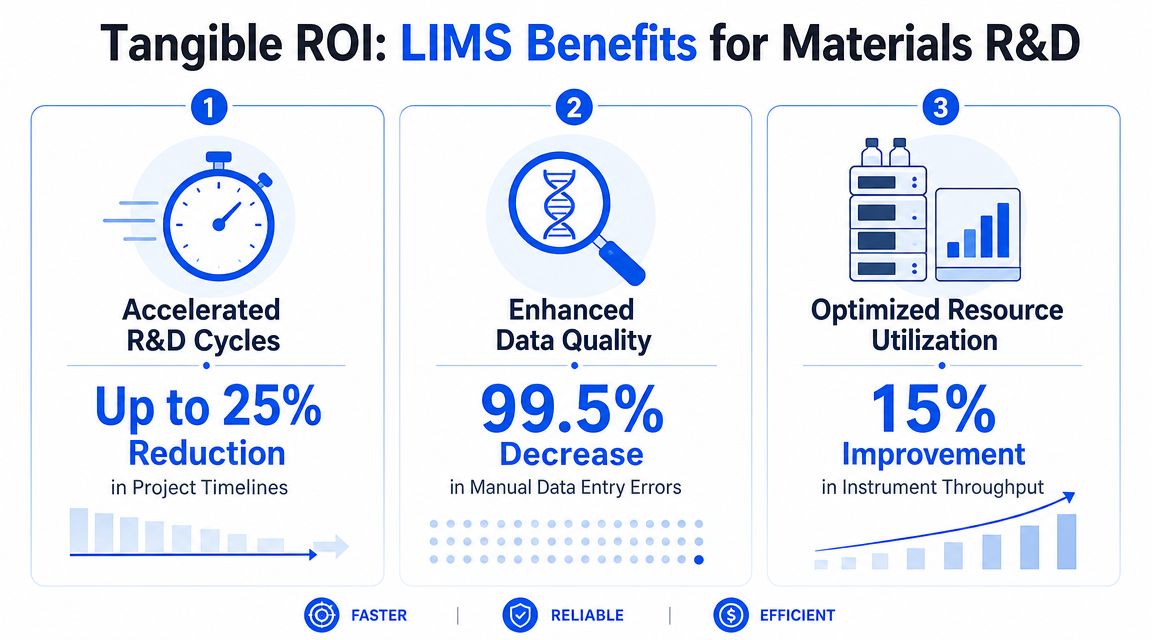
Its value comes from reducing the friction between experimental work and trustworthy data. A recent peer-reviewed review notes that the core value of a LIMS is its ability to reduce turnaround time and centralize data across fragmented instruments and sites, and that post-implementation labs have seen significant improvements in time-to-result and overall data quality, as discussed in this 2024 review on laboratory information management systems.
Better speed where R&D actually loses time
Most labs don't lose days because instruments are idle all the time. They lose days in handoffs.
A formulation waits because metadata is incomplete. A result gets delayed because the analyst can't confirm which specimen ID is correct. A project review stalls because nobody trusts that all teams used the same method version. A LIMS reduces those delays by creating a controlled operational path.
Higher-quality data for modeling and decision-making
Materials organizations increasingly want to use historical experimental data for trend analysis, formulation guidance, and machine learning. That only works if data is consistent enough to compare.
A LIMS improves that foundation by enforcing structure around sample identity, workflow state, and result capture. It doesn't make data magically useful on its own, but it gives your data team something far better than disconnected exports and lab folklore.
Less rework during transfer and scale-up
Scale-up is where undocumented variability becomes expensive.
If process development, quality, or manufacturing asks how a promising lab result was produced, they need more than the final number. They need a traceable package: formulation version, raw material identity, process conditions, test route, exceptions, approvals, and supporting records. A LIMS helps preserve that trail so transfer work starts with evidence instead of reconstruction.
A more credible compliance posture
Even in innovation settings, labs often operate under internal quality controls or regulated expectations. Traceability, auditability, and controlled records matter. They matter for customer qualification, method defensibility, and cross-site consistency.
A LIMS supports that posture by making the record more complete and less dependent on manual memory.
- For R&D leaders: It creates a cleaner operational view across programs.
- For scientists: It removes repetitive status chasing and manual reconciliation.
- For QA and scale-up teams: It makes the data package easier to trust.
- For analytics teams: It produces a more usable starting point for downstream data engineering.
Integrating LIMS with AI and Knowledge Platforms
A materials R&D team identifies a promising formulation, but six months later no one can fully reconstruct why it worked. The tensile data is in one system, processing notes are in an ELN, raw material details live in a spreadsheet, and instrument files sit in a folder only one scientist understands. AI will not fix that. It will inherit the confusion.
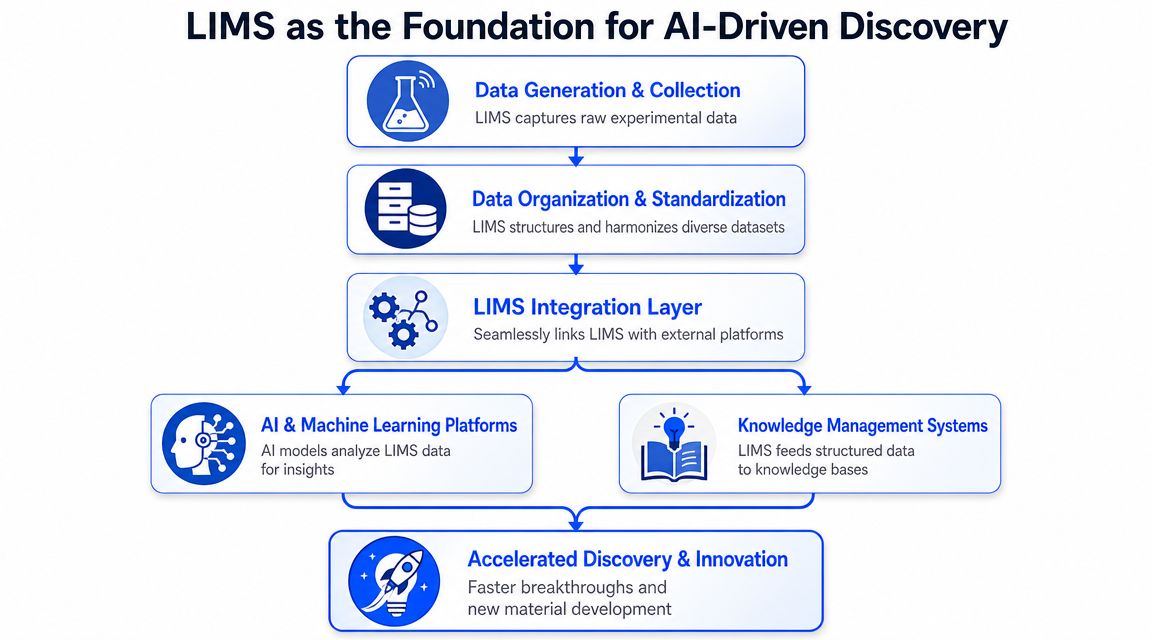
A modern LIMS matters here because it creates the operational record that advanced analytics can use. In a materials lab, that means linking each result to the right sample, batch, formulation, method, and workflow state so the data keeps its meaning after the experiment ends.
Why AI projects fail without a strong operational data layer
Materials AI depends on context as much as volume.
A property value alone has limited use. A model needs to know what was made, how it was processed, how the specimen was prepared, which method was used, and whether the result passed review. Without that chain of context, the dataset may look large but still be hard to trust.
That is why a LIMS plays a specific role in an AI-ready stack. It turns day-to-day lab activity into structured records with lineage. For data scientists, that reduces time spent tracing columns back to their origin. For R&D leaders, it increases confidence that a model is learning from real experimental history rather than a stitched-together export.
What the integration path usually looks like
The flow is usually practical rather than flashy. The lab runs experiments. The LIMS captures the sample-linked workflow and records the results in a controlled way. Integration layers or APIs pass that data into search, analytics, and knowledge systems. AI applications then use the organized record for prediction, similarity search, experiment planning, or technical question-answering.
For teams designing that broader stack, it helps to start with clear digital product requirements. That forces early decisions about data objects, handoffs, identifiers, and system boundaries before anyone starts connecting tools.
Platforms such as Polymerize can sit above that operational layer. In that setup, the LIMS handles traceability and execution records, while the AI or knowledge platform works with centralized experimental data to support property prediction, formulation optimization, and next-step recommendations.
A useful way to view the relationship is simple. The LIMS records what happened in the lab. The knowledge layer makes that history searchable and comparable. The AI layer uses the structured history to help teams decide what to test next.
Strong AI outputs usually start with disciplined upstream records. In materials informatics, sample governance often determines whether modeling work helps or stalls.
This overview gives a useful visual of how the stack connects in practice:
From archive to active knowledge asset
Many materials labs store historical data without making it reusable. The records exist, but comparing experiments across formulation families, process windows, or test methods still takes manual effort.
Connected to a knowledge platform, LIMS data becomes easier to search and combine. Scientists can find related experiments faster. Data teams can assemble cleaner training sets. Program leaders can review technical progress with more than summary slides because the underlying evidence is linked and queryable.
That is the definition that matters for modern materials R&D. A LIMS is not only a sample tracker. It is the foundational data layer that turns lab activity into reusable organizational knowledge and gives AI systems a credible starting point.
How to Select and Implement the Right LIMS
The best LIMS selection projects start with operational clarity, not vendor demos.
A LIMS is a workflow and data-integrity layer, and implementation guidance stresses that requirements should define data types, primary keys, character limits, audit trails, electronic signatures, and integration points before deployment, as outlined in CloudLIMS guidance on what a LIMS is. If those decisions are vague, teams end up doing manual work outside the system or revisiting the design after go-live.
Start with the lab's real operating model
Before evaluating products, document how work moves through the lab.
That means identifying:
- Sample lifecycles: What enters the lab, how it branches, and when records should close
- Critical data objects: Formulations, batches, specimens, tests, methods, results, approvals
- Integration points: Instruments, ELNs, file repositories, quality systems, analytics layers
- Control requirements: Audit trails, review rules, permissions, signatures, and retention needs
If your team needs a practical format for that exercise, a good starting point is this guide to clear digital product requirements. It's useful because LIMS projects often fail for the same reason software projects do. Teams buy before they define.
Questions worth asking vendors early
Don't ask only for feature lists. Ask how the system handles your hardest edge cases.
- Can it model materials-specific entities? Formulations, parent-child sample structures, and multi-step test routes matter.
- How configurable is the workflow layer? You don't want every method change to require custom code.
- How does it integrate? APIs, file ingestion, instrument connectivity, and export flexibility all affect adoption.
- What does the audit model look like? Traceability must be usable, not just technically present.
- Who owns configuration after launch? Internal admins need a realistic maintenance path.
Treat implementation as change management
The technical install is only one part of success. The harder work is getting scientists, analysts, QA staff, and data teams to use the same system consistently.
Start narrow if needed. Pick one workflow family, one sample class, or one testing area. Make it work. Then expand. A smaller, well-governed rollout usually creates more trust than a sprawling launch that leaves exceptions everywhere.
If you're building a materials R&D stack that goes beyond record-keeping, Polymerize is one option to evaluate alongside your LIMS strategy. It focuses on unifying fragmented experimental data into an AI-ready foundation and supporting materials teams with analytics and model-driven experiment planning.
Put your R&D data to work
See how materials teams use Polymerize to plan fewer experiments and reach target properties faster.