
You're probably dealing with some version of the same scene. A team has promising polymer concepts, a backlog of characterization requests, old data scattered across spreadsheets and ELNs, and one project that keeps circling because nobody fully trusts the last round of results. The chemistry may be sound, but the work still slows down because the information around the chemistry is disorganized.
That's where a lot of polymer r&d programs get stuck. Not at the idea stage, and not even at the testing stage, but in the gap between experiments, decisions, and scale-up. Teams run work. Data gets generated. Yet very little of it becomes reusable intelligence.
A modern polymer r&d organization has to do more than synthesize and test materials. It has to build a system that captures what was tried, why it was tried, what happened, and what should happen next. That shift changes the entire lifecycle, from early discovery to manufacturing transfer.
Table of Contents
- Discovery starts with a technical brief, not a molecule
- Formulation and testing have to stay connected
- Scale-up feeds back into discovery
- Methods that answer structural questions
- Methods that answer performance questions
- Methods that answer durability and use-case questions
- Why one-factor-at-a-time keeps teams busy but not always informed
- What good experimental design looks like in practice
- Actionable data has to be reusable data
- Reproducibility problems usually start upstream
- Scale-up failures are often information failures
- Compliance and IP depend on traceability
- AI only helps when the data foundation is usable
- Closed-loop learning changes how teams search formulation space
- Comparing R&D Approaches Traditional vs AI-Driven
The New Imperative in Polymer R&D
One failed cycle rarely kills a polymer program. Repeated low-learning cycles do. A formulation misses target properties, the team adjusts one variable, the next batch behaves differently, and a week later the discussion is still centered on whether the data is comparable. That's not a chemistry problem alone. It's a decision system problem.
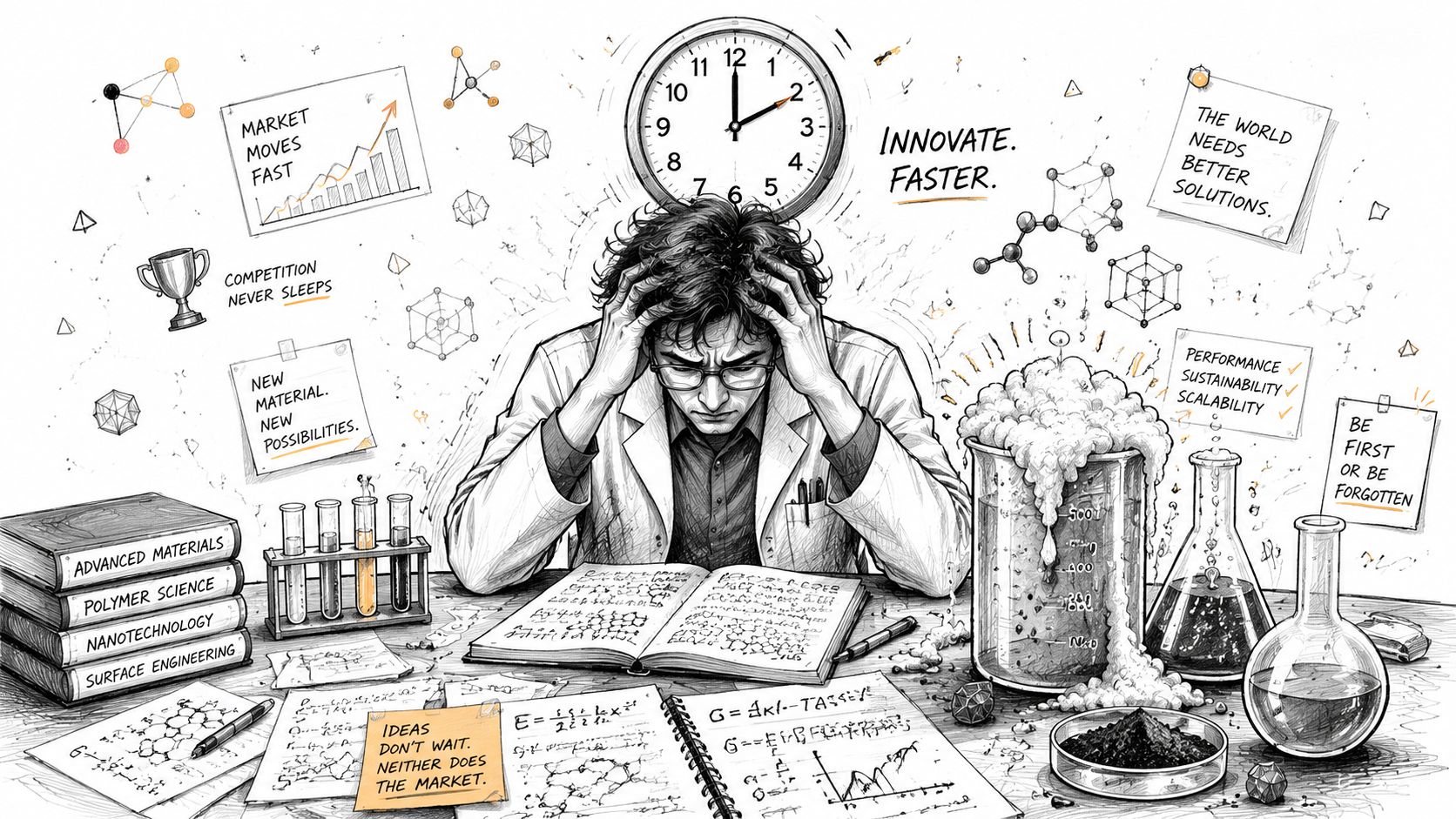
The business pressure behind that problem is no longer abstract. The polymers market is projected at about USD 1.4 trillion in 2026 and USD 2.1 trillion by 2035, with Asia Pacific expected to hold 48.7% of the market by 2035, according to Research Nester's polymers market outlook. When markets are that large, experiment efficiency and process optimization stop being purely technical concerns. They become strategic levers.
Why traditional speed-ups stop working
Teams often try to accelerate by pushing harder on familiar tools:
- More parallel experiments: Scientists run more samples, but if naming, metadata, and test conditions aren't standardized, the team creates more noise, not more insight.
- More meetings: Cross-functional reviews help, but they can't compensate for weak data lineage.
- More heroic troubleshooting: Senior formulators often rescue programs through experience, though that knowledge stays trapped in people instead of becoming institutional memory.
Practical rule: If your team can't quickly answer what changed between two “similar” experiments, you don't have a throughput problem first. You have a data architecture problem.
What the new imperative actually is
A key shift in polymer r&d is this. Every stage has to produce data that is immediately useful for the current project and reusable for the next one. That means treating experimental planning, sample tracking, property measurement, and scale-up observations as parts of one learning system.
A data-centric approach doesn't remove scientific judgment. It makes judgment more effective. Scientists still define targets, interpret anomalies, and decide which trade-offs matter. But they do it with a more reliable record of prior work, stronger comparisons, and cleaner feedback loops.
That's how teams move faster without lowering technical standards. They stop treating data as exhaust from lab work and start treating it as the operating backbone of polymer r&d.
The Modern Polymer R&D Lifecycle From Discovery to Scale-Up
Most polymer programs aren't linear. They loop. A scale-up issue changes the formulation. A failure analysis reshapes the test plan. An application test forces a different molecular design choice. Teams that understand this early build a better workflow from the start.

Discovery starts with a technical brief, not a molecule
Discovery begins with a target window, not with chemistry for chemistry's sake. In practice, that means translating market or application needs into property requirements. A bio-based adhesive, for example, might need bond strength, cure behavior, thermal stability, and substrate compatibility that fit a specific assembly process.
At this stage, weak teams jump straight into synthesis. Strong teams define the decision criteria first. They document what success looks like, what constraints can't be violated, and which measurements will determine whether a concept deserves more work.
A useful way to frame discovery is with four questions:
- What application problem are we solving?
- Which properties determine success?
- Which trade-offs are acceptable?
- What data will let us reject poor candidates quickly?
Formulation and testing have to stay connected
Once the team starts synthesis and characterization, the risk is fragmentation. Formulation records live in one place, instrument outputs in another, and application notes in a third. That creates delays and weakens interpretation.
For polymer systems, this stage often reveals non-intuitive behavior. A strong example comes from Sandia National Laboratories, which described a molecule that contracts when heated. When incorporated into a polymer, it suppresses the polymer's usual thermal expansion and helps it bond more reliably to metals or ceramics under temperature cycling, as shown in Sandia's discussion of low-CTE polymer design. That's a useful reminder that advanced formulation doesn't always follow intuition.
Teams need a shared record that connects:
- Recipe details with batch identifiers and raw material versions
- Characterization results with exact test conditions
- Application performance with substrate, environment, and loading context
- Interpretation notes with the reasoning behind next-step decisions
Later in the cycle, seeing the process visually helps align teams on where handoffs usually break down.
Scale-up feeds back into discovery
Scale-up is where many elegant lab results become messy reality. Mixing order matters more. Residence time matters more. Heat transfer, viscosity, dispersion, contamination sensitivity, and operator variation all show up at once.
The best scale-up teams don't treat plant feedback as a late-stage nuisance. They treat it as design input that should reshape earlier assumptions.
A practical lifecycle view for polymer r&d looks like this:
| Stage | Core question | Typical failure mode | Data strategy need |
|---|---|---|---|
| Discovery & design | What should we make? | Vague targets | Clear requirement-property mapping |
| Synthesis & characterization | What did we actually make? | Incomplete metadata | Structured experiment capture |
| Application & testing | Does it work in context? | Detached testing | Linked performance and conditions |
| Scale-up & commercialization | Can we repeat it at production conditions? | Lab-to-plant disconnect | Process-aware traceability |
When teams operate this way, discovery, formulation, process optimization, and transfer stop feeling like separate departments. They become one iterative learning cycle.
Essential Polymer Characterization and Testing Methods
Characterization only creates value when it answers a decision question. Too many polymer r&d teams fall into a checklist mindset. They run DSC because DSC is standard, tensile because tensile is required, microscopy because morphology might be useful, and then wonder why project reviews still feel ambiguous.

Methods that answer structural questions
Structural and compositional methods tell you whether the intended chemistry and morphology are present. Spectroscopy helps identify molecular bonds and functional groups. Chromatography separates and quantifies components. Microscopy reveals phase separation, dispersion quality, fracture surfaces, and local defects.
These methods are especially important when teams are comparing nominally similar formulations. If one batch shows different performance, structural data often explains whether the cause was chemistry, morphology, contamination, or processing history.
Use them when you need to answer questions like:
- Did the reaction or blend behave as expected?
- Are additives distributed consistently?
- Is the failure linked to microstructure rather than bulk composition?
Methods that answer performance questions
Thermal and mechanical methods tell you whether a material is likely to survive conversion, assembly, and service. DSC and TGA help teams understand transitions, cure windows, and degradation behavior. Tensile, impact, and related mechanical tests reveal stiffness, strength, elongation, and toughness.
The key is not to read these as isolated numbers. Read them in relation to application context. A polymer that looks excellent in a tensile report may still be unsuitable if it softens during processing, embrittles after conditioning, or varies too much between batches.
A good characterization plan doesn't ask, “Which tests should we run?” It asks, “Which uncertainty is blocking the decision?”
Rheological behavior belongs in this same decision layer. Viscosity, melt flow, cure progression, and shear response often determine whether a material can be processed reliably. For many programs, rheology is where promising chemistry first collides with manufacturing reality.
Methods that answer durability and use-case questions
Performance in real service conditions is where lead candidates separate from interesting lab samples. Chemical resistance, weathering, aging, thermal cycling, and application-specific tests expose failure modes that broad screening doesn't catch.
A practical way to organize testing is by decision point:
| Decision point | Most useful method categories | What the team is trying to learn |
|---|---|---|
| Early screening | Structural, thermal | Is the concept real and stable enough to continue? |
| Lead selection | Mechanical, rheological, morphological | Which candidate best balances properties and processability? |
| Application validation | Durability, compatibility, environmental exposure | Will it perform in the intended use case? |
| Troubleshooting | Microscopy, compositional analysis, thermal history | Why did this sample or batch fail? |
The mistake is treating every method as equally important at every stage. Good teams sequence testing. They use fast, informative methods early, then reserve deeper characterization for the candidates and failure modes that matter.
That discipline becomes even more important once the lab begins generating data at a scale where patterns can be modeled rather than just reviewed manually.
Designing Experiments for Actionable Insights
One-factor-at-a-time experimentation survives in polymer r&d because it feels controlled. Change one variable, observe one outcome, and tell yourself the conclusion is clean. In simple systems that can work. In polymer systems with interacting additives, processing effects, and property variability, it often produces false confidence.

Why one-factor-at-a-time keeps teams busy but not always informed
Think about formulating a polymer blend the way you'd think about baking. If you change only flour and keep everything else fixed, then later change only temperature, then later only mixing time, you still won't understand how those factors interact. Polymer formulations behave the same way, except the interactions are often less forgiving.
Polymer properties often deviate from simple distributions or simple causes. A peer-reviewed study on high-performance polyamide fibers found that Weibull statistics described the distribution of mechanical properties more accurately than a Gaussian model, reinforcing why polymer testing needs rigorous statistical treatment, as discussed in this study on mechanical property distributions in polyamide 6 fibers. If variability itself carries technical meaning, then experiment design has to respect that from the beginning.
What good experimental design looks like in practice
A useful Design of Experiments approach does three things at once. It reduces blind screening, reveals factor interactions, and creates data that can support predictive modeling later.
In practice, that means planning experiments around a structured set of controllable variables such as:
- Composition variables: polymer ratio, additive loading, plasticizer type
- Process variables: mixing speed, order of addition, temperature profile
- Conditioning variables: humidity exposure, cure time, aging regime
- Response variables: modulus, adhesion, viscosity, dimensional stability
The shift is cultural as much as statistical. Scientists have to stop asking, “What should I try next?” and start asking, “What experiment gives the most learning per run?”
Don't optimize your schedule around sample count alone. Optimize it around information gain.
Actionable data has to be reusable data
Well-designed experiments do more than answer the current question. They produce data someone else can interpret later without hunting through emails or lab notebooks.
That requires a minimum operating standard:
- Define factors and ranges before running the study
- Capture exact materials, versions, and units
- Record test conditions with the response
- Flag anomalies, protocol deviations, and operator notes
- Store failed runs, not just successful ones
A lot of teams say they want AI in polymer r&d, but they still run experiments in a way that destroys future usability. Missing metadata, inconsistent naming, and unstructured observations make the data hard to compare and almost impossible to reuse.
Good experimental design fixes that upstream. It gives scientists cleaner answers now and gives the organization a stronger foundation for model-assisted work later.
Navigating Common R&D Bottlenecks and Challenges
Most recurring polymer r&d frustrations look technical on the surface. A batch can't be reproduced. A pilot run behaves differently from the lab trial. Compliance documentation takes too long. Patent discussions stall because nobody agrees which version of the formulation constitutes the invention. Underneath those symptoms, the issue is often system quality.
Reproducibility problems usually start upstream
When scientists say, “It worked yesterday,” the meaning is usually narrower. It worked under a set of conditions that were not fully captured, not easily retrievable, or not standardized across the team.
The hardest reproducibility failures are not dramatic ones. They are the quiet inconsistencies that waste weeks. Slightly different raw material records. Instrument files stored locally. A key observation written in a notebook but not in the project record. Those gaps accumulate until two experiments that look identical on paper are not identical at all.
A major obstacle here is the data plumbing problem. Polymer data is often fragmented across ELNs, spreadsheets, instrument outputs, and lab notebooks, and workflows such as contact-angle and surface-energy based compatibility prediction only become effectively useful when the underlying measurements are centralized and standardized, as discussed in this article on using contact-angle measurements to predict polymer blending.
Scale-up failures are often information failures
Scale-up exposes every shortcut taken in the lab. If the process record never captured mixing order precisely, plant engineers are forced to infer it. If rheology data was stored separately from formulation history, troubleshooting starts with reconstruction instead of analysis.
A few warning signs show up repeatedly:
- Underspecified lab procedures: “Mix until uniform” is not a transfer-ready instruction.
- Detached process data: Pilot observations sit outside the core experiment record.
- No common identifier strategy: Lab, pilot, and production batches can't be linked cleanly.
- Selective memory: Teams remember the winning formulation but lose the failed pathways that explain why it won.
Compliance and IP depend on traceability
Regulatory and IP work often gets treated as downstream administration. That's a mistake. In practice, both depend on disciplined records from the start.
For compliance, teams need clear lineage of materials, conditions, changes, and test outcomes. For IP, they need dated evidence of conception, iteration, and differentiating performance logic. If the project history is fragmented, both activities become slower and riskier.
A resilient polymer r&d system does three things well:
| Risk area | Weak practice | Strong practice |
|---|---|---|
| Reproducibility | Local files and informal notes | Centralized, structured experiment records |
| Scale-up | Handoff by slide deck | Linked lab-to-pilot process history |
| Compliance and IP | Reconstruction after the fact | Continuous traceability during development |
Teams don't remove bottlenecks by asking scientists to be more careful. They remove bottlenecks by making good data capture the default operating environment.
How AI and Data Platforms Accelerate Polymer Innovation
AI can accelerate polymer r&d, but only after the organization fixes the operating basics. If records are fragmented, naming conventions drift, and test data sits outside the experiment context, models won't save the workflow. They'll inherit its weaknesses.
AI only helps when the data foundation is usable
The first job of a modern platform is unglamorous. It has to unify formulations, process parameters, characterization results, and decision history into a single usable backbone. Only then can teams start predicting properties, ranking candidates, or recommending next experiments with confidence.
This is why infrastructure matters. The teams that move fastest usually don't rely on manual exports and ad hoc file stitching. They build or adopt systems that support continuous, structured movement of lab and process data, often alongside low-latency AI data pipelines that make model-assisted workflows practical instead of theoretical.
One example of this category is Polymerize, which is designed to centralize fragmented experimental records and provide model-driven support for formulation and next-best-experiment planning. That kind of setup is useful when the goal is not just analytics, but a working decision environment for scientists.
Closed-loop learning changes how teams search formulation space
The strongest proof of concept for AI in this field isn't a dashboard. It's autonomous, closed-loop experimentation. MIT researchers demonstrated a system that can choose, mix, and characterize polymer blends, then use the resulting data to select subsequent experiments. In that work, the platform found a blend that performed 18% better than any of its individual components, reaching an REA of 73%, according to MIT's report on autonomous polymer blend discovery.
That matters because polymer formulations often contain interactions that human intuition alone won't search efficiently. Closed-loop systems don't replace scientists. They reduce unproductive trial-and-error and surface promising regions of formulation space faster.
The practical value of AI is not that it “knows chemistry.” It's that it can help teams search complex option spaces with more discipline than manual iteration allows.
Comparing R&D Approaches Traditional vs AI-Driven
| R&D Stage | Traditional Approach | AI-Driven Approach |
|---|---|---|
| Discovery | Scientists start from prior experience and scattered project history | Teams query centralized historical data and identify stronger starting hypotheses |
| Formulation development | Recipes are screened manually with limited visibility into interaction effects | Models help rank candidates, estimate likely property windows, and suggest productive regions to test |
| Characterization review | Data is interpreted instrument by instrument, often after delays | Results are linked to formulation and process context, making cross-run comparison faster |
| Experiment planning | Next steps depend heavily on individual memory and local spreadsheets | Algorithms and structured records support next-best-experiment decisions |
| Scale-up | Pilot issues trigger retrospective reconstruction of lab history | Process knowledge, batch lineage, and test outcomes stay connected across transfer |
The difference is not just speed. It's cumulative learning. In a traditional workflow, each project can feel like a fresh climb. In an AI-supported workflow built on good data, each project inherits more of what the organization has already learned.
Building Your R&D Intelligence Engine
The most important shift in polymer r&d isn't adopting a specific algorithm. It's deciding that every experiment should make the organization smarter, not just move one project forward.
Start with the system, not the model
Teams often ask when they should “start using AI.” A better question is whether their current workflow produces analysis-ready experimental history. If not, the first move is not model selection. It's data discipline.
That means establishing a common backbone for formulations, process conditions, test outputs, sample identifiers, and scientist observations. It also means preserving failed work. Failed experiments are often the missing context that turns future recommendations from guesswork into informed guidance.
A strong intelligence engine in polymer r&d has a few visible characteristics:
- Consistent experiment structure: Scientists capture comparable records across projects.
- Linked lifecycle data: Discovery, characterization, and scale-up information stay connected.
- Searchable history: Teams can retrieve precedent, not just archive it.
- Decision visibility: The reasoning behind changes and selections is recorded, not assumed.
What to do next
If you lead an R&D organization, start with a data maturity review. Pick one active polymer program and trace how its information moves from formulation through testing to process discussion. Look for handoffs that depend on memory, file hunting, or manual re-entry. Those are the first places to fix.
Then define a minimum standard for experiment capture. Not a perfect one. A workable one that scientists will follow. Once that foundation is in place, predictive models, recommendation systems, and closed-loop experimentation become much more credible.
Polymer r&d will always depend on scientific judgment. But judgment works better when the lab is supported by a system that learns from every run.
If your team is trying to turn fragmented experimental history into a usable decision engine, Polymerize is worth evaluating. It's built for materials R&D teams that need to centralize lab data, support explainable model-driven experimentation, and connect discovery work with scale-up reality without forcing scientists back into manual data cleanup.
Put your R&D data to work
See how materials teams use Polymerize to plan fewer experiments and reach target properties faster.