

A lot of materials R&D teams are living in a split reality. The official record sits in a paper notebook. Formulation details live in spreadsheets. Instrument outputs are buried in local folders, shared drives, or vendor software. When someone asks a simple question like “Have we tested this additive family at this loading under similar curing conditions?” the answer often depends on who still remembers.
That setup worked when experiments were smaller, teams were local, and the main goal was preserving a defensible record. It breaks down when polymer, chemical, and advanced materials programs need cross-project reuse, multi-site collaboration, and analysis that can guide the next experiment instead of just documenting the last one. A digital lab notebook changes that only if it does more than digitize handwriting.
The urgency is real. The global market for electronic lab notebooks was valued at USD 659.8 million in 2023 and is projected to reach USD 966.2 million by 2030, according to Grand View Research's ELN market analysis. That growth tracks what many R&D leaders already see on the ground. Data integrity, traceability, and workflow automation are no longer side concerns.
If you're working through the operational side of this shift, this guide on wet lab data integrity is a useful companion because it focuses on the discipline required to make digital records reliable, not just convenient.
Table of Contents
- Structured capture beats open-ended note taking
- Integration determines whether data survives
- Search analytics and governance have to work together
- Start with the operating model not the demo
- Questions that expose real platform fit
- Pilot for behavior not just functionality
Introduction The End of an Era for Paper Notebooks
Paper notebooks rarely fail all at once. Their failures are often subtle.
A scientist leaves, and the only person who understood a formulation lineage goes with them. A process engineer wants to compare dispersion behavior across projects, but half the context sits in handwritten margins and the rest in instrument exports with inconsistent file names. A technical manager asks for all failed trials involving a resin, catalyst, and temperature window, and nobody can answer without a manual hunt.
That's the practical limit of paper in modern materials R&D. The issue isn't that paper is impossible to use. The issue is that paper cannot act as a shared, queryable system for formulation knowledge.
Where the friction shows up first
The first pain point is usually retrieval. Teams can record almost anything on paper, but they can't reliably search it. The second is coordination. Formulation chemists, analytical scientists, and scale-up teams often work from different versions of the same experimental story. The third is reuse. Data exists, but it's trapped in formats that make cross-project learning expensive.
Berkeley Library describes electronic research notebooks as a digital, organized, and secure recordkeeping environment built for modern interdisciplinary science as research moved from paper to digital workflows. That shift matters more in materials labs because experiments are rarely just text. They combine composition, order of addition, processing parameters, environmental conditions, characterization data, and interpretation.
Practical rule: If your notebook can store an experiment but can't standardize the fields that define it, you haven't created a data asset. You've created a cleaner archive.
A digital lab notebook worth implementing is not just a paper replacement with a better search bar. It's the point where experimental work becomes structured operational knowledge. That means templates for formulations, captured metadata from instruments, governed records, and enough consistency that the same notebook can support scientists today and models tomorrow.
What changes when the notebook becomes a data layer
The strategic shift is simple to state and hard to execute. You stop thinking about recordkeeping as an end-of-experiment task. You start designing it as the system that captures experimental intent, context, outcome, and provenance at the moment work happens.
That's why the phrase digital lab notebook matters more now than electronic notebook did a decade ago. The category has moved. The labs getting the most value aren't asking, “How do we get rid of paper?” They're asking, “How do we make every experiment reusable?”
From Paper to Pixels Why a DLN is More Than a Digital Binder
The easiest way to understand the evolution is to compare three models.
A paper notebook is like a physical photo album. Everything is there, but only if you already know where to look. A traditional ELN is like a folder of digital photos. It's easier to store and share, but context still depends on naming discipline and human memory. A modern digital lab notebook is closer to a smart photo library. The system doesn't just hold content. It tags, organizes, links, and makes content retrievable by meaning.
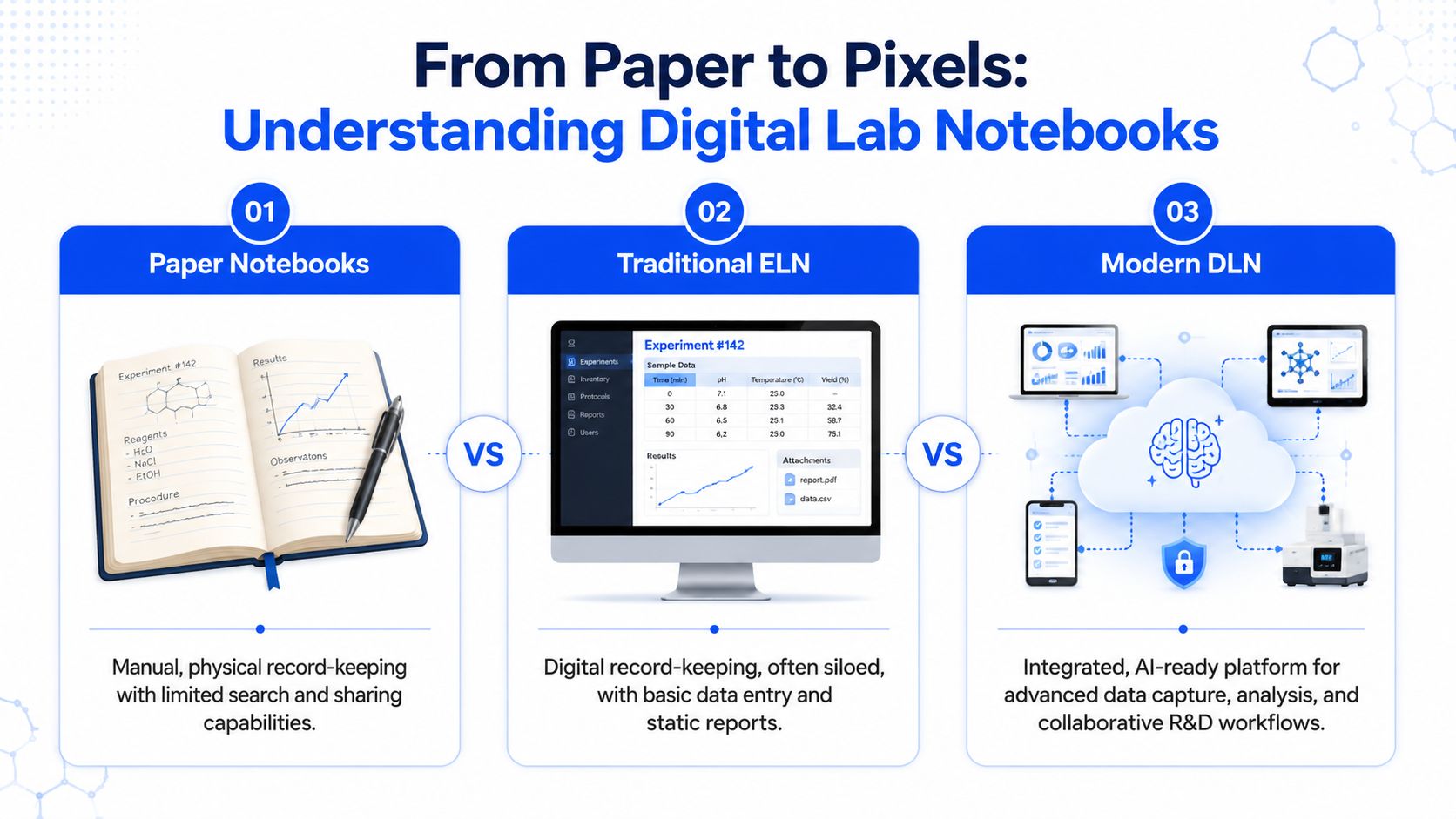
The real difference is structure
Paper is flexible, which is why scientists still like it. You can sketch a reactor setup, jot an observation, tape in a printout, and move on. But that flexibility comes with hidden costs.
You can't query all experiments with the same filler, target viscosity range, and drying profile unless someone manually encoded those details somewhere else. You can't easily collaborate in real time. You also can't depend on paper to manage access, traceability, or controlled review.
Traditional ELNs solved part of that problem. According to LabKey's overview of ELN benefits, ELNs enable multiple researchers to work in the same notebook simultaneously and automatically time-stamp entries for regulatory traceability. That's a real operational step forward. Many labs gain immediate value from shared visibility and cleaner auditability alone.
The gap is that many traditional ELN deployments still behave like digital paper. Teams upload PDFs, paste screenshots, attach files, and write long unstructured notes. The notebook is electronic, but the data model is weak.
A digital notebook becomes strategically useful when scientists can search by experimental variables, not just by project name or author.
Comparison of record-keeping paradigms in R and D
| Capability | Paper Notebook | Traditional ELN | AI-Ready DLN |
|---|---|---|---|
| Search | Manual browsing | Keyword and record search | Search across structured experiment fields, metadata, and linked records |
| Collaboration | Sequential, physical access | Shared access and simultaneous editing | Shared workflows with governed collaboration and reusable experiment templates |
| Traceability | Manual signatures and dating | Automated timestamps and edit history | End-to-end provenance tied to data, process context, and related systems |
| Data structure | Freeform | Often mixed, sometimes template-based | Structured capture designed for analysis and model readiness |
| Instrument data | Usually printed or copied manually | Attached as files or linked | Captured with metadata and connected to experiment context |
| Reuse for analytics | Very limited | Possible, but inconsistent | Built for filtering, comparison, and downstream modeling |
| Knowledge retention | Dependent on individuals | Better centralized retention | Institutional memory with consistent schemas and linked experiment histories |
Materials teams feel this difference more sharply than many wet-lab groups because process matters as much as composition. A polymer blend entry without mixing sequence, residence time, shear condition, and test method may be technically complete for a human reader and still be unusable for analytics.
That's why a DLN should be evaluated less like office software and more like R&D infrastructure. If it only captures notes, it won't change much. If it captures structured experimental knowledge, it becomes the base layer for optimization, tech transfer, and AI-assisted discovery.
Core Features of an AI-Ready Digital Lab Notebook
Most DLN buying conversations focus on user interface, storage, and signatures. Those matter. They are not what determines long-term value in materials R&D.
What matters is whether the system can turn experiments into structured knowledge that survives beyond the individual scientist and can be reused across programs.
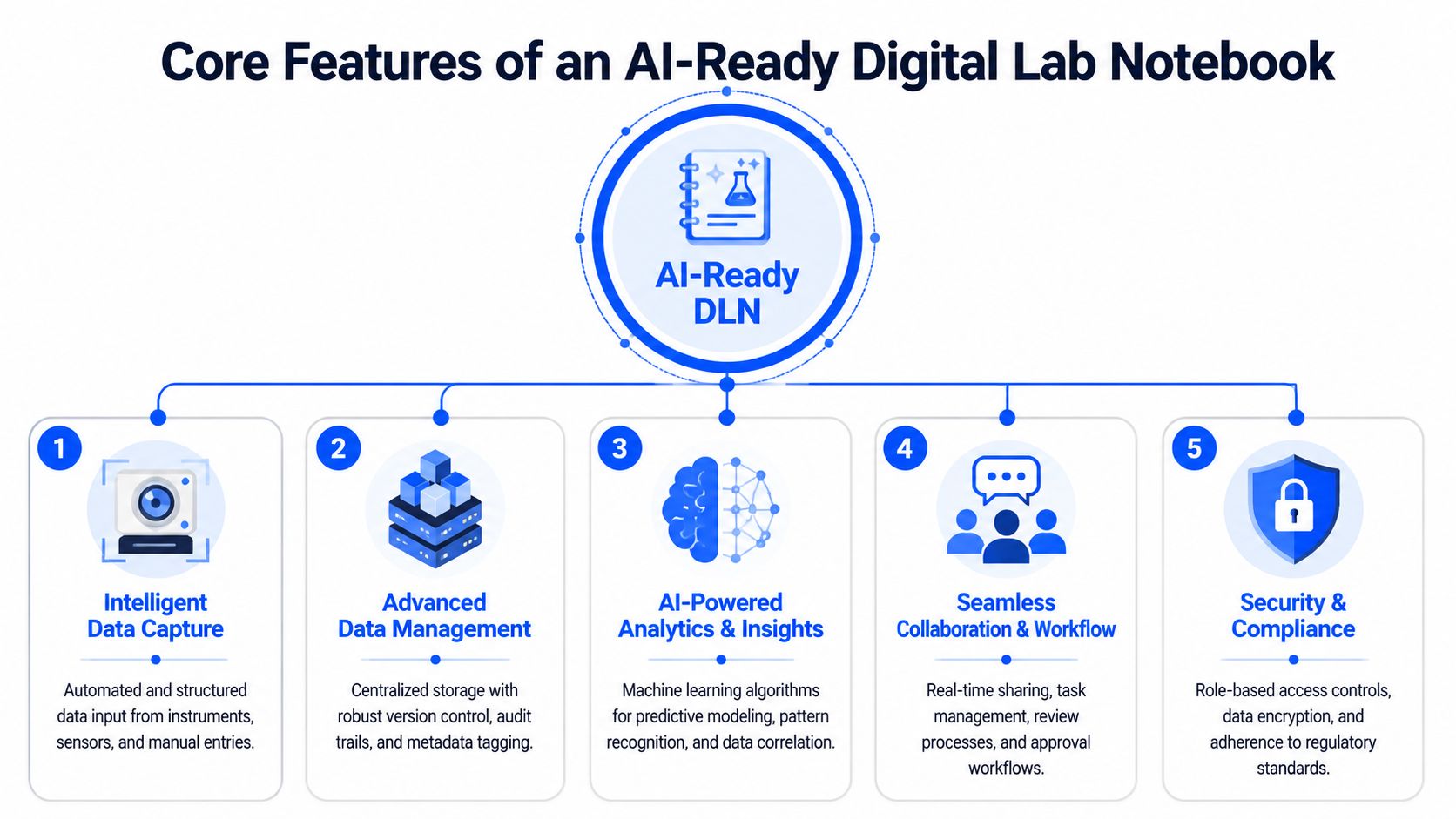
Structured capture beats open-ended note taking
For formulation and materials work, free text should be the exception, not the operating model.
A useful digital lab notebook needs configurable templates for things like:
- Formulations: Component identity, grade, supplier, loading, batch, and order of addition.
- Process conditions: Mixing speed, temperature profile, cure schedule, dwell time, humidity, line settings.
- Characterization results: Test method, specimen preparation, instrument settings, and observed properties.
- Interpretation: Hypothesis, deviation, failure mode, and next action.
The technical reason is straightforward. An experiment has to be captured in a way that supports comparison. If one chemist writes “high filler” and another records a specific loading field, those records won't aggregate cleanly.
An ACS review on ELNs for materials synthesis emphasizes that searchability and reuse depend on metadata such as composition, synthesis approach, and shape, and notes that ELNs can integrate computational approaches to derive insights and suggest next synthesis steps in the ACS Chem. Mater. review on electronic lab notebooks for materials synthesis. In practice, that means template design is not administrative overhead. It is model design for future reuse.
Integration determines whether data survives
A DLN becomes valuable when it reduces manual copying.
Instrument outputs from rheometers, spectrometers, thermal analysis systems, tensile testers, and imaging tools should flow into the notebook with enough context to remain interpretable later. If the scientist still has to download a file, rename it, upload it, and type the setup conditions by hand, the system will lose fidelity over time.
The same applies to adjacent systems:
- LIMS connections matter when sample identity and analytical workflows need synchronization.
- SDMS links matter when raw data files must remain accessible and controlled.
- APIs and connectors matter when the notebook needs to sit inside a broader informatics stack instead of becoming another island.
Benchling's notebook positioning centers on centralizing experiments, metadata, and analysis in one platform with advanced search and consistency tools in Benchling Notebook. That framing is useful even if your organization chooses a different platform. The principle is correct. The notebook has to centralize context, not just attachments.
Search analytics and governance have to work together
Search is where most labs notice value first. Analytics is where they realize they either built the system correctly or didn't.
In one materials science project, structured knowledge from a digital lab notebook covering more than 500 experiments, including failed runs, was converted into machine-learnable datasets. That work helped identify conditions associated with high ionic conductivity in organic lithium-ion electrolytes, as summarized in the EurekAlert report on the materials-science DLN project. The point isn't just that machine learning was applied. The point is that failed experiments and environmental parameters were preserved in structured form.
Field note: Negative results often carry the strongest signal in formulation work. If your DLN makes them hard to capture or hard to search, you are training your organization to forget what it already paid to learn.
An AI-ready digital lab notebook should also include:
- Granular permissions: Teams need to share selectively across programs, geographies, and external partners.
- Audit trails: Every change should be attributable and reviewable.
- Controlled workflows: Review, approval, and versioning must support both science and governance.
- Electronic signatures where needed: Especially when records support regulated development or defensible IP.
A notebook without structure becomes a repository. A notebook without governance becomes a risk. A notebook without integration becomes another silo. AI-readiness only appears when all three work together.
Navigating Security Compliance and Integration
Security and compliance questions usually surface late in software evaluations. In practice, they should shape the architecture from the start.
A digital lab notebook holds experimental history, process know-how, formulation logic, and often the earliest record of patent-relevant work. For many materials organizations, that makes the DLN part of the company's IP control surface, not just a lab productivity tool.

Hybrid records are the real migration problem
Most articles make migration sound cleaner than it is. Labs don't move from paper to digital in one step. They move through a messy hybrid stage where evidence exists across notebooks, printouts, spreadsheets, instrument software, and scanned records.
The NIH's intramural policy makes that operational burden explicit. As of June 30, 2024, NIH investigators must use electronic resources for new and ongoing research, while legacy paper notebooks may remain for reference. The same policy also requires compliant capture of paper-only artifacts such as temporary notes and instrument printouts, as detailed in the NIH intramural electronic lab notebook policy.
That is the fundamental implementation challenge. Not whether scientists can type into a notebook, but whether the organization can preserve provenance when evidence still arrives in mixed formats.
If printouts, handwritten observations, and instrument screenshots still enter the workflow, your governance model has to define who captures them, when they become part of the record, and how they are linked to the experiment.
For regulated or security-sensitive teams, that often intersects with broader enterprise controls. If your internal IT group is stretched, it helps to review how providers think about monitoring, access, and incident prevention. A practical overview of that broader posture is proactive IT security services, especially for organizations treating R&D systems as part of core operational risk.
Integration strategy matters more than feature volume
A DLN should not become the place where data goes to wait.
It needs a defined relationship with adjacent systems:
- LIMS for samples, workflows, and analytical status
- SDMS for raw file management and retrieval
- ERP or PLM systems when formulation handoff and scale-up require controlled transfer beyond the lab
- Identity and access systems for role-based provisioning and offboarding
At this point, many projects drift. The vendor demo shows attractive experiment pages and signatures, but nobody decides which system is the source of truth for sample IDs, test methods, or approved formulations. Without that decision, integration turns into duplication.
A good architecture usually treats the digital lab notebook as the working system for experiment context and scientific reasoning. It should link to raw data systems, consume key metadata from instruments or adjacent platforms, and expose records cleanly enough for downstream analysis. That's different from trying to make one product do every job.
For teams evaluating options in materials informatics, one example is Polymerize, which unifies experimental data across spreadsheets, ELNs, and siloed systems into a centralized data backbone and supports AI-driven analysis for materials R&D. It fits best in organizations that want the notebook layer tied directly to formulation intelligence rather than maintained as a separate documentation tool.
Your Selection and Implementation Checklist
The wrong way to buy a digital lab notebook is to start with a feature matrix. The right way is to start with the operating problems you need to solve.
A polymer formulation group, a process development team, and a central analytical lab may all say they want a DLN. They usually mean different things. One wants formulation templates and experiment reuse. Another wants controlled handoff to scale-up. The third wants instrument context and searchable test history.
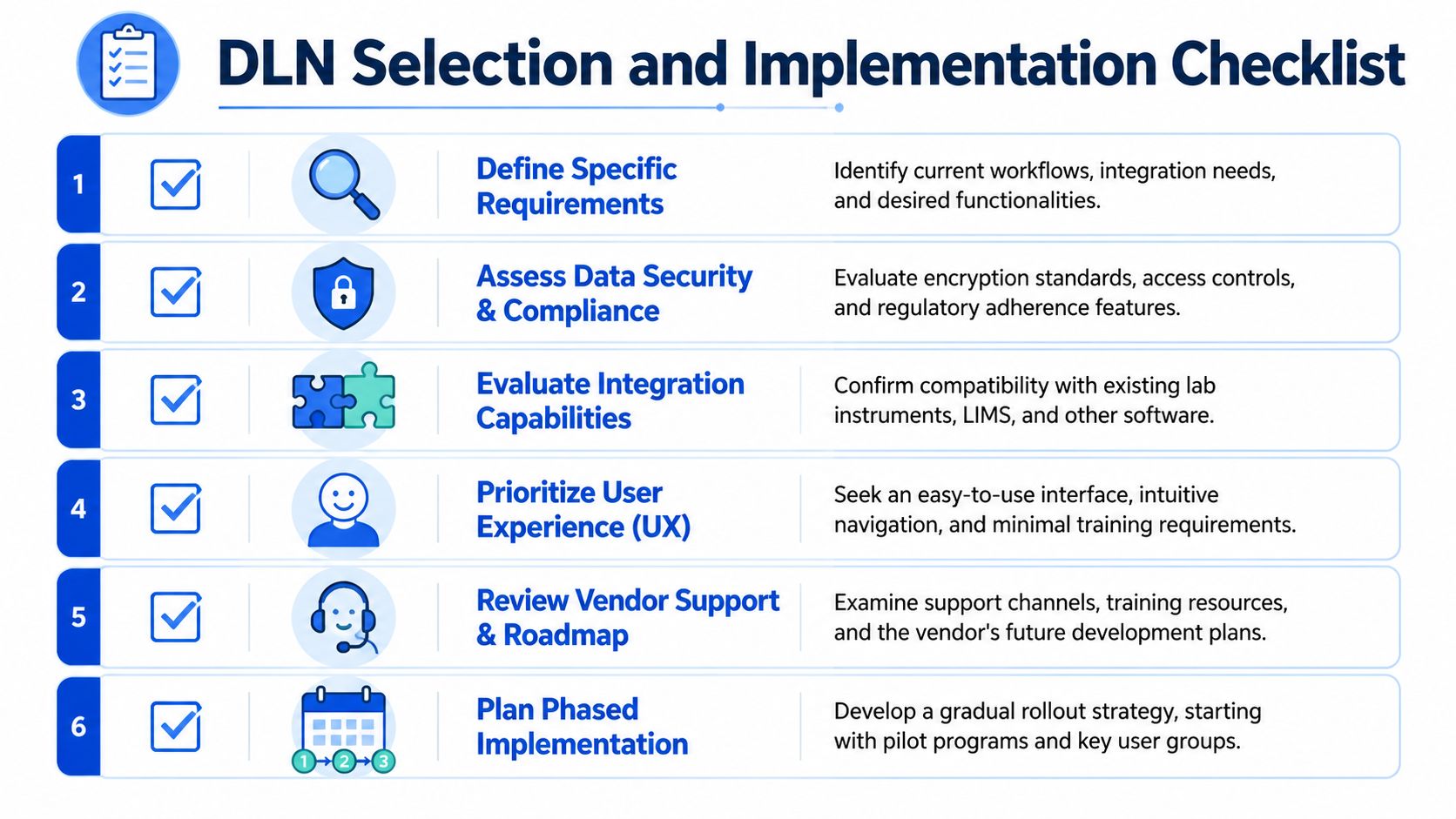
Start with the operating model not the demo
Write down where knowledge is currently lost. Be specific.
Map the experimental lifecycle
Track how an idea becomes a formulation, how the run is executed, where instrument data lands, who reviews it, and how results move into the next decision.Define your critical data objects
For materials teams, these usually include formulations, batches, process runs, test results, raw files, deviations, and approvals.Separate must-have structure from scientist freedom
Lock down the fields required for reuse and governance. Leave room for observations, sketches, and interpretation.Name the user groups early
Formulation chemists, bench scientists, process engineers, analytical leads, and IP or quality reviewers often need different interfaces and permissions.
Selection test: If you can't describe the minimum required metadata for a successful experiment record, you're not ready to evaluate platforms.
Questions that expose real platform fit
Most vendors can show a notebook entry page. Fewer can answer the questions that matter in materials R&D.
Use questions like these:
- Can the system model formulations cleanly? Look for support for components, grades, loadings, units, and lineage across iterations.
- How does it handle instrument outputs? Ask whether data is linked, ingested, or merely attached.
- What happens to failed experiments? The platform should make them easy to record and retrieve, not hide them as exceptions.
- Can search operate on scientific variables? Keyword search is not enough.
- How do approvals work? Review and sign-off should fit your actual workflow rather than forcing a generic template.
- What integration methods are available? API access, connectors, export quality, and schema clarity matter more than broad claims of interoperability.
Don't ignore the vendor's implementation posture either. A product can be powerful and still fail if the onboarding model assumes your scientists will redesign workflows on their own.
Pilot for behavior not just functionality
A pilot should answer one question: will this change how the team works?
Keep the scope narrow. Pick one active project with enough complexity to test templates, data capture, search, review, and collaboration. Include at least one scientist who is skeptical. Enthusiasts are useful for adoption. Skeptics are useful for truth.
During the pilot, watch for:
- Record completion quality: Are required fields being filled in?
- Time-to-entry: Does documentation happen during work or get deferred?
- Search usefulness: Can users answer real experimental questions without manual digging?
- Data linkage: Are files, metadata, and conclusions staying connected?
- Review behavior: Are leads using the system for decision-making or only for compliance?
Implementation usually works best when teams create internal champions, publish simple SOPs, and phase rollout by function rather than by forcing a site-wide cutover. Training should be scenario-based. “Record a new formulation,” “attach a characterization package,” and “compare failed trials” will land better than generic platform tours.
A digital lab notebook succeeds when scientists trust it as the fastest place to recover context. If it feels like extra work with no local benefit, adoption will stall.
Measuring ROI and Scaling Innovation in Polymer Labs
The ROI conversation around a digital lab notebook often starts too small. Time saved on writing, retrieval, and review is real, but that's only the surface.
The bigger return comes from reuse. When scientists can find prior formulations, compare process windows, preserve failed runs, and carry context into scale-up, the organization stops paying twice for the same learning.
Measure reuse not just efficiency
For materials and polymer teams, useful ROI indicators often include:
- Experiment reuse: How often teams can start from prior work instead of rebuilding background from scratch.
- Failure learning: Whether failed or inconclusive runs remain searchable and influence future design.
- Scale-up continuity: Whether lab records transfer cleanly into pilot and production discussions.
- IP quality: Whether invention history, rationale, and supporting evidence are easier to assemble.
- Cross-project visibility: Whether one business unit can learn from another without relying on personal networks.
The ACS review noted earlier makes the core point well. Standardized metadata on composition and process is what makes entries searchable and reusable for AI-driven analysis and next-experiment suggestions. That's the business case. Structure creates optionality.
What ROI looks like in polymer and chemical programs
In a polymer lab, ROI might show up when a team trying to hit a target balance of stiffness and impact performance can pull prior blend ratios, processing conditions, and test outcomes without hunting through legacy files. The notebook doesn't invent insight on its own. It makes prior work usable enough that scientists can design the next run with better constraints.
In an adhesives program, the gain may come from preserving formulation history across resin families, tackifier choices, and cure conditions so that teams can compare trade-offs instead of repeating dead ends. In a coatings environment, the value may appear during handoff, when application testing, substrate prep, and environmental conditions remain connected to the formulation record.
The strongest DLN implementations don't just help scientists document work. They help organizations remember how they learned.
That is why the digital lab notebook should be treated as a foundation for innovation scale, not a software replacement project. If the system captures standardized experimental context, your team can support better search, stronger governance, and eventually AI-guided experimentation on top of a reliable base. If it doesn't, you still have digital records, but you won't have a compounding R&D asset.
Polymerize is worth evaluating if your goal goes beyond notebook digitization into AI-native materials R&D. Its platform is built to unify fragmented experimental data, structure it into an AI-ready backbone, and support formulation optimization, property prediction, and next-experiment planning for polymers, chemicals, and advanced materials. You can explore the platform at Polymerize.
Put your R&D data to work
See how materials teams use Polymerize to plan fewer experiments and reach target properties faster.