

Your team probably already has an electronic lab notebook problem, even if nobody calls it that yet.
A formulation chemist records observations in a personal spreadsheet. Another scientist keeps critical rationale in a paper notebook. Instrument files sit in folders named by date, operator, or whatever seemed convenient that day. Six months later, someone tries to answer a simple question: have we tested this resin, additive, and cure profile combination before? The answer exists somewhere, but finding it takes longer than rerunning the work.
That's not just inefficient documentation. It's a strategic failure in how the organization captures learning. In materials R&D, where outcomes depend on interacting variables and subtle process conditions, fragmented records block reuse, slow scale-up, and make AI ambitions impossible. An electronic lab notebook is the first serious fix. Not because it digitizes paper, but because it turns scattered experimental activity into a managed corporate record.
Table of Contents
- More than digital paper
- The features that separate enterprise ELNs from basic note tools
- Why the category matters now
- A practical comparison
- Why paper stays longer than it should
- Why spreadsheets become a hidden IP risk
- Where LIMS fits, and where it doesn't
- Why the ELN sits in the middle
- Why record integrity matters
- Security controls that matter in enterprise use
- Security supports continuity, not just compliance
- What AI-ready actually means in materials R&D
- Where standalone ELNs hit their ceiling
- The operating model that works better
- Start with live workflows, not archival perfection
- Use integration to remove friction
- Plan the cloud and change model together
The End of R&D Chaos
A formulation team is in a review meeting. One sample outperformed the rest six months ago, and nobody can reconstruct why. The composition is in a spreadsheet, the processing note sits in a paper notebook, instrument output lives in a local folder, and the scientist who made the batch remembers part of the story but not enough to repeat it with confidence.
Materials organizations lose time when they cannot reliably recover what they already know.
That failure shows up in ordinary work, not just audits or major program reviews. Early formulation data sits in Excel. Process deviations get scribbled at the bench. Test files are exported from instruments into personal or departmental storage. When a project lead asks what changed between two similar batches, the team starts assembling screenshots, PDFs, and email attachments. The result is delay, debate, and a record that nobody fully trusts.
Where fragmentation hurts most
In materials R&D, small details often determine whether a result can be reproduced or scaled. Mixing order, hold time, ambient humidity, raw material lot, operator judgment, or a late adjustment can explain why one experiment succeeded and another failed. If those details are split across systems and personal habits, the company does not have a usable learning system. It has fragments.
The costs are predictable:
- Repeated experiments: teams rerun work because prior attempts are hard to find or too incomplete to trust
- Slow technical reviews: scientists and project leads spend time rebuilding context instead of judging results
- Weak handoffs: process development and scale-up inherit partial experimental history and hidden assumptions
- Institutional memory loss: when people change roles or leave, practical know-how disappears with them
Poor documentation does more than waste lab time. It breaks the link between one project and the next, which is where enterprise R&D gets its real return.
An electronic lab notebook changes that operating model. It creates a shared record for experiments, methods, observations, and attachments so teams can search prior work, compare runs, and review decisions against a consistent history. For leadership, that matters because portfolio decisions improve when the underlying experimental record is complete enough to trust.
But an ELN should be viewed clearly. It solves the capture problem first. That is a major step, and for many organizations it is overdue. It does not, by itself, create AI-ready R&D. If data is captured inconsistently, trapped in attachments, or disconnected from instruments, formulations, and test context, the enterprise still cannot use it well for advanced analytics or machine learning.
For a CTO or head of R&D, this is the fundamental shift. The ELN is not the endpoint. It is the first layer of an R&D data backbone that turns experimental work from personal documentation into managed organizational knowledge.
What Is an Enterprise Electronic Lab Notebook
A formulation scientist updates a recipe, attaches spectra as PDFs, and logs a result in a shared folder. Six months later, another team can find the file, but they still cannot tell which method version was used, what changed between runs, or whether the conclusion can be trusted. That is the gap an enterprise electronic lab notebook is meant to close.
An enterprise electronic lab notebook is the system of record for experimental work. It captures experiments in a way the organization can review, search, govern, and reuse across teams, sites, and product programs. For CTOs and R&D leaders, that matters because digital transformation in the lab fails when records stay trapped at the level of individual scientists or isolated projects.

More than digital paper
A basic note-taking tool stores information. An enterprise ELN preserves experimental context.
That difference shows up in routine decisions. Reviewers need to know which protocol was in force, whether a sample was reworked, who approved a change, and what raw evidence supports the result. If the record cannot answer those questions quickly, the company still has a documentation problem, even if the lab stopped using paper.
In practice, a true ELN brings exploratory work into a governed environment without forcing every scientist into a rigid manufacturing workflow. That trade-off matters in materials R&D, where teams need flexibility for formulations, iterative test plans, and changing methods, but still need traceability strong enough for technical review, IP protection, and transfer to downstream functions.
The features that separate enterprise ELNs from basic note tools
An enterprise ELN usually combines several capabilities:
- Structured templates: formulation studies, synthesis steps, characterization methods, and stability work need repeatable fields and metadata
- Method and protocol versioning: teams need a clear record of what procedure was used at the time of execution
- Role-based collaboration: scientists, managers, QA, legal, and external partners need controlled access to the same record
- Audit trails: edits, signatures, approvals, and timestamps must be preserved
- Searchable records: teams need to retrieve work by material, parameter, project, author, or result, not by filename alone
- Attachment and data linking: images, spectra, instrument outputs, and supporting files must stay tied to the experiment they support
Together, those features turn documentation into managed R&D knowledge.
Why the category matters now
The market is growing because organizations are trying to fix a broader data problem, not just replace paper. Grand View Research estimates the global ELN market was USD 659.8 million in 2023 and projects it will reach USD 966.2 million by 2030, with 5.7% CAGR from 2024 to 2030, according to its electronic lab notebook market analysis.
That demand makes sense. Companies want faster technical reviews, better continuity across programs, and stronger control over experimental IP. An ELN can deliver those outcomes only if it is deployed as enterprise infrastructure, with templates, governance, and integration choices that fit how R&D operates.
That said, an ELN solves the capture layer. It does not automatically produce AI-ready data. If experimental records remain inconsistent, buried in attachments, or disconnected from instruments and test systems, the organization gets cleaner documentation without gaining the data backbone needed for advanced analytics and machine learning.
ELN vs Paper LIMS and Spreadsheets
Most labs don't choose between a perfect system and a bad one. They inherit a patchwork. Paper survives because scientists like the freedom. Spreadsheets survive because they're flexible. LIMS survives because operations need rigor. The problem is that none of those tools, on their own, fit exploratory materials R&D particularly well.

A practical comparison
| System | Where it works | Where it breaks in materials R&D |
|---|---|---|
| Paper notebook | Fast freeform note-taking at the bench | Hard to search, hard to share, weak traceability, easy to lose context |
| Spreadsheet | Flexible calculations, ad hoc tracking, quick analysis | Version confusion, weak governance, inconsistent fields, poor auditability |
| LIMS | Routine workflows, sample tracking, QA/QC, controlled processes | Too rigid for exploratory experiments, iterative formulations, and evolving methods |
| Electronic lab notebook | Experimental design, execution, collaboration, searchable scientific records | Still needs integration and data standards to support enterprise analytics |
Why paper stays longer than it should
Paper notebooks are intuitive. Scientists can sketch, annotate, and improvise without friction. That's exactly why they persist.
But paper fails as soon as work needs to move beyond the individual. A bench scientist may remember where a key observation sits on a page. A project lead reviewing ten related experiments won't. Searchability, sharing, and auditability are weak, and retrieval gets worse as teams grow.
Why spreadsheets become a hidden IP risk
Spreadsheets solve today's problem while creating next quarter's mess. They're excellent for temporary analysis and local flexibility. They're poor as a long-term experimental system.
In practice, spreadsheet-heavy R&D environments usually suffer from conflicting versions, inconsistent naming, missing metadata, and copy-paste drift. Scientists can work around those issues for a while, but management can't build reliable program memory on top of them.
Spreadsheets are powerful calculators. They are poor scientific record systems.
Where LIMS fits, and where it doesn't
LIMS is often the wrong target for early R&D digitization. It excels when workflows are stable, throughput is high, and process control matters more than scientific exploration. That's why it works well in QA, QC, and regulated sample management.
Materials discovery doesn't behave that way. Formulations evolve. Test sequences change. Researchers branch midstream based on observations. Forcing exploratory work into a rigid LIMS too early usually frustrates scientists and drives shadow systems back into spreadsheets.
Why the ELN sits in the middle
An electronic lab notebook handles the fluid nature of R&D better than LIMS while imposing far more discipline than paper or spreadsheets. It gives researchers room to work while making the resulting record searchable, reviewable, and shareable.
That doesn't mean ELN replaces everything. In mature environments, ELN, LIMS, and instrument systems each have a role. The mistake is assuming any one of them can carry the full digital burden alone.
Key Capabilities and ROI for Materials R&D
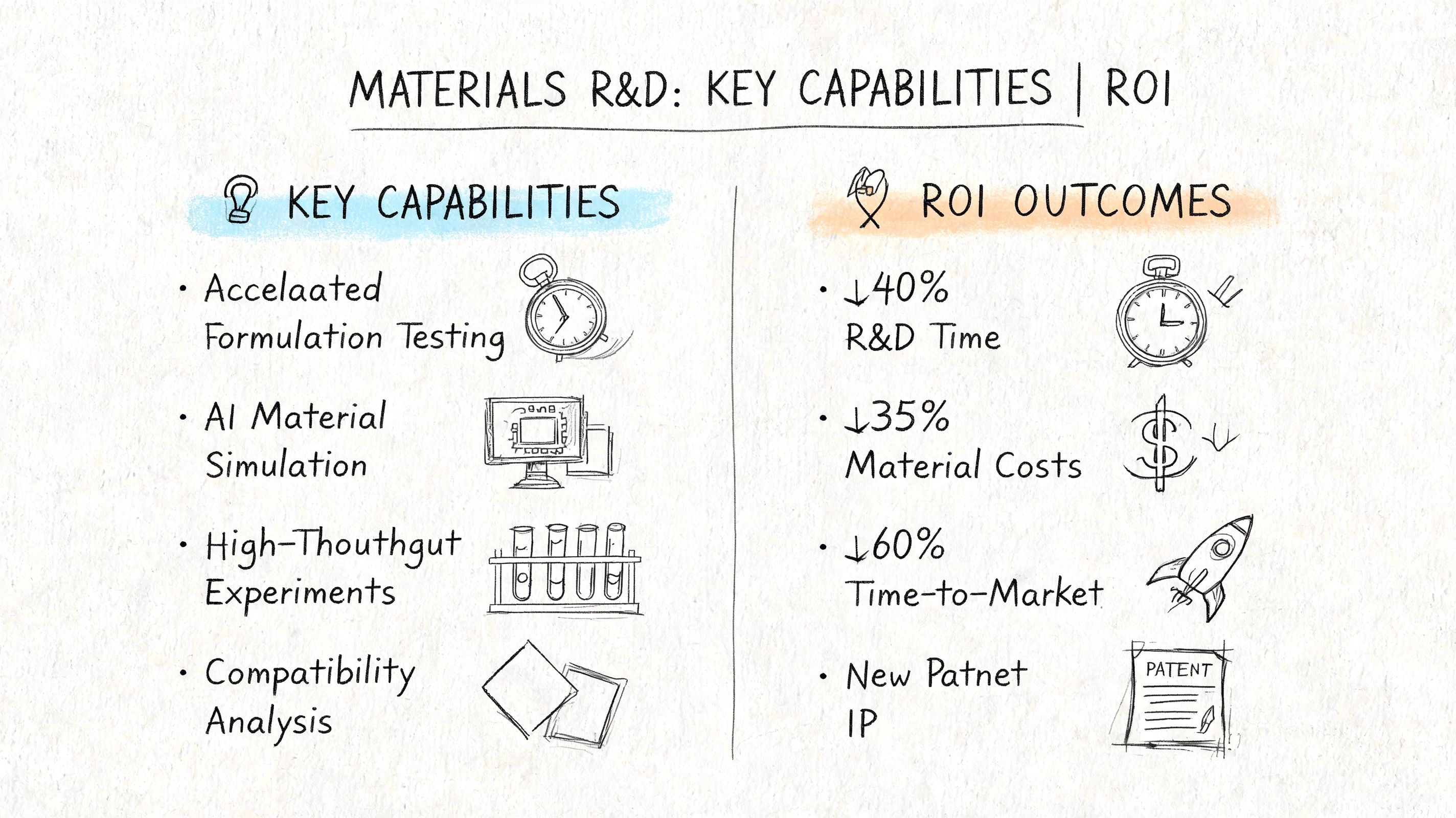
A materials team runs 200 formulation trials across six months, then needs to explain why one variant passed humidity exposure while a near-identical one failed. The answer is usually buried in execution details. Lot history, mixing sequence, dwell time, ambient conditions, operator notes, or a test method revision. If those details were captured inconsistently, the team has data, but not usable program memory.
That is where an ELN earns its keep in materials R&D. It creates enough structure at the point of work to make experiments comparable later. For polymers, coatings, composites, adhesives, and specialty chemicals, that matters because performance rarely traces back to a single input. It comes from interactions between formulation, process, and test context.
What good ELN design looks like in practice
Useful ELN design starts with recurring decisions the organization wants to improve. Which formulations should we repeat? Why did scale-up fail? Which processing variables keep showing up in successful samples? Those are management questions as much as scientific ones.
That changes how templates should be designed.
A formulation group may standardize fields for composition, supplier and lot, order of addition, dispersion method, viscosity checkpoints, substrate, cure schedule, and final test conditions. A synthesis team may require reagent identity, stoichiometry, temperature profile, workup conditions, and analytical attachments. The goal is not more form filling. The goal is a record that another scientist, project lead, or data scientist can reliably compare across experiments.
As noted earlier, ELNs are strongest when they turn repeatable experimental context into structured fields and metadata rather than leaving everything in free text.
Where ROI actually shows up
The first return is usually operational. Scientists spend less time hunting for prior work. Managers get cleaner project reviews. New hires learn from actual experimental history instead of partial handoffs and tribal memory.
The larger return is strategic.
An ELN helps a company preserve experimental context in a form that can be searched, reviewed, and reused across programs. That improves portfolio decisions because teams can see patterns in failed and successful work, not just isolated study results. It also reduces the dependence on individual memory, which is one of the quietest sources of delay in R&D organizations.
In practice, the strongest gains tend to show up in a few places:
- Fewer repeat experiments caused by poor visibility: teams can check prior formulations, process conditions, and outcomes before recreating work
- Faster technical reviews: project leaders can compare records across batches, chemistries, or test campaigns without reconstructing the experiment from attachments
- Better onboarding and handoffs: scientists inherit methods with context, rationale, and result history
- Stronger knowledge retention: process know-how stays with the company when people change roles or leave
- Better preparation for downstream analytics: structured records make later modeling possible, even if the company is not ready for AI yet
That last point is easy to miss. An ELN does not create AI-driven discovery on its own. It does create the minimum level of data discipline required for that future to be realistic.
Practical rule: If a scientist cannot compare two related experiments side by side without opening multiple files and interpreting inconsistent notes, the ELN is still capturing activity more than knowledge.
Common failure modes
I see two patterns repeatedly.
The first is loose configuration. Everything is optional. Attachments carry the actual content. Metadata is sparse. Free text does most of the work. In that setup, the company has digitized record keeping, but it has not improved retrieval, comparison, or analysis.
The second is overdesign. Teams try to define every field for every possible experiment before adoption is stable. Scientists then route around the system, keep shadow spreadsheets, or enter the minimum needed to close the record. The result looks standardized from a governance perspective and performs poorly in daily use.
The trade-off is straightforward. Capture enough structured context to support comparison and reuse. Leave room for scientific judgment where methods evolve quickly.
A useful test is simple. Can the team recover exact conditions from a prior experiment, compare them to related work, and understand what changed without asking the original author? If yes, the ELN is creating enterprise value. If not, it is still a documentation tool, not the start of an intelligence layer.
For CTOs, that distinction matters. If the company also needs audit confidence around the systems that hold R&D data, it is worth reviewing how to get fast SOC 2 penetration tests before broader platform integration begins.
Securing R&D Data and Protecting Intellectual Property
A patent filing is being drafted. Legal asks for the experiment history behind a formulation claim, who reviewed the work, which protocol version was used, and whether the record can show a defensible sequence of invention. That is the moment an ELN stops being a lab convenience and becomes an enterprise control point.
For CTOs, the question is simple. Can the company trust its R&D record under scrutiny? If the answer depends on shared drives, editable spreadsheets, and scattered attachments, the organization has an IP exposure problem.
Why record integrity matters
In materials R&D, invention rarely appears in one clean breakthrough. It builds through iterations. A sample is reformulated, a process window shifts, a characterization method changes, a result gets reinterpreted, and a go or no-go decision follows. If that chain is incomplete or hard to authenticate, the company loses more than efficiency. It weakens its ability to defend ownership, support filings, and resolve disputes about what was done.
An ELN improves that position by creating a time-sequenced, attributable record. Entries are tied to named users. Revisions remain visible. Review and approval actions are preserved. Search improves, but the bigger value is evidentiary. The organization can reconstruct how work progressed without depending on memory or on the original scientist still being available.
That distinction matters at scale. Searchable records help scientists find prior work. Defensible records help the business protect the value created by that work.
Security controls that matter in enterprise use
Security discussions around ELNs often drift into vendor feature lists. A better approach is to test whether the platform supports real R&D risk scenarios, cross-site collaboration, external partners, staff turnover, and legal review.
Focus on controls that hold up under those conditions:
- Role-based access: project visibility should follow business need, not default openness
- Audit trails and version history: teams need a clear record of what changed, who changed it, and when
- Electronic signatures: useful for formal review, controlled procedures, and approval checkpoints
- Retention and export controls: records need to remain available during transfers, audits, disputes, or diligence
- Vendor security posture: the ELN will hold high-value IP, so assurance should include more than marketing claims
Many platform evaluations stop at application features and skip the wider control environment. That is a mistake. If procurement or compliance needs stronger evidence during vendor review, practical guidance on how to get fast SOC 2 penetration tests can help separate real assurance from checkbox language.
Security supports continuity, not just compliance
Regulated teams usually address this first because approval workflows and controlled records are already expected. Non-regulated materials organizations face the same underlying risk. People change roles. Programs get reprioritized. Joint development agreements expand access. Years later, the company still needs to know which method generated which result, who had access to the record, and whether the history is intact.
Weak record control creates two business problems at once. Technical decisions become harder to trust, and the IP behind them becomes harder to defend.
An electronic lab notebook addresses that specific layer well. It gives the enterprise a controlled scientific record that paper notebooks and spreadsheets cannot provide. It does not, by itself, create the structured, connected, analysis-ready data model needed for AI-driven discovery. But without secure and attributable records, that larger ambition rests on unstable ground.
Beyond Documentation The Leap to AI-Ready Data
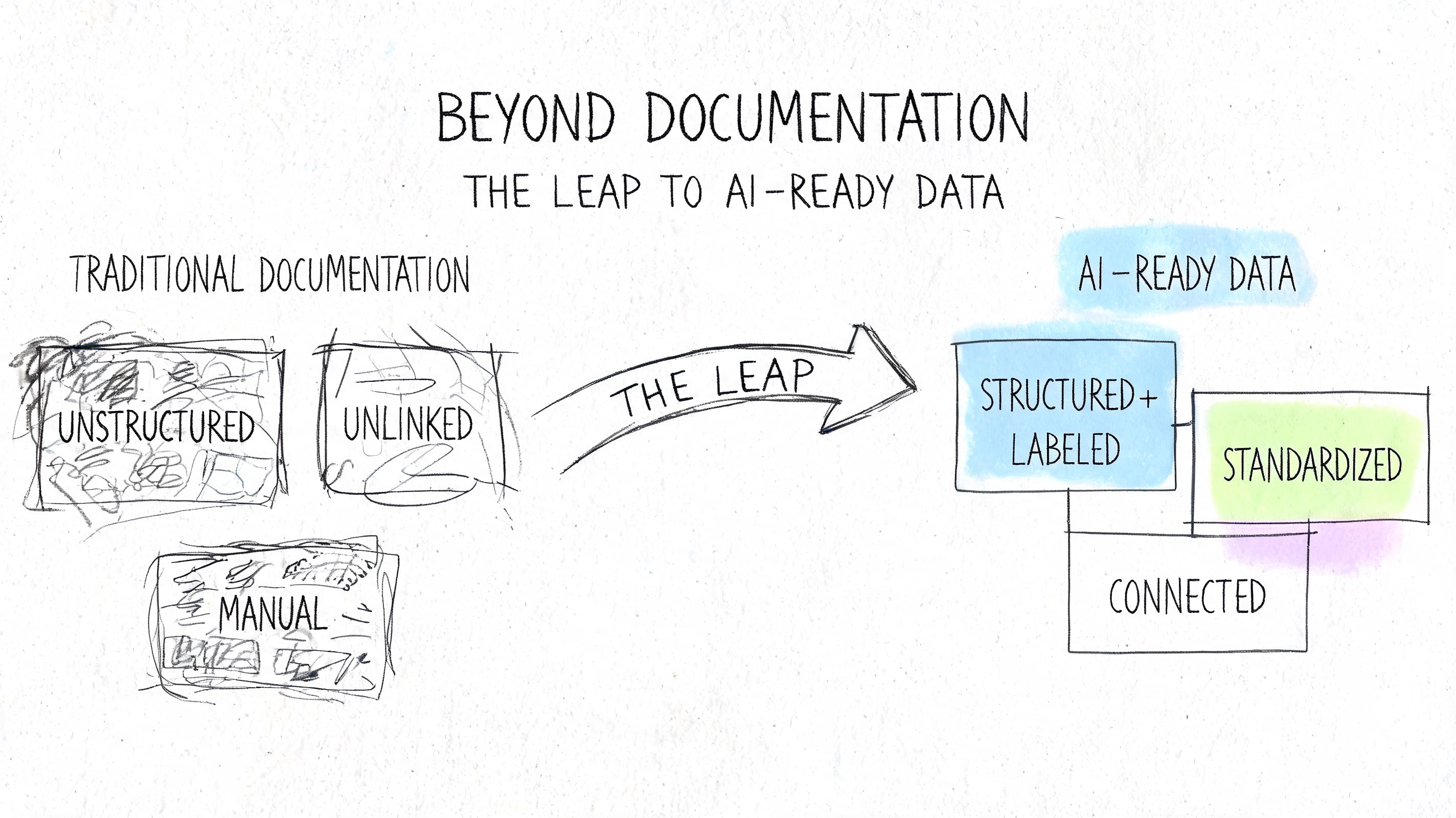
Many ELN strategies stall at this stage. The company digitizes documentation, standardizes some templates, and declares the lab transformed. It isn't.
An electronic lab notebook captures work. The enterprise goal is to learn from work at scale. Those are related, but they aren't the same thing.
What AI-ready actually means in materials R&D
For AI or advanced analytics to help a materials organization, data needs more than timestamps and attachments. It needs structure, context, and consistency across experiments.
That usually means:
- Consistent variable definitions: the same ingredient, property, process step, and test method can't appear under five names
- Experimental context: outcomes must remain linked to conditions, protocol versions, and material lineage
- Cross-system connectivity: instrument outputs, sample records, formulations, and results can't remain isolated
- Model-usable formats: data has to be clean enough for comparison, trend analysis, and predictive workflows
Without those conditions, the ELN remains useful for search and compliance, but limited for discovery acceleration.
Where standalone ELNs hit their ceiling
IDBS notes that modern ELNs are being designed for AI readiness, yet their primary function is still data capture. It also highlights that true AI-driven R&D requires data structured for downstream modeling, and that an ELN does not by its very nature determine next-best-experiment planning or causal relationships, as described in its discussion of modern ELN platforms.
That gap is especially important in materials science. Teams don't just want to know what was tested. They want to understand which variables drove performance, which experiments are comparable, where the unexplored design space sits, and what to test next.
The operating model that works better
The ELN should sit at the front of a broader data backbone, not at the end of the journey.
In practice, that means connecting the ELN to instrument data, sample and inventory systems, test data repositories, and analytical environments. It also means agreeing on naming conventions, controlled vocabularies, and minimum metadata standards that survive across teams and sites. The moment those foundations are in place, historical experiments stop being archived paperwork and start becoming usable training data.
Better documentation improves recall. Connected, standardized data improves prediction.
If you're leading digital transformation in R&D, that's the strategic lens to keep. Buy the ELN for disciplined capture. Design the architecture for intelligence.
Best Practices for ELN Migration and Adoption
ELN projects usually fail for ordinary reasons. The team migrates too much low-value history, asks scientists to change everything at once, or chooses a configuration that makes documentation feel slower than the old workaround.
The technical platform matters, but adoption is mostly an operating model problem.
Start with live workflows, not archival perfection
Don't begin by trying to convert every historical notebook, spreadsheet, and instrument folder into pristine structured records. That effort can consume the project before users see value.
A better sequence is to standardize the highest-value active workflows first. Pick a few experiment types that matter across teams, build templates with clear required fields, and define what must be captured versus what can remain optional. Then decide what legacy data deserves migration because it supports current programs, IP continuity, or future modeling.
Use integration to remove friction
Scientists adopt systems that reduce re-entry. They resist systems that create it.
STARLIMS notes that robust ELN deployments are often combined with LIMS and LES in a unified platform, and that advanced ELNs address integration with instruments and other systems to reduce manual entry, improve accuracy, and support compliance in its overview of ELN integration capabilities. That aligns with what works in practice. If users still copy values from instruments into templates by hand, the platform will feel like overhead.
A few implementation rules help:
- Choose internal champions: senior bench scientists carry more influence than project announcements.
- Pilot with one painful workflow: solve a visible problem first, such as formulation traceability or test result retrieval.
- Measure behavior, not slogans: look for completeness of records, search reuse, and reduction in side spreadsheets.
- Keep template governance tight: too much freedom recreates chaos, too much rigidity creates resistance.
Plan the cloud and change model together
Many ELN programs now depend on cloud architecture, identity management, storage policies, and system integration decisions that extend beyond the lab. If your rollout includes broader infrastructure moves, this guide on how to optimize your AWS setup with these tips is a useful companion for planning migration dependencies and avoiding avoidable platform friction.
The final adoption point is cultural. Veteran scientists don't need to be sold on digitization as an abstract concept. They need to see that the system preserves scientific nuance, protects their work, and makes it easier to recover prior knowledge. Once that happens, the ELN stops being "new software" and starts becoming the place where real work lives.
If your organization has already outgrown disconnected spreadsheets, static ELNs, and fragmented experiment history, Polymerize is worth a look. It helps materials R&D teams unify experimental data into an AI-ready backbone, connect historical and live records, and move from documentation toward explainable next-best-experiment guidance for polymers, chemicals, and advanced materials.
Put your R&D data to work
See how materials teams use Polymerize to plan fewer experiments and reach target properties faster.