
A formulation team is trying to answer a simple question: have we already tested a similar resin, filler package, and cure profile before? The answer exists somewhere. Part of it sits in a senior chemist's spreadsheet. Part of it is buried in an ELN entry with inconsistent naming. Instrument files live on a shared drive. A process note is trapped in email. The microscopy images are saved, but nobody linked them to the final property data.
That's not a tooling inconvenience. It's an R&D speed problem.
In materials science, fragmented data slows every part of the loop. Scientists repeat work because they can't trust what's already been done. Scale-up teams inherit incomplete context. AI initiatives stall because the underlying records don't line up. The lab ends up doing data archaeology when it should be doing formulation design.
That's why interest in unifying platforms keeps rising. The global Data Management Platforms market was valued at US$ 3.8 billion in 2026 and is projected to reach US$ 9.7 billion by 2033, growing at a 14.4% CAGR, according to Persistence Market Research's analysis of the DMP market. In practice, that growth reflects a familiar operational need: teams want one system that can unify fragmented data instead of adding another isolated repository.
For materials R&D leaders, data organizing software matters when it becomes the system that connects experiment history, sample lineage, process context, and property outcomes into something a scientist can effectively use. Not just store. Use.
Table of Contents
- Start with a workflow that exposes fragmentation
- Define the scientific grammar before scale
- Roll out in stages that prove traceability
Introduction Why Spreadsheets Are Slowing Your R&D
Most materials organizations didn't choose chaos. They accumulated it.
A polymer development group starts with spreadsheets because they're fast. Then the team adds an ELN for experiment notes, a LIMS for sample tracking, and a few shared folders for instrument outputs. Years later, nobody has a complete record of why one formulation failed, why another passed aging, or which processing condition changed the final property profile. The data exists, but the context doesn't.
That gap shows up in daily work. A scientist asks for prior dispersant trials and gets five filenames. A scale-up engineer wants to compare lab and pilot outcomes but can't reconcile version history. A technical manager tries to launch a modeling project and learns that ingredient names, batch identifiers, and test methods were recorded differently across programs.
The hidden cost is decision latency
In most labs, the slowdown isn't generating data. It's reconstructing it.
When records are split across personal files, disconnected applications, and undocumented naming habits, the team loses confidence in reuse. Scientists rerun experiments because prior outcomes are hard to verify. Managers wait longer to make portfolio calls because the evidence is fragmented. Informatics teams spend more time mapping and cleaning than enabling actual analysis.
Practical rule: If a scientist has to remember where data lives, the system isn't organized yet.
Spreadsheets still have a role. They're useful for quick exploration and local analysis. They fail when they become the operating memory of the lab. They don't preserve lineage well, they rarely enforce consistent structure, and they break down when multiple functions need the same experimental history for different reasons.
What a better foundation changes
Data organizing software addresses a different problem than basic storage. It creates a usable record across formulation, process, test, and outcome.
That matters in materials science because the same result can't be interpreted without context. A tensile value without sample prep details is incomplete. A viscosity shift without raw material lot history is misleading. A “successful” formulation without processing conditions won't transfer cleanly to manufacturing.
The labs that move faster usually aren't the ones generating the most data. They're the ones that can retrieve comparable historical evidence quickly, trust it, and use it to guide the next experiment.
Defining Data Organizing Software for Materials Science
In a materials lab, data organizing software should work like a central nervous system for R&D. It connects formulations, process settings, instrument outputs, test data, and project metadata into one operational picture.
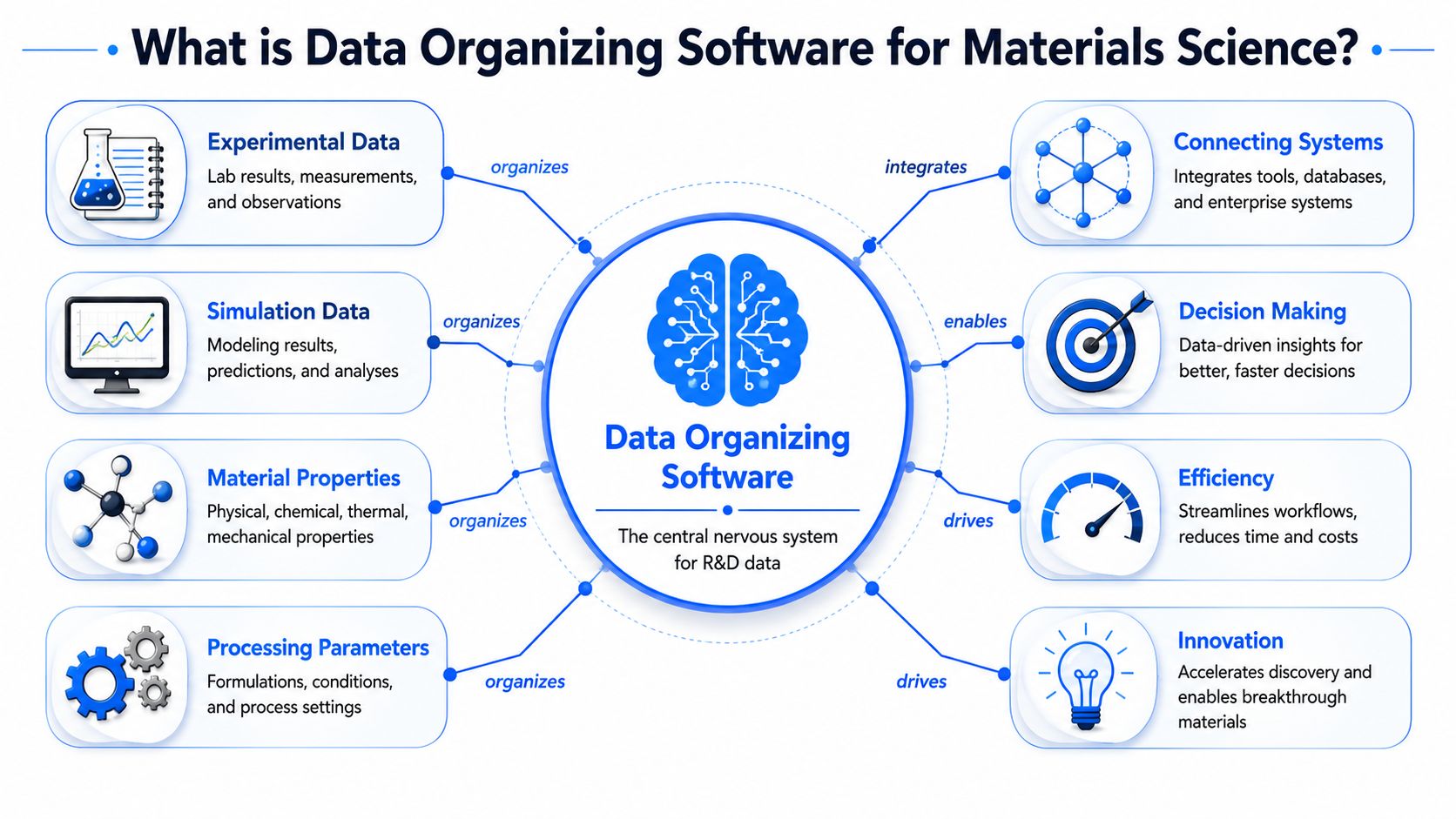
A useful definition is simple: it's the layer that takes scattered technical records and turns them into structured, linked, reusable knowledge. That makes it very different from a folder tree, a generic database, or a passive archive.
Polymerize's guide to scientific data management software in R&D describes modern SDMS as a central integration layer that captures diverse outputs through metadata tagging, improving integrity and auditability and creating an AI-ready R&D backbone. That framing is accurate for materials science because the value is not just storage. The value is that scientists and models can both work from the same organized substrate.
What it actually does in a lab
A strong system ingests records from instruments, spreadsheets, ELNs, and operational systems, then attaches technical meaning to them.
For example, it should connect:
- Formulation intent with ingredients, ratios, and substitutions
- Process history with mixing order, temperature, shear, cure, or extrusion conditions
- Characterization outputs with method, equipment, operator, and sample lineage
- Decision context with project goals, constraints, and final interpretation
That's why I treat data organizing software as a decision tool, not an IT accessory. In materials R&D, nobody wants one more place to upload files. They want a system that answers questions like: Which additive families improved impact strength without destroying flow? Which historical trials are comparable enough to trust? Which process variables changed between lab and pilot?
Why materials teams need more than storage
A generic repository can hold documents. It usually can't preserve scientific context.
Materials data is relational by nature. Raw material identity affects processing behavior. Processing affects morphology. Morphology affects performance. If those links are broken, the data becomes harder to reuse with every project cycle.
The lab doesn't need another bucket for files. It needs a system that remembers how results were created.
The practical test is whether a scientist can move from a property result back to the exact formulation, process conditions, raw data, and related historical trials without opening six tools and messaging three colleagues. If not, the organization has storage. It doesn't yet have organized intelligence.
Core Capabilities Your R&D Team Needs
Platforms often look convincing in a demo. The true test comes three months later, when a scientist needs to compare a failed pilot batch with a lab-scale formulation from two years ago and the answer has to come back in minutes, not after a day of digging through folders, ELN entries, and instrument exports.

What separates a usable system from another silo
A materials R&D team needs four capabilities from data organizing software.
First, the system must unify and harmonize data across formats. Importing files is the easy part. The harder part is mapping inconsistent material names, normalizing metadata, and linking experimental records to samples, test results, and project history. If carbon black, CB, and supplier-specific trade names all describe the same filler family, the platform should help your team reconcile that instead of preserving the inconsistency forever.
Second, it needs intelligent search and retrieval based on scientific meaning. Scientists rarely search by filename. They search by resin class, additive loading, processing window, test method, and performance outcome. If search cannot handle those attributes, the team still depends on memory and side conversations.
Third, the platform has to preserve lineage and version control in a way that supports actual technical decisions. Teams need to see what changed, when it changed, and whether the change was a reformulation, a processing adjustment, a test method update, or a corrected interpretation. Good organization still depends on disciplined structures, clear naming, and repeatable templates. Modern software should enforce those habits inside the workflow instead of relying on every scientist to manage them manually.
Fourth, it must create an AI-ready foundation. This is the capability many buyers underestimate. If formulations, process parameters, characterization data, and decision metadata are not structured consistently, any future modeling effort will stall in data cleanup. The result is predictable. Data scientists rebuild context by hand, scientists lose confidence in the model inputs, and the organization pays twice for the same data.
A practical evaluation is to compare the before and after state:
| Situation | Before organized system | After organized system |
|---|---|---|
| Prior art search | Scientists rely on memory and local files | Teams query across projects and linked metadata |
| Experiment comparison | Results are hard to normalize | Comparable runs can be grouped with context |
| Version tracking | Final files overwrite local copies | Changes are recorded with lineage |
| Model preparation | Data cleaning happens from scratch | Structured records are ready for analysis |
The architecture question many R&D groups skip
Interface polish matters less than data model fit. If the underlying system cannot represent materials, batches, formulations, process steps, test methods, and property results as related entities, it will become another repository with better branding.
That is why architecture deserves attention early in the selection process. Teams evaluating platforms should ask how the system handles entity relationships, schema changes, and mixed structured and unstructured records. Toolradar's overview of choosing the right database system is a useful refresher if your team wants to review the trade-offs before vendor demos.
A common failure mode is easy to spot. The platform can ingest everything, but it cannot connect anything in a way scientists can trust.
For materials organizations, that distinction matters. A file store collects history. A System of Intelligence turns that history into reusable experimental knowledge, and gives ELNs, LIMS, and data lakes a shared backbone instead of leaving each system to operate as its own island.
Unifying Your Lab ELNs LIMS and Data Lakes
A lot of confusion comes from expecting one system to do every job. That usually leads to bad implementations and disappointed scientists.
Each system has a job
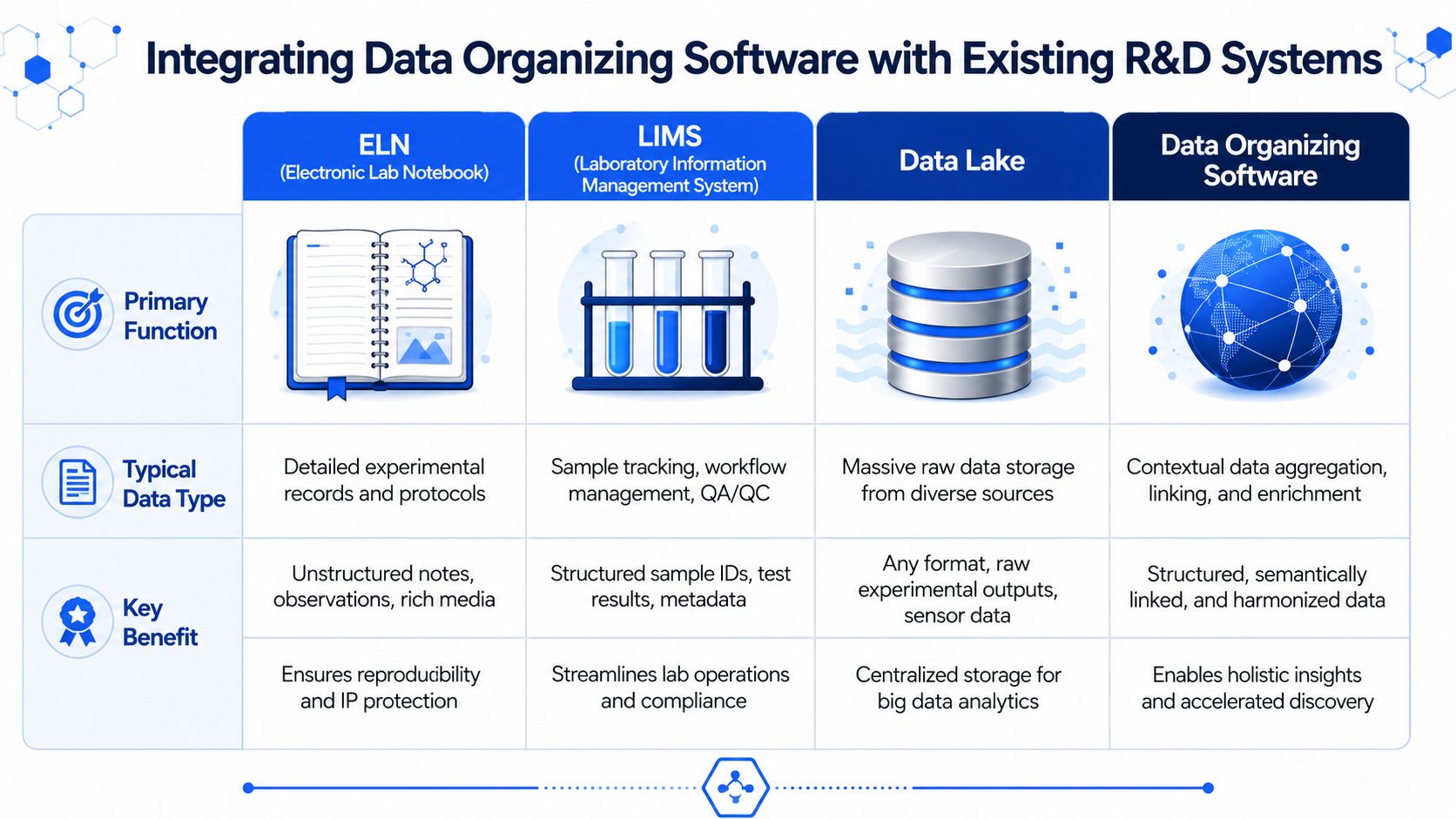
An ELN records what the scientist did. It captures procedures, observations, attachments, and the narrative logic of an experiment.
A LIMS manages samples, workflows, and formal testing operations. It's strong where traceability, throughput, and QA discipline matter.
A data lake stores large volumes of raw data in many formats. It's valuable for central retention, especially when instrument or sensor outputs are diverse.
Data organizing software plays a different role. It connects the scientific and operational meaning across those systems. It links the ELN protocol to the sample in LIMS, ties both to raw files in the data lake, and exposes the combined record in a way that supports comparison and decision-making.
For a quick visual explanation of how these layers fit together, this short video is useful:
What the intelligence layer adds
Without a unifying layer, each system performs its own function well enough, but the organization still struggles to answer cross-system questions. For example:
- Formulation reuse: Can we find all prior experiments that used a similar base resin and reached the target modulus?
- Scale-up traceability: Which lab trials correspond to the pilot sample that later failed processing?
- Failure analysis: Did the outlier result come from a material change, a method deviation, or a process shift?
Those questions require more than coexistence. They require linkage.
A useful mental model is this:
| System | Best at | Weakness when isolated |
|---|---|---|
| ELN | Experimental narrative and IP record | Hard to analyze at scale across programs |
| LIMS | Sample and test workflow control | Limited formulation context |
| Data lake | Raw storage and retention | Low interpretability without structure |
| Data organizing software | Cross-system context and harmonization | Depends on good integrations and governance |
The goal isn't to replace working systems. It's to stop asking scientists to be the integration layer.
When teams get this right, ELNs and LIMS become more valuable, not less. The organizing layer gives them a shared context, which is what turns scattered records into a system of intelligence.
How to Choose the Right Data Organizing Software
Choose this category of software the same way you would evaluate a new characterization method. Do not ask only whether it works in a controlled demo. Ask whether it holds up under the noise, heterogeneity, and revision cycles of a real materials R&D program.
The selection mistake I see most often is buying for the current cleanup project instead of the operating model the lab needs in two years. Data organizing software should become the system of intelligence for the group. It should unify ELNs, LIMS, spreadsheets, instrument files, and shared drives into one usable context for retrieval, comparison, and later-stage AI work. If it only collects records, it will add another repository without fixing the underlying fragmentation.
Security and governance come first because this layer sits close to formulation history, method details, and IP. Research Data Sweden's guidance on organizing data highlights the basics: role-based access, ISO 27001/SOC 2 controls, and GDPR/CCPA compliance for systems that consolidate research data. In a materials organization, those are operating requirements tied directly to partner management, traceability, and reproducibility.
Questions that expose weak platforms fast
Ask vendors to show how the system handles the messy parts of your environment. Clean sample datasets hide the exact problems this software is supposed to solve.
Use questions like these:
- Integration reality: Can it connect to your ELN, instrument outputs, and file stores with maintainable connectors, or does every new source turn into a services project?
- Scientific fit: Does the data model represent formulations, properties, processing parameters, batches, and sample lineage natively, or is it a generic record system with scientific fields pasted on top?
- Context across systems: Can it link an experiment record, a test result, a sample ID, and a process condition into one traceable history, or do those relationships have to be rebuilt manually?
- Access control: Can you separate teams, projects, external collaborators, and restricted programs cleanly without burying the admin team in permission work?
- Change tolerance: If your ontology, naming conventions, or test methods change, can the platform absorb that change without corrupting historical comparability?
Vendor category matters. Generic enterprise data platforms can store a lot, but materials teams often end up spending months translating scientific context into schemas that central IT can manage. Purpose-built options, like Polymerize, can reduce that configuration burden because they are designed around experimental and materials data rather than generic business records.
What usually goes wrong in vendor selection
Feature count gets overweighted. In practice, retrieval speed and data reuse matter more than a long module list. If a scientist cannot find prior experiments with comparable resin chemistry, processing conditions, and property results in minutes, the platform is not solving the core challenge.
A second failure mode is choosing a system that looks strong from an enterprise architecture view but weak in scientific semantics. Materials data is sensitive to units, method versions, composition hierarchies, and sample lineage. If those relationships feel awkward in the platform, scientists will route around it. The spreadsheet does not disappear. It becomes the shadow system again.
Buy for retrieval, reuse, and traceable context. Ingestion alone is not enough.
Be careful with AI-ready claims. Ask what entities are structured by default, how metadata is controlled, and whether lineage survives across imported files, ELN records, and test outputs. If the answer depends on a future services engagement, the foundation is still incomplete.
Your Implementation Checklist for Polymer and Chemical Labs
A good rollout starts with one workflow that already costs the lab time, judgment, and repeat work. In polymer and chemical R&D, that is often formulation screening, stability studies, or bench-to-pilot transfer, where composition, process history, and test results are scattered across ELNs, LIMS, spreadsheets, instrument files, and inboxes.
Start with a workflow that exposes fragmentation
The goal of the pilot is not migration volume. The goal is to prove that the new system can become the lab's System of Intelligence, the place where sample lineage, formulation context, process conditions, and property data stay connected across tools.
Use a checklist that reflects how materials work moves:
Find the highest-value data that is hardest to reconstruct
Map where records live today. Include spreadsheets, ELNs, LIMS exports, shared drives, instrument outputs, and email attachments. If a scientist has to assemble a formulation history by hand, that workflow belongs near the top of the list.Choose a pilot that crosses team boundaries
Pick a use case where synthesis, characterization, and process teams depend on the same technical history. That pressure is useful. It exposes whether the platform can unify context instead of acting as another isolated repository.Set metadata rules before importing legacy content
Standardize project IDs, sample names, version labels, units, method names, and date conventions early. In materials programs, inconsistent naming breaks comparability fast. Two records can describe the same resin system and still fail to match if terminology drifts.
Define the scientific grammar before scale
Labs often treat implementation as a software task. It is also a data model task. If the language for materials, tests, and process states is weak, the system fills up but retrieval stays poor.
Set operating standards for four areas:
- Material identity: raw materials, intermediates, blends, formulations, and lot-specific variants
- Property language: test names, units, methods, specifications, and result qualifiers
- Process history: order of addition, thermal profile, shear exposure, residence time, drying conditions, cure schedule
- Repeatable workflows: common experiment types, review checkpoints, approvals, and release rules
This work takes discipline. It also prevents a common failure mode. Teams migrate old files into a new platform, then discover they still cannot compare experiments with confidence because composition hierarchy, units, and method versions were never normalized.
Roll out in stages that prove traceability
After the model is defined, test the system under real lab conditions.
Connect one instrument and one existing lab system first
Verify that raw outputs, sample records, and experiment context stay linked. If lineage breaks in the pilot, it will break at scale.Train scientists on retrieval and decision support
Show how to find prior comparable formulations, review negative results, trace a sample back to raw material lots, and compare outcomes across method versions. Upload training alone does not change behavior.Review the pilot with working scientists and lab managers
Look for missing metadata, ambiguous labels, unit conflicts, and places where people still export data to rebuild context manually.
Adoption improves when the system helps scientists answer technical questions faster than the spreadsheet workaround.
For polymer and chemical labs, the implementation test is straightforward. Can the platform unify ELN records, LIMS results, instrument outputs, and historical formulation data into one usable technical record? If yes, the lab is building an AI-ready backbone. If not, it is adding another layer to the stack.
Measuring the True ROI of a Unified Data Strategy
The return on data organizing software rarely shows up first as a flashy dashboard metric. It appears when teams stop wasting technical effort on avoidable rework.
Look for avoided waste not just dashboard activity
A useful ROI review asks practical questions. Are scientists finding prior comparable experiments before launching new ones? Are scale-up teams inheriting better process context? Are project reviews based on linked evidence instead of stitched-together slide decks?
The strongest indicators tend to be operational:
- Less duplicated experimentation
- Shorter time spent searching for historical records
- Faster handoff from bench to process development
- Better reuse of negative as well as positive results
- More reliable preparation for modeling and analytics
Why semantic structure changes the economics
In this scenario, many organizations still leave value on the table. File naming and folder discipline help, but they won't fully utilize old technical records if the underlying chemistry language is inconsistent.
CAS's analysis of dark data in chemistry R&D notes that without semantic frameworks such as specialized ontologies and taxonomies, organizations can lose 40% to 60% of actionable insights from historical experiments. In materials R&D, that's the difference between a searchable technical memory and a digital warehouse full of silent data.
Once records are semantically linked, the economics change. Historical experiments become reusable evidence. Negative trials become design constraints. AI projects have a cleaner substrate. Scientists can spend more time narrowing the next experiment and less time rebuilding the past.
A unified data strategy isn't a back-office cleanup project. For materials teams, it's the operating foundation that determines whether years of formulation history become a competitive asset or remain trapped in disconnected systems.
Polymerize offers one path for teams that want this kind of AI-ready foundation in materials R&D. Its platform is built to unify fragmented experimental data across spreadsheets, ELNs, and silos into a centralized, secure backbone, which can help organizations move from data retrieval problems to structured, model-ready workflows. If you're evaluating how to build a true system of intelligence for polymers, chemicals, or advanced materials, Polymerize is worth reviewing alongside your other options.
Put your R&D data to work
See how materials teams use Polymerize to plan fewer experiments and reach target properties faster.