



A formulation can look perfect in the lab and still fail in the field.
That's the trap many teams fall into when they treat stability testing as a release checklist instead of a product-learning system. The sample still pours, the color still matches, the viscosity is in range, and the chromatogram doesn't trigger concern. Then the product spends time under light, heat, oxygen, stress, or humidity, and the property that matters starts drifting first. Adhesion drops. Toughness falls off. Conductivity wanders. The material hasn't “expired” in the familiar sense. It has stopped doing its job.
That's why the core question behind what is stability testing isn't just “How long does it last?” It's “How long does it remain fit for use under the conditions that matter?”
Table of Contents
- Real-time studies tell you what actually happens
- Accelerated studies compress learning time
- Stress testing exposes failure pathways
- Protocols need timepoints conditions and decision rules
- Your instruments define what you can actually learn
- Good study design beats more samples
- Statistics turn observations into shelf-life decisions
- Models are useful only when mechanisms make sense
- The fixity versus functionality problem
- Failure modes teams miss repeatedly
- Real-world polymer examples
Why Stable Materials Fail Understanding the True Goal of Stability Testing
A coating team finishes qualification on a new formulation. Initial appearance is clean. Mechanical testing is acceptable. Processing is smooth enough for production. The product launches.
Months later, field complaints start coming from the harshest use conditions first. Exterior panels yellow. A bonded interface loses strength after thermal cycling. A once-flexible film becomes brittle after storage and outdoor exposure. Nothing looked obviously wrong at release, but the material was already on a path to failure.
That gap is why stability testing matters. In practice, stability testing is a disciplined attempt to answer two risk questions early: what will change, and which change will matter first.
A pass result can hide a product risk
Many teams still frame stability as a binary outcome. Pass or fail. In-spec or out-of-spec. That framing is useful for compliance, but it's weak for product development. Materials rarely fail all at once. They drift through a sequence. First a subtle chemical shift, then a morphology change, then a property loss that users notice.
Practical rule: If your study only confirms that a sample still looks acceptable, you haven't learned enough to trust it in the market.
The best stability programs don't sit at the end of development. They shape formulation decisions early. They tell the team whether a resin package is oxidation-sensitive, whether a plasticizer migrates, whether a suspension slowly loses redispersibility, or whether UV exposure changes the property that customers pay for.
The real target is performance under use
That's the deeper answer to what is stability testing. It's not just assigning a date on a label. It's a way to map degradation mechanisms to business risk.
For materials scientists, that usually means shifting from a narrow shelf-life mindset to a broader performance-retention mindset:
- During formulation work: use stability to eliminate fragile concepts before scale-up.
- During process development: check whether manufacturing conditions introduce hidden instability.
- During commercialization: confirm the product still performs after storage, shipping, and use exposure.
A stable material isn't merely unchanged on paper. It remains useful in the environment where customers use it.
What Is Stability Testing in Materials Science
In materials science, stability testing is the structured evaluation of whether a material keeps its critical properties over time under defined conditions. Those conditions can represent storage, transport, processing hold time, or end-use exposure. The key word is critical. Not every measurable attribute deserves equal weight.
A resin can maintain color and still lose molecular integrity. An emulsion can remain visually uniform while its droplet structure shifts enough to affect application behavior. A conductive formulation can pass appearance checks while electrical performance drifts out of the useful range. That's why asking only about shelf life gives an incomplete answer.

Three pillars matter in practice
Most useful stability programs look at three connected layers.
Chemical stability asks whether the material resists unwanted reactions. Oxidation, hydrolysis, chain scission, cross-linking drift, additive depletion, and impurity growth all sit here. You usually see these changes through analytical signals before operators or customers notice anything visually.
Physical stability asks whether the structure and presentation of the material remain intact. That includes color shift, sedimentation, crystallization, phase separation, viscosity drift, particle growth, caking, or loss of redispersibility. These are often the first things production or quality teams notice because they affect handling and consistency.
Functional stability is the layer many teams under-measure. This is whether the material still does the job it was designed for. Tensile behavior, adhesion, impact resistance, conductivity, barrier performance, elasticity, thermal response, tack, and cure behavior often belong here.
A material can be chemically altered without obvious visual change, and it can look unchanged while functional performance is already declining.
Shelf life is only one output
The phrase what is stability testing often gets answered with “determining shelf life.” That's true, but only partly true.
Shelf life is an output of stability work. It's not the whole purpose. In R&D, stability testing also helps teams:
- Choose formulations: by identifying which compositions degrade less under relevant conditions.
- Set packaging strategy: by learning whether oxygen, moisture, or light drives the problem.
- Define handling windows: for materials that are stable in sealed storage but unstable after opening or mixing.
- Improve methods: by making sure your measurement system can distinguish real degradation from normal variation.
A useful way to think about stability is this. Shelf life tells you when a product should no longer be sold or used. Functional stability tells you when the product stops delivering value. In advanced materials, those two points often aren't the same.
Exploring the Main Types of Stability Studies
A single study rarely tells the full story. Teams usually need a combination of real-time, accelerated, and stress testing because each one answers a different question. Used together, they create a much clearer picture of how a formulation behaves and why it fails.
Real-time studies tell you what actually happens
Real-time stability is the anchor. You store the material under intended conditions and evaluate it over time. This is the closest representation of what customers or downstream plants will experience during normal storage.
Real-time work matters because some degradation pathways are slow, coupled, or non-linear. A material may respond one way at moderate temperature over a long interval and a very different way under harsher conditions. If your product has complex phase behavior, additive migration, or slow structural relaxation, real-time data keeps the team honest.
What real-time studies do well:
- Confirm true use-relevant behavior: especially for products with narrow processing or performance windows.
- Validate accelerated assumptions: by showing whether the same degradation trend appears under actual storage.
- Support launch decisions: when the risk of field failure is high and the application is unforgiving.
The drawback is obvious. They take time, and product teams often want answers before the calendar cooperates.
Accelerated studies compress learning time
Accelerated stability studies push conditions harder so you can surface degradation sooner. In practice, that usually means higher temperature, more humidity, stronger light exposure, or other environmental stressors chosen to speed up likely failure pathways.
This approach is useful when the mechanism under acceleration still resembles the mechanism under normal storage. If that assumption holds, you can compare candidate formulations much faster and screen out weak options early. If that assumption fails, accelerated data can become misleading.
Teams get the most value from accelerated work when they use it as a comparative tool rather than a blind shelf-life shortcut. It's excellent for ranking formulations, testing packaging ideas, or identifying obvious vulnerabilities. It's weaker when used alone to make confident claims about complex, mechanism-dependent aging.
Stress testing exposes failure pathways
Stress testing, often called forced degradation, is different. The goal isn't to mimic reality closely. The goal is to break the material fast enough to understand how it breaks.
The World Health Organization guidance describes stress conditions such as 75% relative humidity or greater, oxidation conditions, photolysis exposure, and hydrolysis assessment across broad pH conditions, while also requiring stability-indicating analytical procedures that capture relevant quality attributes such as suspension rheology, emulsion stability, and powder reconstitution behavior in appropriate product types (WHO stability guidance).
That makes stress testing especially valuable during early development, because it answers questions like these:
- Which pathway dominates first: oxidation, hydrolysis, photolysis, thermal breakdown, or something else?
- Which measurements respond early: impurity profile, viscosity, particle size, thermal transition, or mechanical property?
- Which controls may work: antioxidant package, UV stabilizer, desiccant, oxygen barrier, pH adjustment, or process change?
Stress studies are not there to make the product fail unfairly. They are there to reveal what your normal study might take months to teach you.
Teams that combine these three study types usually learn faster and make fewer expensive assumptions.
Common Protocols and Analytical Measurement Techniques
A good stability study is not just a set of samples in an oven. It is a protocol with defined storage conditions, timepoints, attributes, methods, and decision rules. If any one of those pieces is vague, the resulting data will be hard to interpret and even harder to defend.
Protocols need timepoints conditions and decision rules
In regulated pharmaceutical work, the most widely recognized framework is ICH Q1A(R2). It specifies a testing schedule of every 3 months over the first year, every 6 months over the second year, and annually thereafter, along with standard long-term storage conditions of 25°C/60% relative humidity and accelerated conditions of 40°C/75% relative humidity (ICH Q1A(R2) stability guideline).
Materials teams outside pharma don't need to copy that framework exactly, but they can learn from its discipline. The practical lesson is simple. Stability data becomes useful only when the study defines:
- Storage environment: temperature, humidity, light, atmosphere, orientation, packaging state.
- Sampling cadence: when each material will be tested and why those intervals matter.
- Acceptance logic: what attribute drift is acceptable and what constitutes loss of fitness for use.
- Replicate strategy: enough structure to distinguish true change from noise.
A sloppy protocol creates false confidence. A disciplined one makes trends visible early.
Your instruments define what you can actually learn
The protocol sets the question. The analytical method determines whether you can answer it.
For many formulation and polymer programs, the best measurement set mixes compositional, structural, thermal, rheological, and application-relevant tests. A chromatographic method may catch additive loss long before the naked eye sees a change. A rheometer may reveal network breakdown before the sample fails an appearance check. A DSC trace may show transition drift that explains later brittleness.
Here's a practical mapping.
| Analytical Technique | Property Measured | Detects Degradation Via |
|---|---|---|
| HPLC | Chemical purity and impurity profile | Loss of parent species, additive depletion, impurity growth |
| FTIR | Bonding and functional group changes | Oxidation, hydrolysis, cross-linking changes, chain scission signatures |
| DSC | Thermal transitions and heat flow behavior | Glass transition drift, crystallinity change, cure state variation |
| Rheometer or viscometer | Flow and viscoelastic response | Structural breakdown, aggregation, gelation drift, phase instability |
| Particle size analysis | Distribution of dispersed phase or solids | Agglomeration, coalescence, crystal growth |
| Mechanical testing | Strength, elongation, modulus, impact behavior | Functional property loss not visible in appearance |
| Spectrophotometry or colorimetry | Color and optical change | Yellowing, haze, photodegradation response |
Measurement rule: Don't ask one method to prove stability for a material that can fail by several mechanisms.
The most common mistake is over-weighting whatever is easiest to measure. Viscosity gets checked because the lab has the instrument ready. Appearance gets checked because it's fast. But the right methods are the ones tied directly to the failure mode that matters in use.
For suspensions, emulsions, and powders, physical attributes can be central to quality. The WHO guidance explicitly points to properties such as particle size distribution, redispersibility, phase separation, viscosity, globule size distribution, color, reconstitution time, and water content as relevant stability attributes in appropriate systems, again reinforcing the need for stability-indicating methods rather than superficial checks, as outlined in the earlier linked guidance.
Designing Studies and Analyzing Stability Data
Collecting stability samples is easy compared with interpreting them correctly. Many teams generate months of measurements and still can't answer the one question the business cares about: is this material likely to remain fit for purpose long enough, under the conditions that matter?

Good study design beats more samples
Before the first sample goes into storage, the team should decide what uncertainty it is trying to reduce. That sounds obvious, but many studies still collect everything they can instead of what they need.
A better design starts with a few sharp decisions:
- Define the critical response. Choose the property that represents failure in practice, not just the one that is easiest to measure.
- Select conditions tied to mechanism. Heat, humidity, light, oxygen, and packaging state should reflect the plausible pathway.
- Plan comparisons deliberately. Batch, formulation variant, and packaging changes should be structured so the team can separate formulation effects from noise.
That's where a disciplined DoE mindset helps. You don't need endless combinations. You need combinations that isolate the variables most likely to drive change.
Statistics turn observations into shelf-life decisions
In formal regulatory stability analysis, shelf-life decisions are grounded in statistics, not visual judgment. The statistical evaluation of stability data relies on regression analysis, where the 95 percent confidence limit for the mean is compared against acceptance criteria. Before pooling data from multiple batches, an ANCOVA test is required using a significance level of 0.25 to assess common slopes and intercepts (VICH GL51 statistical evaluation guidance).
For materials scientists, the practical takeaway is broader than compliance. If you don't model uncertainty, you'll tend to over-trust noisy trends. You may think a formulation is stable because the mean still looks fine, while the confidence around that mean already suggests risk.
A sensible analysis workflow usually includes:
- Trend fitting: to determine whether drift is linear, curving, or condition-dependent.
- Batch comparison: to check whether lots behave similarly enough to combine.
- Limit comparison: to estimate when the measured response will cross the useful threshold.
If your decision depends on a trend line, your confidence limits matter as much as the trend itself.
Models are useful only when mechanisms make sense
Many teams use Arrhenius-style reasoning to translate accelerated temperature data into room-temperature expectations. That can be useful, but only if the same mechanism dominates across the studied range. Once the mechanism changes, the model may remain mathematically tidy while becoming physically wrong.
That's why mechanism-aware interpretation matters. If high heat triggers a degradation route that never dominates at ambient storage, the apparent prediction can mislead the team. The model should support the science, not replace it.
In practical terms, the strongest stability programs combine three layers. Measured data over time. Statistical treatment of uncertainty. A mechanism-level explanation for why the trend exists. When all three agree, decisions become much more reliable.
Common Pitfalls and Real World Polymer Examples
A team signs off a polymer because it still looks good in the jar, still runs through the line, and still passes the standard storage check. Six months later, customers report brittle parts, weak bonds, or unstable electrical behavior. The problem is rarely that the material changed in no way. The problem is that the study watched the wrong response.
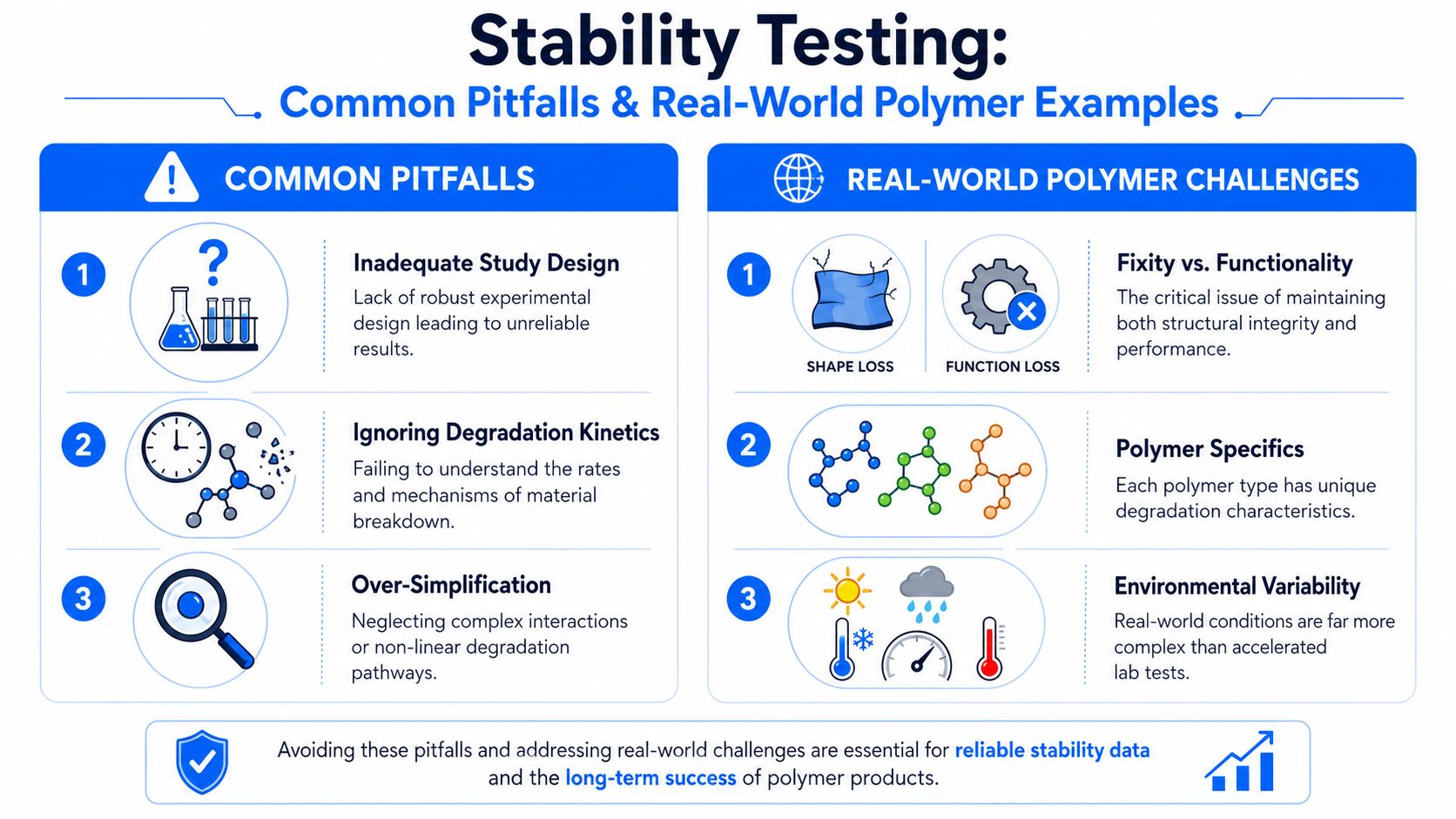
The fixity versus functionality problem
In practice, stability fails when the test panel is easier to run than the product is to use.
A polymer can remain visually acceptable and still lose the property that makes it commercially useful. I see this often in programs that track color, phase separation, and viscosity carefully but treat end-use performance as an occasional confirmation test. That choice saves time early and costs months later.
Three examples show the pattern clearly:
- An adhesive keeps its viscosity window but loses tack or peel strength. The batch still looks processable, yet bond formation becomes inconsistent at the customer line speed and substrate temperature.
- A transparent film stays clear but loses impact resistance. No haze triggers concern, but chain scission, plasticizer loss, or morphology drift reduces toughness enough to create cracks in handling or service.
- A conductive filled polymer stays well dispersed by routine inspection but drifts out of electrical spec. The network that carries charge changes before the sample looks different under a simple visual check.
These are functional stability failures. They matter more than cosmetic ones because they determine whether the product still does its job.
Failure modes teams miss repeatedly
The recurring mistakes are usually methodological, not mysterious chemistry.
- One accelerated condition stands in for the whole use environment. A single oven study may reveal thermal oxidation, but it will miss humidity-driven hydrolysis, UV effects, stress cracking, or additive bloom.
- Convenience measurements replace stability-indicating measurements. Bulk properties can stay flat while the failure-driving change is already underway in molecular weight, crosslink density, crystallinity, interfacial adhesion, or conductive network structure.
- Packaging gets treated as a container instead of a variable. Oxygen transmission, moisture ingress, light exposure, and headspace composition often change the degradation path enough to alter the actual shelf life.
- Teams test the unopened product and ignore the opened product. For many coatings, sealants, inks, and reactive systems, the critical clock starts after first use, not before.
One practical rule helps here. Start from the field failure, then design the study backward.
If the customer rejects the product because a film cracks after forming, tensile retention and impact resistance belong in the panel. If an adhesive fails because wet-out changes after opening, then open-container aging and application testing belong in the panel. If a conductive compound fails because resistivity drifts under heat and humidity, those coupled conditions need to be in the matrix from the start.
Real-world polymer examples
Consider a pressure-sensitive adhesive. A standard study may show acceptable viscosity, appearance, and solids content over time. The product still fails in market if oxidation or subtle composition drift reduces tack, peel, or shear under the actual application conditions. The useful question is not whether the drum still looks stable. It is whether the bond still forms and holds where the customer uses it.
Now consider a polyolefin film with a stabilizer package. In storage, it can remain clear and dimensionally acceptable while oxidative degradation slowly lowers elongation at break. The first visible defect may appear only after converting, folding, or impact in transit. By then, the damage is already done and the lot release decision is hard to reverse.
Filled and conductive systems create another trap. Carbon black, graphene, metal flakes, or other functional fillers can maintain acceptable dispersion by routine microscopy while the percolation network shifts enough to change conductivity, EMI shielding, or sensor response. A study that checks appearance and basic viscosity will miss the failure mode that customers pay for.
That is why functional stability testing needs mechanism awareness. The measured property should sit as close as possible to the product claim and the known degradation route. This is also where data-driven methods start to help. Historical results across formulations, fillers, additives, packaging formats, and storage conditions can reveal early patterns that a traditional shelf-life study does not isolate in time.
How AI and Data Platforms Accelerate Stability Studies
Traditional stability work is slow because the learning loop is slow. Data sits in spreadsheets, instrument folders, slide decks, local drives, and scattered ELN entries. By the time someone notices a pattern, the team has often already spent months on formulations that were never likely to survive.
That changes when historical stability, formulation, process, and characterization data are connected well enough to support prediction.
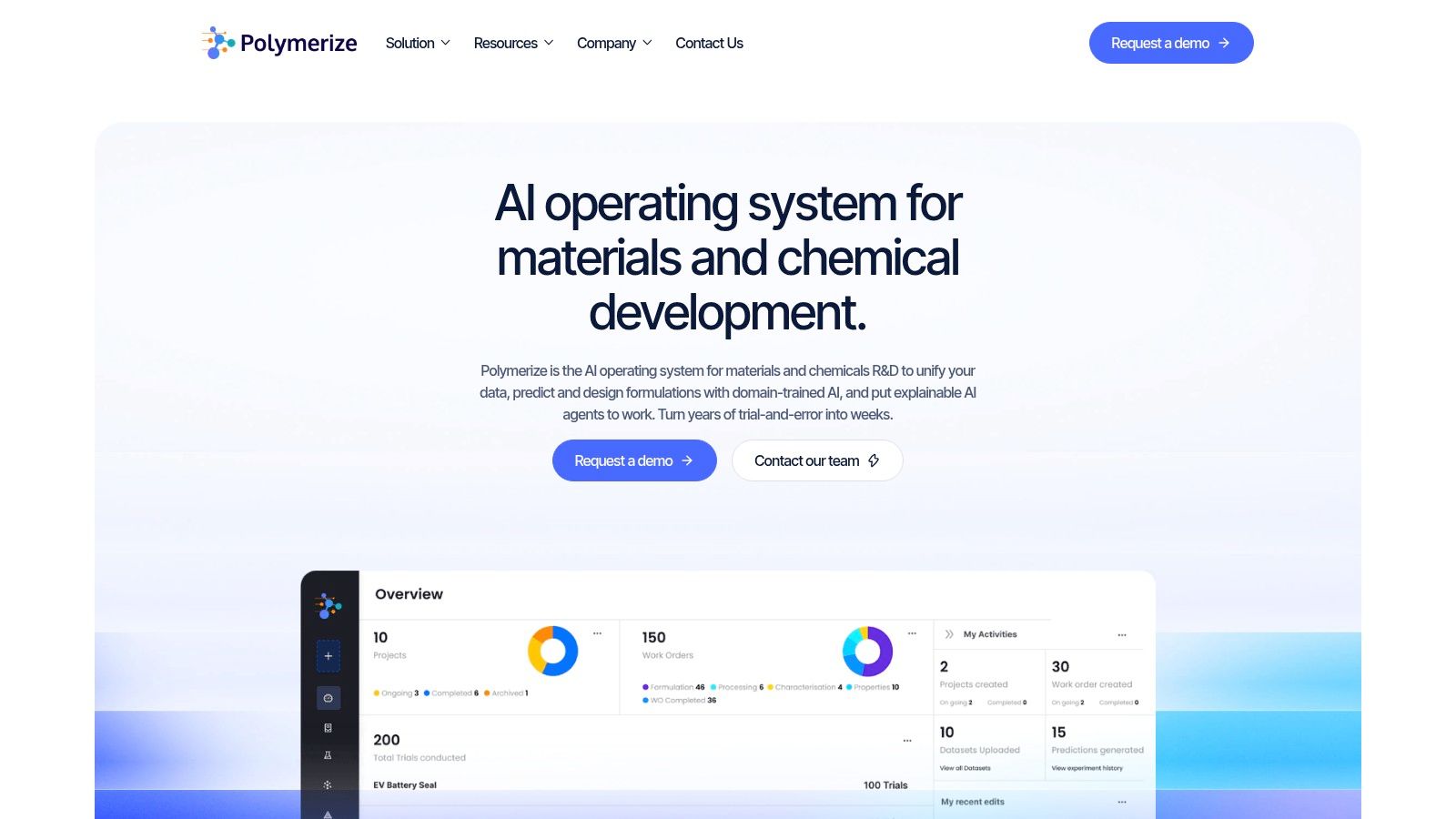
Prediction changes when data becomes connected
In most organizations, stability knowledge exists, but it isn't usable. One scientist remembers that a certain antioxidant package failed under light. Another has old rheology data from a similar backbone chemistry. A third team has packaging trial results that never made it into a shared model.
Once those records are unified, machine learning can do something practical with them. It can identify which formulation variables tend to correlate with drift, which environmental factors matter most, and which candidate experiments are most worth running next. That doesn't replace lab work. It narrows it.
For advanced materials teams, the benefit is not just faster ranking of candidates. It's earlier identification of likely failure drivers such as additive interactions, composition-sensitive instability, or process conditions that push a system toward later breakdown.
AI is most useful before the failure happens
The strongest use of AI in stability isn't reporting. It's preemption.
The provided business context states that Polymerize data shows 50% fewer failed experiments when explainable AI is used to surface causal drivers, and the publisher information notes that customers report up to 50% fewer failed experiments within three months. Used correctly, that kind of workflow helps teams ask better questions before they commit scarce lab time.
A good platform can support work like this qualitatively:
- Predict likely weak candidates early: before full study setup and long hold times.
- Recommend higher-value experiments: so the team tests uncertainty, not habit.
- Surface causal patterns: linking composition, process, storage condition, and observed degradation.
- Preserve institutional memory: so stability lessons don't disappear when teams change.
A short product walkthrough helps make that concrete.
The important shift is conceptual. Stability testing no longer has to be a purely reactive exercise where you wait for the sample to fail and then explain it afterward. With connected data and explainable models, teams can predict where risk is likely to sit, design tighter studies, and spend more effort on candidates that have a realistic path to reliable performance.
If your team is trying to reduce failed formulation cycles and build a more predictive stability workflow, Polymerize offers an AI-native system for materials R&D that connects fragmented experimental data, surfaces causal drivers, and helps scientists plan the next best experiment with more confidence.
Put your R&D data to work
See how materials teams use Polymerize to plan fewer experiments and reach target properties faster.