

You can do everything right on the bench, still end up with RNA that looks fine on NanoDrop and fails the downstream assay. That usually shows up as messy Ct values, weak cDNA synthesis, or a sequencing library that tells you the sample carried phenol, salts, or degradation into the next step. A TRIzol RNA extraction protocol fixes that only when the workflow is handled with discipline, because yield and integrity depend on timing, phase separation, and how carefully you treat the pellet after precipitation.
Table of Contents
- Introduction to Protocol and Objectives
- Materials Reagents and Safety Practices
- Cultured cells and solid tissue need different handling
- Homogenization is the point where most variability enters
- Cleanup is worth it when the downstream assay is strict
- QC should look beyond a single absorbance readout
Introduction to Protocol and Objectives
A poor extraction usually is not subtle. The tube may look normal, the RNA may quantify cleanly, and the downstream workflow still underperforms because the sample chemistry was never controlled from the start. TRIzol remains useful because it separates RNA from DNA, proteins, and lipids in one workflow, but it only works when the procedure is handled as a sequence of fixed decisions, not a loose recipe.
The goal is straightforward, recover RNA that is clean enough for RT-qPCR or sequencing, while keeping enough integrity to trust the result. Institutional protocols point to the same control points, including 0.2 mL chloroform per 1 mL TRIzol, a 15-second shake or inversion, and centrifugation at no more than 12,000 × g for 15 minutes before isopropanol precipitation and a 75% ethanol wash (UConn protocol, Cornell TREx protocol). Those values matter because this workflow depends more on dwell time, phase handling, and centrifugal force than on visual judgment. If you want to buy reagents with fewer surprises in a regulated or shared lab setting, use a Guide on purchasing research chemicals that prioritizes documentation and consistency.
Practical rule: If the aqueous phase looks cloudy or the interphase gets disturbed, stop treating the sample like it can be fixed later. Most downstream problems start there.
This protocol also focuses on sample type, modern QC, and the specific places where TRIzol fails in real labs. Scarce input, plant-rich matrices, and pellets that do not redissolve cleanly all change how much usable RNA you recover. The same workflow can give strong yield from one sample and poor integrity from another if you do not adjust for matrix, carryover risk, and how the pellet is handled after precipitation.
Materials Reagents and Safety Practices
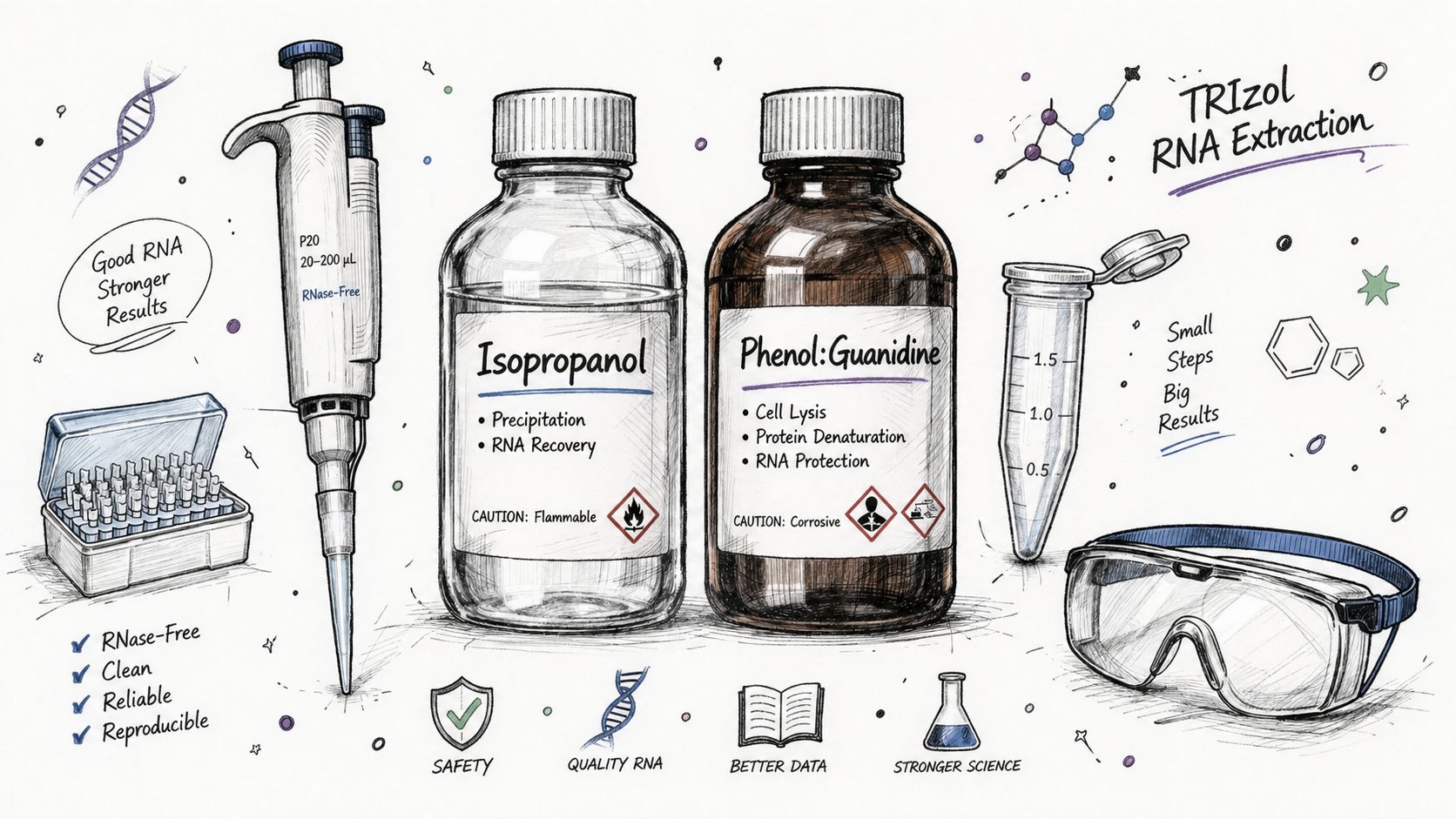
Set up the bench before the tube is opened. Have TRIzol reagent, chloroform, isopropanol, 75% ethanol, RNase-free water, nuclease-free microcentrifuge tubes, RNase-free filter tips, a microcentrifuge that can reach the needed g-force, and a pipette set reserved for RNA work. For low-input samples, keep RNase-free glycogen on hand as a carrier. Small pellets disappear easily during precipitation and wash steps, so a carrier often makes the difference between a visible recovery and a tube you do not trust.
A clean setup matters as much as the reagent list. Handle chloroform and phenol-containing reagents in a fume hood, wear gloves, a lab coat, and eye protection, and keep waste streams separated so organic waste does not end up in aqueous disposal. The workflow depends on protecting the user and the sample at the same time, since RNase contamination and solvent exposure can compromise the same tube.
Sourcing also matters. Use reagents with consistent quality and clear documentation, then check storage conditions before use. If your team needs a broader framework for laboratory chemicals, the Guide on purchasing research chemicals is a practical reference when you are standardizing supplier checks across consumables and solvents.
The chloroform step deserves careful handling because the phase split is unforgiving. A common high-yield workflow uses 0.2 mL chloroform per 1 mL TRIzol lysate, mixed by hand shaking or inversion for about 15 seconds, then centrifuged at 12,000 to 16,000 × g for 10 to 15 minutes at 4°C for clean separation. The tube, rotor, and cold handling all need to be ready before the lysate ever meets chloroform.
Sample Preparation and Lysis Process
Cultured cells and solid tissue need different handling
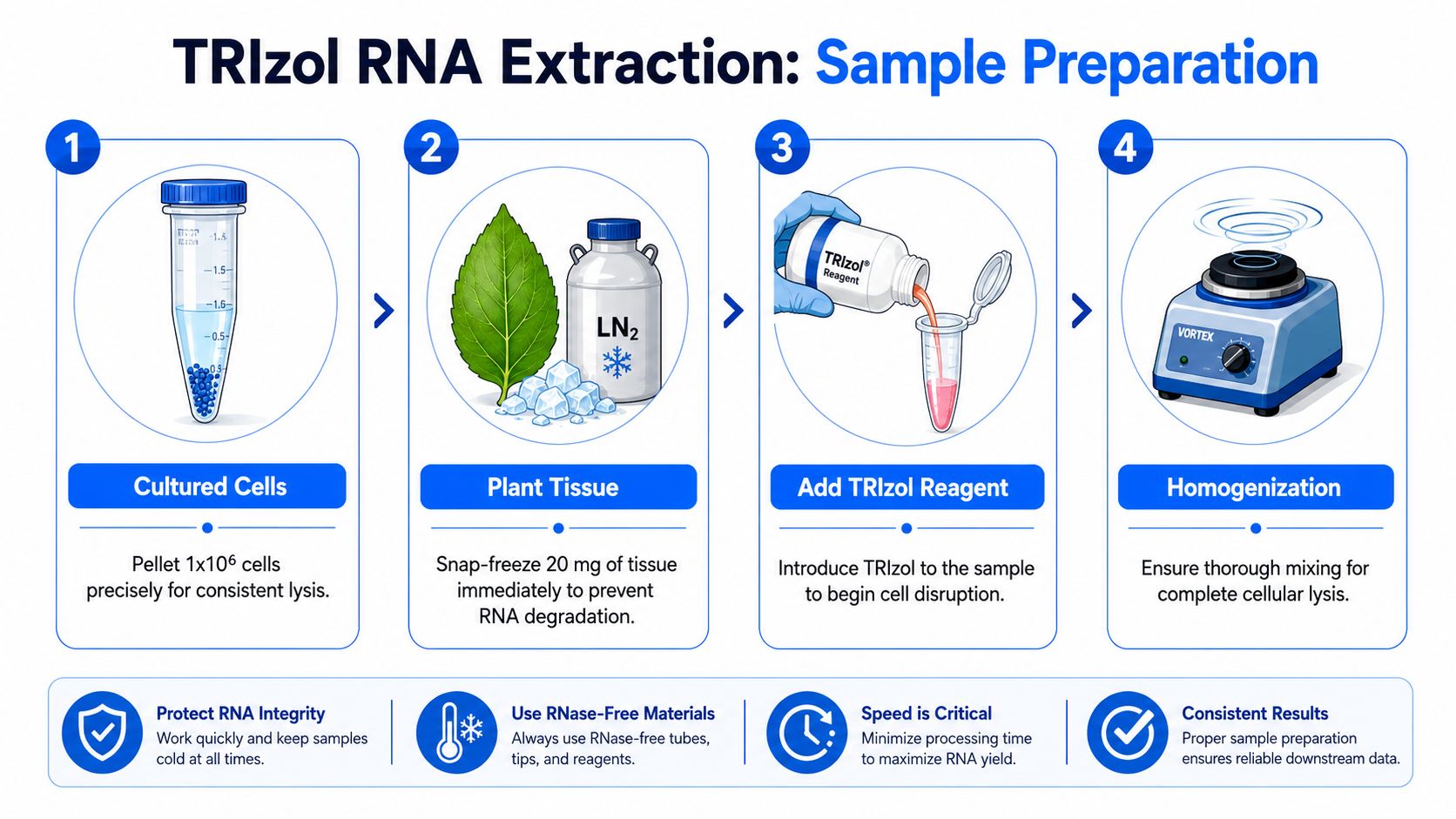
Clean lysis starts before TRIzol touches the sample. Cultured cells should be pelleted in a way that keeps the input defined, while tissue should stay cold during collection and transfer so RNA does not drift into degradation before the reagent has a chance to inactivate RNases. TRIzol can protect the sample once contact is made, but it cannot fix sloppy pre-analytic handling.
Small or fragile inputs often need a carrier to keep recovery visible. For low-input extractions, adding RNase-free glycogen before isopropanol precipitation can help preserve a pellet that would otherwise be hard to see, especially when working from a small aqueous phase. That trade-off is straightforward, more handling steps, but less guesswork when the pellet is faint.
Keep the input defined, keep the tube cold, and do not leave lysis quality to interpretation after the fact.
Homogenization is the point where most variability enters
Bead mills, rotor-stator homogenizers, and careful pipetting for soft material all aim at the same result, fully dissociate nucleoprotein complexes without heating the sample or creating aerosols. A practical workflow keeps the sample moving just long enough to clear visible fragments, then stops before heat buildup starts to work against yield and integrity. If the lysate still looks stringy or gritty, it needs more homogenization, not a faster route to chloroform.
Sample-specific handling matters more than a generic “add TRIzol and mix” approach. In practice, the best yields come from matching the lysis method to the material, then protecting the future aqueous phase from the start so later cleanup is not asked to rescue a poor first pass.
Phase Separation and RNA Precipitation Steps
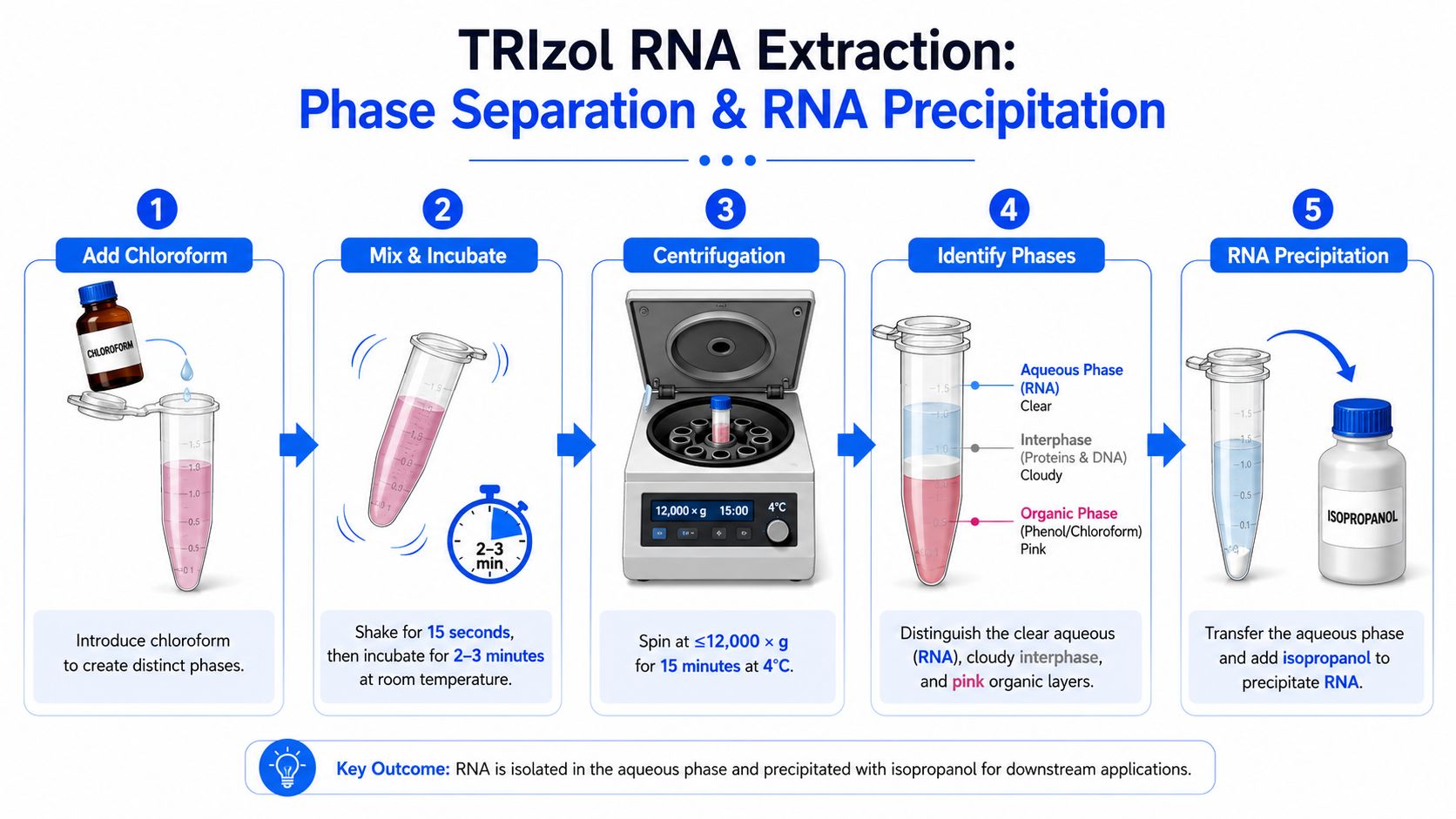
Make the aqueous phase the only layer you trust
Add 0.2 mL chloroform per 1 mL TRIzol, cap the tube tightly, and mix by hand shaking or inversion for about 15 seconds. Keep the agitation gentle, because aggressive vortexing makes phase boundaries less clean and increases the chance of carryover. After mixing, let the sample sit for the specified incubation window, then centrifuge at no more than 12,000 × g for 15 minutes to separate the phases. Transfer the upper aqueous layer carefully and leave the interphase untouched.
The interphase is the part that causes trouble later. If too much of it comes along, phenol and protein can follow into the next step, and the RNA may still pellet while downstream assays suffer from inhibition. Clean transfer is a technique issue, not a matter of luck, and it matters more when working with tough tissues or samples that generate a cloudy separation.
Precipitate, wash, and dry with restraint
Once the aqueous phase is in a fresh tube, add isopropanol and let the RNA precipitate for 10 minutes, then pellet it with the recommended centrifugation step and wash with 75% ethanol using the protocol's defined spin time. The wash removes soluble contaminants that would otherwise interfere with RT, library prep, or other sensitive readouts. For difficult sample types, this is often where a visibly small recovery still hides enough contaminant to affect QC metrics, so the wash needs the same discipline as the phase split.
Drying is the point where experienced users still create avoidable losses. A protocol from Smith warns not to dry the pellet completely because that greatly decreases its solubility (Smith protocol). In practice, the pellet should be free of visible ethanol, but not left as a hard, glassy film that resists resuspension. If the RNA will be used for downstream QC, a pellet that dissolves quickly is usually a better sign than one that sat exposed to air for too long.
A pellet that won't dissolve is often a drying problem, not a yield problem.
Optional Cleanup DNase Treatment and QC Methods
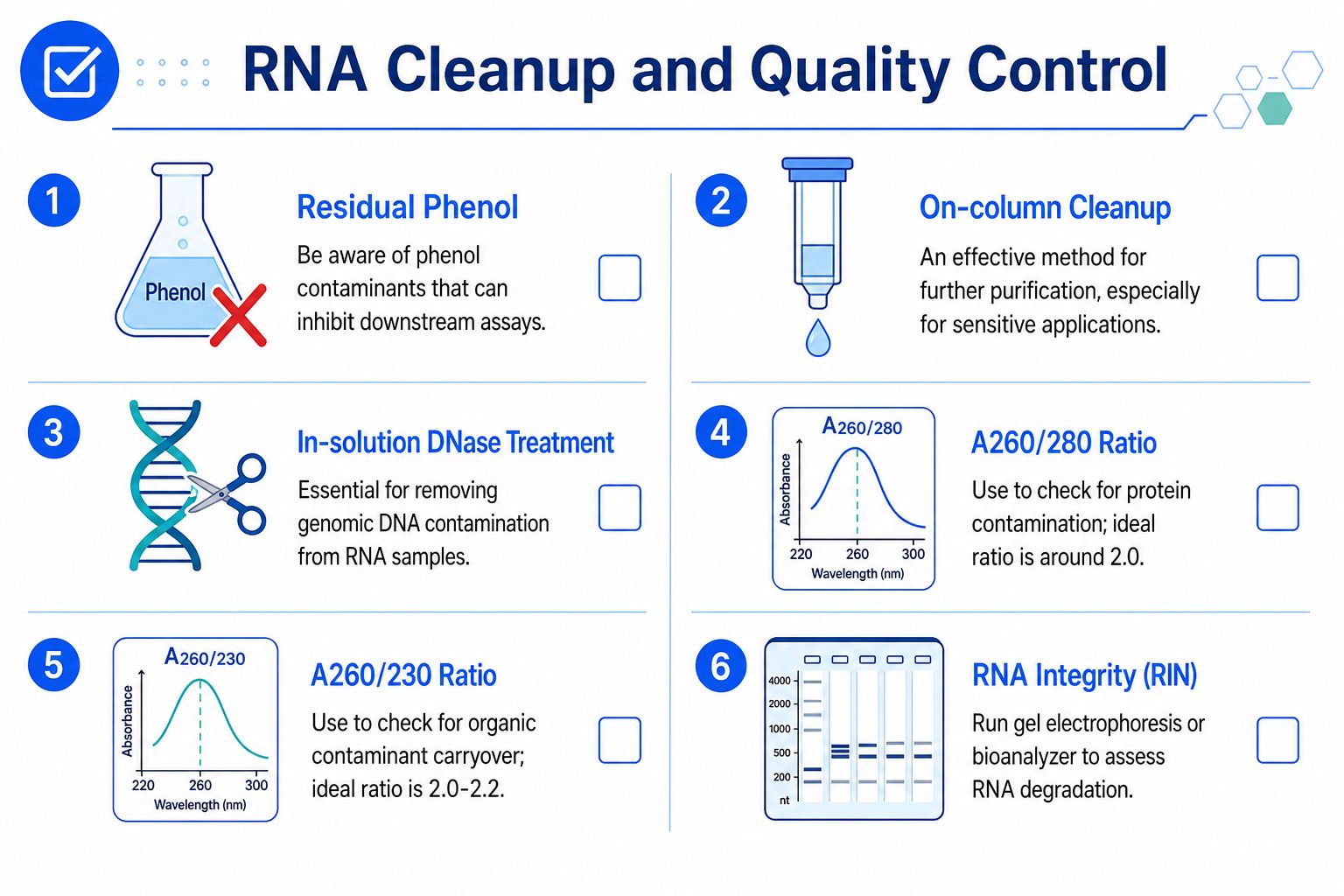
Cleanup is worth it when the downstream assay is strict
TRIzol often gives a usable pellet on the first pass, but that does not always mean the RNA is ready for a demanding assay. If the sample is going into sensitive RT-qPCR, sequencing, or any workflow that reacts badly to inhibitors, cleanup is a risk-reduction step, not a cosmetic one. Residual organic carryover can still compromise assay compatibility, so decide early whether the extract needs another purification step before you hand it off.
The practical choice is usually between an on-column cleanup and an in-solution DNase treatment. On-column cleanup works well when you want a quick way to remove contaminants after extraction, while in-solution DNase is the better fit when genomic DNA contamination matters and you want to avoid another binding step that can cost material. The right choice depends on whether your main problem is purity, DNA carryover, or low sample input.
QC should look beyond a single absorbance readout
NanoDrop has a place, but it does not tell you whether the RNA is analytically trustworthy. Protocols often recommend absorbance-based quantification, yet they also warn that pellet overdrying or organic carryover can reduce quality, and the pellet should not be dried completely because that hurts solubility (Smith protocol). Treat absorbance as a first screen, not the final decision.
Use A260/280 and A260/230 as contamination checks, then confirm integrity with gel-based assessment or a bioanalyzer-style readout if the downstream application depends on fragment size. I trust an extraction when the RNA dissolves cleanly, behaves the same way across batches, and gives a profile that fits the assay coming next. For transcriptomics, that bar should be higher than “the concentration looks fine.”
Troubleshooting Tips and Final Thoughts
Low yield in TRIzol is often a sample chemistry problem, not a reagent failure. For tissues rich in polyphenols or polysaccharides, adding sodium citrate and NaCl during isopropanol precipitation can improve purity, which is a strong sign that matrix composition drives the failure mode (BOC Sciences protocol). That adjustment is especially relevant for plant, agrifood, and biomaterials samples where the chemistry is less forgiving than in standard cell culture.
Brownish pellets, cloudy aqueous layers, and sticky resuspensions usually point to phase transfer mistakes or contaminant carryover. If the aqueous phase is hard to recover cleanly, slow down at the transfer step and leave a little volume behind rather than chasing every drop through the interphase. If the pellet is stubborn, don't keep overdrying it, and don't assume more force will fix the problem.
Batch consistency matters too. Use the same rotor, the same cold room habits, the same transfer order, and the same QC checkpoints so results can be compared across runs instead of interpreted sample by sample. In materials and bio-based R&D, that discipline is what turns RNA extraction from a routine prep step into data you can defend.
If you're standardizing RNA workflows across variable sample types, document the protocol details, the QC readouts, and the failure modes in one place, then review them before the next extraction batch. For teams building that kind of reproducible experimental memory, A CTA for Polymerize.
Put your R&D data to work
See how materials teams use Polymerize to plan fewer experiments and reach target properties faster.