


A formulation team has a promising AI pilot, a folder full of historical experiments, and a dashboard that looks impressive in a steering meeting. Then a chemist tries to use the recommendation during a real development program. The data needs cleaning, the result can't be traced back to its source, the tool doesn't fit the existing ELN workflow, and nobody knows who owns the next step. The pilot hasn't failed technically. It has failed to become part of the work.
That distinction defines a practical technology adoption strategy for materials R&D. Adoption isn't a procurement milestone or a software launch. It's the deliberate redesign of how scientists plan experiments, capture evidence, evaluate uncertainty, and transfer formulations from lab to production. Enterprise technology spending reached 1.85 trillion U.S. dollars in 2022, more than 16% higher than the previous year, while cloud technologies were used by over 90% of organizations globally by 2023. Public cloud spending also surpassed 560 billion U.S. dollars, according to TEKsystems' enterprise AI adoption overview. The infrastructure is no longer the unusual part. Making it useful inside a formulation workflow is.
Table of Contents
- Data readiness starts with location and meaning
- People and process determine whether the backbone gets used
- Score the blockers that budgets hide
- Create a backbone that scientists can trust
- Select the pilot around a decision, not a demo
- Use a disciplined 90-day shape
- Measure the work, not the launch
- Decide when a pilot deserves scale
- Scale by similarity, not by org chart
Why Materials R&D Needs a Different Adoption Playbook
A generic digital transformation program often starts with a capability. Materials R&D needs to start with a decision. Which experiment should happen next? Which formulation variable is driving a property change? Can a result be defended months later when a customer, auditor, or manufacturing team asks how the recommendation was produced?
Those questions make adoption unusually demanding. Formulation work combines variable experimental conditions, incomplete observations, proprietary compositions, instrument output, operator judgment, and scale-up constraints. A model can produce a plausible prediction while still being unusable if the team can't see the source data, understand its confidence, or reproduce the underlying experiment.
A pilot may look successful because a model performs well against a prepared dataset. The lab experiences success differently. Scientists need to enter or retrieve information without creating duplicate work, compare results across projects, understand why a recommendation appears, and preserve a defensible record of what happened. A tool that improves a model while adding a hidden documentation burden won't survive contact with a busy lab.
Adoption has moved beyond isolated pilots
Enterprise technology adoption is uneven by design. In 2023, 92% of leaders reported cloud adoption at a small or large scale, compared with 61% for big data and analytics, 36% for AI, and 32% for IoT, as documented by WalkMe's digital transformation statistics. The pattern matters for materials leaders. Cloud infrastructure can become a baseline before teams have the governance, data quality, and workflow confidence required to scale AI.
The same source reports that 49% of organizations were piloting or considering AI, while 28% were piloting or considering IoT. That gap isn't a reason to chase the newest tool. It's a reason to sequence adoption around business readiness. A materials team should first establish how experimental data is structured, who can access it, and what a successful decision looks like before adding more advanced prediction.
Practical rule: Buy technology to support a changed workflow, not to decorate an unchanged one.
Start with the first success moment
The most useful question isn't, “How do we roll out AI?” It's, “What should a scientist accomplish successfully for the first time?” That might be finding a comparable formulation, generating a traceable next-experiment recommendation, or reviewing a property prediction with enough context to decide whether to trust it.
A practical sequence is to define that first success moment, map the shortest path to it, remove the largest friction point, and measure one primary signal. This approach is consistent with the practical AI guide for executives, which emphasizes connecting adoption to business outcomes rather than treating product activity as proof of value.
For materials R&D, good adoption means the system changes experimental behavior. Scientists spend less time reconstructing history, teams reuse knowledge instead of recreating it, and process engineers receive evidence they can follow from formulation through scale-up. That is the standard the rest of the strategy should meet.
Assessing Readiness Without Boiling the Ocean
Readiness assessments fail when they become broad audits with no decision attached. A formulation organization doesn't need a perfect inventory of every file before it can learn where adoption will break. It needs a focused snapshot of the conditions that determine whether a scientist can reach the first success moment.
Assess four dimensions, then score each one using a simple qualitative scale such as weak, workable, or ready. The score isn't a maturity badge. It's a prioritization device.
Data readiness starts with location and meaning
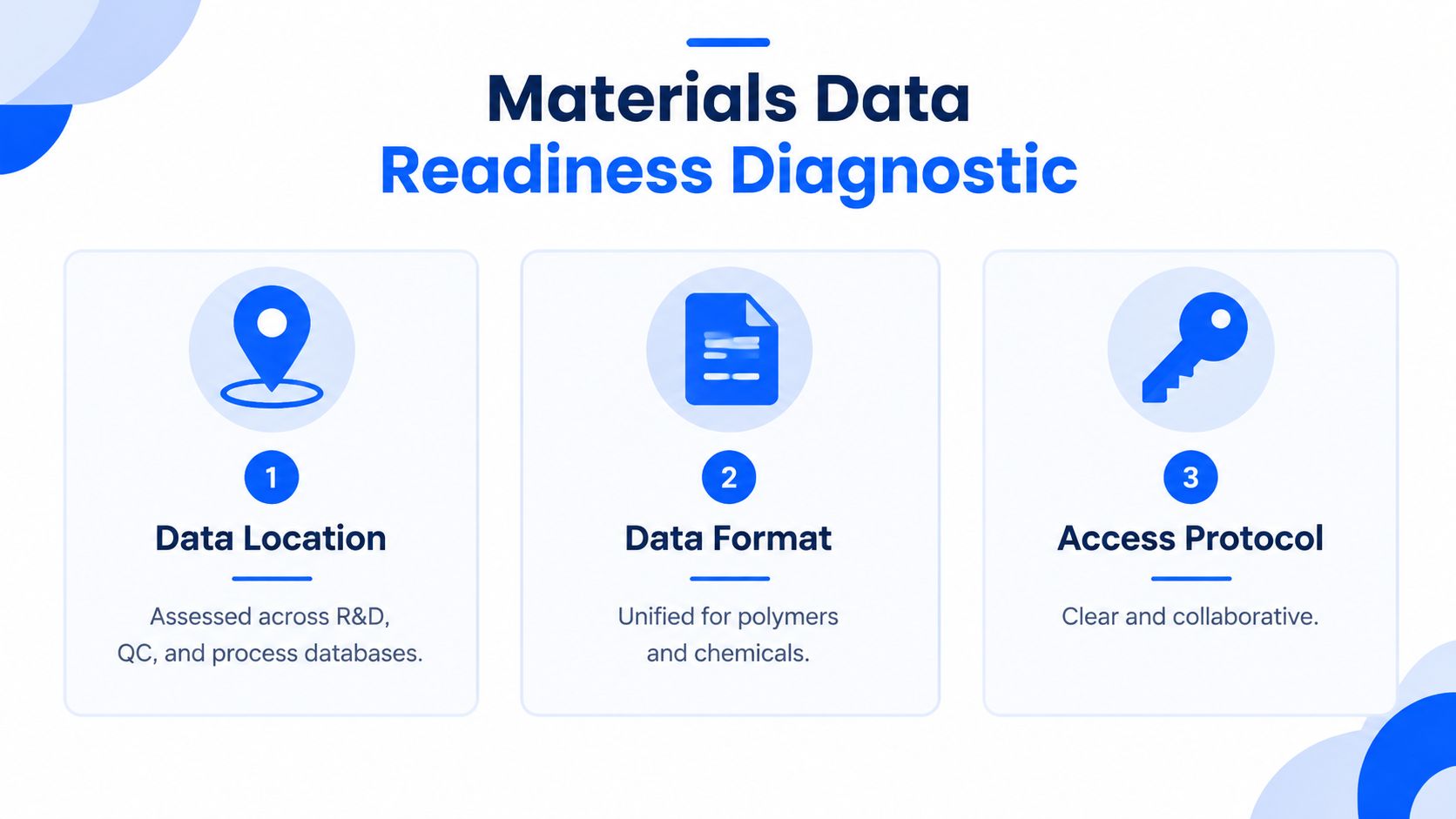
First, map where experimental evidence lives across R&D, quality control, and process databases. Include spreadsheets, ELNs, laboratory instruments, shared drives, databases, and personal working files. Location alone isn't enough. Record what each source contains, who maintains it, how often it changes, and whether another scientist can interpret it without asking the original author.
Then inspect format. A property value without units, a resin grade without a clear identifier, or a processing condition recorded in free text may be searchable but not reliably comparable. An AI-ready schema should connect materials, formulations, ingredients, methods, instruments, conditions, properties, outcomes, and provenance. It should also preserve uncertainty and missingness rather than converting incomplete records into apparently precise data.
People and process determine whether the backbone gets used
Model literacy doesn't mean every chemist needs to become a data scientist. It means users can interpret a prediction, recognize when a result is outside the model's experience, and explain what evidence supported an experimental choice. Identify the scientists who can act as translators between domain knowledge and data practice. Their role is often more valuable than a generic training program.
Process readiness asks whether the new workflow has an owner. Who approves a schema change? Who resolves conflicting material identifiers? Who decides whether a recommendation can guide an experiment? If those responsibilities remain vague, the platform becomes another repository rather than a working system.
Score the blockers that budgets hide
The UK government's rapid evidence review identifies financial cost as a significant barrier for 33% of respondents and skills gaps for 25%, as reported in its review of advanced technology adoption barriers. The OECD material cited in the same verified evidence highlights maintenance costs, training time, and hardware costs as major SME digitalisation barriers.
Use those findings as prompts, not as a reason to delay. Add maintenance ownership, training capacity, legacy integration, cybersecurity review, and executive sponsorship to the readiness snapshot. The output should be a short backlog with a sequence:
- Fix first: Issues that prevent a scientist from completing the first success moment.
- Work around: Imperfections that can be contained with a defined operating procedure.
- Defer deliberately: Improvements that add polish but don't affect the pilot decision.
Sometimes the right move is to repair data before modeling. Sometimes a narrow pilot can expose which fields matter most, using imperfect historical data while enforcing better capture prospectively. The decision depends on whether poor data blocks a trustworthy decision or merely limits broader generalization. A focused diagnostic preserves momentum without pretending that readiness is binary.
Building an AI Ready Data Backbone and Choosing Pilots That Prove Value
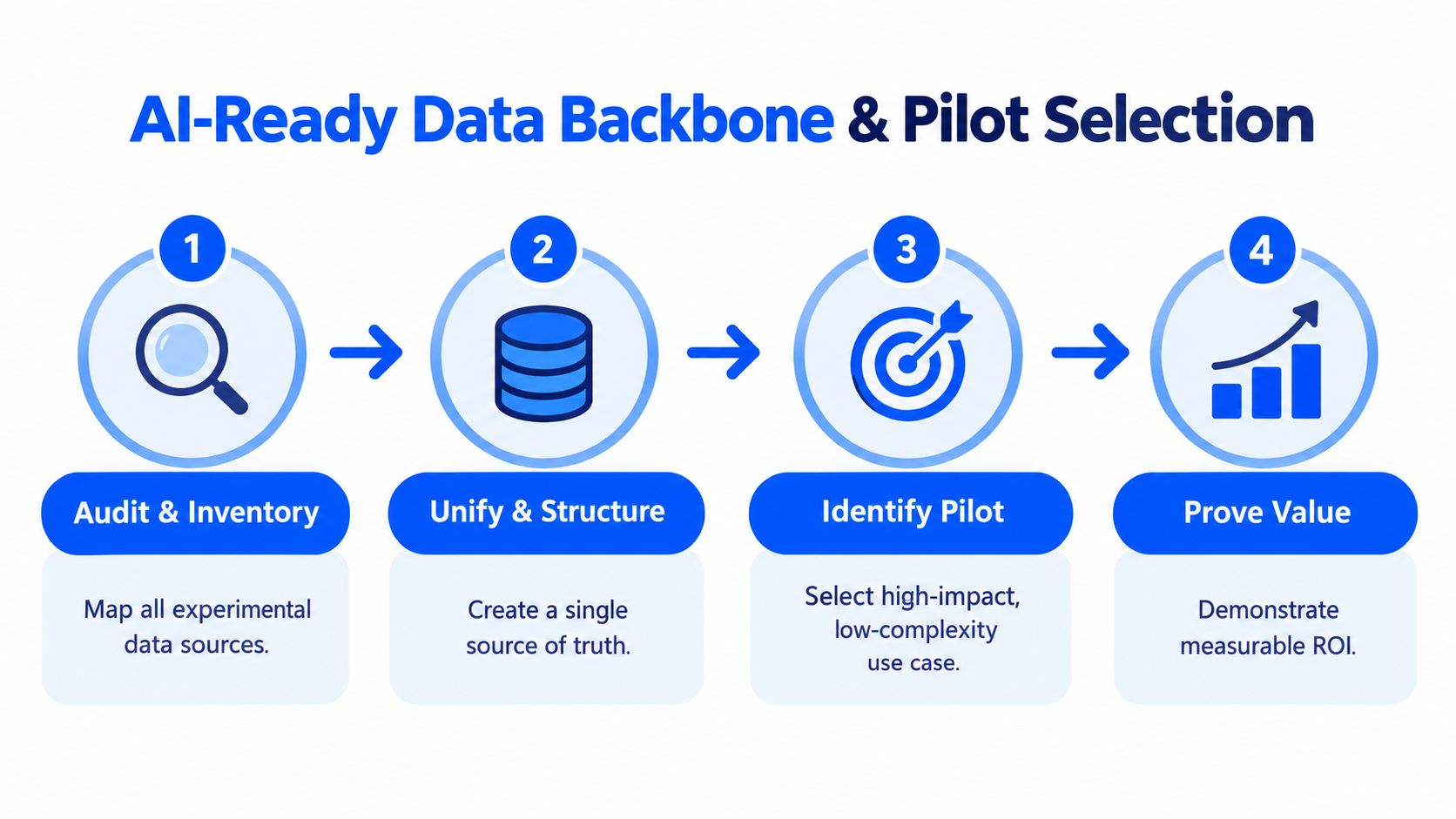
Data foundation and pilot selection should be one workstream. If the team builds a warehouse without a live use case, it may optimize for storage rather than decisions. If it launches a pilot without a usable backbone, the team may mistake manual data preparation for product value.
Start by inventorying the evidence required for a specific R&D decision. For a formulation recommendation, that could include ingredient identities, concentration ranges, processing conditions, test methods, measured properties, batch context, and failed experiments. Define the minimum viable record before importing everything. A smaller, coherent dataset is more useful than a large collection whose identifiers and units cannot be reconciled.
Create a backbone that scientists can trust
The backbone should provide a single working view of experimental evidence while retaining links to source records. It needs structured fields for common materials and chemicals, flexible capture for unusual experiments, role-based access for sensitive IP, and data provenance that shows how a value entered the system.
A platform such as Polymerize Connect represents this pattern by unifying experimental data from fragmented sources into a centralized, secure environment with collaboration, provenance, and workflow dashboards. The product choice is less important than the design test: can a scientist locate relevant history, understand its context, contribute new evidence, and retrieve the result later without rebuilding the record?
Build validation into ingestion. Flag missing units, duplicate identifiers, impossible ranges, and incompatible test methods. Preserve the original value alongside any normalized representation. For model use, store the dataset version, feature preparation, model version, prediction, confidence information, and resulting experiment. That chain gives scientists a basis for judgment and gives governance teams a basis for review.
Select the pilot around a decision, not a demo
Use the first-success-moment method:
- Define the moment. Write the exact decision a target user should make, such as selecting a next experiment from comparable formulations.
- Map the shortest path. List every step from login or setup to the decision. Include data retrieval, approval, interpretation, and handoff.
- Remove the largest friction. If missing historical context is the obstacle, fix retrieval before adding model complexity. If scientists distrust opaque outputs, add explanations and precedent records.
- Choose one primary signal. Measure a business outcome such as failed-experiment reduction or time to the next defensible experiment. Avoid treating clicks, logins, or walkthrough completion as the result.
Strong pilot candidates usually have a bounded workflow, accessible data, a visible user group, and a decision that repeats often enough to learn. Examples include prioritizing candidate formulations, finding comparable historical experiments, identifying likely drivers of a target property, or recommending processing conditions for a defined material family.
Use a disciplined 90-day shape
A practical pilot can follow this rhythm without turning the calendar into a promise of guaranteed results:
- Weeks 1 to 3: Confirm the decision, users, data sources, security requirements, baseline workflow, and primary KPI.
- Weeks 4 to 6: Connect priority data, resolve identifiers, test the workflow with representative users, and document exceptions.
- Weeks 7 to 10: Run the pilot inside real project work. Capture predictions, user decisions, overrides, and reasons for rejection.
- Weeks 11 to 13: Review the KPI, data quality, user feedback, support burden, and governance record. Decide whether to stop, redesign, or harden.
The pilot isn't a miniature enterprise rollout. It's a controlled test of workflow fit, evidence quality, and decision value.
A short demonstration can help users see the intended behavior before they encounter the live workflow. The following video can serve as a visual reference for teams discussing data management and pilot selection:
Governance Compliance and IP Protection That Enable Speed
Governance becomes a drag when it arrives as a review queue after the workflow has already been designed. It enables speed when the rules are embedded in the daily path, so scientists know what they can do, what requires review, and what evidence they need to preserve.
Materials organizations should distinguish between lightweight governance for exploration and stronger controls for decisions that affect regulated submissions, customer commitments, or production release. Both need traceability. They don't need the same approval burden.

Compare governance by consequence
| Governance approach | Appropriate use | Required controls | Main risk |
|---|---|---|---|
| Lightweight exploratory | Internal hypothesis generation and early formulation work | Access control, source tracking, clear labeling of predictions | Users may treat exploratory output as validated evidence |
| Controlled development | Decisions that guide formal experiments or customer-facing work | Dataset and model versioning, review records, confidence context, approval ownership | Review steps can slow work if they aren't integrated |
| Formal release governance | Production transfer, regulated evidence, or high-consequence decisions | Complete lineage, documented validation, separation of duties, retention rules | Excessive process can push users toward shadow tools |
Security controls should reflect the value of the IP and the sensitivity of the work. Polymerize describes an enterprise control model built around ISO 27001 and SOC 2 controls, role-based access, and GDPR/CCPA compliance. Other platforms can be evaluated against the same requirements. Ask where data is stored, who can export it, how access is revoked, and whether administrators can reconstruct a model-assisted decision.
Make explainability part of the user interface
A formulation prediction needs more than a value. Scientists should see the relevant inputs, comparable historical precedents, influential variables, confidence context, and known boundaries. Explainability doesn't remove uncertainty. It makes uncertainty visible enough for an expert to use.
Record the complete decision path. Store the input dataset, preprocessing rules, model version, prediction, confidence score, user interpretation, experiment selected, and observed outcome. This record supports learning as well as auditability. A rejected recommendation can reveal a missing constraint or a domain rule that the model didn't encode.
Governance should answer “what happened and why” without forcing the scientist to leave the workflow.
Avoid blanket restrictions that encourage shadow AI. Define approved tools, permitted data classes, review thresholds, and escalation paths. Give scientists autonomy within those boundaries, then use stage gates when a result moves from exploration to formal development. The aim isn't to make every experiment bureaucratic. It's to make the important decisions defensible.
Driving Change Measuring Impact and Scaling What Works
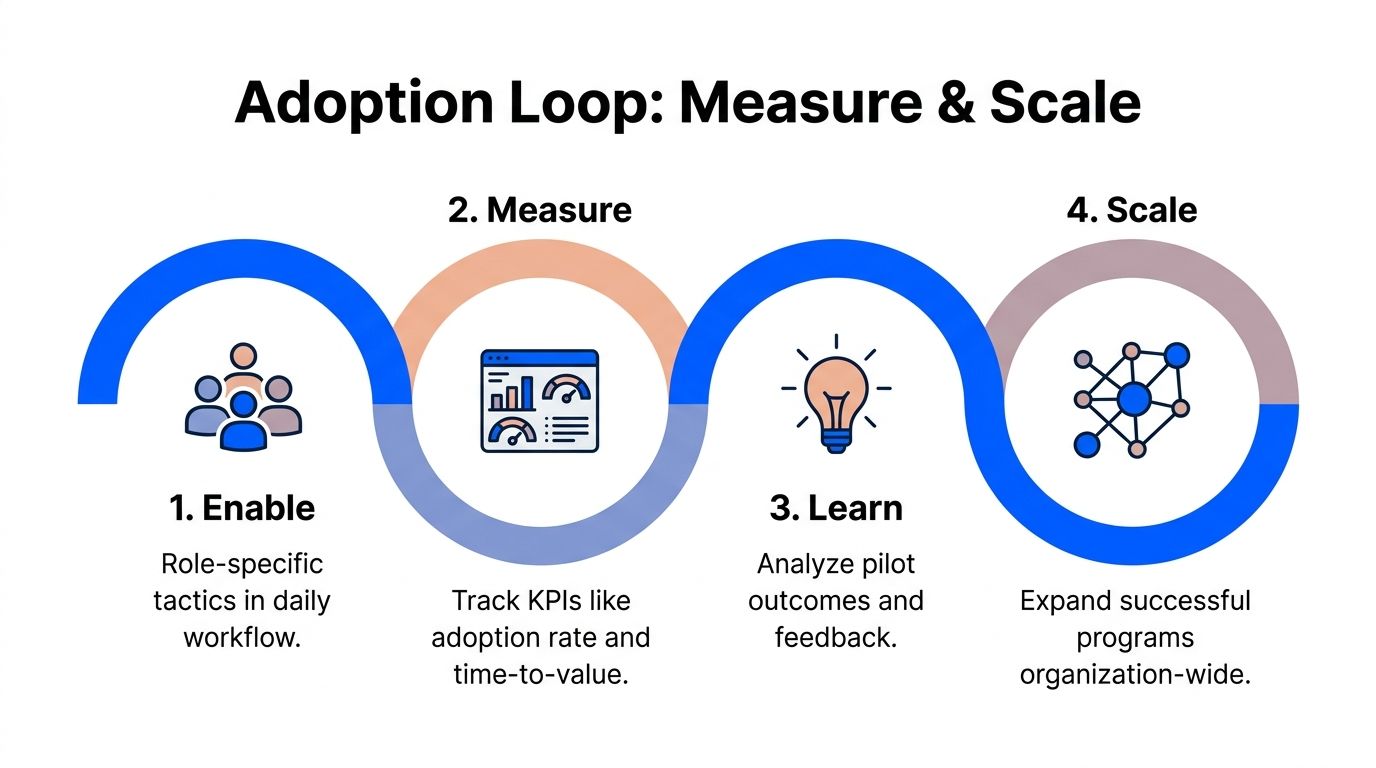
A pilot becomes durable only when people can perform the new workflow under normal pressure. One training session won't achieve that. Formulation scientists need role-specific examples, in-workflow prompts, quick help when data is missing, and managers who reinforce the new behavior during project reviews.
A chemist needs to know how the system changes experiment planning. A data steward needs to know how to resolve identifiers. A project leader needs to know how to interpret the KPI and challenge a recommendation. A process engineer needs to know what evidence is required before scale-up. Training should reflect those differences.
Measure the work, not the launch
The strongest adoption measures connect system behavior to operational outcomes. Track sustained use of the target workflow, completion of required data fields, time from question to defensible experiment, error or rework patterns, and the quality of handoff between lab and process teams. Use support requests and override reasons as diagnostic evidence, not as proof that users are resistant.
A digital transformation benchmark cited by Market.us reports that only about 35% of digital transformation initiatives are successful, while around 70% fail mainly because of employee resistance and only 16% of organizations report sustained performance improvement afterward. Those figures reinforce a practical point: launch completion is a weak gate. Sustained behavior and measurable workflow improvement are stronger gates.
A useful adoption loop is enable, measure, learn, and scale.
Decide when a pilot deserves scale
Use explicit gates rather than enthusiasm from a successful demonstration. The pilot should advance when users can complete the target workflow, the primary KPI moves in the intended direction, data lineage is intact, exceptions are understood, and support demand is manageable. It should pause when users need manual workarounds, predictions can't be explained, or integration effort is consuming the value being tested.
For leaders building a broader change program, Prometheus Agency's guide to change management for AI adoption offers useful context on treating behavior change, communication, and reinforcement as operational responsibilities rather than launch communications.
| Use Case | Workflow Fit | Integration Effort | Primary KPI Gate |
|---|---|---|---|
| Historical formulation retrieval | High if scientists already search past work | Low to moderate | Time to find usable precedent |
| Next-experiment recommendation | High when decision criteria are explicit | Moderate | Time to a defensible next experiment |
| Property prediction | Moderate when test methods are consistent | Moderate | Decision usefulness and justified override rate |
| Cross-site scale-up support | Variable until identifiers and methods align | High | Handoff completeness and rework reduction |
Scale by similarity, not by org chart
The first expansion should usually go to a related material family or adjacent workflow where the data model and user behavior are similar. Then add another site or team after validating local constraints. Multi-site rollout before harmonizing terminology, methods, and access rules creates apparent scale without comparable evidence.
A practical roadmap moves from one contained workflow, to a related project group, to a site-wide operating pattern, and finally to cross-site reuse. At every step, retain the same primary KPI logic while adding local measures for integration, training, and governance. Scaling what works means preserving the decision mechanism, not copying every screen and process unchanged.
Common Pitfalls and How to Avoid Them
The common assumption is that adoption is mainly a leadership and procurement problem. In materials R&D, it's often a workflow redesign and risk-management problem wearing a procurement label. The biggest blockers are usually visible only after the contract is signed: acquisition and implementation cost, legacy integration, cybersecurity exposure, limited training time, and maintenance responsibility.
A UK government evidence review identifies cost and skills as significant adoption barriers. The TABS evidence summarized in the verified research also points to high acquisition or implementation cost, legacy integration difficulty, and cybersecurity risk as frequent organizational priorities. These aren't arguments against adoption. They're design constraints that should shape the pilot.
Fix the failure mode at its source
- High acquisition cost: Start with a decision that has a clear owner and a measurable operational signal. Don't fund a broad platform rollout before proving the workflow.
- Legacy integration difficulty: Connect the smallest useful set of systems first. Preserve source links and define a manual exception path instead of waiting for every integration to be complete.
- Cybersecurity risk: Classify data before ingestion, apply role-based access, and define export and review rules with security teams early.
- Skills gaps: Pair domain scientists with data and product specialists. Teach interpretation and decision use, not abstract model theory.
- Weak reinforcement: Put prompts, examples, office hours, and manager review into the workflow. One-time training teaches features. Repetition changes practice.
- Wrong success metric: Replace clicks and attendance with task completion, decision quality, rework, cycle time, or another primary outcome tied to the first success moment.
Recent evidence on adoption methodology warns that hidden setup burden, weak post-training reinforcement, and vanity metrics can leave adoption below 50%, according to Infostream Global's enterprise technology adoption analysis. Treat that threshold as a warning signal, not a target. If users can't reach value without support, the team should simplify the workflow before expanding it.
Use a hardening checklist
Before moving beyond the pilot, confirm that the team has a named workflow owner, a defined data dictionary, source traceability, role-specific guidance, an exception process, a primary KPI, a review cadence, and a scale decision. The 30-day work should remove the largest friction. The 60-day work should test behavior in live projects. The 90-day decision should determine whether the use case is ready to harden, needs redesign, or should stop.
The strongest technology adoption strategy doesn't ask scientists to become enthusiastic about software. It gives them a faster, more defensible way to make decisions while protecting the evidence behind those decisions.
Polymerize helps materials R&D teams unify fragmented experimental data with Polymerize Connect and apply explainable, AI-guided experiment design through Polymerize Labs. Visit Polymerize to see how your team can build an AI-ready backbone and move a formulation workflow from pilot activity to repeatable value.
Put your R&D data to work
See how materials teams use Polymerize to plan fewer experiments and reach target properties faster.