



The most popular advice in specification development is to “set clear limits early.” That sounds disciplined, but in materials R&D it can be a fast way to freeze the wrong assumptions. A number written before the team understands the failure mechanism, test method, scale-up behavior, and available evidence often becomes an administrative barrier rather than a useful control.
A qualification-ready specification does something more demanding. It turns an intended use into measurable attributes, connects those attributes to suitable tests, accounts for uncertainty, and tells people what decision to make when results are normal, borderline, trending, or out of specification. The document matters, but the decision system behind it matters more.
That distinction has become increasingly important as specification development has expanded from informal technical memoranda into sustained global standards work. The Internet RFC Series began in April 1969 with the publication of “Host Software,” and by 2026 more than 8,500 RFCs had been published across standards, experimental protocols, informational material, and best-practice guidance, as summarized in this history of the RFC process. Formal standards bodies operate at comparable scale. ISO reported 25,703 International Standards and standards-type documents in force at the end of 2024, including 1,533 published in 2024 and 88,739 pages produced that year in the review of ISO standards activity.
The practical lesson is simple: a specification isn't finished when the prose is approved. It's finished when scientists, quality teams, suppliers, and manufacturing operators can use the same evidence to reach consistent decisions.
Table of Contents
What Makes a Material Specification Useful
A useful specification starts with the application, not the test catalogue. The first question isn't “Which properties can the laboratory measure?” It's “Which material behaviors determine whether this product will work in its intended environment?”
That question creates an attribute-to-use map. A coating may need to flow, cure, adhere, and resist a defined exposure. A polymer emulsion may need to form a continuous film at the application temperature while remaining stable during storage and pumping. A powder for additive manufacturing may require controlled flow, thermal response, particle morphology, and finished-part performance. Each requirement should connect to an observable attribute and a decision rule.
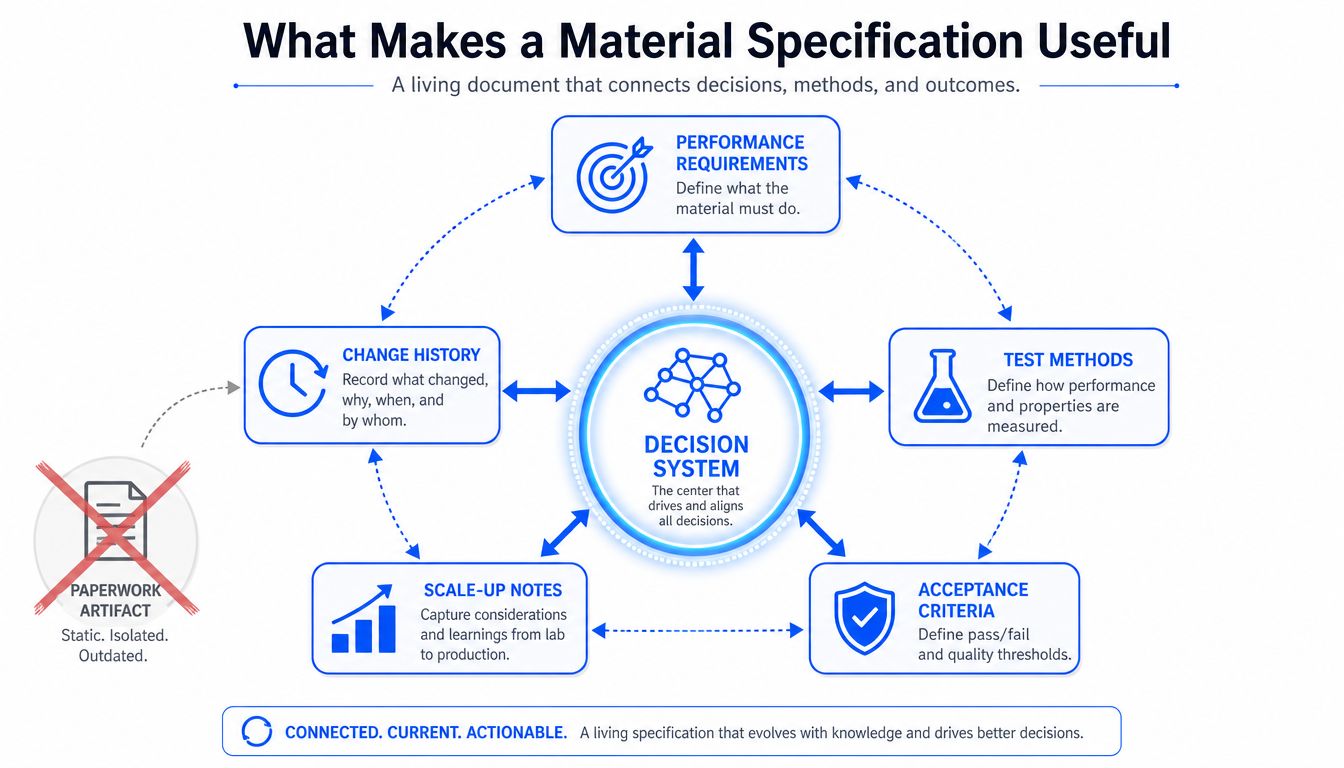
Four conditions separate useful specifications from paperwork
A specification becomes operational when it satisfies four conditions:
- Clear functional mapping: Every critical attribute has a reason tied to end use, processability, safety, or compliance.
- Suitable measurement: The method can distinguish acceptable from unacceptable material under realistic sampling and operating conditions.
- Justified tolerance: The acceptance range reflects functional risk, process variation, and measurement uncertainty rather than personal preference.
- Complete traceability: Reviewers can follow the path from raw observation to calculated result, acceptance decision, deviation, and later revision.
The last condition is often neglected. A limit may look precise while hiding an unstable sample-preparation step, an instrument effect, or a result that sits at the edge of the method's reliable range. That apparent precision can create arguments between R&D and quality instead of improving control.
Practical rule: If a limit can't be defended through intended use, method performance, and batch evidence, label it provisional rather than presenting it as a mature release criterion.
Consider a powder-coating reformulation. An early development team might freeze a particle-size limit because the first formulation produced a narrow distribution and the laboratory's existing method made that attribute easy to report. Later, a reformulation could shift the distribution while improving melt flow, film uniformity, and final coating performance. Rejecting it solely because of the early particle-size boundary would make the specification protect an observation, not the product's function.
The specification should therefore record its development status. Screening limits may guide experiments. Provisional limits may support pilot work. Qualification limits should rest on evidence that the attribute, method, and process relationship are understood. A mature specification also records scale-up notes, change history, sample location, and the action required after a borderline result.
For teams building digital workflows, it helps to think beyond a static document. A useful reference is this practical breakdown of what's inside an AI tech pack, because structured inputs, assumptions, requirements, and evidence are just as important in materials work as they are in AI-enabled product development. The same principle applies here: capture the context that lets another person interpret the result correctly.
Define Critical Quality Attributes and Decision Rules
Critical quality attributes, or CQAs, are not the properties a laboratory happens to measure regularly. They're the small set of material characteristics that can materially affect performance, safety, processability, compliance, or downstream reliability.
Start with intended use and failure modes. Ask what can go wrong in application, during storage, during processing, and in the finished product. Then screen candidate attributes against four questions:
- Functional impact: Would a shift plausibly cause a meaningful failure?
- Variability risk: Does the attribute vary across raw materials, batches, operators, or process conditions?
- Measurability: Can the team measure it with a method that has adequate precision and practical availability?
- Process sensitivity: Does it respond to variables that manufacturing can control or monitor?
An attribute that scores highly for functional impact but can't be measured reliably may remain a research variable, but it shouldn't become a release specification until the measurement problem is solved. Conversely, an easy-to-measure property with weak functional relevance may belong in a supporting control panel, not the CQA list.
Use a scoring worksheet to force useful debate
The worksheet below isn't a substitute for engineering judgment. It makes assumptions visible and gives formulation, process, analytical, and quality specialists a common discussion format.
| Candidate Attribute | Functional Impact (1-5) | Variability Risk (1-5) | Measurability (1-5) | Process Sensitivity (1-5) | CQA Decision |
|---|---|---|---|---|---|
| Viscosity | |||||
| Particle size | |||||
| Minimum film-forming temperature | |||||
| Density | |||||
| pH |
A polymer-emulsion development program illustrates the distinction. Viscosity, particle size, and minimum film-forming temperature may carry the functional story because they influence application, dispersion behavior, and film formation. Density and pH can still be valuable controls, especially for batch consistency or process monitoring, but their role needs to be stated clearly. Calling every routine test a CQA dilutes attention and makes deviation review harder.
The decision rule should be written as a complete instruction, not just a number. At minimum, specify:
- the target value or acceptable range,
- the analytical method and relevant method version,
- the sample location and preparation,
- the acceptance boundary,
- the response to a borderline result,
- the response to an out-of-specification result,
- the escalation or investigation owner.
A borderline result may trigger confirmation, trend review, or additional functional testing. An out-of-specification result may require quarantine and formal investigation. Those actions shouldn't be improvised after the result appears.
Write CQAs for the future process
A bench method can make an attribute look more important than it will be in production. A formulation scientist may optimize viscosity under a narrow laboratory shear profile, while manufacturing needs a material that pumps consistently through different equipment. The CQA definition should survive that translation.
The specification should also distinguish discovery targets from qualification criteria. Early targets can be broad enough to support learning. Later criteria should reflect demonstrated process behavior, supplier capability, and end-use risk. This prevents teams from carrying a convenient laboratory boundary into production without proving that it controls the intended outcome.
Select and Validate Fit for Purpose Test Methods
The cheapest test method isn't automatically the most economical choice. A low-cost method that produces disputed results, requires fragile sample preparation, or can't transfer to manufacturing can consume more time than a better-designed method selected at the beginning.
Materials R&D commonly draws from several method families:
- Spectroscopic methods are useful for identity, composition, functional groups, and chemical changes, but interpretation can depend on calibration, baseline treatment, and sample presentation.
- Chromatographic methods can separate and quantify components with strong specificity, although they may require more preparation, reference materials, and operator skill.
- Rheological methods describe flow and deformation, but geometry, shear history, temperature control, and preconditioning can strongly affect results.
- Particle-sizing methods can support powder and dispersion control, yet wetting, dispersion energy, agglomeration, and instrument model can change the reported distribution.
- Performance assays often have the closest connection to end use, but they may be slower, more variable, and harder to use for every lot.
The right choice depends on the decision. If the specification controls pumpability, a fast viscosity test may be more useful for release than a detailed rheological curve, provided the simpler method correlates with the process risk and performs consistently.
Validate the method against its intended decision
Fit-for-purpose validation should address accuracy, precision, range, and transferability. It should also show how sample preparation, operator technique, instrument configuration, and environmental conditions influence the result.
A common rheology scenario makes the trade-off clear. A cone-and-plate method may produce highly precise viscosity values in a development laboratory, but the geometry, cleaning requirements, sample conditioning, and instrument availability may prevent reliable use in manufacturing quality control. A simpler spindle method can become the reference method if the team validates its relationship to the relevant process behavior and defines its operating conditions carefully.
A method isn't fit for purpose because it generates a decimal result. It's fit for purpose when that result supports a repeatable decision.
The most frequent validation gaps are practical rather than theoretical. Teams omit intermediate precision, ignore sample-preparation effects, or write limits at the edge of quantitation because the available data happen to sit there. Those choices create specifications that look rigorous but fail under routine use.
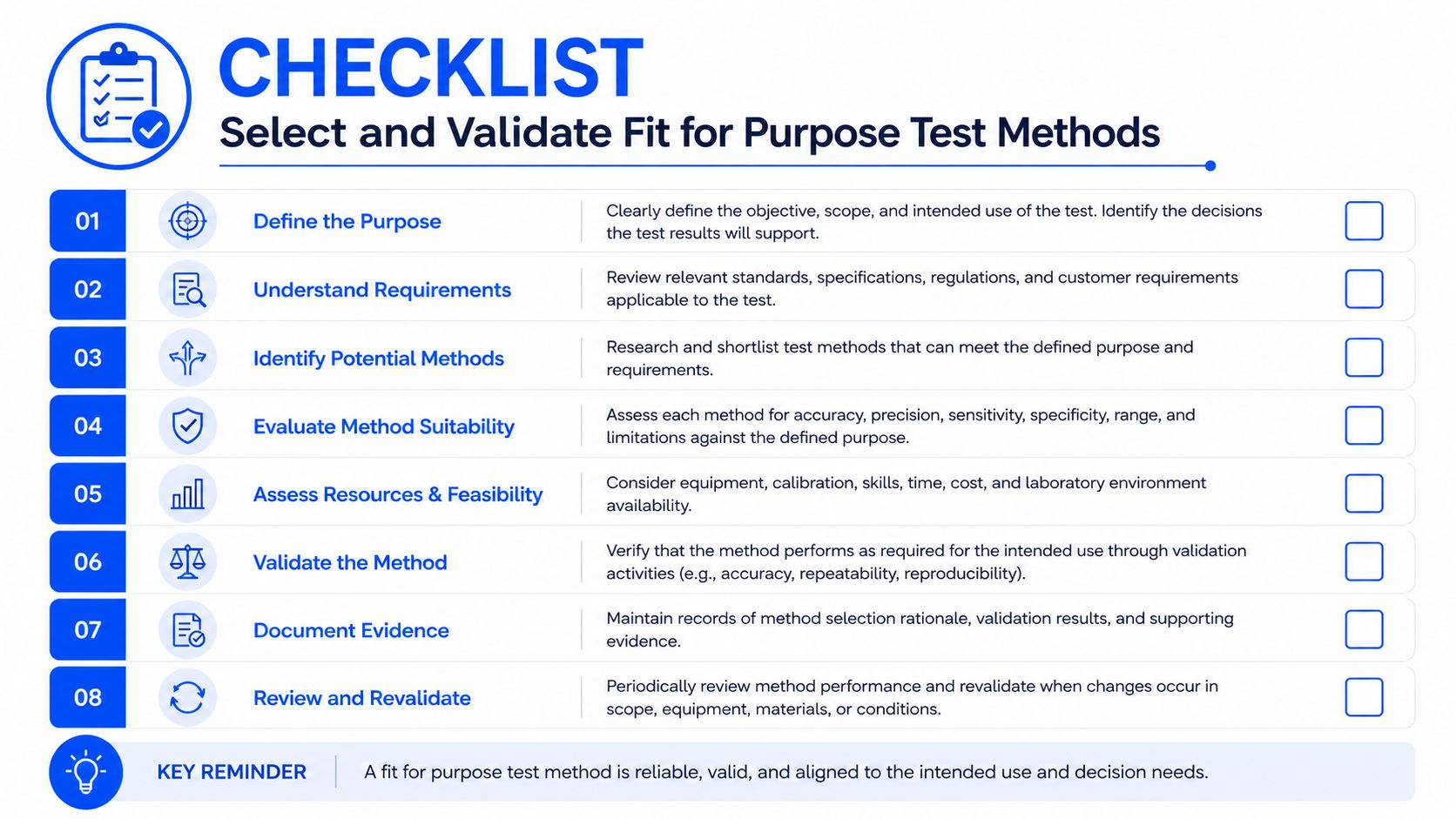
A defensible specification package should allow a reviewer to trace each limit to:
- the method's working range and calibration model,
- repeatability and intermediate precision evidence,
- sample-preparation instructions,
- robustness checks,
- instrument and operator requirements,
- transfer or bridging results,
- the functional relationship supporting the acceptance boundary.
If a test can't transfer between sites, the team should either standardize the equipment and procedure or define a bridging approach. Otherwise, two laboratories may apply the same written specification while measuring different practical quantities.
Set Tolerances and Sampling Plans
Tolerances should emerge from evidence, not from how tidy a table looks. A useful limit combines the expected analytical variation, observed process behavior, functional risk, and development maturity.
During early formulation work, a wide screening window may be appropriate because the team is trying to learn which variables matter. A qualification band should be narrower only when the process, method, and performance relationship justify that restriction. Tightening a limit without understanding the source of variation can increase false failures and encourage unnecessary adjustment.
Separate measurement variation from material variation
The team should estimate analytical variability from replicate results and intermediate precision, then compare it with process variation observed across representative batches. Pilot data can support process capability analysis, including Cpk where the data and assumptions are suitable. The acceptance boundary should leave enough room for measurement noise while still protecting the failure mode.
That doesn't mean every limit should be wide. A safety-critical or performance-critical attribute may require a conservative one-sided boundary. Other attributes may need two-sided limits because values that are too low or too high create different risks. Some properties are better controlled through a maximum allowable variability or a trend limit than through a single release value.
Match sampling to the decision
Sampling plans should reflect where variation can occur:
- Lot sampling checks release conformity.
- Stratified sampling covers different containers, locations, suppliers, or process stages.
- Variable sampling uses measured values and their distribution when the method and assumptions support it.
- AQL-based approaches can be useful for attribute inspection, but they shouldn't replace a functional understanding of the material.
- Process bracketing tests conditions near the edges of important operating ranges rather than relying only on nominal runs.
Sample size should be justified by the desired confidence, observed variability, consequence of failure, and the decision being made. A small sample may be adequate for a low-risk screening experiment, but not for supplier qualification or a material with pronounced within-lot heterogeneity.
| Stage | Tolerance Basis | Sample Size (n) | Acceptance Rule |
|---|---|---|---|
| Discovery screening | Broad functional window and learning value | Defined by experiment purpose | Use results to update the working hypothesis |
| Formulation refinement | Observed performance and analytical variation | Sufficient to compare candidate conditions | Confirm direction, investigate unexpected shifts |
| Pilot qualification | Process variation, method precision, and risk | Justified across representative pilot material | Release only when attribute and performance evidence agree |
| Routine production | Proven process behavior and ongoing trend data | Defined by lot risk and monitoring strategy | Apply release, trend, deviation, and investigation rules |
Retesting needs its own rule. A second measurement should confirm a documented sampling or analytical issue, not replace an unfavorable result. Outlier handling should define when a result can be excluded, who approves the exclusion, and what evidence is retained.
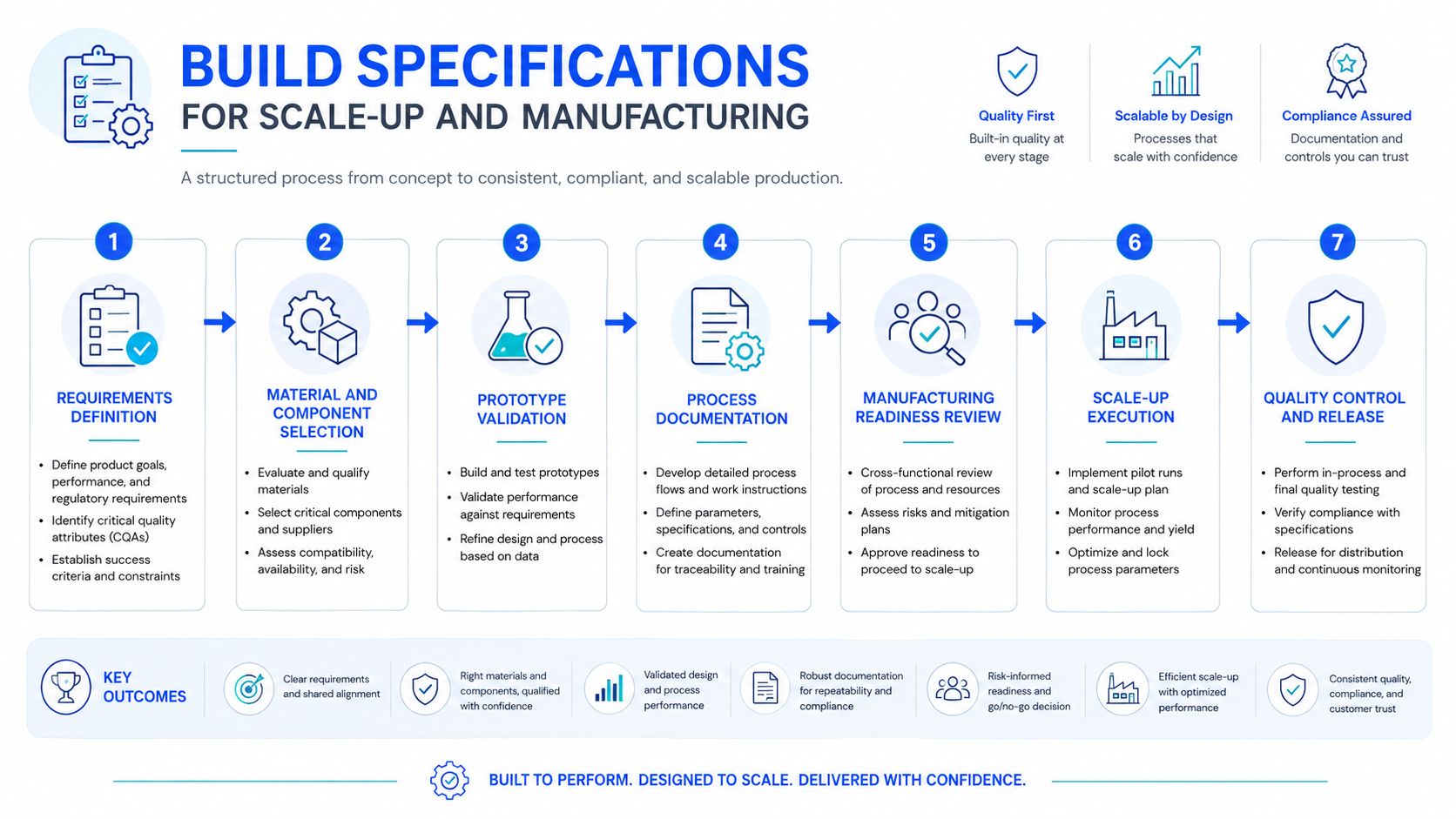
Build Specifications for Scale Up and Manufacturing
Scale-up exposes assumptions that bench work can hide. Mixing geometry changes local shear and circulation. Heat transfer affects reaction or drying history. Residence time shifts with equipment volume and throughput. Operators and automated systems may also introduce different timing, sequencing, and handling variation.
A scale-up-ready specification translates those variables into measurable control points. For a dispersion, that could include solids content, particle-size distribution, viscosity at a defined temperature and shear condition, and hold-time stability. For a polymerization, it may include conversion, residual content, molecular-weight indicators, heat history, and sampling points tied to the process sequence.
Treat the specification as a process map
Each critical variable should have four parts:
- Control point: Where in the process is it measured?
- Frequency: Is it checked per batch, at a process stage, or through continuous monitoring?
- Expected range: What is nominal, and what range has been demonstrated as acceptable?
- Response: What happens when the result trends toward a limit or crosses it?
Design-space thinking helps separate these states. A nominal range describes routine operation. A proven acceptable range captures conditions supported by development and pilot evidence. An edge-of-failure condition signals that the team needs a deviation review, additional testing, or process intervention.
Equipment capability belongs in the same evidence chain. Calibration alone doesn't prove that an instrument or unit operation can deliver the required control. The team should examine repeatability, operating range, maintenance state, and whether the pilot and production equipment produce comparable material histories.
Use bridging studies instead of assumptions
A bridge between sites should compare both the test system and the material outcome. Run representative material through the pilot and production methods, document differences in equipment and sampling, and identify which attributes require site-specific procedures. If a method can't be made equivalent, define a conversion, correlation, or separate acceptance approach that quality reviewers can defend.
The specification shouldn't become so broad that it loses meaning. It also shouldn't become so detailed that routine manufacturing can't execute it. During transfer, add variables that proved scale-sensitive, remove laboratory-only observations that don't control product performance, and loosen any boundary that reflects measurement artifacts rather than real risk. Tighten only when production evidence shows that a narrower range is necessary.
A practical transfer review asks:
- Which attributes changed with equipment geometry or process scale?
- Which laboratory steps have no manufacturing equivalent?
- Which measurements need new sampling locations?
- Which limits rely on data from a single operator or instrument?
- Which out-of-trend signals should trigger intervention before release failure?
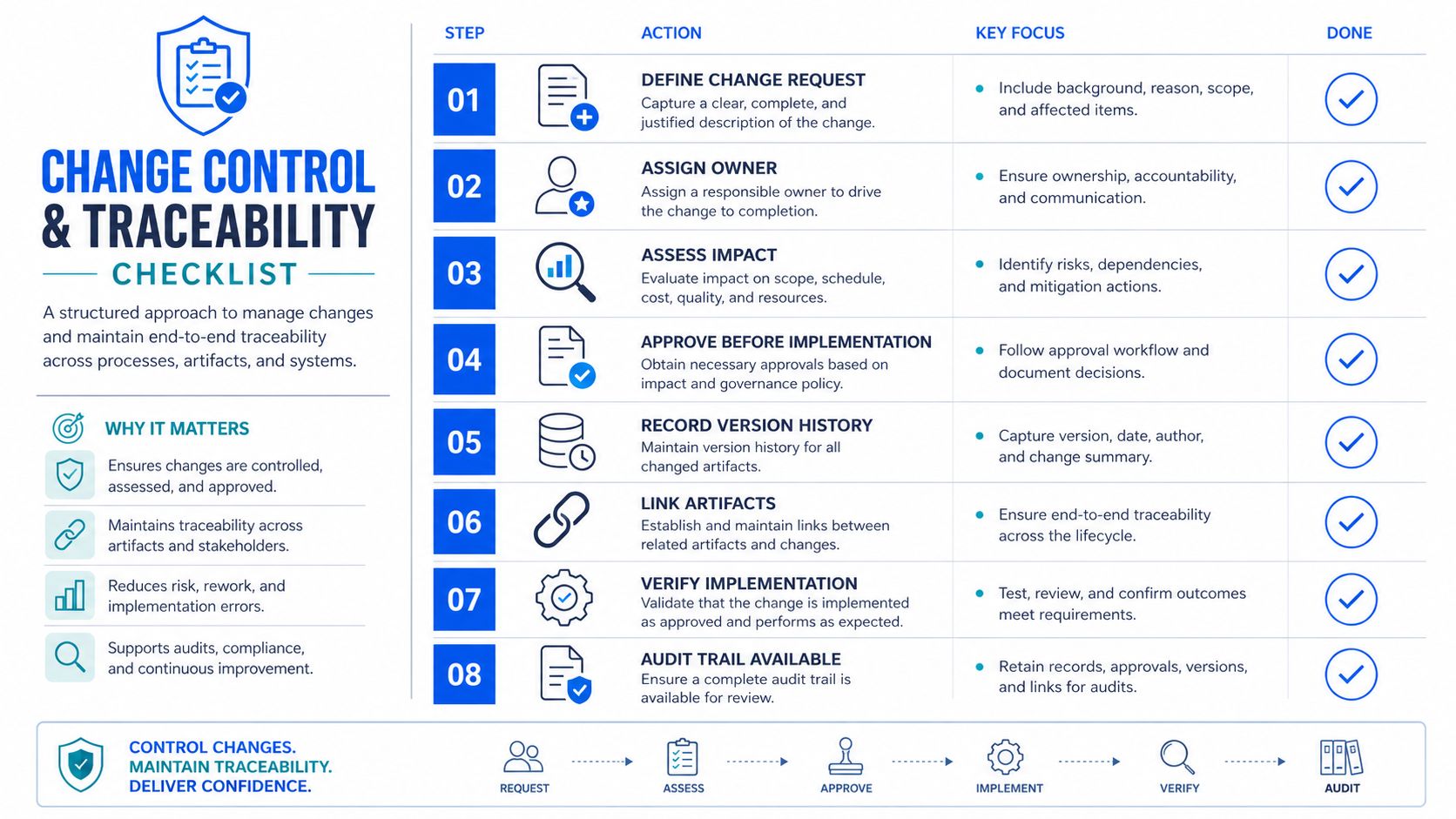
Establish Change Control and Traceability
Specifications remain defensible only when the team can explain how they changed. A living specification needs version control for limits, methods, sampling instructions, acceptance rules, and supporting rationale. Each release should link back to the CQAs, method evidence, batch data, risk assessment, and approvals that support it.
This doesn't require a heavy bureaucracy. A lightweight governance routine can work if it captures the right relationships. Record the original requirement, the evidence used to define the attribute, the method version, the batches evaluated, the known limitations, and the decision made. Preserve deviations and out-of-specification investigations, including the initial result rather than only the final disposition.
Make every change record answer six questions
A practical specification change record should state:
- What changed: Identify the attribute, method, limit, sample instruction, or decision rule.
- Why it changed: Describe new evidence, a supplier change, equipment change, formulation change, or identified defect.
- What supports it: Link the relevant method studies, batch results, functional testing, and risk assessment.
- What is affected: List batches, suppliers, sites, products, and downstream documents.
- Who approved it: Assign roles for R&D, analytical science, process engineering, quality, and regulatory review where applicable.
- When it takes effect: State the effective date, transition requirements, and any retained-material plan.
Supplier-driven changes deserve the same discipline as internal changes. An alternate raw-material source may alter particle morphology, impurity profile, moisture behavior, or reactivity even when the certificate of analysis appears similar. Equipment, process, and formulation changes should be categorized by likely impact, with requalification depth proportional to that impact.
Traceability also protects the team from pressure-driven limit changes. When a batch fails, the record should show whether the issue came from the material, sampling, method, equipment, or an unsuitable boundary. That evidence may support tightening a limit, loosening it, replacing the test, or retiring the attribute. Without the chain of reasoning, every revision looks negotiable.
Use AI to Accelerate Specification Qualification
AI can shorten the path to a useful specification, but it can't turn weak evidence into qualification evidence. The safest role for AI is to prioritize experiments, expose relationships, estimate uncertainty, and identify where the current data set is insufficient.
Begin with structured inputs. Capture candidate CQA ranges, formulation variables, processing parameters, prior batch results, functional outcomes, sample metadata, and measurement uncertainty. A model trained on unstructured spreadsheets may detect correlations, but the team won't know whether those correlations reflect chemistry, equipment, operator practice, or missing context.
Build a gated experimental loop
A defensible workflow looks like this:
- Prepare the data: Standardize units, method versions, sample locations, batch identifiers, and missing-value handling.
- Define the prediction task: State whether the model estimates yield, performance, risk, or the probability of crossing a provisional boundary.
- Represent uncertainty: Report confidence or prediction intervals rather than a single unqualified value.
- Select the next experiment: Use active learning to choose a condition that reduces uncertainty or tests a meaningful trade-off.
- Review the recommendation: A scientist checks chemical plausibility, process feasibility, safety, and data quality.
- Run confirmation work: Compare the prediction with a focused laboratory experiment before expanding the design space.
- Update the record: Store the result, model version, decision, and reason for accepting or rejecting the recommendation.
The model should also provide explainable feature attributions where possible. If a prediction depends heavily on a variable that was measured inconsistently, the recommendation needs review before it influences a specification. A model registry should track training data, model version, retraining trigger, performance review, and the specification decision connected to each output.
Recent materials-AI reviews identify recurring constraints around data scarcity, causal reasoning, and the limits of purely data-driven optimization, while discussing active learning, digital twins, autonomous experimentation, and agentic systems as developing approaches. The review of adaptive AI methods for advanced materials development supports a cautious interpretation: future specifications may need adaptive guardrails and confidence thresholds, not only fixed pass or fail numbers.
AI governance rule: A prediction can decide which experiment to run next. It shouldn't decide that a material is qualified without confirmatory evidence.
For teams assessing operational software around this workflow, the Uptool resources for shops offer useful context on the gap between isolated AI tools and systems that connect operational data, workflows, and decisions. In materials R&D, that connection is what makes model outputs traceable rather than merely interesting.
Before using AI in specification qualification, check:
- Data quality: Are units, methods, batches, and conditions comparable?
- Evidence quality: Has the test method been shown fit for the intended decision?
- Uncertainty: Does every recommendation include a meaningful confidence assessment?
- Human review: Who can approve, reject, or override the recommendation?
- Confirmation: What laboratory or pilot result must verify the prediction?
- Traceability: Can the team connect the model output to the resulting specification change?
Specification development works best when it remains a disciplined conversation between intended use, measurable evidence, process reality, and controlled decisions. The strongest teams don't write the most elaborate documents. They build specifications that can be tested, transferred, challenged, revised, and still understood months later.
Polymerize helps materials teams organize experimental data, convert qualitative observations into quantitative specifications, and use explainable models to prioritize the next qualification experiment. Visit Polymerize to see how its materials R&D workflows can connect formulation evidence, uncertainty, and scale-up decisions in one system.
Put your R&D data to work
See how materials teams use Polymerize to plan fewer experiments and reach target properties faster.