



The most surprising thing about self-healing polymers is that the chemistry is no longer the hardest part. The hard part is proving that a material can still heal after processing, aging, loading, and exposure to the same conditions that make products fail in the first place. The field began with a real milestone in 2001, when White et al. reported an autonomous epoxy system using microencapsulated healing agents and achieved about 75% crack recovery in the original demonstration, which helped define the two routes the field still uses today, extrinsic and intrinsic healing (PMC review).
Table of Contents
Why Self-Healing Polymers Matter Beyond the Lab
Self-healing matters because it can keep a coating from letting a scratch become a corrosion path, let a composite recover enough function to remain in service, or restore electrical continuity after minor damage in an electronic material. The practical value comes from recovered barrier function, regained mechanical performance, and fewer premature failures. It does not come from the novelty of watching a defect disappear.
That distinction matters because chemistry is often evaluated before the service problem is defined. A useful material has to heal at the right time, in the right place, and without forcing a redesign of the full manufacturing line. A formulation that works in a carefully prepared coupon but falls apart under heat, humidity, or cyclic loading is a laboratory demonstration, not a production-ready answer.
The field still splits into two design philosophies. Extrinsic systems place a healing payload in capsules or similar reservoirs, while intrinsic systems build reversibility into the polymer network itself. That architectural divide still shapes modern self-healing polymers, and the early White et al. milestone remains a useful reference point for the field, as summarized in the PMC review.
For the coatings perspective, the logic is close to the reasoning behind how polymer coating protects your car, but self-healing materials add an active recovery step rather than relying only on a passive barrier. That extra step only matters if it survives production, storage, and repeated service stress.
Practical rule: if a self-healing polymer cannot be described in terms of damage mode, trigger, recovery, and repeatability, it is not ready for industrial discussion.
Intrinsic vs Extrinsic Healing Mechanisms Explained
Two very different repair logics
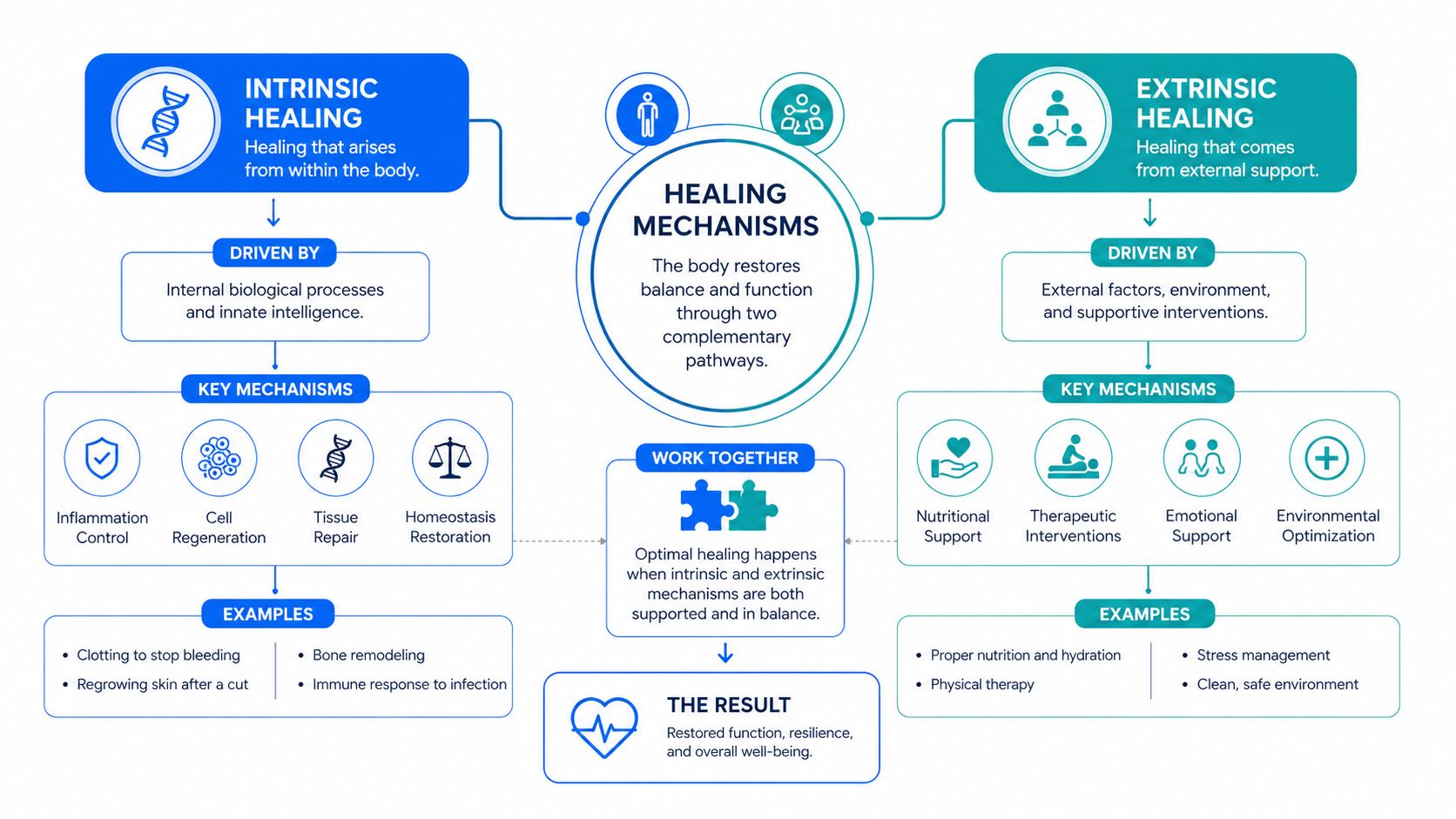
Intrinsic self-healing polymers repair damage through bonds that can break and reform inside the network. Those reversible interactions include hydrogen bonding, π–π stacking, ionic clusters, and dynamic covalent chemistries such as Diels–Alder, disulfide exchange, boronic ester, and imine systems. The practical constraint is chain mobility, because the damaged interface has to move enough for the reversible bonds to reconnect. Without that mobility, the chemistry may be reversible on paper but ineffective in a finished part.
The first widely cited intrinsic system used thermally reversible Diels–Alder chemistry in 2002. It showed a tensile strength of 68 MPa, elongation at break of about 3.2%, and healing efficiencies of 41% at 120°C and 50% at 150°C (ACS review). That result mattered because it showed the network itself could be remended, not merely patched by an outside reservoir. It also exposed the first manufacturing trade-off, a network can heal, but only if the service temperature and the segmental mobility are high enough for the bonds to exchange.
Extrinsic systems use a different repair path. They carry a healing agent in microcapsules, hollow fibers, or vascular networks. When damage ruptures the capsule or vessel, the payload flows into the crack and reacts, often with a nearby catalyst or matrix component. The mechanism works like a sealant capsule embedded in paint, with the key difference that the repair chemistry is stored outside the matrix until damage releases it.
The trade-off is direct. Intrinsic systems can, in principle, heal multiple times because the chemistry remains in the matrix. Extrinsic systems usually heal once per damaged location because the reservoir is consumed. That difference shapes processing, repeatability, and the confidence a production team can place in the material. It also affects characterization, since a one-time capsule rupture and a repeatable bond-exchange network need different fatigue, thermal, and aging tests to prove they will hold up in service.
Comparing the Four Core Chemical Strategies
Four routes, four very different manufacturing outcomes
A practical comparison starts with trigger, repeatability, and whether the chemistry fits the process window. Those three variables decide whether a self-healing polymer remains a lab curiosity or survives the constraints of coating lines, curing ovens, packaging, and service conditions.
| Strategy | Typical Trigger | Healing Efficiency | Repeatability | Best-Fit Applications |
|---|---|---|---|---|
| Supramolecular | Heat, moisture, mechanical relaxation | Qualitatively strong when chain mobility is available | Often repeatable | Soft coatings, elastomers, flexible interfaces |
| Dynamic covalent | Heat, moisture, sometimes catalyst or light | Can be high, depending on network design and protocol | Repeatable if bonds remain active | Structural polymers, coatings, electronics |
| Microcapsule | Mechanical damage, then local reaction | Can be near-complete when capsule and catalyst are well matched | Usually single-event at one site | Protective coatings, corrosion barriers |
| Vascular | Mechanical damage, then fluid delivery | Potentially strong in local repair zones | More repeatable than capsules, but architecture-dependent | Research systems, niche high-value structures |
The most studied intrinsic chemistries are Diels–Alder and boronic ester networks. Diels–Alder systems are attractive because they can preserve a respectable mechanical baseline, but the trade-off is clear, healing needed higher temperature, not ambient service conditions (ACS review). That makes them easier to justify in parts that can tolerate a thermal refresh step, and harder to defend in assemblies that must recover in place without extra heat.
Boronic-ester systems sit in a different operating window. A recent RSC review reports about 90% healing after 3 days at 85% relative humidity, and also notes bulk systems with tensile strength around 1.5 MPa and >60% healing efficiency under humid reprocessing conditions, which means humidity control is part of the formulation strategy rather than a secondary detail (RSC review). That kind of sensitivity matters because a line operator can control oven temperature more easily than ambient water activity, and a packaging engineer cannot assume every storage or service environment will support the same exchange kinetics.
The industrial conclusion is straightforward. If healing depends on moisture, the network has to be designed around the realities of a dry process room, a low-moisture package, or a rigid matrix that slows bond exchange. If healing depends on heat, the part has to survive a higher temperature reactivation step without distortion, loss of adhesion, or unacceptable cycle time. The chemistry is only one part of the decision, and the manufacturing window often decides the outcome.
Selection rule: if the application can only tolerate one repair event, extrinsic chemistry may be enough. If the part must recover more than once, intrinsic chemistry usually deserves the first look.
Strategy choice is really a system choice
Microcapsule systems tend to fit coatings and other products where damage is discrete and localized. Vascular networks are better suited to repeatable delivery, but they remain difficult to integrate outside research-oriented architectures because the supply path, channel durability, and processing complexity all have to stay intact after manufacture. In production terms, the key question is not which chemistry sounds strongest on paper, but which chemistry matches the damage pattern, line speed, curing method, and service environment.
That is also where AI-assisted formulation platforms can shorten the design-to-scale loop. By comparing composition, cure behavior, and predicted processing constraints earlier, tools such as Polymerize help teams screen out chemistries that will fail on humidity control, activation temperature, or network mobility before they consume pilot-line time. The value is not abstract prediction, it is earlier elimination of formulations that cannot be made repeatable under real manufacturing conditions.
Testing and Characterization Methods That Matter
A self-healing claim is only as credible as the protocol behind it. A sample that looks convincing under optical microscopy can still fall short in tensile recovery, fatigue resistance, or barrier restoration, and each of those tests answers a different question. The field still contains numbers that cannot be compared cleanly because the damage method, cure schedule, and healing environment change from paper to paper.
What a credible dataset has to include
A recent PMC review lays out the minimum dataset needed for serious benchmarking, and it is more demanding than many papers admit. A report should identify the polymer type, curing schedule, dynamic bond type, activation trigger, filler identity and loading, dispersion evidence, and the full healing protocol, including trigger, temperature, time, environment, and number of cycles. Without those details, a healing percentage does not say much about how the material will behave outside the lab.
The damage method matters as much as the chemistry. A razor cut, a notch, and an impact event leave different crack geometries and different stress fields, so they do not produce the same healing challenge. Optical microscopy can show whether a crack closes, while SEM and AFM are useful for checking whether the interface recontacts and whether the repaired region is morphologically continuous. For functional systems, the endpoint may be barrier recovery, conductivity recovery, or adhesion recovery, not just a tensile number.
The same review also shows how strongly protocol affects reported performance. One epoxy system reached 100% healing in 48 h at 150°C, while another exceeded 80% healing in 48 h at 80°C. Those results are useful, but only if the reader also knows the thermal budget and catalyst proximity that shaped the outcome.
Benchmarking rule: never accept a healing percentage without the trigger, duration, environment, and number of cycles that produced it.
The tests that reveal real function
For internal screening, teams usually need three layers of evidence. First, a mechanical recovery test, often tensile or fracture-based. Second, a repeatability check, because a one-time recovery result can hide rapid degradation. Third, a function-specific assay, such as insulation recovery for electronics or permeability recovery for coatings.
If the material is headed into a product line, the test should mirror the service failure mode as closely as possible. A coating team should care about barrier closure after scratches. An electronics team should care about continuity after strain. A structural team should care about retained load-bearing behavior after repeated damage, not just a single neat crack closure image.
The Industrial Reality Gap in Lab Demos
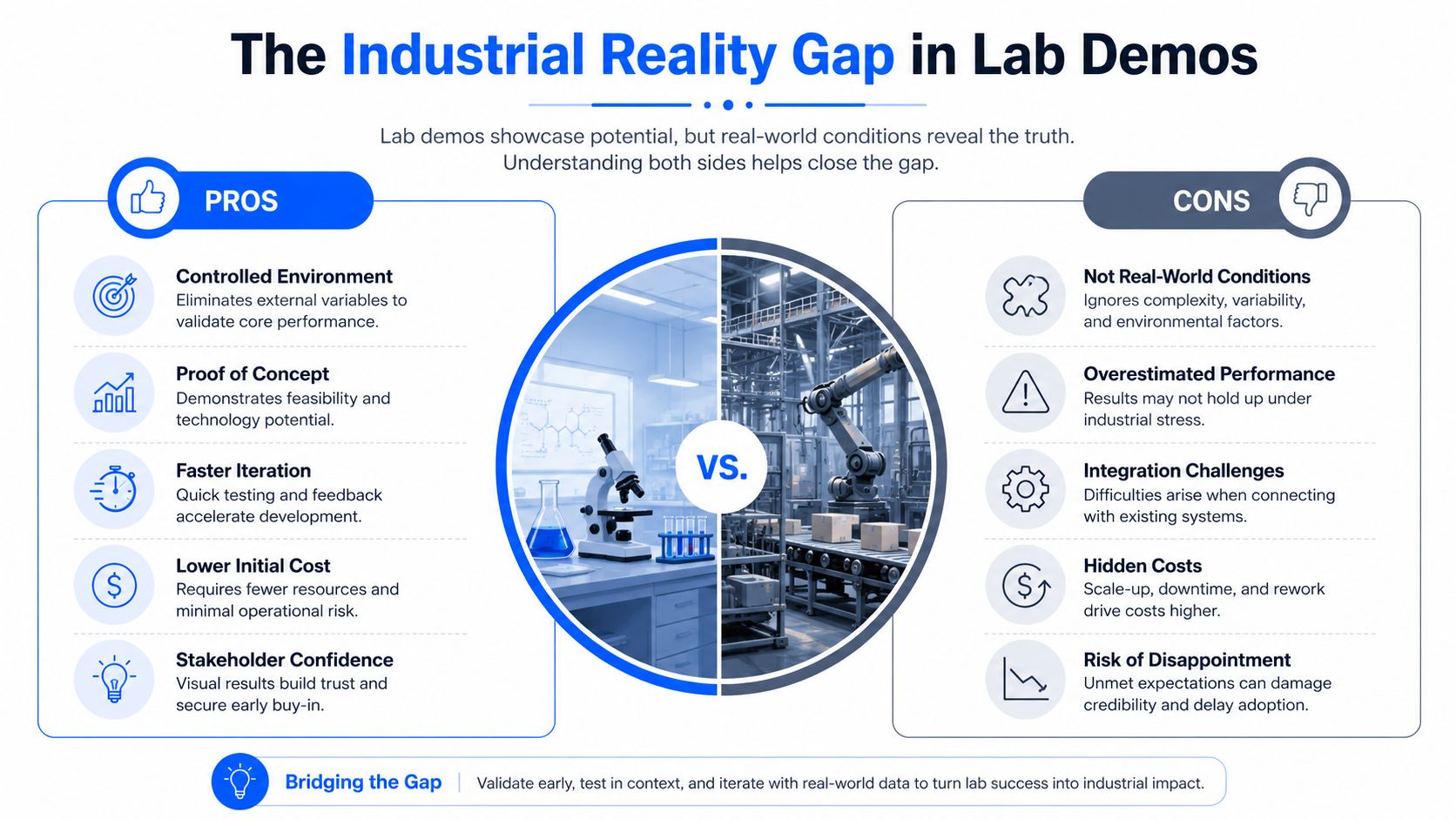
Lab studies often make self-healing look cleaner than production ever will. Samples are small, humidity is tightly controlled, damage is created on purpose, and the healing cycle is often long enough for the chemistry to work even when that same timeline would be unusable in a plant. That is useful for proving feasibility, but it can overstate what a real product will deliver.
What papers often leave out
The missing variables are the ones that matter most in service. Coupled thermal and humidity cycling can change both mobility and bond exchange. UV exposure can age the network. Sustained mechanical loading can keep crack faces from recontacting. Chemical or electrochemical attack can damage the matrix even when the healing chemistry itself is still intact.
A recent review says the field is still “relatively unexplored” from an industrial perspective, and another calls for standardized performance protocols and long-term stability studies under coupled mechanical, environmental, and electrochemical stresses (PMC review). That gap matters because a material that heals once in the lab may still fail after months of real use.
The deeper issue is that many studies optimize for visible recovery, not for process resilience. A healing system can look excellent when a researcher controls the cut, the temperature, and the waiting time. The same system can become fragile if production requires fast cure, thin films, contamination resistance, or repeated service loads.
Why standardization is the key enabler
The field needs more than better chemistry. It needs a common test language. Without standard protocols, one lab's strong result cannot be compared fairly with another lab's modest one, and decision-makers are left guessing whether the difference comes from chemistry, geometry, or the way the sample was aged.
For industrial buyers, the right question is direct. What happens after repeated damage, under the actual environment, on the actual part geometry? If the supplier cannot answer that, the lab number is not enough. Standardized protocols also make it easier for AI-driven design platforms, including tools such as Polymerize, to compress the design-to-scale loop by comparing formulation changes against consistent test outputs instead of scattered one-off demonstrations.
Scale-Up, Processing, and Repeatability Challenges
The easiest way to break a promising self-healing polymer is to run it through manufacturing without checking whether the healing mechanism survives the process. A chemistry that looks elegant in a flask may fail in extrusion, molding, or coating because the thermal budget, shear history, or curing profile destroys the very features that enable repair.
Processing compatibility decides commercial viability
Extrinsic systems often struggle at scale because the capsules have to survive compounding, pumping, or coating, then rupture only when damage occurs in service. If they break too early, the material loses its healing reservoir before the product is even shipped. If they're too durable, the damage event won't open them cleanly.
Intrinsic systems avoid the single-shot capsule problem, but they introduce another constraint, the matrix has to remain mobile enough for bond exchange while still meeting the product's mechanical target. That's why chemistry and processing can't be separated. A dynamic network that heals in a humidity chamber may not survive a fast, hot manufacturing window unless the polymer architecture was built for it.
The broader scale-up challenge is repeatability. Healing after one damage cycle is not the same as healing after several. The field still spends too much time on first-pass demonstrations and too little on aging, reprocessing, and service life under real use conditions. Recent literature also points toward scalable synthesis and processing routes as a central research direction, alongside a growing interest in bio-based chemistries that fit supply-chain and sustainability goals (Nature review).
A practical scale-up checklist
- Thermal window: Can the chemistry survive the plant's cure or melt history without losing activity?
- Shear tolerance: Will capsules, vessels, or dynamic domains survive mixing and extrusion?
- Dispersion quality: Are fillers or capsules distributed well enough to avoid weak zones?
- Repeat damage: Does healing persist after more than one event, or does performance collapse?
- Supply-chain fit: Can the raw materials be sourced, handled, and stored without special fragility?
The most useful insight here is that manufacturing doesn't just “implement” a healing chemistry. It selects which healing chemistry is even possible. If the process window is narrow, the material design has to work around that limitation from the start.
Application Case Studies and Where AI Compresses the Loop
Self-healing polymers are closest to industrial value where the damage is local, recurring, and expensive to ignore. That's why protective coatings, flexible electronics, structural adhesives or composites, and energy devices keep showing up in the literature. Each application asks for a different balance of chemistry, trigger, and process fit.
Where the chemistries tend to land
In protective coatings, extrinsic systems and some intrinsic networks are attractive because scratch closure and barrier recovery matter more than heavy structural load bearing. In flexible and stretchable electronics, intrinsic systems are often more compelling because repeated strain demands repeatable healing rather than a one-time reservoir. In structural composites and adhesives, the material has to keep enough mechanical baseline to remain useful after damage, which makes network design and interface control central. In energy devices, especially separators, binders, and encapsulants, chemical stability and functional recovery matter as much as crack closure.
That application mapping is where the design loop usually slows down. Teams generate data in one substrate, then discover the same chemistry behaves differently in a real formulation, a different filler package, or a different cure schedule. A useful reference for teams trying to shorten that loop is Rite NRG on AI-driven strategy, especially for understanding how materials organizations can connect experimentation to broader digital decision-making without losing scientific rigor.
Why AI changes the iteration economics
AI helps most when it compresses the number of blind experiments between an idea and a testable formulation. In materials R&D, that means unifying fragmented experimental data, training property models on those records, and using the result to choose the next experiment with better odds of success. That's especially relevant in self-healing polymers, where the interaction between bond chemistry, filler loading, curing, and trigger conditions creates a huge search space.
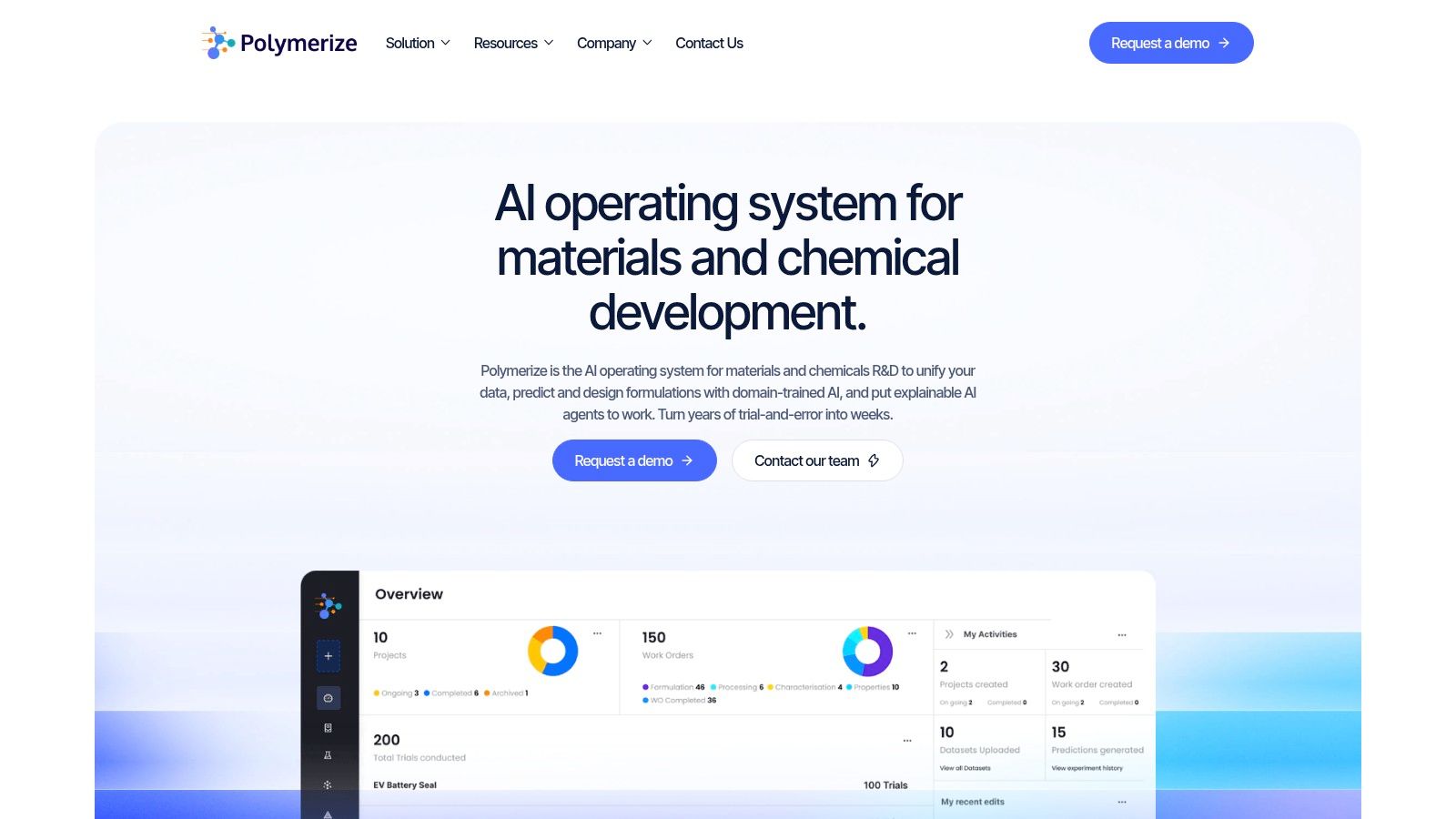
The most credible AI platforms do not replace chemistry judgment. They shorten the distance between formulation data, property prediction, and prototyping so teams can spend less time repeating failed variants and more time testing promising ones. In this field, that matters because the biggest bottleneck isn't knowing that a reversible bond exists, it's figuring out which combination of trigger, matrix, and process will still work after the material leaves the lab.
What to Decide Before Your Next Self-Healing Polymer Project
The first decision is intrinsic or extrinsic. If the application can live with a single local repair event, extrinsic chemistry may be enough. If the part has to recover more than once, intrinsic chemistry usually deserves priority. The second decision is the trigger you can deliver in production, whether that's heat, moisture, light, or autonomous recovery built into the network.
The third decision is your minimum characterization package. At a minimum, ask for the chemistry, cure schedule, bond type, activation trigger, filler identity and loading, dispersion evidence, and a healing protocol with environment and cycle count. Without those details, you can't compare suppliers or papers in a meaningful way.
The fourth decision is process fit. Don't ask whether the chemistry heals in isolation, ask whether it survives your compounding, coating, drying, or molding conditions. That question usually exposes the core constraint faster than any slide deck.
Treat AI as a way to reduce iteration count, not as a substitute for knowing the chemistry. The teams that win here use data to narrow the search, then use materials judgment to decide what deserves scale-up.
If you're developing a self-healing formulation and need to move from scattered lab results to a defensible scale-up plan, visit Polymerize and see how its data backbone, explainable models, and prototyping support can compress the design-to-scale loop. It's built for materials teams that need faster iteration without losing control over chemistry, process, or IP.
Put your R&D data to work
See how materials teams use Polymerize to plan fewer experiments and reach target properties faster.