


The model looks ready to ship. Cross-validation is strong, the error metrics are acceptable, and the dashboard gives the team a reassuring green status. Then a chemist tests a new formulation, the result misses the target, and nobody can explain why the model was confident.
That failure is common in materials R&D because the data rarely behaves like a clean, exchangeable dataset. Experimental campaigns change, raw material lots shift, equipment gets upgraded, and promising formulations often sit outside the model's training domain. The right model validation techniques must reflect those realities, not just produce a good score on randomly shuffled rows.
Table of Contents
- Use cross-validation when every experiment matters
- Use nested cross-validation for honest model selection
- Add external validation whenever deployment conditions differ
- Preserve the direction of time
- Weight recent regimes deliberately
- Test regime shifts as explicit scenarios
- Pre-validation checklist
- Select the validation method by failure risk
- Report results so stakeholders can act
- Automate checks without automating judgment
Why Your Model Fails in the Lab Despite Perfect Validation Scores
A formulation model can perform well in cross-validation and still fail during scale-up. The problem usually isn't the algorithm. It's the gap between the validation setup and the way scientists use the model.
Consider a polymer property model trained on results collected across several experimental campaigns. The dataset includes formulations, process conditions, and measured properties. A randomly shuffled validation split distributes observations from every campaign across training and validation folds. The score looks stable because the validation examples resemble the training examples closely.
Later, the team changes a supplier, adjusts equipment, or explores a composition range that wasn't represented in the original work. The model now faces a different input distribution. Its prediction may still look precise, but the chemistry has moved beyond the evidence used to train it.
Practical rule: Validate against the conditions you'll face after deployment, not the conditions that make the current dataset easiest to score.
Random splits can hide the real deployment problem
Materials datasets contain dependencies that ordinary random splitting can obscure. Replicates from the same experiment, measurements from the same batch, and related formulations can end up on both sides of a split. The validation set then tests familiarity rather than genuine generalization.
Temporal structure creates another problem. A model trained on early experiments should usually be evaluated on later experiments if the production workflow moves forward in time. Shuffling the observations can allow information from later conditions to influence the apparent validation result.
The same issue appears with extrapolation. A model may interpolate effectively between known formulations but behave unpredictably outside the range of observed compositions, temperatures, curing conditions, or molecular structures. A low average error doesn't tell you whether the model is trustworthy in the region where the next experiment will occur.
Validation is a lifecycle, not a launch gate
The initial split remains useful, but it only answers a narrow question. It tells you how the model performs under a particular sampling design and a particular snapshot of the data.
Materials teams also need to ask:
- What changed? Did suppliers, instruments, process settings, or measurement protocols shift?
- Where is the model operating? Are new candidate formulations inside the training domain or beyond it?
- What happens after release? Do errors increase as new experimental evidence arrives?
- Can scientists audit the result? Are the influential variables chemically plausible and traceable?
A validation program separates training, tuning, and final evaluation, then adds tests for temporal behavior, domain shift, uncertainty, and production feedback. The strongest improvement often comes from changing the validation design rather than replacing a random forest with a neural network.
Core Validation Methods and When to Use Each
Start by describing the deployment scenario before selecting a split. A model used to rank candidates within an established formulation space needs a different validation design from a model expected to predict a new polymer family or a future process regime.
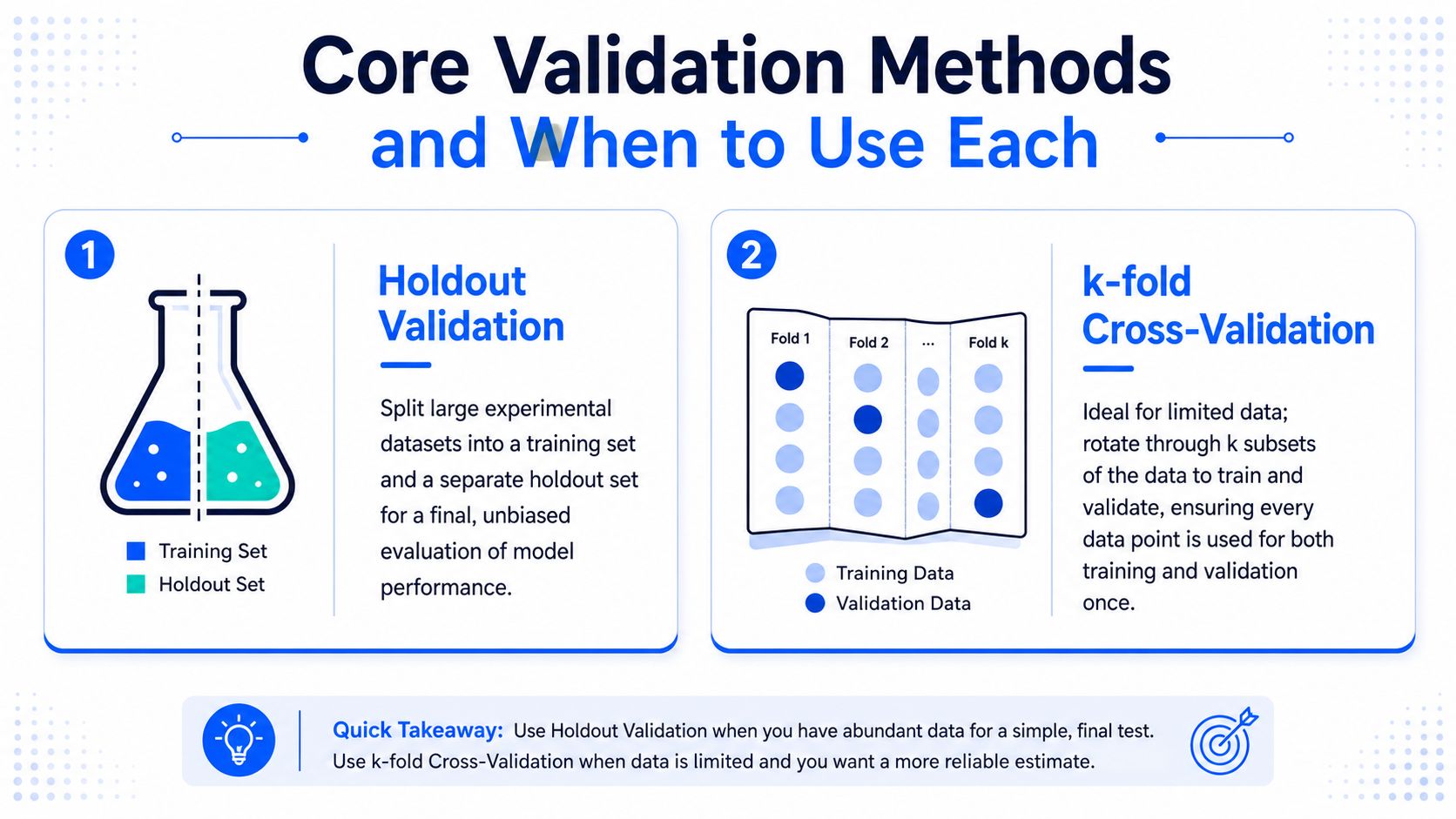
For a large experimental dataset with broad coverage, holdout validation offers a clean operational pattern. Reserve a representative portion for final evaluation, keep it untouched while selecting features and tuning the model, and score it only after the development decisions are complete. The holdout should reflect the conditions that matter in production, including relevant materials, campaigns, and property ranges.
Use cross-validation when every experiment matters
When the dataset is limited, k-fold cross-validation lets each observation contribute to both model fitting and evaluation across different folds. It usually provides a more efficient estimate than discarding a large portion of scarce laboratory data for a single validation split.
That efficiency doesn't remove the need for careful grouping. If several measurements come from one batch or formulation family, keep related observations together when leakage is possible. Otherwise, the model may see near-duplicates during training and receive credit for memorizing local structure.
Stratification can help when the target distribution is uneven. For classification, preserve the representation of important classes across folds. For continuous properties, consider whether the split maintains coverage across low, middle, and high regions of the response. The point isn't to force equal bins. It's to prevent a validation fold from missing the rare but commercially important behavior the model must recognize.
Use nested cross-validation for honest model selection
Hyperparameter tuning can contaminate evaluation. If you repeatedly try configurations against the same validation result, you're using that result to make decisions, even if the code labels it “validation.”
Nested cross-validation separates model selection from performance estimation. The inner loop tunes hyperparameters, while the outer loop estimates performance on data that didn't influence those choices. When data are limited, this approach is recommended because it reduces information leakage during model selection, as described in the guidance on independent evaluation and nested cross-validation.
Add external validation whenever deployment conditions differ
External validation uses independently derived, unseen data from a new setting. For materials R&D, that could mean a separate experimental campaign, another site, a new instrument, or a later production-relevant batch. It's a stronger generalizability test than repeatedly resampling the original study.
Bootstrap validation still has a role when datasets are small. Repeated resampling can estimate optimism by comparing apparent performance with performance on the original sample, producing optimism-corrected measures such as RMSE, AUC, or error rates. The overview of external and bootstrap validation explains why those corrected estimates are more realistic than in-sample scores.
Before model evaluation, make sure the measurement process itself is controlled. A practical Herbilabs reagent testing guide can help teams think through quality-control evidence and testing discipline that should accompany experimental datasets.
Validation Strategies for Time-Dependent and Non-Stationary Data
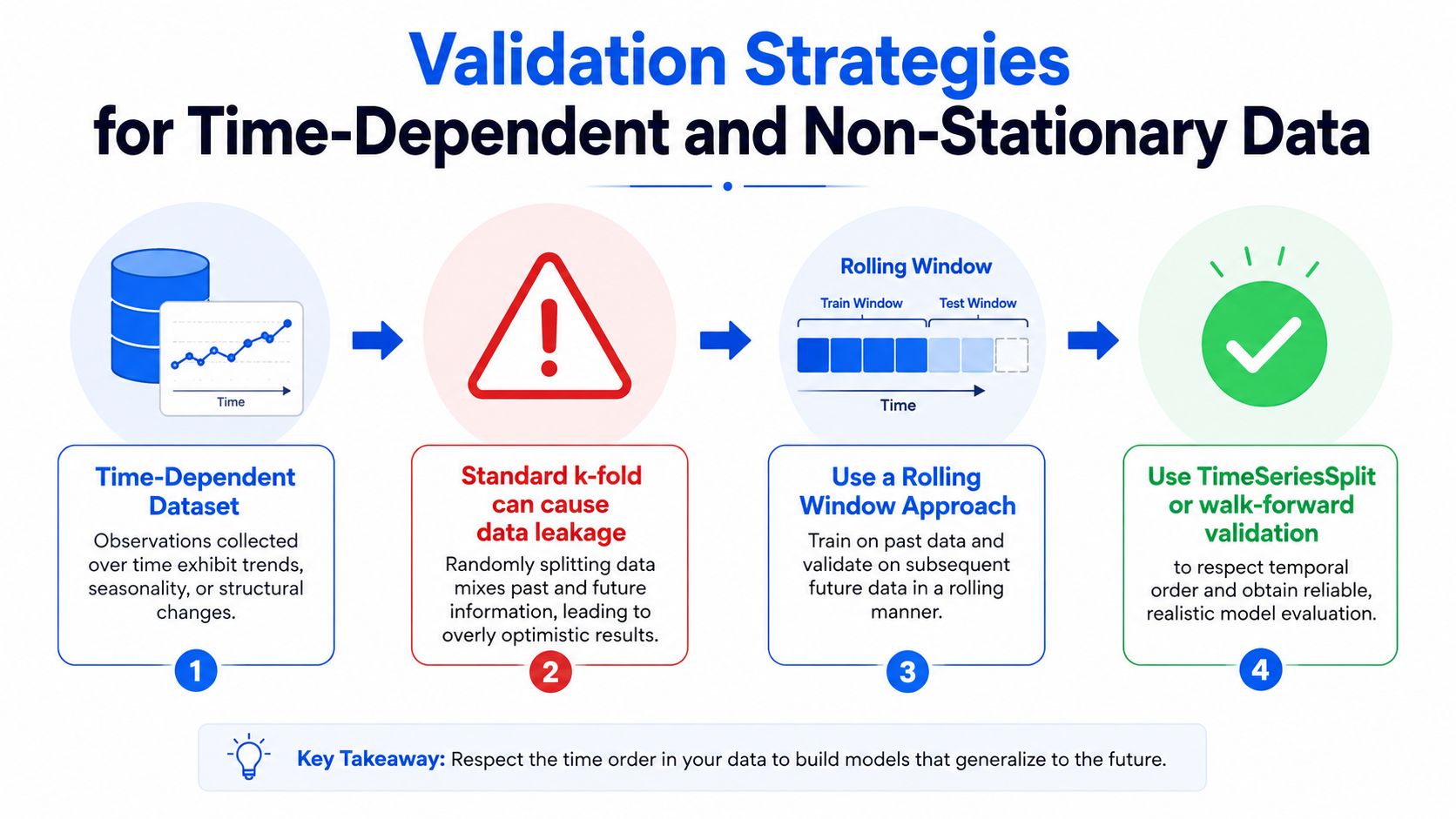
Random k-fold validation can be misleading when materials data has an order. In a sequential formulation campaign, later experiments may reflect decisions made from earlier results. In a process dataset, measurements may reflect equipment state, operator practice, raw material lots, or environmental conditions that evolve with time.
Shuffling those observations breaks the operating history. The model may train on examples from a later regime and validate on an earlier one, or it may learn a condition that was unavailable at the point of prediction. The resulting score can look healthy while the model fails in a genuine forward-looking test.
Preserve the direction of time
Forward-chaining validation trains on earlier observations and evaluates on subsequent observations. Each validation window represents a future decision made with the information available at that point. This design is useful for polymerization processes, where feed conditions and process responses arrive in sequence, and for formulation campaigns where scientists refine candidates over successive rounds.
A rolling window is often more realistic than an expanding window when old data becomes less relevant. The training period moves forward, retaining a recent history that better reflects the current process. The choice depends on whether older experiments still describe the mechanism you expect to operate.
Weight recent regimes deliberately
Recent work on time-series cross-validation found that an exponential weighted k-fold time-series split outperformed a generally weighted version, reinforcing that validation should account for temporal structure rather than applying generic folds by default. The time-series validation research supports treating ordering and changing relevance as part of the validation design.
In practice, review the causes of change instead of treating drift as a purely statistical event. A new supplier may alter impurity profiles. An equipment upgrade may change residence-time behavior. A revised analytical method may change the measured target without changing the material itself.
Test regime shifts as explicit scenarios
Maintain validation slices for known transitions. Evaluate the model before and after a supplier change, across equipment versions, and across process modifications. If a shift is large enough, create a separate external validation set rather than averaging both regimes into one score.
The key output isn't only a metric. It's a deployment decision: safe to use within the current regime, restricted to a defined domain, or due for retraining and additional experiments.
Uncertainty Quantification and Model Calibration
A point prediction answers only one question, what value does the model expect? Materials scientists also need to know how much confidence to place in that value and whether the candidate lies near familiar evidence or in an uncertain part of the design space.
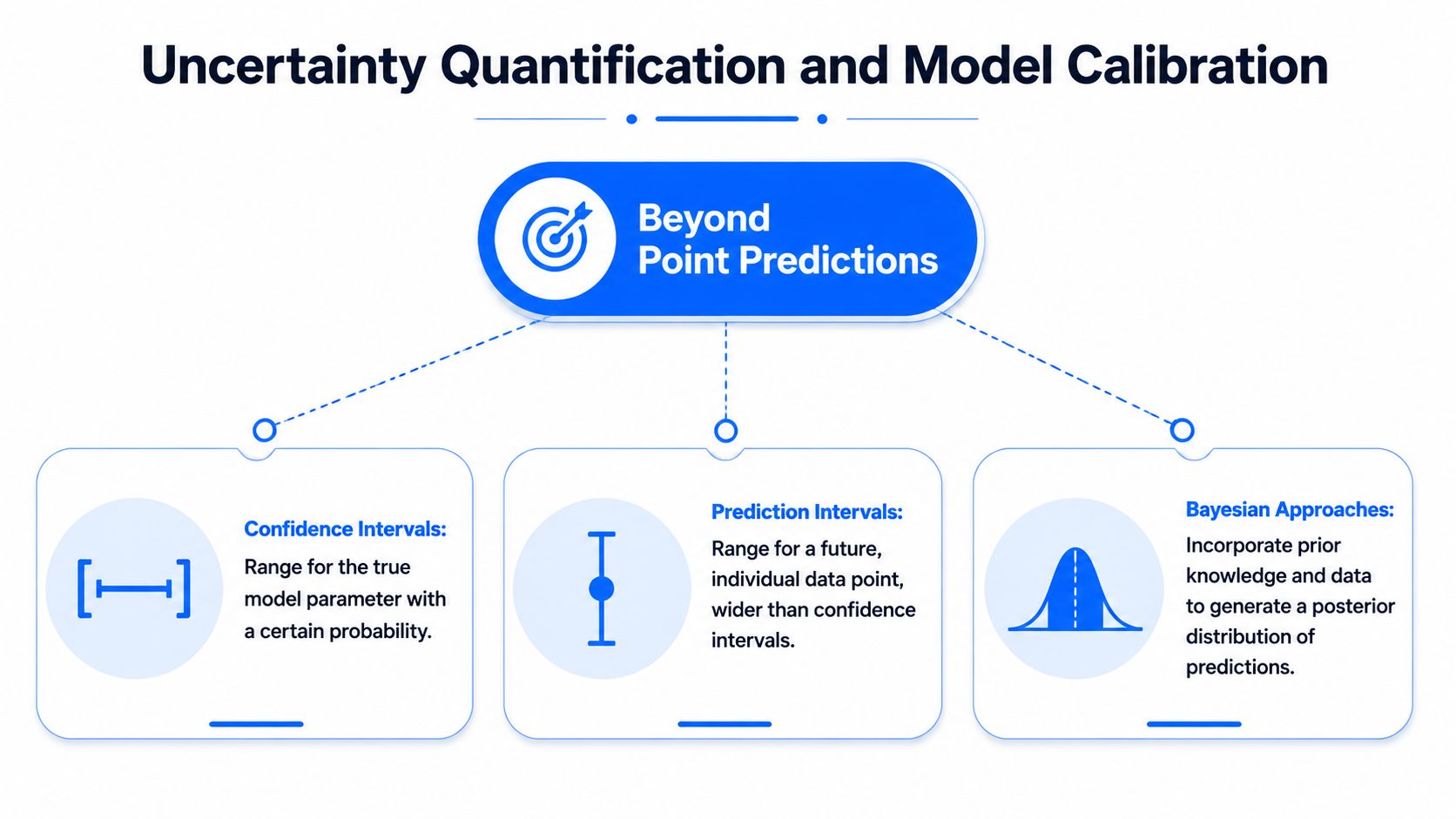
Confidence intervals describe uncertainty around an estimated model parameter or average response. Prediction intervals describe the expected range for a future individual observation, so they're generally wider because they include both model uncertainty and observation-level variability. Confusing these two creates overconfident decisions during formulation selection.
Compare practical uncertainty approaches
| Approach | Useful when | Main trade-off |
|---|---|---|
| Prediction intervals | Scientists need a plausible range for an individual formulation result | They can be broad when measurement noise is substantial |
| Bootstrap estimates | The dataset is small and teams need an empirical view of performance variability | Results depend heavily on how representative the original sample is |
| Bayesian approaches | Prior scientific knowledge can inform the model and a full predictive distribution is valuable | The prior and computational setup require careful review |
| Ensemble disagreement | Teams need a practical signal for unfamiliar regions | Disagreement is a warning signal, not proof that the interval is calibrated |
Bayesian methods can incorporate prior knowledge about structure-property relationships and return posterior predictive distributions. That makes them attractive when domain knowledge is strong, although scientists still need to scrutinize whether the prior is appropriate for the new chemistry.
Ensembles offer a simpler operational signal. If independently trained models disagree strongly on a candidate, treat it as a reason to inspect the domain and consider a confirming experiment. This does not guarantee accurate uncertainty, but it can expose regions where the model has little consensus.
Validate the uncertainty, not just the mean
An interval is useful only if it behaves credibly on unseen observations. Check whether observed outcomes fall within the stated ranges at the expected frequency, and examine coverage across formulation families, property ranges, and process regimes.
Calibration matters for classification too. If a model assigns a probability to a failure event, that probability should correspond meaningfully to observed frequencies over comparable cases. Calibration curves and expected calibration error can support this review, but they should be paired with domain-specific consequences. A well-calibrated average can still conceal poor behavior in the high-risk region that governs release decisions.
Use uncertainty to guide experimental design. Candidates with high expected value and high uncertainty may deserve targeted experiments, while candidates with low value and high uncertainty may not justify immediate lab capacity. That turns validation into a mechanism for choosing the next informative experiment, not merely rejecting weak models.
Building Validation Pipelines from Lab to Production
A reliable pipeline begins before model training. Dataset provenance determines whether later validation means anything. Record the source experiment, material identity, batch or lot context, instrument and method details, process conditions, operator-relevant changes, and the point in time when each value became available to the model.
Without that history, teams can't reproduce the split or explain why a result changed. They also can't distinguish a model failure from a measurement change.
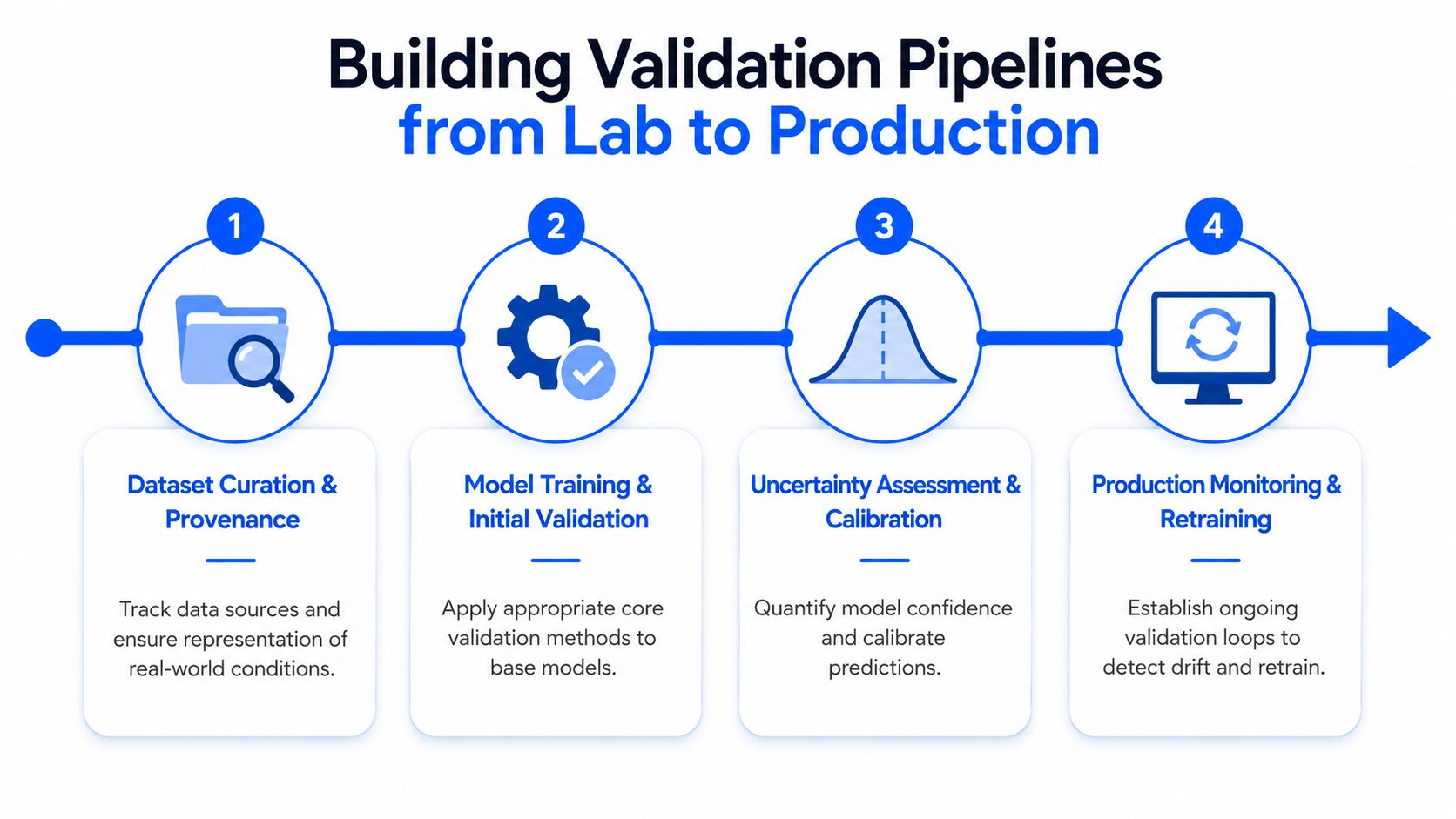
Build four connected layers
Dataset curation and provenance should identify duplicates, missing context, inconsistent units, impossible values, and measurements created under incompatible protocols. Store the rules used to exclude or transform records. A cleaned dataset without a record of its cleaning decisions isn't a dependable validation asset.
Initial validation should match the intended use. Use grouped or stratified approaches where appropriate, nested cross-validation when tuning is likely to leak information, and time-aware splits for sequential workflows. Keep a final evaluation set isolated from repeated experimentation.
Uncertainty and interpretability should be reviewed by scientists, not only by the modeling team. Feature attribution maps, causal pathway analysis, confidence scoring, and similar historical experiments can help users challenge implausible predictions and identify where the model's evidence is weak. The validation record should show whether important variables make chemical and process sense.
Production monitoring should compare live inputs with the training domain, track delayed outcomes when laboratory results arrive, and record feedback from users. Trigger investigation when performance, input distributions, uncertainty, or operational behavior moves outside the accepted range.
Continuous validation is still underbuilt in many organizations. A recent review found that cross-validation was used in 25.49% of the examined continuous validation approaches and online retraining in 23.53%, while iterative model refinement and workflow or feedback integration each accounted for 15.69%. These figures come from the review of continuous validation and improvement practices, which highlights the need to embed validation in MLOps rather than treat it as a final development gate.
Make the runtime reproducible
Package the model, dependencies, preprocessing logic, and validation checks together. Teams evaluating deployment architecture can use guidance on containerization for AI models to keep environments consistent between development, validation, and production.
Domain-shift detection should sit beside performance monitoring. If the target arrives slowly, input drift can provide an earlier warning, but it shouldn't automatically trigger retraining. First investigate whether the shift represents a new valid operating regime, a data-quality defect, or a process change that requires a new model.
Actionable Validation Checklists for Enterprise Workflows
Start every project with a written validation contract. It should state what the model predicts, who uses the prediction, which conditions are in scope, what evidence is available after deployment, and what action follows an uncertain or out-of-domain result.
Pre-validation checklist
Use this before fitting candidate models:
- Define the prediction moment: Confirm which inputs were available when the prediction would have been made.
- Audit experimental identity: Link measurements to formulations, batches, lots, campaigns, instruments, and protocols.
- Remove leakage paths: Check whether derived variables, post-treatment measurements, or later decisions enter the feature set.
- Map the design space: Identify sparse regions, extrapolation zones, rare property values, and known regime boundaries.
- Choose the deployment split: Decide whether the test should be random, grouped, stratified, temporal, or external.
- Lock the final evaluation data: Prevent repeated tuning against the same untouched evidence.
- Document exclusions: Record why records were removed, transformed, merged, or retained.
A model shouldn't enter comparison until the team can explain what each row represents and why the split resembles a real decision.
Select the validation method by failure risk
Use this decision path:
- Will the model predict future experiments or process states? Use forward-chaining or rolling time-series validation.
- Will it encounter a new site, supplier, instrument, or campaign? Reserve independent external validation from that setting.
- Is the dataset limited? Use cross-validation, and use nested cross-validation when hyperparameter tuning is substantial.
- Are classes or property regions unevenly represented? Use stratified or distribution-aware splits.
- Will the model operate outside the observed design space? Add domain checks, uncertainty review, and targeted extrapolation experiments.
- Will predictions influence high-cost or safety-relevant decisions? Require calibrated uncertainty, scientific review, and a defined human escalation path.
Report results so stakeholders can act
A validation report should contain more than a single score. Include the data snapshot, split logic, feature provenance, preprocessing steps, model version, tuning procedure, metrics by relevant segment, uncertainty behavior, known limitations, and the decision boundary for deployment.
A useful report also separates three conclusions:
- What the model demonstrated: Performance under the tested conditions.
- What remains unknown: Unseen suppliers, sparse chemistry, future process states, or delayed targets.
- What users must do: Stay within the domain, review flagged candidates, collect confirmation data, or stop using the model after a defined trigger.
Automate checks without automating judgment
Put schema checks, duplicate detection, range checks, leakage tests, reproducibility checks, and drift alerts into the MLOps pipeline. Run a fixed evaluation suite whenever data, features, code, model weights, or deployment dependencies change.
Retraining should require more than a generic alert. Define triggers around sustained performance degradation, meaningful domain shift, recurring user overrides, new experimental regimes, or a change in measurement protocol. Then require a human review of the new training window and validation evidence before promotion.
Validation effectiveness is measured by the quality of decisions it supports. Track whether failures are detected before lab release, whether scientists can identify out-of-domain predictions, whether retraining resolves the underlying shift, and whether the validation record can be reproduced during technical or compliance review. Those signals keep the process aligned with real R&D risk instead of allowing a familiar metric to become a ritual.
Polymerize helps materials teams unify experimental data, apply explainable models with confidence scores and historical precedents, and connect predictions to lab validation and next-best-experiment planning. Visit Polymerize to see how its materials R&D platform can support a traceable validation workflow from formulation discovery through scale-up.
Put your R&D data to work
See how materials teams use Polymerize to plan fewer experiments and reach target properties faster.