


A CTO asks which formulation should move to pilot scale. The team has simulation output, months of lab results, and years of notes spread across spreadsheets, ELNs, shared drives, and instrument files. The answer still depends on who can reconstruct the last failed batch and whether anyone trusts the metadata.
That is the bottleneck in many R&D groups. The limiting factor is rarely the physics alone. It is the gap between simulation, messy experimental reality, and data that is structured well enough to support a decision.
Day to day, that gap shows up in expensive ways. A team adjusts resin content, changes cure conditions, reruns mechanical testing, then argues about whether the shift came from chemistry, process variation, sample prep, or incomplete records. Weeks disappear. Budgets get spent on experiments that had little chance of changing the decision. Programs slow down because neither the model nor the lab history is reliable enough to guide the next step with confidence.
Materials simulation software helps when companies treat it as part of the R&D workflow rather than a tool used by a small expert group. The practical gain is not just better predictions. It is a tighter loop between model output, experimental evidence, and decision-making. Teams can rank candidates earlier, design fewer but better experiments, and identify where the model is weak before that weakness reaches pilot or production.
This shift is strategic because enterprise adoption depends less on having another solver and more on having data the software and the scientists can use. In strong implementations, simulation results are linked to formulation history, processing conditions, assay data, and AI models that learn from both successful and failed experiments. This is where the key advantage emerges. Simulation stops being a side analysis and starts acting like a screening and risk-reduction layer across the development process.
For CTOs, the question is straightforward. Will simulation reduce physical trial volume, shorten cycle time, and lower the odds of scaling the wrong candidate? It can. But only if the surrounding data, workflow, and model-governance pieces are in place.
Table of Contents
- Should we choose open-source or proprietary tools
- What team do we need to make simulation useful
- How quickly can a company see value
Introduction The End of Trial-and-Error R&D
A specialty materials program often starts with confidence and ends in drift. The target is clear. Better thermal stability. Better impact strength. Better barrier performance. The first few experiments feel productive because the team is learning. By the second or third round, the pattern changes. Scientists are no longer exploring the design space. They're chasing noise, rechecking assumptions, and trying to reconcile results from disconnected systems.
That's where many CTOs realize the problem isn't effort. It's method.
A physical lab is slow by nature. Raw materials must be sourced, samples prepared, conditions controlled, tests run, and failures interpreted. That's unavoidable. What is avoidable is using the physical lab to answer questions that a virtual workflow could screen earlier. If the team can eliminate weak candidates before synthesis, the lab stops being a guessing machine and starts acting like a validation engine.
Practical rule: Use physical experiments to confirm decisions, not to generate every possible decision.
Materials simulation software earns its place when it narrows the field before expensive work begins. Teams can test how a polymer blend might respond to stress, how a metal microstructure may influence fatigue life, or how a process change could affect downstream properties without building every scenario in the lab. That doesn't eliminate experiments. It makes them sharper.
Research summarized in a ScienceDirect article on ANN-based materials modeling shows why this approach has held up over time. Materials simulation software has long supported the optimization of processing parameters with minimum investment of time and money for experimental work, and trained neural-network-based models can predict correlations between processing parameters, microstructure, and material properties such as surface hardness, corrosion resistance, and fatigue life.
The strategic shift
The strongest simulation programs don't treat software as an isolated expert workstation. They use it to change how projects are governed.
Three operational changes usually separate useful adoption from shelfware:
- Earlier screening: Teams reject weak concepts before procurement, sample prep, and testing consume time.
- Tighter experiment design: Scientists run fewer, better-targeted experiments because the model helps define what matters.
- Stronger cross-functional alignment: Engineering, formulation, and manufacturing work from a common prediction framework instead of debating disconnected observations.
The end of trial and error doesn't mean the end of uncertainty. It means uncertainty gets managed upstream, where it's cheaper.
What Is Materials Simulation Software
Materials simulation software is best understood as a virtual laboratory. It lets scientists and engineers model a material, apply conditions, and predict behavior on a computer before committing to physical work. That can mean exploring molecular interactions, estimating how a formulation will behave under load, or studying how processing conditions may change structure and performance.

The important point for leadership isn't the mathematics underneath. It's the decision advantage. These systems let teams ask, before running a batch, whether a candidate is likely to meet performance requirements, whether a parameter shift is worth testing, and where failure is most likely to appear.
What the software actually does
At a practical level, most materials simulation software supports some combination of these jobs:
- Property prediction: Estimate mechanical, thermal, chemical, or structural behavior from composition or structure.
- Process optimization: Explore how curing, mixing, cooling, forming, or heat treatment may influence outcomes.
- Failure analysis: Model where stress concentrations, cracking, deformation, or degradation may emerge.
- Material selection: Compare candidates against a defined operating environment or product requirement.
For an R&D leader, that means fewer blind experimental branches.
For a scientist, it means the model becomes a filter. The team can screen possibilities digitally, then send the most credible options to the bench.
Why the virtual lab matters
The phrase “virtual laboratory” is useful because it sets the right expectation. Simulation isn't magic, and it isn't a replacement for domain expertise. It's an environment for controlled exploration. You can vary one factor, isolate another, and inspect interactions that may be expensive or hard to observe directly in physical testing.
A good simulation program doesn't remove the scientist from the loop. It gives the scientist a much better first draft.
That's especially valuable in advanced materials where composition, processing, and structure interact in non-obvious ways. In those settings, software acts as the bridge between theory and execution. It converts physical principles into project decisions.
The business value follows from that. When teams can predict more before they build, they waste less effort on dead ends. When they understand processing-property relationships earlier, scale-up becomes less fragile. And when simulation is paired with disciplined validation, the organization gets a repeatable way to learn faster than trial-and-error programs ever can.
The Four Scales of Materials Simulation
Not all simulation answers the same question. One of the most common adoption mistakes is asking the wrong model to solve the wrong problem. A CTO doesn't need every scientist to become a computational specialist, but the leadership team does need a working map of the four main scales.
Choosing the right scale for the business question
Quantum mechanics sits at the smallest scale. It's used when teams need to understand electron-level interactions, bonding, reactivity, or highly specific molecular behavior. If you're evaluating a catalyst, a conductive material, or a chemistry problem where atomic interactions drive performance, this is often the right starting point. The trade-off is computational cost. It delivers depth, but not speed for large practical systems.
Molecular dynamics moves up a level. It models how atoms and molecules move and interact over time. This is useful for polymers, interfaces, diffusion behavior, and local structural effects that influence bulk properties. It gives formulation and materials teams insight into mechanisms that bench tests can hint at but not always explain cleanly. The compromise is scale. It still won't tell you everything about a finished product or component.
Mesoscale simulation fills the middle ground. It's useful when structure matters above the molecular level but below the finished part, such as domains, phases, particles, or morphological evolution. This is often where soft materials and complex formulations become more realistic to model. The challenge is that mesoscale work can be conceptually hard for organizations to operationalize because it demands good assumptions from both chemistry and process teams.
Continuum and finite element analysis sits closest to product engineering. It models bulk behavior such as deformation, stress, strain, heat transfer, and failure in parts, assemblies, or processing equipment. That makes it highly useful when the business question is tied to design validation, manufacturability, or reliability in service.
A WorldMetrics overview of material simulation software states that modern FEA software such as Abaqus can achieve experimental accuracy within 2–5% of real-world outcomes when models are correctly validated and calibrated. That's why engineering teams rely on FEA to predict nonlinear material behavior and failure points before physical production.
Comparison of materials simulation methods
| Simulation Scale | What It Models | Typical Use Case | Computational Cost |
|---|---|---|---|
| Quantum Mechanics | Electron-level interactions and bonding | Catalyst behavior, reactivity, fundamental material properties | High |
| Molecular Dynamics | Motion and interaction of atoms and molecules over time | Polymer behavior, interfaces, diffusion, local structure effects | Medium to high |
| Mesoscale | Structures between molecular and bulk scale | Phase behavior, morphology, particle or domain evolution | Medium |
| Continuum / FEA | Bulk mechanical and physical response | Stress testing parts, process equipment analysis, failure prediction | Medium, depending on model complexity |
The table matters because scale choice is really a business decision disguised as a technical one. If the question is “will this car component survive service loads?” FEA is usually the answer. If the question is “why does this additive change chain behavior?” molecular simulation may be more useful. If the question is “can this chemistry even work?” quantum methods are often the place to start.
What works in practice
The best teams don't argue about which scale is superior. They chain scales together when the economics justify it. Small-scale models inform larger ones. Experimental data checks the assumptions. Product teams use the outputs in context.
What doesn't
Two patterns fail repeatedly:
- Overmodeling: Teams spend too long building a perfect atomistic representation of a problem that only needed engineering-level validation.
- Undervalidating: Teams trust an elegant simulation because the plots look convincing, even though the model has weak calibration against real data.
A model is only useful when it changes a decision with enough confidence to save time or reduce risk.
Practical Use Cases in Polymers and Formulations
In polymers and specialty formulations, simulation is most useful when it removes waste from everyday development work. The gains don't come from replacing chemistry intuition. They come from focusing that intuition where it counts.
Where simulation helps formulation teams first
A formulation team developing a new adhesive rarely needs a grand digital transformation to get started. They usually need help with narrower questions. Which ingredient ranges are worth testing? How sensitive is cure behavior to temperature changes? Will a softer formulation compromise durability too far? Simulation can screen those trade-offs before the team spends time preparing dozens of samples.
The same logic applies in coatings, elastomers, packaging films, and composites. A group working on a polymer blend can use simulation to explore likely compatibility issues, deformation behavior, or thermal response. A cosmetic or personal care team can use models to understand how compositional changes may affect structure and performance windows before stability and application testing begin.
For composite-heavy workflows, virtual testing has become especially practical. A Siemens Simcenter discussion of fast virtual testing for composites explains that modern tools use regression strategies inspired by machine learning to characterize response variability, achieving accuracy comparable to Monte Carlo simulations while avoiding the need to rerun full finite element calculations on every virtual specimen. For an enterprise team, that means variability can be studied faster without building a brute-force computational pipeline.
What works and what usually fails
The useful pattern is simple. Start with a narrow, repetitive problem where testing is expensive, slow, or messy.
Common starting points include:
- Blend optimization: Screening candidate compositions before extrusion or compounding trials.
- Cure and process windows: Exploring how processing conditions may affect final performance.
- Durability questions: Checking likely failure modes before committing to long test cycles.
- Variability assessment: Understanding response spread in composites or structured materials.
The first win usually comes from reducing bad experiments, not from discovering a breakthrough material on day one.
What doesn't work is choosing a glamorous use case that lacks clean historical data or clear validation criteria. If the team can't define what “better” means in operational terms, simulation becomes an academic exercise. Another failure mode is forcing scientists to use a model that doesn't match the material system. Polymers, filled systems, and formulated products don't behave like clean textbook materials. The workflow has to reflect that messiness.
In real formulation environments, simulation succeeds when it helps a team decide which few experiments deserve attention next.
Evaluating Simulation Software for Enterprise R&D
Buying simulation software for enterprise R&D isn't the same as buying a technical feature set. The essential question is whether the platform will survive contact with your organization's data, security rules, decision process, and scale-up workflow.

A surprising number of evaluations go wrong because the demo looks polished and the physics engine is strong, but nobody tests how the software fits the actual operating environment. In enterprise settings, fit matters as much as capability.
The questions that matter in vendor reviews
Start with scalability. Can the tool handle growing model complexity, larger datasets, and more users across multiple teams? A pilot run by one expert on a local workstation doesn't tell you much about enterprise viability.
Then look at security and IP protection. Materials programs often involve proprietary formulations, process parameters, supplier data, and regulated documentation. If the platform can't fit your security posture, the technical discussion is over.
Third is explainability. Scientists don't need marketing language about AI enhancement. They need to know why a prediction was made, what assumptions sit underneath it, and how the output should be challenged. If users can't interrogate the model, they won't trust it when project risk rises.
Last is validation discipline. The vendor should have a clear answer for how model outputs get compared against physical results, updated over time, and governed when discrepancies appear.
A practical evaluation checklist
Use a scorecard that goes beyond solver performance:
- Model fit: Does the software handle your material classes and the phenomena that matter to your business?
- Workflow compatibility: Can it connect to CAD, PLM, LIMS, ELNs, or manufacturing systems without heroic integration work?
- Usability: Will a formulation scientist, process engineer, and simulation specialist all be able to use the system appropriately?
- Governance: Are version control, permissions, auditability, and review workflows built for enterprise use?
- Data readiness: Can the platform consume messy experimental history, or does it assume pristine inputs?
For the last point, teams often need supporting infrastructure before the simulation layer delivers consistent value. Resources on enterprise data quality tools are useful when assessing how to standardize, validate, and clean the experimental records that models depend on.
Buyer's test: Ask every vendor to show how a bad dataset is detected, corrected, or quarantined. If they only show ideal inputs, the evaluation is incomplete.
A strong platform doesn't just solve equations. It fits how your R&D organization works.
From Simulation to Solution The Integrated R&D Workflow
A CTO approves a simulation program, the team licenses strong software, and six months later the bottleneck is still the same. Formulation data sits in spreadsheets, instrument outputs lack context, ELN records use inconsistent naming, and the AI layer has nothing reliable to learn from. In enterprise R&D, this is the failure point far more often than the physics engine.
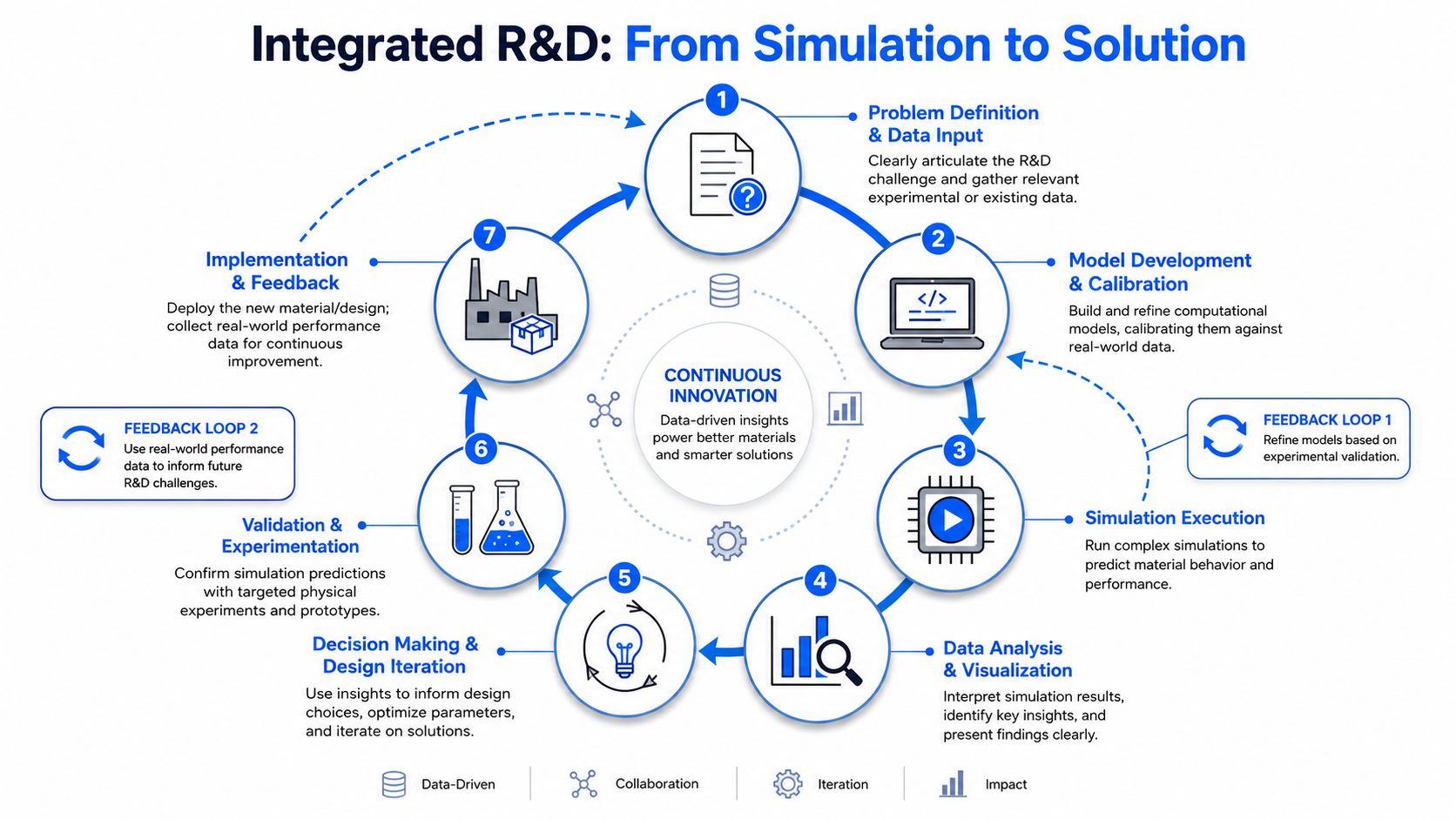
Simulation delivers value when it sits inside an operating workflow, not as a standalone expert tool. The business outcome is straightforward. Fewer blind experiments, faster screening, and fewer late surprises when a material moves from lab conditions to production reality.
Why data readiness decides whether simulation delivers
Ansys notes in its overview of computational materials science and AI integration that a major underserved issue is the practical integration of AI with fragmented experimental data from spreadsheets, ELNs, and silos. That point matters because enterprise teams rarely start with clean, complete, well-structured records.
The hard part is usually not generating another model. It is deciding which historical results are comparable, which test conditions were recorded well enough to use, and which datasets should be excluded from calibration.
A polymer scientist may store formulation adjustments in a local spreadsheet. Analytical results may sit in a LIMS export. Processing conditions may live in instrument files or operator notes. Until those records are standardized and linked, simulation and AI produce inconsistent recommendations, and project teams lose confidence quickly.
The first milestone is simple. Make experimental history machine-usable.
The closed-loop workflow that speeds up R&D
The teams that get results follow a repeatable loop:
- Define the decision. Set the target property, process window, cost boundary, and failure criteria in terms the lab and the business both use.
- Assemble usable data. Pull together prior formulations, test results, processing conditions, and metadata from ELNs, spreadsheets, instruments, and supplier files.
- Qualify and calibrate. Separate trusted records from noisy ones, then calibrate the model against data that reflects real operating conditions.
- Simulate the highest-value questions. Test the narrow design space that matters commercially instead of running broad virtual searches with weak assumptions.
- Choose the next physical experiment. Use model output to decide which lab run will reduce uncertainty fastest.
- Compare prediction with reality. Feed measured results back into the model and capture why any mismatch occurred.
- Repeat with better constraints. Each cycle sharpens the model, improves the dataset, and reduces wasted lab work.
Here's a useful overview of that loop in visual form:
This workflow changes how R&D decisions get made. Instead of asking the lab to test every plausible option, teams use simulation to rank candidates and use experiments to resolve the uncertainty that matters most.
That trade-off is important. Simulation does not remove the need for experimental work. It makes experimental work more selective and more informative. In practice, that is where cost reduction shows up. Fewer low-value runs, less duplicated effort, and faster convergence on materials that can survive scale-up, compliance review, and manufacturing constraints.
The strongest programs treat simulation, data engineering, and lab execution as one system with shared ownership. That is how simulation moves from an interesting technical capability to a repeatable R&D advantage.
Measuring Success ROI and Risk Reduction
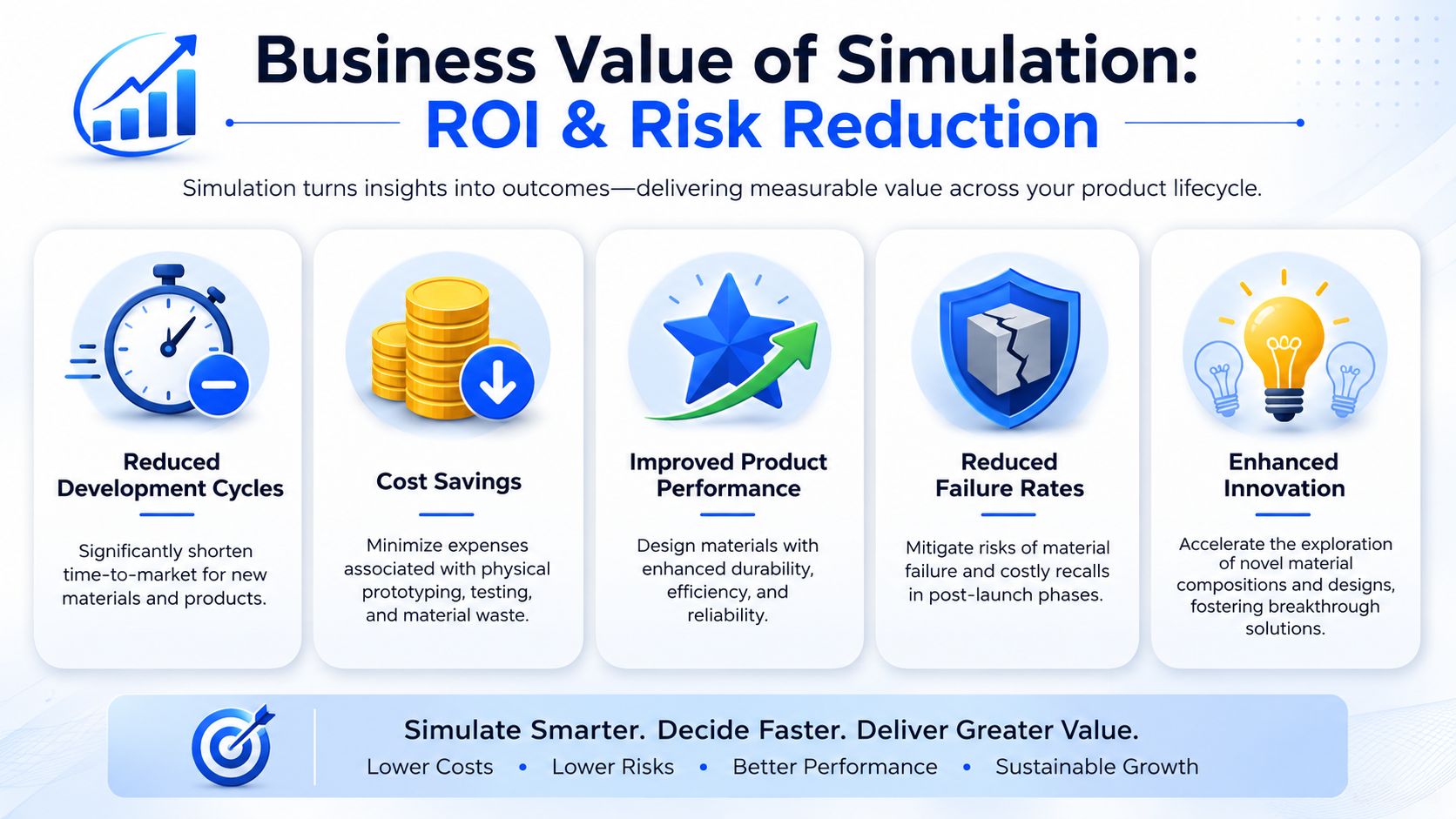
A CTO usually asks the right question after the pilot demo: what changes in the business if we fund this properly? That is the standard to use here. Materials simulation software should earn its place by improving project economics, cutting avoidable risk, and helping teams make better decisions sooner.
What to measure beyond model accuracy
Prediction error matters, but it is rarely the limiting factor in enterprise adoption. The harder question is whether simulation changes the quality and pace of R&D decisions once it is connected to real lab data, historical results, and the AI tools teams use to rank options. A technically impressive model with poor data traceability or weak workflow fit will not produce much return.
Measure the operating impact:
- Experiment efficiency: Are scientists avoiding test runs that add little information?
- Cycle time: Is the team reaching a go, no-go, or reformulation decision faster?
- Prototype burden: Are broader screening matrices shrinking before material ever reaches the bench?
- Scale-up risk: Are process, manufacturability, or stability issues surfacing earlier?
- Data reuse: Are experimental results being captured in a form the next project and the next model can use?
- Decision quality: Are teams killing weak candidates earlier and backing stronger ones with more confidence?
The last two metrics are often missed, and they matter. In practice, simulation creates value when it sits inside a repeatable workflow, not when it produces a one-off visualization. If every project still requires manual data cleanup, disconnected spreadsheets, and custom model setup, the software cost is only a small part of the problem. The primary drag is labor, delay, and inconsistent decisions across teams.
Risk reduction deserves its own line item. Late-stage material failure is expensive, but so is false confidence. Teams need to track how often simulation catches a bad direction before pilot work, how often it reduces the size of validation plans, and where predictions break because the underlying experimental data was sparse, biased, or poorly structured. That is especially important when AI models are layered on top of simulation outputs. Weak data pipelines can make the system look smarter than it is.
As noted earlier, the chemistry simulation software market is growing, which reflects real demand from R&D organizations trying to cut experimental cost and shorten development cycles. The more important signal for buyers is not market size. It is whether their own program can convert model output into fewer failed runs, faster handoffs, and better portfolio decisions.
A useful ROI case is usually straightforward. Show fewer low-value experiments, shorter time to a validated candidate, earlier identification of scale-up problems, and better reuse of hard-won experimental data. At that point, simulation is no longer just software spend. It becomes additional R&D capacity with better control over technical risk.
Frequently Asked Questions
Should we choose open-source or proprietary tools
It depends on the material class, internal expertise, and how much operational support your team needs. Open-source tools can be attractive for research flexibility, cost control, and custom development. They're often a sensible fit for technically strong teams that can manage setup, maintenance, and method validation internally.
Proprietary platforms usually offer a smoother path for enterprise deployment, stronger support, and more complete surrounding workflows. The trade-off is lock-in risk, licensing cost, and less transparency into the underlying stack.
The choice gets murkier in soft materials. A TechXplore report on open-source software for soft materials notes that the tradeoff remains poorly answered in practice, while proprietary platforms often emphasize performance claims such as 1,000x faster performance but leave accessibility and total cost of ownership less clear for smaller labs and enterprise buyers alike.
What team do we need to make simulation useful
You usually don't need a large dedicated simulation department at the start. You do need the right mix of roles. One domain expert must understand the material system. One technical owner must understand model setup and validation. One data or digital lead should handle data structure, traceability, and workflow integration.
If any of those roles are missing, adoption slows. The scientist may not trust the outputs. The computational expert may build models no one uses. The digital lead may create a clean pipeline for data that doesn't answer a real R&D question.
How quickly can a company see value
Initial value appears fastest when the first use case is narrow and expensive to test physically. Composite variability assessment, formulation screening, and process-window optimization are common starting points because they produce visible operational decisions.
Longer-term value takes more work. The organization needs clean enough historical data, a validation routine, and a governance model for when predictions and physical results disagree. Companies that skip those basics often conclude the software underperformed when the actual problem was workflow design.
The right expectation is practical. Start with one workflow where better prediction can eliminate wasted lab effort. Prove that the model changes decisions. Then expand.
If your team is trying to connect simulation, messy experimental records, and AI-guided next-step decisions into one usable R&D system, Polymerize is worth a look. It's built for materials organizations that need to unify fragmented data, make it AI-ready, and turn trial-and-error development into a more targeted, explainable workflow.
Put your R&D data to work
See how materials teams use Polymerize to plan fewer experiments and reach target properties faster.