


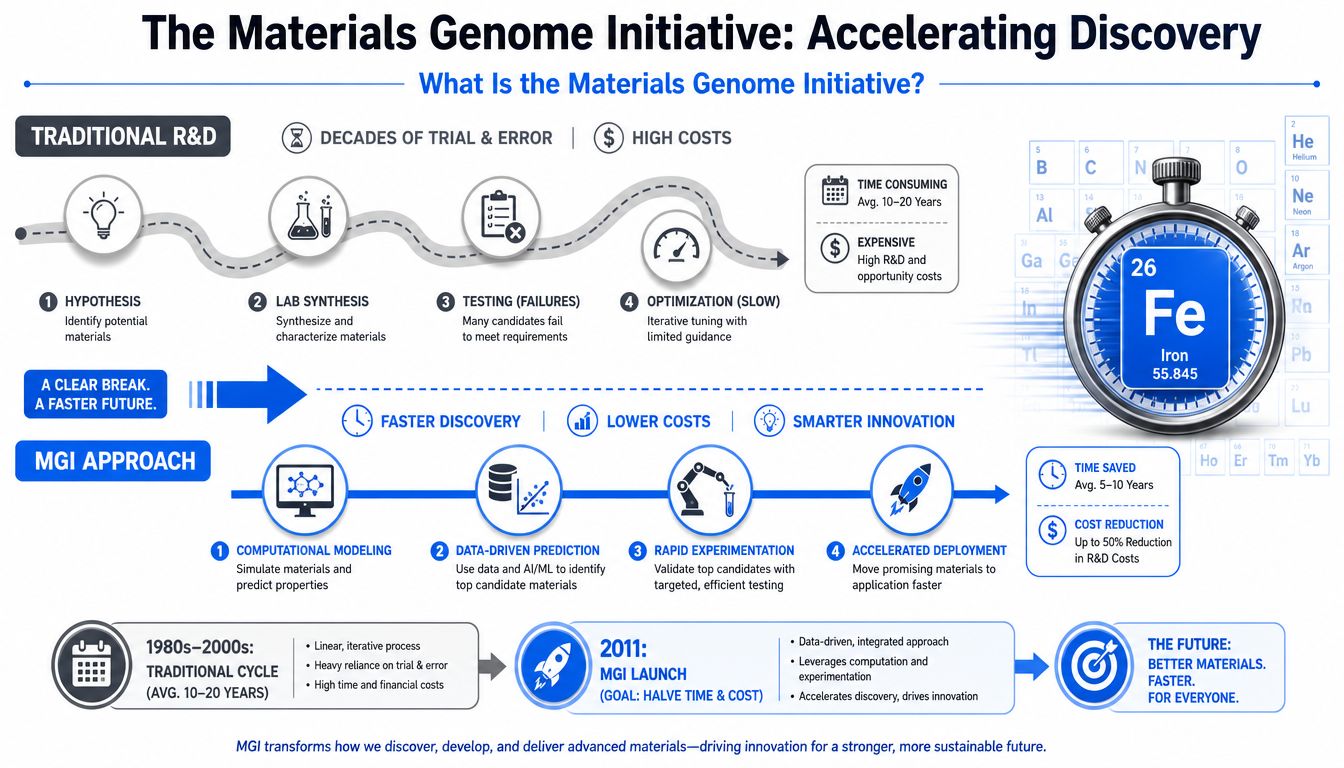
A striking place to start is this: the Materials Genome Initiative was created with the explicit goal of cutting the traditional advanced materials development cycle, often 10 to 20 years, by more than half while also aiming to reduce development costs by 50 percent (Materials Genome Initiative strategic plan update).
For a CTO, that changes the conversation. This isn't just a federal science program. It's a blueprint for how modern R&D should work when speed, capital efficiency, and technical certainty all matter at once.
Most discussions of the Materials Genome Initiative stay at the policy or academic level. The more urgent question for industry is simpler. What does this mean for a commercial R&D team trying to launch better materials faster, especially in polymer development where data is messy, experiments are iterative, and IP protection is essential?
Table of Contents
- Computation as a front-end filter
- Experiments as a learning engine
- Data infrastructure as the shared memory
- Workforce and ecosystem
- What inverse design changes in practice
- The domains where MGI thinking shows up
- Examples that matter strategically
- Why polymers create a harder enterprise problem
- What MGI changes inside a company
- Why so many companies stall
- The CTO takeaway
- Start with a usable source of truth
- Standardize only what supports decisions
- Protect IP without blocking reuse
- Choose AI that scientists can question
- Build adoption around one workflow
- Treat alignment as an operating change
What Is the Materials Genome Initiative?
For many materials teams, the biggest cost in R&D is not a single experiment. It is the repeated cycle of guessing, testing, relearning, and rediscovering what the organization already knew but could not easily reuse.
The Materials Genome Initiative, or MGI, was launched by the White House in 2011 to change that pattern. Its goal was straightforward. Shorten the time it takes to move from material concept to commercial use, and lower the cost of getting there. For a business leader, that makes MGI less a public policy label and more a modern operating model for materials innovation.
Why the old model breaks down
Traditional materials development often runs as a sequence of handoffs. A scientist proposes a formulation. The lab makes samples. Testing produces results. Someone updates a spreadsheet. A modeler works from partial inputs. Later, scale-up inherits a candidate without full process history or a clear record of why earlier decisions were made.
That setup slows learning.
A new CTO usually spots the same bottleneck quickly. Knowledge is scattered across notebooks, spreadsheets, local files, instrument outputs, and disconnected software systems. The organization may have good people and strong science, yet still struggle to build momentum because each project starts from fragments instead of a usable knowledge base.
MGI addresses that exact problem. It promotes a development process where computation, experimental work, data management, and manufacturing context inform one another from the start. The point is not only to run more simulations or collect more data. The point is to make every experiment produce reusable knowledge.
Practical rule: MGI improves R&D by cutting avoidable learning cycles, not just by speeding up individual lab tasks.
Why it is called a "genome" initiative
The name can mislead people at first. MGI does not suggest that materials have genomes like living organisms.
The comparison comes from the value of mapping relationships systematically. In biology, the Human Genome Project helped researchers connect underlying code to observable function. MGI applies that same disciplined mindset to materials science by linking composition, structure, processing, and properties in a form that can be searched, modeled, compared, and reused.
That shift matters because it changes how decisions get made. Instead of relying mainly on expert memory and isolated project files, teams can build a shared system for predicting which candidates are worth pursuing and which should be stopped early. In business terms, the work becomes more repeatable, easier to scale across programs, and less dependent on informal knowledge transfer.
Here is the operating change MGI encourages:
| Traditional approach | MGI approach |
|---|---|
| Make and test many candidates | Screen promising candidates before full lab effort |
| Store results locally | Organize data so teams can reuse it |
| Separate modeling from lab work | Connect modeling and experimentation |
| Learn one project at a time | Build cumulative organizational knowledge |
Why business leaders should care
For enterprise R&D, MGI's value is strategic. Teams that can predict earlier, test more selectively, and carry learning from one program to the next can allocate budget with much more discipline. They stop spending premium lab time on low-probability candidates. They also reduce the risk of repeating failed paths because the record of prior work is easier to find and trust.
This matters even more in polymers, a category often left out of MGI discussions. Polymer systems are messy in exactly the ways that expose weak data practices. Performance depends on formulation details, additives, processing history, morphology, and end-use conditions that interact in nonlinear ways. A small change in mixing sequence or cure profile can alter viscosity, adhesion, impact strength, thermal behavior, or long-term stability.
That is why MGI should matter to private-sector polymer teams now. It sets a standard for R&D that is integrated, data-centered, and increasingly ready for AI. If your data is trapped in PDFs, lab notebooks, and inconsistent naming conventions, advanced modeling will stay expensive and unreliable. If your data infrastructure is structured around reuse, context, and feedback from real experiments, AI and simulation become practical tools for faster innovation and lower development cost.
In that sense, MGI is the bridge between a national research vision and an enterprise execution model.
The Core Components of the MGI Framework
The engine behind the Materials Genome Initiative is often described as the Materials Innovation Infrastructure, or MII. That term can sound abstract. In practice, it means the technical and organizational system that lets a team learn faster than traditional R&D allows.
Think of it as four interlocking parts. If one is weak, the whole system slows down.

Computation as a front-end filter
The first pillar is computational tools. In MGI-style work, simulation doesn't sit off to the side as an academic exercise. It acts like a front-end filter for the experimental pipeline.
A useful analogy is a digital wind tunnel for materials. Before a team commits lab resources, it can explore how candidate structures might behave, which variables matter most, and where performance trade-offs may appear. That doesn't eliminate physical testing. It makes physical testing more selective.
For a CTO, the business impact is straightforward. Computation can shift scarce lab time toward higher-value questions.
Experiments as a learning engine
The second pillar is integrated experimentation. MGI emphasizes that experiments, computation, and theory should interact continuously rather than sequentially.
In strong implementations, teams don't just run tests to confirm what they already suspect. They design experiments to sharpen models, reduce uncertainty, and expose causal relationships. High-throughput methods and autonomous workflows fit naturally here because they increase the rate at which a team can generate comparable, structured evidence.
Many enterprise labs face a common difficulty. They may own advanced instruments but still operate with project-specific workflows that don't produce reusable data.
A lab isn't MGI-ready because it has modern equipment. It's MGI-ready when each experiment improves the next decision.
Data infrastructure as the shared memory
The third pillar is data infrastructure. This is often the least glamorous part and the most decisive.
Without shared formats, metadata standards, version control, and searchable repositories, valuable results become hard to compare or reuse. Teams then repeat work they already paid for. Data infrastructure solves that by creating a persistent memory for the organization.
You can think of it as a materials-specific operating layer with three jobs:
- Capture context: Record composition, process conditions, test methods, and outcomes in a structured way.
- Enable reuse: Make prior results discoverable across teams, sites, and programs.
- Support analytics: Give AI and statistical tools data they can interpret reliably.
Workforce and ecosystem
The fourth pillar is people and collaboration. The Materials Genome Initiative was built around a broader strategic plan that included workforce development, integrated methods, and data access, not just software or databases.
That matters because MGI fails if chemists, modelers, process engineers, and data scientists work on different definitions of the same problem. A modern materials team needs shared language, common decision criteria, and incentives that reward collective learning instead of local optimization.
A simple way to read the framework is this:
- Model likely candidates early
- Run focused experiments
- Store results in reusable form
- Feed the learning back into the next cycle
When those loops are connected, speed improves. So does confidence.
Key Programs and Milestones So Far
The Materials Genome Initiative would be easy to dismiss if it existed only as a strategic ambition. It doesn't. Its influence is visible in programs that turned data sharing and computational discovery into operational tools.
The clearest example is the Materials Project. Supported by the Department of Energy's Basic Energy Sciences program, it currently disseminates computed and experimental data, algorithms, and modeling capabilities to more than 200,000 users worldwide and distributes several million data items daily (National Academies review of the Materials Genome Initiative).
That scale matters because it shows what MGI looks like when it moves beyond white papers.
Why the Materials Project matters
The Materials Project is important for more than its size. It demonstrates a practical principle that many enterprise teams still struggle to implement internally: data becomes more valuable when it is structured, searchable, and connected to computational workflows.
A researcher can use that kind of environment to screen candidate materials before committing to expensive synthesis. A modeler can compare predictions against a broad body of known behavior. A program leader can steer resources toward candidates with stronger technical rationale instead of relying only on intuition.
In other words, the platform doesn't just store information. It changes the quality of questions people can ask.
What it proved to the field
Before efforts like this, materials knowledge was often fragmented across papers, local databases, and project archives. The Materials Project helped normalize a different expectation. Materials data could be treated as infrastructure, not as an afterthought.
The broader MGI effort has also supported data-mining approaches that predict bulk mechanical behavior from atomistic structure and enabled work such as artificially aged glasses with unprecedented stability through high-throughput integration, as described in the same National Academies review. Those details matter because they show the initiative isn't only about digitization. It's about using integrated methods to reach results that would be harder to achieve through disconnected workflows.
The milestone isn't simply that a database got big. The milestone is that a data-centric model of discovery became operational at global scale.
A useful lesson for industry
A new CTO shouldn't read this as a call to replicate a public database inside the company. That's not the point. The lesson is architectural.
The most successful MGI-aligned programs make data, models, and experiments part of one working system. Enterprise teams that still treat those as separate functions will move slower, even if they hire strong scientists and buy good instruments.
For commercial R&D, the milestone isn't public participation. It's recognizing that integrated infrastructure has become a competitive capability.
Real-World Impacts and Design Breakthroughs
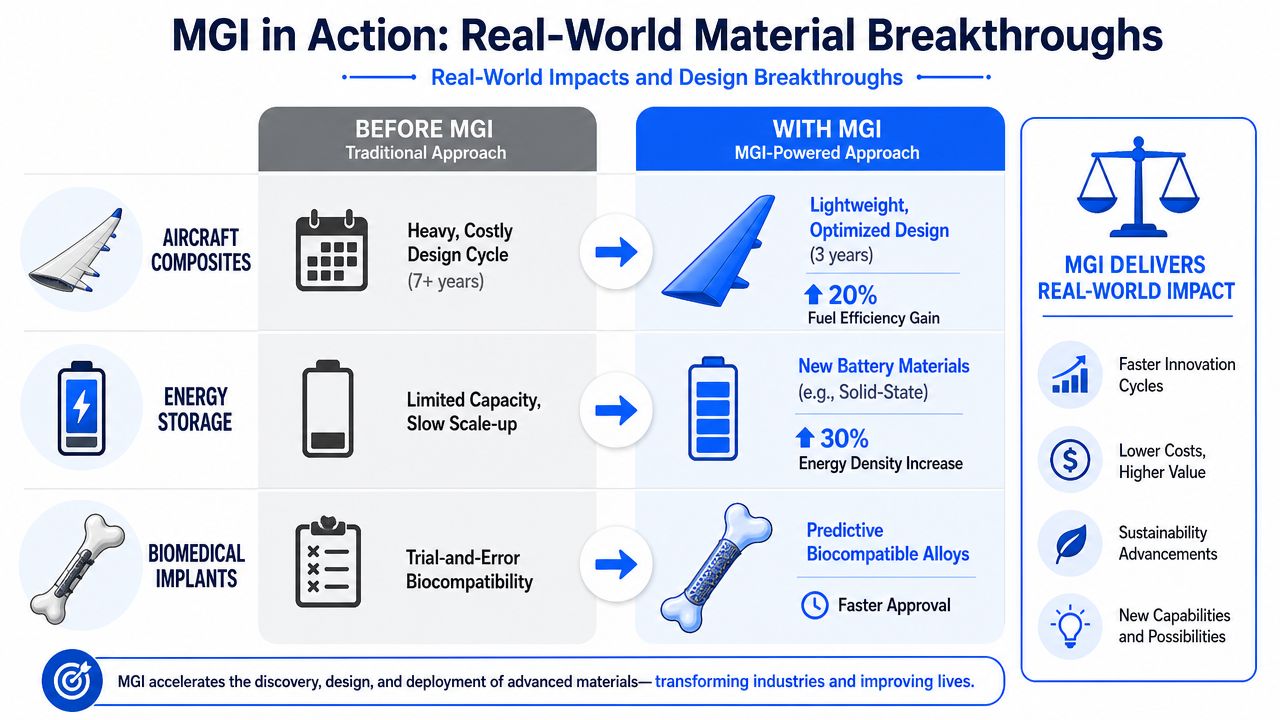
The most important technical idea to understand here is inverse design. Traditional materials development usually starts with a material and asks, "What properties does this have?" Inverse design flips the question and asks, "What structure or composition could deliver the properties we need?"
That shift sounds subtle. It isn't. It changes how teams prioritize experiments, how they use simulation, and how they define success.
According to a npj Computational Materials article on the Materials Genome Initiative, the framework employs inverse design approaches in which computational tools define target structures before physical synthesis, enabling materials with previously unrealized properties and supporting data-mining techniques that predict bulk mechanical behavior from atomistic structure (MGI overview in npj Computational Materials).
What inverse design changes in practice
In a conventional workflow, scientists may spend months exploring composition space without a clear map of what matters most. In an inverse-design workflow, the target comes first. That target might be a mechanical profile, a thermal window, a conductivity threshold, or a manufacturability constraint.
Computation then narrows the field. Experiments validate and refine. Data from those experiments feeds back into the model.
For leadership teams, that means project reviews can become more rigorous. Instead of asking only whether a candidate passed the latest test, you can ask whether the team is converging on the required property space and learning which variables are causal.
The domains where MGI thinking shows up
The initiative organizes its work across six application-focused domains that include materials for health and consumer applications, information technologies, new functional materials, efficient separation processes, energy and catalysis, and multicomponent materials and additive manufacturing, as described in the npj Computational Materials review cited above.
Those domains span very different technical challenges, but they share a common operating logic:
- Target function first: Start with the property or application need.
- Use models to reduce search space: Avoid synthesizing every plausible candidate.
- Integrate process knowledge early: A material that works only in theory won't help the business.
- Treat data as cumulative capital: Each run should improve future search efficiency.
This matters in commercial settings because many materials programs fail not from lack of creativity, but from lack of disciplined convergence.
Examples that matter strategically
The same review points to advances such as negative stiffness materials and mesostructured soft materials that can fold into complex three-dimensional forms from two-dimensional patterning. Even without diving into every underlying mechanism, the strategic lesson is clear. When teams integrate high-throughput data mining with modeling, they can tailor physical behavior in ways that were difficult to reach through sequential experimentation alone.
For polymer leaders, this should feel familiar. Polymers rarely reward linear thinking. Their performance often emerges from coupled effects involving molecular architecture, additives, processing history, and environmental exposure. That makes them well suited to an inverse-design mindset, provided the team has data systems strong enough to support it.
Inverse design doesn't remove scientific judgment. It gives scientific judgment a sharper starting point.
The practical world-world payoff is better alignment between technical exploration and market needs. Instead of discovering properties after the fact, teams can design toward them.
What the MGI Means for Enterprise R&D
For large R&D organizations, the Materials Genome Initiative matters for one simple reason. It sets a benchmark for how fast a materials team can learn when data, models, and experiments work as one system instead of three separate efforts.
That has direct business consequences. Faster learning cuts the number of experimental cycles needed to reach a viable formulation, lowers rework, and improves the odds that promising ideas survive scale-up.

A useful way to frame MGI for a CTO is this: the public-sector vision was to compress the time from discovery to deployment. In industry, that same logic becomes an operating model for reducing cycle time, improving technical hit rates, and making prior experimental work reusable across programs.
The gap between vision and practice is often widest in polymer R&D.
Why polymers create a harder enterprise problem
Metals and small-molecule systems can be difficult. Polymers add another layer of complexity because performance rarely comes from composition alone. It emerges from molecular structure, additives, processing history, environmental exposure, and supplier variability, all interacting at once.
That makes polymer development less like testing a single ingredient and more like tuning a recipe, oven, and cooling method at the same time. If one team records resin identity carefully but another leaves out shear conditions or drying time, later analysis can miss the underlying cause of success or failure.
In practical terms, many enterprise polymer teams have the science talent to use AI well, but not yet the data environment to support it. Knowledge sits across spreadsheets, instrument files, reports, and free-text notes. The result is familiar. Teams can run analytics projects, but they struggle to build a repeatable learning system.
What MGI changes inside a company
MGI does not ask an enterprise team to copy a federal program. It asks the company to treat materials development as an integrated workflow.
For a business, that means four shifts:
| Shift | What changes operationally | Business impact |
|---|---|---|
| From project memory to institutional memory | Experimental results are structured so later teams can reuse them | Less repeated work and faster program starts |
| From isolated screening to guided search | Models help narrow the next set of experiments | Lower testing costs and shorter decision cycles |
| From property-only thinking to process-aware development | Formulation, processing, and characterization data stay connected | Fewer late-stage surprises in scale-up |
| From AI pilots to production use | Data quality and traceability support routine model use | Better return on digital R&D spending |
Often, private-sector discussions about MGI grow overly abstract. For an enterprise leader, the critical question is not whether integrated materials innovation sounds attractive. The question is whether the company has built the data plumbing, decision rules, and team habits required to make each experiment improve the next one.
Why so many companies stall
The common failure point is not a lack of algorithms. It is weak continuity between lab work, data capture, and decision-making.
A model is only as useful as the experimental context behind it. If tensile strength is recorded without batch history, sample prep, cure schedule, or test method, the number has limited value outside the original project. Multiply that problem across years of polymer work, and the company has a large archive but a small base of reusable knowledge.
That is why closed-loop experimentation still feels immature in many industrial settings. Automated instruments can speed up execution, but automation alone does not create trust. Teams need traceable metadata, shared identifiers, version control for formulations, and a clear path for model recommendations to influence the next run.
Without that foundation, autonomous experimentation stays at the demo stage.
The CTO takeaway
A CTO should read the MGI as a signal about operating maturity. The winners will be the organizations that turn materials data into an asset that compounds, especially in polymer businesses where subtle process differences often determine commercial success.
That also explains why private-sector adoption requires more than software procurement. It usually involves changes in data governance, lab workflow design, and leadership expectations around documentation and reuse. Programs like Silicon Valley Speakers' AI programs can help leadership teams translate AI ambition into a practical rollout plan.
Enterprise teams rarely fall short because the science is beyond reach. They fall short because their systems do not let learning accumulate.
MGI, viewed through an enterprise lens, is a blueprint for making R&D more cumulative. For polymer companies in particular, that can mean fewer dead-end trials, stronger scale-up confidence, and a shorter path from formulation concept to commercial result.
How to Align Your Materials Team with MGI Principles
A materials team does not need a government badge to work in an MGI-aligned way. It needs an operating model where each experiment leaves the next team smarter, faster, and less likely to repeat expensive dead ends.
For a CTO, the goal is straightforward. Build an R&D system that turns data, models, and lab work into a compounding asset. In polymer businesses, that matters even more because small changes in formulation, additives, mixing history, or processing conditions can shift performance in ways that are hard to recover from later.
Start with a usable source of truth
MGI principles break down quickly when formulation data lives in spreadsheets, instrument outputs sit in separate folders, and interpretation remains trapped in free-text notes. That setup is like asking a design team to build from parts stored in unlabeled boxes. The material may be there, but reuse is slow and error-prone.
A shared data foundation fixes that. The point is not archival perfection. The point is making new work arrive in a structure that another scientist, model, or business unit can reuse.
A practical first step is to define the minimum record every experiment must include: material identity, batch or lot context, process conditions, test method, result, and a note on data quality or confidence.
Standardize only what supports decisions
Many scientists hear "standardization" and expect bureaucracy. The better frame is interoperability. If two teams measure the same property in different ways and record it with different names, comparison becomes manual, slow, and unreliable.
That problem shows up often in polymer R&D. One group may log a thermal transition under one label, another may store it as a free-text observation, and a third may omit instrument settings that affect interpretation. At that point, your historical data library looks large but behaves small.
Keep the standardization effort focused on the objects that drive decisions:
- Define core data objects. Formulations, samples, process steps, tests, and results usually come first.
- Set a short list of required fields. High compliance beats ambitious templates that no one completes.
- Record context consistently. Units, methods, instrument settings, and operators often matter as much as the result itself.
- Test retrieval with real users. If a scientist cannot find, trust, and compare prior work in minutes, the structure still needs work.
Protect IP without blocking reuse
Commercial teams often hesitate to centralize materials data because the most valuable knowledge is also the most sensitive. In polymers, formulation details, processing windows, and performance trade-offs are often the business itself.
That concern should shape the architecture, not stop the program.
A strong setup separates discoverability from full visibility. Scientists should be able to know that relevant prior work exists without automatically seeing every proprietary field, customer-specific recipe, or program-level detail. Role-based permissions, project boundaries, audit trails, and controlled access to sensitive attributes let a company share learning internally while still protecting what creates competitive value.
The business benefit is easy to miss at first. Better governance does more than reduce risk. It also makes teams more willing to contribute high-value data because they trust how it will be used.
Choose AI that scientists can question
Predictive accuracy matters. Adoption matters more.
If a model recommends a new formulation but cannot show the variables behind that recommendation, many scientists will treat it as a curiosity rather than a decision tool. Enterprise R&D needs models that support reasoning, not only ranking.
That is especially true in polymer development, where process history, ingredient interactions, and scale-up effects can distort simple pattern matching. Explainable AI helps teams see which inputs are influencing a prediction, how certain the model is, and where more experimentation would reduce uncertainty. It works like a senior scientist who shows their notebook, not just their conclusion.
For a CTO, this is an AI-readiness issue as much as a modeling issue. If your data lacks traceable context, even a good algorithm will struggle to produce recommendations your scientists trust.
Build adoption around one workflow
Many enterprise programs fail because they launch a platform instead of improving a workflow. Scientists do not adopt infrastructure for its own sake. They adopt tools that help them answer a live question faster.
Start with one high-value use case. In a polymer organization, that might be reducing formulation iterations for a target property, improving transfer from bench to pilot scale, or identifying which process variables are driving scrap or retest rates. Then connect the data model, decision rules, and modeling approach to that specific workflow.
This approach keeps MGI alignment practical. It ties digital discipline to shorter development cycles, lower experimental waste, and better handoffs across teams.
Treat alignment as an operating change
MGI is often discussed as a public research vision. In private industry, it is a management discipline.
Teams align with MGI principles when they document work in reusable form, preserve context that models need, protect proprietary knowledge with clear controls, and choose tools that strengthen scientific judgment rather than bypass it. The companies that do this well build R&D systems that learn over time. The ones that do not keep paying for rediscovery.
The Future of Materials Discovery Is Integrated
The Materials Genome Initiative introduced more than a policy agenda. It introduced a new operating model for innovation.
Its lasting contribution is the insistence that materials discovery shouldn't depend on isolated trial and error when computation, structured data, and targeted experimentation can work together. That idea applies far beyond government programs. It applies directly to any enterprise trying to shorten development cycles, reduce wasted experiments, and make better technical bets.
For CTOs, the takeaway is simple. The next generation of advantage won't come from one breakthrough tool. It will come from building an internal system where experiments produce reusable data, data improves models, and models help teams choose smarter experiments.
The organizations that adopt that integrated model will make faster decisions with stronger evidence. The rest will keep paying for the same lessons twice.
If your team is trying to build that kind of integrated, AI-ready materials R&D system, Polymerize is worth a look. Polymerize helps enterprises unify fragmented materials data, apply explainable AI to formulation and property prediction, and protect proprietary knowledge with enterprise-grade controls, so scientists can move from scattered trial and error to a more targeted discovery workflow.
Put your R&D data to work
See how materials teams use Polymerize to plan fewer experiments and reach target properties faster.