

A formulation chemist needs the historical solubility data for a polymer system before approving the next experiment. The relevant records exist, but one set is in an old spreadsheet, another is buried in an ELN export attached to an email, and the instrument conditions live in a laboratory system that uses different sample names. By the time the scientist reconstructs the context, the team has already repeated work that the organization had effectively completed.
This is the everyday cost of weak materials data management. The problem isn't only that information is difficult to find. Teams can't reliably interpret, compare, or reuse data when sample identity, processing history, test conditions, and results remain disconnected. A centralized, governed data backbone turns those records into an operational asset, allowing scientists to plan targeted experiments instead of relying on memory and trial and error.
Table of Contents
The Hidden Cost of Fragmented Materials Data
The spreadsheet itself rarely causes the failure. The failure comes from the missing relationships around it. A formulation may be recorded by an internal nickname in one file, by a batch identifier in an ELN, and by an instrument-generated code in a LIMS. Without a shared identity model, a search for prior solubility work returns incomplete results or, worse, results that appear comparable but were produced under different conditions.
Researchers then compensate with manual work. They search folders, ask colleagues, inspect old reports, and rebuild context from partial notes. Experienced scientists may know where the useful information is, but that knowledge remains tribal rather than accessible to the broader team. New researchers face a longer learning curve, while senior scientists spend time acting as human search engines.

Why fragmentation creates failed experiments
Fragmented records make it difficult to answer basic scientific questions:
- What was tested? The material name may not be unique across systems.
- How was it prepared? Processing history can sit in free text or a separate attachment.
- Under which conditions? Instrument settings and environmental variables may be absent from the result file.
- Can the result be trusted? Teams may not know whether a value was corrected, reprocessed, or superseded.
These gaps push scientists toward repeated screening. Repetition isn't always wasteful, since carefully designed replication is part of good science. Unintentional repetition is different. It consumes laboratory capacity without improving understanding, and it makes scale-up decisions harder because the organization can't distinguish a new result from a rediscovery of an old one.
Practical rule: Treat every experiment as a connected record, not as an isolated file.
A centralized backbone doesn't eliminate imperfect data or remove the need for scientific judgment. It gives people a consistent place to capture identities, link evidence, preserve context, and retrieve prior work. That foundation changes the conversation from “Can anyone find the old result?” to “Which historical experiments are relevant to this formulation, and what should we test next?”
How Materials Data Management Evolved from Handbooks to Big Data
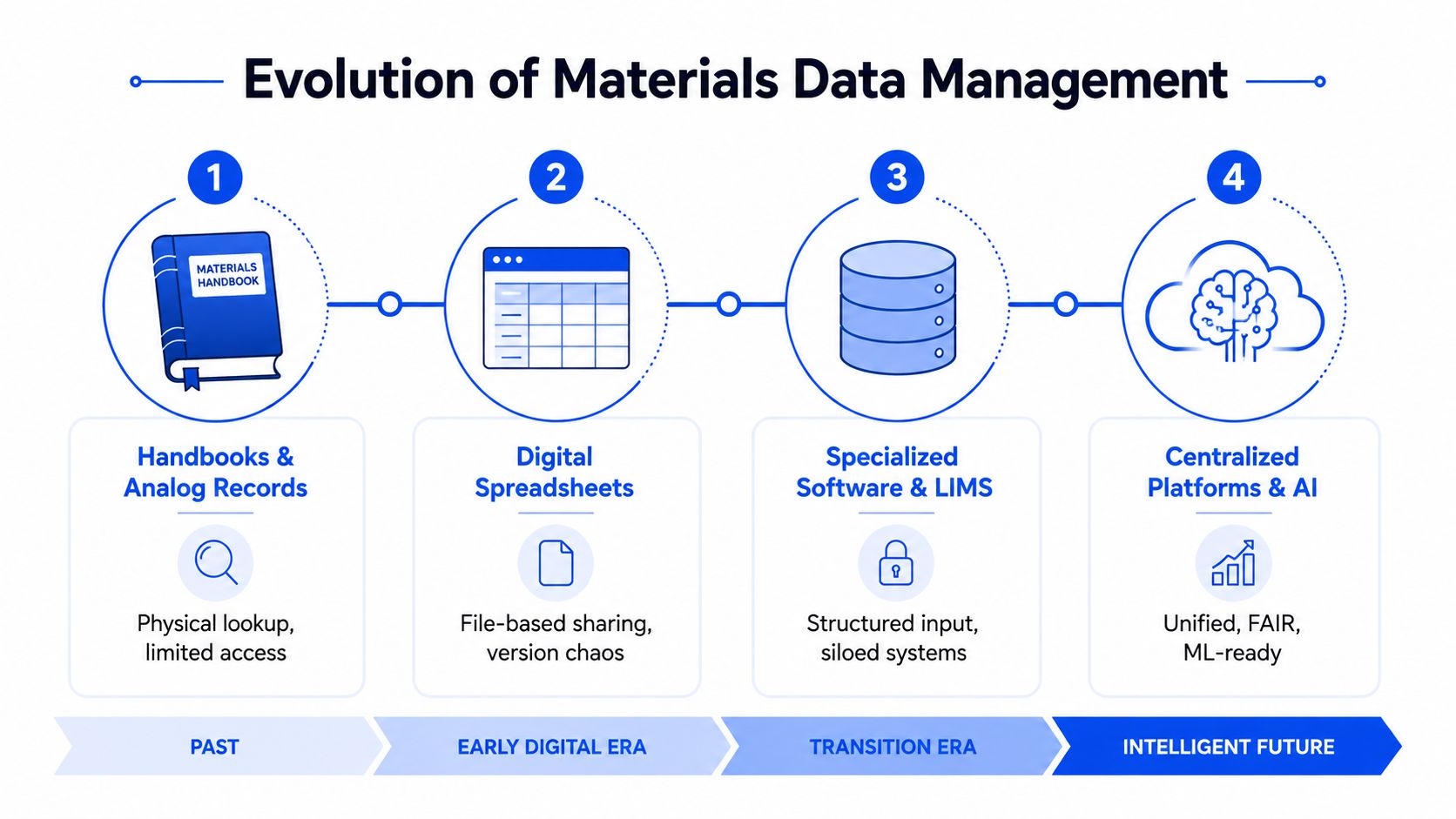
Materials information has passed through a long, three-stage evolution, commonly described as handbooks, databases, and big data. The 2018 review in Chinese Physics B describes the first stage as handbook-style reference collections, the second as database systems supporting material selection, and the third as big-data approaches directed toward material development. The progression reflects a change in purpose, not just a change in storage capacity. The review of materials data management's historical development connects static reference information with later decision-support and discovery workflows.
In the handbook era, scientists consulted curated references containing established properties and known systems. Access was limited by the collection itself, and the data generally described materials that had already been characterized. Database systems made information easier to search and compare, shifting the emphasis toward selecting materials for a defined need. Modern big-data approaches go further by connecting synthesis, properties, characterization, and analysis so teams can develop new materials rather than only retrieve known values.
Scale changes the governance problem
A defining benchmark in current materials informatics is the move from tens of thousands of records to millions of materials experiments and analyses. A npj Computational Materials paper on data lineage explicitly addresses systems that must track “millions of materials experiments and analyses” and demonstrates lineage tracking through the High-Throughput Experimentation Joint Center for Artificial Photosynthesis repository. The paper on materials data lineage and traceability shows why volume alone isn't enough. At that scale, provenance, versioning, and traceability determine whether a result can support scientific decisions.
This is why a modern platform can't be treated as a larger file cabinet. It needs relationships between samples, formulations, processing steps, measurements, analyses, and model outputs. It also needs to retain the history of changes, because a revised dataset or corrected measurement shouldn't erase the state used in an earlier conclusion.
The transition to AI and machine learning makes this requirement stricter. Models consume structured relationships, not informal context remembered by one scientist. If the infrastructure can't preserve where a value came from and how it was generated, the organization may produce a prediction without being able to defend, reproduce, or improve it.
Building an AI-Ready Data Model with FAIR Principles
Metadata capture belongs inside the experimental workflow. It shouldn't be a cleanup exercise assigned to a curator after the laboratory work is complete. In an electrochemical laboratory case study, researchers identify low data quality as a major barrier to big-data methods and emphasize the need to link experimental records with enriched metadata so the data becomes findable, accessible, interoperable, and reusable. The RSC case study on machine-actionable electrochemical laboratory data makes the practical implication clear: analytics depends on structured context.
Start with a stable identity model. Assign unique identifiers to materials, samples, batches, formulations, instruments, methods, and experiments. Then define how those entities relate. A sample should connect to its parent material, preparation route, operator, instrument method, test conditions, raw output, processed result, and associated interpretation.
Capture context at the point of work
A useful schema should make important information difficult to omit without making the scientist enter the same fact repeatedly. Capture instrument settings directly where possible, use controlled vocabularies for units and test methods, and separate measured values from derived values. Free-text notes still matter, but they shouldn't carry the entire scientific meaning of the record.
Use this review checklist before calling a dataset AI-ready:
- Identity: Can a scientist distinguish every material, sample, batch, and formulation without relying on local nicknames?
- Context: Are preparation steps, environmental variables, instrument settings, and processing history linked to the result?
- Semantics: Do teams use shared terms for properties, units, methods, and failure modes?
- Lineage: Can a user trace a model input back to the original record and raw measurement?
- Access: Can authorized users retrieve the data through predictable interfaces and permissions?
- Reuse: Does the record explain enough about its limitations and conditions for another team to use it responsibly?
FAIR principles work because they connect human usability with machine actionability. Findability helps a scientist locate a relevant experiment. Interoperability lets a model compare it with records from another laboratory. Reusability requires the provenance and context needed to decide whether that comparison is scientifically valid.
NIST also treats interoperable laboratory infrastructure and materials traceability as prerequisites for machine-actionable data in data-intensive materials science. That makes metadata a design decision, not an administrative afterthought.
A short visual overview can reinforce how these principles fit together:
Integrating ELNs, Spreadsheets, and Laboratory Systems
Most organizations don't have the luxury of replacing every system at once. The practical question is how to connect spreadsheets, CSV exports, ELNs, LIMS, instrument files, and paper records without creating another fragile layer of translation. NIST's analysis identifies interoperability as a continuing weakness even where repositories and collaboration tools exist, while materials-data ecosystem work points to fragmentation and poor translation between algorithms and laboratories as core barriers. NIST's analysis of materials data infrastructure and interoperability provides useful context for evaluating integration choices.
Compare the integration patterns
| Approach | Where it works | Main trade-off |
|---|---|---|
| Point-to-point connectors | A small number of stable systems with narrow data flows | Fast to start, but every new source adds another dependency |
| Middleware platform | Several systems need transformation, validation, and routing | More control, but requires integration ownership and careful schema management |
| Unified data backbone | Multiple labs need shared identities, search, lineage, and analytics | Greater implementation effort, but stronger consistency and scalability |
Point-to-point connections can be sensible for a focused pilot. They become difficult to govern when each connector interprets sample names, units, and status fields differently. Middleware helps centralize transformation rules, but it doesn't automatically solve semantic disagreement. A shared backbone provides the strongest foundation when the organization needs one coherent view across projects, provided the team invests in data ownership and adoption.
Integrate in layers, not all at once
Begin with the sources that contain the highest-value experimental history. Preserve raw files, map them to canonical entities, and flag uncertain matches for scientist review instead of forcing a conversion. The system should also record whether a value was imported, manually entered, calculated, or corrected.
A platform such as Polymerize Connect can unify experimental data from spreadsheets, CSV files, ELNs, and other silos into a centralized, secure data backbone. The important evaluation criteria are broader than the product interface. Ask whether the system supports shared identifiers, validation rules, source-level provenance, access controls, and an export path that keeps the organization from becoming dependent on undocumented transformations.
Interoperability isn't achieved when two systems exchange files. It's achieved when scientists can interpret the same record consistently across systems.
Governance, Security, and Compliance for Sensitive R&D Data
A centralized repository can put formulation data, synthesis routes, process conditions, and performance results in one place, which also concentrates risk. Better retrieval has to be matched by controls that protect intellectual property and define who may use each record.
Governance assigns ownership for data definitions, access decisions, quality rules, and retention. Role-based access control lets teams share project information without exposing every formulation detail to every user. Encryption protects data in transit and at rest. Audit trails record who accessed, changed, approved, or exported a record.

Make compliance operational
ISO 27001 provides a framework for an information security management system. SOC 2 helps organizations evaluate controls for service delivery and customer information. GDPR and CCPA create obligations around personal data, including user accounts, laboratory notes, collaboration records, and support workflows, even when the main dataset concerns materials.
These frameworks make security responsibilities explicit and auditable, but they do not define scientific ownership or data meaning. A vendor review should examine both technical and operational controls:
- Access design: Can administrators apply permissions by role, project, site, or data type?
- Auditability: Does the system preserve a usable history of changes and access events?
- Data handling: Can the organization control exports, retention, deletion, and recovery?
- Model governance: Can teams identify the records used to train or evaluate a model?
- Incident readiness: Are responsibilities and escalation paths documented before a problem occurs?
For teams assessing data provenance for training data, the practical test is traceability. A model input should connect to its origin, every transformation, and its approval status. That record supports reproducibility and lets scientists investigate a suspicious result without discarding the workflow.
Implementation friction usually appears at the boundaries. Teams must agree on ownership, classify sensitive fields, review permissions as projects change, and test exports and recovery before an incident. Good governance enables collaboration while protecting sensitive work through explicit permissions, dependable records, and accountable stewardship.
From Searchability to AI and ML Workflows
A searchable repository is useful, but search is only the entry point. A scientist may find a prior experiment and still lack the conditions needed to compare it with a current formulation. An AI or machine-learning workflow needs more. It must connect synthesis data, property data, characterization results, and the provenance that explains how each value entered the dataset.
The Matbench benchmark suite illustrates the challenge across 13 materials property prediction tasks, spanning small datasets with only a few hundred samples and large simulation-derived datasets exceeding 10^5 samples. The benchmark uses nested cross-validation to estimate errors across mechanical, electronic, and thermodynamic properties. The Matbench benchmark paper shows why teams need disciplined evaluation when materials programs combine sparse experimental records with large computational datasets.
Build a decision pipeline
A reliable materials AI workflow usually has four connected layers:
- Evidence layer: Store raw measurements, synthesis conditions, formulations, and characterization outputs with stable identities.
- Interpretation layer: Standardize units, methods, labels, and derived features while retaining the original values.
- Validation layer: Define prediction tasks, preserve provenance, and test models with leakage-resistant evaluation.
- Decision layer: Present predictions, causal drivers, confidence information, and relevant historical precedents in a form scientists can challenge.
The benchmark repository assembled 50 materials datasets to address the lack of standardized and diverse materials ML data, reinforcing the importance of dataset selection and normalization. The materials datasets benchmark repository is a useful reference point for teams designing benchmark-ready schemas, although internal data still requires domain-specific governance.
Avoid impressive but fragile models
Inconsistent curation can make development performance look stronger than production performance. Duplicate samples, inconsistent task definitions, missing conditions, and hidden links between training and test records can all distort evaluation. The fix isn't just a more complex algorithm. It starts with clear inclusion rules, preserved lineage, standardized targets, and a documented distinction between measured, calculated, and imputed values.
Once those controls exist, models can support more than property prediction. They can help identify likely drivers, prioritize candidate formulations, and recommend the next experiment that best separates competing hypotheses. The model doesn't replace the scientist. It gives the scientist a structured way to spend laboratory effort where the expected information is greatest.
Starting Your Materials Data Management Journey
A complete transformation isn't a prerequisite for useful progress. Teams can begin with a narrow, high-value workflow and expand after they understand where scientists lose time and where data quality breaks down. Waiting until every legacy record is clean often delays the learning needed to design the right system.
Start with one decision, not every dataset
Choose a decision that recurs, matters commercially, and depends on information spread across systems. Formulation optimization, failure analysis, or scale-up transfer can all expose identity, metadata, and interoperability problems quickly.
Use a staged plan:
- Stage one, establish control: Inventory the relevant sources, define the core entities, assign owners, and preserve original files during migration.
- Stage two, connect the workflow: Integrate the ELN, spreadsheet imports, test results, and approved vocabularies needed for one use case.
- Stage three, activate intelligence: Add model-ready schemas, validation routines, experiment comparison, and decision support after the underlying records are trustworthy.
A reverse approach works well here. Start from the decision the scientist needs to make, identify the minimum evidence required, and then build backward toward capture and integration. This avoids spending months standardizing fields that no current workflow uses.
A practical first 90 days
During the opening period, interview scientists and technicians before selecting software. Map where sample identity changes, where results are manually copied, and where approvals happen outside the official system. Next, digitize the most valuable active records, create a small controlled vocabulary, and appoint a data steward who can resolve ambiguous mappings.
Data scientists should join when the team can state a prediction or prioritization task clearly. Before that point, domain owners and system architects usually have more influence on success because they define what the data means. Address resistance by reducing duplicate entry and showing scientists how captured context returns value during search, comparison, and review.
Measuring Success and Scaling Your Data Strategy
Database size is a weak success measure. A large repository can still produce poor decisions if records lack context, identities don't match, or scientists can't trust the results. Strong materials data management should improve the quality and speed of decisions while making useful work easier to reproduce.
Track outcomes that reflect laboratory reality:
- Experiment success rate: Monitor whether teams achieve the intended test objective and distinguish planned replication from accidental repetition.
- Time to insight: Measure the effort required to retrieve, interpret, and compare prior experiments.
- Model reusability: Record whether a validated model, feature definition, or dataset can support another project without rebuilding its foundations.
- Cross-lab collaboration: Observe whether teams can share records using common definitions rather than manually translating files.
- Scale-up continuity: Check whether formulation and process context remains available as work moves from laboratory development toward production.
Create feedback loops between data quality and model behavior. When a prediction fails, the review should examine the data lineage, measurement conditions, task definition, and applicability range, not only the algorithm. When a scientist identifies a missing variable or ambiguous label, the steward should feed that learning back into the schema and capture workflow.
Assign responsibility explicitly. Scientists own meaning, laboratory managers own execution discipline, data stewards own definitions and quality rules, and technology teams own reliability and access. Leadership then reviews whether the infrastructure is improving scientific throughput and decision quality, rather than rewarding the team for accumulating records.
Materials data management is a strategic capability because it compounds. Each well-structured experiment strengthens retrieval, comparison, validation, and future model development. The result isn't merely a cleaner archive. It is a more deliberate R&D system that replaces repeated searching and blind trial-and-error with traceable, targeted innovation.
Polymerize provides a centralized materials R&D foundation that connects experimental data from spreadsheets, ELNs, and laboratory silos, with tools for structured records and AI-guided experimentation. Visit Polymerize to see how your team can turn fragmented materials data into a secure, reusable workflow for discovery and scale-up.
Put your R&D data to work
See how materials teams use Polymerize to plan fewer experiments and reach target properties faster.