
You know the routine if you run materials R&D: the formulation data lives in spreadsheets, the synthesis notes sit in an ELN, failed batches are buried in email threads, and the next experiment is still chosen by whichever senior chemist has the clearest memory of last quarter. The team keeps making progress, but it's slow, and every promising candidate seems to demand one more round of trial and error before anyone trusts it.
Machine Learning for Materials Discovery changes that rhythm by turning scattered history into a ranked search strategy. Instead of asking scientists to scan everything, the model helps narrow the next experiment, the next simulation, or the next composition space to the candidates most likely to matter. That shift has deep roots in materials informatics, a term coined in 2003 and formalized in 2004 and 2005, including Krishna Rajan's 2005 paper in Materials Today, which helped define the modern data-driven approach for discovery ACS review on materials informatics.
The practical appeal is obvious. Teams want fewer dead ends, better prioritization, and a workflow that still respects chemistry, physics, and manufacturing reality. The catch is that the shiny benchmark result is rarely the hard part, because the hard part is getting predictions to survive synthesis, scale-up, and messy enterprise data.
Table of Contents
Introduction
A polymer team can spend months chasing a formulation that looks strong in simulation, only to find in the lab that the precursor path is unstable or the processing window is too narrow. A battery group can build a promising candidate list from first-principles screens, then discover that half the list was never practical to synthesize. Those failures are not model failures alone, they are prioritization failures.
Machine learning helps by reframing discovery as a prioritization problem rather than an exhaustive search problem. The question is not whether the model can replace experiments. The question is whether it can help decide what to predict, generate, rank, or close the loop on next. In materials informatics, the model learns from historical measurements, structure-property relationships, and uncertainty, then directs scientists toward candidates most likely to move the program forward materials informatics foundation.
The strongest programs start with a clear decision. A team may need property prediction for triage, generative methods for expanding a design space, ranking for fast selection, or active learning to tighten the experimental loop. That choice matters because the wrong setup can produce elegant charts and still waste months of lab time.
Practical rule: if the model cannot tell you what to test next, it is still a research tool, not a production workflow.
This guide takes a practitioner's view. It focuses on what works when data is sparse, the lab is noisy, and leadership expects a workflow that can survive procurement, synthesis, and scale-up.
Core Machine Learning Approaches for Materials Discovery
The four approaches that matter most in real materials programs are property prediction, generative design, surrogate modeling, and high-throughput screening. Each one solves a different bottleneck, and each one fails in a different way if you push it outside its lane.
Match the method to the task
Property prediction is the most familiar starting point. You train a model on labeled examples so it can estimate something like stability, conductivity, glass transition behavior, or another target property from composition, structure, or descriptors. This works best when you already have a decent historical dataset and you need fast triage, not creative exploration.
Generative design goes one step further. Instead of scoring existing candidates, it proposes new ones, which is useful when your current design space has been exhausted. The danger is that unconstrained generation often produces objects that look novel but fail simple chemistry or synthesis checks, so generative models need guardrails.
Surrogate models are the workhorses for expensive simulation pipelines. They approximate a slower physics-based calculation so teams can evaluate more candidates without paying the full computational cost. In practice, they're most useful when first-principles simulation is too slow to sit inside an active search loop.
High-throughput screening is the operational layer. It uses models or simulations to rank large candidate sets, then pushes only the most promising materials into deeper calculation or lab validation. DeepMind's GNoME effort showed what this looks like at scale, reporting 2.2 million newly discovered crystal structures and 380,000 predicted stable materials in 2023, with the researchers describing the scale as equivalent to nearly 800 years of human knowledge generation DeepMind GNoME.
A simple decision table
| Goal | Best fit | What to watch |
|---|---|---|
| Predict a measured property from existing data | Property prediction | Watch for sparse labels and poor coverage |
| Propose novel candidate materials | Generative design | Constrain chemistry and synthesis space |
| Replace a costly simulation step | Surrogate model | Validate against the real physics target |
| Narrow a huge search space | High-throughput screening | Measure ranking quality, not just fit |
A useful resource on organizing an R&D team around this kind of workflow is the enterprise machine learning team insights case study, especially if your data, modeling, and lab teams still work in separate lanes.
A lot of teams overestimate how much novelty they need and underestimate how much routing and ranking they need. The best first step is usually not the fanciest architecture, it's the one that can sort 500 candidates down to 20 sensible experiments.
Data Preparation and Active Learning Workflows
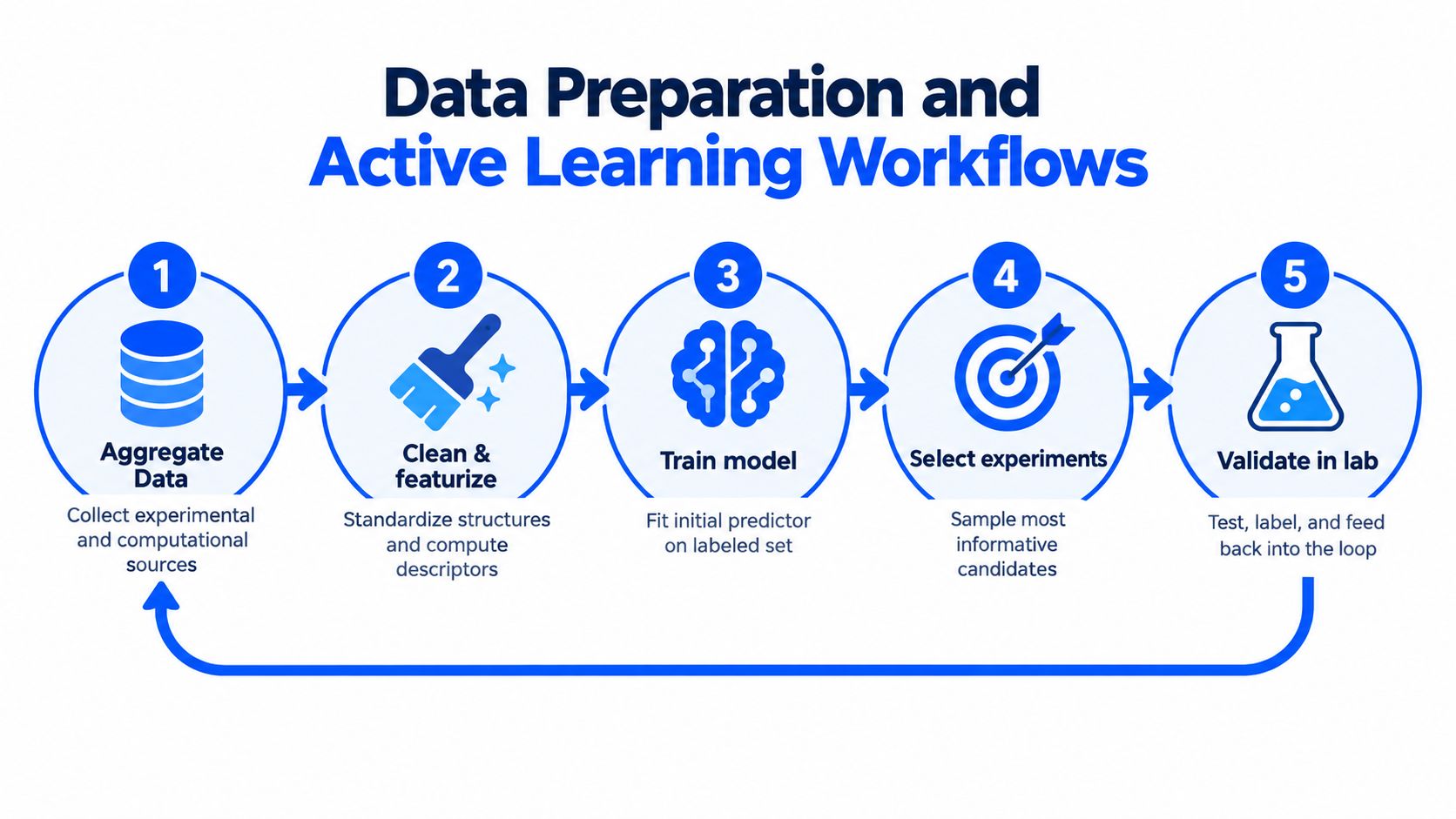
The model is only as useful as the data pipeline behind it. In materials work, that means consolidating experimental records, simulation outputs, failed runs, and metadata that explain how a sample was made, measured, and stored. If those pieces stay fragmented, the model ends up learning lab-specific noise instead of chemical signal.
Build the dataset like an experiment, not a spreadsheet
Start by aggregating data from every source that can survive an audit. Then standardize structures, units, ontologies, and measurement context so the model isn't guessing whether two records are actually comparable. The workflow only becomes useful once the team can trust that a label means the same thing across batches, operators, and instruments.
Practical rule: if you can't explain the provenance of a record, don't let it drive a candidate choice.
Next comes feature engineering. For some projects, that means hand-crafted descriptors such as stoichiometry, topology, processing conditions, or domain-specific embeddings. For others, it means representation learning, but the critical test is always the same: whether the representation preserves the chemistry well enough for the downstream decision.
Active learning is where this becomes a discovery engine rather than a static model. Reviews of materials discovery describe the strongest loop as forward prediction plus uncertainty estimation, then Bayesian optimization or another selection rule to choose the next experiment from a small candidate pool active learning review. That loop matters because it cuts wasted synthesis and characterization by asking the model to point to the most informative next test, not just the most likely winner.
What a ready workflow looks like
- Aggregate data from ELNs, spreadsheets, simulations, and instrument exports.
- Clean and featurize the records so structure, composition, and process history are comparable.
- Train the first model on the labeled set, even if it's small.
- Select experiments using uncertainty or acquisition logic, not gut feel alone.
- Validate in the lab and feed the result back into the loop.
That's also where implementation discipline matters more than algorithmic flair. Teams that treat the lab as a feedback source, not just a validation endpoint, usually get to useful behavior faster.
Model Interpretability and Evaluation Metrics
A model that predicts well but can't explain itself won't last long in a real R&D organization. Scientists need to know whether the model is keying on chemistry, artifacts, or process history, because they're the ones who will decide whether to trust the next recommendation. Interpretability is not a nice-to-have, it's part of the scientific review process.
What scientists need to see
For structured materials data, tools like feature attribution methods and attention-style mechanisms can show which inputs are driving the prediction. That matters when a formulation chemist wants to know whether the model is really responding to a polymer backbone, a filler interaction, or an accidental correlation in the training set. If the explanation conflicts with chemical intuition, the result usually deserves a second look.
Evaluation is just as important. Generic accuracy on a static test set can look strong while the model still fails at actual discovery. The Matbench Discovery framework was introduced specifically to evaluate energy models as pre-filters for high-throughput search of stable inorganic crystals, shifting attention toward thermodynamic stability and candidate prioritization rather than generic prediction error Matbench Discovery.
That shift reflects a core truth. In discovery work, a small ranking improvement can matter more than a tiny reduction in mean error, because the business question is often “how many expensive experiments can we avoid?” not “how much can we shave off a benchmark score?” A model should be judged on the decision it supports, not just the loss function it optimizes.
A good internal test is simple, if the top-ranked candidates fail when a domain expert inspects them, the evaluation protocol is probably measuring the wrong thing.
For enterprise teams, that means evaluation should match the stage of the workflow. Early-stage screening may care about ranking and recall of viable candidates. Late-stage development may care more about calibration, uncertainty, and the confidence with which the model rejects bad options. The same model can be useful in one stage and misleading in another.
The Synthesizability Gap and Data Reliability Challenges
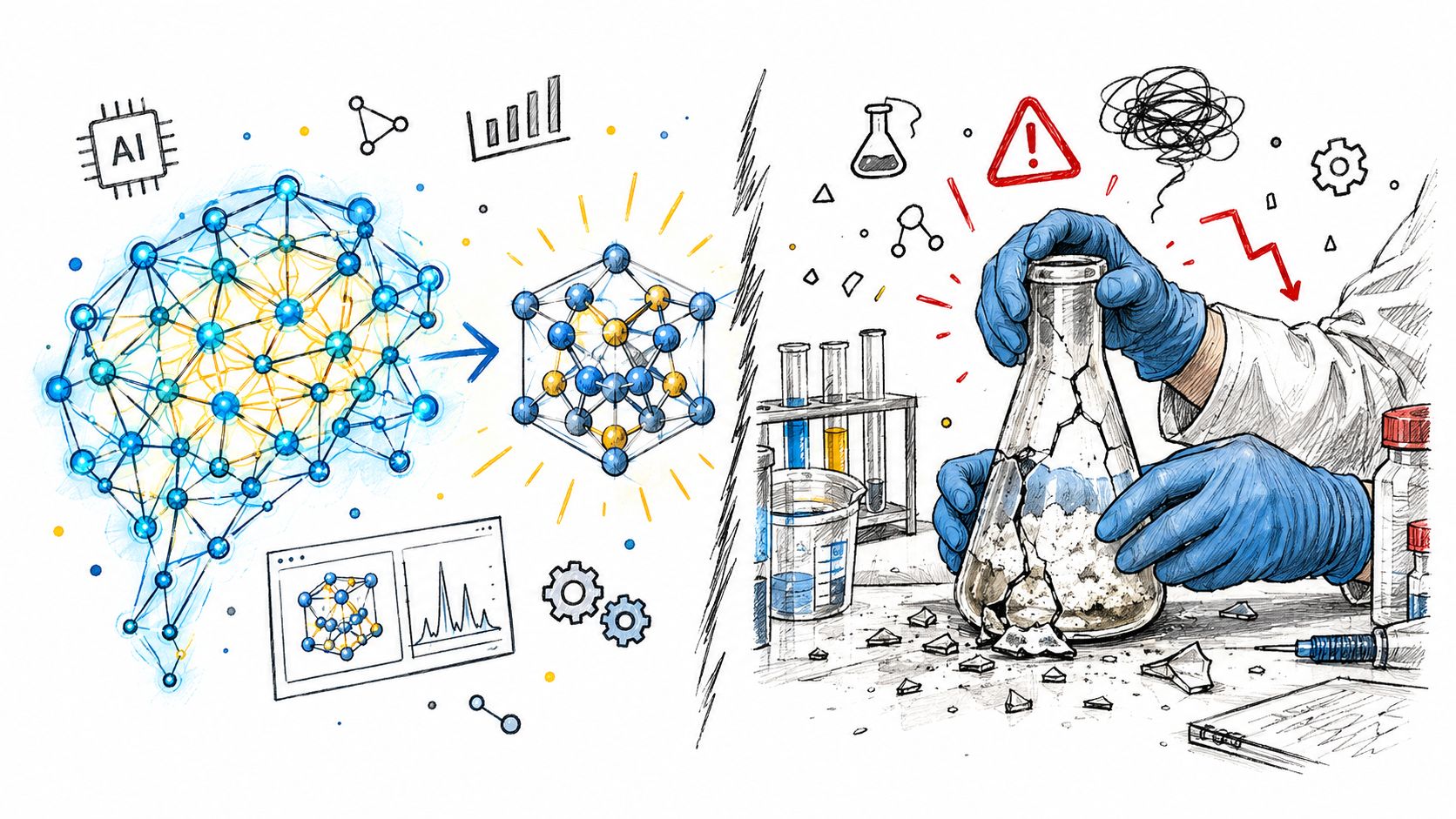
The hardest failure mode in machine learning for materials discovery is a prediction that looks excellent and still cannot be made. A model can flag a candidate with strong properties, then miss the fact that no practical synthesis route exists under real laboratory constraints. That is the synthesizability gap, and benchmark scores often hide it.
Why promising candidates still fail
A 2026 review of synthesis-aware screening argues that structure-centric and DFT-trained generative models often struggle once predictions meet synthesis, and one preprint reports that fewer than 2% of over 50,000 low-enthalpy phases from high-throughput surveys were ever realized experimentally synthesizability review. The practical lesson is straightforward. Thermodynamic plausibility is not the same as manufacturability, and a candidate that looks ideal on paper may still fail because of precursor constraints, kinetics, contamination risk, or process windows.
Enterprise teams need synthesis-aware screening at this stage. The model has to stay inside chemically and physically feasible regions, not drift into elegant but irrelevant territory. The workflows that work combine property prediction with feasibility checks, active learning, and experiment planning so the search narrows before anyone books a furnace or spends a week of operator time.
Why enterprise data makes the problem harder
Real company datasets rarely behave like benchmark data. The 2026 enterprise reliability review highlights a rich-get-richer pattern, where stable compounds are overrepresented while reactive intermediates, defects, interfaces, and extreme-condition cases are undercovered enterprise reliability review. That bias matters because models generalize best where they have seen enough examples, and the sparse regions are often the ones that matter most.
The same review points to inconsistent simulation settings, weak benchmarking, missing negative results, and poor provenance tracking. Those problems do more than lower scores. They distort the model's sense of what is chemically normal. In practice, success depends less on model novelty than on data infrastructure, FAIR-like practices, multimodal fusion, and active learning loops that deliberately query the missing corners of the space.
The enterprise question is not “Can the model fit my data?” It is “Can it survive my data quality, my synthesis constraints, and my edge cases?”
That is why the best teams treat data reliability as a design requirement. They test how the model behaves outside the neat benchmark slice, then build the data and workflow scaffolding needed to keep it honest.
Enterprise Integration and Next Steps
The organizations that get value from materials ML don't treat it as a one-off pilot. They wire it into the existing workflow, with explicit ownership for data, modeling, experimental validation, and decision review. That sounds ordinary, but it's the difference between a demo and a repeatable capability.
Build the operating model first
Start with the data backbone. If records are still scattered across spreadsheets, ELNs, and local drives, the first win is centralization and lineage, not a new neural network. Once the data is usable, define who approves labels, who reviews model outputs, and who decides when a candidate is good enough to synthesize.
For teams looking at the software side of that transition, the enterprise MLOps strategic guide is a useful reference for thinking about deployment, monitoring, and governance in a production environment. The same principle applies in materials, the system has to keep working after the first successful model.
That's also where a platform like Polymerize fits naturally, because it centralizes fragmented materials data, applies explainable property models, and supports experiment planning inside an enterprise workflow. It's one option for teams that need a controlled data layer plus decision support instead of another isolated modeling notebook.
Pick the next step by readiness level
- If the data is fragmented, begin with a data audit and provenance cleanup.
- If the data is usable but the search is large, launch a ranking model or surrogate screen.
- If the lab can run iterative tests, connect the model to an active learning loop.
- If scale-up is the bottleneck, add synthesis-aware filters and validation gates before commit decisions.
The common mistake is to chase broad automation before the workflow is stable. A smaller loop that reliably improves candidate selection is far more valuable than a broad system that cannot explain why it recommended a failed batch.
The right goal is augmentation, not replacement. Scientists still choose the constraints, interpret the edge cases, and decide what the lab should trust. Machine learning just makes that judgment faster, narrower, and more repeatable.
If your team is trying to turn materials data into a reliable discovery workflow, Polymerize is built for that bridge from fragmented records to experiment-ready recommendations. Visit Polymerize to see how its data backbone and explainable models can support your next materials program.
Put your R&D data to work
See how materials teams use Polymerize to plan fewer experiments and reach target properties faster.