


A materials team rarely notices inventory when things are going well. They notice it when a formulation run stalls because the catalyst bottle on the shelf is expired, when a freezer sample can't be located, or when two scientists record the same material under different names and feed conflicting lineage into the ELN. At that point, inventory stops being a stockroom problem and becomes an R&D reliability problem.
That matters more now because modern materials programs don't just need materials on hand. They need clean, connected, traceable inventory data that can support reproducibility, cross-team collaboration, and eventually AI-guided experimentation. If your inventory still lives in spreadsheets, labels, inboxes, and lab memory, your lab is building models on shaky ground.
Table of Contents
- Practices that are non-negotiable
- Access, disposal, and exception handling
- KPI Comparison Manual vs Digital Inventory Systems
Beyond the Stockroom The Strategic Value of Inventory Data
A failed experiment often gets blamed on chemistry, process conditions, or operator variation. In many labs, the primary culprit is upstream. The reagent had the wrong lot. The polymer standard was stored in the wrong condition. The sample ID in the notebook didn't match the label on the vial. Those aren't clerical mistakes. They're broken data links.
That's why laboratory inventory management should be treated as part of the experimental data stack, not a support function. The inventory record tells you what entered the lab, where it moved, how it was stored, when it was used, and what result it influenced. If that record is incomplete, every downstream analysis becomes less trustworthy.
Why digital inventory matters now
The shift is already underway. The global laboratory inventory management software market is projected to grow from USD 3.14 billion in 2026 to USD 4.92 billion by 2030 at an 11.9% CAGR, reflecting broader adoption of digital systems to improve efficiency and transparency, according to Research and Markets' laboratory inventory management software market report.
That market growth is useful context, but the practical point is simpler. Labs are moving away from passive lists and toward systems that create a usable digital thread.
Inventory is the only lab dataset that touches procurement, storage, experiment execution, safety, quality, and scale-up all at once.
For materials R&D, that digital thread is especially valuable because the same material can change meaning across stages. A raw monomer becomes a formulated blend. A blend becomes a screened sample. A screened sample becomes a scale-up candidate. If those parent-child relationships aren't captured, your team can't reliably answer basic questions like:
- Which lot produced the best property profile
- Which storage condition correlated with drift
- Which formulation inputs are safe to reuse in a new model
- Which failed experiments were inventory quality failures
What changes when inventory becomes data
A spreadsheet can tell you what should be in a cabinet. A modern system should tell you whether a material is fit for use, what experiment it supports, and whether its metadata is complete enough for search, audit, and model training.
That's the strategic value. Better laboratory inventory management doesn't just reduce chaos in the stockroom. It gives scientists, lab managers, and digital teams a common source of truth. In AI-driven materials R&D, that source of truth is the backbone that keeps discovery work fast without making it fragile.
The High Stakes Benefits and Risks in Materials R&D
Treat laboratory inventory management like office administration and the lab pays for it in delays, waste, and bad science. Treat it like a controlled data asset and the lab gets faster execution, stronger reproducibility, and fewer avoidable setbacks.
A useful analogy is this. A spreadsheet is a handwritten parts list. A digital inventory system is closer to an asset management layer with identity, history, condition, location, and use records attached to every item. That difference changes how the lab operates.

What good inventory control delivers
In materials R&D, the upside starts with reproducibility. When every reagent, sample, and consumable has a reliable identity and usage history, scientists can trace outcomes back to actual inputs instead of assumptions. That reduces argument over what happened in a run and shortens root-cause work when results drift.
The next gain is speed. Scientists stop hunting through freezers, cabinets, and shared files. Purchasing teams stop guessing what's really on hand. Lab leads can make better scheduling decisions because they know which materials are available, reserved, quarantined, or nearing end of life.
A strong inventory system also improves audit posture. If your lab supports regulated programs, customer validation work, or technology transfer, you need to show custody, status, and handling history without rebuilding the story manually from disconnected records.
What poor inventory control costs
The downside is concrete. Inadequate inventory management in health facilities led to a 12.94% wastage rate from expiration and damage, and the average stock-out lasted 58 days, according to this study on laboratory commodity inventory performance. In a materials setting, the same failure pattern translates into halted experiments, rescheduling, compromised continuity, and teams working around missing inputs instead of executing the plan.
If a lab can't trust the identity, availability, or condition of its materials, it can't trust the conclusions built on them.
For AI-driven programs, the risk gets sharper. Poor inventory discipline doesn't just waste chemicals. It contaminates the training set. If sample lineage is ambiguous, if lot changes are unrecorded, or if degraded materials are treated as valid inputs, the model learns from noise. The result is false confidence, weak recommendations, and avoidable rework.
The real trade-off
Leaders sometimes frame inventory modernization as a trade-off between scientist time and administrative overhead. In practice, the actual trade-off is between structured effort upfront and unstructured firefighting later.
Here's what usually does not work:
- Spreadsheet patching: One more tab, one more naming convention, one more owner. It scales confusion.
- Manual sign-out habits: They depend on perfect behavior in a busy lab.
- Partial digitization: Barcode labels without workflow rules still leave gaps in traceability.
What tends to work is narrower and more disciplined:
- Single source of truth: One system owns status, location, and material identity.
- Defined receiving and disposal workflows: Items enter and exit the system through controlled steps.
- Traceability by default: Scientists don't have to remember to create lineage after the fact.
That's the business case. Better laboratory inventory management protects spend, but it also critically protects decision quality in a research environment where one bad material record can ripple through months of work.
Core Components and Digital Workflows
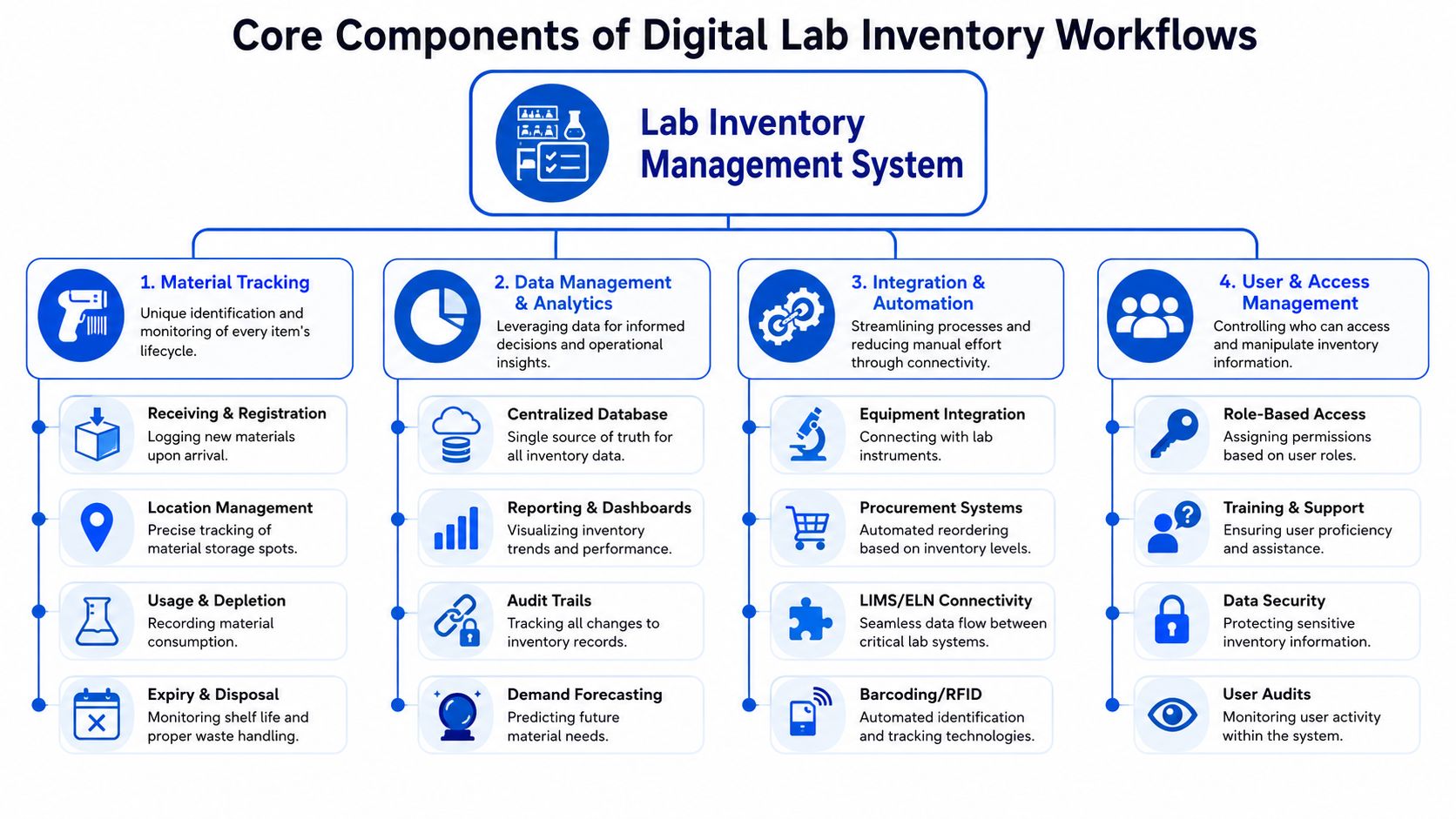
A good inventory system isn't built by counting containers. It's built by deciding what each class of material needs in order to be searchable, traceable, and analytically useful. In materials R&D, four groups usually matter most: reagents and chemicals, custom samples, consumables, and equipment-linked assets.
Reagents and chemicals
Start with identity. Effective inventory management relies on assigning unique identifiers to every item, which reduces traceability errors and supports FAIR data practices, as discussed in Frontiers on digital inventory, unique IDs, and traceability.
For reagents, the minimum useful record usually includes internal ID, supplier, manufacturer part number, lot or batch, concentration or purity, receipt date, expiration or retest date, hazard class, storage condition, container size, current quantity, and storage location. In formulation labs, I'd also track approved substitutes and any restrictions tied to customer or protocol requirements.
The workflow should be simple and strict:
- Receive and register the item once.
- Assign the unique ID before it reaches the shelf.
- Label the storage location down to cabinet, shelf, rack, or freezer box.
- Log each use event against the material ID, not a free-text name.
- Quarantine or dispose through a recorded status change, not a verbal note.
Custom samples and internal materials
Many labs often lose the plot. Internal samples often carry more R&D value than purchased reagents, yet they're tracked less rigorously.
Custom materials need lineage metadata. Parent formulation, synthesis route, processing conditions, operator, date created, linked notebook entry, analytical results, and derivative children all matter. If a sample is split, blended, milled, aged, or reformulated, the system should preserve that chain.
Practical rule: If a scientist can't reconstruct where a sample came from and what happened to it in under a minute, the sample isn't truly managed.
A materials team should also define status states that mean something operationally. Examples include draft, under test, approved for reuse, reserved, stability hold, and retired. Generic labels like “active” or “done” aren't enough.
Consumables and equipment-linked assets
Consumables don't always need the same level of metadata, but they still need enough structure to prevent interruption. Think pipette tips, filters, vials, wipes, PPE, columns, and specialty substrates. Track what creates downtime if it disappears.
Equipment-linked assets deserve their own layer. Calibration standards, reference materials, dedicated fixtures, and instrument-specific accessories often sit between inventory and asset management. If an analytical balance, reactor, extruder, or thermal analyzer depends on a controlled accessory, its availability and status should be visible inside the same workflow logic.
A practical model looks like this:
| Inventory class | What matters most | Workflow priority |
|---|---|---|
| Reagents and chemicals | Identity, lot, quantity, condition | Controlled receipt-to-disposal |
| Custom samples | Lineage, status, experimental linkage | Parent-child traceability |
| Consumables | Availability, reorder logic, location | Fast replenishment |
| Equipment-linked assets | Compatibility, calibration, assignment | Usage readiness |
The goal isn't to make every object in the lab equally complex. The goal is to build the right amount of structure so each item can participate in a reliable digital thread.
Essential Best Practices and Performance KPIs
Most inventory systems fail for process reasons, not software reasons. Labs buy a tool, migrate partial data, print labels, and then keep making exceptions. Within months, the system becomes another place where information might be true. The fix is operational discipline.
Practices that are non-negotiable
Start with naming rules. Every material class needs a controlled vocabulary, and aliases should be handled centrally. Don't let one scientist enter “DMAc,” another “Dimethylacetamide,” and a third a supplier shorthand. Search quality and analytics quality collapse when naming drifts.
Next, assign barcodes or RFID at the point of receipt or creation. Retrofitting identifiers later is painful because the item has already entered workflows without a stable identity. The same principle applies to locations. Freezers, cabinets, shelves, and bins should have machine-readable labels, not informal nicknames.
Environmental monitoring matters just as much as quantity tracking. Temperature and humidity deviations can degrade sensitive reagents and produce unreliable outcomes, and integrating IoT sensor data with inventory software helps teams anticipate degradation risk before a material is used. In practice, that means storage condition isn't a note in the record. It's a live signal tied to material fitness.
Access, disposal, and exception handling
Role-based permissions are often overlooked in laboratory inventory management. Purchasing staff, EHS personnel, lab managers, and scientists don't all need the same rights. The system should control who can receive, edit, reserve, release, quarantine, and dispose of materials.
Disposal is another weak point. A material shouldn't disappear because someone threw away the bottle and forgot the record. Labs that handle decommissioning well usually define disposal triggers, approval rules, and documentation requirements ahead of time. If your lab also retires old instruments or clears storage tied to aging projects, this guide to secure scientific equipment disposal is a useful operational reference.
Here's the practical standard I recommend:
- Standardize names: One approved name, controlled aliases, no ad hoc abbreviations.
- Track condition, not just count: A full bottle stored badly may be less usable than an almost-empty one stored correctly.
- Record every status change: Receiving, in use, reserved, quarantined, expired, disposed.
- Audit exceptions weekly: Manual overrides reveal where the workflow is weak.
KPI Comparison Manual vs Digital Inventory Systems
You don't need dozens of KPIs. You need a small set that reveals whether scientists can trust the system and whether the system protects experimental flow.
| KPI | Manual System (Typical) | Digital System (Target) |
|---|---|---|
| Inventory accuracy rate | Frequent mismatches between record and shelf | Record and physical count stay closely aligned |
| Time to locate material | Dependent on staff memory and local habits | Fast search by ID, location, status, or lot |
| Reagent wastage rate | Expired and duplicate stock discovered late | Early visibility of expiry, low stock, and overbuying |
| Stock-out response | Reactive ordering after failure | Planned reorder based on usage and lead time |
| Sample traceability | Partial lineage, notebook-dependent | Searchable parent-child history |
| Audit readiness | Manual reconstruction of events | Complete audit trail in system |
| Environmental compliance | Checked periodically or informally | Continuous monitoring with alerts |
The best KPI is the one that changes scientist behavior. If nobody acts on it, it's reporting, not management.
How to Choose the Right Lab Inventory Software
Software selection gets derailed when teams buy for today's storage problem instead of tomorrow's research model. In materials R&D, the right platform has to do more than tell you where the bottle sits. It has to support traceable experimentation, cross-system data flow, and growth across programs, sites, and material classes.
A quick visual checklist helps focus the evaluation.
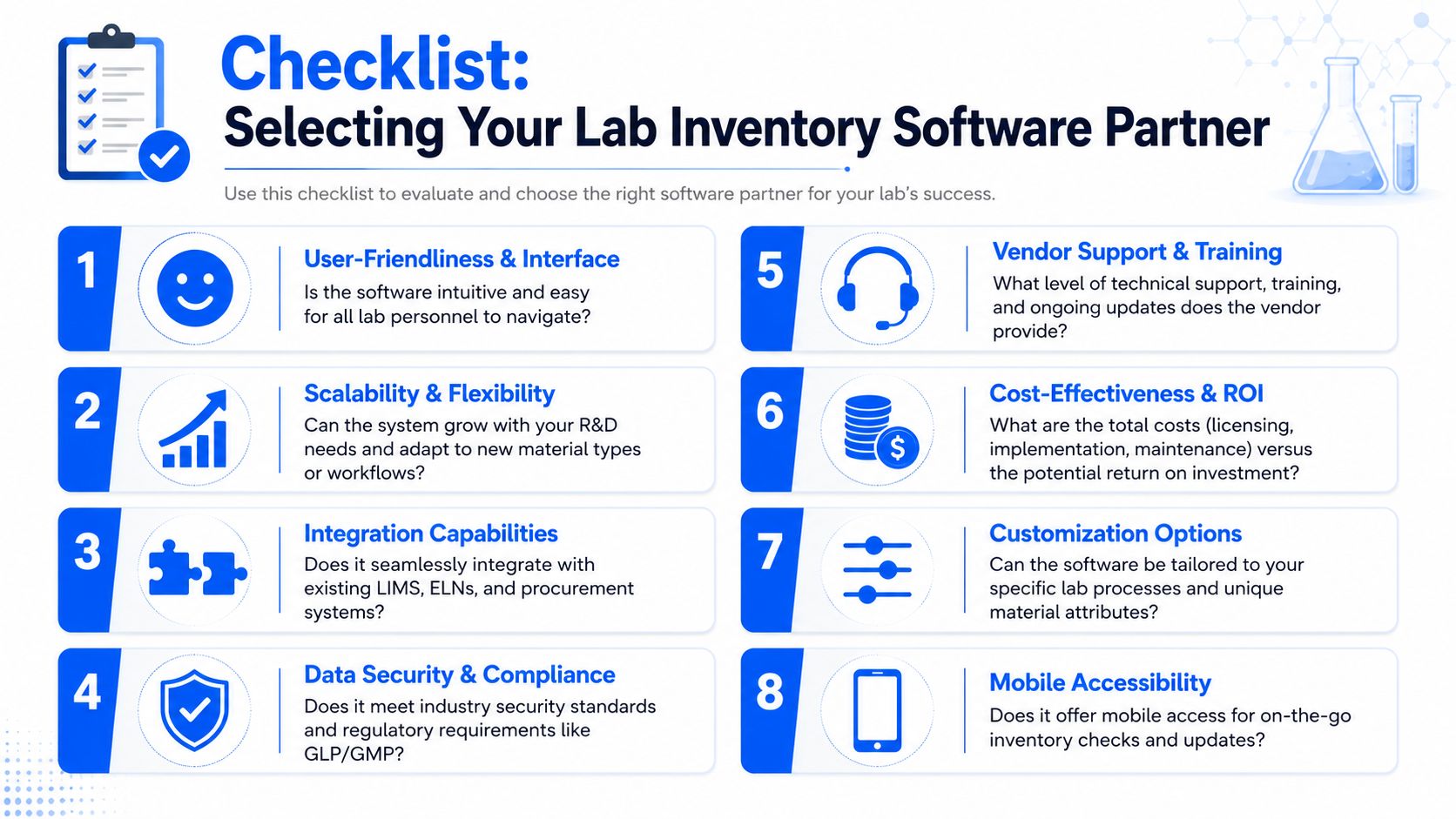
The criteria that matter most
Integration sits at the top. If the software can't connect cleanly to your ELN, LIMS, procurement tools, and analytics stack, you'll create a new silo while trying to remove the old ones. Ask vendors how material IDs travel between systems, how lineage is preserved, and whether APIs support bidirectional updates instead of one-way exports.
Security and compliance come next. Materials R&D labs often handle proprietary formulations, customer specifications, regulated workflows, and internal know-how that can't leak or drift. Look for role-based access, detailed audit logs, controlled data exports, and security controls that fit enterprise expectations. The broader conversation around connected operational systems is similar to what many manufacturers consider when evaluating strategies for industrial asset efficiency. The same lesson applies here. A tool that looks fine in isolation can become expensive if it doesn't fit the larger operating environment.
Don't skip usability and AI readiness
Scientists won't maintain a system that feels like enterprise paperwork. The user experience has to support quick scans, bulk actions, mobile use at the bench, and low-friction search. Ask to see the receiving workflow, not just the dashboard. Ask to see how a scientist links a sample to an experiment, not just how an admin configures fields.
This video offers a useful view of what software evaluation looks like in practice:
AI readiness is the newer and often neglected criterion. A system is AI-ready when it structures data so models can use it without heavy cleanup. That means stable identifiers, controlled vocabularies, lineage support, contextual metadata, and exportability into analysis pipelines. If the vendor talks only about dashboards and reorder alerts, keep pressing.
Ask questions like these:
- Can the system preserve parent-child relationships across synthesized and reformulated samples
- Can we distinguish material identity from container identity
- Can storage conditions, lot changes, and usage events be queried together
- Can our data team access clean records without custom scraping
What to watch out for
Good demos hide bad operations. Always test the software with your own messy workflows.
Be wary of platforms that are easy to demo but hard to govern. Common warning signs include weak permissioning, no meaningful audit trail, rigid metadata models, limited integration options, and a search function that depends on exact text matches.
The best choice usually isn't the one with the longest feature list. It's the one your scientists will use consistently and your digital team can extend without rebuilding the architecture a year later.
A Practical Roadmap for Implementation Success
Labs usually struggle with implementation when they try to digitize everything at once. The better approach is phased, narrow at the start, and strict about data quality.

Start with a controlled pilot
Choose one inventory category that causes visible friction. In many materials labs, that's critical reagents, reference standards, or custom samples tied to high-value programs. Define the metadata model, assign unique IDs, label locations, and enforce one receiving workflow.
Don't migrate every historical record. Bring over what the team still uses, what affects current experiments, and what is needed for continuity. Archive the rest separately if required.
A solid pilot should answer a few basic questions:
- Can scientists find materials faster
- Can the lab trust quantity and status
- Can managers see impending shortages or expiry risks early
- Can sample-to-experiment traceability be demonstrated without manual reconstruction
Expand by workflow, not by enthusiasm
After the pilot, extend the system to adjacent workflows that benefit from the same structure. Add linked consumables, internal samples, and equipment-dependent materials. Integrate with the ELN or LIMS once the inventory records are stable enough to deserve system-level trust.
This is also where governance becomes real. Define who owns master data, who approves new material classes, who reviews exceptions, and how often KPIs are checked. Labs that skip these decisions end up with software installed but not operationalized.
Optimize for data reuse
Once the core system is running, the highest return comes from reuse. Connect inventory data to experiment planning, purchasing, quality reviews, and model-building workflows. Through this integration, laboratory inventory management stops being administrative infrastructure and becomes R&D acceleration infrastructure.
Keep improving the system with small cycles:
- Review exception logs for naming drift, missing scans, and manual corrections.
- Tighten SOPs where the same error repeats.
- Refine metadata so the records support search and analysis, not just storage.
- Promote only trusted data into broader reporting or AI workflows.
A successful rollout isn't the moment labels go live. It's the moment scientists stop keeping backup spreadsheets.
The labs that get value fastest don't overcomplicate the first phase. They make a narrow process reliable, prove that the data can be trusted, and then scale that discipline outward.
If your team is trying to turn fragmented lab records into an AI-ready foundation for faster materials discovery, Polymerize is built for that challenge. It helps materials R&D organizations unify experimental and inventory-adjacent data across silos, create a secure backbone for traceable decision-making, and use explainable AI to guide the next best experiment with more confidence.
Put your R&D data to work
See how materials teams use Polymerize to plan fewer experiments and reach target properties faster.