


You can have a formulation that looks perfect on the bench, passes every quick check, and still fall apart the moment the team fills a pilot vessel. That's the part that often leaves an impression, the surprise failure, the emergency root-cause meeting, the scramble to explain why a process that seemed obvious in the lab suddenly lost its shape in production. In practice, lab scale production is where that failure either gets exposed early or gets hidden long enough to become expensive.
The difference comes down to more than batch size. Lab work is where you generate the process evidence that tells you whether a recipe is merely possible, or reproducible across changing geometry, mixing, oxygen transfer, heat transfer, and supply conditions. If the data isn't clean at the bench, scale-up becomes guesswork, and guesswork is a terrible way to spend pilot budget.
Table of Contents
- The Billion-Dollar Gap Between the Beaker and the Reactor
- Comparison of Production Scales of Lab, Pilot, and Commercial
- Start with the material, not the recipe
- Lock down the process variables that matter
- Treat repeatability as the real product
- Document like you expect to reuse the data
- Use application metrics, not only chemistry metrics
- The data backbone matters more than the interface
- AI only helps when the data is structured
- Predictive tools change how engineers think about scale
The Billion-Dollar Gap Between the Beaker and the Reactor
A team can spend months perfecting a formulation in the lab, then watch the first pilot run produce a different texture, a different particle distribution, or a different level of consistency than expected. The science didn't disappear. The process moved into a new environment where the same inputs no longer behaved the same way.
That gap is why lab scale production matters so much. It isn't just the small-batch stage before “real” manufacturing. It's the phase where the process is converted into a body of evidence, with enough structure to tell you what holds up, what drifts, and what breaks once the vessel gets larger. A bench result without repeatability is just a promising observation.
Practical rule: if a process only works when one person performs it one way, it's not ready for scale, it's just familiar.
The cleanest way to think about the gap is this. The beaker proves the chemistry, the reactor proves the system. A lab-scale workflow should answer questions about the material's ability to withstand variations, not only yield. It should show whether the material can survive changes in mixing, addition rate, thermal behavior, and raw-material lot variation without losing its identity.
That's why many teams treat the lab as a discovery space and stop too early. The better mindset is to treat it as a validation engine. Every run should produce data that can later explain a failure, defend a scale-up decision, or train a predictive model. Without that, the pilot plant becomes an expensive place to learn what should have been learned in the lab.
Defining the Scales Lab vs Pilot vs Commercial
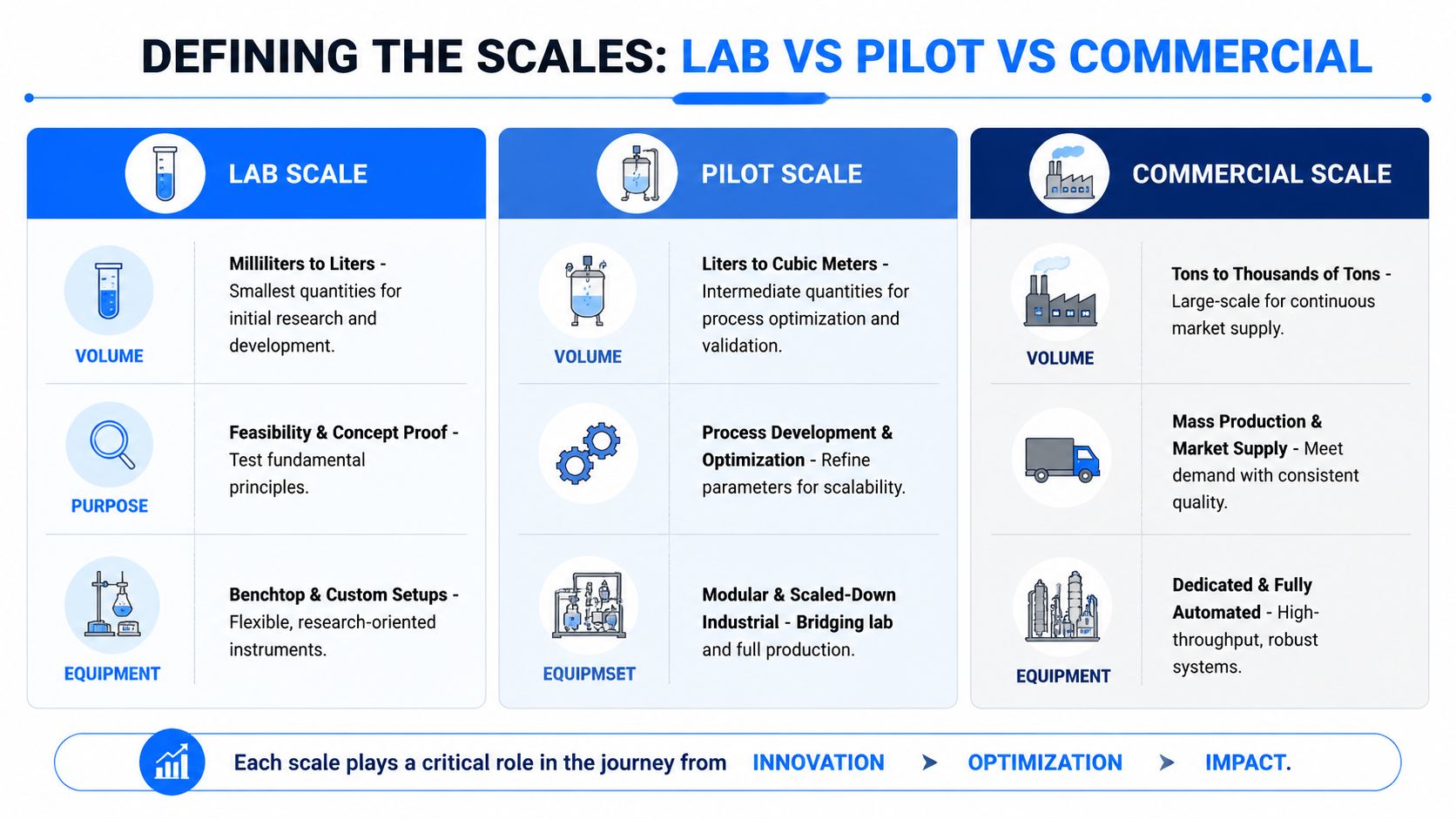
The easiest mistake is to think of scale as a straight line from small to large. It's not. Lab, pilot, and commercial production are three different jobs with three different risk profiles, and each one asks a different question of the process.
Lab scale is about feasibility and process definition. Pilot scale is about proving that the process still works when the equipment behaves more like production hardware. Commercial scale is about repeatable output under controlled operations. A kitchen prototype, a test kitchen, and a factory line all make food, but they don't answer the same question.
Comparison of Production Scales of Lab, Pilot, and Commercial
| Attribute | Lab Scale | Pilot Scale | Commercial Scale |
|---|---|---|---|
| Typical volume | Milliliters to a few liters | About 10 to 1,000 liters | Much larger production volumes |
| Main purpose | Feasibility and concept proof | Process development and validation | Mass production and market supply |
| Equipment style | Benchtop and custom setups | Modular and scaled-down industrial systems | Dedicated and highly automated plant systems |
| Risk profile | Low-cost experimentation, high flexibility | Higher commitment, realistic process stress | Highest cost of error, least flexibility |
| Key question | Can it be made at all? | Can it be reproduced and transferred? | Can it be supplied consistently? |
The controlled jump between these scales matters because industry guidance commonly uses 5 to 10-fold stepwise expansion instead of a direct leap, and batch processes are often expanded by up to 10 times from the original output level with relatively low risk to quality and consistency, provided the critical parameters stay aligned (scale-up guidance on stepwise expansion and process control). That's also why constant P/V, tip speed, or kLa shows up so often in scale-up conversations. Those are the engineering levers that keep process behavior closer to what was proven at bench scale.
Lab scale tells you whether the idea is chemically sound. Pilot scale tells you whether the workflow survives reality. Commercial scale tells you whether the whole chain can run without surprises.
The practical takeaway is simple. Don't ask a bench system to do a pilot system's job, and don't ask a pilot run to carry the burden of discovery that should have happened earlier. Each scale is a distinct validation step, and each one should produce different kinds of evidence.
Core Principles for Lab Scale Success
Strong lab scale production starts with a discipline that looks boring from the outside and saves entire development programs later. The goal is not just to make a sample. The goal is to make a sample you can trust, repeat, compare, and eventually transfer.
Start with the material, not the recipe
The raw material is where a lot of hidden variation enters the process. A formulation that behaves well with one supplier's material can drift when impurity profiles, particle size distributions, or synthesis routes change. Independent scale-up guidance also emphasizes that research-grade inputs and commercial-grade inputs often behave differently, so batch-specific CoAs, production-like samples, and dual-sourcing for critical materials are worth building into the plan early.
Lock down the process variables that matter
At bench scale, small changes can create large differences in the data. That is why process temperature, addition order, agitation, residence time, and environment should be handled as controlled variables, not casual operator choices. If the process window isn't documented clearly, you can't tell whether a later change came from the chemistry or from the setup.
Treat repeatability as the real product
One indexed lab-scale production study showed that changing from two spray nozzles to four reduced the lowest coefficient of variation from 4.5% to 2.3%, while the highest CV shifted from 13.4% with two nozzles to 6.4% with four nozzles. The same source reported pilot-scale CV values ranging from 2.7% to 11.1% (Science.gov lab scale production index). That's a useful reminder that the equipment itself shapes consistency. If you haven't measured variation carefully in the lab, you're not optimizing, you're hoping.
Document like you expect to reuse the data
A good notebook is not a record of effort, it's a record of decision-making. Note the material lot, the instrument settings, the sampling method, the time sequence, and any visible anomalies. That documentation becomes the map for scale-up, especially when someone new has to repeat the process months later.
Use application metrics, not only chemistry metrics
A material can meet a lab target and still fail in the application. Teams that need to understand throughput, cycle time, or downstream handling often pair formulation work with measurement discipline that reflects how the material will be used in practice. If you need a practical reference for that side of the problem, measure application performance is a useful lens because it forces the discussion back to operational reality.
The point is not perfection. The point is controlled variation, well-defined windows, and evidence that can survive translation. When the lab becomes a data engine, scale-up stops being a gamble and starts being an engineering decision.
The Scale-Up Gauntlet Common Pitfalls to Avoid
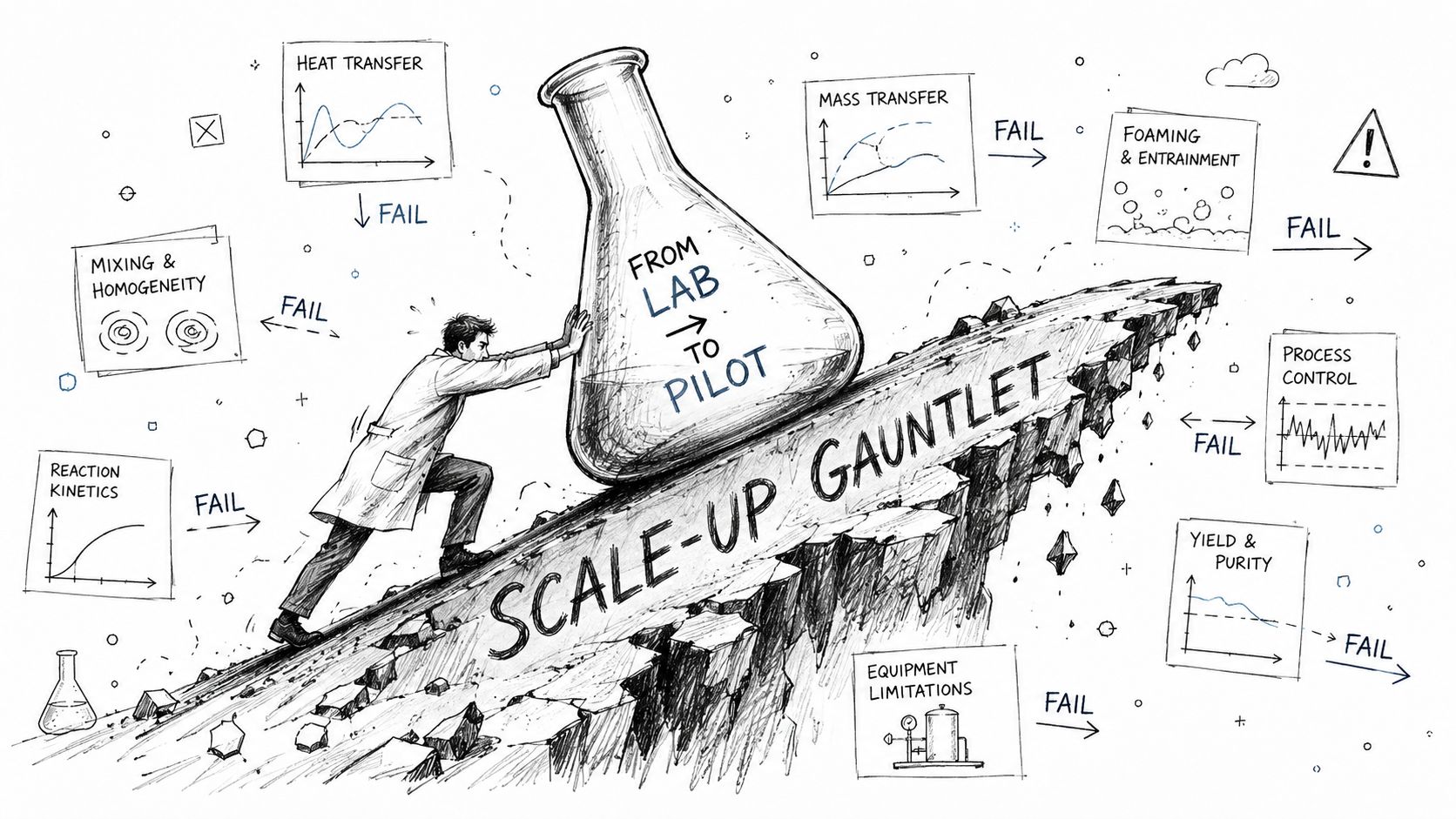
The hardest failures at scale are often not dramatic chemistry failures. They're gradual mismatches between what the small vessel hid and what the large vessel can't ignore. Heat removal, mixing quality, and raw-material fit all change at once, and any one of them can invalidate a “successful” bench method.
Heat transfer gets worse as vessels get bigger
A critical engineering constraint is the non-linear change in surface-area-to-mass ratio. As vessel size increases, heat-removal capacity falls, and that changes both fluid mechanics and thermodynamics because reaction behavior no longer scales in a simple linear way (USPTO petition document on scale-up constraints). A flask can look stable because it sheds heat easily. A larger reactor can trap heat, shift kinetics, and expose instability that never showed up in the lab.
Mixing problems create local failure modes
Scale-up problems rarely start with the whole tank behaving badly. They start with local concentration hotspots, uneven addition zones, or transient regions where a component is overfed. At scale, local supersaturation and uncontrolled nucleation can appear during rapid phase contact or addition, which can produce oversized aggregates or structures that aren't the intended product (BocSci process scale-up guidance). That's why a process that looks smooth in a beaker can fail in a larger vessel even when the chemistry itself is unchanged.
After the chemistry is stable, the procurement side can still undo the process. Many teams assume the scale-up issue is in the reactor, when the actual problem is the input material.
The hidden trap is raw-material variability and supplier qualification. Research-grade material can differ sharply from commercial-grade material in impurity profile or particle size, and a recipe that works in R&D can fail once the supply chain changes. That's not a cosmetic issue. It's a transfer issue. A process developed around a material that was never intended for commercial sourcing may be technically elegant and operationally fragile at the same time (raw-material challenges in scale-up production).
The practical answer is to validate the process under realistic stress, then qualify the inputs with the same seriousness you give the vessel. Teams that only tune the reactor often end up troubleshooting a supply problem with process language. That wastes time and hides the underlying constraint.
Building a Data-Driven Bridge to Production with AI
The modern shift in lab scale production is not just about better equipment. It's about turning fragmented experiments into a data system that can explain why one run succeeded and the next one slipped. That's the difference between a lab notebook and a predictive development engine.
The data backbone matters more than the interface
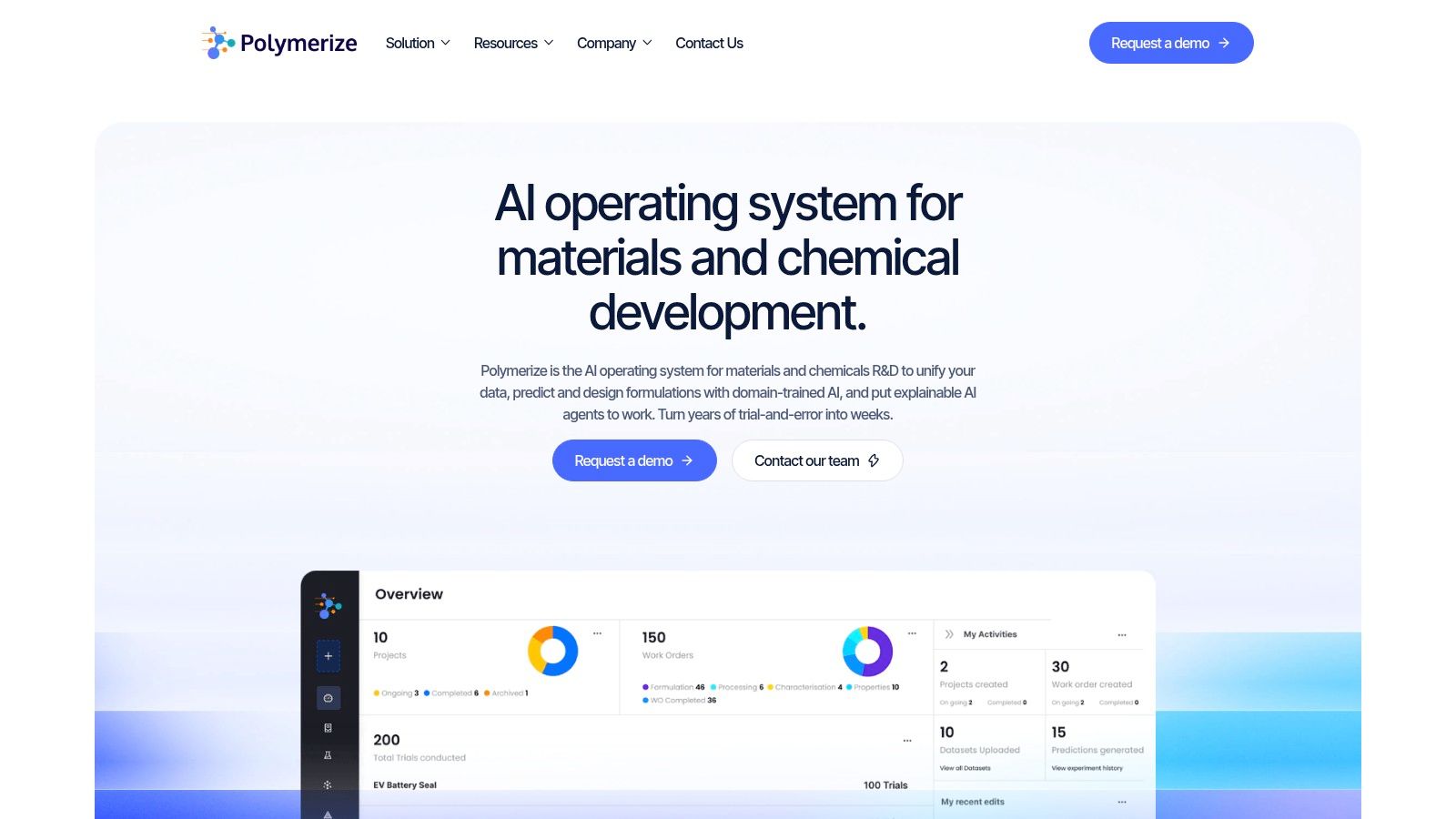
If the experimental record lives across spreadsheets, notebooks, and disconnected files, the process can't be modeled cleanly. Teams need a unified backbone that captures raw-material batch information, process settings, sample history, and outcomes in one place. That's what turns isolated results into a dataset that can support model building instead of just filing.
The change in mindset is already visible in industry language. The modern R&D challenge is moving from “can we make it?” to “can we make it predictably, with less waste, and lower data fragmentation?” and that shift is pushing adoption of AI-enabled process modeling and integrated data systems that treat lab-scale operations as a predictive validation engine rather than a discovery-only phase (Romaco on innovations in pharmaceutical lab-scale manufacturing).
AI only helps when the data is structured
Machine learning won't rescue vague records or inconsistent sampling. It needs consistent inputs, clean traceability, and enough repeat runs to distinguish real signal from operator noise. Once that foundation exists, the model can help identify critical parameters, surface causal drivers, and suggest the next experiment instead of forcing the team into blind trial and error.
For teams working in materials R&D, a platform such as Polymerize is one option that centralizes experimental data, supports explainable prediction models, and helps teams plan the next experiment from a shared data backbone. That kind of system is most useful when the lab is already disciplined, because software can amplify good process design, but it can't invent it.
Predictive tools change how engineers think about scale
A digital thread doesn't remove chemistry risk, but it does narrow the search space before a pilot run. That matters because many development programs don't fail from lack of ideas, they fail from too many unconnected assumptions. When data is organized well, the team can compare formulation changes, material lot changes, and processing changes without rebuilding the entire story every time.
If you want a useful analogy from operations, think about condition monitoring in production equipment. A tool like DUCHENG Industrial's VFD insights points to the same core principle, namely that predictive systems work when the underlying signals are visible, structured, and tied to real behavior. In materials R&D, the equivalent is a well-logged experimental system that can support inference instead of guesswork.
The primary benefit is not automation for its own sake. It's reproducibility at the point where technical risk usually spikes. That's how lab data becomes a bridge to production instead of a pile of isolated proofs.
From Lab Experiment to Production Asset
The strongest lab scale production programs don't just create samples, they create reusable knowledge. Every controlled run builds a better map of the process window, every supplier check reduces transfer risk, and every repeat test makes the next decision more defensible. That's how a lab ceases to be a place where ideas are merely tested and becomes a place where production paths are validated.
The companies that scale well usually share the same habit. They treat data quality as a manufacturing input. They care about what the material is, how it was made, how it was sampled, and whether the record is detailed enough to support a later decision under real production pressure.
That mindset matters even more now because scale-up is becoming a predictive discipline. AI can only accelerate what the team has already made legible. If the lab data is fragmented, the model will be fragile. If the lab data is structured, the model can help narrow risk before anyone books a pilot slot or commits to a production asset.
The shift is straightforward. Stop thinking of the bench as a small version of the plant. Start thinking of it as the place where the plant's success is made measurable.
If your team wants to turn lab results into a predictive development workflow, visit Polymerize and see how a centralized data backbone and explainable modeling can support faster, more reproducible scale-up. The right system won't replace process judgment, but it will make your lab data far more useful when the next pilot decision is on the line.
Put your R&D data to work
See how materials teams use Polymerize to plan fewer experiments and reach target properties faster.