

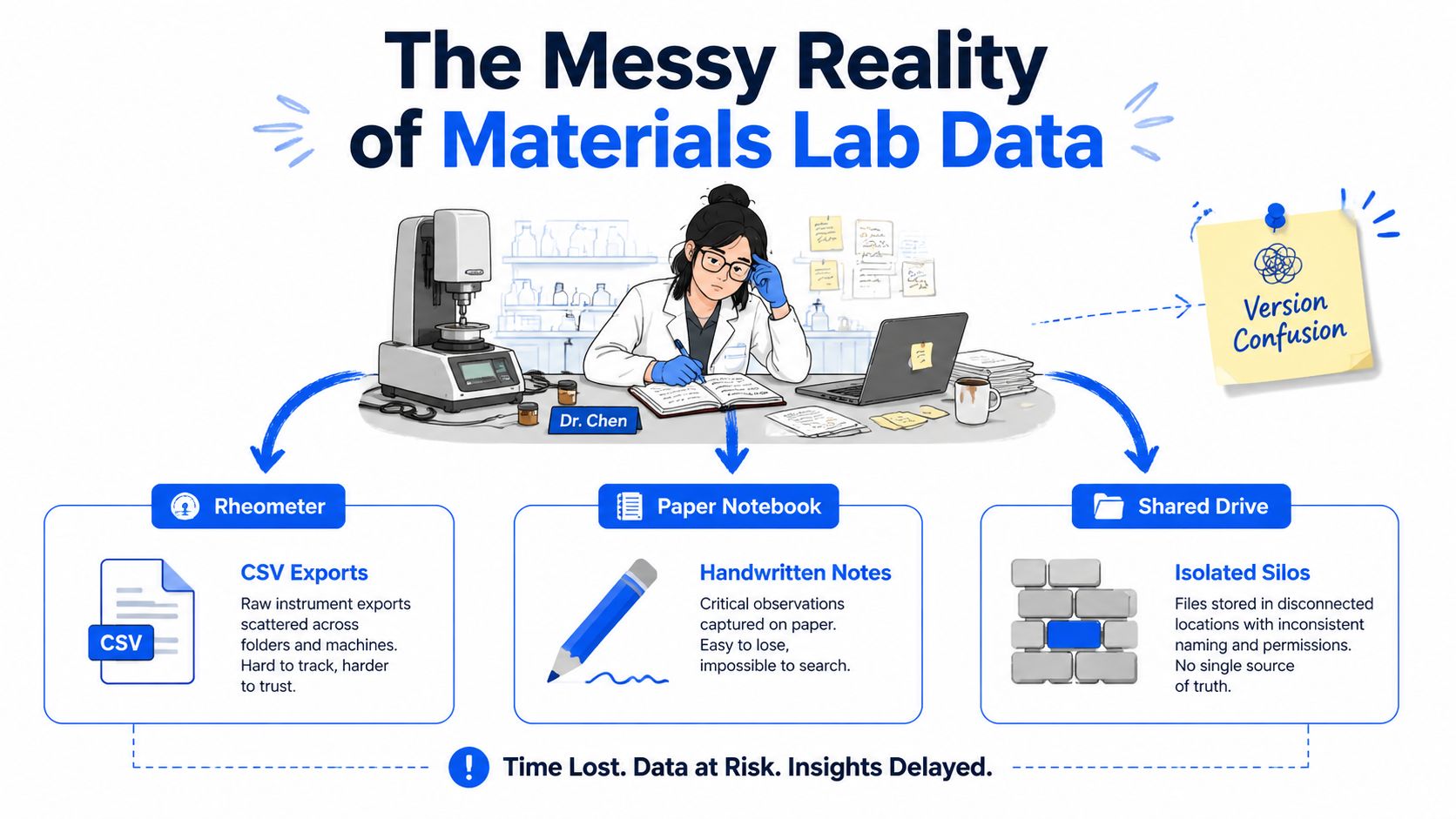
Dr. Chen knows exactly what she wants to ask. A polymer batch performed better than expected, and she needs to understand why before the team repeats the work at scale. The evidence is scattered across a rheometer CSV, a paper notebook with a hand-drawn cure profile, an ELN entry with missing fields, and a formulation spreadsheet maintained by a colleague in Germany.
None of those records is useless. The problem is that they don't form a connected experimental history. A scientist can spend hours reconstructing which sample came from which formulation, process condition, instrument run, and operator note. An AI model faces the same problem, only at a much larger scale. It can't explain a prediction when the relationships between inputs and outcomes were never captured.
Lab data integration is therefore more than an IT plumbing exercise. It creates the connected, traceable foundation that lets materials R&D teams use AI for explainable discovery rather than unsupported prediction.
Table of Contents
The Messy Reality of Materials Lab Data
Dr. Chen's week reflects a common materials R&D workflow. The rheometer exports files to a shared drive. Her notebook contains observations that never reach the ELN. The ELN was introduced to create a digital record, but scientists populate it inconsistently because it doesn't fit every experiment. A colleague's spreadsheet contains the formulation history, but its column names and sample identifiers don't match the instrument files.
When the team investigates the successful batch, nobody can search one record and see the full chain. They have to compare files manually, interpret handwriting, ask the colleague for spreadsheet context, and decide whether two similar sample names refer to the same material. That process makes valuable knowledge difficult to reuse and makes model training dangerous.
Why scattered records limit AI
A predictive model needs more than a property value. It needs the conditions that produced the value, the identity and lineage of the sample, the measurement method, and enough provenance to determine whether the result is trustworthy. If those details remain in separate systems, an analyst may flatten them into a table by hand, often losing context along the way.
That creates two problems:
- Reproducibility suffers: another scientist may not know which process detail mattered or whether the same protocol was followed.
- Explainability weakens: a model may identify a correlation, but the team can't inspect the experimental evidence behind it.
The slow adoption of digital lab records has a long history. A survey cited by Lab Manager's discussion of ELN adoption and data-system integration reported that only 4% of academic labs had adopted electronic lab notebooks, with 60% of adopting labs being chemistry labs. The same source describes Indiana University School of Medicine's centrally supported rollout, which began with 15 research labs in late 2018, expanded institution-wide in 2019, and reached 829 users by August 2021.
The lesson isn't that every lab needs the same platform. It's that adoption grows when data organization, security, and sharing are built into the workflow instead of added as a separate administrative task. Integration turns scattered artifacts into a searchable experimental record, giving both scientists and AI systems something they can inspect.
What Lab Data Integration Is
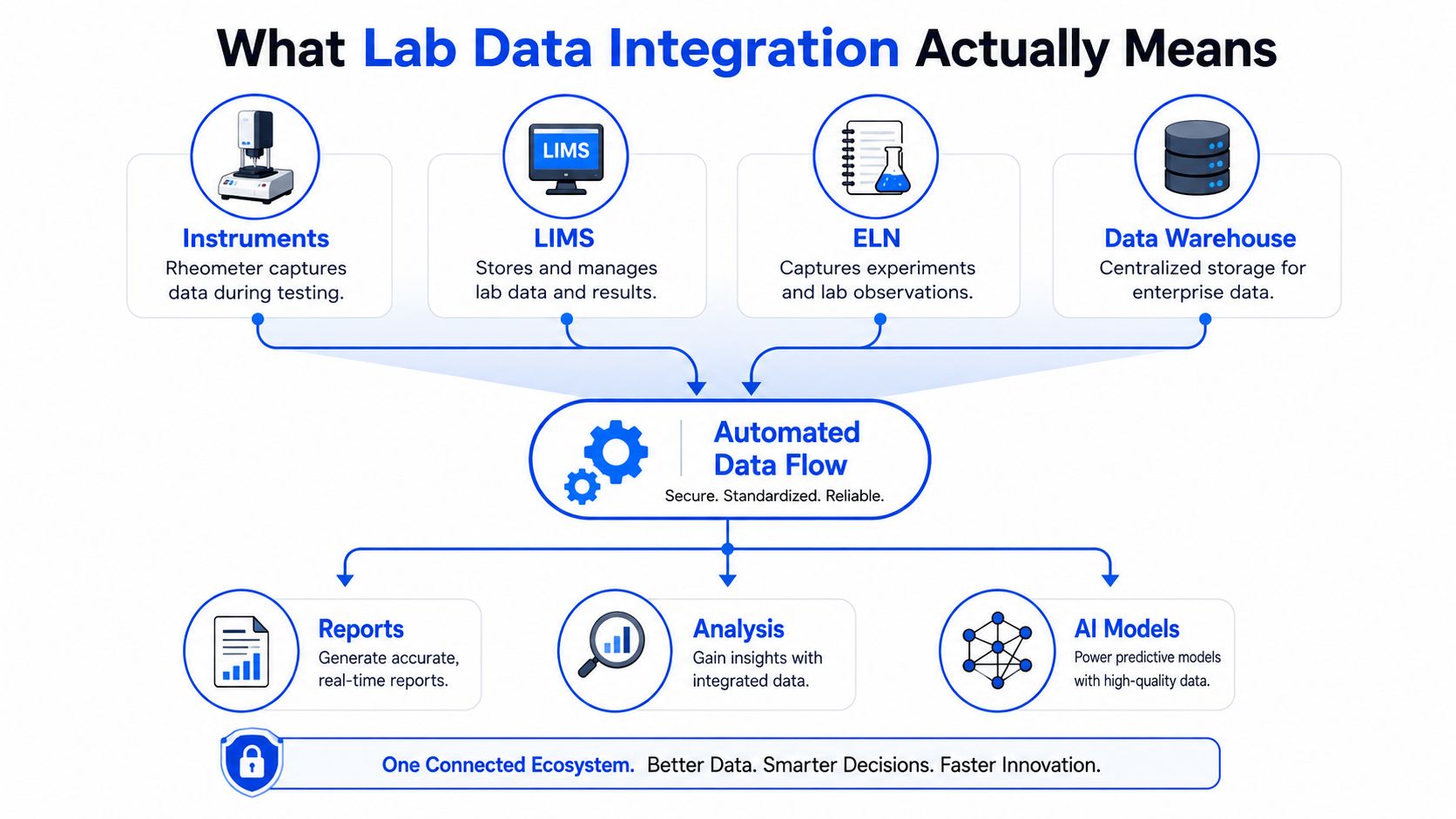
A materials scientist can have a tensile result, a formulation spreadsheet, and an instrument file, yet still lack one usable experimental record. Lab data integration connects the systems that capture, store, and process experimental information, allowing data to move between them without manual re-entry or interpretation. These systems may include spreadsheets, ELNs, LIMS, instrument software, sample registries, data warehouses, and analytical applications.
The goal is explainable AI, not a larger file repository. A shared drive stores files, but it does not reconcile sample IDs, normalize units, connect a test result to its formulation, or preserve the relationship between a raw signal and a reported value. A data lake can hold CSV, JSON, PDF, and binary files, but models still need metadata and relationships to use those files reliably.
The shared notebook analogy
Integration works like a shared lab notebook that instruments and scientists can read and update. When a tensile tester produces a result, the record should connect it to:
- the formulation and material composition,
- the sample and batch identifiers,
- the processing conditions,
- the test method and instrument,
- the operator's observations,
- the original file and transformation history.
That connected record must serve different users without losing experimental context. A scientist may search it through a dashboard, an analyst may query it for a statistical study, and an AI application may build a training dataset while retaining links to the original experiment.
Five practical stages
A useful integration design usually includes five activities:
- Capture: collect source data without forcing scientists to retype results.
- Ingest: bring files, records, and metadata into a controlled environment.
- Harmonize: map names, units, identifiers, and experimental concepts to shared definitions.
- Connect: associate samples, batches, processes, instruments, and outcomes.
- Expose: make the result available through queries, reports, analytical datasets, and AI tools.
Storage alone becomes insufficient at the exposure stage. A repository that cannot answer, “Which cure conditions were associated with these tensile results?” remains an archive rather than an integrated knowledge system. For broader context on connected applications and unified workflows, Wistec's overview of system integration explains the underlying concept.
Adoption grows when organization, security, and sharing fit the laboratory workflow instead of becoming separate administrative work. The practical test is whether a scientist can trace a model input to the exact experiment and raw evidence that generated it. If that path is missing, the organization has storage and perhaps reporting, but it lacks the connected foundation needed for explainable AI.
Common Data Sources in a Materials Lab
A formulation scientist opens a spreadsheet, an instrument saves a raw signal, and the LIMS records an approved result. The experiment may be one workflow, but its evidence is scattered across systems with different vocabularies and controls. Integration must preserve those differences while connecting the records well enough for analysis and explainable AI.
A source-by-source view
| Data Source | Typical Pain Point | Integration Value |
|---|---|---|
| Spreadsheets | Scientists can change column names, units, formulas, and sample identifiers without schema controls. | Adds consistent structure, lineage, validation, and links to related experiments. |
| ELNs | Experimental intent and observations may remain inside proprietary formats or incomplete records. | Makes procedures, notes, and results available to downstream analysis while preserving context. |
| Instruments | DSC, TGA, rheometers, XRD, NMR, and spectroscopy systems generate files that may be archived manually and separated from sample metadata. | Connects raw signals and derived results to samples, methods, batches, and process conditions. |
| LIMS | Sample tracking and test requests can be well controlled while remaining disconnected from raw instrument data and formulation history. | Joins chain of custody, test status, results, and source files into one traceable record. |
Spreadsheets often hold valuable formulation knowledge alongside the weakest controls. A formulation chemist may rely on one for rapid iteration, calculations, and local experiments, so immediate replacement can create resistance. A practical ingestion process keeps the original file and maps known fields into a governed model. That approach retains evidence while making selected values usable by predictive models.
ELNs provide the experiment's reasoning and observations. They may not contain the complete machine output, however. The integration layer should connect an ELN entry to its instrument file, method, and sample record. Otherwise, an AI model may receive a conclusion without the measurements needed to explain it.
Instrument files create the reverse problem. Their numerical structure can be precise, yet a curve or spectrum has little meaning without context. Temperature profiles, rheology data, and other signals need sample identity, method settings, calibration context, and processing history. Those links let a scientist inspect why a model used a measurement and whether the comparison involved equivalent conditions.
LIMS platforms generally provide strong governance for samples and tests. Their scope may stop at the approved result. A record can show that a sample was tested and identify its reported value while omitting the formulation rationale or raw signal. Joining LIMS control with ELN context, formulation history, and instrument evidence gives the model a traceable path from prediction back to experiment.
Integration Architectures from ETL to Data Mesh
Architecture determines where data is transformed, who owns its definitions, and how easily a scientist can trace an AI result back to experimental evidence. The right choice depends less on fashion than on workflow, governance, and the level of change the organization expects.
Three patterns with different strengths
| Dimension | ETL Pipeline | Data Lake | Data Mesh |
|---|---|---|---|
| Core idea | Transform data before loading it into a curated destination. | Store raw and varied data first, then transform it for use. | Let domain teams own governed data products for their area. |
| Materials R&D fit | Compliance-heavy reporting and stable test workflows. | Exploratory modeling across diverse instrument and experiment files. | Multi-site organizations with distinct formulation, synthesis, and testing domains. |
| Main strength | Predictable structure and centralized control. | Flexibility for new sources and iterative analysis. | Clear ownership and domain-specific meaning. |
| Main risk | Rigid pipelines can break when workflows or schemas change. | Poor metadata can create an unsearchable data swamp. | Teams need strong data literacy and shared governance. |
| Explainability requirement | Preserve source lineage through each transformation. | Keep raw files linked to curated datasets. | Publish discoverable products with definitions, owners, and provenance. |
An ETL pipeline suits an organization that must produce consistent, auditable reports from known sources. For example, a quality team may extract approved LIMS results, transform them into a controlled schema, and load them into a reporting store. The trade-off is rigidity. A new instrument field or revised formulation workflow may require pipeline changes before the data becomes usable.
A data lake gives materials informatics teams room to experiment. Raw CSV files, JSON records, images, and proprietary instrument outputs can be retained while analysts develop new transformations. That flexibility only works when the organization records metadata, identifiers, and lineage at ingestion. Otherwise, the lake becomes a large collection of files that models can't reliably interpret.
A data mesh treats formulation, synthesis, characterization, and process engineering as separate domains with responsibility for their data products. This can scale across sites because the people closest to the work maintain definitions and quality. It also introduces coordination overhead. Shared concepts such as sample, batch, property, and protocol still need common rules.
Architecture test: If a model predicts a material property, the team should be able to identify the experiment, sample, instrument run, and transformation steps behind every important input.
For a broader comparison of integration patterns and architectural trade-offs, see how Magnitude Marketing explains data integration solutions. In materials R&D, the most important design decision remains traceability. A flexible architecture that loses provenance is less useful than a simpler one that preserves it.
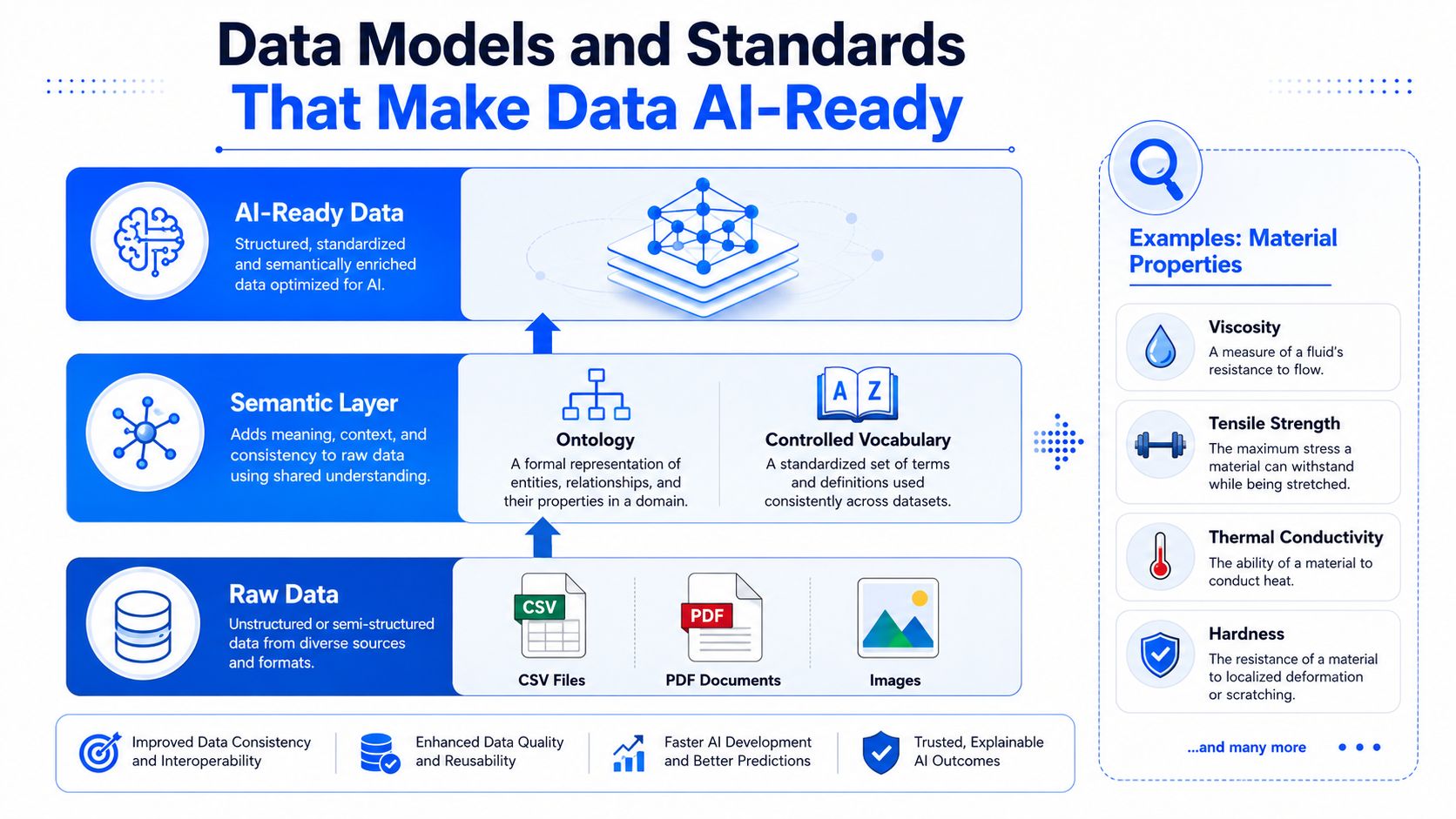
Data Models and Standards That Make Data AI-Ready
Raw data becomes AI-ready only after the organization gives it meaning. A model can't reliably distinguish between “temp,” “temperature,” and “cure temp” unless the system maps them to a defined concept. It also needs to know whether a value describes a sample, a process step, or a test result, and which unit applies.
The semantic layer
A semantic layer provides that shared meaning through ontologies, controlled vocabularies, metadata schemas, and relationships. In a materials setting, it can define how composition, processing, characterization, and properties connect. It can distinguish a polymer grade from a sample prepared from that grade, and a measured tensile strength from a target tensile strength.
Useful standards and frameworks can play different roles:
- Laboratory ontologies provide controlled concepts for experiments, materials, methods, and measurements.
- Metadata extensions describe entities consistently across systems.
- Materials-specific models connect composition, processing conditions, and measured properties.
- Unit vocabularies prevent a numerical value from being interpreted without its measurement scale.
The Allotrope Foundation ontology is one example of a laboratory-focused approach, while schema.org-based extensions can support broader machine-readable descriptions. Emerging materials frameworks aim to represent relationships among composition, process, structure, and performance rather than storing each value as an isolated spreadsheet cell.
Why graphs preserve explanation
Flat tables are efficient for many analyses, but they can hide relationships. RDF and knowledge graphs represent entities and connections directly, allowing a system to link an experiment to a sample, a sample to a batch, a batch to a synthesis process, and that process to a property measurement.
This approach is reflected in the 2025 materials-science ontology paper describing ELN-to-RDF conversion. The described pipeline retrieves experimental data from an ELN, converts it into a machine-actionable representation, and then transforms it into RDF for semantic interoperability. A related Nature Scientific Data paper on knowledge-graph interoperability describes selective retrieval with SPARQL, script-based processing, and reintegration into a knowledge graph.
A 2026 chemistry and materials review argues that a standard material data structure is a critical next step for consistent exchange among laboratories, instruments, and software. It also describes machine-readable vial tags, such as QR codes, that can carry precursor identity, synthesis conditions, and storage environment, helping another lab resume an experiment without manual reinterpretation. Read the review's discussion of standard material data structures and machine-readable metadata.
Explainable AI depends on this layer. When a model predicts tensile strength, a scientist should be able to inspect the relevant synthesis parameters, material lots, test protocol, and prior observations. Without shared semantics and preserved relationships, the model may produce an answer, but the organization can't establish why that answer deserves trust.
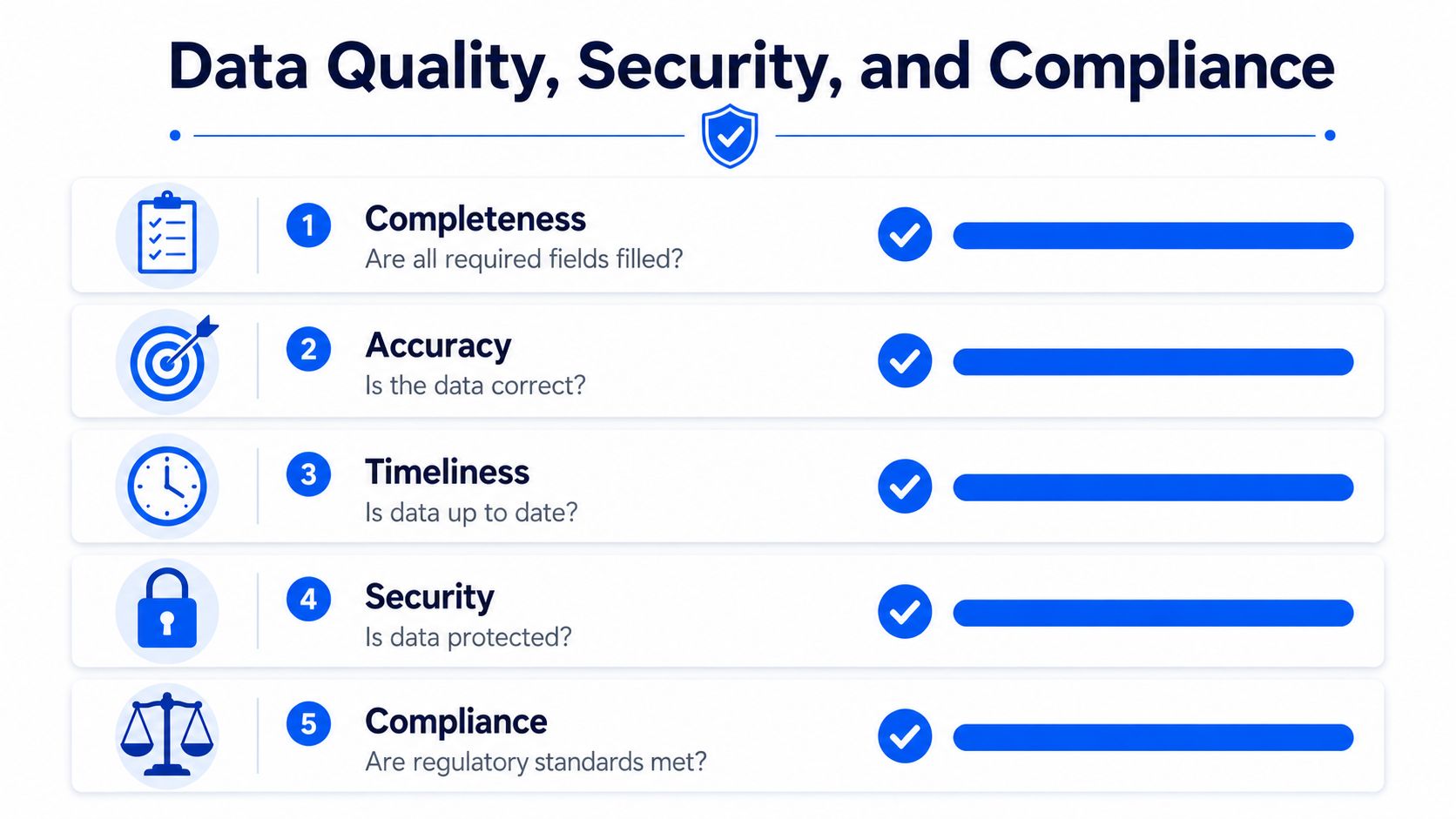
Data Quality, Security, and Compliance
Governance determines whether an AI output can support a real R&D decision. A model trained on incomplete or ambiguously labeled experiments may appear advanced while learning artifacts from inconsistent recording practices.
Quality begins at ingestion
Materials teams should evaluate more than whether a file arrived. They need to ask whether the record is complete, interpretable, current, and traceable.
- Completeness: Are formulation components, process conditions, test methods, and observations present?
- Consistency: Does the organization use the same definition and unit for a property across sources?
- Timeliness: Is the result available when the next experiment or review depends on it?
- Accuracy: Does the integrated value match the source record and the approved calculation?
- Lineage: Can a user follow the value back to the original instrument file and transformation?
A missing humidity condition or annealing step can make two apparently comparable measurements scientifically different. The system should flag that absence when data enters the platform, not after a model has already used the record.
Governance principle: A model can only explain the evidence that the lab captured and connected.
Security extends beyond login controls. Proprietary formulations, process recipes, customer requirements, and unpublished performance data can represent valuable intellectual property. Role-based access should limit visibility by project, site, function, or sensitivity, while audit trails should record meaningful changes and access events.
Organizations may also encounter ISO 27001 information-security requirements, SOC 2 controls for service providers, and privacy obligations under GDPR or CCPA when experimental records contain personal data. These frameworks address different risks, so teams shouldn't treat one certification as a substitute for a complete governance program.
A sound backbone retains raw data, controls transformations, documents ownership, and makes permissions part of the architecture. That foundation lets R&D leaders share selected information with partners, regulators, and AI systems without losing control of the underlying intellectual property.
Building an AI-Ready Backbone with Polymerize Connect
A practical integration backbone has to accommodate the way materials scientists already work. That means accepting spreadsheets, ELNs, instrument outputs, and LIMS records without requiring every source to be replaced before the organization can gain value.
Polymerize Connect provides one example of this pattern. It is designed to bring fragmented experimental data into a centralized repository, then organize the information so experiments, formulations, and results can be used together. The important architectural distinction is between preserving source data and creating analysis-ready representations. A raw instrument file should remain available, while a normalized table or graph makes its contents easier to query.
Three layers make the design practical
Ingestion handles the sources. Connectors, scheduled synchronization, and instrument-file parsing bring records into the backbone. The ingestion layer should record when data arrived, where it came from, and which source identifier it carries.
Harmonization gives the records shared meaning. The system maps material and process concepts, normalizes units, and links samples to batches and experiments. A local spreadsheet field becomes a defined property that downstream tools can interpret consistently.
Exposure makes the integrated data useful. Query interfaces, dashboards, and machine-learning datasets allow different users to work from the same governed foundation. Scientists can inspect a formulation history, analysts can assemble a dataset, and model developers can retain the path from an input back to its source.
The design also needs governance hooks. Role-based access can separate sensitive projects, audit trails can document changes, and controlled workflows can support security and compliance requirements. Those controls matter because explainability isn't only about showing a feature importance chart. It also requires confidence that the underlying records weren't altered or assembled from incompatible sources.
The result is a working definition of AI readiness: data is connected, semantically consistent, queryable, governed, and traceable to the experiment that produced it. Polymerize Connect is one option for assembling those capabilities within a materials R&D environment.
Best Practices and a Practical Starting Checklist
Start with discovery, not platform selection. List every source, its owner, file or database format, update pattern, identifiers, and known quality issues. Include the informal sources scientists rely on, because excluding them leaves the most valuable context outside the integration effort.
Then define a small ontology for the first use case. Begin with samples, formulations, processes, measurements, and outcomes. Agree on names, units, required fields, and relationships before expanding into every possible material concept.
A focused pilot is easier to govern than an enterprise-wide migration. Choose one high-value dataset and connect it from source capture through an analysis-ready output. Preserve the raw files, validate the normalized records, and test whether a scientist can trace a result back to its experiment.
Use this checklist:
- Assign ownership: Name a data steward for each source and domain.
- Validate at ingestion: Check required fields, identifiers, units, and duplicate records as data arrives.
- Preserve lineage: Store source references and transformation history with every derived value.
- Protect access: Apply role-based permissions and audit logging from the first release.
- Test with a model: Run a small predictive workflow and ask scientists to inspect its inputs and explanations.
- Measure scientist value: Track whether queries become easier, reports require less manual reconciliation, and experiments are more reproducible.
Treat lab data integration as an ongoing operating capability, not a one-time cleanup project. As the backbone matures, explainable AI can connect predictions to experimental evidence, helping scientists choose the next experiment with a clearer understanding of the variables that matter.
Polymerize helps materials R&D teams unify spreadsheets, ELNs, and lab silos through an AI-ready data backbone, with connected experimental context for explainable analysis. Visit Polymerize to see how its platform can support governed lab data integration and more targeted materials development.
Put your R&D data to work
See how materials teams use Polymerize to plan fewer experiments and reach target properties faster.