

Two formulation batches arrive from the same supplier. The specification sheet looks clean. The protein concentration matches. The pH window is within tolerance. You run the same mixing protocol, the same cure schedule, and the same characterization panel.
One batch gives you the texture, binding behavior, or film integrity you expected. The other drifts. Viscosity shifts earlier than it should. Aggregation appears in storage. Mechanical performance becomes harder to reproduce. The instinct is to blame process noise, contamination, or an untracked storage variable.
Sometimes that instinct is right. Sometimes the hidden variable sits inside the protein itself.
A lot of materials scientists work with biological ingredients as if each named protein were a single, fixed object. In practice, a “protein” can exist as a family of closely related molecular versions. Those versions can behave differently in solution, bind differently to surfaces, unfold differently under shear or heat, and respond differently to salts, solvents, and pH. Those variants are protein isoforms.
If you're building formulations, training AI models on experimental history, or trying to understand why a promising bio-based material fails during scale-up, isoforms deserve a place on your variable list. They aren't just a biological detail. They're often a practical explanation for why “identical” inputs don't perform identically.
Table of Contents
- Introduction When Identical Formulations Produce Different Results
- Why one gene doesn't mean one protein
- Why materials scientists should care
- Alternative splicing edits the same script in different ways
- Genetic variants alter the blueprint itself
- Proteolytic processing trims the finished part
- Post-translational modifications decorate the surface
- Bottom-up proteomics is strong for screening, but weak on molecular context
- Top-down proteomics keeps the full molecule intact
- RNA methods, blots, and electrophoresis answer narrower but useful questions
- Where isoforms create experimental risk
- Why isoforms and proteoforms are not the same thing
- What to change in your workflow
Introduction When Identical Formulations Produce Different Results
A team screens a protein-based binder for a new formulation. Early work looks promising. Bench samples disperse well, the rheology stays manageable, and the dried material hits the target feel. Then the next lot arrives, and the same formulation starts drifting. Nothing obvious changed. The spreadsheet says the recipe is identical.
At this point, many investigations stall. Teams check storage conditions, operator differences, and instrument calibration. They often don't ask whether the “same protein” was the same molecular species.
That question matters because many proteins are not single products in the way a commodity monomer is a single product. They can come as mixtures of related versions with different lengths, domain content, sequence details, or surface chemistry. If one version binds more strongly to a filler, unfolds faster at higher temperature, or aggregates sooner in a solvent-rich environment, your formulation may move with it.
For materials R&D, this changes how you interpret variability. Instead of treating unexplained drift as noise, you can treat it as a structural question. What exact molecular forms were present? Which ones were active under your process conditions? Which ones survived purification, drying, storage, and rehydration?
Sometimes the failed batch isn't telling you your hypothesis was wrong. It's telling you your material definition was too coarse.
That shift in thinking is useful for experimental design and for AI modeling. If the input variable is just “protein X,” your model may miss the underlying driver. If the meaningful variable is “protein X with isoform composition Y,” then better data granularity can turn apparent randomness into a learnable pattern.
What Are Protein Isoforms A Primer
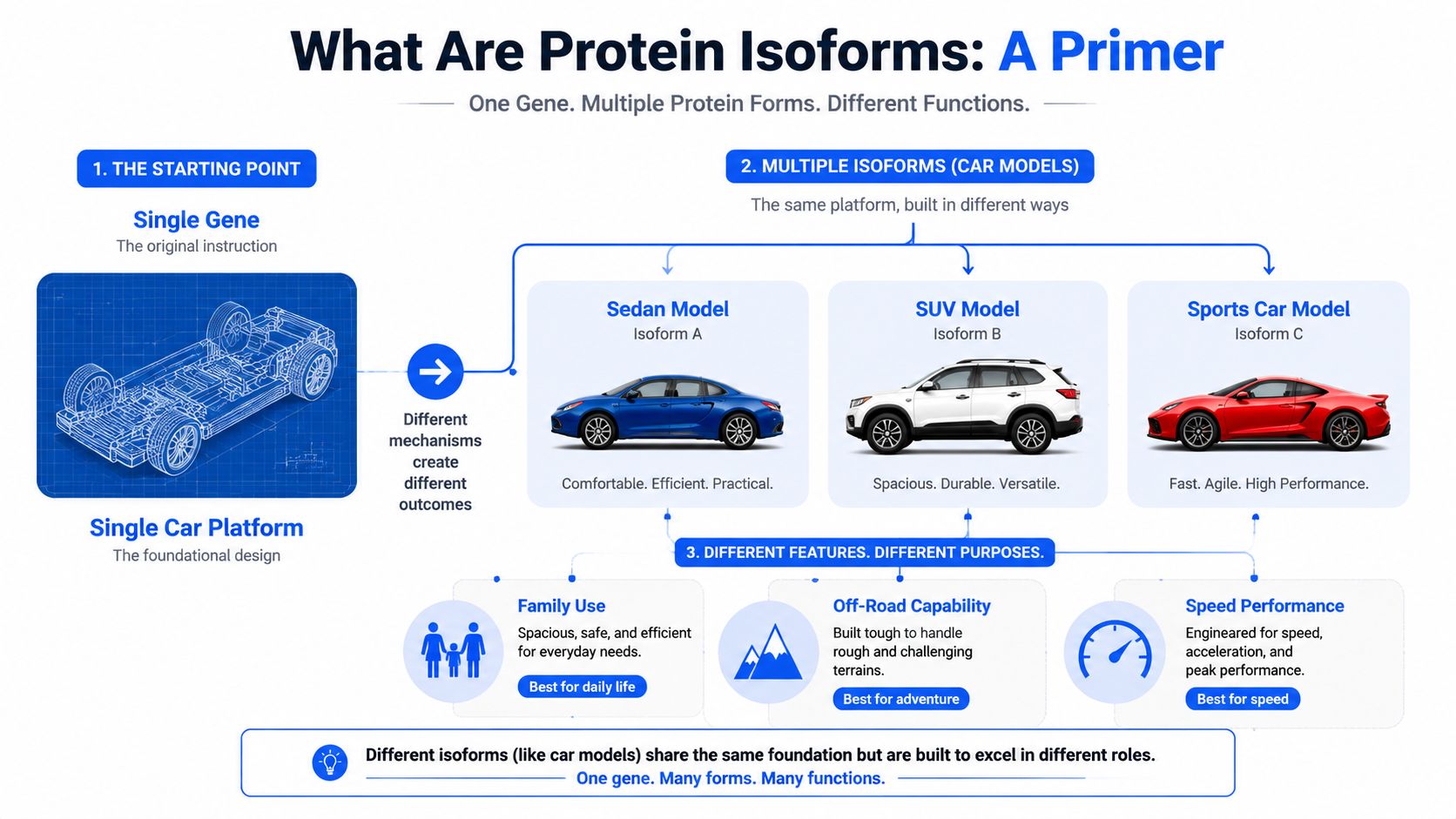
A useful starting point is this: one gene is often less like one finished chemical and more like one product family built from a shared design.
In materials terms, protein isoforms resemble resin grades that come from the same base polymer chemistry but differ in chain length, side-group placement, or end-group treatment. The label looks similar. The processing behavior does not. Proteins follow the same logic. A single gene can produce several closely related protein versions, and those versions can behave differently enough to matter in the lab.
Protein isoforms are different versions of a protein produced from the same gene, with differences in amino acid sequence and, as a result, often in structure and behavior.
That shared origin is the key point. Isoforms are related molecular variants, not unrelated proteins. They usually retain much of the same sequence, so they can be grouped under one protein name in a database or specification sheet. For experimental work, though, the differences are often the part that drives performance.
Why one gene doesn't mean one protein
Many scientists first learn the central dogma as a clean pipeline: gene to RNA to protein. That model is helpful, but it hides an important source of molecular diversity. Cells can produce multiple transcript versions from the same gene, and those transcript differences can lead to proteins with altered lengths, missing segments, or modified functional regions.
The result is common, not rare. A large share of human protein-coding genes are known to generate multiple isoforms. So if your assay, formulation screen, or machine learning model treats "protein X" as a single fixed entity, you may be compressing several distinct molecular states into one label.
That compression creates practical problems. Two samples may both be called the same protein while carrying different domain architecture, different surface charge patterns, or different flexibility in a loop that controls binding.
Why materials scientists should care
Small sequence changes can propagate into large formulation effects. Remove one region from a protein, and you may change how it packs at an interface. Shorten a flexible segment, and you may change viscosity response or aggregation kinetics. Shift a charged patch, and adsorption to particles, films, or vessel surfaces can change.
For materials R&D, isoform differences often show up in places that look familiar:
- Adsorption behavior: One isoform may bind more strongly to a filler, membrane, or container surface.
- Solution stability: A modest structural difference can shift aggregation, precipitation, or phase behavior.
- Process sensitivity: Heat, pH, shear, drying, and solvent exposure may affect one isoform more than another.
- Model performance: AI systems trained on protein identity alone may miss the true driver if isoform composition is what changes the outcome.
The practical takeaway is simple. "Same gene" is not a sufficiently precise material definition when protein structure influences performance. If reproducibility is slipping, or if a predictive model keeps treating similar samples as noise, isoform composition is one of the first hidden variables worth checking.
How Protein Isoforms Are Generated
A formulation team can source what appears to be the same protein twice and still get different adsorption, different stability, or a model prediction that fails on the second batch. One common reason sits upstream of formulation. The cell did not make one uniform molecular part. It made a family of related versions from the same gene.

Several mechanisms create that diversity. Some change how an RNA message is assembled. Others change the DNA sequence itself. Others trim the protein after it is produced. For anyone building formulations or training AI models, the practical lesson is simple. A gene name is often too coarse to describe the material you tested.
Alternative splicing edits the same script in different ways
Alternative splicing is the main route by which one gene generates multiple protein isoforms. Film editing is a useful comparison. The raw footage is the same, but different cuts produce different final versions with scenes included, removed, or rearranged.
Inside the cell, the initial RNA transcript contains segments that can be joined in different combinations. One isoform may keep a segment that forms part of a binding domain. Another may skip it. A third may use a different start or end point and produce a shorter protein with altered surface exposure or flexibility.
A short explainer helps show that process in motion.
As noted earlier, this is not a rare exception. Approximately 80% of human protein-coding genes produce splice variants that lead to protein isoforms of different sizes. The impact for materials science is that two samples assigned to the same protein can carry different interaction surfaces, different conformational freedom, and different failure modes during processing.
That difference is easy to underestimate. Removing a short segment can change how a protein packs at an interface. Swapping one exon can move a charged patch and alter adsorption to particles, films, or vessel walls. In AI workflows, this is the kind of hidden variable that looks like noisy data until you label it correctly.
Genetic variants alter the blueprint itself
Isoforms can also arise because the gene sequence differs between cells, donors, strains, or engineered production systems. In that case, the change is in the blueprint, not only in the editing of the transcript.
Even a single sequence change can matter if it alters an amino acid at a binding site, changes local charge, or shifts how the RNA is spliced. A small edit at the sequence level can produce a measurable change in solubility, aggregation tendency, or compatibility with a polymer or solvent system.
For materials R&D, this means biological source history belongs in the same conversation as pH, temperature, and mixing conditions. If upstream biology varies, downstream material behavior can vary with it.
Proteolytic processing trims the finished part
Some isoforms appear after translation, when a longer precursor is cut into a shorter mature form. The manufacturing analogy is post-machining. You start with one fabricated part, then trim it to expose the final geometry.
Those cuts can activate a protein, remove a flexible region, or create a new terminus with different binding behavior. In practical terms, the protein present at purification may not be identical to the protein present after storage, transport, or repeated handling.
That point affects experiment design. If cleavage occurs during hold time or under stress, day-10 material can behave like a different component than day-1 material, even when the label and nominal concentration stay the same.
Post-translational modifications decorate the surface
This point often causes confusion, so precision helps. Post-translational modifications, or PTMs, are chemical changes added after the protein sequence is made, such as phosphorylation or glycosylation.
Strictly speaking, PTMs are usually classified as proteoforms rather than sequence-based isoforms. The boundary matters, especially for analytical work and AI labeling. But from a formulation perspective, both can change the surface properties the rest of your system experiences.
A useful engineering analogy is surface finishing. Two parts can share the same bulk geometry yet behave differently because one has a different coating, charge pattern, or exposed chemistry. Proteins behave the same way. If your experiment depends on interfacial behavior, colloidal stability, gelation, or binding to a matrix, surface modifications can shift results even when the amino acid sequence is unchanged.
If your experiment depends on how a protein interacts with a particle, solvent, or polymer network, the molecule's surface state can matter as much as its name.
Key Methods for Isoform Detection and Analysis
A formulation team can run the same protein through two analytical workflows and walk away with two different stories. One report says the target protein is present. Another shows a size shift, a charge variant, or an unexpected intact mass. Both results can be correct because each method is looking at a different slice of the molecule.
That is the first practical lesson. Isoform analysis is not one measurement problem. It is a resolution problem.
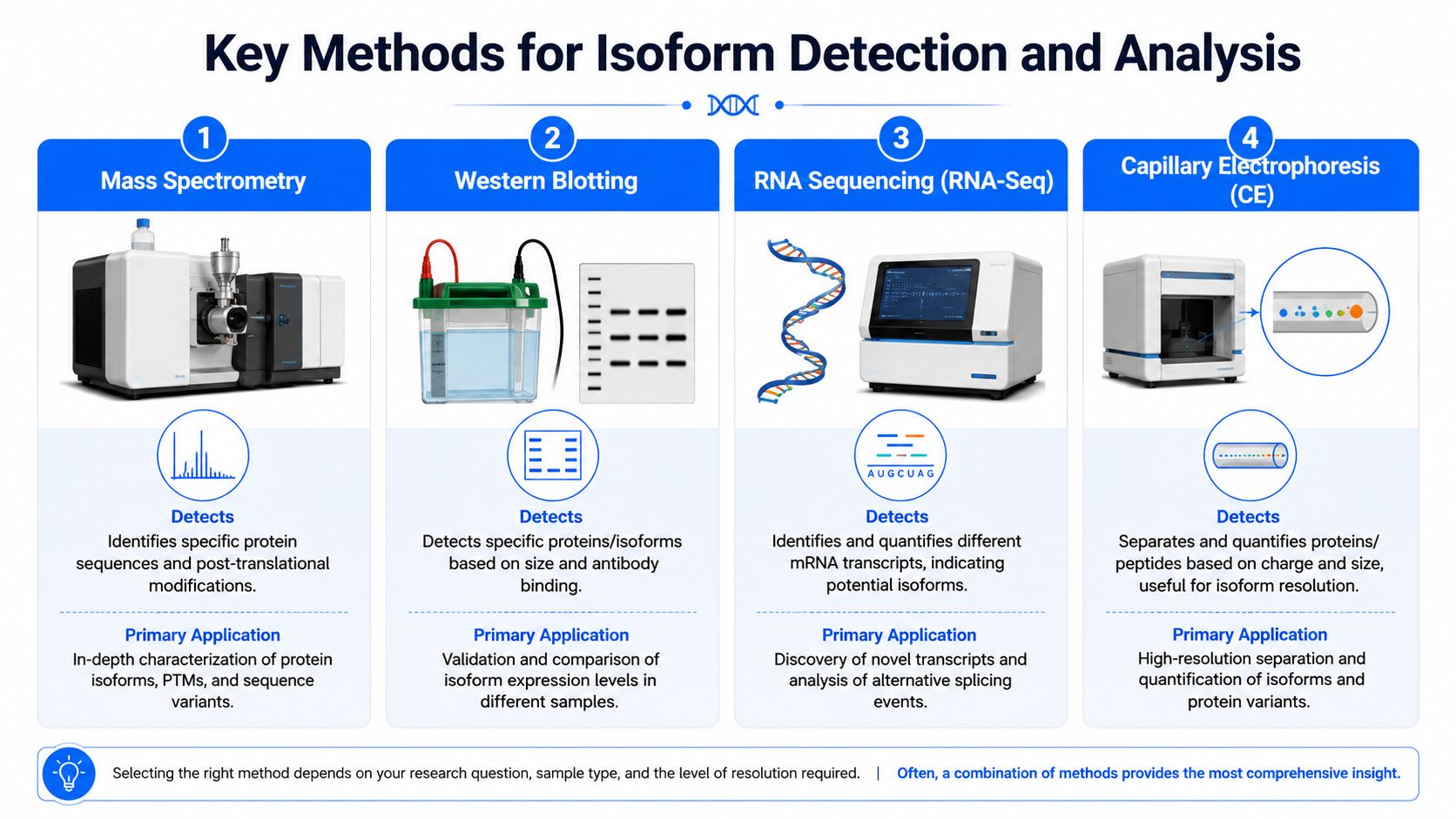
For materials R&D, this distinction matters because your downstream question is rarely just, “Is the protein there?” More often it is, “Which molecular version is there, in what proportion, and will that version change viscosity, interfacial behavior, aggregation, or shelf stability?” The method should match that decision.
Bottom-up proteomics is strong for screening, but weak on molecular context
Bottom-up proteomics cuts proteins into peptides and then measures those pieces. Labs use it widely because it handles complex mixtures well and can identify many proteins in one run.
The limitation is structural context. If two isoforms differ only by one skipped exon or a short terminal segment, many peptides will still be shared. You can confirm that the protein family is in the sample while remaining uncertain about which full-length version was present.
For a materials scientist, this works like grinding two similar polymers into monomers and then asking which original chain architecture you started with. Some information survives. Some does not. That loss of connectivity is exactly why bottom-up workflows can miss distinctions that later show up as formulation variability.
Top-down proteomics keeps the full molecule intact
Top-down proteomics measures intact proteins first, rather than reconstructing them from fragments. That preserves the relationship between mass, sequence variation, truncation, and other features on the same molecule.
If your decision depends on isoform identity, top-down data is often more informative than peptide-level data. It answers a different question. Instead of asking whether pieces associated with a protein exist, it asks which intact molecular forms are present in the vial.
That difference has direct consequences for AI-driven discovery. Training data built from family-level labels can blur meaningful variation. Training data built from intact-form measurements gives the model a cleaner link between molecular state and observed material behavior.
A practical comparison looks like this:
| Method | What it sees well | Where it struggles |
|---|---|---|
| Bottom-up proteomics | Complex mixtures, broad protein identification | Distinguishing highly similar full-length isoforms |
| Top-down proteomics | Intact sequence context, isoform definition, sequence variation | Higher technical demands and instrumentation requirements |
| RNA-Seq | Transcript diversity, potential isoform production | Doesn't directly confirm the final protein species |
| Western blot or CE | Size shifts, relative separation, targeted checks | Limited specificity unless reagents and standards are strong |
Instrument quality matters here. The FTICR mass spectrometry review in PMC describes high-resolution Fourier Transform Ion Cyclotron Resonance mass spectrometry as a benchmark approach for top-down protein analysis, particularly when closely related forms must be distinguished with high mass accuracy.
RNA methods, blots, and electrophoresis answer narrower but useful questions
Not every program needs intact-protein characterization at the start. In early screening, lower-cost or higher-throughput methods can still reduce uncertainty.
- Western blotting: Good for checking whether a band shifts in size or whether a targeted form may be present, provided the antibody effectively separates the species you care about.
- RNA sequencing: Useful for mapping which transcript isoforms could be produced upstream. It is a design and hypothesis tool, not direct proof of the final protein population.
- Capillary electrophoresis: Useful for resolving size or charge differences in comparative workflows, especially when you need lot-to-lot or stress-condition comparisons.
A good way to set up an analytical plan is to treat these methods like layers of inspection in manufacturing. RNA-level assays define what could be built. Peptide-level assays show which parts are present. Intact-protein methods confirm the finished product.
Practical rule: Use RNA-level methods to generate hypotheses, peptide-level methods to screen broadly, and intact-protein methods when formulation decisions, stability studies, or AI labels depend on the actual molecular form.
The Functional Impact of Isoform Diversity
The hardest part of learning about isoforms isn't understanding how they arise. It's accepting how much a seemingly small change can alter function.
Two isoforms can share most of their sequence and still behave like different tools. One localizes to one tissue or compartment. Another loses a regulatory region. A third keeps the same core catalytic activity but interacts with a different set of partners.
Small sequence changes can redirect behavior
A concrete example comes from the SYNJ1 gene. As described in the Biostars summary discussing isoform-specific function, SYNJ1 encodes two distinct isoforms: SYNJ-145Da, predominantly found in the brain, and SYNJ1-170 kDa, which is expressed throughout the rest of the body. The point isn't just that there are two versions. It's that the versions are tied to different physiological contexts.
That pattern shows up broadly in biology. Many isoforms keep the same general job description but differ in where they operate, when they're expressed, or what regulatory elements they carry.
Why this matters outside biology
If you're working in materials science, replace “tissue-specific function” with “process-specific behavior.” The logic transfers cleanly.
A short deletion can change flexibility. A missing domain can remove a binding surface. A shifted terminus can alter degradation or aggregation propensity. Those effects can show up as practical observations you already care about:
- Surface interactions: A small sequence change can alter adhesion to fillers, fibers, or interfaces.
- Network formation: Different isoforms may contribute differently to gelation, crosslinking, or assembly.
- Stability under stress: Heat, shear, salt, or solvent exposure may destabilize one isoform before another.
You don't need to assume that every isoform change will produce a dramatic material effect. But you also can't assume equivalence. When an experiment is sensitive to molecular shape, charge distribution, or interaction kinetics, related protein variants can produce distinctly different outcomes.
A formulation can be reproducible at the recipe level and still be irreproducible at the molecular level.
Practical Implications for Materials R&D and Formulation
A team can run the same nominal formulation twice, using the same protein name on the spec sheet, and still get different rheology, adhesion, or storage stability. In many cases, the hidden variable is not the reactor or the operator. It is the molecular population inside that protein ingredient.
For materials scientists, isoform awareness is a control problem. If your input is a mixture of closely related protein versions, then "protein present" is too coarse a description for design, troubleshooting, or model building. It is similar to treating two polymer feedstocks as identical because they share the same monomer family, while ignoring differences in chain length distribution or branching. The label is directionally useful. It is not precise enough to predict behavior.

Where isoforms create experimental risk
One common failure mode is false structure-property mapping. A team observes better film formation, cleaner self-assembly, or stronger surface binding and assigns that result to a named protein. If the active ingredient does contain a shifted isoform distribution, the team may optimize around the wrong feature and struggle to reproduce the result later.
Another problem shows up as batch drift that passes routine quality checks. Supplier, concentration, and purity may remain within spec while the relative abundance of isoforms changes enough to alter unfolding pathways, intermolecular contacts, or aggregation behavior. The experiment looks noisy, but the noise has structure.
AI workflows are especially sensitive to this kind of hidden variability. If successful and unsuccessful runs are both tagged with the same ingredient name, the model receives conflicting examples under one label. That weakens feature importance, blurs real structure-property relationships, and makes the model look less useful than it is.
As noted earlier, isoform-resolved analysis often reveals biological differences that disappear at the coarse gene or protein-label level. The practical lesson for formulation work is straightforward. Broad biological naming can collapse meaningful sources of variation into a single column in your dataset.
Why isoforms and proteoforms are not the same thing
This distinction matters in development work because it changes what you need to measure.
Isoforms differ at the sequence level. Proteoforms is the broader category that includes isoforms plus changes added after translation, such as phosphorylation or glycosylation. For a materials team, that means two layers of variability can influence performance. One is the underlying protein blueprint. The other is the chemical finishing applied to that blueprint.
That second layer can dominate behavior under industrial conditions. A constant sequence can still behave differently if surface modifications change solubility, charge shielding, hydration, degradation rate, or interfacial interactions during high salt exposure, thermal cycling, drying, solvent contact, or pH shifts.
The News-Medical explainer on proteoforms draws this boundary clearly. That is useful for R&D teams because it prevents a common mistake. Sequence variation and post-translational variation are related problems, but they do not require the same analytical response.
What to change in your workflow
Start by defining the decision before choosing the assay. If the question is lot identity, a broad screen may be enough. If the question is why one formulation gels and another phase-separates, you may need isoform-level or proteoform-level resolution.
A practical workflow looks like this:
- Define the ingredient at the right molecular level: Record more than protein name and vendor. Capture the specific product form, biological source, expression system, and any evidence of isoform composition.
- Match characterization to failure mode: If the risk is altered binding or assembly, use methods that can distinguish closely related variants rather than only confirming total protein presence.
- Track provenance and handling: Purification route, storage duration, freeze-thaw history, and process exposure can all shift which molecular species are present at the point of use.
- Record the environment the protein is exposed to: pH, ionic strength, solvent fraction, temperature profile, and shear history often determine which variants remain functional inside the formulation.
- Store molecular descriptors as model features: If you have isoform ratios, modification state proxies, or even a supplier-specific fingerprint, keep them in structured fields instead of burying them in notebook text.
Teams also benefit from a change in mindset. Treat unexplained variability in protein-enabled materials the way you would treat unexplained variation in particle size distribution or polymer dispersity. Assume the input may be heterogeneous until measurement says otherwise.
This becomes especially useful during scale-up. Bench conditions may preserve one subset of the protein population, while intensified mixing, longer hold times, or different thermal profiles favor another. In that situation, the process has not merely changed yield. It has changed which molecular variants survive long enough to influence the material.
Conclusion Turning Isoform Complexity into a Competitive Advantage
Protein isoforms add complexity, but they also add resolution. They help explain why one named protein can produce inconsistent behavior across lots, process conditions, or suppliers. They help separate true causal drivers from misleading labels. And they force more discipline in how teams define biological ingredients inside materials workflows.
For scientists building formulations or training predictive models, the practical takeaway is simple. If protein identity is part of the hypothesis, broad protein naming may be too crude. Sequence-level variation can matter. Surface-level variation can matter too. Keeping the distinction between isoforms and proteoforms clear makes your analysis cleaner and your experiments easier to interpret.
That doesn't mean every project needs the deepest possible characterization. It means teams should know when hidden molecular diversity is likely to be the reason an otherwise sensible program won't reproduce, won't scale, or won't model well.
The opportunity is bigger than troubleshooting. Once you start treating isoform composition as a design variable, you can search for better-performing biological inputs with more precision. You can build datasets that capture the actual source of variation. And you can give AI systems a better chance to learn real structure-property relationships instead of averaging over unresolved mixtures.
In other words, isoform complexity isn't just a biological complication. In the hands of a disciplined R&D team, it becomes another lever for designing more stable formulations, more interpretable experiments, and more reliable paths to scale.
If your team is trying to connect noisy formulation outcomes to underlying molecular drivers, Polymerize can help unify scattered experimental data, structure ingredient-level variables more rigorously, and build AI-ready workflows for materials R&D. It's designed for scientists who need to move from ambiguous trial-and-error toward explainable, data-driven formulation decisions.
Put your R&D data to work
See how materials teams use Polymerize to plan fewer experiments and reach target properties faster.