

A formulation chemist needs one historical result to compare a new polymer blend. The value may be in an ELN, the test conditions in a spreadsheet, and the raw instrument output on a local drive. The scientist spends the afternoon reconciling sample names, units, curing temperatures, and version history before deciding whether the result is usable.
That friction is more than an inconvenience. Data quality is the foundation of predictive Materials Informatics, because a model can't distinguish a meaningful material relationship from a missing field, duplicated sample, changed unit, or undocumented processing condition. Learning how to improve data quality therefore starts with experimental workflow design, not a late-stage IT cleanup project.
Table of Contents
The True Cost of Fragmented Experimental Data
Materials R&D creates fragmentation naturally. An ELN may hold the experiment narrative, a LIMS may store sample identifiers, an instrument may export measurements into proprietary files, and a spreadsheet may contain the formulation logic that connects them. Each source can be locally useful while the combined record remains difficult to interpret.
The most expensive defect often isn't an obviously impossible value. It's a plausible result with incomplete context. A tensile-strength measurement without conditioning information, a viscosity value without temperature, or a polymer name recorded under several spellings can pass a human spot check while weakening every downstream comparison.

Why downstream cleanup loses
The economics of data defects favor prevention. The data quality cost analysis reports that poor data quality costs organizations an average of $12.9 million per year. The same source describes a prevention-to-failure escalation of $1 to check a data item, $10 to correct it, and $100 to fix it after an error has propagated.
For an R&D organization, that progression maps directly to the experimental lifecycle:
- At entry, a required-field check can stop a record with no curing temperature.
- During integration, a steward may reconcile identifiers, units, or naming conflicts.
- After propagation, the team may need to retrain a model, repeat an experiment, revisit a scale-up decision, or audit an entire dataset.
The difference is not only financial. Late correction also consumes scarce scientific attention. Scientists must determine whether a value reflects real material behavior or a recording defect, then preserve enough provenance to explain the decision.
Practical rule: If a defect can be prevented where data is created, don't design the operating model around correcting it after it reaches analytics.
Fragmentation blocks model readiness
Predictive Materials Informatics depends on comparable observations. A model needs formulations, process conditions, measured properties, and outcomes represented in a way that allows valid comparison. Fragmented sources undermine that requirement through inconsistent schemas, unclear definitions, and missing lineage.
A centralized repository alone won't solve this problem. Copying low-quality records into a new platform only creates a larger collection of difficult-to-trust data. The useful investment is a controlled path from experiment design to ingestion, validation, storage, analysis, and feedback.
Start by identifying which experimental decisions depend on which fields. If a formulation model requires composition, mixing conditions, cure profile, and test temperature, those fields should receive stronger controls than an optional free-text note. That prioritization keeps governance connected to scientific value rather than turning data management into paperwork.
Profiling and Scoring Your Current Data Assets
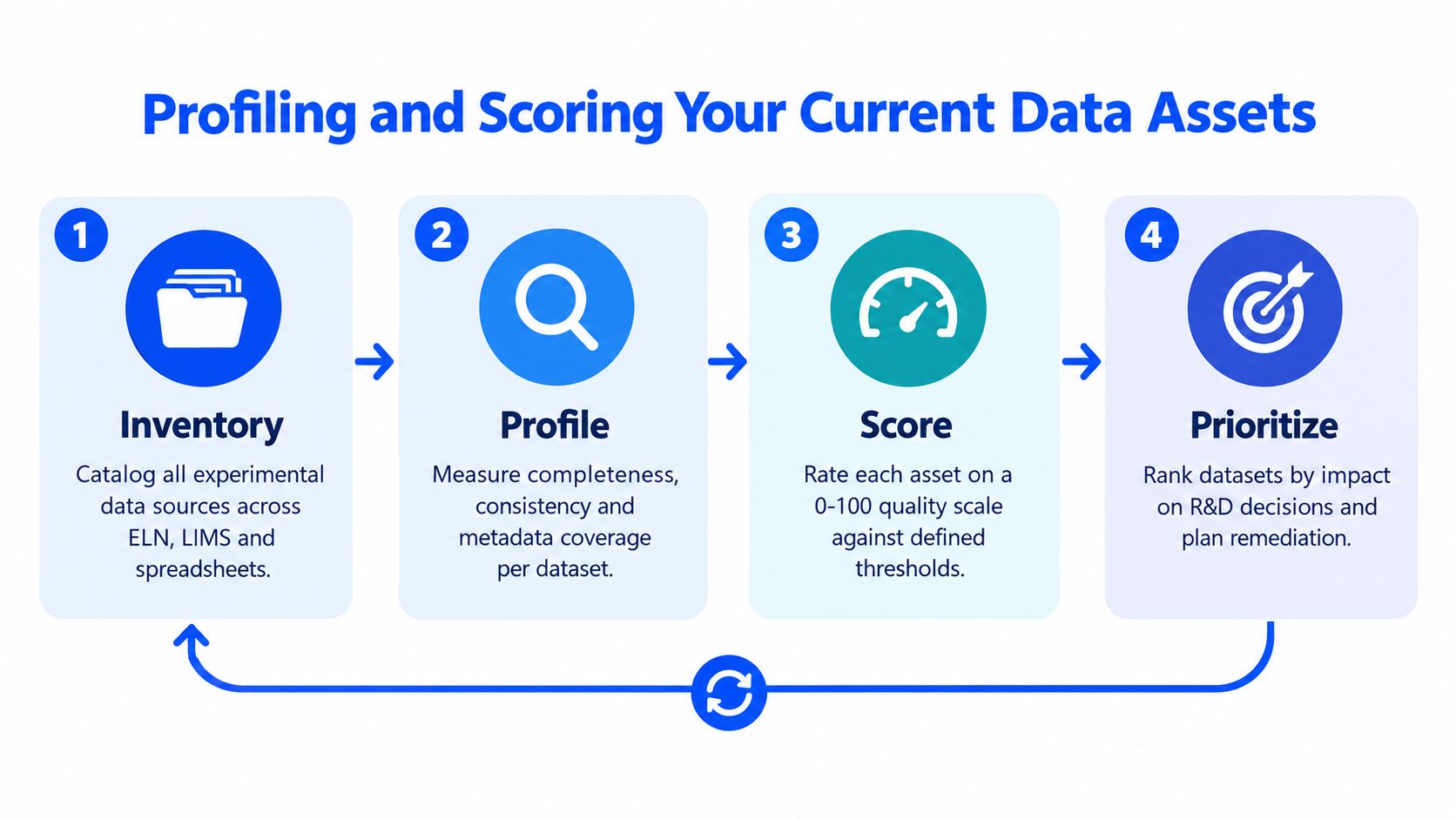
Before changing schemas or launching a cleansing campaign, establish what is wrong. “The data is messy” is a useful signal, but it isn't a diagnosis. A structured assessment turns that complaint into defect categories, measurable rules, and accountable remediation.
The IBM data quality assessment framework recommends defining scope, profiling data, establishing explicit quality rules, scoring results, and prioritizing remediation. In experimental environments, the cycle should include both structured fields and the context surrounding each measurement.
Build an evidence-based inventory
Catalog the sources that contribute to a decision, not just the systems owned by IT. Include ELNs, LIMS tables, instrument exports, formulation spreadsheets, shared drives, analysis notebooks, and reference data. Record the responsible team, update pattern, access constraints, and relationship to other sources.
Then select a representative sample. Avoid choosing only the cleanest recent experiments, because that sample will hide legacy naming, missing metadata, and instrument-specific issues. Include the datasets scientists use when they compare materials or prepare model training data.
A useful inventory records:
- Business purpose: Which R&D decision depends on the asset?
- Grain: Does one row represent a sample, a test, a batch, or an experiment?
- Identity: How does the source identify materials and specimens?
- Context: Which process, environmental, and test conditions accompany a result?
- Ownership: Who can explain the field and approve a correction?
Score dimensions that scientists recognize
Use explicit dimensions rather than a single subjective quality label. Completeness asks whether required formulation and test context exists. Validity checks whether values match permitted types, units, ranges, and controlled terms. Consistency compares the same concept across systems. Uniqueness identifies duplicate samples or repeated imports. Timeliness measures whether the record is available and current enough for the decision.
Create rules that reflect physical and operational reality. A temperature field may require a unit and a permitted range. A material identifier may need to match a master record. A tensile-strength result may require the specimen, method, and conditioning context. Rules should distinguish a true exception from a data-entry error, rather than rejecting unusual but scientifically valid behavior automatically.
A simple scorecard might show each dimension separately. That matters because an asset with strong completeness but weak consistency requires a different intervention from one with complete, invalid measurements. Assign each failed rule to an owner, capture the reason for the defect, and track whether the source process changes after remediation.
Don't cleanse symptoms
Manual editing can make a dataset look better without improving the workflow that produced it. If a team standardizes polymer names in a one-time spreadsheet while the ELN still accepts unrestricted free text, the next batch will recreate the problem.
Profile rejected and accepted records, inspect defect clusters, and ask where the error entered the process. The best remediation may be a controlled vocabulary, an integration mapping, a better form, or training for a specific laboratory group. Profiling protects the program from spending effort on visible records while leaving the generating cause untouched.
Unifying Silos with Metadata Standards and Governance
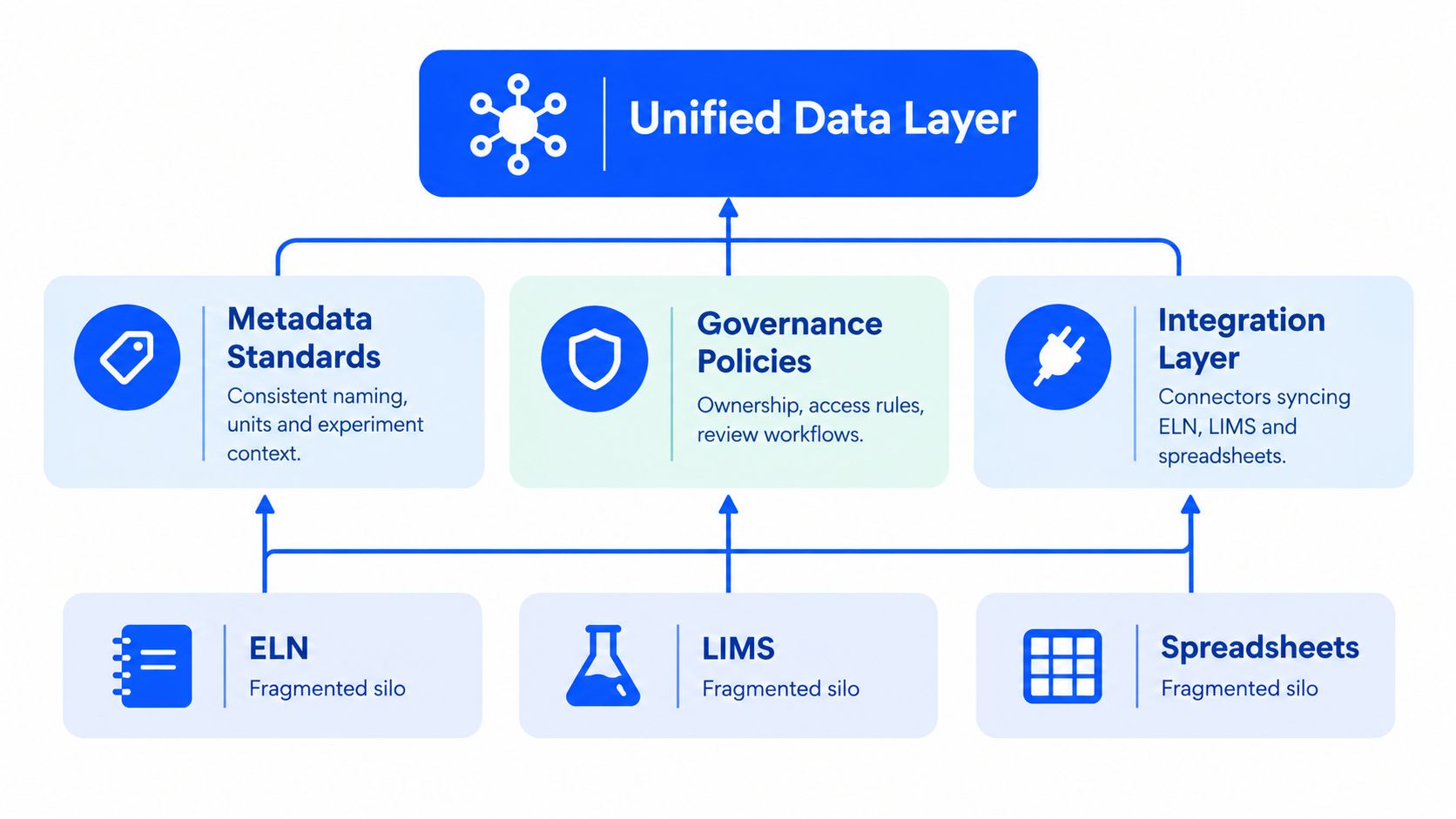
A unified data layer should make experimental meaning portable across systems. It doesn't require every researcher to abandon familiar tools overnight, and it shouldn't force every source into an identical database structure. The practical objective is a shared interpretation of core entities and measurements.
Start with a canonical model for the concepts that connect experiments. A material, formulation, batch, specimen, experiment, process step, test method, result, and instrument run should each have a defined identity and relationship. The model can preserve source-specific attributes while requiring common fields for the analyses that matter.
Standardize meaning before formatting
A unit conversion is easy compared with a definition conflict. Two systems may both contain “tensile strength” while using different methods, specimen conditions, or reporting conventions. Metadata must therefore capture not only the value and unit, but also the method, context, timestamp, operator or system, and source record.
Controlled vocabularies help where terms recur. Define approved names for polymers, additives, solvents, test methods, failure modes, and process stages. Keep aliases for historical values so legacy data remains searchable, but map those aliases to a preferred concept instead of deleting the original term.
Use schema mapping to make integration explicit. For each source field, document its target concept, transformation, unit behavior, null handling, and conflict rule. When two sources disagree, preserve both raw values and record the resolution decision. Silent overwriting creates a clean-looking dataset with an unreliable history.
Make governance usable at the bench
Governance fails when scientists experience it as a gate that slows experimentation without improving interpretation. It becomes workable when the system asks for information at the moment it has scientific meaning, provides valid choices, and explains why a field matters.
Assign ownership by domain. A polymer scientist may own the definition of a formulation attribute, a laboratory manager may own a test method, and a data engineer may own the transformation that moves the result into the unified layer. Ownership should include authority to approve definitions and responsibility for monitoring defects.
Access controls need the same balance. Role-based permissions can protect intellectual property while allowing appropriate collaboration. Researchers may need to view a result without editing its provenance, while stewards can correct metadata through a review workflow. Keep raw instrument data immutable, and record approved interpretations separately.
This organizational design matters because the data integrity outlook identifies inadequate automation tools as a barrier for 49% of respondents, inconsistent definitions and formats for 45%, and a shortage of skills and staff for 42%. Those obstacles point to a combined technology and operating-model problem. A unified layer without ownership becomes another silo, while governance without practical integration becomes a manual burden.
Instrumenting Pipelines for Validation and Lineage
A predictive workflow needs more than a successful file transfer. It needs evidence that the incoming record is structurally valid, scientifically interpretable, and traceable to its origin. Validation should happen as close as possible to data entry, then continue as the record moves through transformation and analysis.
Validate before committing the record
Define checks at each ingestion boundary. A spectrometer export might require a known sample identifier, an expected file structure, a valid timestamp, and measurement values within physically plausible bounds. A formulation import may require component identities, concentrations, units, and a link to the experiment that produced the batch.
Separate hard failures from review flags. A missing identifier should usually block downstream use. An unusual property value may be scientifically important and should trigger review rather than automatic rejection. This distinction prevents quality controls from filtering out the discoveries that R&D teams are trying to find.
Useful pipeline checks include:
- Schema validation: Confirm required columns, data types, and version compatibility.
- Identity validation: Match samples, batches, instruments, and experiments to known entities.
- Unit validation: Require explicit units and convert them through documented rules.
- Range and relationship checks: Detect impossible values and incompatible combinations.
- Duplicate detection: Identify repeated files, records, or sample-result pairs.
- Change detection: Flag unexpected changes in source structure or process behavior.
Preserve the chain of evidence
Lineage should answer a scientist's question without a forensic exercise. For a model input or predicted property, the system should identify the transformed record, the source table or file, the original instrument output, the experiment, the operator or system that generated it, and relevant environmental or process conditions.
Store transformation history with version information. If a unit conversion, normalization, or entity match changes the representation, retain the raw value and the applied operation. This allows a researcher to reproduce the model input and challenge an automated mapping when the scientific context warrants it.
Pipeline reliability is part of data quality, not a separate infrastructure concern. The enterprise data quality benchmark attributes 26.2% of issues to pipeline execution faults, 16.6% to ingestion disruptions, and 15.2% to platform instability. Hardening orchestration, permissions, deployment workflows, retries, and change management can therefore prevent defects that no record-level cleansing rule will catch.
A model can't explain a result that the pipeline can't trace.
Use quarantine areas for failed records rather than discarding them. Give the responsible team enough detail to correct the source or approve an exception, then reprocess the record through the same controls. That creates a feedback loop instead of a hidden manual workaround.
Shifting from Manual Checks to Automated Observability
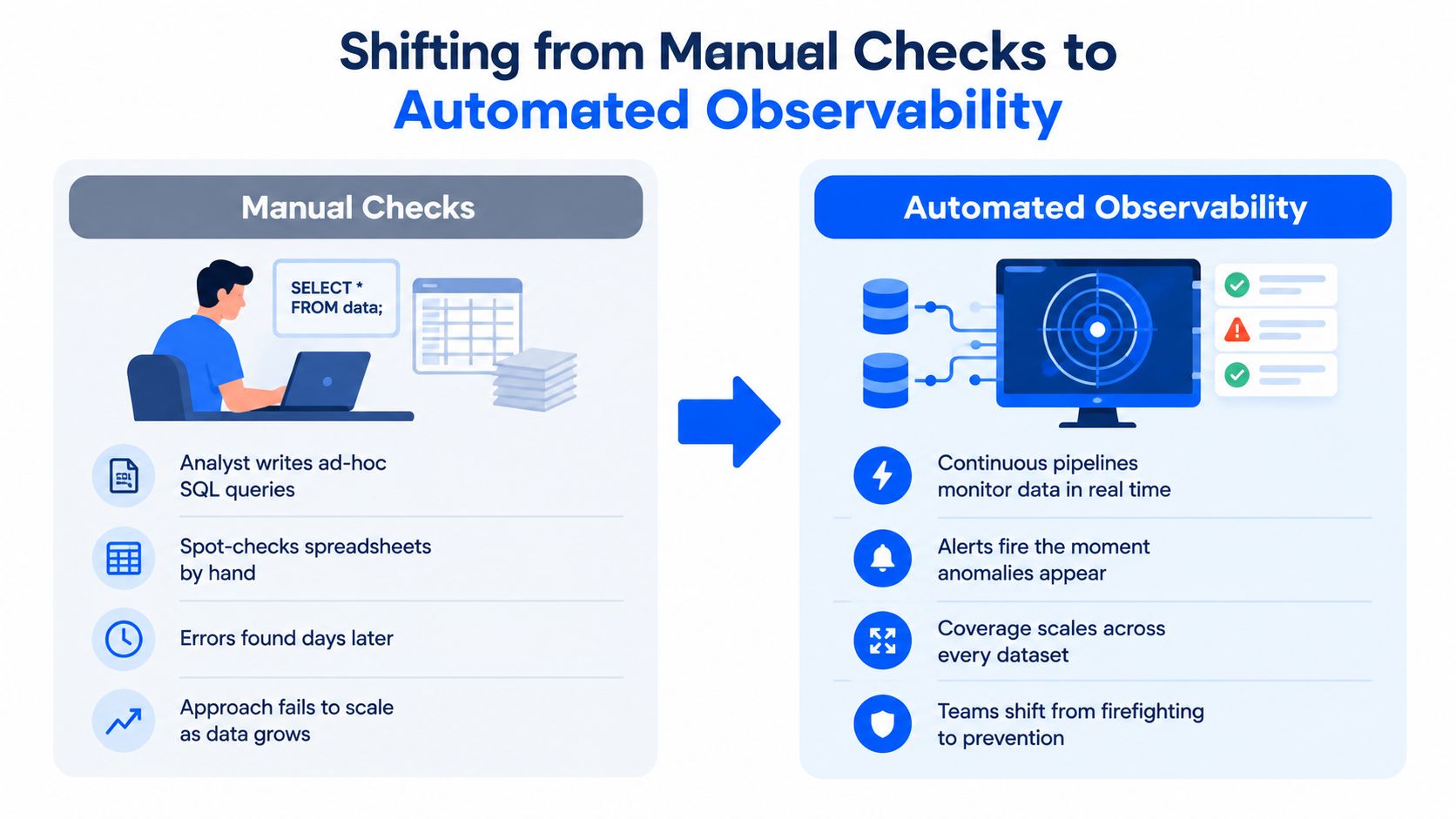
Manual SQL checks and spreadsheet spot reviews have a place during discovery and rule design. They help experts understand unfamiliar datasets. They fail as the primary control once sources change frequently, volumes grow, and defects emerge between scheduled reviews.
A manual process also creates uneven coverage. Analysts tend to inspect the datasets that are already visible, while a silent schema change, declining sensor quality, or delayed ingestion can affect model inputs without appearing in a familiar query. Late detection increases the chance that an invalid record will be copied into features, reports, and experiment decisions.
Design monitoring around failure modes
Observability should monitor the behavior of data and pipelines, not merely whether a job completed. Track freshness, volume, schema, distributions, null patterns, duplicate rates, and rule failures. For experimental data, add domain signals such as unexpected unit mixes, abrupt changes in instrument distributions, or a new category appearing in a controlled field.
Use anomaly detection alongside deterministic rules. A fixed range can catch impossible measurements, while distribution monitoring can identify gradual sensor drift or a process change that remains within the permitted range. Alert thresholds should reflect business impact. A failure in a dataset used for a high-value formulation decision deserves a different escalation path from a low-priority archival feed.
The data quality benchmark survey reports that insufficient knowledge of how to test well is the top data quality challenge. It also finds that 27% of respondents use a dedicated data observability platform, while 61% rely on manual checks or SQL-based validation. The implication is practical: buying a monitoring platform won't solve weak test design. Data owners need to define what “healthy” means for each asset and connect alerts to a response.
Give every alert a human owner
An alert without an owner becomes background noise. For each critical dataset, define who receives the notification, who can investigate the source, who approves an exception, and how downstream consumers are informed.
A workable incident record includes the failed check, affected data, first detected time, probable source, business impact, disposition, and prevention action. Link the incident to a rule or monitor so recurring failures reveal a process problem rather than appearing as unrelated tickets.
Use automated observability for continuous coverage and retain manual review for ambiguous scientific cases. That combination is stronger than either extreme. Tools can detect patterns consistently, while domain experts decide whether an unusual material result is an error or a valuable outlier.
Embedding Quality into the R&D Operating Model
Data quality becomes durable when R&D treats it as part of experimental practice. Scientists already document methods, record observations, and preserve evidence to support reproducibility. Quality controls should extend that discipline to identifiers, metadata, units, and digital lineage without turning every experiment into an administrative exercise.
The operating model needs clear trade-offs. Maximum standardization can restrict novel work, while unrestricted flexibility makes comparison difficult. A strong design uses mandatory controls for the fields that determine interpretation and flexible capture for exploratory details, with a review path for new concepts.
Define roles and measures
A data steward should own the meaning and permitted values within a scientific domain. A platform or pipeline owner should maintain ingestion logic, validation, and lineage. Laboratory and formulation leaders should decide which quality failures affect active R&D priorities and how quickly teams need to respond.
Measure health through indicators that lead to action. Examples include completeness of required experimental context, validity of units and identifiers, unresolved lineage breaks, recurring rule failures, and time to resolve a material incident. Pair technical measures with adoption signals, such as whether scientists can find and reuse prior experiments without manual reconciliation.
Don't reward teams for producing clean dashboards while hiding exceptions. A transparent exception process is healthier than silent edits. Preserve the original observation, document the scientific rationale for any correction, and make the approved interpretation visible to downstream users.
Compare cleanup projects with lifecycle controls
A one-time cleanup can rescue a valuable historical dataset, especially when a model or scale-up decision depends on it. It won't protect the next experiment unless the source workflows change. Lifecycle controls require more coordination at the start, but they reduce repeated reconciliation and make defects easier to diagnose.
The maturity gap remains substantial. The TDWI state of data quality report states that only 17% of organizations have a formal process for measuring data quality metrics, 14% have automated data quality management, and 68% report an average data incident detection time of four hours or more. These figures support a simple management decision: assign data quality a recurring operating budget, named owners, and review cadence rather than treating it as an occasional migration task.
For materials organizations, the payoff is decision confidence. A scientist should be able to inspect a model recommendation, trace it to measured evidence, understand the processing conditions, and identify where uncertainty remains. That capability lets predictive models guide the next experiment without replacing scientific judgment.
Begin with one decision-critical workflow, such as mechanical-property prediction or formulation optimization. Inventory its sources, profile its defects, define ownership, instrument its pipeline, and review the resulting incidents with scientists. Once the controls work in that workflow, extend the patterns to adjacent material families and test methods.
Polymerize helps materials R&D teams unify experimental data from spreadsheets, ELNs, and other silos, with ingestion checks for required fields, identifiers, units, and duplicate records. Visit Polymerize to see how its centralized data backbone can support governed, traceable, AI-ready experimentation.
Put your R&D data to work
See how materials teams use Polymerize to plan fewer experiments and reach target properties faster.