
The most popular advice about active learning is also the least useful: choose a model, define an acquisition function, and let the algorithm pick the next experiment. That sequence makes the work sound like a software installation. In a materials lab, the difficult part usually comes earlier. You need a decision the model can improve, data that reflect the formulation space, experiments the lab can execute, and a feedback path that preserves what happened when the bench work diverged from the plan.
Active learning is better understood as closed-loop experimental design. A surrogate model estimates outcomes, an acquisition function ranks unexplored candidates, and the team runs the experiments expected to provide the most useful information. The loop then updates the model and changes the next recommendation. This approach has roots well before modern machine learning, with adaptive experiment selection appearing in scientific work associated with Laplace in the eighteenth century, as documented in the Nature paper on closed-loop materials discovery.
The operational question isn't whether active learning sounds promising. It's whether your organization can repeatedly convert a model recommendation into a valid experiment, a trustworthy result, and a better next decision.
Table of Contents
- Start with a representative seed set
- Train a baseline you can explain
- Rank candidates with explicit trade-offs
- Run, capture, and retrain
- Treat the ELN as part of the loop
- Design around batch reality
- Protect data quality at the point of capture
Why Most Active Learning Projects Stall Before They Start
Active learning projects rarely stall because the team chose the wrong algorithm. They stall because the lab cannot execute the recommendations, historical measurements are not comparable, or nobody has agreed on what counts as a useful discovery. A polished dashboard cannot resolve any of those constraints.
The deeper issue is treating active learning as a software component rather than an operating model. It changes experimental work from a fixed test plan into a sequence of decisions that adapts as evidence arrives. A surrogate estimates outcomes, an acquisition function ranks candidates, and the team chooses experiments that may improve the next decision. The model only creates value when that recommendation becomes a valid experiment and the result returns to the loop with enough context to interpret it.
Test the problem before testing the model
Active learning fits projects with a broad design space, expensive or slow experiments, incremental observations, and a lab that can act on recommendations. Polymer formulation, catalyst composition, battery materials, and coating systems often meet those conditions because practical screening capacity covers only part of the possible combinations.
The fit is weaker when the design space is already small and nearly complete, when every candidate must pass a long qualification sequence before any learning occurs, or when test procedures change enough to make results incomparable. An acquisition function cannot compensate for labels produced by inconsistent methods.
Define the decision before choosing the metric:
- Discovery objective: Find candidates that meet a threshold or expose a previously untested region.
- Optimization objective: Improve a target property while respecting formulation and processing constraints.
- Learning objective: Reduce uncertainty or clarify a structure-property relationship.
- Operational objective: Increase useful experiments per lab cycle without overloading technicians or instruments.
Prediction accuracy supports these objectives, but it does not replace them. A model can predict familiar formulations well and still recommend experiments that teach the team little.
Practical rule: If the team cannot explain what decision the next experiment will change, pause model development and repair the problem definition.
The interface affects adoption as much as the model. Scientists need to see why a candidate was selected, understand what the uncertainty represents, and override a recommendation that conflicts with material availability, safety, scheduling, or lab judgment. An intelligent interface design guide can help teams structure that explanation without requiring every researcher to become a machine-learning specialist.
Establish the minimum operating conditions
Begin with a data audit, not a model benchmark. Trace each measurement to its source, test method, units, missing fields, failed experiments, and procedure changes. Separate a poor result from an experiment affected by mixing, curing, contamination, instrument downtime, or an incomplete record. Those distinctions determine whether the model learns chemistry, process risk, or documentation noise.
Then document the lab's operating limits. Include available instruments, batch sizes, raw-material availability, safety boundaries, scheduling windows, and technician capacity. A recommendation that looks excellent in silico but cannot be made this week has little practical value.
Agree on a baseline before running the loop. Random sampling provides a direct comparison for judging whether the strategy improves the efficiency of labeled data rather than merely producing attractive visualizations. Measure the useful evidence obtained within the available experimental budget, including failed or infeasible recommendations, because those costs belong to the deployment reality.
The project is ready to proceed when the team has a defined decision, usable labels, executable experiments, and a way to record deviations. Without those conditions, model selection is premature.
Building Your First Active Learning Loop
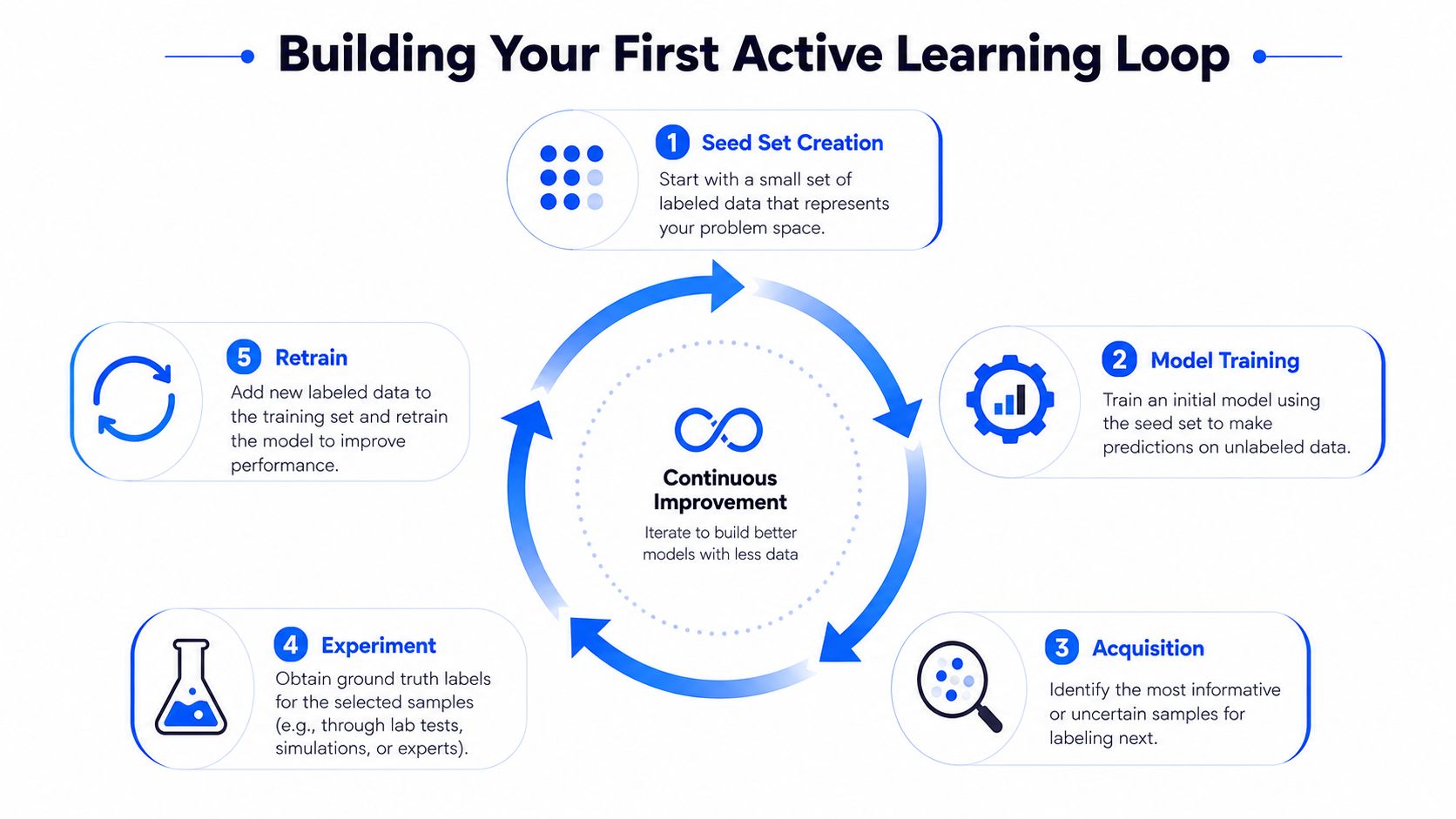
A first loop should be deliberately small and auditable. Don't begin by automating every instrument or connecting every data source. Build a complete cycle that a scientist can inspect from seed data through recommendation, experiment, result capture, and retraining.
Start with a representative seed set
The seed set determines what the first model believes is possible. Select examples that cover the major formulation families, processing conditions, target-property ranges, and known failure modes. A small but representative set is more useful than a larger collection dominated by one easy-to-measure chemistry.
For a polymer campaign, the seed data might include formulations across composition ranges, molecular-weight bands, curing conditions, and observed defects. For a catalyst campaign, it might span active components, supports, preparation conditions, and deactivation outcomes. Keep failed experiments in the dataset, but classify the failure where possible. The model needs to distinguish an intrinsically poor candidate from an execution problem.
The Stanford active learning implementation notes describe the practical cycle as a representative labeled set, baseline training, scoring of the unlabeled pool, query selection, annotation or experimentation, retraining, and repetition until the budget is exhausted or performance stops improving.
Train a baseline you can explain
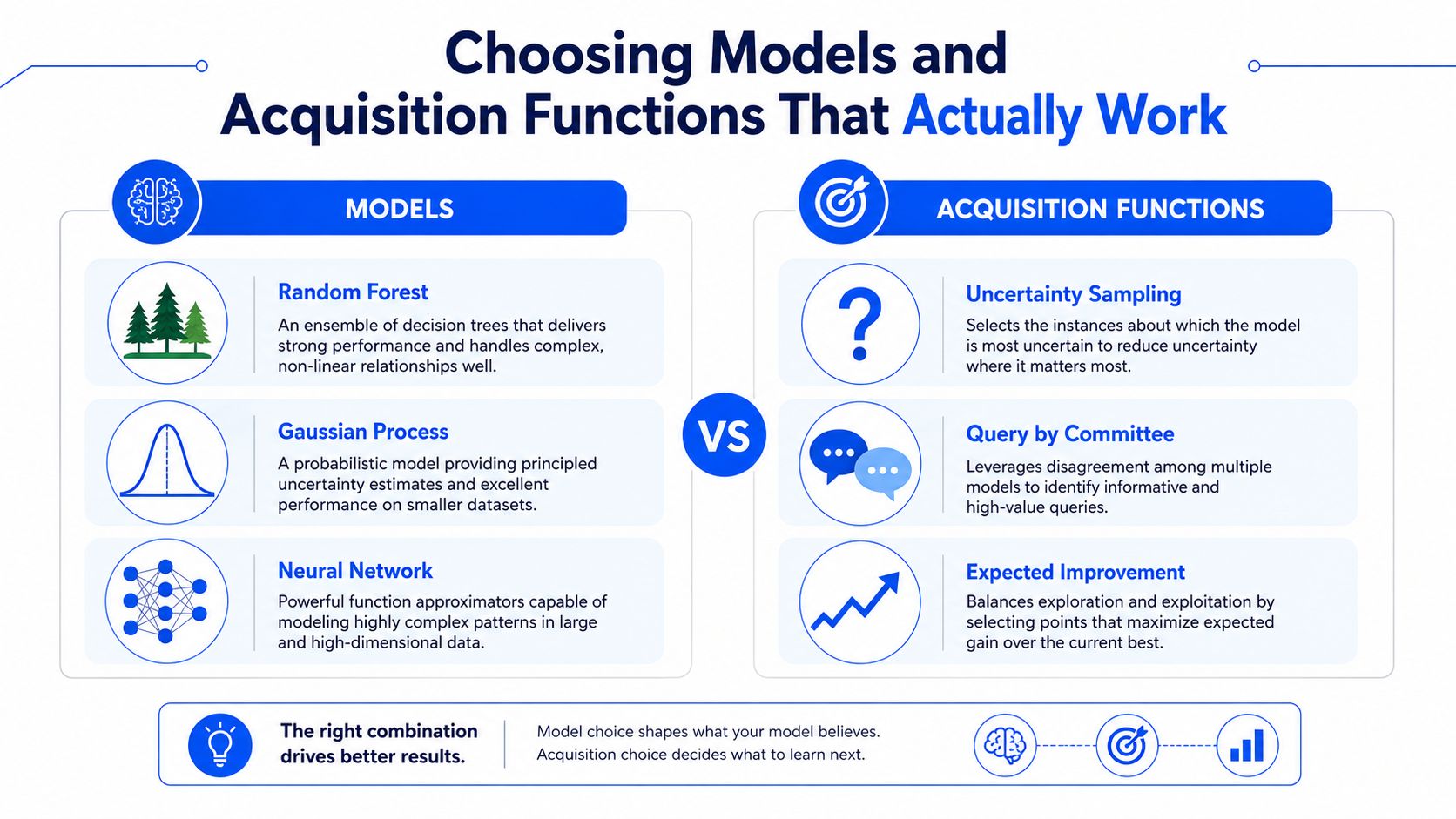
Use a model that produces predictions and uncertainty in a form the team can inspect. A Gaussian process can be useful for smaller, structured datasets because it naturally represents predictive uncertainty. Tree ensembles can handle mixed features and nonlinear relationships, while neural networks become more attractive when the dataset and representation justify their added complexity.
Don't optimize only for a single holdout score. Examine calibration, error by formulation family, performance near constraints, and behavior in sparse regions. Hold out data by chemistry, batch, or time where appropriate, not just by random row, because random splitting can make the model appear more capable than it will be on a new formulation.
Rank candidates with explicit trade-offs
The acquisition function should reflect the campaign objective. Uncertainty sampling favors candidates where the model knows least. Exploitation favors candidates predicted to have strong performance. A combined strategy can seek high predicted value while reserving capacity for informative exploration.
Multi-objective materials work needs an explicit feasibility layer. A candidate may have attractive predicted strength but unacceptable viscosity, cure behavior, cost, safety characteristics, or processability. Filter hard constraints before ranking, then make the remaining trade-offs visible to the scientist.
Run, capture, and retrain
Send a manageable batch to the lab, record the exact recipe and conditions, and attach metadata to every result. Include execution status, not just the final property. Retrain after results are validated, and compare the new model with the prior model and the random baseline.
Stop when the campaign reaches its decision threshold, the remaining candidates offer little expected information, the labeling or experimental budget is exhausted, or the loop repeatedly selects candidates the lab cannot execute. Stopping is a design decision, not evidence that the project failed.
Choosing Models and Acquisition Functions That Actually Work
Model selection should follow the data and the decision, not fashion. Materials datasets often combine continuous measurements, categorical ingredients, processing variables, missing values, repeated batches, and noisy outcomes. No single architecture handles every combination reliably.
A useful starting comparison looks like this:
| Model family | Useful when | Main operational concern |
|---|---|---|
| Gaussian process | Data are limited and the feature space is structured | Computation and kernel assumptions can become restrictive |
| Random forest or ensemble | Features are mixed and nonlinear behavior matters | Uncertainty may need careful interpretation and calibration |
| Neural network | Data volume and representations support a flexible model | Training instability and unreliable confidence estimates can mislead selection |
The model's uncertainty is more important here than its raw flexibility. If the acquisition function uses uncertainty to select the next experiment, overconfident predictions can send the lab toward apparently safe but poorly understood candidates. Validate uncertainty on held-out data and inspect whether errors grow in the regions the model labels as uncertain.
Match acquisition to the campaign
Use uncertainty sampling when the priority is mapping an unfamiliar design space or finding where the current model is weak. It can waste capacity by selecting candidates that are uncertain but irrelevant, infeasible, or chemically unrepresentative.
Use expected improvement when the team has a clear property target and a credible incumbent. It focuses attention on candidates likely to improve the current result, but it can become conservative and neglect unexplored chemistry.
Use query-by-committee when different plausible models disagree. The disagreement identifies candidates that can separate competing explanations, which is useful for understanding structure-property relationships. It also adds model-management overhead, so the committee must be diverse for a reason, not assembled for complexity.
Composite strategies often work better than a single rule. Combine uncertainty with diversity, representativeness, feasibility, or predicted performance. The large-scale active-learning benchmark on strategy behavior emphasizes that different uncertainty variants win in different settings and that composite approaches can outperform random selection in data-scarce scenarios.
The acquisition function is a business rule expressed mathematically. It decides what the lab will not do, so its constraints deserve the same review as the model.
Run an offline replay before sending recommendations to the bench. Pretend the historical sequence arrived incrementally, allow the strategy to select from the candidates available at each point, and compare it with random sampling. Then run a prospective pilot where scientists review every recommendation. Track failed experiments, infeasible suggestions, diversity of selected formulations, and progress toward the actual campaign objective.
A prediction can be accurate while an acquisition policy is poor. Validate the policy directly.
Integrating Active Learning with Lab Workflows and ELNs
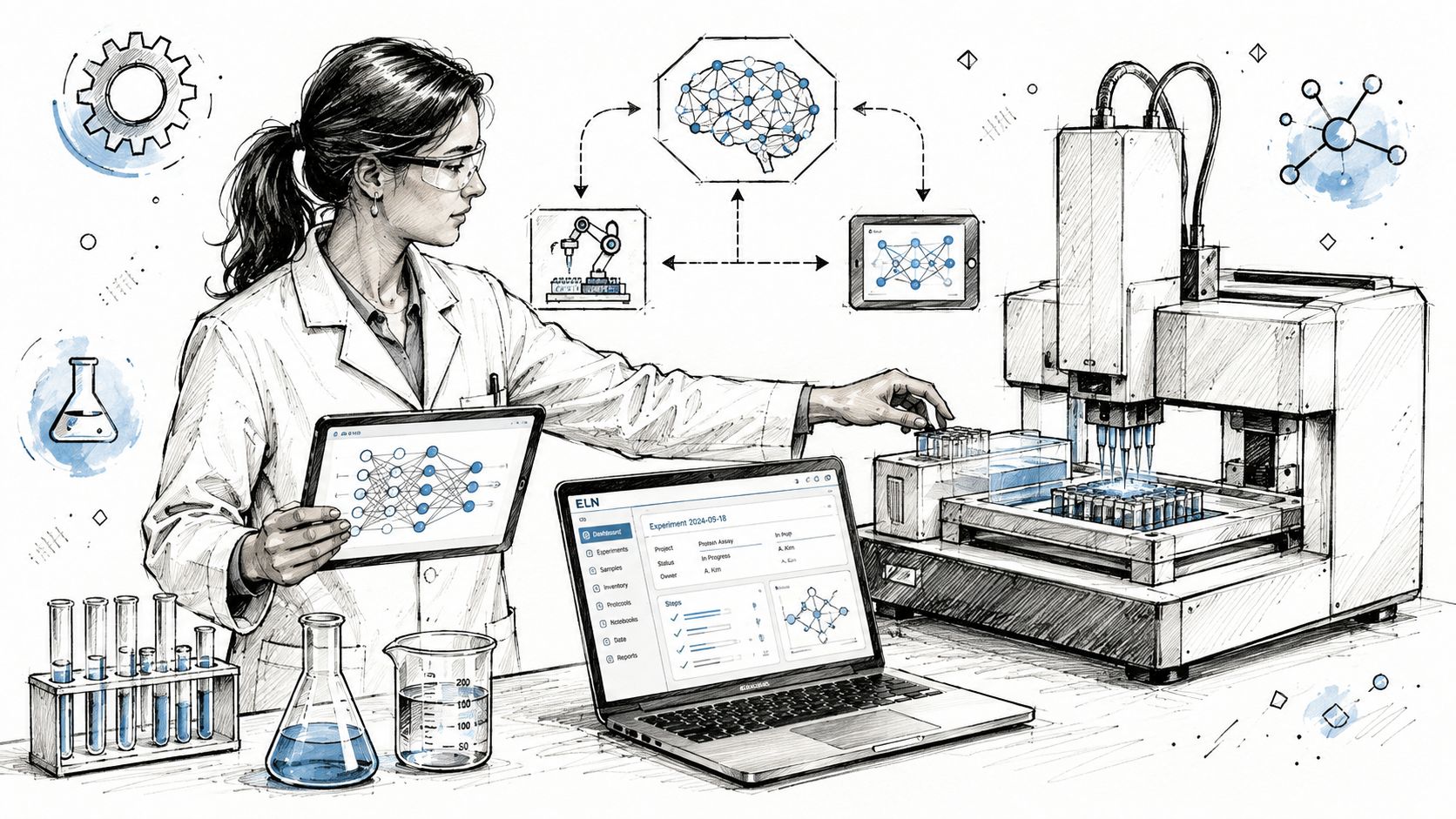
A model should not hand a scientist a formulation and disappear. A production loop needs a controlled path from recommendation to approval, execution, result validation, and retraining. The electronic lab notebook, sample registry, instrument system, and model service must share identifiers for the material, experiment, batch, and measurement. Without that identity layer, teams spend their time reconciling records instead of improving the campaign.
Treat the ELN as part of the loop
An ELN integration must capture more than the final property. Store the proposed and approved recipes, actual weighed quantities, process conditions, instrument method, operator notes, deviations, and result status. If a technician substitutes a raw material or changes a heating profile, preserve the difference. Treating the run as identical to the plan contaminates later analysis.
Use explicit states such as proposed, approved, scheduled, running, completed, invalidated, and failed execution. The model should train on validated results, not incomplete records that happen to contain a number.
Human review remains part of the control system. Scientists need structured rejection reasons, including unavailable material, safety concern, poor processability, duplicate coverage, or an out-of-scope condition. Those reasons can improve future filtering and expose gaps in the feasibility model.
Design around batch reality
Labs rarely run one isolated experiment at a time. Instruments, reactors, ovens, and technicians impose batch constraints. The acquisition service should propose a compatible set of candidates rather than only a ranked list, while preserving diversity and shared process conditions.
A practical batch-selection sequence is:
- Filter infeasible candidates with safety, material, instrument, and process rules.
- Group compatible runs by method, equipment, and preparation requirements.
- Rank within the feasible pool according to the campaign's acquisition objective.
- Review the batch with scientists before releasing it to the ELN.
- Return execution metadata with the measured property.
Long experiment cycles create a second operational risk. If runs take weeks, waiting for every result before retraining leaves the model stale. Retraining on validated subsets can help, provided the system distinguishes pending results from negative results. A pending experiment offers no evidence about the property yet.
For researchers working across experimental disciplines, a guide to biology AI for researchers provides context on how domain workflows and scientific judgment shape AI adoption. Materials teams face the same integration requirement: the system must support the scientist's process rather than force the process to imitate the model.
Protect data quality at the point of capture
Use controlled vocabularies for ingredients and units, validation rules for required fields, and automatic checks for impossible values. Flag duplicate formulations, suspiciously identical measurements, and results recorded without a linked method. Keep raw data immutable, then create separate curated views for analysis.
After each batch, review three questions: Did the lab execute what the model requested? Are the results technically valid? Did the candidates provide the information the acquisition function expected? These checks catch execution and recording failures before they enter training data.
When Active Learning Breaks Down and How to Fix It
Active learning breaks down when its assumptions don't match the campaign. The design space may be too narrow to reward exploration. Measurement noise may exceed the property differences the team wants to optimize. The model may be calibrated on historical chemistry that excludes the region the acquisition function keeps selecting.
Diagnose the failure by comparing the observed behavior with the intended mechanism:
| Observed problem | Likely cause | Practical response |
|---|---|---|
| Recommendations cluster around familiar chemistry | Acquisition favors exploitation or the seed set is narrow | Add diversity and coverage constraints |
| High uncertainty produces unusable candidates | Uncertainty isn't connected to feasibility | Apply hard filters before acquisition |
| Results don't improve the model | Measurements are noisy, inconsistent, or weakly linked to the target | Audit methods and separate execution failures |
| The loop repeats similar candidates | The candidate pool or representation lacks meaningful distinctions | Review descriptors and refresh the pool |
A data-sparse campaign doesn't automatically need a more complex model. It may need a better seed set, a simpler representation, or a hybrid design that combines space-filling experiments with active selection. Traditional design of experiments remains useful for establishing coverage and estimating major effects, while active learning can prioritize follow-up experiments once the system has enough signal to make informed choices.
Compare strategies against the same baseline
Uncertainty sampling can be effective for discovering blind spots, but it can chase outliers. Expected improvement can accelerate property optimization, but it may narrow the search too early. Diversity-based selection protects coverage, but it can spend experiments on candidates with little chance of meeting the target. Query-by-committee can expose disagreement, but its value depends on whether the competing models represent meaningful hypotheses.
Don't switch strategies because one batch looks disappointing. Use held-out evaluation, offline replay, and prospective monitoring to identify whether the problem is model error, uncertainty miscalibration, acquisition bias, or lab execution. The Scientific Reports study on active learning in automated physical systems frames the value in terms of discovery rate, which is a more useful lens than predictive accuracy alone.
If the loop can't reduce failed or uninformative experiments, it hasn't earned more automation.
Resetting the campaign can be sensible when the model has become trapped in a narrow region. Rebuild the seed set with representative high performers, failures, and boundary cases, then restart with a different acquisition balance. If the experiment cost is too high for repeated learning, use expert-designed screening or a simpler sequential design instead. Active learning is a means to better decisions, not a requirement for every materials problem.
Operationalizing Active Learning at Scale
A pilot becomes a production system when the organization can reproduce its decisions, detect degradation, and assign responsibility. Treat models, datasets, feature definitions, acquisition settings, constraints, and experiment records as versioned assets.
Use an operational checklist
- Version the evidence: Store the exact dataset, preprocessing rules, model artifact, and acquisition configuration behind every recommendation.
- Automate controlled retraining: Trigger retraining after validated results arrive, then require review before deployment when the model changes materially.
- Monitor the loop: Watch for feature drift, missing fields, changing measurement distributions, rising infeasibility, repeated recommendations, and divergence between predicted and observed outcomes.
- Keep a human gate: Give scientists authority to approve, modify, or reject experiments, with structured reasons captured in the system.
- Scale by campaign: Reuse platform components, but keep objectives, constraints, descriptors, and acceptance criteria specific to each chemistry or process.
- Report operational value: Show useful experiments completed, failed executions avoided, time to decision, coverage of the design space, and progress toward the defined material target.
Survey evidence from higher education offers a broader adoption warning: basic digital tools are widely used, while advanced strategies remain underused because of training gaps, limited resources, and institutional resistance, as discussed in the survey on active-learning implementation barriers. Materials organizations face a similar challenge. Deployment requires training, governance, workflow ownership, and trust, not just an API.
Teams can use platforms such as Polymerize to connect fragmented materials data and support explainable property prediction, formulation optimization, and next-experiment planning. The important evaluation criterion is whether the system fits the laboratory's evidence chain and makes its recommendations auditable.
Polymerize helps materials R&D teams connect experimental data, predict formulation properties, and plan AI-guided experiments within a controlled workflow. Visit Polymerize to see how its platform can support a practical active-learning loop from fragmented lab records to validated material decisions.
Put your R&D data to work
See how materials teams use Polymerize to plan fewer experiments and reach target properties faster.