


An R&D team is preparing for an audit. A scientist has copied supplier contact details into an analysis spreadsheet, a customer testing file sits in an electronic lab notebook, and an AI experiment uses a dataset whose original purpose nobody can clearly explain. The privacy policy is current, but no one can show which system contains each record, who can access it, how long it should be retained, or which lawful basis supports the processing.
That situation is common in materials research. GDPR compliance depends less on having a polished policy than on making controls work across fragmented workflows. To understand how to ensure GDPR compliance for materials R&D platforms, treat privacy as an operating system for data governance, not as a one-time legal review.
Table of Contents
- Why fragmented research workflows create control gaps
- Why a phased program beats a certification exercise
Why GDPR Compliance Is a Systems Integration Challenge
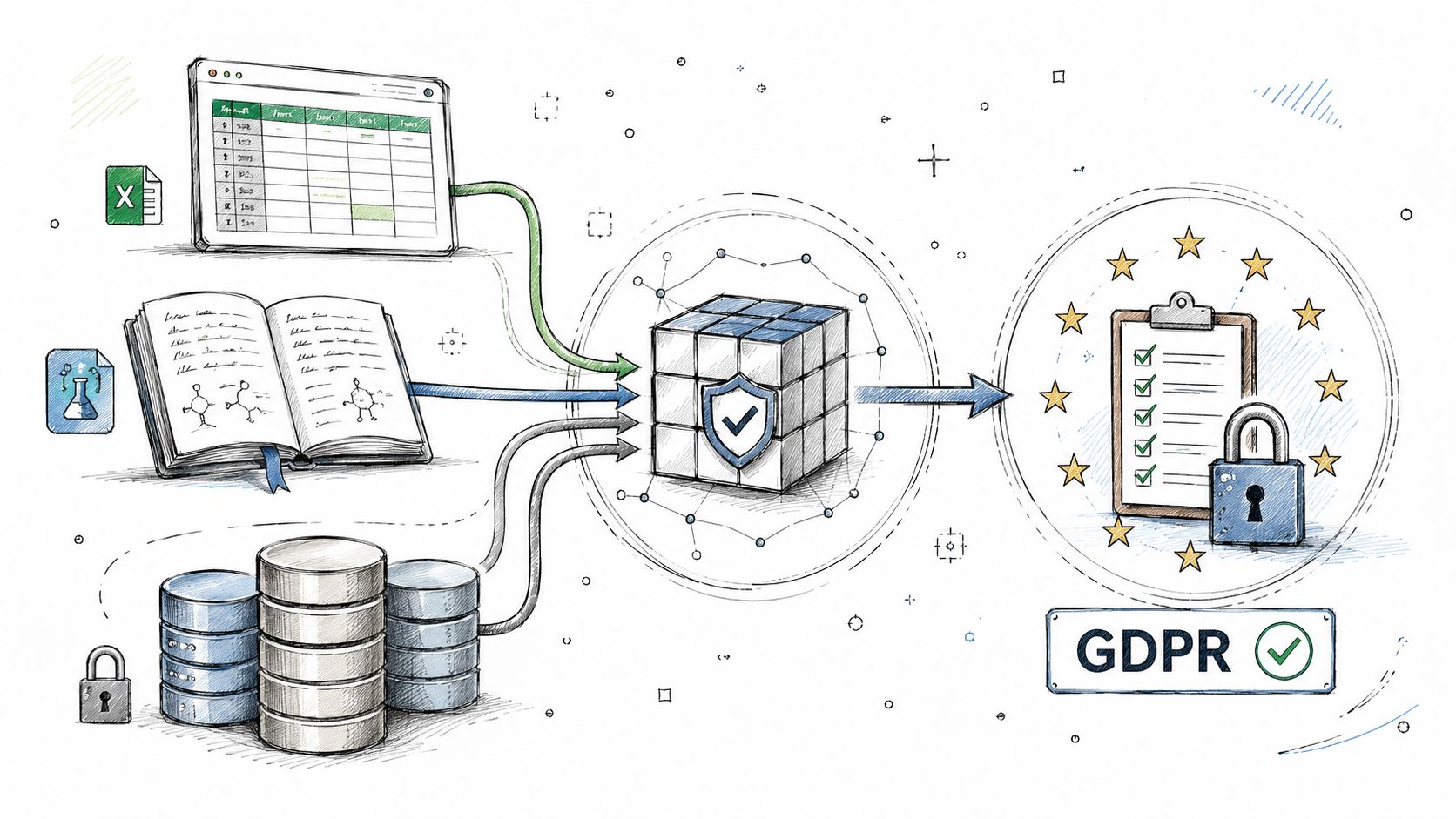
A materials R&D environment rarely has one clean source of truth. Personal data may enter through supplier onboarding, customer testing, recruitment of research participants, laboratory access records, or project collaboration. From there, a scientist might move it from an ELN into a spreadsheet, from a spreadsheet into a formulation database, and from that database into a model-training workspace.
During an audit, each handoff becomes a question. Who approved the transfer? Was the new use compatible with the original purpose? Did the access permissions follow the data? Can the organization find and delete every copy? A policy can't answer those questions by itself. The team needs traceable ownership, data lineage, retention rules, access evidence, and an escalation path.
Why fragmented research workflows create control gaps
A spreadsheet often has no reliable connection to the system where the data originated. An ELN may preserve experimental context but fail to communicate retention or deletion changes to downstream tools. A vendor's AI service may process a file outside the EEA while the R&D team sees only a convenient upload button.
The practical failure is usually not deliberate misuse. It's loss of control during copying, transformation, and reuse. A privacy management program must therefore connect legal decisions to the systems and people that process the data.
That requires a living inventory covering:
- Data sources: Identify spreadsheets, ELNs, formulation databases, shared drives, laboratory instruments, collaboration tools, and external platforms.
- Processing owners: Assign a person or function responsible for each purpose, not merely for each application.
- Lineage and destinations: Record where data came from, where it travels, and which teams or processors receive it.
- Lifecycle controls: Attach retention, access, correction, deletion, and transfer requirements to the relevant records.
- Evidence: Preserve approvals, access reviews, processor assessments, and incident decisions in a retrievable location.
Practical rule: If a control exists only in a policy document and not in a workflow, system setting, or review record, it will be difficult to defend during an audit.
Why a phased program beats a certification exercise
Enforcement has become a sustained compliance environment. The GDPR became applicable on 25 May 2018, and DLA Piper reported cumulative fines of EUR 7.1 billion by January 2026 in the jurisdictions surveyed. CMS's GDPR Enforcement Tracker recorded 2,685 fines with complete information, or 3,062 cases including incomplete records, with total fines of around EUR 6.11 billion as of March 2026. The recorded average fine across 2018–2026 was EUR 2,277,122, according to the same tracker.
Those figures don't mean every R&D mistake leads to a major penalty. They do show why supervisors expect organizations to demonstrate repeatable governance rather than a point-in-time review. One implementation guide estimates that reaching full compliance can take 14-18 months, so a staged program with control testing is more credible than promising instant completion. The secure device disposal rules for 2026 are one example of the broader lifecycle thinking teams need, because retired devices can still hold copies of research and personal data.
Mapping Data Flows and Documenting Lawful Basis
Start with the data map, not the privacy notice. A useful map follows a record from collection through analysis, sharing, retention, and deletion. It should expose the operational reality of research, including manual exports and unofficial working files.
Build an inventory that reflects actual R&D behavior
Create a record for each processing activity rather than each application. “Customer testing program” is a processing activity. The ELN, spreadsheet, survey tool, and external testing partner are systems or recipients within that activity.
For every activity, capture:
- The people represented: Scientists, supplier contacts, customer testers, visitors, or other individuals.
- The fields collected: Names, contact details, identifiers, employment information, test observations, or other personal data.
- The purpose: State the business or research purpose in plain language.
- The systems involved: Include source systems, working files, analysis tools, backups, and vendors.
- The recipients and locations: Record internal teams, processors, subprocessors, and international destinations.
- The retention rule: Tie deletion to a research or business event, not to an indefinite “keep as needed” statement.
- The risk and safeguards: Document access roles, pseudonymization, encryption, review requirements, and transfer controls.
Suppose a scientist copies a customer tester's identifier from an ELN into a shared spreadsheet to compare material performance. The map should show the original collection point, the new spreadsheet, the purpose of the comparison, the people with access, and the process for correcting or deleting the identifier. If the same dataset later supports machine-learning training, that new purpose needs its own assessment. Reusing data isn't automatically prohibited, but the organization must examine purpose limitation, transparency, compatibility, and the relevant lawful basis.
Document the lawful basis per purpose
Do not assign one lawful basis to an entire project. A supplier contact record used to administer a contract may require a different analysis from customer testing data used for optional product research. Consent can be appropriate in some workflows, but it shouldn't become the default because it feels straightforward.
The enforcement pattern supports that priority. The GDPR compliance failure analysis from CSIDE records 797 cases involving insufficient legal basis, representing 28.29% of the listed cases. It also identifies 737 cases involving non-compliance with general principles, or 26.16%, and 523 cases involving weak technical or organizational security measures, or 18.57%.
For each purpose, write a short lawful-basis rationale that answers:
- What specific processing is taking place?
- Why is this basis appropriate?
- Why isn't another basis being used?
- What notice explains the processing to individuals?
- What evidence proves the decision was made before processing began?
- What changes would trigger a reassessment?
Store the rationale beside the processing record and link it to the system workflow. A lawyer's memo that never reaches the product owner or laboratory administrator won't prevent an unlawful export.
The following video can help teams visualize the relationship between data flows, processing decisions, and operational controls:
Implementing Consent Controls and Data Minimization
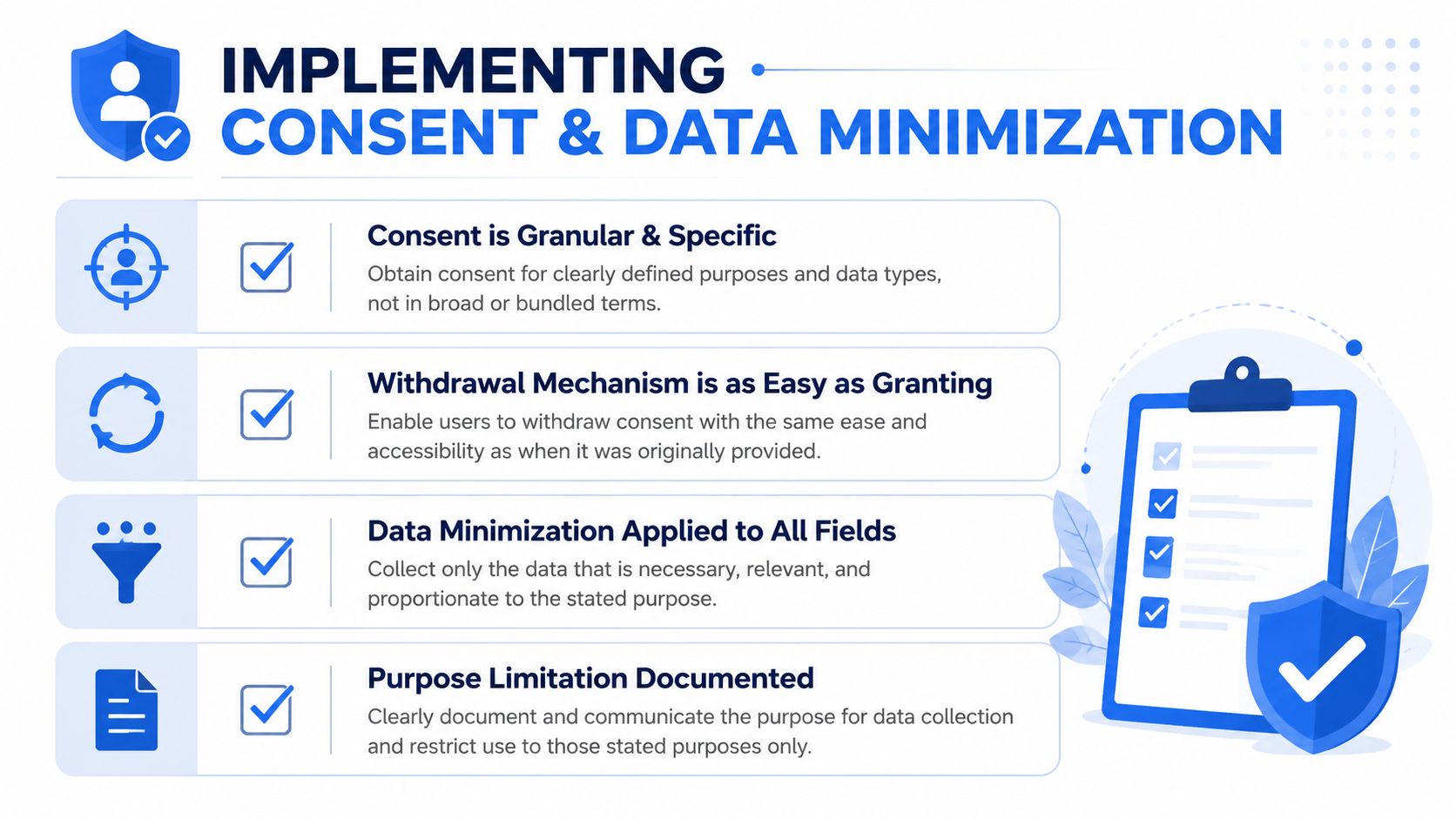
Consent is a control with a lifecycle. It must be specific, informed, granular, freely given, and easy to withdraw. A checkbox captured at registration isn't enough if the organization can't show what the person agreed to, which purpose it covered, when it was collected, and how withdrawal reaches every downstream system.
Design consent around the real use case
For a customer testing program, separate participation in the test from optional uses such as future contact, product feedback, or model development. Present each purpose distinctly, explain the categories of data involved, and record the version of the notice shown at the time.
Withdrawal should trigger an operational event, not just change a field in a consent database. The event needs to reach the testing platform, ELN, analysis workspace, exports, and relevant vendor. If a downstream dataset has been pseudonymized, document how the organization can identify and remove the associated records when required.
Supplier workflows need similar discipline. A business contact may provide details to manage a commercial relationship, but that doesn't automatically authorize unrelated marketing or research profiling. Keep contractual processing separate from optional consent, and make the withdrawal path no harder than the original opt-in. Teams that need a structured intake can build a GDPR data request form for access, correction, or deletion requests, provided the resulting workflow connects to the systems holding the data.
Minimize at collection and at reuse
Data minimization works best before data enters the research environment. Ask whether the team needs a name, or only a study identifier. Ask whether a full address is necessary, or whether a region is sufficient. Avoid collecting fields merely because a form template makes them available.
In practice, use several layers:
- Field-level minimization: Remove optional fields from forms and APIs unless a documented purpose requires them.
- Pseudonymization: Replace direct identifiers with a controlled research key, and keep the re-identification table separate with restricted access.
- Role separation: Let scientists see the information needed for research while limiting identity data to approved administrators.
- Purpose-specific datasets: Create a dataset for the defined analysis instead of granting access to a broad source table.
- Retention triggers: Define deletion or review events tied to the end of a test, contract, project, or approved research purpose.
Pseudonymization reduces exposure, but it doesn't make personal data anonymous if the organization can reconnect the key to an individual. The control remains accountable for access, retention, rights requests, and downstream sharing.
Design test: Remove a field and ask whether the experiment, service, or decision still works. If it does, challenge the reason for collecting it.
Managing Cross-Border Transfers and Vendor Oversight
Cloud R&D platforms and AI services can turn an ordinary collaboration into an international transfer. The difficulty isn't only identifying where a primary vendor is incorporated. Teams must trace support access, subprocessors, backups, telemetry, model-improvement workflows, and administrative operations.
The transfer review should begin with an inventory of every international recipient. Classify each destination by its mechanism, record the contractual documents, and preserve the reasoning behind the decision. Where required, document a transfer-impact assessment and the supplementary safeguards that address the risks identified.
Compare the available mechanisms
| Mechanism | Requirements | Best For | Limitations |
|---|---|---|---|
| Adequacy decision | Confirm that the destination is covered by a current adequacy decision and monitor its status | Transfers where the destination has recognized adequate protection | The decision can change, and it doesn't remove the need for purpose, security, or accountability controls |
| Standard Contractual Clauses | Select the appropriate clauses, complete the parties and processing details, assess the transfer context, and monitor performance | Routine controller or processor transfers without an adequacy decision | Contract language alone may not address practical access risks or complex subprocessor chains |
| Other safeguards | Use an approved alternative mechanism where applicable and document its legal and operational basis | Specialized arrangements that require safeguards beyond standard clauses | The organization must understand the conditions, evidence, and ongoing obligations attached to the mechanism |
Cross-border transfers can carry substantial financial exposure. A compiled breakdown at GDPRfine's violation analysis places the average fine for cross-border transfer violations at EUR 557 million in that breakdown. That figure should prompt careful review, but it isn't a substitute for understanding the facts of each enforcement action.
Treat vendors as part of the control environment
The processor contract should identify permitted purposes, security expectations, confidentiality duties, assistance with rights requests, breach escalation, deletion or return obligations, audit rights, and subprocessor controls. Procurement shouldn't approve a vendor merely because the security questionnaire is complete. The privacy owner needs to know what data the service receives and whether the service can reuse it.
For AI-heavy workflows, ask specific questions:
- Does the provider use submitted data to train or improve a general model?
- Which subprocessors can access prompts, files, logs, or support tickets?
- Where are data and backups stored?
- Can the customer restrict administrative access by region or role?
- How does the provider respond to deletion, correction, and access requests?
- What evidence is available for transfer assessments and security reviews?
Run vendor reviews on a recurring cycle and after material changes. A new subprocessor, model feature, hosting location, or support arrangement should reopen the assessment rather than wait for the next annual procurement review.
The enforcement pattern reinforces this focus. The 2025 GDPR lessons reported by GDPR Register identifies insufficient legal basis and non-compliance with general processing principles as the two most common fine categories, with 669 and 644 fines respectively, while insufficient technical and organizational measures accounted for 418 fines. The same source reports that 82% of companies in 2025 cited uncertainty about exact data protection requirements as a challenge. Clear vendor ownership and documented decisions help turn that uncertainty into a manageable review process.
Building a Breach Response Workflow That Meets the 72-Hour Clock
A breach response plan fails when it starts with “contact legal” and stops there. In a fragmented R&D environment, the first signal may come from an ELN administrator, a laboratory manager, a vendor, or a scientist who notices that a shared file has the wrong permissions.
The UK Information Commissioner's Office says a notifiable personal data breach must be reported without undue delay and no later than 72 hours after the organization becomes aware of it. The ICO's personal data breach guidance provides the relevant regulatory context. The organization needs a process that starts before the legal team has every fact.
Use a clock-based escalation model
The following matrix gives each role a defined responsibility:
| Stage | Primary owner | Required action |
|---|---|---|
| Initial detection | Any employee or service owner | Preserve evidence, report through the incident channel, and avoid altering affected records |
| Containment | Security and system owner | Restrict access, suspend exposed credentials, isolate affected files or integrations, and preserve logs |
| Impact assessment | Privacy lead, security, and R&D owner | Identify the data, individuals, systems, recipients, jurisdictions, and likely consequences |
| Notification decision | Controller representative and DPO or privacy counsel | Decide whether the breach is notifiable, document the reasoning, and prepare the submission |
| Remediation | Control owners | Correct the weakness, communicate actions, and track residual risk |
| Review | Governance team | Record lessons, update controls, and test whether the fix works |
During the first stage, responders should establish when the organization became aware of the incident. That timestamp drives the statutory clock. They should also preserve access logs, file versions, vendor notifications, screenshots, and communications, while restricting informal discussion that could contaminate the evidence trail.
Prepare the evidence before an incident
Maintain notification templates with fields for the nature of the breach, affected data categories, likely consequences, containment measures, and contact details. Keep a current list of system owners, processors, subprocessors, the DPO or privacy lead, security contacts, and decision-makers who can approve notification.
The initial assessment should answer practical questions quickly:
- Was personal data involved, or only confidential non-personal research data?
- Which individuals and categories of data were affected?
- Was the data accessed, disclosed, altered, lost, or merely exposed?
- Are copies still accessible in spreadsheets, backups, exports, or vendor systems?
- Which safeguards reduce the risk?
- What actions can stop further exposure immediately?
Test the workflow with scenarios that resemble laboratory work, such as a shared formulation file containing supplier contacts or a compromised vendor account with access to customer test records. A tabletop exercise exposes unclear ownership much earlier than a real incident will.
Continuous Monitoring and Audit Evidence
A defensible GDPR program generates evidence during routine R&D work. Approving a new supplier should update the processing record. A role change should trigger an access review. A vendor's subprocessor change should prompt a transfer assessment. A reported disclosure should open an incident record.
Connect these events in one operating cadence. Otherwise, spreadsheets, ELNs, vendor portals, and shared folders create separate versions of the truth.
Create a quarterly control rhythm
Use a repeatable agenda for each quarterly review:
- Processing inventory: Confirm that new projects, tools, vendors, and datasets are recorded.
- Lawful-basis decisions: Recheck changed purposes, including secondary analytics and model training.
- Access controls: Compare role-based permissions with current R&D responsibilities and remove unnecessary access.
- Retention: Find records that reached a review or deletion trigger, then verify that downstream copies were addressed.
- Vendor oversight: Check contracts, subprocessors, transfer mechanisms, incidents, and material service changes.
- Rights workflows: Test intake, identity verification, search, correction, deletion, response, and evidence preservation.
- Incident readiness: Review open risks, contact lists, templates, and tabletop exercise results.
- Training: Record completed training and target teams with recurring data-handling risks.
This cadence responds to the weaknesses identified in UK benchmark findings on privacy management gaps, including gaps in privacy by design, governance, data handling, accountability, staff training, and privacy management. Fragmented R&D systems make informal handling easy and formal evidence difficult, so the review must test how controls operate across systems, not only whether policies exist.
Make audit evidence usable
An independent reviewer should be able to reconstruct a decision without relying on someone's memory. Store approval records, data maps, lawful-basis assessments, DPIA decisions, access reviews, vendor assessments, training records, rights-request logs, retention actions, and incident timelines with named owners, dates, and version history.
Require the same evidence from project delivery. Before a new formulation workspace or AI feature goes live, record the personal data required, the purpose, permitted roles, processing locations, deletion method, and response if an individual exercises a right. These fields expose missing decisions before the system becomes embedded in laboratory work.
Tools support this process, but automation cannot repair an undefined control. A materials R&D platform such as Polymerize can centralize experimental data from spreadsheets, ELNs, and other silos while supporting role-based access and a controlled data backbone. The governance team still must define purposes, retention rules, lawful bases, vendor conditions, and review ownership.
The practical answer to GDPR compliance is operational: map the data, assign the decision, enforce the control, test it regularly, and retain evidence that the control worked. This gives R&D leaders a repeatable way to protect personal data while accommodating fragmented research workflows.
If your materials R&D data is spread across spreadsheets, ELNs, and disconnected systems, visit Polymerize to see how its centralized data backbone and role-based controls can support a more auditable research environment. Use the platform assessment to identify where data lineage, access governance, and GDPR evidence can fit into your existing R&D workflows.
Put your R&D data to work
See how materials teams use Polymerize to plan fewer experiments and reach target properties faster.