

Most advice on how to achieve ISO 27001 certification starts with policies. That's the wrong starting point. Auditors don't certify a folder of documents. They assess whether your information security management system, or ISMS, identifies material risks, assigns accountability, operates controls consistently, and produces trustworthy evidence when someone tests it.
That distinction matters even more in materials R&D. A laboratory may have proprietary formulations in an electronic lab notebook, experimental records in spreadsheets, simulation outputs in cloud storage, and contractor access to shared instruments. A policy can describe the intended state while daily work follows a different path. Certification succeeds when those two realities match.
The practical roadmap is straightforward, but it isn't easy: define a defensible scope, assess risk consistently, select controls you can justify, operationalize them, test the ISMS internally, and maintain evidence after the certificate is issued. The current standard, ISO/IEC 27001:2022, was published on 25 October 2022, and its Annex A structure contains 93 controls, including 11 new controls. ISO's official ISO/IEC 27001 page explains the standard and its current version.
Table of Contents
What ISO 27001 Certification Requires
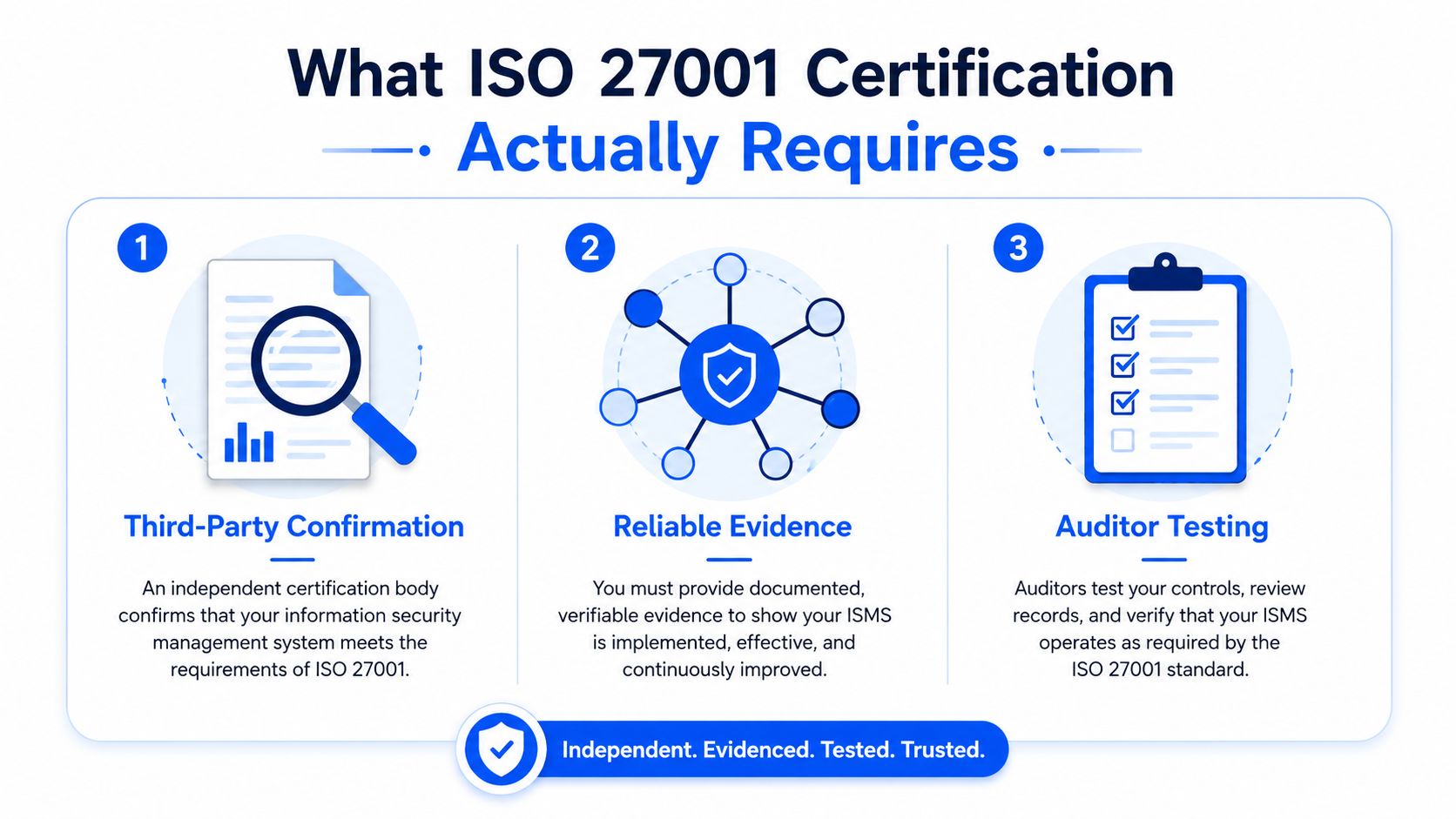
ISO 27001 certification confirms through an independent audit that your ISMS operates as a management system. Auditors test whether leadership owns the system, risk decisions guide control selection, and employees can demonstrate repeatable operation. They do not certify the disappearance of every security risk.
The implementation target is an evidence-producing operating system for information security. Your program must withstand external sampling, employee interviews, management review, corrective actions, and recurring surveillance. A complete-looking binder is useless if lab staff cannot show how controls operate in daily work. ISO's survey shows certification is established across industries and countries, not limited to IT organizations. ISO's standard overview provides the relevant background.
The four deliverables auditors expect
Four outputs anchor the certification program:
- ISMS scope: Define the locations, people, processes, systems, services, interfaces, and exclusions covered by the ISMS.
- Risk assessment: Show how the organization identifies, analyzes, and evaluates information-security risks through a consistent method.
- Statement of Applicability: Explain which Annex A controls apply, which do not, why each decision was made, and how implementation is progressing.
- Internal audit results: Demonstrate that the organization tested its ISMS and addressed the issues it found.
Clauses 4 through 10 require close attention. They establish organizational context, leadership, planning, support, operation, performance evaluation, and improvement. Annex A controls support the system, but a polished control matrix cannot compensate for weak leadership evidence, inconsistent risk assessment, missing objectives, or an internal audit that avoids operational reality.
Practical rule: If a control appears in your Statement of Applicability but no owner can produce current evidence, treat it as an implementation gap, not a writing problem.
Materials R&D organizations need a sharper evidence model than a typical SaaS company. Auditors may examine shared test rigs, physical research areas, visiting researchers, external testing partners, proprietary formulations, sample custody, and contractor access. Evidence should connect the risk decision, assigned owner, control activity, review record, and corrective action. That chain proves control over a defined business environment and exposes gaps hidden by generic policies.
Defining Scope and Running the Initial Gap Analysis
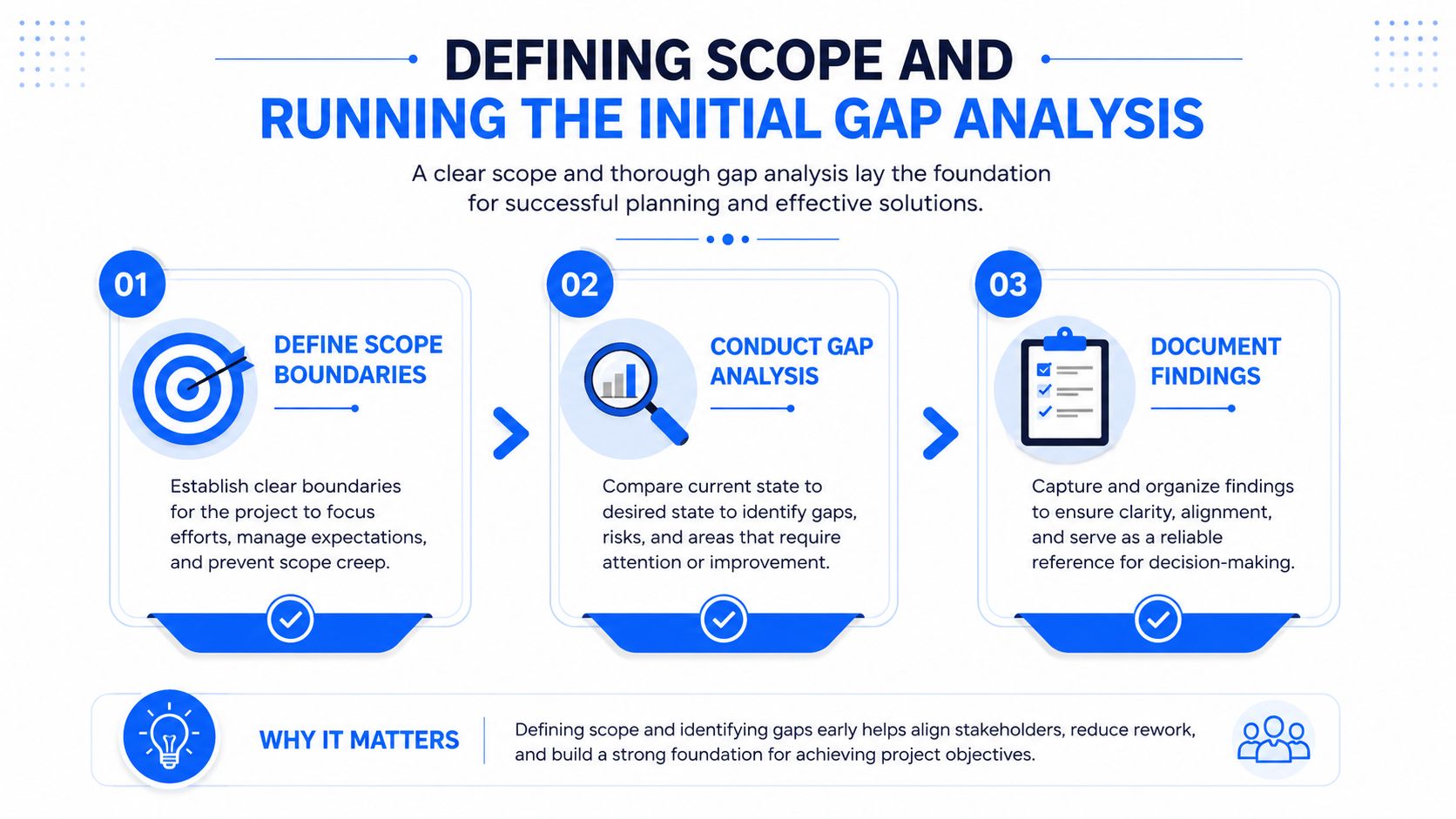
Define scope by mapping every system, site, process, and organizational unit the ISMS must cover before testing begins. A boundary that is too broad creates obligations the team cannot operate consistently. A boundary that is too narrow can leave out laboratory data, people, or suppliers that customers expect the certificate to cover.
Start with a named business unit, laboratory, product line, or service. Document the interfaces that affect security across that boundary. In a materials R&D environment, identify the lab site, formulation databases, electronic lab notebooks, instrument systems, identity provider, collaboration tools, cloud storage, data processors, and support teams. The certificate should describe the environment where information is created, handled, stored, and shared.
Build the evidence base before scoring
Do not begin with a workshop based on memory. Gather operational inputs first:
- Asset inventory: Include lab instruments, LIMS platforms, ELNs, formulation repositories, simulation environments, shared drives, notebooks, backups, and physical records.
- Process maps: Trace work from sample intake through experimentation, analysis, approval, storage, collaboration, and release.
- People inventory: Include employees, visiting researchers, interns, contractors, service engineers, and administrators with privileged access.
- Dependency register: Record suppliers, cloud platforms, instrument vendors, external testing laboratories, and other third parties handling in-scope information.
- Interested-party register: Capture customer, regulator, partner, employee, and contractual requirements that affect the ISMS.
Run the gap analysis against clauses 4 through 10 and each Annex A control that might apply. Test the operating environment, not only the policy set. Physical access, supplier assurance, awareness, records management, and business continuity can affect a laboratory scope even when IT or facilities owns the activity.
Make exclusions defensible
A good Scope Statement names the included sites, systems, services, processes, and organizational units. It explains exclusions and dependencies in language an auditor can challenge. “Corporate IT is excluded” fails if corporate IT supplies identity management, endpoint protection, backups, or incident response to the laboratory.
Create a clause-level heat map, then connect every rating to an artifact, an accountable owner, and a remediation action. A red item without an owner is only a warning. A green item without sampled evidence creates false assurance.
Certification is familiar to customers and procurement teams. The ISO Survey 2021 recorded 58,687 valid ISO 27001 certificates covering 99,755 sites worldwide, while industry analysis of ISO Survey 2024 figures reported 96,709 valid certificates covering 179,877 sites. The published ISO Survey 2021 document provides the historical comparison. Weak scope logic will attract scrutiny, so settle boundaries and dependencies before the audit starts.
Building the Risk Assessment and Selecting Controls
Use one risk methodology and apply it without exceptions. ISO 27005, NIST SP 800-30, or a documented hybrid can work. The failure comes from changing definitions between departments, scoring only IT threats, or allowing owners to describe risk in vague language.
Score confidentiality, integrity, and availability separately. Define the likelihood and consequence scales before workshops begin, then calculate inherent risk using the approved method. The risk register should identify the asset, threat, vulnerability, business impact, existing safeguards, risk owner, treatment decision, target date, and residual-risk position.
DNV's audit study found 78% of organizations had at least one finding, 40% had at least one severe finding, and 27% failed the risk-assessment requirement, often because the method was inconsistent or too narrow. DNV's audit study is a useful warning for R&D teams that focus on network security while overlooking intellectual-property leakage, physical access, supplier exposure, and experimental-record integrity.
Force a real treatment decision
Every material risk needs a clear decision:
- Avoid: Stop the activity or remove the information exposure.
- Transfer: Use insurance, contractual allocation, or a supplier arrangement, while recognizing that transfer doesn't eliminate accountability.
- Modify: Implement controls that reduce likelihood or consequence.
- Accept: Obtain explicit approval from an authorized executive, with an expiry or review condition.
Don't assign risk ownership to “R&D” or “the security team.” Name the person who can authorize treatment, fund remediation, or accept the remaining exposure.
For laboratory programs, prioritize the controls that protect proprietary data, supplier information, and instrument reliability. Relevant examples include access control, information deletion, data leakage prevention, supplier relationships, cryptography, and ICT readiness. Threat modeling can strengthen the connection between product or research risks and compliance requirements. DevArmor's threat modeling compliance guide offers useful context for making that connection explicit.
Make the Statement of Applicability the control decision record
The Statement of Applicability should address all 93 Annex A controls, with inclusion or exclusion, justification, implementation status, and links to evidence. It isn't a decorative appendix. Auditors use it to understand whether your control set follows from the risk assessment and whether the documented ISMS matches operational reality.
| Treatment Option | Decision Owner | Evidence Required at Audit | Common R&D Example |
|---|---|---|---|
| Avoid | Process or business owner | Approved decision, retired process record, scope update | Discontinue external sharing of an unapproved formulation dataset |
| Transfer | Executive owner and procurement | Contract clauses, supplier assessment, insurance or service terms | Allocate defined security obligations to an external testing provider |
| Modify | Control owner | Implementation record, operating procedure, test results, monitoring records | Apply least-privilege access and review permissions for an ELN |
| Accept | Executive risk owner | Signed acceptance, rationale, expiry or review condition | Accept residual exposure from a legacy instrument that can't support modern authentication |
Operationalizing Controls, Documentation, and Evidence
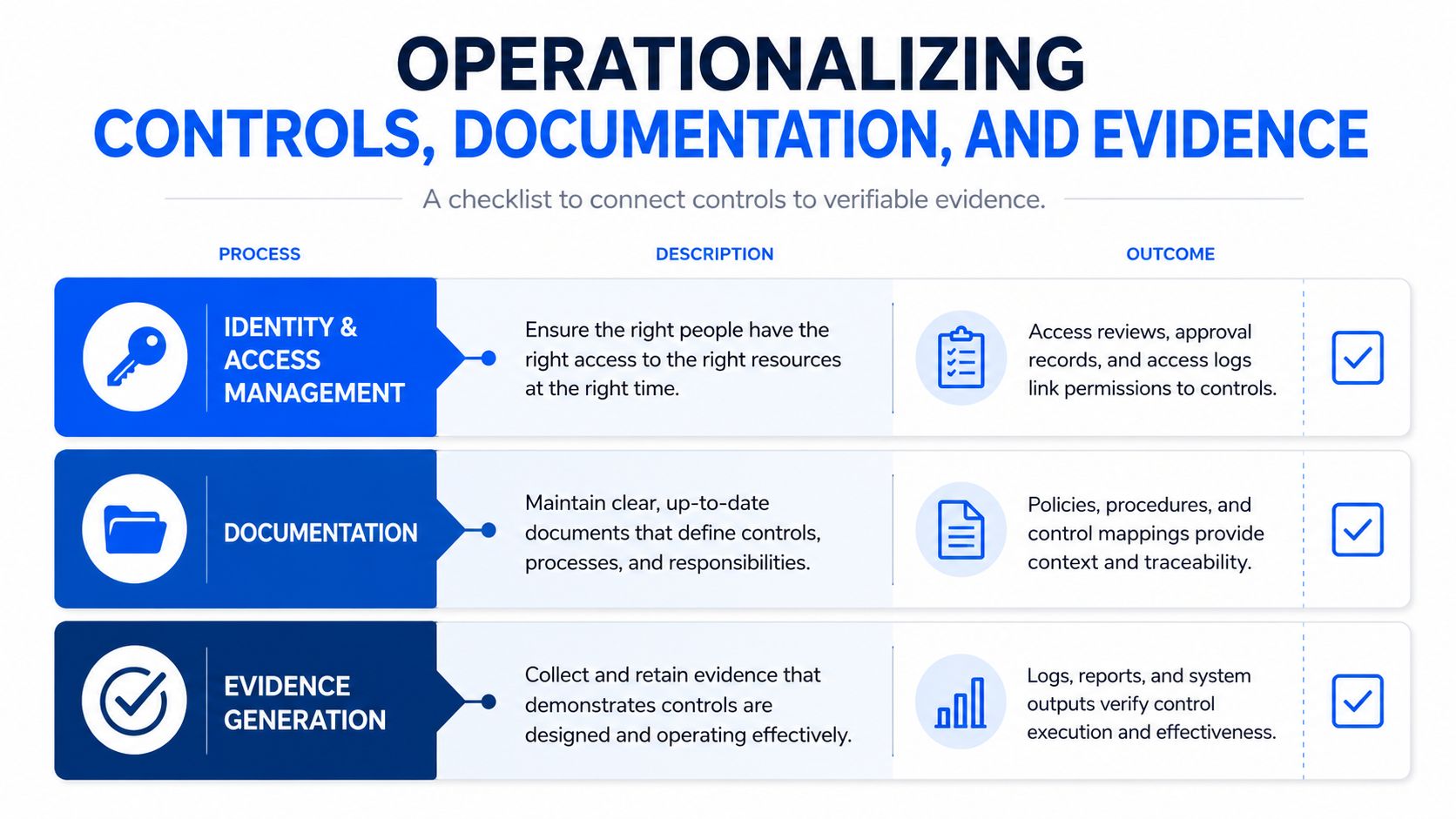
The most common operational failures involve access restriction, awareness and training, and information classification. A policy can require least privilege, but the auditor will ask who approved access, when it was reviewed, what changed after a transfer, and whether departing contractors were removed promptly. The same principle applies to training and classification. Intent isn't evidence.
Connect each control to a repeatable workflow
For identity and access management, define joiner, mover, and leaver workflows. Enforce MFA on systems containing research data, place privileged credentials in an approved vault, and require business owners to recertify access. Include physical access to laboratories and instrument rooms, not just application permissions.
Training should reflect job risk. Researchers who handle proprietary datasets need role-relevant instruction, while administrators and facilities personnel need different scenarios. Keep completion records, competence evidence, awareness acknowledgments, and follow-up actions where people miss required training.
Classification must cover the actual information researchers create:
- Lab notebooks and experimental records: Define handling, sharing, retention, and approval expectations.
- Simulation outputs and formulation data: Mark sensitivity and restrict collaboration spaces accordingly.
- LIMS and instrument records: Protect integrity, preserve traceability, and control export.
- Third-party SaaS data: Record supplier ownership, permitted use, retention, and deletion requirements.
Build a document hierarchy from policy to standard, procedure, work instruction, and record. Control versions, approvals, review dates, and superseded copies. Where integrity matters, use a controlled repository and cryptographic hashes or equivalent change-detection mechanisms for critical records.
Run a 90-day operationalization cycle
Days 1 to 30 should establish ownership. Approve the policy set, assign control owners, confirm the asset inventory, configure access workflows, and define evidence locations.
Days 31 to 60 should create operating history. Capture access approvals and reviews, training completion, change tickets, supplier reviews, incidents, backup tests, and exception decisions.
Days 61 to 90 should test whether the system works. Sample records, interview researchers, verify leaver access removal, inspect classification in active workspaces, and run a first internal verification. Correct the process, not just the individual record.
Auditors often find the gap in unmanaged JupyterHub instances, unapproved cloud notebooks, personal storage, shared credentials, or instrument workstations that bypass central controls. Include those systems in discovery and either bring them under governance or justify their exclusion with evidence.
Evidence standard: A control is operational only when a named owner can show what happened, who approved it, when it happened, and how exceptions were handled.
Choosing a Certification Body and Surviving the Audit
Treat the certification body as an audit partner, not a booking option. Choose an accredited CB based on audit credibility, technical fit, and the quality of its findings. Compare accreditation through bodies such as ANAB, UKAS, or DakkS, then verify experience with manufacturing, laboratory environments, intellectual property, cloud services, and multi-site scopes.
Stage 1 determines whether the ISMS is ready for detailed testing. Auditors review the scope, organizational context, policies, risk methodology, Statement of Applicability, objectives, and evidence that the organization understands its obligations. Stage 2 tests implementation and effectiveness through sampling, interviews, observation, and record review. For an R&D organization, the audit should examine the operating system for evidence across lab data, IP, instruments, collaboration platforms, and third-party tools.
Compare certification bodies deliberately
| Criterion | What to Evaluate | Why It Matters for R&D |
|---|---|---|
| Accreditation | Current accreditation and certificate recognition in target markets | Procurement teams may scrutinize the certificate's market acceptance |
| Sector experience | Auditor background in laboratories, manufacturing, IP, and cloud systems | The auditor will understand instrument, formulation, and collaboration risks |
| Auditor continuity | Tenure, availability, and continuity across audit stages | Consistent context reduces repeated explanations and missed dependencies |
| Geographic coverage | Ability to cover sites, countries, and remote operations | Distributed research teams create scope and sampling complexity |
| Audit approach | Sampling depth, interview style, and reporting quality | A rigorous but practical audit produces findings the team can act on |
| Commercial terms | Audit days, travel, surveillance, and recertification conditions | The lowest initial quote may not reflect the full certification cycle |
Ask the CB how it samples decentralized evidence. A lab may store experimental data in an ELN, analytical results on instrument workstations, formulations in restricted project spaces, and supplier records in separate systems. If the auditor cannot examine these dependencies, the audit may miss the actual exposure. If the audit team examines them closely, owners must show current evidence rather than explain intended processes.
Expect questions about physical security, confidential project segregation, backup restoration, supplier due diligence for ELNs and modeling tools, incident response rehearsals, and access recertification. Researchers should explain how they classify data, report incidents, request access, handle removable media, and respond when a collaborator needs information.
Use a four-week Stage 2 cadence
- Week one, refresh: Update scope, risk register, Statement of Applicability, policies, asset inventory, and management approvals.
- Week two, rehearse: Walk through the laboratory, sample active projects, test access workflows, and interview control owners.
- Week three, verify: Reperform access reviews, sample training records, inspect supplier files, test backup restoration evidence, and close corrective actions.
- Week four, brief: Coach front-line staff to answer from practice, not memorized policy language. Confirm evidence locations and daily audit contacts.
Auditors do not expect researchers to recite the standard. They expect answers to match records. If a scientist says access is reviewed regularly, the owner must produce the review, identify the approver, and explain any exception. A missing record is an operational failure, even when the policy is well written.
Common Pitfalls and How to Recover From Them
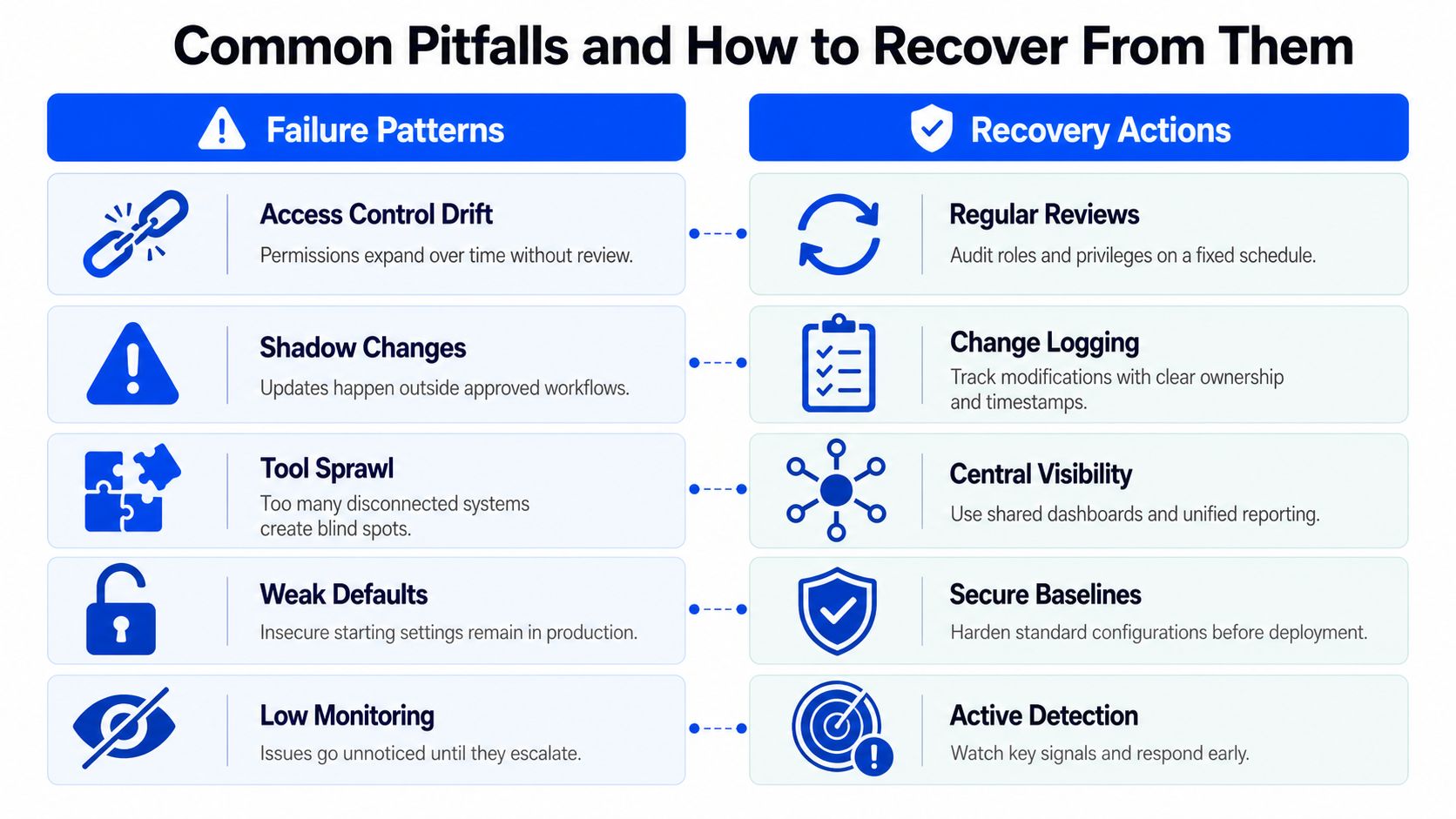
Certification programs usually break where the ISMS diverges from daily research work. DNV's audit findings reinforce this point, particularly around inconsistent or narrow risk assessment methods. The DNV findings analysis should be treated as a preparation benchmark, not as a reason to add paperwork.
Four failure patterns auditors recognize
Research collaboration risks are missing. The risk register covers malware and outages but ignores a collaborator exporting a formulation dataset. Assign an R&D risk owner, model the collaboration path, decide treatment, and retain approval and verification evidence.
Access drifts as people cycle through the lab. Interns, contractors, and visiting researchers keep permissions after projects end. Reconcile HR, facilities, identity, and application records, remove excess access, and test the workflow with a later sample.
The Statement of Applicability contradicts reality. It says a control is implemented, while staff use an unapproved notebook or shared drive. Update either the operation or the SoA, then link the decision to a current record.
The internal audit becomes compliance theater. The auditor checks document existence but never interviews researchers or samples records. Use independent auditors, test actual transactions, record nonconformities, identify root causes, and require management review of closure.
Triage findings by consequence
| Finding Severity | Remediation SLA | Required Response |
|---|---|---|
| Critical exposure or systemic failure | Immediate executive triage | Contain exposure, assign executive owner, document corrective action and verification |
| Major nonconformity | Prioritized before certification decision | Perform root-cause analysis, implement corrective action, and provide objective evidence |
| Minor nonconformity | Scheduled corrective action | Name owner and deadline, correct the record or process, and verify effectiveness |
| Opportunity for improvement | Risk-based planning | Decide whether to act, document rationale, and monitor through management review |
An internal audit should challenge scope, risk scoring, control operation, evidence quality, supplier dependencies, physical security, and management accountability. Auditors usually ignore harmless formatting preferences. They escalate missing evidence, uncontrolled access, unsupported risk acceptance, repeated exceptions, and a pattern of staff behavior that conflicts with documented controls.
Maintaining Certification Through Continual Improvement
Certification remains valid only when the ISMS continues to operate after the initial audit. Organizations typically undergo annual surveillance audits and recertification on a three-year cycle. Preserve current records, decisions, and evidence throughout that period. For a materials R&D organization, this means retaining defensible proof that laboratory data, intellectual property, instruments, ELNs, cloud services, and third-party tools remain governed as the environment changes.
Management review should address changes in risk and context, audit findings, incidents, control performance, supplier issues, objectives, resources, and improvement decisions. Use indicators such as control effectiveness, remediation time, training completion, asset-inventory drift, and supplier risk. Keep the review practical. Executives need to see where the ISMS is weakening, which exposure requires a decision, and whether assigned actions worked.
| Activity | Frequency | Owner |
|---|---|---|
| Risk and context review | Scheduled recurring review and after material change | ISMS manager and risk owners |
| Access recertification | Defined recurring cycle and after role changes | Application owners and HR |
| Internal audit | Planned audit program | Independent internal auditor |
| Statement of Applicability refresh | After risk, scope, or control changes | ISMS manager |
| Supplier review | Risk-based recurring review | Procurement and supplier owners |
| Management review | Formal recurring governance meeting | Executive sponsor |
| Board or executive reporting | Agreed reporting cadence | CISO or ISMS leader |
Apply change control when the laboratory adds a site, acquires a business, adopts a new ELN, moves data to another cloud service, or changes an instrument workflow. Reassess scope, dependencies, risks, controls, and evidence before the new process becomes routine. Update the operation or the Statement of Applicability, then connect the decision to a current record. This keeps the certificate aligned with the actual operating environment.
The implementation timeline depends on scope and organizational maturity. An adoption survey found 60% of organizations completed implementation within 12 months, 20% achieved certification in under 6 months, and 93% were certified within two years. It also reported average certification fees of around Stg £4,800 across Europe, North America, and Japan. The ISO 27001 adoption survey provides planning benchmarks, not promises. Internal labor, remediation, evidence production, and surveillance determine the actual burden.
Polymerize provides a centralized environment for materials R&D data, consolidating information from spreadsheets, ELNs, and other silos with role-based access and stated ISO 27001 and SOC 2 controls. Visit Polymerize to assess its fit for laboratory evidence, access, and intellectual-property protection requirements.
Put your R&D data to work
See how materials teams use Polymerize to plan fewer experiments and reach target properties faster.