
A lot of materials R&D teams are in the same spot right now. Experimental data lives in instrument exports, old spreadsheet folders, ELNs that don't quite match each other, and a few critical notes that only one scientist knows how to interpret. When a team tries to compare last quarter's polymer runs with this month's formulation changes, they spend more time reconciling records than learning from them.
That becomes painful the moment AI enters the conversation. A model can only learn from data that's traceable, consistent, and trustworthy. If no one can answer basic questions like which version of a recipe was used, who changed a measurement, or whether a result came from a validated instrument workflow, the model sits on a weak foundation.
Enterprise data governance is what turns that situation around. In materials R&D, it isn't a bureaucratic layer added on top of science. It's the operating discipline that makes experimental data usable across labs, teams, and digital systems.
Table of Contents
- The technology stack that supports governance
- Metrics that actually help teams manage
- Compliance in experimental environments
- Example one from disconnected records to a usable catalog
- Example two validation rules at the point of capture
- Example three building an AI ready backbone
Introduction and Importance
In a polymer lab, data chaos rarely looks dramatic. It looks ordinary. A scientist exports tensile test results to a spreadsheet. Another logs synthesis conditions in an ELN. A third person updates a formulation table on a shared drive without marking the version clearly. Weeks later, the team tries to connect processing conditions to final material performance and realizes the records don't line up.
That's where enterprise data governance starts to matter. It gives teams a shared way to define, capture, protect, and use data so people aren't guessing which result is current or whether a dataset can support modeling. Without it, researchers lose hours checking provenance, rebuilding context, and debating whose file is right.
The urgency is no longer theoretical. The global enterprise data governance market grew from USD 3.5 billion to USD 5.29 billion in the early 2020s, with 61% of enterprises adopting formal frameworks, according to Gitnux data governance statistics. In plain terms, many organizations now treat governance as a core business capability, not a side project.
Practical rule: If your scientists must manually explain where a dataset came from every time someone wants to use it, governance is too weak.
For materials R&D teams, the payoff is straightforward. Better governance means cleaner experimental history, more reliable handoffs between labs and process teams, and a stronger base for AI-guided discovery.
Defining Enterprise Data Governance and Core Concepts
Enterprise data governance is the system a company uses to decide how data is defined, handled, checked, shared, and protected. In a materials organization, that includes experimental runs, formulation tables, spectral data, instrument metadata, ELN records, sample genealogy, and the rules that connect them.
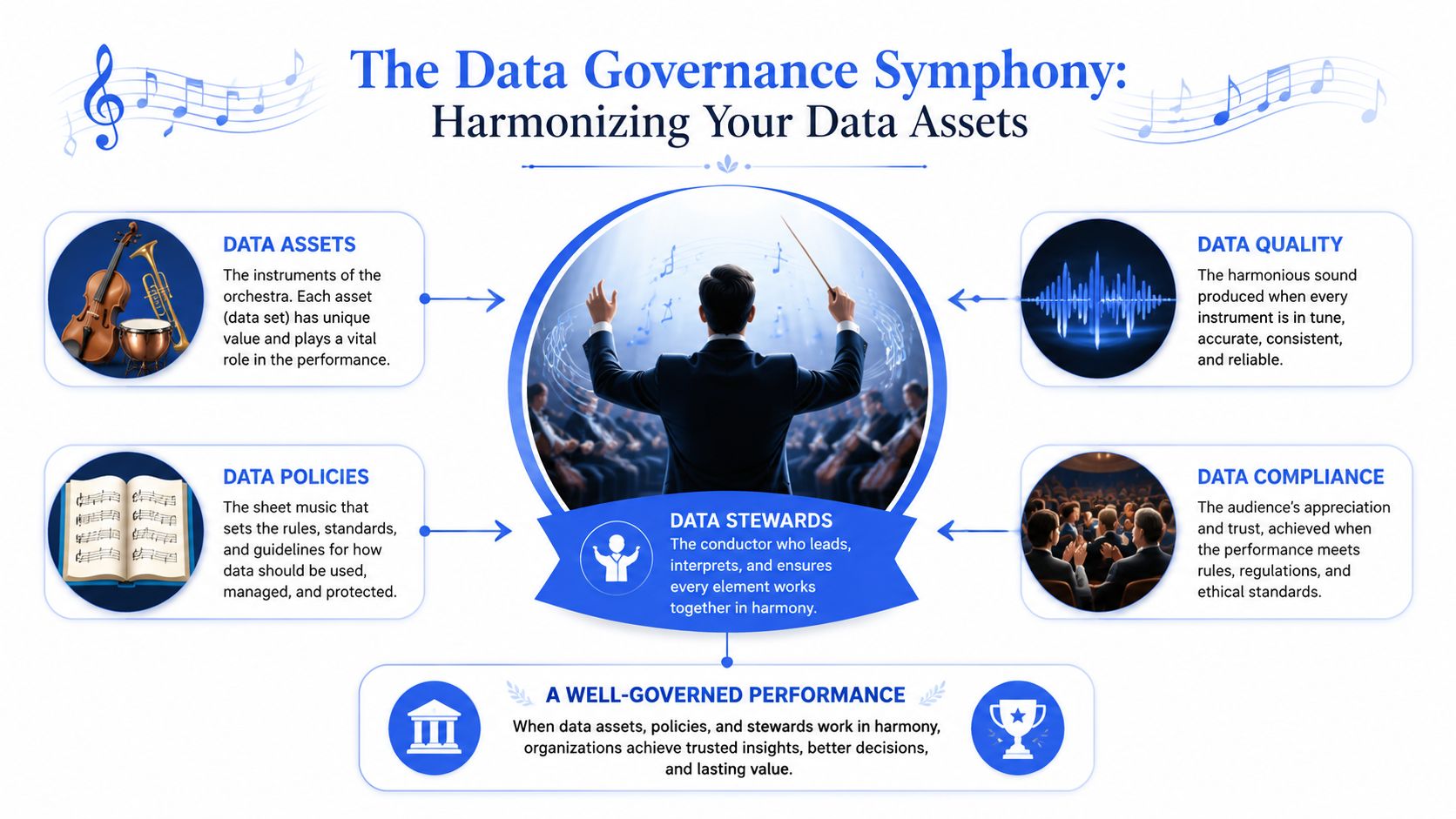
A simple analogy helps. Think of your data environment as an orchestra. Each dataset is an instrument. Policies are the sheet music. Stewards act like conductors who keep everyone in time. Quality is the sound the audience hears. If one section plays from a different score, the whole performance suffers.
Why governance matters beyond IT
Many scientists hear “governance” and think of permissions, audits, and compliance forms. Those matter, but they're only part of the picture. Governance also answers the practical lab questions that block progress:
- What does this field mean: Does “viscosity” refer to a single test condition, or several?
- Which record is authoritative: The spreadsheet, the ELN entry, or the instrument export?
- Can this result be reused: Was it captured under a method the team accepts?
- Who can change it: Can a scientist edit a released formulation table after scale-up review?
In that sense, governance is closely related to broader information management. If you're thinking about how content, records, and operational data support digital platforms across the business, EIM for DXP success is a useful companion perspective.
This short explainer helps frame the topic visually before going deeper.
The core building blocks
A workable governance model usually rests on a few core concepts.
| Concept | Plain meaning in materials R&D | Example |
|---|---|---|
| Data asset | Any information worth managing | A formulation dataset, DSC output, or sample history |
| Metadata | Data that describes other data | Unit, method, instrument ID, operator, version |
| Lineage | The history of where data came from and how it changed | Raw instrument file to processed dataset to model input |
| Stewardship | Named responsibility for keeping data usable | A scientist or manager responsible for a formulation domain |
| Policy | A rule for how data must be handled | Required fields before an experiment is marked complete |
When readers get confused here, it's often because “data quality” and “data governance” sound interchangeable. They aren't. Data quality is the condition of the data. Governance is the management system that keeps quality from drifting.
A lab can clean one spreadsheet by hand. It can't scale trust across hundreds of experiments without governance.
Principles and Governance Frameworks
Strong enterprise data governance doesn't begin with software. It begins with principles that people can apply consistently in real work. In materials R&D, those principles need to hold up under pressure when timelines are tight, experiments are iterative, and records change often.
Four principles that hold up the system
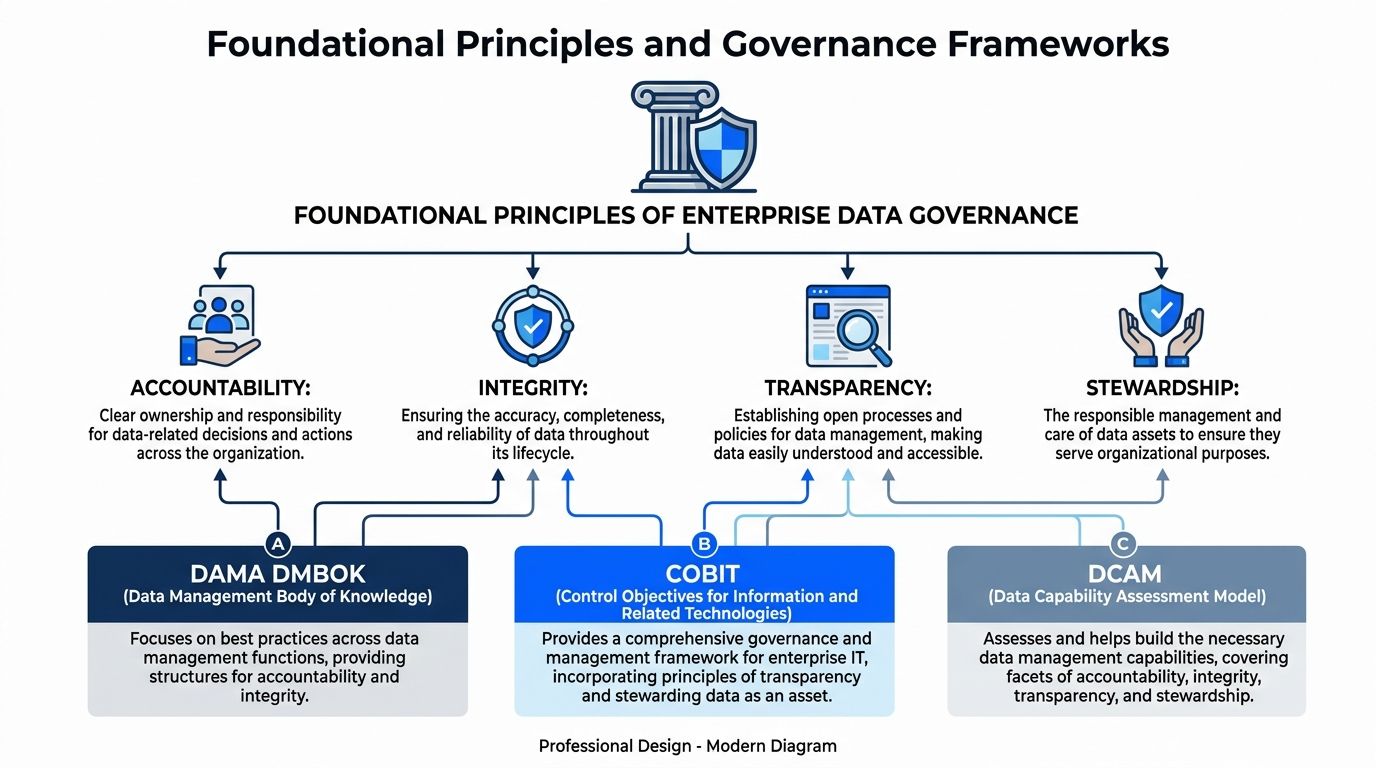
Accountability means someone is clearly responsible for a data domain. In a formulation lab, that might be the person who owns the approved recipe structure, field definitions, and release workflow. If ownership is vague, disputes stay unresolved.
Integrity means the record remains accurate and dependable as it moves through the workflow. A version-controlled formulation table is a good example. Scientists can update working drafts, but released versions stay protected and traceable.
Transparency means people can understand how a result was created, transformed, and approved. When a model predicts a target property, the team should be able to trace the experimental inputs, preprocessing steps, and method context behind that prediction.
Stewardship means governance isn't abstract. Real people maintain standards, fix issues, and coach others. In many labs, this role works best when it's embedded close to the science rather than isolated in a central office.
How common frameworks help
Frameworks such as DAMA DMBOK, COBIT, and DCAM give teams a structure so they don't build governance from scratch. Each helps in a different way.
- DAMA DMBOK is useful when the organization wants broad coverage across data quality, metadata, architecture, and stewardship.
- COBIT helps when governance needs strong alignment with enterprise controls, risk management, and IT oversight.
- DCAM is helpful when leaders want to assess maturity, identify gaps, and prioritize improvements.
For a materials organization, the best choice usually isn't strict adherence to one framework. It's selective adaptation. A central team may borrow DAMA language for stewardship, use COBIT-style control thinking for regulated data, and apply DCAM concepts to track maturity across labs.
A simple way to compare them is this:
| Framework | Best use in R&D | Watch out for |
|---|---|---|
| DAMA DMBOK | Building a broad common vocabulary | Teams may over-document too early |
| COBIT | Aligning governance with enterprise risk and controls | Can feel too IT-heavy if translated poorly |
| DCAM | Assessing capability and planning maturity | Needs practical lab examples to feel relevant |
Teams often stumble when they adopt a framework as if it were a finished operating model. It isn't. A framework is more like a scaffold. Your lab methods, data types, review gates, and collaboration habits still need to be designed.
Use frameworks to shorten design work, not to replace thinking.
Mapping Roles and Processes for Effective Governance
Once principles are clear, people need to know who does what. That's where many governance efforts either become practical or fade into a slide deck. In a materials environment, roles have to fit the flow of experimental work, not sit beside it.
Who owns what in a lab environment
A useful governance structure usually includes four groups.
Data owners make decisions about a defined data domain. In a coatings team, a data owner may decide which formulation fields are mandatory and which approval state marks a record as fit for scale-up use.
Data stewards handle the day-to-day care of that domain. They monitor quality issues, maintain definitions, and work with scientists when records are incomplete or inconsistent.
A governance council resolves cross-functional questions. That might include IT, R&D leadership, compliance, and quality. They don't review every record. They settle policy, priorities, and exceptions.
Lab champions translate policy into local practice. These are often senior scientists who know where workflows break and where a rule will create friction if it's written badly.
A lightweight matrix can help:
| Role | Main responsibility | Typical question they answer |
|---|---|---|
| Data owner | Decision rights | What counts as the official formulation record? |
| Data steward | Quality and definitions | Why are these fields missing or inconsistent? |
| Governance council | Policy and escalation | Should this exception be allowed across sites? |
| Lab champion | Adoption in workflow | How do we make this usable at the bench? |
How a governed process works day to day
Take a simple formulation pipeline. A chemist records a new resin blend in an ELN. Instrument outputs are attached from test equipment. A steward checks that required metadata is present. If a field fails policy, the record is flagged before it enters a shared dataset used by downstream analytics or modeling.
That workflow sounds formal, but it should feel ordinary to users. Good governance doesn't force scientists into a separate administrative process. It makes the standard workflow more reliable.
A practical sequence often looks like this:
- Capture experimental data in a controlled template.
- Classify the record by project, sensitivity, and domain.
- Validate required fields, units, and method references.
- Review exceptions when a rule can't be met.
- Publish trusted data to a catalog or governed repository.
- Audit changes when a record is reused or revised.
The chemist shouldn't need to become a compliance expert. The process should carry the policy.
Where teams get stuck is exception handling. Some experiments don't fit the template cleanly, especially exploratory work. That doesn't mean the policy failed. It means the governance process needs a way to document why a deviation happened, who approved it, and whether the exception should remain local or become standard.
Implementation Roadmap with Maturity Model
Most organizations can't govern every dataset, every lab, and every workflow at once. They shouldn't try. Enterprise data governance works better when it grows in stages, each with a clear operational goal.

A five stage path for R&D organizations
Stage one is initiation. Start with inventory and a pilot. Identify the highest-value data domains, usually where experiments drive repeated decisions or where teams are preparing for AI use. In many materials groups, formulation records, property results, and sample lineage are strong starting points.
Stage two is development. Define core policies and assign roles. Teams then agree on names, required fields, approval states, and what “trusted” means for a dataset. Keep the first rule set small enough that scientists can follow it without needing a handbook at the bench.
Stage three is implementation. Put the rules into working systems. That may include templates in ELNs, validation checks in data pipelines, access rules for sensitive projects, and a searchable catalog for shared datasets. Training matters here because confusion usually appears when policy meets daily workflow.
Stage four is refinement. Review where the process creates friction or misses real lab behavior. Governance becomes more realistic at this stage. Teams may discover that one business unit needs extra metadata for scale-up, while another needs tighter method linking for model development.
Stage five is optimization. Automation becomes part of the operating model. Quality checks run earlier. Exceptions are tracked cleanly. Feedback from users changes policy design. Governance no longer depends on a few people remembering to inspect records manually.
What maturity looks like in practice
A maturity model is useful because it helps leaders avoid two common mistakes. The first is calling the program “done” after a pilot. The second is trying to jump straight to automation before the organization agrees on definitions and ownership.
You can judge maturity qualitatively across a few dimensions:
Coverage
Are only a few datasets governed, or do core R&D domains follow shared standards?Consistency
Do different labs define the same measurement the same way?Traceability
Can the team follow a result from raw capture to model input or decision use?Operational fit
Do scientists comply because the workflow is usable, or only because someone reminds them?Improvement loop
Are rules reviewed and updated when real exceptions appear?
Benchmark evidence shows why the later stages matter. Tencent Cloud's governance benchmark summary states that implementing automated quality monitoring reduces failed experiments by 50% within three months, and that governance-embedded CI/CD checks deliver 30% faster scale-up from lab to production. For materials R&D leaders, that's a strong reminder that governance is not just a control layer. It can directly improve experimental efficiency and handoff reliability.
A practical maturity pattern often looks like this:
| Maturity stage | What you'll see in the lab |
|---|---|
| Initiation | Key datasets identified, but records still scattered |
| Development | Policies drafted, owners named, pilot workflows defined |
| Implementation | Templates, checks, and cataloging live in daily use |
| Refinement | Feedback improves policy fit across teams and sites |
| Optimization | Automated monitoring supports continuous governance |
The best roadmap is usually narrow at the start. Choose one data domain, one pilot team, and one downstream use case that matters. In materials R&D, that often means governed experimental data that can support reuse, comparison, and eventually AI modeling.
Technologies Metrics and Compliance
Technology doesn't create governance by itself, but it makes governance durable. In materials R&D, that usually means connecting systems that were never designed to work together cleanly. ELNs, instrument files, spreadsheet-based formulation trackers, data warehouses, and modeling environments all need a shared layer of definition, traceability, and control.

The technology stack that supports governance
A typical governance stack in a research enterprise includes several parts.
Data catalog tools help users find what exists. For a materials team, that could mean locating all validated tensile datasets for a polymer family, along with the method and project context attached.
Metadata management provides shared definitions. It tells the organization what a field means, which unit is accepted, which ontology applies, and what version rules govern changes.
Lineage visualization shows how records move and transform. This matters when a property prediction model uses features derived from multiple experiments, preprocessing scripts, and merged sample histories.
Access controls decide who can see or edit what. In R&D, that's especially important when projects involve sensitive IP, external partners, or cross-site collaboration.
The confusion point for many teams is whether lineage is just “nice to have.” In AI-ready R&D settings, it isn't. Databricks' governance discussion notes that automated data lineage with ABAC reduces data integrity errors by 35%, and that untracked data causes up to 40% of AI model failures in AI-native R&D contexts. That's why lineage and attribute-based access control belong near the center of the stack, not at the edge.
Metrics that actually help teams manage
Governance metrics should help teams decide what to fix next. They shouldn't exist only for executive dashboards.
Useful metrics in a materials environment often focus on a few operational questions:
Quality metrics
Are records accurate, complete, and timely enough for reuse?Traceability metrics
Can the team follow datasets back to source experiments and methods?Workflow metrics
How often do records fail validation before entering shared use?Adoption metrics
Are scientists using governed templates and approved data paths?Issue resolution metrics
How quickly do stewards close recurring data problems?
The key is to choose measures that reflect actual scientific work. For example, if a modeler regularly rejects experimental datasets because units, context, or sample IDs are unclear, that's a governance signal. If scale-up teams keep asking the same provenance questions before release, that's another one.
Good governance metrics expose friction in the workflow. They don't just prove that a committee met.
Compliance in experimental environments
Compliance often sounds like a legal issue, but in R&D it's operational. Teams need to know who accessed sensitive data, whether policy-controlled records changed, and whether the organization can explain how a result entered a decision process.
A practical compliance posture usually includes:
| Area | What to control | Why it matters |
|---|---|---|
| Audit trails | Who changed what and when | Supports review and accountability |
| Access policy | Which users can view, edit, export, or approve | Protects IP and limits misuse |
| Retention logic | How long records remain active and where | Prevents unmanaged sprawl |
| Policy enforcement | What blocks publication of incomplete data | Stops weak records from spreading |
In materials organizations, compliance and usability have to stay balanced. If access controls are too rigid, scientists work around them. If controls are too loose, no one can trust the review trail. The right design usually gives local teams enough flexibility to work while preserving central standards for sensitive and high-value data.
Materials R&D Examples in AIReady Environments
Governance becomes easier to understand when you see how it changes ordinary research work. The examples below are patterns drawn from common materials R&D situations rather than named company case studies.
Example one from disconnected records to a usable catalog
A polymer development group had formulation history in spreadsheets, results in multiple ELNs, and supporting instrument files in separate storage locations. Scientists could usually find what they needed, but only if they already knew who created the experiment.
The first governance move wasn't advanced analytics. It was cataloging. The team defined a common structure for experiment identifiers, sample lineage, project labels, and method references. Once records were indexed under shared metadata, researchers could search by chemistry, property, or test method instead of by folder memory.
The practical result was better reuse. Scientists stopped rerunning some work because they couldn't find or trust the earlier version.
Example two validation rules at the point of capture
Another lab focused on validation rather than cataloging first. Their biggest issue wasn't discoverability. It was poor comparability. Critical fields such as unit, cure condition, substrate type, and operator notes were often missing or written differently across records.
They introduced controlled templates and rule-based checks at capture. If a required field was blank or a unit didn't match the accepted standard, the record could remain in draft but not move into the governed dataset used downstream.
That changed the discussion inside the team. Instead of arguing later over whether a dataset was usable for analysis, they handled quality expectations when the experiment was documented. Scientists still had room for exploratory notes, but the reusable layer of data became much cleaner.
A governed workflow doesn't eliminate scientific freedom. It separates exploratory flexibility from reusable evidence.
Example three building an AI ready backbone
A third organization wanted to support AI-guided materials discovery, but model development kept stalling because the training data lacked enough context. Records existed, yet the team couldn't consistently reconstruct provenance across experiments, transformations, and approvals.
They treated governance as a prerequisite for AI readiness. Experimental data from ELNs, spreadsheets, and related sources was organized into a shared backbone with stronger metadata, lineage, and role-based control. That made it easier for scientists and data teams to agree on which datasets were suitable for training, comparison, and model review.
The lesson from all three examples is the same. Enterprise data governance doesn't need to begin with a giant enterprise-wide rollout. It starts by removing the most damaging uncertainty in the data path. In one lab, that's discoverability. In another, it's validation. In another, it's provenance for AI use.
Conclusion and Future Outlook
Enterprise data governance gives materials R&D teams something more valuable than cleaner records. It gives them a reliable scientific memory. When data is defined clearly, governed consistently, and connected across systems, teams can reuse experiments, defend decisions, and build AI workflows on firmer ground.
The direction is clear. Labs are moving toward more connected, automated, and federated ways of governing data across sites and functions. The teams that start now, with a narrow pilot and practical rules, will be in a stronger position to scale both discovery and deployment.
If your organization is trying to unify fragmented experimental data across spreadsheets, ELNs, and silos into an AI-ready foundation, Polymerize is worth a close look. It's built for materials R&D teams that need a secure data backbone, explainable AI support, and a more reliable path from experiment to scale-up.
Put your R&D data to work
See how materials teams use Polymerize to plan fewer experiments and reach target properties faster.