



You're probably sitting in a review meeting with a materials team, a process engineer, and a product lead, all asking the same question in different ways, which storage material should we lock in before the rest of the program moves forward. That choice doesn't just affect a datasheet, it shapes manufacturability, safety, warranty risk, and cost structure for years. For energy storage materials, the hard part isn't memorizing chemistry names, it's matching the material stack to the duty cycle and then proving it can survive production.
Table of Contents
- Electrochemical systems move ions and electrons
- Thermal systems store heat, not charge
- Mechanical and chemical storage solve different problems
- The cathode sets much of the energy story
- The anode and electrolyte make the stack usable
- Chemistries win by duty cycle, not by pride
- Characterization has to answer different questions
- Standardization is already shaping procurement
- Manufacturing constraints quietly remove candidates
- Phase one focuses on selection discipline
- Phase two fixes the data problem
- Phase three tests the highest-leverage predictions
Why Energy Storage Materials Matter to Your R&D Program
A storage program usually starts with a deceptively simple request. The business wants a new product line, the system team wants range or backup time, and the lab gets asked to recommend a chemistry that won't collapse under manufacturing or field conditions. That is where energy storage materials stop being an academic topic and become a strategic decision.
The landscape is broader than batteries
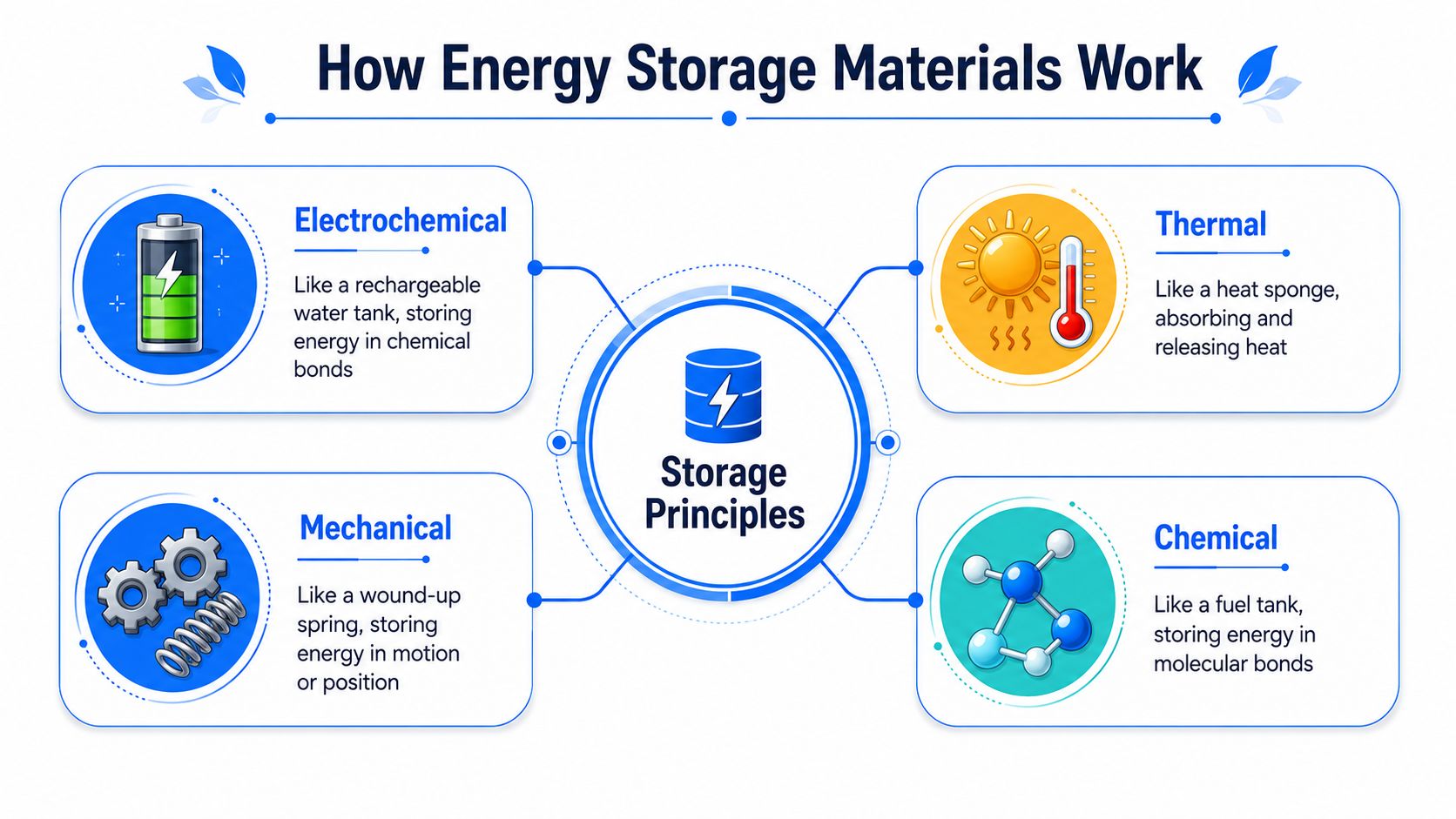
The field includes electrochemical, thermal, mechanical, and chemical storage. Electrochemical systems cover batteries and dominate portable electronics and electric vehicles. Thermal systems store heat, mechanical systems store energy in motion or pressure, and chemical systems store energy in molecular bonds for later release.
The historical arc helps explain why the market looks the way it does. The first true battery, Volta's voltaic pile, dates to 1800, Planté's lead-acid battery to 1859, and the first commercial lithium-ion batteries were sold by Sony in 1991 (IBM on energy storage history). Those milestones mark the shift from early electrochemical cells to the high-energy-density rechargeable materials that now anchor portable electronics and increasingly support EVs and grid storage.
Practical rule: if the application needs compactness, fast response, and repeat cycling, start with electrochemical materials. If it needs long dwell time, lower cost, or different temperature handling, widen the search beyond batteries.
The metrics that decide the program
Every storage material gets judged by the same core set of metrics, even if the team uses different words for them. Energy density tells you how much energy fits in a given mass or volume. Power density tells you how fast the system can deliver or absorb energy. Cycle life tells you how long the material lasts under repeated use. Safety and cost decide whether the design survives qualification and procurement.
That is why lithium-ion dominates today, but not because it is universally best. It became practical because it combined useful energy density with rechargeability and manufacturability, while other families kept their own niches. Mechanical and thermal systems still matter because large installed storage is not synonymous with battery storage.
The U.S. battery market shows how fast this space can move. Battery storage capacity in the United States grew from 59 MW in 2010 to 1,756 MW in 2020, a nearly 30-fold increase in a decade, according to the American Clean Power Association (ACP battery storage facts). That kind of growth forces R&D teams to think beyond lab performance and ask whether a material system can scale.
The Four Material Classes and Their Storage Mechanisms
A project usually gets clearer once the team starts with the duty cycle instead of the chemistry label. A grid buffer, an EV pack, a heat reservoir, and a fuel system all solve different storage problems, even if they are all described under the same umbrella term. The useful question is which material stack and interface architecture will survive the duty cycle and scale economically.
Electrochemical systems move ions and electrons
Electrochemical materials are the familiar starting point for most R&D teams. A battery stores energy by moving ions between electrodes while electrons travel through an external circuit. A rechargeable water tank is a useful analogy, except the stored “water” is charge carried by ions and electrons.
Their reach in electronics and EVs comes from a practical balance of energy density, rechargeability, and manufacturing readiness. That balance is also why the field spends so much time on interface stability, safety, temperature window, and aging. The material stack has to work as a system, not as a single idealized compound.
Thermal systems store heat, not charge
Thermal storage holds energy as heat. Some systems store it as sensible heat, some as latent heat during a phase change, and some through reversible thermochemical reactions. A heat sponge is a good mental model because the material absorbs heat when supply is available and releases it later when demand rises.
That makes thermal storage attractive where the desired output is heat or cooling rather than electricity. Material selection depends on the operating temperature, the form factor, and how much temperature swing the system can tolerate. Battery-style metrics can mislead here, because the governing losses and the useful output are different.
Mechanical and chemical storage solve different problems
Mechanical storage holds energy in motion or pressure. A flywheel stores kinetic energy. Compressed gas stores pressure energy. These systems behave like a wound-up spring, so they can deliver power quickly, but they also face engineering limits that are unlike those in a cell chemistry.
Chemical storage keeps energy in molecular bonds. Hydrogen, ammonia, and synthetic fuels fit here. They are closer to a fuel tank than a battery, because energy is stored in chemical form and released later through conversion. That can suit long-duration or transportable energy, but the conversion chain adds efficiency losses and system complexity.
The classification question that usually helps most is simple. What physical state holds the energy, and which loss mechanism is most likely to dominate first?
That framework keeps the discussion grounded. A new technology may look unrelated on the surface, but if it stores charge, heat, motion, or molecules, it belongs in one of these buckets. For R&D teams, that is the quickest way to reason about duration, response time, losses, and where the design trade-offs sit.
For a closer look at one material class that often enters thermal and ceramics discussions, see ClaimKit's high purity alumina guide.
Inside the Electrochemical Family Cathodes, Anodes, and Electrolytes
The electrochemical family matters most commercially, so it deserves a more careful breakdown. Here, the material stack is not just “the active material.” It is a coordinated system of cathode, anode, and electrolyte, each shaping performance in a different way.
The cathode sets much of the energy story
The cathode is often treated as the energy reservoir, and that's a helpful shorthand. Its chemistry helps define specific energy, voltage window, thermal behavior, and long-term stability. A team choosing between chemistries is really choosing which compromise it wants to live with.
The DOE primer gives a good snapshot of the trade space. It reports lithium-ion systems at about 210 to 325 Wh/kg with 4,000 to 6,500 cycles and operating temperatures of -20 to 65°C, while lithium iron phosphate, or LFP, is listed at 220 to 250 Wh/L, about 2,000 cycles, and less than 1% self-discharge per month (DOE lithium-ion primer). Those figures aren't a universal ranking, they're a reminder that cathode choice changes the design triangle.
The anode and electrolyte make the stack usable
The anode hosts ion insertion during charge and release during discharge. In practical terms, it helps determine how fast the battery can be charged, how much swelling or degradation is tolerated, and how the cell behaves over many cycles. The electrolyte is the highway that lets ions move between the electrodes.
Liquid, gel, solid-state, and aqueous electrolytes alter the safety and energy-density profile in different ways. Solid-state systems promise a different safety envelope and can support new architectures, but they also introduce interface and manufacturability challenges. That is why a promising active material can still fail as a product if the electrolyte and interfaces are not ready.
For teams evaluating supplier claims, the materials conversation often gets lost in packaging language. A useful supplement is a procurement-oriented source like ClaimKit's high purity alumina guide, which helps frame how purity and material consistency affect downstream performance in advanced materials supply chains.
Chemistries win by duty cycle, not by pride
LFP's appeal in stationary storage and entry-level EVs comes from how it balances durability, thermal tolerance, and cost sensitivity. High-nickel chemistries tend to serve more demanding energy-density targets, which is why they stay relevant in premium mobility and aerospace contexts. The right choice depends less on which chemistry sounds advanced and more on which one survives the actual operating profile.
If you are deciding between cell families, don't ask for the “best” chemistry in the abstract. Ask which one fits the required form factor, can be manufactured consistently, and still leaves room for the inevitable abuse cases that appear after launch.
Matching Material Systems to Application Duty Cycles
Application is the filter that turns a long list of materials into a short list of serious candidates. A chemistry that looks excellent in a brochure can be a poor fit once the duty cycle, temperature window, and replacement cost show up. That's why the same material system can be ideal in one market and wrong in another.
Portable, mobility, grid, and long-duration needs are not the same
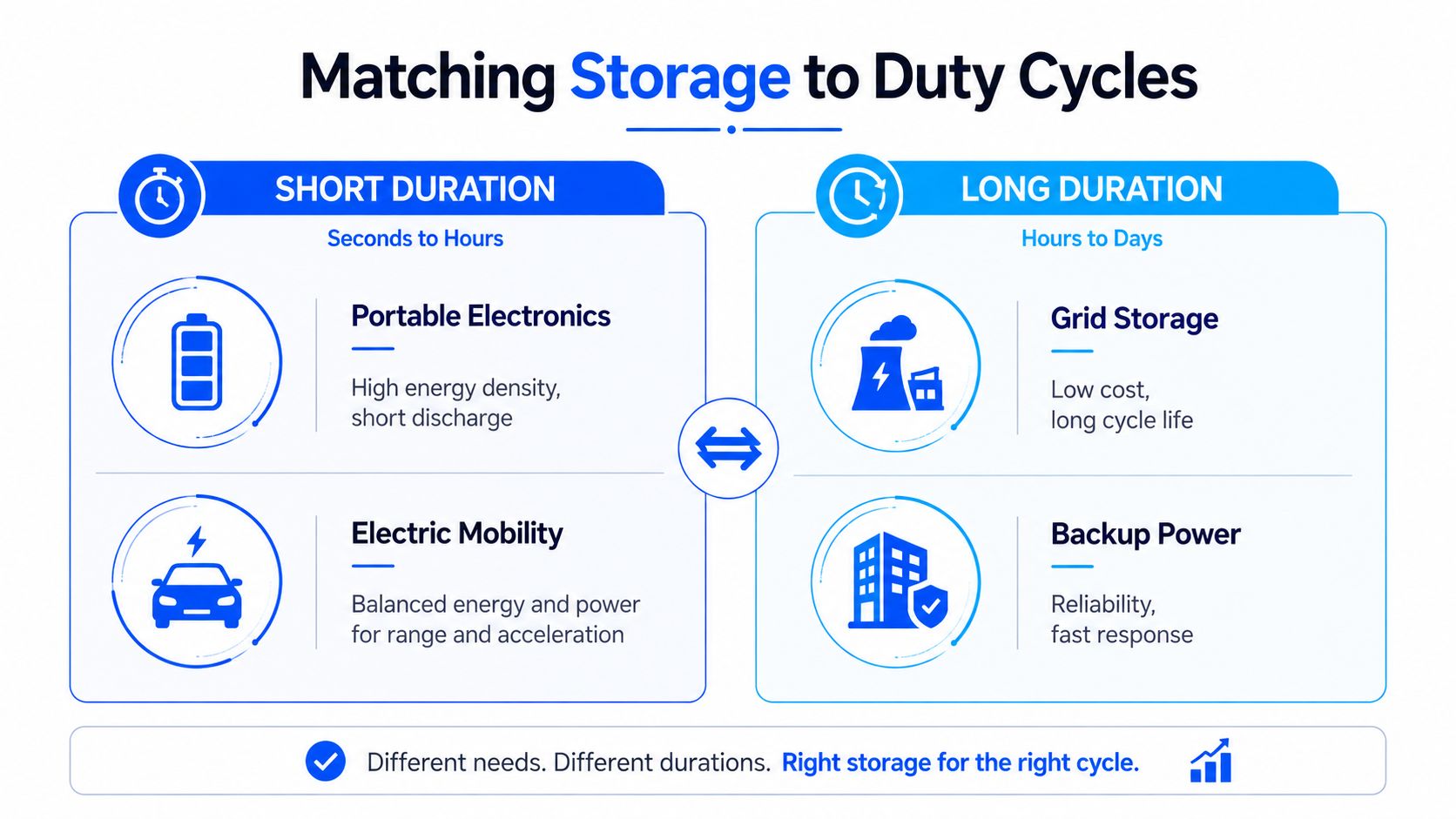
Portable electronics care most about compactness and short-duration discharge. Electric mobility needs a balance between energy and power so the pack can provide range without sacrificing acceleration. Short-duration grid services care about fast response and repeated cycling. Long-duration stationary storage cares about staying economical, safe, and durable over extended use.
Decision lens: the commercially relevant question is rarely “what has the highest theoretical performance?” It's “what survives the duty cycle, tolerates abuse, and stays economical at scale?”
The U.S. Department of Energy's 2024 report on low-cost long-duration energy storage makes the gap explicit. The challenge is not only higher energy density, but materials that can deliver 10+ hours of discharge, low cost, and multi-decade durability for grid use, and it notes that no single technology meets all needs across duration, cost, safety, and scale (DOE long-duration storage report). That is the most important framing shift for R&D teams that still treat batteries as the default answer to every storage problem.
Use case drives the shortlist
For a compact device, electrochemical materials usually dominate because the product spec rewards energy density. For EVs, the shortlist often narrows to lithium-ion chemistries tuned for power, range, and safety. For grid support, especially where response time matters, electrochemical systems still play a major role, but the decision starts to include thermal, mechanical, and chemical approaches if the duration requirement stretches.
The catch is that many public discussions stop at chemistry labels and ignore system duty cycle. A grid asset does not fail because the active material looked weak on paper. It fails when the selected stack cannot survive the actual cycle pattern, the thermal environment, or the manufacturing tolerances needed at scale.
That is why application-first selection is more useful than chemistry-first taxonomy. Once the duty cycle is clear, the relevant material classes often become obvious, and the wrong options disappear quickly.
From Lab Material to Qualified Product Characterization and Scale-Up
A material that looks impressive in a coin cell can still fail in production. That gap is where many teams lose time, because the lab protocol and the manufacturing spec often describe different things. The move from discovery to qualified product depends on whether the material can be characterized, controlled, and reproduced.
Characterization has to answer different questions
X-ray diffraction tells you about phase and crystallinity. SEM and TEM show morphology and microstructure. BET is useful when surface area matters. Electrochemical cycling reveals degradation behavior. Impedance spectroscopy helps separate transport limits from interfacial problems.
None of those tests is optional in a serious scale-up path, but each answers a different question. XRD won't tell you whether coating uniformity is stable, and a cycling curve won't tell you whether the particle distribution is batch-to-batch consistent. That is why the strongest qualification packages connect structure, morphology, surface area, and electrochemical behavior rather than relying on one headline result.
Standardization is already shaping procurement
Silicon nanosized negative electrodes show how quickly a promising material becomes a specification problem. IEC TS 62565-5-3 exists specifically to standardize how vendors report material characteristics and how buyers specify them for lithium-ion batteries (IEC TS 62565-5-3 preview). That matters because particle-related characteristics and batch comparability need to be contractually measurable if a material is going to move from lab curiosity to a buyable input.
Manufacturing constraints quietly remove candidates
A formulation can look excellent until it meets real process limits. Slurry rheology affects coating behavior. Electrode coating uniformity determines local loading variations. Calendaring windows shape porosity and mechanical integrity. These are not side issues, they are the hidden filters that decide whether a candidate chemistry survives pilot line translation.
Practical rule: if a material can't be specified, coated, and repeated at batch level, it isn't ready for scale, even if the electrochemistry looks strong.
The teams that move fastest are usually the ones that connect lab tests to plant questions early. They don't just ask whether the material works. They ask whether the same result can be reproduced across lots, operators, and equipment settings.
The Hidden Frontier Interfaces, Interphases, and Mesoscale Architecture
A common mistake in materials R&D is assuming progress mainly comes from discovering a better active material. In energy storage, much of the performance loss comes from places the eye can't see, such as interfaces, interphases, and internal structure. That is where the field is advancing.
Interfaces often decide the outcome
The broader research agenda now emphasizes materials-system integration rather than isolated ingredients, including layered materials, advanced electrodes, electrolytes, membranes, and non-battery approaches (ScienceDirect review on materials-system integration). The reason is straightforward, performance losses often begin at interfaces and move through coupled electrochemical-structural effects.
Solid electrolyte interphases and cathode-electrolyte interphases can govern stability, transport, and aging. Particle morphology changes local current distribution. Porosity gradients affect ion access. Stress-driven cracking can open new failure paths even when the active phase itself is chemically sound.
Architecture can matter as much as composition
That is why a better material stack and interface architecture often beats a better material in isolation. A particle with excellent intrinsic capacity can underperform if transport is poor or the interface degrades quickly. A modest material can outperform expectations if its morphology and interfaces are engineered for the actual duty cycle.
The most useful framing in an R&D meeting is not “which material has the highest theoretical number?” It is “which stack holds together when the current density, temperature, and mechanical strain all move at once?” That question forces teams to design for the system, not the ingredient.
The next jump in performance is often a coordination problem, not a discovery problem.
That shift matters because it changes where resources go. Instead of only funding synthesis of new actives, stronger programs also invest in interface control, mesoscale characterization, and failure analysis. The teams that treat architecture as a first-class design variable usually learn faster and waste less effort on dead-end candidates.
Accelerating Discovery and Scale-Up with AI-Native Materials Platforms
The fastest way to compress materials R&D is to stop treating data as an archive and start treating it as an operating asset. Teams already have the raw ingredients, spreadsheets, ELN entries, instrument files, and test results. The problem is that the information is fragmented, so every new decision starts with manual reconstruction.
Unifying the data backbone changes the workflow
An AI-native materials platform starts by centralizing experimental records into a secure, searchable backbone. That gives the team a consistent place to join formulations, processing conditions, characterization outputs, and performance data. Once that foundation exists, the models can do something useful instead of just being decorative.
Domain-specific, explainable models can predict properties, optimize formulations, and highlight causal drivers with confidence scores and historical precedents. That matters in energy storage materials because the scientist needs more than a number. They need to know why a formulation is being recommended and what to test next.
For readers who want a plain-English overview of how this kind of work gets organized, a general guide to AI engineering can help frame the data, model, and deployment layers before those ideas are applied to materials R&D.
Where AI helps most in storage programs
One use case is narrowing the search space before a lab campaign starts. Another is learning which formation protocols correlate with longer cycle life, so the team can stop repeating avoidable failures. A third is identifying coating windows or formulation ranges that are more likely to survive pilot conditions.
That is also where a platform such as Polymerize fits naturally in the workflow. It unifies experimental data across spreadsheets, ELNs, and silos, then layers explainable models on top so teams can plan the next best experiment instead of guessing. For organizations that need a broader implementation path, it also supports end-to-end materials R&D acceleration.
Here's the key point. AI doesn't replace materials judgment, it reduces the amount of blind trial-and-error required to reach a defensible decision. The practical value comes from fewer dead-end experiments, faster interpretation, and a clearer link between the lab result and the scale-up question.
Your 90-Day Action Plan for Energy Storage Materials R&D
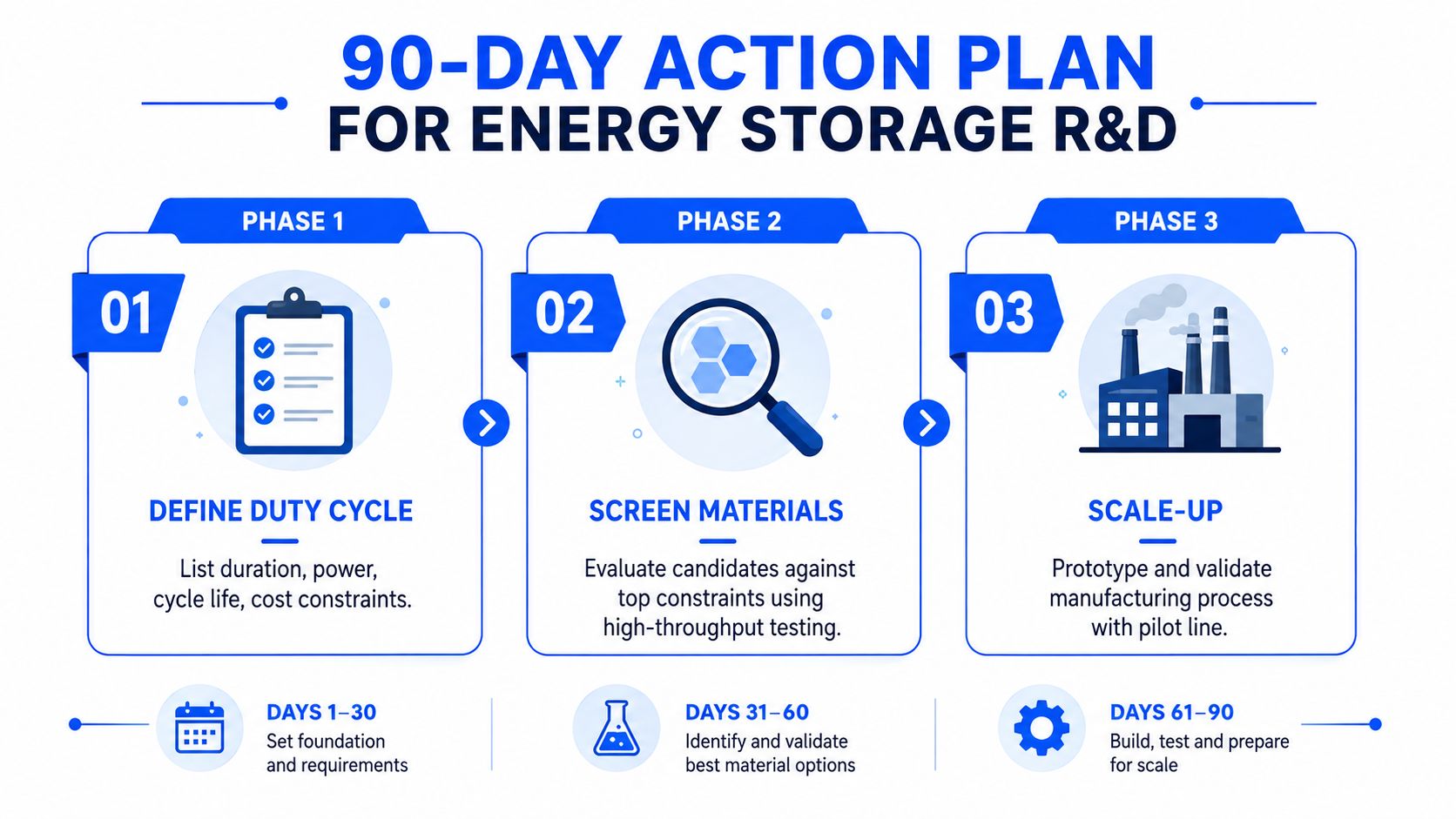
Start by writing the application before you write the chemistry. Define duration, power, cycle life, cost ceiling, and safety window in one page, then make the team agree that these are the binding constraints. If the duty cycle is fuzzy, the rest of the program will drift.
Phase one focuses on selection discipline
Rank candidate material families against the use case, not against generic performance claims. If the product needs compactness and rapid cycling, electrochemical systems stay in the first pass. If it needs long-duration heat shifting or transportable chemical energy, widen the screen immediately.
Phase two fixes the data problem
Audit where formulation records, characterization files, and cycling data live. Bring them into a unified structure that can support comparison across batches and conditions. Without that backbone, any AI pilot will inherit the same fragmentation that slowed the lab work in the first place.
Phase three tests the highest-leverage predictions
Pick a small set of targets, such as cycle life, energy density at production-relevant loading, and manufacturability windows. Run a scoped pilot with explainable models and keep the experimental loop tight. The point is not to automate judgment, it's to reduce the number of uncertain decisions.
If the program is working, you should see fewer failed experiments, a faster handoff from lab to production, and a traceable decision history for each formulation choice. That's the kind of evidence leadership can support and manufacturing can trust.
If your team is trying to move an energy storage material from concept to qualified product, Polymerize can help organize the data backbone, connect characterization outputs, and support model-driven experiment planning. Visit Polymerize to see how an AI-native materials R&D workflow can fit your next formulation, scale-up, or storage platform program.
Put your R&D data to work
See how materials teams use Polymerize to plan fewer experiments and reach target properties faster.