


You can get a polymer film to shift color in seconds on the bench, then spend weeks wondering why the same material looks tired, hazy, or slow once it's built into a real device. That gap is where electrochromic polymers become interesting, not just as colorful lab materials, but as a full system problem involving backbone design, ion motion, film processing, and failure control. The field has moved from early electrochromic devices in the 1970s and polymer-specific milestones in the 1980s toward integrated all-polymer devices and newer full-spectrum materials, so the question is no longer whether the chemistry works, but which architecture survives the device.
Table of Contents
- Step 1, redox changes the backbone state
- Step 2, the bandgap decides the color
- Step 3, ions decide whether it works well in a device
- Family choice is application choice
- Representative electrochromic polymer families and key performance signals
- Why transparency is harder than it looks
What Electrochromic Polymers Are and Why They Matter
A thin film on glass can look almost invisible, then shift hue the moment a small voltage is applied. That first switch still feels like a trick, but the chemistry is straightforward. Electrochromic polymers are macromolecular materials whose optical absorption changes as their oxidation state changes.
A practical definition
A useful working definition is direct. These are conjugated or donor–acceptor polymers whose electronic structure shifts under electrochemical bias, which changes how they interact with visible light. The polymer is not merely “changing color.” It is changing which wavelengths it absorbs and which wavelengths it transmits.
That distinction matters because polymer design gives formulation teams more control points than many inorganic electrochromes. The backbone, side chains, blend behavior, film morphology, and substrate compatibility can all be tuned. A polymer can also be solution-processable, mechanically flexible, and easier to pattern over large areas, which is why these materials keep appearing in smart windows, low-power displays, wearable optics, and other form factors where brittle coatings struggle.
A practical rule follows from that. If an application needs a film that stays light, bends without cracking, and can be tuned for a specific optical state, polymers deserve serious consideration before a device architecture is fixed.
Why the field keeps expanding
The field has expanded because switching performance is only part of the story. Color control has broadened, from single-color materials toward systems that can reach multi-color, transparent-to-colored, black, and other application-specific optical states. The historical record shows the same shift from chemistry demonstrations to device-oriented materials, including the first all-polymer electrochromic devices reported in 2003, which marked a real integration step rather than a bench-top curiosity source.
For a formulation chemist, the lesson is simple. Electrochromic polymers are switchable optical materials whose color, transparency, and durability are encoded in the backbone, the film, and the electrolyte environment. If you focus only on color, you miss the system. If you focus only on conductivity, you miss the optics. AI-driven R&D starts to matter here because it can connect those variables faster than a trial-and-error loop, helping teams test how backbone design, ion transport, and failure modes interact before the first round of device fabrication is complete.
How Electrochromic Switching Works
A coated window may look passive until a voltage is applied, and then the color or transparency shifts in place. That change is not magic. It is electrochemistry coupled to molecular design, where the polymer backbone, the ions around it, and the film structure all determine what light is absorbed after charge enters or leaves the material.
Step 1, redox changes the backbone state
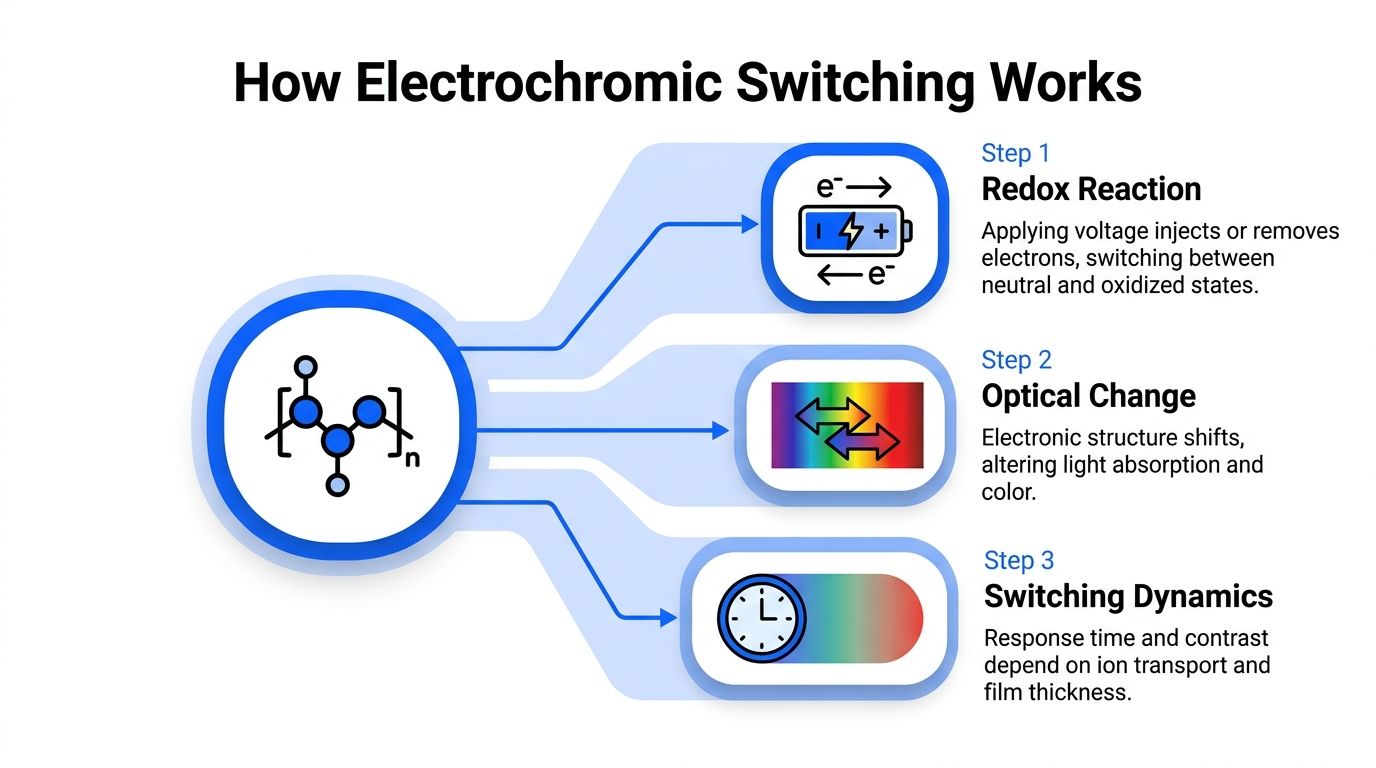
Apply a potential, and the polymer is oxidized or reduced. That shifts the electron distribution along the chain and changes the energy levels available to the material. The backbone remains in place, but its electronic state changes, which is why the device can move between optical states and then return again.
A rechargeable battery is a useful comparison. Charge goes in or out, and an optical response follows. The important caveat is that the polymer film is only one part of the system, because ions must also move to keep charge balanced. Without that ion compensation, the redox state cannot be maintained cleanly through the thickness of the film.
Step 2, the bandgap decides the color
Different redox states absorb different wavelengths, so the eye sees a different color. Backbone chemistry controls that outcome directly. One polymer may present a bandgap that leaves the visible region largely untouched in the neutral state, while another places absorption squarely in the visible and gives a stronger color change.
The patent literature gives a clear example of how structure shapes optics. A backbone built from partially meta-conjugated linkers and aromatic moieties can yield neutral-state transmittance of 85% to 99.9% at 550 nm for films 10 to 1500 nm thick, while still reaching oxidized-state transmittance of 40% to 0.1% and optical contrast of 60% or more source. The useful lesson is qualitative, not just numerical. If unnecessary visible absorption is suppressed in the neutral state, the film can stay clear until it is driven into the colored state.
Step 3, ions decide whether it works well in a device
Electrons travel through the external circuit, but ions must move into and out of the film to balance charge. That ion transport often sets the switching rate and also affects how well the material holds its optical state after the bias is removed.
Practical rule: if a polymer switches nicely in a three-electrode test but slows down or drifts in a full device, ion motion and film morphology are usually the first places to examine.
This is why drive voltage, switching speed, and optical memory should not be treated as separate knobs. They depend on the backbone electronics, the film structure, and the electrolyte chemistry acting together. A formulation can look strong on paper and still fail if one of those pieces blocks ion transport or traps charge in an unfavorable way. AI-driven R&D becomes useful here because it can connect those variables earlier, before the first device iteration is finished, and help teams test how backbone design, ion transport, and failure modes interact.
A Brief History of Electrochromic Polymer Development
A useful way to read the history of electrochromic polymers is as a series of problems the field learned to control one by one. Early work established that color could be switched with an electric stimulus, but it did not yet explain how to make the response stable, processable, and useful in a device. Patents from Philips and ICI appeared in the early 1970s, a viologen-based electrochromic device followed in the same period, and the first electrochromic polymer device emerged in the early 1980s. That early sequence still sets the baseline for how the field thinks about backbone design, ion transport, and failure modes source.
From early conducting polymers to engineered color
The next stage centered on the classic conducting polymer families. Poly-N-methylpyrrole was reported in 1981, and polyaniline plus polythiophene systems drew sustained attention from 1983 onward because they made the electrochromic effect easier to reproduce, compare, and study in detail source.pdf). Those polymers were important not because they solved every problem, but because they gave researchers a controllable platform. Once a backbone could be synthesized reliably, the field could begin asking the more practical questions about switching speed, coloration efficiency, and durability.
The later shift was more deliberate. Donor–acceptor design made it possible to shape neutral-state color and oxidized-state transparency in ways that broadened the usable color range. In 2013, starburst triarylamine-derived units were introduced into polyimides, and 9Ph-6FPI was described as the first polyimide-based electrochromic polymer to combine multicolor variation with high cycling stability source. That matters because the design goal had changed. Researchers were no longer only asking whether a polymer could change color, they were asking whether the color change could be tuned, repeated, and built into a usable device without rapid degradation.
Where the frontier sits now
Recent work has pushed the field beyond a simple clear, colored split. A 2024 Nature Communications study reported high-performance black copolymers that absorb across the visible spectrum, and a 2026 review frames colorless to other colors polymers as a distinct emerging class source. That shift matters because application needs are diverging. A smart window may prioritize transparency in one state, while a display, camouflage layer, or indicator film may need black, neutral, or carefully controlled intermediate states.
The bigger lesson from this history is straightforward. Progress in electrochromic polymers has come from tighter control over the backbone, better handling of ion movement, and more realistic attention to how films fail once they leave the lab bench. Data-driven R&D now changes the pace of that work. It can test how structure, transport, and degradation interact before a full device loop is complete, which helps researchers move from isolated color changes to materials that survive real switching conditions.
Main Polymer Families and How They Compare
The common mistake is to treat “electrochromic polymer” as one category. In practice, the family you choose shapes the switching voltage, neutral-state appearance, processability, and durability profile long before the device is assembled.
Family choice is application choice
Polythiophenes remain useful because they are familiar, versatile, and easy to formulate. Polyanilines are still important for the same reason, especially in legacy literature and comparative studies. PEDOT and related derivatives are often favored where conductivity and processability matter. Donor–acceptor conjugated polymers are attractive when you need tunable optical states. Triarylamine-based polyimides have earned attention where multicolor switching and cycling stability are central design goals.
The strongest design lesson from the literature is that backbone structure controls visible absorption and switching behavior. The benchmark patent on poly(3,4-propylenedioxypyrrole), or PProDOP, shows how structure changes the electrochemical window and optical spectrum. PProDOP has an oxidation peak potential of +0.58 V vs Fc/Fc+, a reduction potential of -0.89 V vs Fc/Fc+, an absorption maximum near 482/523 nm, and a bandgap of 2.2 eV. Its N-methyl analogue shifts to a larger bandgap of 3.0 eV and a much shorter-wavelength absorption maximum at 330 nm source.
What that means in practice: side-chain substitution and backbone rigidity can move the color window, the drive voltage, and the device power budget at the same time.
Representative electrochromic polymer families and key performance signals
| Polymer family | Typical switching voltage | Neutral-state color behavior | Reported strengths |
|---|---|---|---|
| Polythiophenes | Structure-dependent | Often colored in one state, tunable by substitution | Familiar chemistry, broad literature base |
| Polyanilines | Structure-dependent | Strong redox-linked color change | Historical workhorse, easy to compare across studies |
| PEDOT and derivatives | Structure-dependent | Often highly conductive and optically active | Processability, conductivity, device familiarity |
| Donor–acceptor conjugated polymers | Structure-dependent | Tunable neutral-state color, including green and transparent designs | Optical programmability, color control |
| Triarylamine-based polyimides | Structure-dependent | Multi-color switching possible | Cycling stability, engineered optical states |
Why transparency is harder than it looks
High-transparency designs rely on suppressing unnecessary visible absorption in the neutral state without killing redox activity. The patent example above shows why meta-conjugated linkers matter. They reduce neutral-state optical density while keeping the redox-driven state change intact, which is exactly what you want in a window film that should look like glass until you switch it.
The takeaway is straightforward. Pick the family for the device, not for the paper that impressed you. A polymer that looks great in one test may have the wrong neutral-state appearance, the wrong redox window, or the wrong kinetics for your target application.
Synthesis, Processing, and Characterization Workflow
The lab workflow starts with molecular design, but it does not end there. A polymer that looks elegant on paper can still fail because the synthesis route, film method, or electrolyte choice introduces defects that matter more than the nominal structure.
From monomer to film
Design usually begins with monomer selection and the decision about whether to use a conjugated backbone or a donor–acceptor architecture to set the bandgap. From there, teams choose polymerization chemistry, either chemical synthesis or electrochemical deposition. Chemical routes give more freedom over scale and purification, while electrochemical routes can be useful for screening and direct film formation.
Film processing is where formulation chemists often start to see constraints. Spin coating, drop casting, slot-die coating, and inkjet printing all have different implications for thickness control, defect density, and compatibility with substrates such as ITO or flexible plastics. After that comes device assembly, usually with an electrolyte layer and an ion-storage counter electrode to complete the circuit.
A good lab note should record more than the final color. It should capture the monomer batch, polymerization route, solvent system, film thickness, substrate treatment, and electrolyte composition, because each one changes what the next experiment means.
What the measurements actually tell you
- Cyclic voltammetry maps the redox potentials and shows how easily the polymer switches.
- Spectroelectrochemistry links the voltage to the optical state, so you can see which wavelengths move with bias.
- Chronoabsorptometry measures switching speed and optical memory, which is critical if the device has to hold its state between activations.
Those tests are not just quality checks. They generate the dataset you later need for model building, failure analysis, and formulation optimization. If the experiment is poorly logged, the data are much less useful than the chemistry deserves.
The most practical mindset is this. Characterization is not the end of the workflow, it is the beginning of the decision tree. Once the dataset is clean, you can start asking which backbone, side chain, thickness, or electrolyte is driving the behavior you see.
Why Lab Promises Often Break at the Device Level
A polymer that switches cleanly in a cuvette can still disappoint once it is assembled with electrodes, electrolyte, and a real substrate. That gap is not a small engineering inconvenience. It is the main reason many promising materials never move cleanly from paper results to working devices.
A lab film is isolated. A device is a coupled system. Once the polymer is asked to exchange ions, hold charge, tolerate mechanical stress, and keep its optics stable at the same time, the weak points show up fast.
The failure modes are familiar
Recent reviews note that organic electrochromic materials still face weaker cycling stability than inorganic alternatives source. In practice, that shows up as fading contrast, hue drift, or slower recovery after repeated switching. In flexible formats, the interface can also start to fail, especially when the substrate bends or the surrounding environment shifts.
Ion behavior often sets the pace of that failure. Work focused on polymer–ion interactions highlights that ion motion and trapping sit at the center of real-device degradation source. When ions remain trapped, the film can hold an unwanted charge state, which weakens optical memory and makes the next switch less predictable. When ion transport is sluggish, the device slows down even if the backbone itself is chemically well designed.
Why the bottleneck is not just chemistry
The public conversation often stops at “new polymer, new color.” Device behavior is wider than that. A backbone that gives a strong spectrum may still be too dense, too brittle, or too unfriendly to ions for a large-area film. A film that looks highly transparent in the neutral state may still need a better electrolyte match to keep contrast after cycling.
A useful way to frame the problem is this. The polymer, the electrolyte, the electrodes, and the substrate form a coupled balance, and one part rarely fails alone.
That is also where data-driven R&D starts to matter in a practical sense. If teams build clean datasets on backbone design, film thickness, ion mobility, and cycling response, they can screen out failure modes earlier and test structure-property tradeoffs with far less guesswork. AI does not replace device physics. It shortens the loop between a design idea and the first sign that the idea will or will not survive in a real stack.
The main point for R&D leaders is straightforward. Current work is still optimizing core structure-property tradeoffs rather than following a settled commercialization recipe source. The teams that move fastest are the ones that identify failure earlier, not just the ones that produce a clean first cycle.
Where Electrochromic Polymers Are Deployed
A lab film that switches cleanly on a benchtop can still fail in a product if the application demands the wrong balance of clarity, cycling, and mechanical stability. That is why deployment concentrates in places where the optical state matters more than visual spectacle, and where the device can tolerate the trade-offs built into the chemistry.
The requirements differ by market
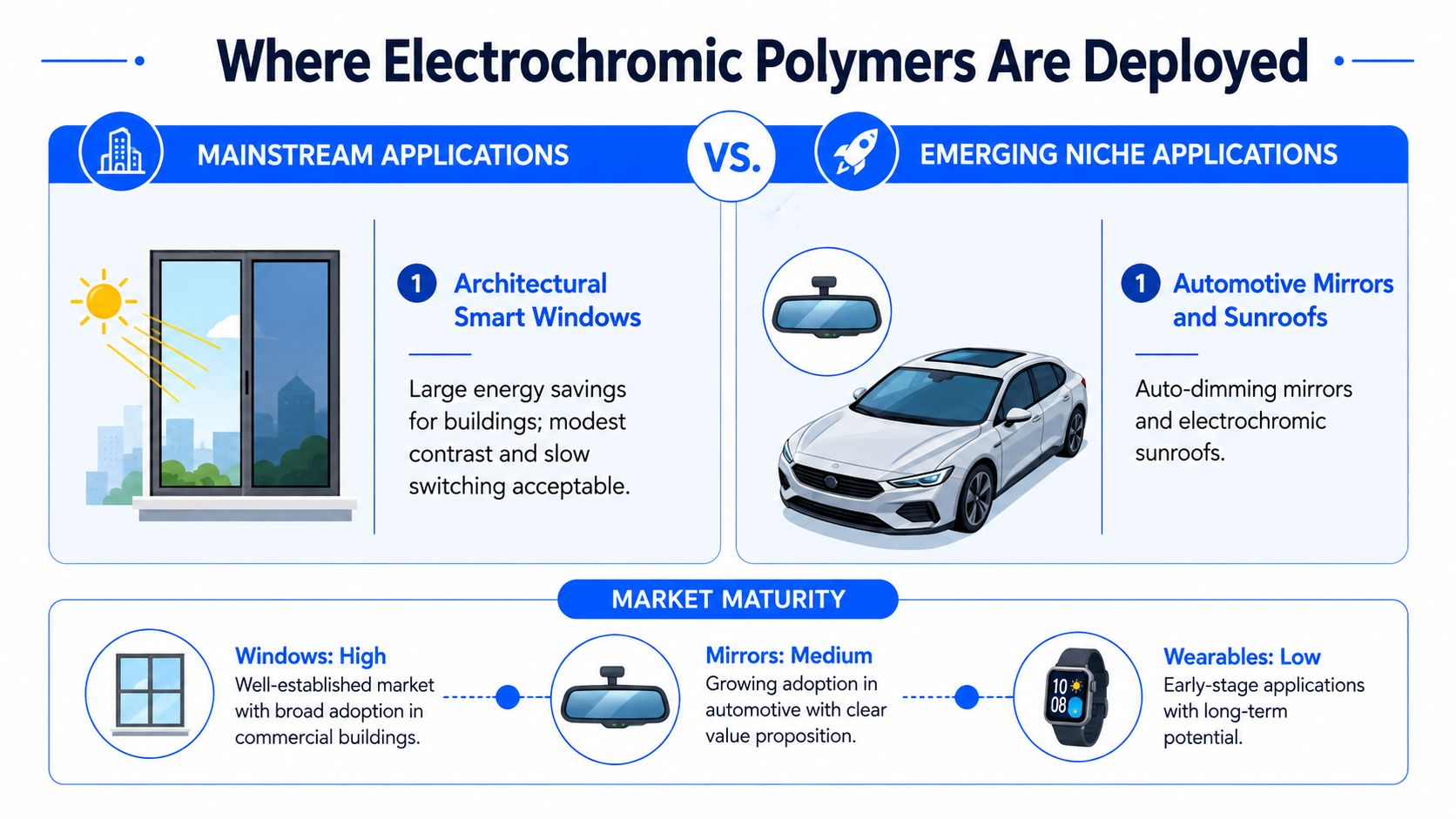
Architectural smart windows remain the clearest commercial fit because the value proposition is easy to understand. Buildings want controllable light transmission, and a device can still be useful even if switching is not especially fast, provided the optical state is stable and the film survives long service. In that setting, transparency and durability usually matter more than dramatic color shifts.
Displays follow a different set of constraints. E-paper and segmented readouts care about low power, bistability, and visual clarity. The polymer does not need to refresh like a phone screen. It needs to hold a defined state and stay readable for long periods, which puts redox stability and contrast retention on equal footing.
Wearables and adaptive eyewear bring the material into a harsher setting. Flexibility matters, but so do sweat, UV exposure, and repeated bending. That makes mechanical durability part of the electrochromic specification, not a separate concern that can be handled later.
The design choices change with the device target. A backbone that looks excellent in solution can still be a poor fit if the film cracks, the ions move too slowly, or the interface degrades under repeated cycling. That is why formulation chemists increasingly treat backbone design, ion transport, and failure modes as one coupled problem instead of three isolated ones.
Match the device to the property
- Smart windows: prioritize transparency, contrast, and outdoor durability.
- Displays: prioritize bistability, low power, and legibility.
- Wearables: prioritize flexibility, adhesion, and environmental resistance.
- Automotive mirrors and sunroofs: prioritize response reliability and integration with vehicle systems.
- Speculative camouflage and sensor readouts: prioritize adaptive optical states and pattern control.
Automotive dimmable mirrors and sunroofs already show how a narrow niche can support practical commercialization. These applications do not reward chemistry for chemistry's sake. They reward devices that keep working after repeated switching, temperature swings, and integration into a larger control system.
The more experimental uses, including adaptive camouflage and optical memory, push the materials harder, but they still follow the same logic. The first question is the use case. The second is whether the polymer, electrolyte, and device stack can survive that use case without losing contrast or speed. Teams that organize their data well can compare those trade-offs earlier, and a structured workflow such as Webclaw on search APIs shows why searchable experimental history shortens the path from idea to deployable formulation.
How AI-Driven Materials R&D Accelerates the Field
Electrochromic polymer development is a search problem as much as a synthesis problem. The space of monomers, side chains, electrolytes, film processes, and device stacks is too large to explore one variable at a time, and the cost of a bad experiment is higher than most admit.
Why AI matters here
The useful role for AI is not magic prediction. It is hypothesis narrowing. If a lab captures every formulation, every failed film, every redox trace, and every cycling result in a structured way, the next experiment can be chosen on evidence instead of memory. That matters especially in a field where ion trapping, cycling loss, and morphology all interact.
A practical materials informatics workflow pulls data out of spreadsheets, ELNs, and instrument exports, then normalizes them into a single backbone. From there, domain models can estimate likely properties, compare formulations, and surface drivers with confidence scores. That gives a scientist a ranked list of the next best experiments instead of a blank notebook page.
For teams wanting a deeper technical lens on search and retrieval workflows, Webclaw on search APIs is a useful reference point for thinking about how structured access to information changes discovery speed. The same logic applies in materials, where searchable experimental history becomes a real productivity lever.
What changes in practice
- Failed experiments become data: a bad device is no longer a dead end if the failure mode is captured.
- Design cycles shorten: the next formulation is chosen from evidence, not habit.
- Causal drivers become visible: backbone, side chain, electrolyte, and processing variables can be compared together.
- Scale-up gets less random: the models can flag which lab wins are likely to survive process changes.
Enterprise controls matter too, because formulation data is IP-heavy. Platforms built for this space typically emphasize ISO 27001, SOC 2, and role-based access so that teams can collaborate without loosening control over sensitive experimental data.
The practical takeaway is simple. The fastest labs won't be the ones running the most synthesis. They'll be the ones turning every electrochromic device, good or bad, into a structured search step.
If you're building electrochromic formulations and want a better way to connect backbone design, ion transport, and device outcomes, visit Polymerize. It's built to turn scattered experimental work into an AI-ready materials dataset, so your team can plan the next best experiment instead of guessing.
Put your R&D data to work
See how materials teams use Polymerize to plan fewer experiments and reach target properties faster.