

You're at the bench, the insert is ready, the vector is cut, and the clock's already tighter than you want. The fastest way to lose that advantage is picking a double digest that looks fine on paper but drags in poor buffer overlap, weak activity, or star activity that turns a clean cloning plan into extra cleanup and a repeat digest. NEB's Double Digest Finder exists for exactly that point in the workflow, when you need a compatible enzyme pair and you want the setup to stay simple.
Before opening the tool, gather the sequence file in FASTA format, the restriction enzyme names or codes, and a basic sense of where your cut sites should land. You also need internet access, because the workflow depends on NEBcloner's online guidance and the tool's compatibility logic. If you already know the cloning goal, you can move faster once the sequence is loaded, because the tool helps you test whether a shared-buffer digest makes sense or whether you should plan for a sequential approach.
Table of Contents
Introduction and Prerequisites
A common cloning day starts with a simple problem. You have a PCR product or a gene block, a vector backbone, and two restriction enzymes that should work together, but the key question is whether they will behave in the same tube without wasting time or damaging the DNA. The double digest finder NEB workflow helps at that stage, because it moves the decision away from guesswork and toward a digest plan that matches the sequence and the buffer conditions.
The first check is whether the inputs are ready. A FASTA file is the cleanest way to bring a sequence into the tool, and the enzyme names or catalog codes should be on hand so candidate pairs can be compared quickly. You also need a working understanding of restriction digests, especially the difference between a single-buffer double digest and a sequential digest.
Practical rule: do not start the digest search until the sequence, enzymes, and cloning goal are all in hand. Most delays come from going back to find one missing detail, not from the tool itself.
The tool fits routine cloning prep because it narrows the choices before you touch the bench. NEB's guidance frames the Double Digest Finder as part of NEBcloner, with buffer selection aimed at simultaneous restriction digests while avoiding star activity and product loss, and NEB uses the single-buffer approach only when both enzymes have greater than 50% activity in one buffer. That rule matters because it keeps the digest tied to enzyme behavior instead of memory or habit.
Buffer compatibility is the hidden trap in many double digests. A pair that looks perfect on paper can still fail if one enzyme drops too far in the shared buffer, or if the glycerol level creeps up and pushes the reaction toward star activity. In practice, I check the buffer first, then the enzyme pair, then the reaction setup, because fixing a weak buffer choice after the digest starts usually costs more DNA than expected.
If the sequence is messy, annotate it first. If the enzyme pair is tentative, keep a few alternatives ready. If the workflow has to happen the same day, plan for pairs that will not share a suitable buffer, and treat that as useful feedback from the tool rather than a setback. For a parallel example outside cloning, BacteriaFAQ.com on S. aureus shows how enzyme behavior changes with context, which is the same reason double digests need buffer checks before the reaction is assembled.
Understanding Key Concepts and Tool Workflow
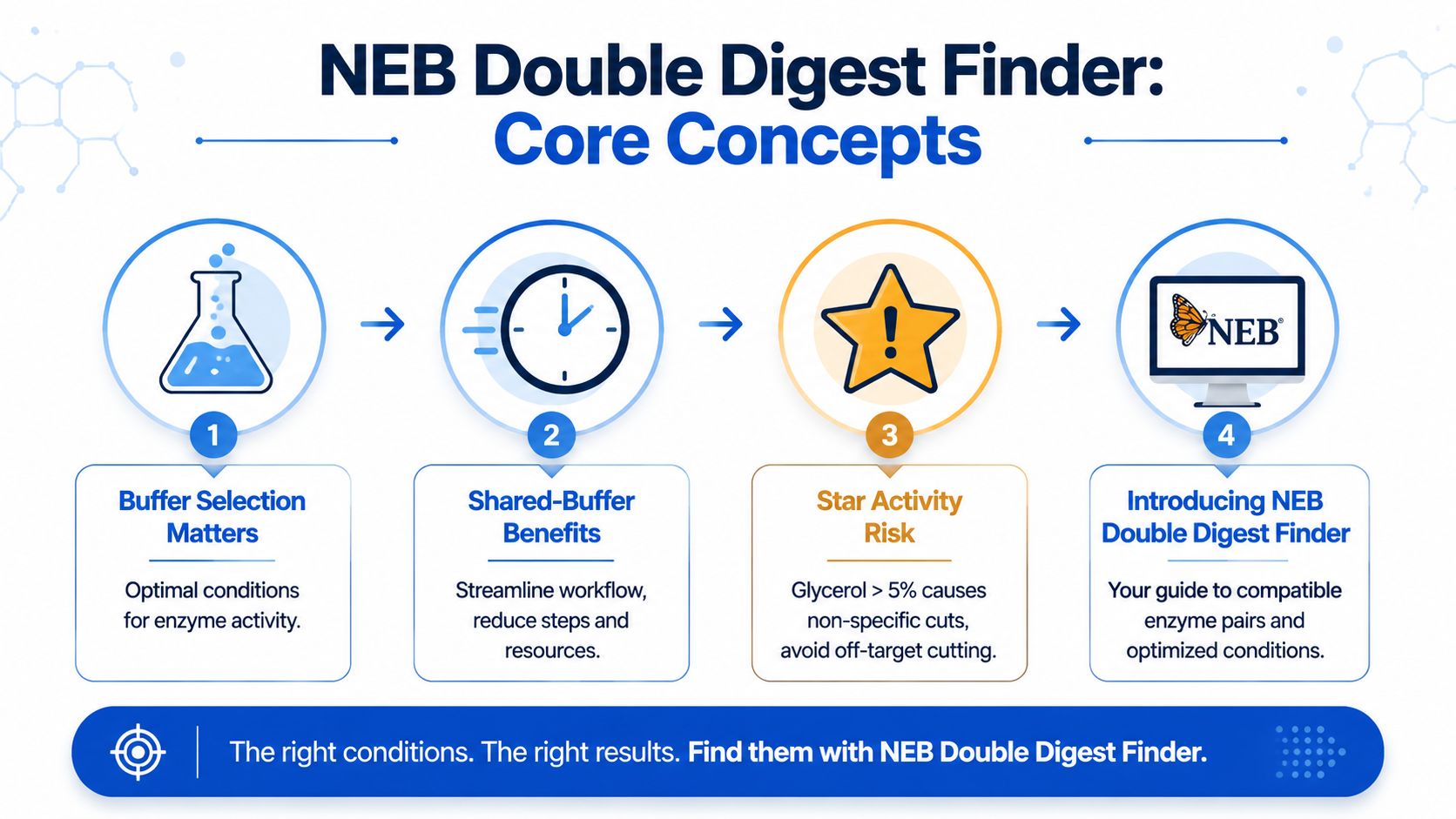
A double digest can look straightforward until buffer choice starts deciding the outcome. If both enzymes perform well in one buffer, the workflow stays short and you avoid an extra cleanup step. If the shared buffer is only borderline for one enzyme, the reaction can move toward incomplete cutting or unwanted side activity. NEB's Double Digest Finder is built to sort out that trade-off by pointing to buffer options that support both enzymes and reduce the chance of star activity, and NEB uses a single-buffer double digest only when both enzymes have greater than 50% activity in one buffer.
Why shared buffers are useful
Shared-buffer digestion saves handling. Fewer transfers mean fewer chances to lose material, mislabel a tube, or shift the reaction conditions by accident. In a cloning workflow, that usually matters more than shaving a few minutes off the setup.
The trade-off is the buffer itself. A convenient shared buffer only helps if both enzymes still perform well enough in it, otherwise speed comes at the expense of yield or specificity. That is why I check buffer compatibility before I worry about the rest of the setup.
The other hidden variable is glycerol. NEB recommends keeping final glycerol concentration below 5% of reaction volume, because higher glycerol can contribute to star activity, and in a 50 µl reaction that means no more than 5 µl total enzyme should be added. That limit is easy to miss when two enzyme stocks are both contributing to the same tube, especially if one or both stocks are concentrated.
For background on how restriction enzymes recognize and cut DNA, BacteriaFAQ.com on S. aureus is a useful refresher. The main lesson carries over here, enzyme behavior depends on context, so the digest plan has to respect both the DNA and the buffer.
What the tool is really checking
The Double Digest Finder does more than match names. It is checking compatibility across the conditions that matter at the bench, including whether a shared buffer is realistic, whether a sequential digest would be safer, and whether the setup is likely to stay within the conditions NEB recommends. As noted earlier, NEB's guidance on NEB double digests centers on keeping both enzyme performance and specificity in range, rather than forcing a pair into a buffer that only looks workable on paper.
That matters in routine cloning, plasmid subcloning, and verification digests. A pair that cuts cleanly in theory can still behave badly if the buffer is weak for one enzyme or if the reaction setup pushes conditions toward star activity. In practice, I trust the tool most when it rules out a tempting pair before I waste DNA on it.
The best setup is the one that gives a clean fragment profile the first time.
Uploading Sequences and Selecting Enzyme Pairs
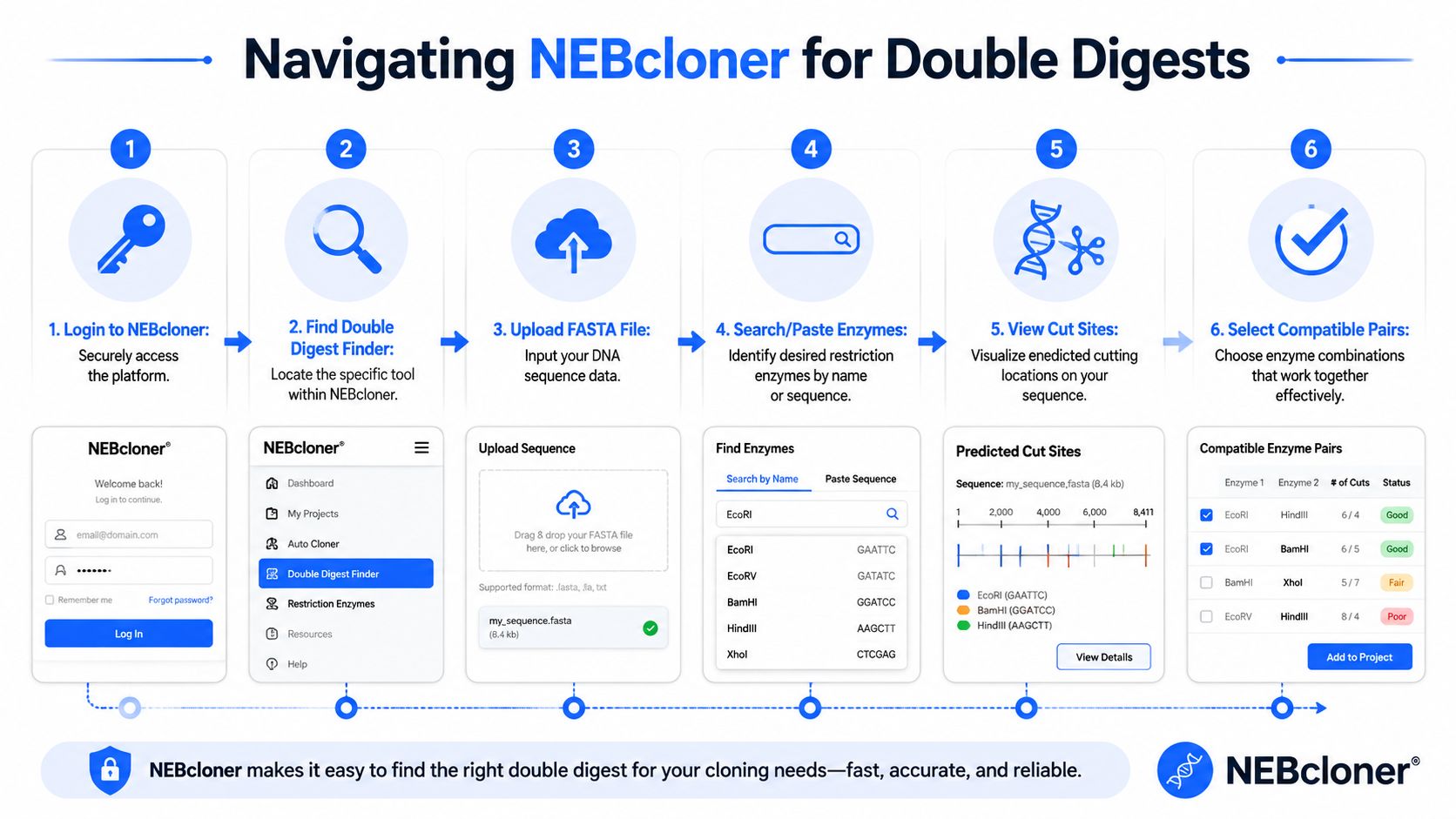
Start in NEBcloner, then open the Double Digest Finder and upload the sequence file in FASTA format. Once the sequence is loaded, the interface can display cut-site information and help you search enzyme names or paste them in directly, which is much faster than manually scanning a sequence string for every recognition site. The point isn't just convenience, it's reducing the chance that you overlook a site buried in a long insert or vector backbone.
A typical use case is a cloning setup with a gene insert and a vector needing directional cloning. EcoRI and HindIII are common candidates because they create different ends and are often easy to reason about when you're checking whether the insert will land in the right orientation. If the fragment map shows the cut sites flank the insert cleanly, and the buffer overlap is acceptable, that pair becomes a practical option rather than a theoretical one.
How to pick a pair without second-guessing yourself
Look at three things together, not one at a time. First, the predicted cut sites. Second, whether the pair leaves the fragment you want in a manageable size window. Third, whether the buffer compatibility supports a single-tube digest.
If the tool suggests a pair with awkward fragment sizes or a weak shared buffer, don't force it. A cleaner pair with slightly less familiar names often beats a familiar pair that needs rescue later. That's especially true for screening digests, where the goal is usually clarity on the gel rather than squeezing every possible shortcut into one tube.
The interface is most helpful when you use it to eliminate bad options early. That leaves you with a digest plan that matches the actual sequence, not the one you assumed was there.
Bench habit: once the enzyme pair looks plausible, check the fragment map one more time before setting up the reaction. A quick visual pass catches more problems than a memory of what the sequence used to look like.
The YouTube walkthrough can be handy if someone in the lab is new to the platform, but the primary value comes from using the tool the same way you'd use a colleague's scratch notes, as a fast sanity check before pipetting begins.
Reading Fragment Maps and Checking Buffer Compatibility
A fragment map is where the tool becomes useful at the bench. It no longer just names enzymes, it shows how the digest should reshape your sequence, so you can judge whether the cut pattern fits the cloning plan. If the predicted fragments sit too close in size, the gel can blur the answer. If the cut sites land where you expected, the digest is much easier to trust.
What to watch in the map and table
The map answers “where,” while the table answers “how well.” Use both together. A clean map with weak buffer compatibility still leaves you with a problem, because the enzyme pair may not cut well under the same reaction conditions.
| Example Buffer Compatibility for EcoRI and HindIII | EcoRI Activity | HindIII Activity | Max Glycerol |
|---|---|---|---|
| Buffer 2 | Shared buffer can be used only if both enzymes exceed the activity threshold | Shared buffer can be used only if both enzymes exceed the activity threshold | Keep final reaction glycerol below 5% |
The table is not there for decoration, it is there to keep you from setting up a reaction that looks tidy on paper but performs poorly in the tube. When both enzymes clear the threshold in one buffer, a single-step digest makes sense. When one enzyme falls short, a sequential digest is usually the safer choice, and NEB says to switch to sequential digest if no shared buffer gives more than 50% activity for both enzymes.
How to read the compatibility result like a bench scientist
Treat the buffer call as a decision point, not a sticker that says go or no-go. If the shared buffer works and the cut pattern is clean, proceed. If the compatibility is marginal, ask whether one extra step costs less time than a failed digest and another day on the gel.
Temperature matters too. If two enzymes need different incubation temperatures, NEB recommends digesting one enzyme first, heat-inactivating it, then adding the second enzyme (NEB double digests). That avoids trying to split the difference and hoping both enzymes tolerate the same condition.
A good map plus a compatible buffer keeps the protocol straightforward. A good map without compatible conditions is a sign to redesign the setup.
Calculating Enzyme Units Incubation Conditions and Troubleshooting
Reaction setup gets messy when people rush the arithmetic. The safest approach is to decide the reaction volume, the DNA amount, and the enzyme volumes before anything touches the tube. In a 50 µl reaction, NEB's glycerol guidance means the combined enzyme volume should stay at 5 µl or less so the final glycerol concentration remains below 5%.
Setting up the reaction without crowding the tube
Start with the enzyme pair, then work backward from the reaction format your lab uses. If both enzymes go into the same tube, their combined stock volumes still have to fit under the glycerol limit, and the reaction must leave room for buffer, DNA, water, and any other required component. People often crowd the tube with enzyme and lose specificity without seeing the problem until the gel.
A practical bench habit is to keep a written setup list beside the rack. Write the enzyme names, the buffer, the incubation temperature, and whether you are running a single-step or sequential digest. That small step helps prevent one stock from being mistaken for another when the workflow is moving quickly.
When the digest goes wrong
No cuts usually means one of three things. The enzyme pair was poor for the buffer, the incubation conditions were off, or the DNA prep was not a good match for the enzyme choice. The first check is whether the pair met the shared-buffer threshold. If it did not, the single-tube digest was the wrong setup from the start.
Partial digestion often points to weak compatibility or a reaction that needed more time under the right conditions. Do not assume the enzyme itself is bad. Check whether the buffer choice was strong enough for both enzymes and whether a sequential digest would have been the better fit.
Star activity is the problem that frustrates people most, because it can look like extra bands or messy cutting even when the intended sites were present. If that pattern shows up, revisit enzyme volume. Higher glycerol raises star activity risk, and NEB recommends keeping the final reaction below 5% glycerol, with no more than 5 µl total enzyme in a 50 µl setup.
Quick fix mindset: if the shared digest is shaky, stop forcing the same setup. Move to a sequential digest or recheck the buffer logic before spending more DNA.
That saves more time than trying to rescue a questionable reaction after the gel shows it was never stable.
Best Practices and Alternative Tools
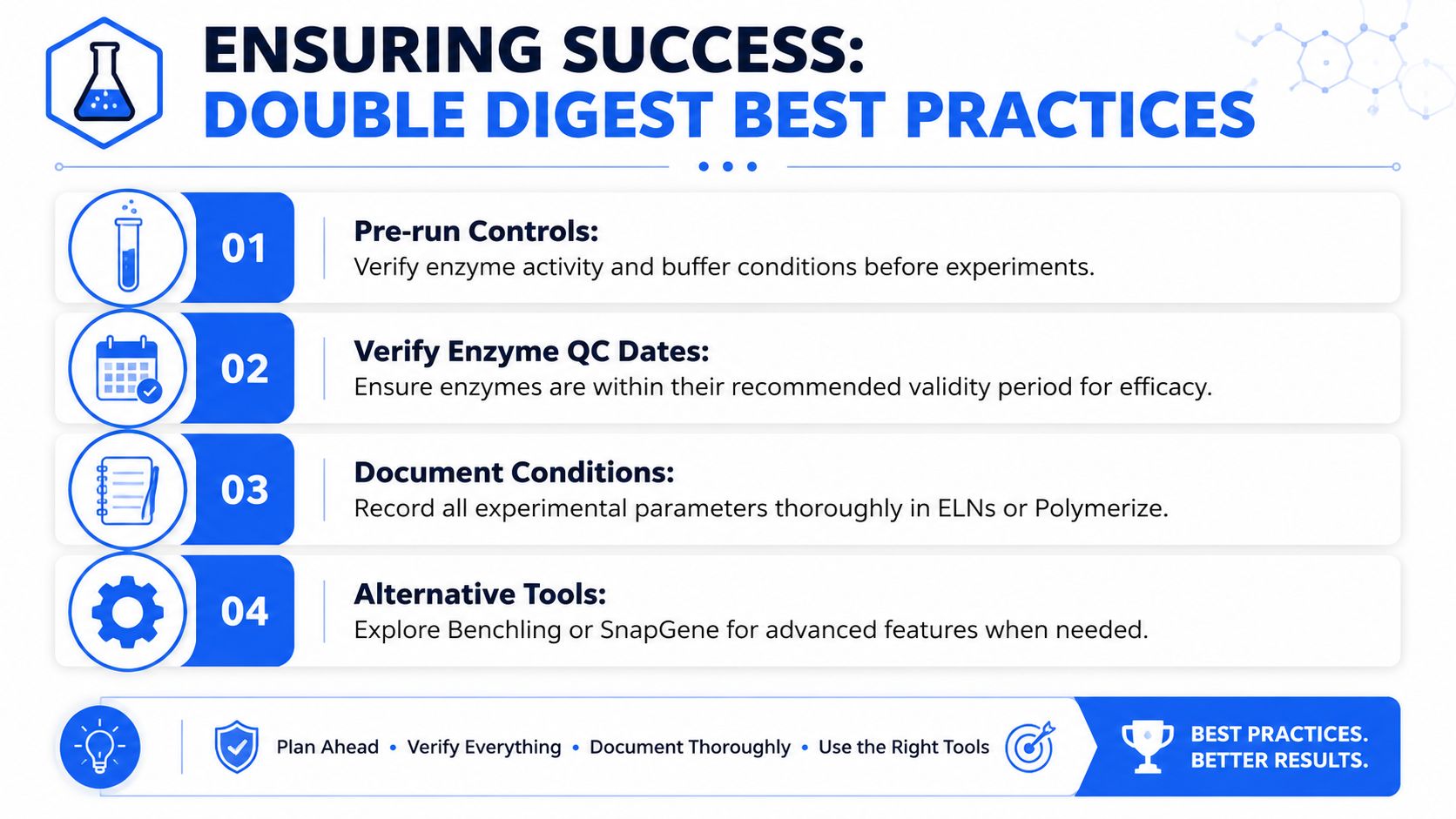
The most reliable double digest runs are boring in the best way. The team checks controls before the run, confirms the enzyme QC dates, and records the setup in an ELN or a system like Polymerize so the next person can reproduce it without guessing. Those habits matter because the digest itself is only one step, and the handoff between planning, execution, and documentation is where many workflows lose clarity.
What to keep consistent every time
- Pre-run controls: confirm the enzyme setup and buffer conditions before committing your DNA sample.
- QC date checks: verify that the enzymes are still within their intended working window before use.
- Documented conditions: record enzyme pair, buffer, temperature, and digestion order in your ELN or Polymerize.
- Tool choice: stay with NEB's workflow when the digest depends on buffer compatibility and activity thresholds, and use other platforms when you need deeper annotation or offline design support.
If you need more advanced annotation or a different planning environment, tools like Benchling and SnapGene can make sense alongside NEB's workflow. Polymerize can also store restriction enzyme planning as part of a broader experimental record, which is useful when the digest sits inside a larger R&D data system. None of those replace the need to respect buffer compatibility, but they can help when you're building a bigger documentation pipeline.
The simplest takeaway is still the most important one. Prioritize shared-buffer activity, keep glycerol in check, and let the Double Digest Finder tell you when a single-tube digest is sensible and when a sequential digest is safer.
Use the NEB tool when you want the digest decision tied directly to enzyme compatibility, then document the final conditions in your lab record so the next cloning run starts from a known-good setup. If your team is standardizing digests across projects, review the workflow in Polymerize and keep the enzyme planning, reaction record, and follow-up notes in one place.
Put your R&D data to work
See how materials teams use Polymerize to plan fewer experiments and reach target properties faster.