


A polymer team asks a frontier model for a candidate that should land inside a defined glass-transition range while meeting a target modulus. The response arrives quickly, complete with plausible monomer choices and a confident synthesis rationale. Then the chemists check the formulation. One suggestion violates the process window, another depends on a route the plant can't run, and the predicted property ignores a thermodynamic constraint that the model never represented.
This is the point where many R&D leaders stop asking whether generative AI is impressive and start asking whether it is safe to use. In materials development, a fluent answer can still produce a failed experiment, a misleading scale-up decision, or an explanation that doesn't survive technical review. Domain specific AI models address that problem by narrowing the model's knowledge, objectives, and evaluation to the work scientists perform.
The shift is larger than a materials-science trend. Gartner's July 2025 forecast, summarized in an industry briefing on the vertical AI market, estimated USD 14.2 billion in worldwide end-user spending on generative AI models in 2025, including USD 1.1 billion, about 8%, for specialized or domain-specific language models. The same forecast projected that specialized-model spending would grow 279.2% year over year, from roughly USD 302 million to USD 1.1 billion, and that more than half of enterprise GenAI usage would come from domain-specific models by 2027, compared with about 1% in 2024. The market is moving because general capability alone doesn't resolve proprietary data, specialized vocabulary, physical constraints, or audit requirements.
Table of Contents
Why R&D Teams Are Moving Beyond Generalist AI
The polymer team doesn't reject a general model because it can never be useful. Generalist systems remain valuable for literature discovery, drafting experimental plans, translating technical language, and helping scientists explore unfamiliar concepts. The trouble starts when an open-ended assistant becomes an unverified decision engine.
A model trained on broad internet text may know how scientists describe glass-transition temperature, tensile modulus, crosslink density, and solvent resistance. It may not know which measurements in your laboratory used a different heating rate, which additives were omitted from failed experiments, or which synthesis route becomes impossible at production scale. Those details often determine whether a recommendation is useful.
Practical rule: Use a general model to widen the search. Use a specialized system to constrain the decision.
The macroeconomic signal reflects that distinction. The Gartner forecast cited above estimated that specialized-model spending rose from roughly USD 302 million in 2024 to USD 1.1 billion in 2025, a 279.2% year-over-year increase, and projected that domain-specific models would account for more than half of enterprise GenAI usage by 2027. That projection doesn't mean every R&D organization should train a model from scratch. It does show that enterprises are allocating budget toward systems aligned with particular workflows rather than treating the largest general model as the default answer.
The cost of a plausible mistake
Materials teams work with asymmetric risk. A wrong summary wastes time. A wrong candidate can consume scarce synthesis capacity, delay a customer program, or distort a regulatory package. A model that refuses an out-of-scope request is often more valuable than one that produces an elegant answer for every prompt.
The practical transition usually begins with a narrow task. A team might extract synthesis conditions from reports, rank formulations against a measured property, identify likely causes of failed batches, or recommend the next experiment under explicit constraints. Each task has a different definition of correctness. None is adequately evaluated by whether an answer sounds scientific.
Materials R&D is also unusually sensitive to intellectual property. Internal lab notebooks, formulation histories, instrument files, and negative results rarely belong in a public model's training or retrieval layer without careful controls. A domain-specific deployment can keep those assets within a governed environment while making them usable for a defined technical purpose.
What Domain Specific AI Models Actually Are
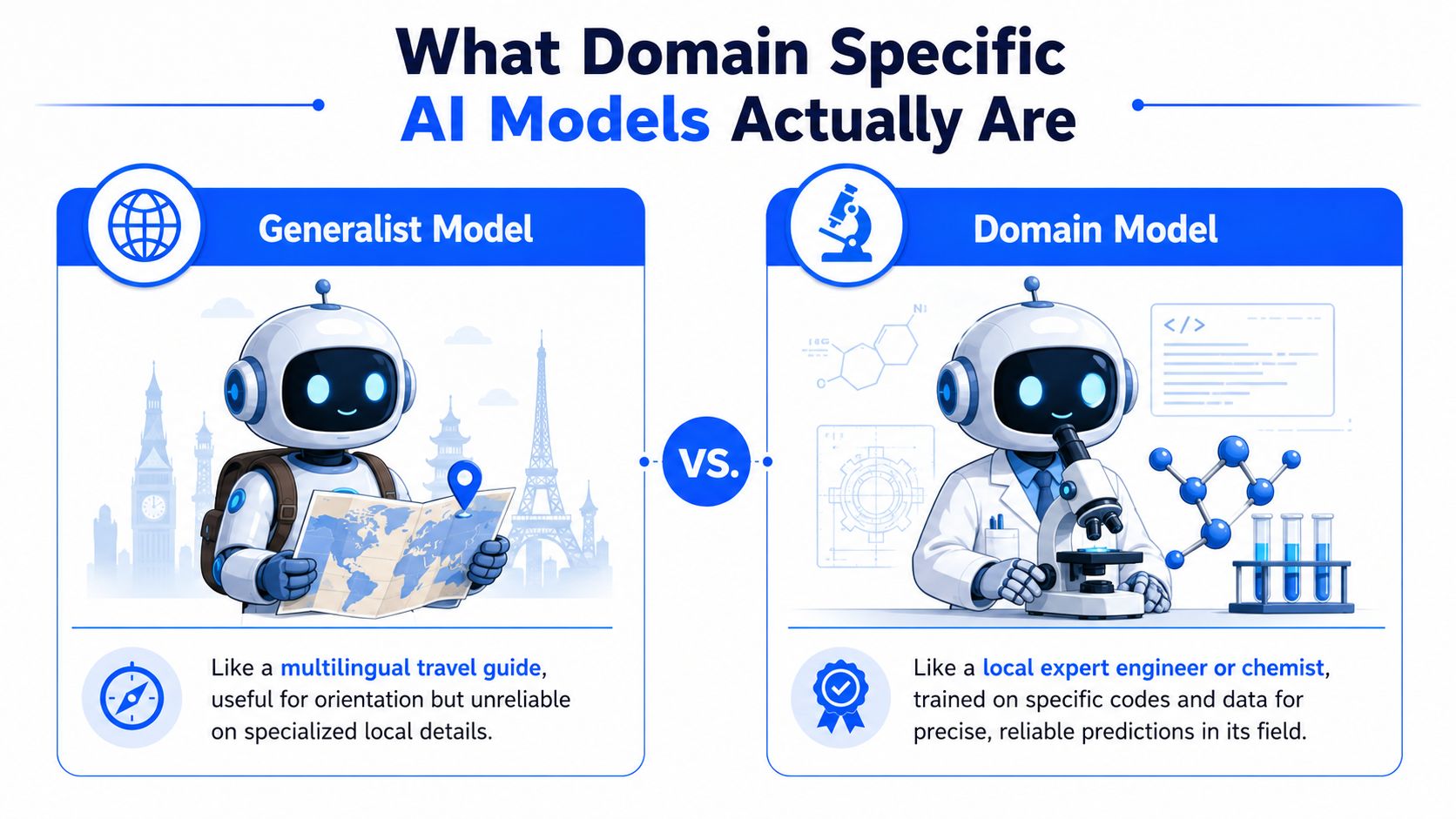
A generalist model is like a multilingual travel guide. It can orient you to a city, explain common customs, and suggest places to investigate. You wouldn't rely on it to approve a pressure vessel against local building codes. A domain-specific model is closer to the licensed engineer who knows the applicable standards, recurring failure modes, material substitutions, and operating limits.
The distinction isn't just model size. It concerns what the system has learned, what it has been optimized to do, and how it behaves when evidence is weak.
Three design differences matter
Training corpus. A general model learns from broad mixed-domain material. A materials model may use curated scientific literature, crystallographic records, synthesis routes, internal characterization reports, simulation outputs, and instrument data with known provenance. The value comes from relevance and consistency, not from adding documents indiscriminately.
Objective. General assistants optimize for useful language completion. A scientific system may be trained for property-conditioned generation, calibrated regression, structure-property prediction, entity extraction, or constraint satisfaction. A model that predicts a polymer property should be judged by error, calibration, applicability range, and physical plausibility, not by conversational fluency.
Behavior. A specialist should expose uncertainty and recognize out-of-domain inputs. A generalist often fills gaps with a likely continuation. In high-value R&D workflows, a measured refusal can be a successful output because it prevents an unsupported wet-lab campaign.
Concrete systems illustrate the range. MatBERT applies language modeling to materials-science papers, making it suitable for extracting entities and relationships that general scientific models may miss. ChemBERTa focuses on chemistry representations and tokenization. A DSC-aware copolymer model can narrow its objective further by relating composition and processing variables to thermal behavior under defined measurement conditions. MatSciML represents another direction, combining machine-learning approaches with materials structures and properties for scientific prediction.
Materials AI research supports the broader pattern. A 2025 effort called LLaMat continued pretraining on materials literature and crystallographic data, while a 2026 paper described a domain-specific machine-learning potential spanning 53 metallic elements, as summarized in the materials AI research record. Independent work reported that MatBERT significantly outperformed general-purpose models when extracting implicit knowledge from compound names and properties. A U.S. national-lab report in 2025 also found that smaller fine-tuned models built from materials Q&A data matched or exceeded much larger general models, reaching up to 20% higher accuracy on domain-specific tasks, according to the same research summary.
The engineering lesson is straightforward. Domain specific ai models aren't merely compressed versions of frontier systems. They encode a narrower task distribution, scientific vocabulary, structured representations, and evaluation criteria that map more closely to the decisions scientists make.
Architectures and Training Strategies That Work
Materials R&D systems work best when each component has a defined responsibility. Model selection should follow the data available, the scientific representation required, and the validation standard for the production task.
Encoder-only transformers such as RoBERTa or MatBERT are suited to extracting compounds, properties, process conditions, and relationships from papers or internal reports. Decoder and encoder-decoder models support synthesis descriptions, structured-input-to-experiment drafting, and candidate route generation. Graph neural networks preserve relationships in crystal structures, molecular graphs, and polymer repeat units that text-only representations may lose.
The training recipe should match the intended decision:
| Architecture or strategy | Typical R&D task | Main trade-off |
|---|---|---|
| Encoder transformer, such as MatBERT | Entity extraction, property extraction, literature mining | Strong domain representation, but it needs labeled examples for the target extraction task |
| Chemistry language model, such as ChemBERTa | Molecular representation and chemistry classification | Useful tokenization and transfer, but text representations don't fully capture physical structure |
| Graph neural network | Crystal, molecular, or polymer structure-property prediction | Represents topology and local environments, but requires clean structured inputs |
| Decoder or encoder-decoder model | Synthesis descriptions, route generation, experiment drafting | Flexible output, but generated routes require chemical and process validation |
| Retrieval-augmented generation | Questions over lab notebooks, reports, and internal PDFs | Keeps source material visible, but retrieval quality limits answer quality |
| Hybrid transformer plus DFT or molecular-dynamics surrogate | Screening and physically informed prediction | Adds scientific constraints, but increases integration and maintenance burden |
Domain pretraining teaches a base model the vocabulary and recurring patterns of materials literature. Fine-tuning on labeled experimental data aligns that model with a measurable target, provided the labels reflect the conditions and uncertainty of real experiments. Retrieval gives a system access to proprietary records without changing model weights. A hybrid pipeline can pair a language model with a DFT or molecular-dynamics surrogate when physical consistency matters more than conversational range.
Benchmark design determines whether these choices are useful. Split data by publication, compound family, batch, or time period where leakage could otherwise make performance look better than it is. Evaluate extraction against expert-reviewed labels, and test property models on held-out chemistry and process conditions, not only random rows from the same dataset.
Choosing the adaptation method
Full fine-tuning changes the model substantially and can produce strong task alignment, but it requires careful dataset versioning and creates a heavier model lifecycle. LoRA adapters reduce the cost of adapting an open-weight model and can keep different business tasks separated. Prompt-only RAG is the fastest route for internal document question-answering, but it does not teach the model to interpret specialized evidence or enforce property constraints.
For proprietary materials datasets, start with the least invasive approach that can beat an internal baseline. If retrieval answers source-grounded questions accurately, fine-tuning adds cost without solving a clear problem. If the system must predict a property, rank candidates, or follow a specialized representation, retrieval alone may not close the gap. Domain-Specific AI models succeed through task fit, data quality, and validation discipline, not architecture labels alone.
How Smaller Specialized Models Beat Larger Generalists
Model size is an incomplete proxy for technical performance. A large generalist has broad priors and strong language capability. A smaller specialist may have fewer parameters but a much closer match between its training distribution and the production task.
A recent German tax-law study provides a clean example. The study evaluated specialized models with 28B and 10B parameters, which achieved 28% ± 2 and 16% ± 2 accuracy respectively, while remaining competitive with much larger general-purpose models in the 14B to 32B range, as reported in the domain adaptation study. The result doesn't transfer automatically to materials science, but it demonstrates the mechanism: targeted adaptation can matter more than scale when the task is narrow and the evaluation reflects expert work.
Four dimensions decide the outcome
| Dimension | Generalist LLM, GPT-4 class | Domain-specific materials model | Reference materials AI baseline |
|---|---|---|---|
| Parameter count | Often larger and more capable across unrelated tasks | Sized for the target workflow and deployment environment | May be small, interpretable, and task-specific |
| Training-data specificity | Broad mixed-domain material | Curated literature, structures, experiments, and process records | Narrow labeled dataset or established scientific calculation |
| Evaluation rigor | General leaderboards and broad prompts | Holdouts designed around material families, conditions, and failure modes | Lab measurements, DFT, or validated historical baselines |
| Materials-task performance | Can reason about concepts but may extrapolate fluently | Optimized for formation energy, band gap, Tg, extraction, or ranking | Provides a task baseline that specialists must beat |
The materials translation is important. A model trained on curated synthesis routes and characterization logs can outperform a general foundation model on a property task because it learns the field's vocabulary, units, known correlations, and exclusions. A graph model can represent a crystal or polymer structure directly instead of asking a language model to infer geometry from prose.
I wouldn't use a fixed parameter threshold or a universal labeled-data rule. The right starting point is the smallest architecture that beats a credible internal baseline on unseen materials. That baseline might be a simple descriptor model, a calibrated regression, a DFT workflow, or the current scientist-designed screening rule.
Decision rule: Choose specialization when the cost of domain errors exceeds the cost of building and maintaining domain data operations.
The benchmark must test the actual task. Expert guidance on domain-specific evaluation recommends building tests from real production work, defining failure modes, and using unseen domain data because those tests predict operational performance better than general leaderboards, as described in the evaluation guidance from Findings of EMNLP.
The Data Bottleneck Most Discussions Overlook
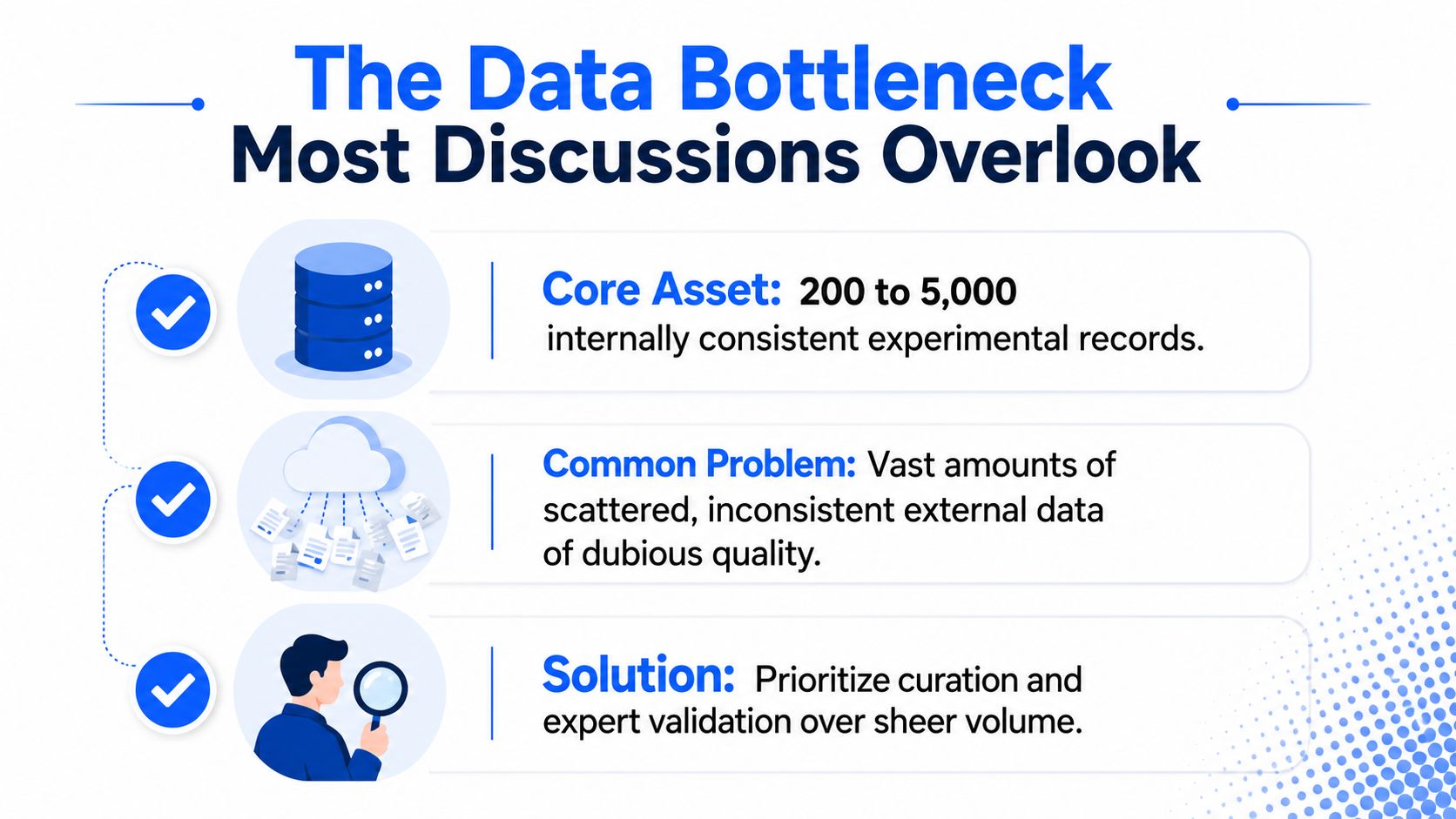
Vendor pitches often reduce the problem to “add more data.” That advice misses the central issue in industrial materials R&D. The useful dataset is usually smaller, fragmented across systems, and harder to interpret than its document count suggests.
A laboratory may have internally consistent records alongside ELN entries, LIMS measurements, supplier datasheets, scanned theses, spreadsheets, and instrument exports. Each source can use different units, naming conventions, test conditions, sample identifiers, and definitions of success. A model trained across those sources without harmonization learns the inconsistencies as if they were scientific variation.
Why quantity can mislead
Materials AI surveys identify inconsistent data quality, limited interpretability, missing standardized sharing frameworks, and weak coverage of small-data settings as persistent problems. A 2026 materials-science commentary describes a “rich-get-richer” pattern, where models disproportionately learn from abundant, easy-to-synthesize compounds while reactive intermediates, defects, and extreme-condition performance remain sparse, as discussed in the materials data bottleneck review.
That imbalance creates a dangerous evaluation effect. The model can appear confident on well-documented chemistries because those chemistries dominate the corpus. The underrepresented cases that matter most for formulation, process optimization, and scale-up remain poorly supported.
The cure is not a larger scrape. Teams need schema harmonization, provenance, negative-result capture, linked experimental conditions, and uncertainty-aware labels. External extraction can support discovery work, and Scalability Professional providers handle large-scale extraction jobs, but extracted records still require domain review before they become training evidence.
A small, consistent dataset can support a useful specialist. A larger dataset with mixed units, missing failures, and ambiguous test conditions can teach the wrong relationships.
Building, Validating, and Governing a Domain Model
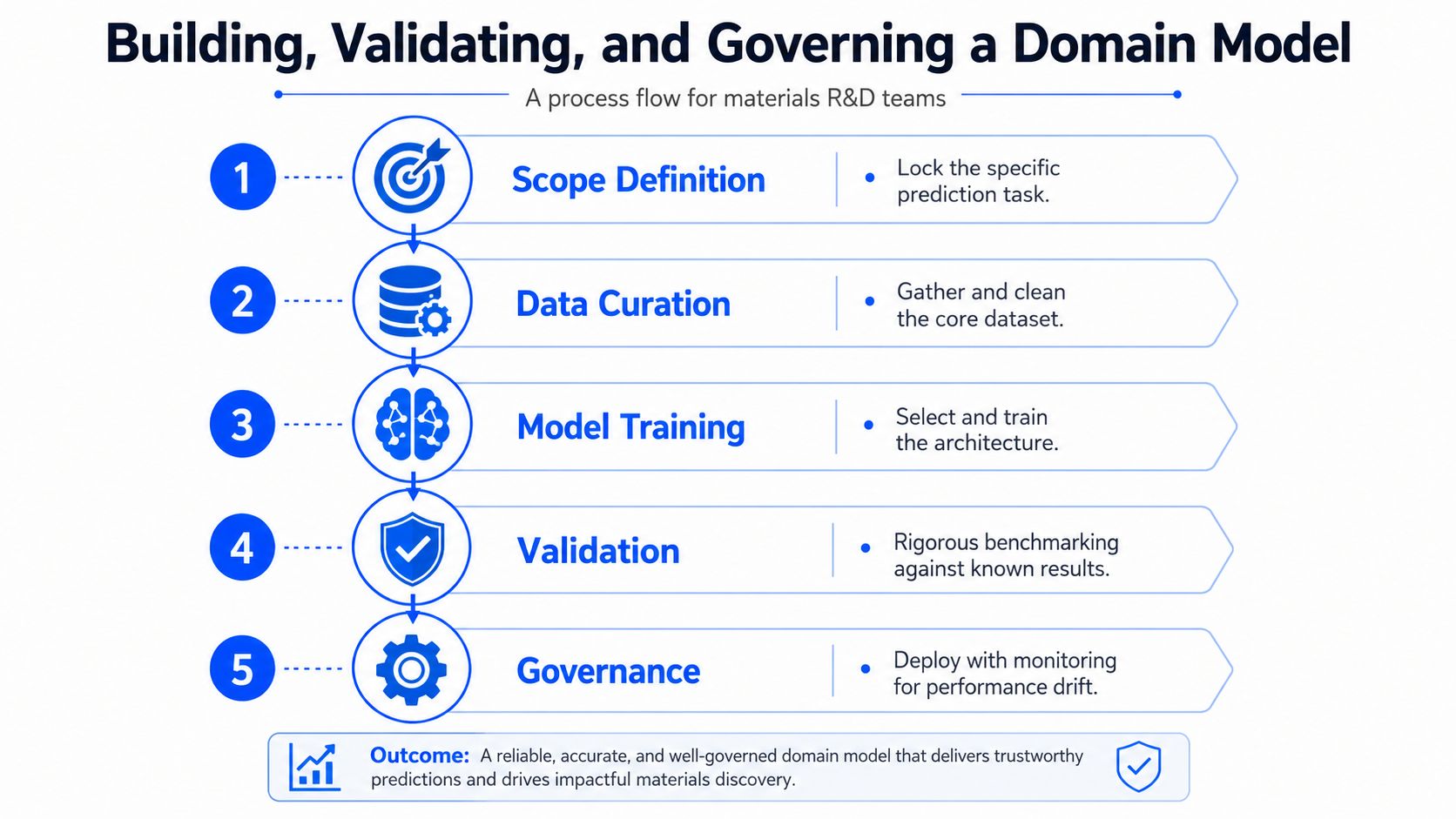
A materials model should enter production through a controlled sequence. The sequence matters because architecture decisions made before task definition usually create expensive rework.
Start with a decision, not a model
Define the target. Specify whether the system predicts solvation free energy, polymer Tg, a synthesis route, formulation performance, or another concrete output. Record the measurement conditions and the action the prediction will support.
Build the data foundation. Attach provenance to every record. Normalize units, preserve test conditions, capture negative results, and separate measured values from estimates or simulations. Keep the original record available so scientists can audit transformations.
Select the representation. A pretrained encoder such as MatBERT or ChemBERTa may suit text and chemical language. An equivariant graph neural network may better represent structures. Retrieval can add internal documents, while a task head converts the representation into a prediction or classification.
Validate against the way the model will fail
Random train-test splits often make a model look stronger than it is. Similar formulations, related material families, or duplicate measurements can appear on both sides of the split. A better test holds out material families, uses temporal separation where the deployment will face future records, and includes chemistry the model hasn't encountered.
Benchmark design should include:
- Unseen-family tests, so close analogues don't inflate performance.
- Physical baselines, such as DFT, molecular dynamics, or trusted laboratory measurements where appropriate.
- Confidence intervals, using bootstrap methods to show how stable the reported result is.
- Applicability checks, which identify inputs outside the training distribution.
- Failure labels, including impossible synthesis conditions, missing units, and contradictory measurements.
Governance begins before deployment. Log each inference with an input hash, model version, retrieval context, and uncertainty estimate. Maintain training-data lineage for IP defense and technical review. Use explanations suited to the architecture, such as SHAP or integrated gradients for appropriate predictors, attention inspection where it is informative, and counterfactual analysis for structured models.
Validation is not a final approval gate. It is the operating definition of what the model is allowed to do.
Deployment, Explainability, and Common Failure Modes
A validated model can still fail after integration. The deployment surface changes the risk. Batch scoring suits candidate libraries and screening campaigns. Inference embedded in a LIMS or ELN can provide predictions at the point of experiment entry. An interactive copilot supports scientists, but it also creates more opportunities for unsupported language and accidental overreach.
Explanations need to travel with the prediction. For a surrogate regressor, SHAP feature attributions can show which descriptors influenced an output. For a graph model, attention or node-level analysis may help inspect structural contributions. Counterfactual neighbors can show which known materials sit near a candidate in latent space. Retrieval-grounded summaries can connect a prediction to the source records that support it.
Failure modes that look reasonable
| Failure mode | Why it looks correct | Detection control |
|---|---|---|
| Scaffold or family leakage | Training and test records look different at the row level | Split by scaffold, material family, or cluster rather than random rows |
| Unit drift | Values remain numerically plausible | Normalize units during ETL and reject records with missing measurement conventions |
| Composition extrapolation | The model returns a smooth prediction for a new formulation | Score domain of applicability and require human review outside supported composition space |
| Prompt-only explanation | The answer gives a coherent causal story | Require retrieved evidence, compare against model features, and prohibit unsupported causal claims |
| Retrieval mismatch | The response cites a related document | Log retrieved passages and test relevance against expert-labeled queries |
| Silent production drift | The service remains available and returns valid syntax | Monitor input distributions, confidence, abstention rates, and outcome feedback |
The most dangerous failure is often not an obvious error. It is a technically wrong result that matches the team's expectations. A polymer property prediction can look credible because its value sits near historical measurements, even though the formulation uses a different test protocol. A synthesis recommendation can cite real papers while ignoring a process constraint specific to the plant.
Operational controls should therefore record not only the answer, but also the evidence path, input transformation, model version, uncertainty, and approval status. Explainability is useful when it exposes the reasoning inputs. It isn't useful when a language model invents a persuasive story after the prediction has already been made.
An Enterprise Playbook for Domain Specific AI Models
Senior informatics leaders can turn the preceding principles into four operating lanes.
Data foundation
Instrument the laboratory for structured capture rather than relying on retrospective cleanup. Establish a controlled glossary for units, test conditions, material names, and failure labels. Version datasets with tools such as DVC or lakeFS, retain acquisition and licensing records, and negotiate data rights when business units or companies are acquired.
Modeling choice
Start with the smallest architecture that beats the internal baseline. Match the loss function to the physical output where possible, and separate prediction, retrieval, and generation instead of forcing one model to perform every role. A bespoke system may be justified when proprietary data and specialized constraints create a persistent gap, but a smaller model plus workflow controls can be more practical than a custom foundation model.
Validation rigor
Use temporal and cluster splits, test open-set applicability separately from closed-set accuracy, and publish benchmark release notes written by scientists. Define what counts as an unacceptable error before the model reaches a production workflow. For teams planning autonomous or semi-autonomous workflows, resources on tailored AI agent development can help frame the integration problem, but agent architecture won't compensate for weak experimental data or an undefined success criterion.
Governance and scaling
Assign a model steward, create change control for datasets and weights, budget for retraining as the process changes, and monitor silent failure in production. Gartner-linked reporting projects that domain-specific GenAI model spending will rise from USD 302 million in 2024 to USD 1.146 billion in 2025, while also warning that cost, complexity, and technical debt can cause custom projects to fail or be abandoned, as reported by National CIO Review's coverage of the forecast. Specialization only creates value when governance and data operations can sustain it.
The procurement advantage will belong to organizations that treat proprietary materials data as a governed asset, not an accidental byproduct of experimentation.
Polymerize helps materials teams turn fragmented experimental records into an AI-ready foundation and applies domain-specific, explainable models to predict properties, optimize formulations, and identify causal drivers with confidence scores and historical precedents. If your team is deciding whether specialized AI can improve formulation and scale-up decisions, visit Polymerize to explore a practical path from curated data to targeted experimentation.
Put your R&D data to work
See how materials teams use Polymerize to plan fewer experiments and reach target properties faster.