

You're staring at a formulation sheet with too many knobs and too few answers. The polymer looks promising in one batch, the viscosity drifts in the next, and the team keeps changing one ingredient at a time while the underlying issue may be the interaction between three or four variables at once. That's the point where design of experiments software stops being a nice-to-have and becomes a practical way to turn scattered trial runs into a repeatable learning process.
For materials teams, the frustration usually isn't a lack of data, it's a lack of structure. Results live in spreadsheets, ELNs, lab notebooks, and people's heads, so every new study starts with fresh guesswork. A systematic DOE approach gives you a way to test more intelligently, preserve what you learned, and avoid repeating the same expensive mistakes.
Table of Contents
Why Trial and Error Slows Down Materials Innovation
A common lab pattern looks harmless at first. Someone tweaks a binder, changes a curing temperature, adjusts a filler loading, and runs a few batches. The team gets one useful result, two ambiguous ones, and one failure that teaches almost nothing because the run conditions weren't planned to expose the relationships.
The problem is that formulation variables rarely act alone. In polymers, chemicals, and advanced materials, a change that helps one property can hurt another, and the effect may only appear when two factors move together. One-factor-at-a-time work is easy to organize, but it hides interaction effects, wastes runs, and makes it hard to tell whether a result is real or accidental.
The hidden cost of scattered experimentation
The cost isn't only wasted material. It's the time spent reconciling inconsistent notes, recreating old conditions, and re-running tests because no one can prove exactly what happened last time.
That's why many R&D teams feel stuck even when they're running plenty of experiments. The team is active, but the learning is thin. A better system turns each study into a building block for the next one, instead of a one-off attempt that disappears into a shared drive.
Practical rule: If an experiment can't be repeated with confidence, it hasn't really been learned from.
Design of experiments software helps by making the study itself more deliberate. Instead of hoping patterns emerge from ad hoc testing, it organizes the work so the results can answer a sharper question. That shift matters most when the formulation space is crowded, expensive, or hard to reproduce.
What Design of Experiments Software Really Does
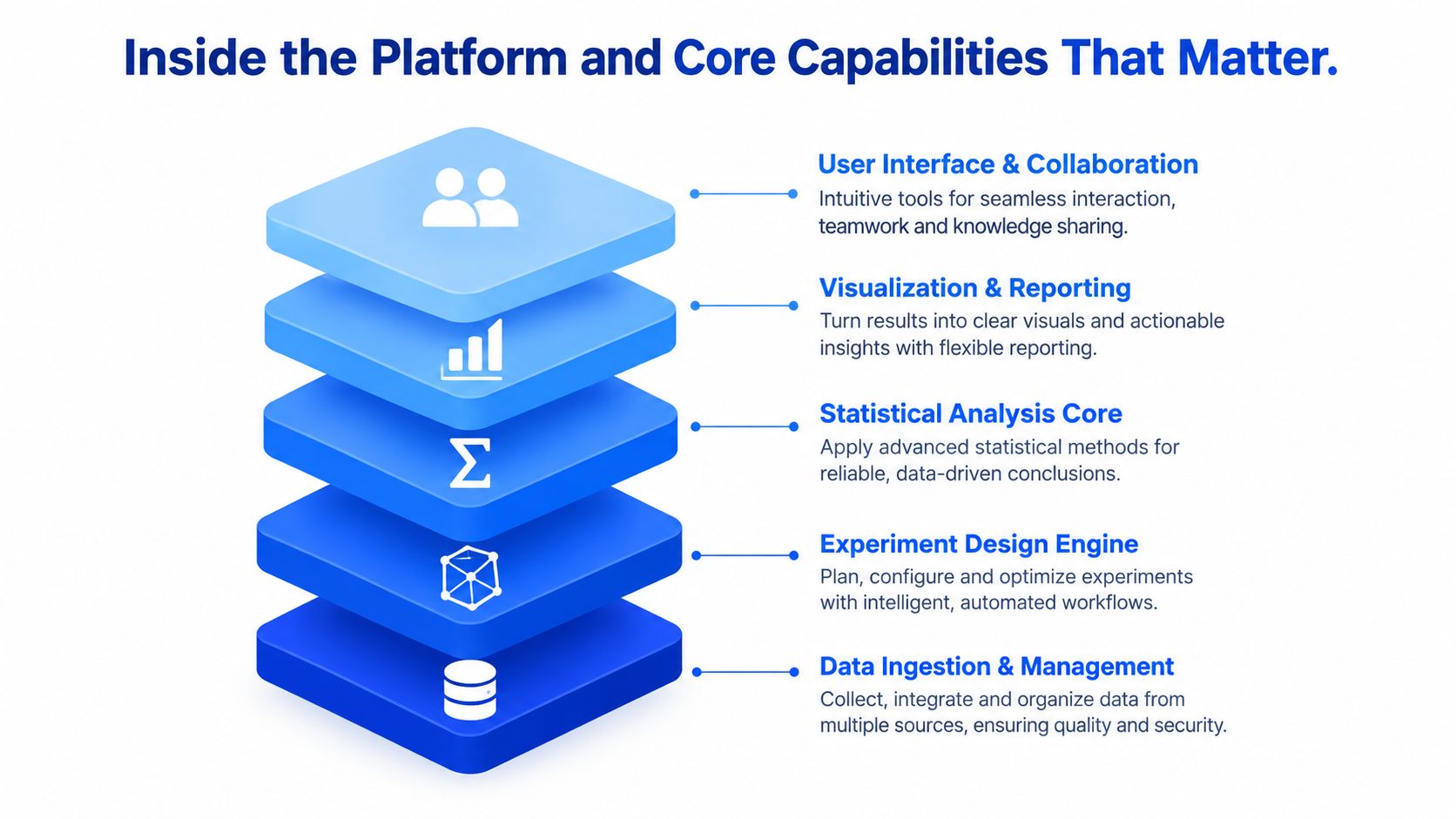
Think of a recipe with flour, water, heat, mixing time, and additives. If you change only one ingredient per batch, you'll miss the fact that the best texture might come from the combination, not the ingredient by itself. Design of experiments software works the same way, it helps you plan a study so the experiment can reveal cause and effect instead of just recording outcomes.
The key difference is that the software is not only a calculator after the fact. It helps build the design before any sample is mixed, which means it shapes the quality of the experiment upstream. A 1987 review of computer-aided design of experiments described this shift from analysis-only use to planning and data-collection support, and that's still the right way to think about modern DOE tools, they're part of the design process itself. Historical summary from Stat-Ease describes how DOE became practical in the desktop-computing era, while a later technical discussion notes the move from analysis into planning and collection as the big change in software use.
The three jobs a DOE platform has to do
First, it builds a sensible run plan. That means deciding which combinations of factors to test, how to randomize them, and where to block them so noise doesn't masquerade as signal.
Second, it captures structure. The software doesn't just list runs, it preserves the relationship between factors, responses, and experimental intent, so the study can be analyzed later without guesswork.
Third, it turns the results into usable insight. That might mean screening the biggest drivers, fitting a response surface, or pointing to the next best experiment when the first pass isn't enough.
A DOE platform should make the experiment more informative before the first sample is ever made.
That's why the software matters to formulation scientists. It isn't just about convenience or cleaner charts. It acts like a quality-control layer for learning, making sure the study is designed to find interactions, not hide them.
Inside the Platform and Core Capabilities That Matter
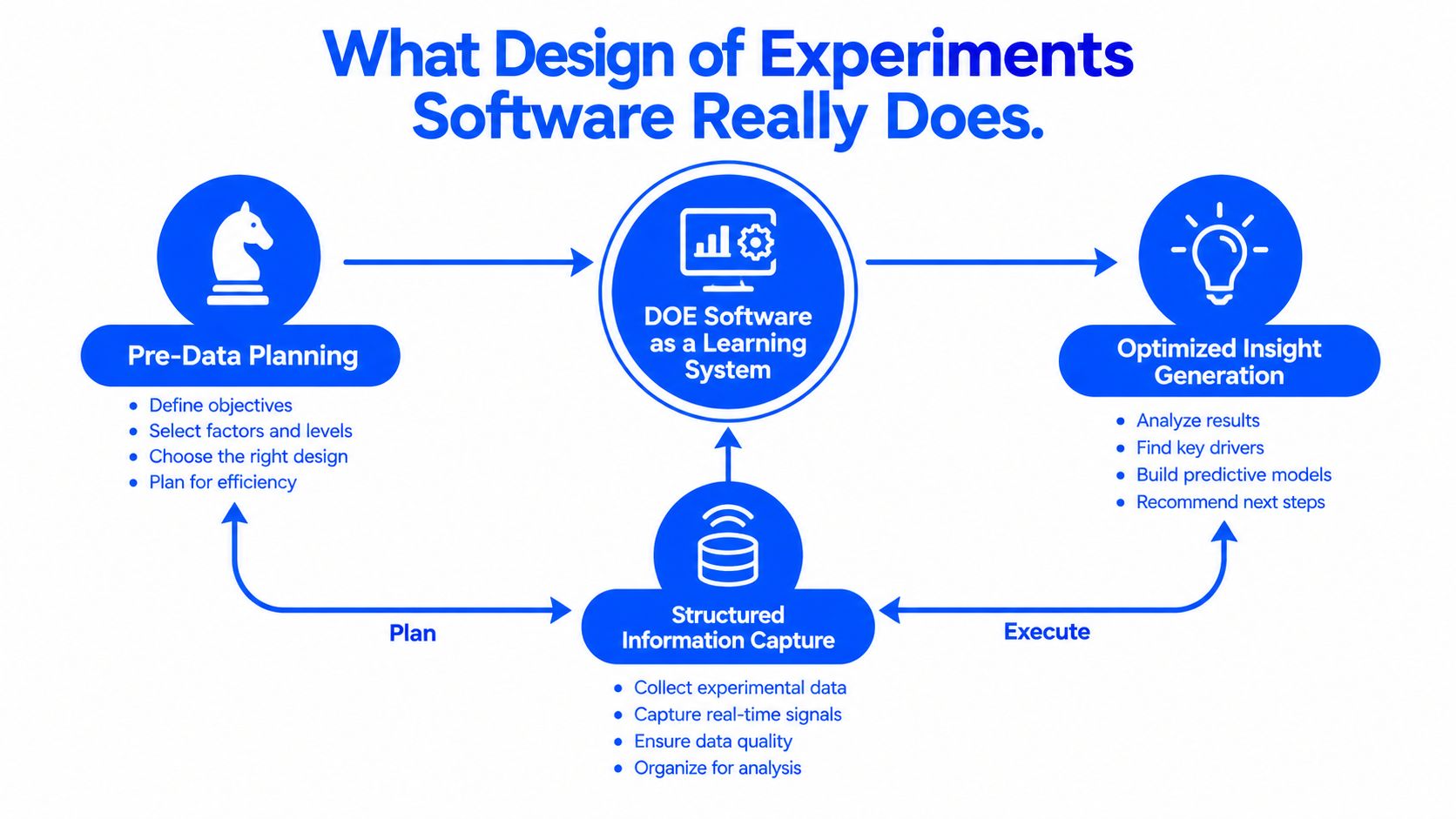
A useful DOE platform has layers, and each layer solves a different problem for the scientist. If one layer is weak, the whole workflow becomes fragile, especially once the study moves beyond a single analyst and into a shared development program.
From design engine to governance layer
At the core sits the experiment design engine. This is the part that builds the run matrix, handles randomization, supports blocking, and creates the structure needed to detect main effects and interactions. For a formulation scientist, that means the software isn't guessing at the plan, it's constructing a deliberate path to learning.
Above that sits the statistical analysis core. This layer fits models, checks whether the chosen design can support the conclusions you want, and makes the results interpretable. A good system doesn't just spit out coefficients, it helps the team decide whether the model is meaningful enough to trust.
Then comes visualization and reporting, which matters more than it sounds. Scientists need to see response trends, factor effects, and trade-offs quickly, because a numerical table alone won't tell a development team where to go next.
The most important enterprise layer is often the least advertised, data ingestion and management. In materials R&D, a design is only as useful as the data backbone behind it. If factor definitions drift between studies, or responses are copied by hand from one system to another, the lineage gets muddy and the experiment becomes hard to reuse.
Finally, there's the collaboration and governance layer. Recent summaries on DOE software emphasize RBAC, audit logs, workflow-state traceability, and reuse of factor definitions and fitted model structures across reruns, which is a strong signal that buyers are looking for a controlled system of record, not just a statistics tool. Governance-focused overview captures that shift well, especially for regulated or cross-functional teams.
Governance matters: the winning tool is often the one that preserves lineage across reruns, not the one with the flashiest model menu.
Modern platforms are also moving toward AI-assisted planning and closed-loop workflows. A useful example is Polymerize, which unifies fragmented experimental data into a centralized backbone and combines that with model-driven experiment planning for materials teams. That kind of setup matters when a lab wants to connect design, execution, and learning without losing control of the record.
Choosing the Right DOE Type for Your Goal
Different DOE types solve different problems, and many teams get tangled. They ask for “DOE software” as if every study needs the same design, when the better question is what you're trying to learn.
Screening is not the same as optimization
If the first goal is to find which factors matter at all, a screening design is usually the right place to start. In materials work, that might mean checking resin type, catalyst level, cure temperature, and mixing time to see which ones drive the biggest changes in performance. You want coverage and speed, not a highly polished model too early.
If the goal shifts to refining a promising recipe, then response surface methods become more useful. These designs are built to explore curvature, so they can help locate a better region inside the design space rather than only testing the edges. That's the right move when the early study says “these factors matter,” but not yet “this exact combination is best.”
A full factorial design is the cleanest way to study all factor combinations when the factor count is manageable. A fractional factorial trims the run count while still catching important effects, which is often the more realistic choice in lab settings. For categorical factors and software-test style combinations, covering arrays can reduce the run burden while keeping interaction coverage practical, which is exactly why DOE shows up in software engineering discussions as a way to fight combinatorial explosion.
Matching design type to the development question
Mixture designs deserve their own treatment because components in a blend don't behave like independent knobs. If one ingredient goes up, another must come down, so the software has to treat the formulation differently from a process study.
For materials scientists, that distinction matters. A polymer blend, an additive package, or a coating formulation can't always be mapped with the same logic as a processing study, so the design type has to fit the physical reality, not just the software menu.
| R&D Goal | Recommended DOE Type | When to Use It | Trade-off to Consider |
|---|---|---|---|
| Find the most important drivers | Screening design | Early-stage formulation work with many factors | You may learn less about fine optimization |
| Test all factor combinations | Full factorial | Small factor sets where completeness matters | Run count rises quickly |
| Reduce runs while keeping key effects | Fractional factorial | When budget or sample volume is limited | Some effects may be confounded |
| Refine a promising region | Response surface method | After screening shows clear winners | More complex planning and analysis |
| Work with blend components | Mixture design | When ingredient proportions must sum to a whole | Interpretation is more specialized |
| Handle categorical combinations | Covering array | When categories create too many possible runs | It's built for coverage, not full numerical optimization |
In practice, the software should help you choose the design, not force you into one pattern. The best system makes the trade-off visible, so the team can decide whether it wants fewer runs, better interaction coverage, or a stronger path to optimization.
How to Evaluate Design of Experiments Software Without the Hype
Many product pages sound impressive because they list features, not outcomes. For R&D teams, that's not enough. The true test is whether the platform can support how scientists work, across data, people, and repeated studies.
What enterprise readiness looks like
Start with the data layer. If the software can't pull in experimental history from spreadsheets, ELNs, and related lab systems without a mess of manual cleanup, the rest of the stack is harder to trust. A strong platform should also help standardize factor definitions so the same variable means the same thing across studies.
Then look at usability. Chemists and materials scientists need to read the design, understand the response, and act on the output without needing a statistician in every meeting. That doesn't mean oversimplifying the math, it means making the workflow understandable enough that the team keeps using it.
Integration matters just as much. DOE doesn't live alone, it has to connect with execution, reporting, and sometimes downstream automation. If the platform can't fit into the lab's broader digital environment, it becomes another isolated tool instead of part of a working system.
Buying rule: prefer the platform that keeps your experimental lineage intact over the one that only looks smart in a demo.
There's also a shift in the market context. Industry reports describe DOE software as a specialized category, but one that's growing and increasingly used in industrial R&D across pharmaceuticals, manufacturing, automotive, and chemicals. They also point to cloud, collaboration, and AI/ML integration as major purchase themes, which fits what many R&D leaders are already seeing inside their own organizations. Market coverage suggests enterprise adoption is widening, even if the category is still narrower than broader analytics software.
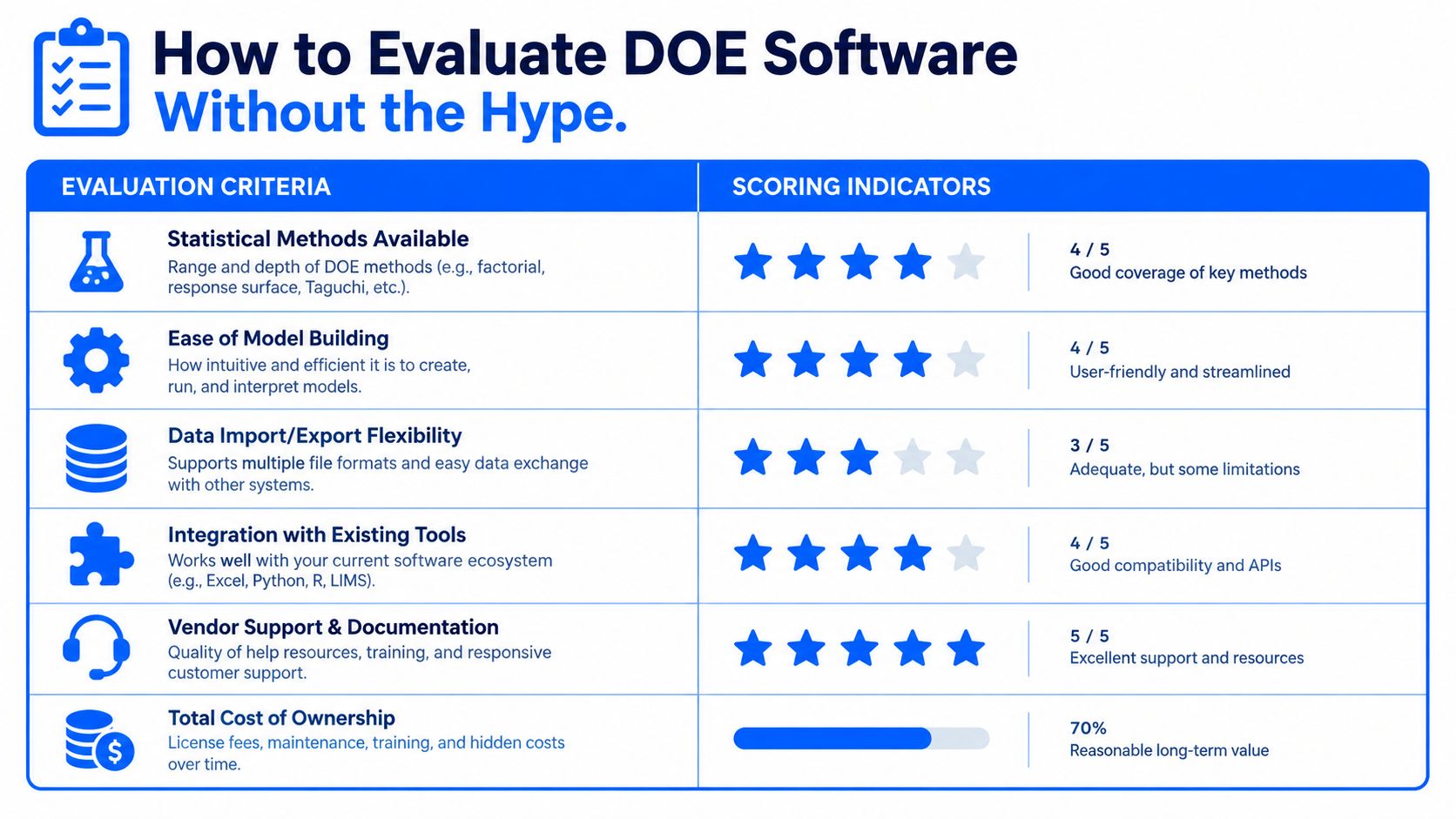
A practical shortlist looks like this:
- Statistical depth: Can the tool handle screening, optimization, and special designs without forcing workarounds?
- Workflow fit: Can a scientist build and review a study without constant translation from a statistician?
- Data flexibility: Can it ingest heterogeneous experimental records cleanly?
- Governance: Does it support review, traceability, and controlled reuse?
- Operational continuity: Can it support repeated studies instead of only one-off projects?
From Pilot to Scale and a Practical Implementation Roadmap
The safest way to adopt DOE software is to treat it like a workflow change, not a software install. Teams that rush straight to enterprise rollout usually discover that their data are fragmented, their factor names aren't consistent, and their lab habits don't match the platform's assumptions.
Start with the data backbone
Begin by auditing the sources you already have. That means spreadsheets, ELNs, instrument exports, and any lab records that hold factor settings or response data. If those records are scattered, create a central structure first, because the software can't govern what it can't see.
Then connect the study to execution. A DOE design only works if the team can run it cleanly, capture the results, and know what changed between runs. That's why many organizations pair experimentation software with broader workflow tools to orchestrate back-office automation around approvals, handoffs, and data movement.
Pilot a real formulation problem
Choose one concrete question, not a giant transformation program. A polymer blend, coating formulation, or process optimization study is ideal because the team can see whether the platform helps them make better decisions.
During the pilot, focus on a few simple signals. Did the team waste fewer runs? Did they capture the data more cleanly? Could they explain the next experiment without reopening a dozen files?
Once that works, extend the same structure to more studies. The goal is not just to generate designs, it's to keep factor definitions, model structures, and experimental lineage reusable across reruns so the learning compounds instead of resetting each time.
A roadmap that includes AI-assisted planning and closed-loop learning is increasingly relevant here. Recent materials on DOE systems point toward connected experimentation, simulation, and human-in-the-loop decision-making, which is exactly where the field is heading. AI-assisted DOE overview frames that shift clearly, especially for teams thinking beyond a single study.
Common Pitfalls and Best Practices for Lasting Results
The most common mistake is overbuilding the first study. Teams often want to test everything at once, but that usually creates a bloated design with too much noise and too little clarity.
Another mistake is treating DOE like a temporary statistics project. If the experiment isn't governed, traceable, and reusable, the organization learns once and forgets twice. That's a bad trade for materials R&D, where the whole point is to build on prior runs.
A few habits make the work last longer:
- Start with screening: Find the meaningful drivers before chasing precision.
- Protect lineage: Keep factor names, response definitions, and run history consistent across studies.
- Respect randomization and blocking: These aren't decoration, they're part of what makes the conclusions believable.
- Reuse proven structures: When a model structure worked once, capture it so the next study doesn't start from zero.
The strongest DOE program is the one the team can rerun, review, and trust six months later.
The best teams think of DOE software as a governed learning layer for materials development. That's a different mindset from a calculator, and it's the one that turns recurring trial-and-error into a faster path from concept to scale-up.
If you're building a more connected experimentation workflow, Polymerize can help unify experimental data, support DOE-driven planning, and keep model lineage tied to the underlying lab record. Visit Polymerize to see how a governed, AI-connected materials platform can fit into your R&D process.
Put your R&D data to work
See how materials teams use Polymerize to plan fewer experiments and reach target properties faster.