

Your formulation team has the data. It just isn't in one place, in one format, or in a form any model can trust.
A polymer chemist logs trial batches in Excel. Analytical data sits in instrument software. A process engineer keeps scale-up notes in email threads. Someone else stores characterization results in an ELN that nobody outside the group uses correctly. Months later, another team repeats work that already failed once because the original result can't be found, interpreted, or trusted.
That's the operational reality behind most discussions about data management system software in materials R&D. The problem isn't a lack of data. It's fragmented context. In a lab, raw values without formulation history, processing conditions, sample lineage, and test method details are often useless. If a CTO wants an AI-ready R&D stack, the first decision isn't which model to buy. It's how to build a reliable data backbone that scientists will use.
Table of Contents
- Ingestion that works with lab reality
- Normalization and metadata discipline
- Governance, provenance, and controlled access
The Hidden Costs of Disconnected R&D Data
A formulation scientist is asked a simple question before the weekly project review. Have we seen this failure mode before under similar mixing conditions? The answer should take minutes. In many materials labs, it takes half a day of checking spreadsheets, instrument folders, old slide decks, and someone's memory of a project that ended two years ago.
That delay is not an inconvenience. It is a recurring operating cost.
In conversations with lab leaders, the visible symptoms come up quickly. Scientists spend hours searching for prior runs. Teams repeat formulations that already failed or delivered marginal results. Scale-up inherits records with missing process context, unclear sample lineage, or no link between analytical output and the batch that produced it. The less visible problem is dark data. Experimental knowledge exists, but the team cannot find it, trust it, or reuse it when a decision is on the line.
Materials R&D is especially vulnerable because the data is interdependent. A tensile result without processing history has limited value. A microscopy image without sample prep details is hard to compare. An instrument export without raw material lot information breaks traceability. Fragmentation turns technically stored data into low-confidence evidence.
The cost shows up in three places at once. First, scientific throughput drops because researchers spend time reconstructing context instead of designing the next experiment. Second, decision quality drops because teams compare partial records and treat weak historical matches as if they were solid precedent. Third, digital initiatives stall. Machine learning, informatics, and cross-site knowledge reuse all depend on data that is consistently labeled, connected, and reviewable.
Why this becomes a CTO issue
A disconnected lab can keep producing experiments. What it cannot do reliably is accumulate learning across programs, sites, and staff changes.
That matters when the business expects faster iteration, tighter transfer from bench to pilot, and defensible use of AI. If chemistry data, process data, analytical results, and external reference files remain separated, every new project starts with an incomplete view. The organization keeps paying to rediscover knowledge it already generated.
A practical test is simple. If a scientist cannot retrieve a prior experiment with its full context, including formulation, process conditions, sample genealogy, method, and outcome, within a reasonable amount of time, the company is maintaining files rather than building usable R&D memory.
This is also where governance and security move from IT hygiene into research operations. Access control, version history, and document integrity affect whether scientists trust the record in front of them. Teams evaluating infrastructure often look at adjacent disciplines for ideas on controlled access and auditability, including approaches such as AITS document security solutions.
What doing nothing really means
Doing nothing usually means the lab adapts around the problem:
- Scientists keep local workarounds because the official system does not match how experiments are run.
- Historical comparisons stay manual because sample IDs, units, file formats, and metadata are inconsistent.
- Tech transfer stays fragile because receiving teams have results, but not enough context to reproduce them with confidence.
- AI projects remain stuck at the demo stage because data lineage, completeness, and consistency cannot be verified.
- Knowledge walks out the door when experienced staff change roles or leave the organization.
For a CTO, this is the actual cost model. Fragmentation increases cycle time, weakens reproducibility, and lowers the return on every experiment already paid for.
That is the hidden tax in materials R&D.
What Is a Data Management System for Materials R&D
A formulation scientist finishes a promising trial, the rheology data sits in one instrument folder, the batch details live in Excel, microscopy images are stored on a shared drive, and the reasoning behind the next iteration is buried in email or a notebook. Six months later, another team tries to build on that work and spends days reconstructing what already happened. In materials R&D, a data management system exists to prevent that loss of time and context.
For a materials organization, a data management system is the digital operating layer that connects formulation inputs, process parameters, characterization results, sample genealogy, and decision history into one usable record of scientific work.
A generic database stores values. A lab-ready system stores meaning in context. It has to capture that a DSC curve belongs to a specific sample, that the sample came from a given batch, that the batch used a particular raw material lot, and that the result should be reviewed alongside mixing speed, residence time, aging conditions, and downstream performance tests. Without that context, retrieval is limited to archive searches instead of enabling scientific reuse.

What the system actually has to do
In practice, good data management system software has three jobs.
First, it preserves sequence and provenance. Teams need to see what was made, how it was made, which inputs changed, and which result set is the trusted one.
Second, it makes data findable in ways scientists work. Search by chemistry, property target, processing condition, test method, project, or failure mode matters far more than a folder path or file name.
Third, it moves trusted data into analysis tools, dashboards, modeling workflows, and business systems without repeated manual cleanup. That is where many programs either gain speed or lose it.
This is also why many enterprise repositories disappoint R&D groups. They handle documents and transactions well, but materials development is rarely linear. One formulation can branch into ten variants. Test methods change mid-program. Data arrives from instruments, simulation tools, supplier specs, and operator notes. The system has to handle that complexity while keeping enough structure for comparison, traceability, and reuse.
What it should connect
A useful platform in this environment should connect several layers at once:
- Experimental execution such as formulations, batch records, and observations
- Analytical outputs such as spectra, thermal analysis, rheology, or microscopy results
- Modeling inputs and outputs from simulation or prediction workflows
- Operational reference data such as material catalogs, units, methods, and sample naming rules
For organizations tightening IP controls around reports, specifications, and technical records, this often sits alongside broader secure document practices. A practical reference point is AITS document security solutions, which shows how document governance and controlled access fit into the larger information architecture.
The right system reduces the cleanup work required to make scientific results reusable.
The broader enterprise market has already pushed the underlying database and data infrastructure stack much further than it was a decade ago, as noted earlier. For a CTO, the practical takeaway is simple. The technical foundation is mature enough. The harder question is whether the system can represent real lab work, reduce the cost of fragmented data, and earn adoption from scientists who already have little patience for extra administrative work.
Core Capabilities Your R&D Team Needs
A materials R&D platform earns adoption in the messy parts of lab work. Vendor demos highlight dashboards and search screens. Scientists judge the system on whether it can absorb instrument files, preserve experiment context, and stop naming drift from corrupting analysis six months later. If those basics fail, the platform becomes another place to upload files after the actual work is done elsewhere.

Ingestion that works with lab reality
The first capability is reliable ingestion from imperfect sources.
That means APIs, but it also means support for the formats labs already depend on. Legacy Excel workbooks, instrument exports, ELN records, LIMS data, and ERP reference tables all show up in the same program history. In a polymer or specialty chemicals environment, the mix usually includes rheometer files, DSC and TGA outputs, spectroscopy data, formulation sheets, and free-text operator notes that were never standardized.
The practical design choice is staged ingestion. Start with the data sources that affect decisions most often, then map them into a shared model and improve quality over time. Teams that wait to clean every historical file before launch usually stall. Teams that ingest high-value data first can start reducing rework early.
Normalization and metadata discipline
The next capability is normalization. Many implementations lose credibility with scientists at this juncture.
Small inconsistencies create large downstream problems. Temperature recorded as Temp, T, °C, and K will break comparisons unless the system enforces rules. A resin grade with multiple aliases across sites will distort search results. Viscosity values collected at different shear rates need method-aware structure or they become misleading rather than useful.
In materials R&D, three metadata layers matter most:
- Sample lineage so each test result connects to exact ingredients, lots, process steps, and intermediate samples
- Method context so a value stays tied to protocol, instrument settings, calibration state, and method revision
- Decision metadata so teams can see the purpose of the experiment, such as screening, optimization, failure analysis, or customer support
Without that structure, a centralized system stores more data but does not reduce the cost of finding, trusting, or reusing it.
Governance, provenance, and controlled access
Governance in an R&D system should be concrete. Who created the record. What changed. Which version was approved. Which team can see it.
That matters when experimental data feeds technical claims, regulated submissions, customer questionnaires, or cross-site development programs. It also matters for day-to-day science. If a team cannot trace a property back to the exact sample, method, and calculation path, they will revert to local spreadsheets because those feel safer.
A common architectural choice is an MDM hub, which centralizes record creation and identifier control. The trade-off is straightforward. Centralized models usually give tighter consistency for materials, methods, and naming conventions, but they can require more upfront data design and stronger change management. Distributed synchronization can be easier to layer onto existing tools, but conflicts between systems tend to surface later, usually when teams start comparing results across programs or sites.
Here's a useful technical explainer before vendor calls:
A capable platform should support the following controls:
| Capability | What it means in a lab | Why it matters |
|---|---|---|
| Versioning | Every formulation and test record has a recoverable history | Scientists can compare results with confidence and revisit prior assumptions |
| Audit trails | Changes are logged with user and timestamp | QA, regulatory, and IP reviews are easier to defend |
| Role-based access | Teams see the programs and records relevant to them | Sensitive projects stay segmented without blocking broader platform use |
| Flexible schemas | New material classes and test methods can be added without major redesign | The system can adapt as research priorities shift |
One practical option in this category is Polymerize Connect, which is built to centralize fragmented experimental data from spreadsheets, ELNs, and lab silos into an AI-ready data backbone for materials R&D. It's an example of a platform designed specifically to structure scientific data beyond basic file storage.
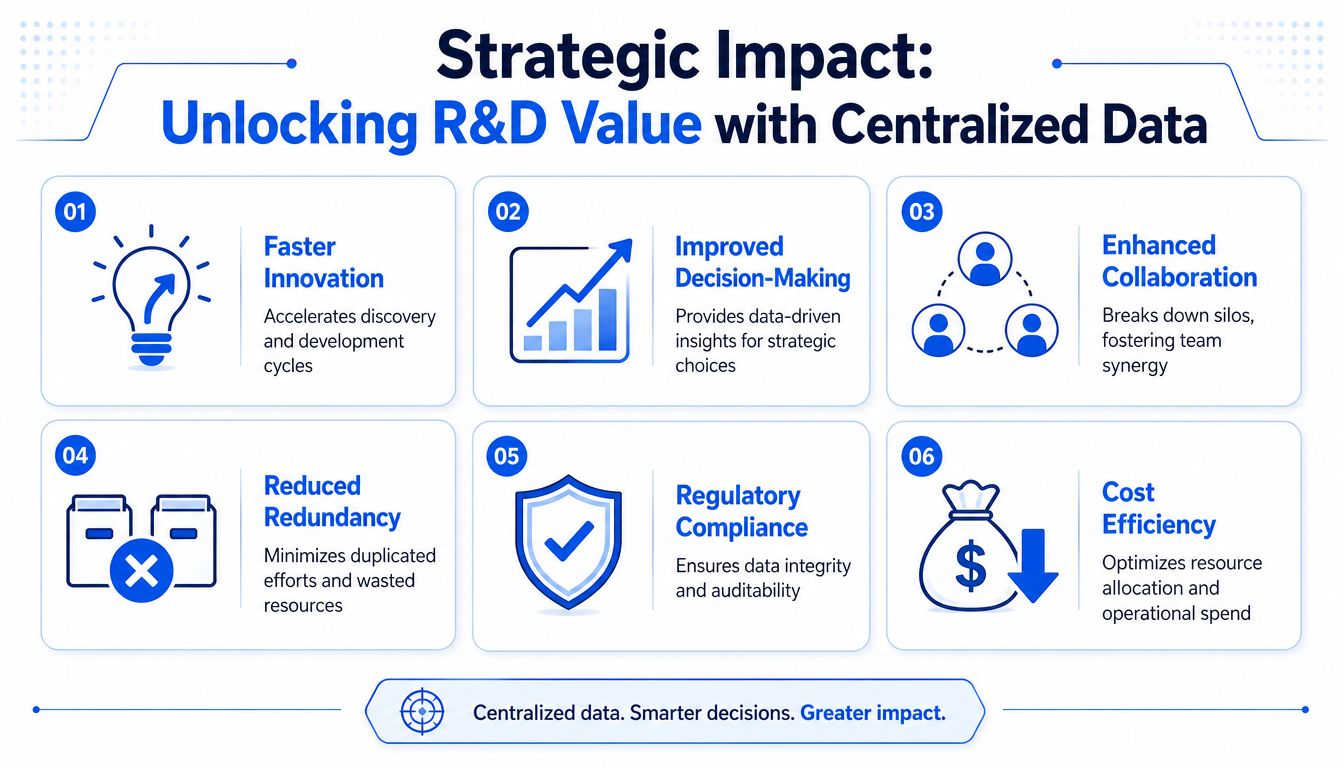
The Strategic Benefits of Centralized R&D Data
The technical features matter because they change scientific decisions. A centralized backbone improves R&D when it helps teams ask better questions, avoid repeated mistakes, and move stronger candidates into scale-up with fewer surprises.
That's why generic “single source of truth” language often falls flat with scientists. They don't care about data centralization as an abstract principle. They care whether the next experiment is smarter than the last one.
Why centralization changes experiment quality
When historical formulations, process conditions, and characterization outputs are easy to retrieve, scientists stop relying on anecdote. They can inspect prior attempts with similar monomers, fillers, additives, cure conditions, or target properties. That doesn't eliminate failed experiments. It makes failure more informative and less repetitive.
The biggest gain usually appears in experiment planning. Teams can compare not only successful runs but also near-misses, edge cases, and conditions that looked promising until one downstream property collapsed. In materials work, those relationships often matter more than headline outcomes.
A centralized record of failed work is often more valuable than a polished archive of successes.
There's also a management benefit. Cross-functional reviews improve when chemistry, process, analytical, and manufacturing teams examine the same evidence base. Conversations get sharper because fewer meetings are spent reconciling whose spreadsheet is current.
Where the business case becomes credible
The business case gets stronger when centralization includes master data management rather than simple aggregation. Organizations that implement MDM report up to a 20% increase in data accuracy, a 15% improvement in organizational efficiency, and a 15% boost in decision reliability due to better data consistency, according to Semarchy's summary of Gartner-referenced MDM statistics.
For a CTO, those numbers matter because they map directly to R&D execution:
- Better data accuracy means formulation and test records are less likely to be misclassified or duplicated.
- Higher organizational efficiency means scientists and data teams spend less time reconciling records by hand.
- Improved decision reliability means project reviews are based on cleaner historical evidence.
Centralized data also strengthens the handoff from lab to plant. Scale-up failures often come from missing context, not missing effort. If processing windows, material definitions, and analytical results are structured from the start, transfer packages become more complete and easier to interrogate.
A generic document repository won't do this well. Materials development depends on relationships across ingredients, process history, properties, and outcomes. If those links are weak, the system becomes an archive. If those links are explicit, it becomes a decision tool.
How to Select the Right Data Management System Software
Buying data management system software for a materials organization is less about feature count and more about fit under stress. Most platforms look capable when the dataset is clean, the workflow is linear, and the demo uses ideal records. Labs don't operate in ideal records.
The better evaluation method is to pressure-test how the system behaves with messy historical data, mixed ownership, and changing scientific workflows.
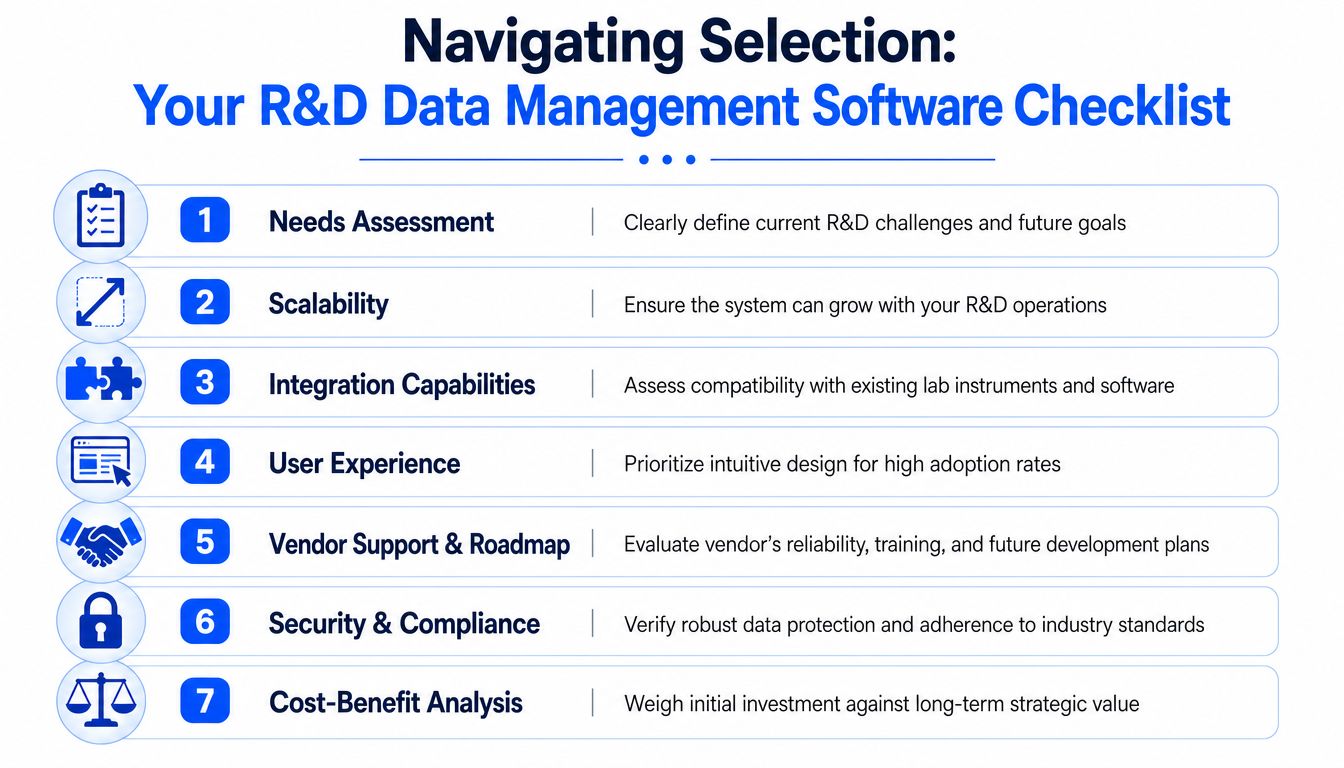
Questions that expose weak platforms fast
Use vendor meetings to force specificity. Ask questions that tie architecture to lab operations.
On scalability
Ask how the system handles growth from small project datasets to enterprise-wide experimental history. Don't accept “cloud-native” as a sufficient answer. Ask what happens to search, retrieval, and lineage tracing as more instruments, sites, and product lines come online.On integration
Ask which connections are production-ready today versus promised on the roadmap. A lab platform should explain how it ingests instrument outputs, ELN records, ERP master data, and external reference datasets without custom work every time a format changes.On AI readiness
Ask whether the platform stores data in a way that preserves scientific context for modeling. Feature engineering should not depend on one data scientist manually decoding every table.On security and IP protection
Ask how role-based access works at the project, material, and document level. In enterprise labs, broad visibility sounds collaborative until a sensitive program leaks across teams.On performance testing
Ask for TPC benchmarks when discussing query efficiency under concurrency. Also ask whether the vendor uses simulation modeling for production estimates, since simulation modeling has been shown to deliver 20 to 30% more accurate performance estimates for deployment scenarios than isolated benchmarking, as described in Raj Jain's database benchmarking guidance.
What good vendor answers sound like
Strong vendors answer with architecture and operational detail. Weak vendors answer with generalized confidence.
A useful comparison looks like this:
| Evaluation area | Weak answer | Strong answer |
|---|---|---|
| Data model | “It's flexible” | Explains how samples, batches, methods, and properties are related |
| Instrument integration | “We support imports” | Identifies supported formats, workflows, and exception handling |
| Governance | “We have permissions” | Shows audit trails, approval states, and stewardship workflows |
| Performance | “It scales in the cloud” | Provides benchmark methodology and concurrency assumptions |
| Adoption | “The UI is intuitive” | Describes onboarding, scientist workflows, and admin burden |
Selection heuristic: If a vendor can't explain how a failed experiment remains discoverable and interpretable years later, they don't understand materials R&D.
One more test helps. Give vendors a small but ugly dataset. Include duplicate material names, incomplete metadata, instrument exports, and a few inconsistent units. Then ask them to demonstrate search, lineage, and cross-experiment comparison. You'll learn more from that than from any polished deck.
Your Phased Implementation Roadmap
Implementation fails when leaders treat the platform as a software rollout instead of a scientific operating change. In materials R&D, the hard part isn't installation. It's deciding what the organization will standardize, what it will tolerate, and how much friction bench scientists will accept.
There's also an uncertainty problem. Existing content rarely answers the practical question of timeline and failure risk for moving a polymer or chemical R&D group to structured data management. That lack of current, materials-specific benchmark data means teams need to manage implementation through scope discipline rather than optimistic assumptions.
Phase one starts with discovery not migration
Start with data discovery and prioritization.
Do not begin by migrating everything. Begin by identifying the data sources that most influence experimental decisions and cross-team reuse. In most labs, that shortlist includes formulation histories, analytical outputs tied to release decisions, sample identifiers, and test methods that determine go or no-go calls.
A good first pass includes:
- Map critical sources such as spreadsheets, ELNs, shared drives, instrument folders, and ERP reference records.
- Rank them by decision value, not by ease of import.
- Document pain points like duplicate sample IDs, missing units, or absent batch lineage.
- Choose a narrow initial domain where better retrieval will change behavior quickly.
Governance before scale
Once the first domain is clear, establish governance rules that are strict where they must be and flexible where science varies.
Teams usually need agreement on a few essential requirements:
- Naming rules for materials, samples, and projects
- Required metadata for every experiment and test result
- Ownership rules for stewardship, approval, and correction
- Access policies for confidential programs and external collaboration
What doesn't work is trying to settle every taxonomy debate upfront. Labs lose momentum when governance becomes philosophical. Focus on standards that directly improve retrieval, comparison, and trust.
Scientists will accept structure when it protects scientific meaning. They resist structure when it feels like administrative theater.
Pilot then expand
Run the pilot in one high-value program with a team willing to engage. The best pilot is not the cleanest dataset. It's the one where fragmented information is already slowing decisions and where a visible improvement will matter.
A practical pilot should test three things at once:
Workflow fit
Can scientists capture context without doubling their documentation burden?Retrieval quality
Can another team member find prior work and understand it correctly?Governance durability
Do naming, access, and approval rules hold up under active project pressure?
After the pilot, expand by use case rather than by organizational chart. Move next into adjacent workflows that benefit from the same identifiers, methods, and material definitions. That usually produces stronger adoption than a site-wide mandate.
For enterprise rollout, change management needs to be explicit:
| Implementation focus | What leaders should do |
|---|---|
| Bench scientist adoption | Show how the system reduces repeated work and protects experiment context |
| Lab manager buy-in | Tie workflows to throughput, traceability, and staff handoff quality |
| IT alignment | Define integration ownership and support boundaries early |
| Executive support | Review usage and decision impact, not just project status |
The common mistake is celebrating go-live. The actual milestone is when scientists use the system to plan the next experiment because they trust what they find.
Measuring Success KPIs and ROI in Materials R&D
A CTO can approve a data management system, complete migration, and still see no measurable improvement in R&D output six months later. The reason is usually simple. Success was tracked as an IT milestone instead of a lab performance change. Judging the success of a materials data backbone requires focusing on scientific and operational outcomes that affect cycle time, reuse, and transfer quality.
Start with a baseline tied to a real program. In materials R&D, fragmented data creates cost through repeated experiments, slow literature-to-lab handoffs, manual reconciliation, and weak traceability at scale-up. A useful KPI set makes those losses visible before rollout and measurable after adoption.
Track scientific throughput and decision quality
Use the same definitions before and after implementation so the comparison holds up in an executive review. Measure one representative program before deployment, then track that program and a follow-on program after adoption. That helps separate platform impact from the habits of one unusually disciplined team.
Useful KPIs include:
Experiment retrieval time
How long it takes a scientist to find prior relevant work with enough context to reuse it correctlyDuplicate experiment rate
How often teams rerun work because prior data was inaccessible, incomplete, or untrustedTime to formulation optimization
How many experimental cycles a team needs to reach an acceptable performance windowLab-to-pilot transfer completeness
Whether scale-up teams receive the process, formulation, method, and analytical context needed to proceed without delaysModel-ready dataset quality
Whether data scientists can assemble training datasets without large manual cleanup and reconciliation effort
These metrics matter because they connect directly to the actual cost of fragmentation. If retrieval time falls but duplicate work stays flat, the search layer improved while scientific trust did not. If transfer completeness improves but optimization time does not, the system may be helping downstream teams more than bench scientists. That kind of signal is far more useful than raw login counts.
Build ROI from avoided waste and faster learning
Financial return in R&D usually appears across several categories at once. Teams spend less time hunting for data, fewer experiments are repeated, project reviews stall less often, and pilot or manufacturing groups spend less time clarifying what was done in the lab.
A practical ROI model can use internal estimates your finance and R&D leaders will recognize:
Avoided repeat work
Count experiments that could have been prevented with accessible historical records, then multiply by material, instrument, and labor costRecovered scientist time
Estimate hours previously spent searching, reformatting, and reconciling records, then compare that with the post-implementation workflowFaster decision cycles
Track whether stage-gate or program reviews move with fewer delays caused by missing, conflicting, or poorly documented dataImproved transfer quality
Measure whether pilot and manufacturing teams need fewer clarification loops before acting on lab results
The strongest ROI story in R&D shifts the focus from data storage to accelerated learning within the same scientific headcount. That is the point most executive teams care about. A better system should increase the number of high-quality decisions a lab can make per quarter, not just the volume of records it can hold.
Review these metrics monthly. Annual summaries arrive too late to diagnose adoption problems, workflow friction, or weak metadata discipline. Short review cycles let R&D leaders correct course while the implementation is still taking shape.
If your team is trying to turn fragmented lab records into an AI-ready R&D backbone, Polymerize is worth evaluating. The platform is built for polymers, chemicals, and advanced materials, with software for unifying experimental data across silos and supporting explainable, model-driven experimentation on top of that structured foundation.
Put your R&D data to work
See how materials teams use Polymerize to plan fewer experiments and reach target properties faster.