


You've got a plate of cells on the bench, a guide RNA order in your inbox, and the uncomfortable thought that a clean “indel detected” result still might not mean the gene is gone. That's the starting point for a CRISPR gene knockout experiment, not the protocol sheet, but the decision of whether knockout is even the right perturbation, and if it is, how hard you need to validate before trusting the phenotype.
The useful mindset is blunt. CRISPR knockout isn't a magical deletion button, it's a way to push a cell toward loss of function, then prove how complete that loss really is. A good experiment starts with the biology, not the kit.
Table of Contents
- How a CRISPR Gene Knockout Actually Works
- When a single cut is enough
- When you need a larger deletion
- When knockout is the wrong perturbation
- Use knockout when the question is binary
- Use CRISPRi or CRISPRa when expression control matters
- Use base editing when the allele is the point
How a CRISPR Gene Knockout Actually Works
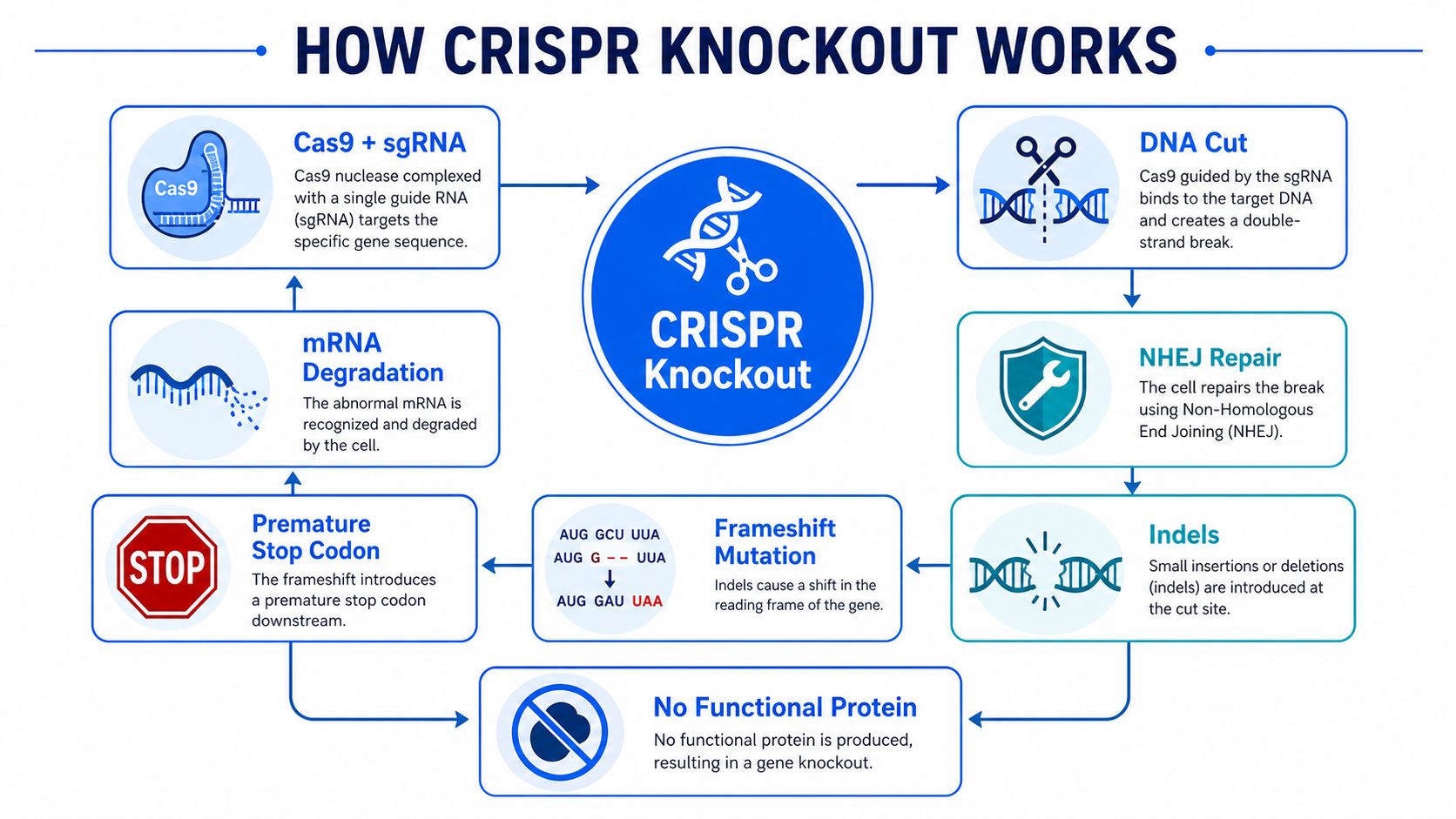
The first trap is thinking the cell deletes a gene cleanly. It usually doesn't. In a standard CRISPR gene knockout, Cas9 is guided to a specific DNA sequence by an sgRNA, and the target must sit next to a valid PAM sequence. Cas9 makes a double-strand break, and the cell repairs that break mainly by non-homologous end joining, which is fast but sloppy and commonly creates small insertions or deletions, indels (Danaher overview of CRISPR knockout).
That messiness is the point. It works like a word processor's find-and-replace tool, except the cell patches the cut with a typo instead of a clean replacement. If the indel shifts the reading frame or disrupts a critical codon, the protein can lose function. If the edit lands in a forgiving spot, the cell may still make something that works well enough to confuse you.
Practical rule: treat the DNA cut as the start of the experiment, not the end of it.
A useful mental model is this, guide recognition, DNA cutting, error-prone repair, altered coding sequence, altered protein output. That chain is why knockout design is about more than “getting a cut.” The cut has to land in a place where the repair outcome destroys function.
The 2017 Nucleic Acids Research study on EGFP copy number made that logic explicit. It found knockout efficiency was relatively insensitive to target copy number and driven more by the guide sequence itself, with potent guides remaining effective across different copy-number contexts when Cas9 and sgRNA expression passed a critical threshold (Nucleic Acids Research, 2017). That result still matters because it tells you where to spend your attention. Guide quality is usually the lever, not raw target abundance.
Knockout Strategies and When Each One Fits
A single-guide NHEJ knockout is the default because it's simple. It can be enough when the gene has one dominant isoform, the coding sequence is not unusually tricky, and you mainly need a fast loss-of-function test. But “simple” and “reliable null” are not the same thing, especially when the targeted exon can be skipped or when an in-frame indel leaves a damaged yet still active protein.
When a single cut is enough
A single cut makes sense when you want a fast screen, when the protein tolerates little structural damage, or when the target region is early in the coding sequence and shared across isoforms. It's also the cleanest first pass for many cell-line projects. The downside is obvious at the bench, a single indel can preserve the reading frame, and that clone may look edited while still making a functional protein.
When you need a larger deletion
Paired guides that remove a critical exon or adjacent sequence are a better call when one cut isn't enough. This is especially useful if the gene has complex splicing, multiple isoforms, or a domain that can survive small local disruptions. As noted in the research brief, newer guidance stresses that complete knockout often needs multiple adjacent sgRNAs or exon deletion strategies rather than a lone cut (Trends in Biotechnology review).
When knockout is the wrong perturbation
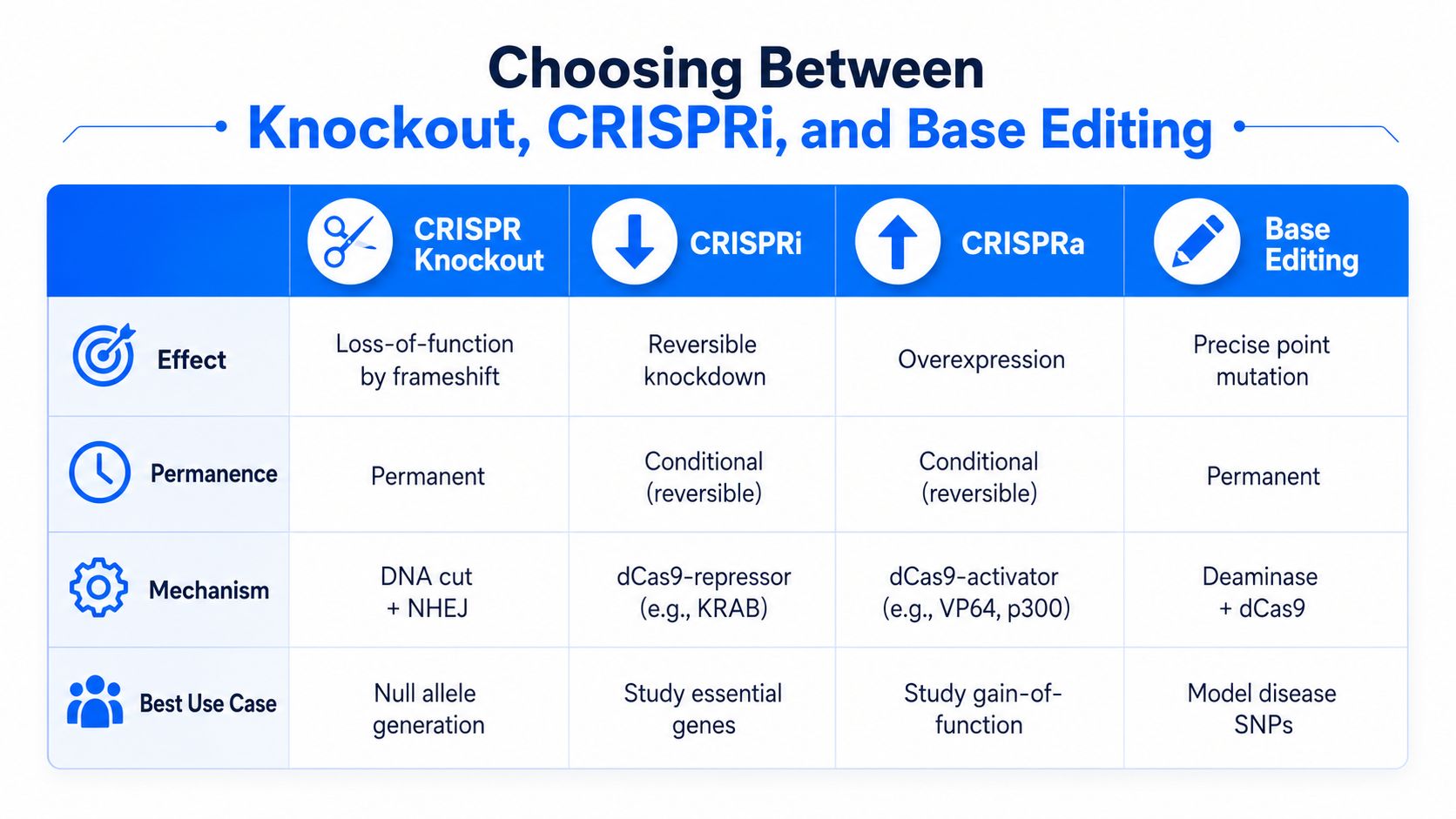
Sometimes you don't want a null at all. CRISPRi is better if you need reversible knockdown, CRISPRa is the right tool for gain-of-function questions, and base editing is the cleaner choice when the allele itself matters more than total gene loss. That trade-off matters because many labs treat knockout as the automatic first move, when the more scientific question is often whether the phenotype needs full ablation, partial suppression, or a precise sequence change.
| Strategy | Best fit | Main strength | Main limitation |
|---|---|---|---|
| Single-guide indel knockout | Fast loss-of-function testing | Simple and quick | Can leave residual function |
| Paired-guide exon deletion | Isoforms, essential domains, true null bias | Better chance of functional disruption | More design and genotyping work |
| CRISPRi | Essential genes, reversible knockdown | Conditional and tunable | Not a DNA knockout |
| Base editing | Allele-specific questions | Precise sequence change | Not a full loss-of-function tool |
Designing the Guide RNA and Choosing the Nuclease
A knockout experiment starts with a decision that is easy to underestimate. The guide RNA is not just a sequence to order, it is the part that determines whether your edit answers the question you asked. If the guide is weak, every downstream readout becomes harder to trust, and a clean-looking edit can still leave you with a misleading result. Guide potency can matter more than target copy number once Cas9 and guide expression are sufficient, so a carefully chosen sgRNA often matters more than a long list of downstream controls.
What to look for before you order
Start with on-target score, then check off-target risk, then inspect the cut site against protein architecture. A guide that lands in an early constitutive exon is usually preferable because it is more likely to disrupt most isoforms and produce a frameshift that matters. If the cut sits near a dispensable tail, you may edit the locus without touching the function you care about.
A good guide is the one that makes a true null plausible. That means looking beyond simple sequence match and asking whether the cut should remove the protein region that carries function. A guide with a strong score but a weak biological location is still the wrong choice.
Bench rule: if you can't explain why that exact cut should kill protein function, don't order the guide yet.
Cas9 versus Cas12a in practice
SpCas9 is the familiar workhorse, and it is usually the first choice when the PAM is available and the design space is broad. Cas12a becomes attractive when the target region suits its PAM constraints or when a staggered cut pattern is useful in your setup. For high-stakes experiments, high-fidelity Cas9 variants are worth considering when off-target control matters more than squeezing out the easiest possible cut.
The nuclease choice should follow the biology, not habit. A strong guide in the wrong region is still a bad knockout. A moderate guide in a critical exon can be the better scientific choice if it is the one most likely to erase the function you need to test.
Before you place the order, use a simple checklist.
- PAM present and accessible: the nuclease can only cut where the sequence allows it.
- Cut near an early exon: this raises the odds that the disruption affects all major isoforms.
- Predicted off-targets acceptable: avoid guides that spread uncertainty across the genome.
- Domain impact clear: the edit should interrupt a domain you can defend biologically.
- Backup guide ready: if one guide underperforms, you want another candidate queued.
Delivery Methods for Different Cell Types
Delivery is the second major decision. A brilliant guide in the wrong delivery format gives you a disappointing edit rate, a stressed culture, or both. The right method depends on the cells, the timeline, and how much persistence you want from the editing machinery.
The practical options
Plasmid transfection is convenient for easy-to-transfect lines and for workflows where you want simple reagent handling. It's often the easiest place to start, but it isn't the best choice for every cell type. Electroporation and nucleofection are the workhorses for primary cells and hard-to-transfect lines, because they get material into cells that shrug off standard transfection approaches.
Ribonucleoprotein, RNP, delivery is often the fastest and most transient option. You introduce Cas9 protein preloaded with sgRNA, get a sharp editing pulse, and reduce the chance of prolonged nuclease exposure. That makes RNP attractive when you want speed and less lingering editing activity.
When viral delivery earns its place
Lentiviral delivery is useful when stable expression matters, especially for pooled screens or when the experiment needs durable expression across divisions. AAV is more relevant when in vivo work or compact payloads are part of the design. For a plain bench knockout in a standard cell line, though, viral delivery is usually a means to an end, not the default best answer.
A good rule is simple. Start with RNP if you want a fast, transient edit. Use plasmid or electroporation based on cell type. Move to viral delivery when you need coverage, persistence, or a stable experimental system. If you're still deciding how viral platforms are used in editing workflows, the overview on viral vectors in gene therapy is a useful background refresher.
| Method | Best for | Integration risk | Typical use case |
|---|---|---|---|
| Plasmid transfection | Easy-to-transfect cell lines | Low to moderate, depending on construct | Quick pilot edits |
| Electroporation | Primary cells and difficult lines | Low | Hard-to-deliver samples |
| RNP delivery | Fast, transient editing | Very low | Minimizing prolonged nuclease exposure |
| Lentiviral delivery | Stable expression and pooled workflows | Higher, because of integration | Screens and durable expression |
| AAV delivery | In vivo or compact cargo needs | Low integration tendency | Specialized delivery contexts |
Validating the Edit from DNA to Function
A knockout that looks clean in a sequencing trace is still only a candidate knockout. Validation has to move from DNA to RNA to protein to function, because each layer catches a different failure mode. That is not extra paperwork. It is the difference between a clone that merely carries an edit and one that behaves like a loss-of-function line.
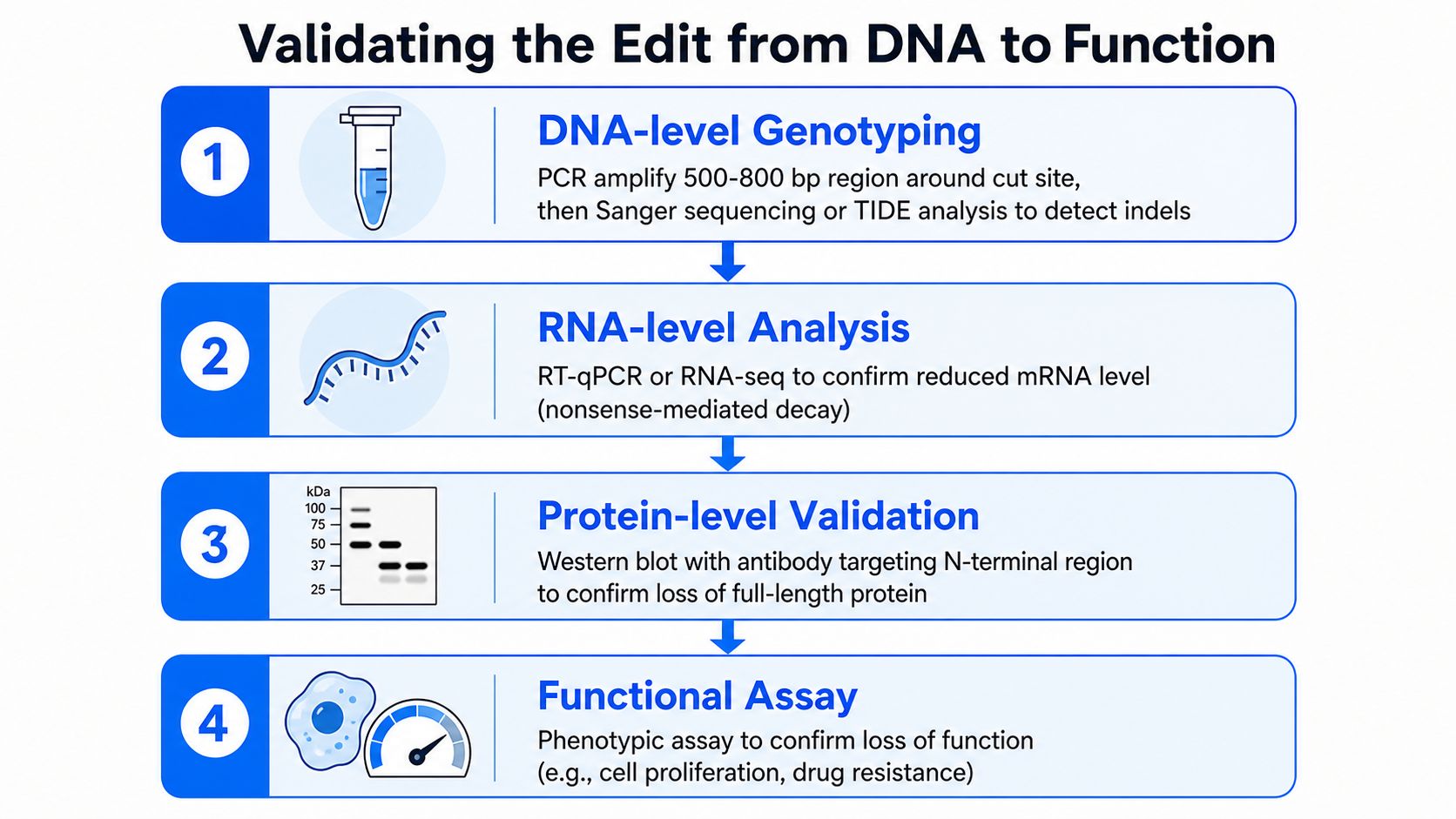
At the DNA level, many workflows screen the bulk pool around 72 hours after transfection, PCR-amplify a 500 to 800 bp region centered on the cut site, and use T7 endonuclease I or Sanger sequencing with ICE/TIDE to estimate indels (LabProtocol CRISPR knockout protocol). That confirms cutting, not gene loss. A site can be edited and still leave behind a product that matters biologically.
What clonal validation has to prove
From there, single cells are isolated and expanded over roughly 2 to 3 weeks. The point of clonal work is not just to find an edit, it is to find the right edit. A true knockout usually needs biallelic disruption, because one intact allele can still make enough protein to muddy the phenotype.
Protein checks come next. Use western blot or immunofluorescence to see whether the full-length protein is gone (Danaher overview of CRISPR knockout). Then test the biology the gene was expected to control with a functional assay. RNA can still look deceptively intact after editing, so transcript data by itself does not prove loss of function.
The bench decision is straightforward. If genotype, protein, and phenotype do not agree, treat the clone as unresolved and keep working. A second guide, a different cut site, or a deletion strategy can expose problems that a single indel hides.
If you need a broader methods primer, viral vectors in gene therapy gives useful context for how delivery format shapes downstream validation.
Why a Successful Knockout Is Not Always a True Null
A clean-looking edit can still leave a gene partly active. That is the trap with CRISPR gene knockout. A 2024 NIH-hosted review reported that at least 30 to 50% of knockout cells or organisms may still produce altered transcripts and proteins after CRISPR-Cas editing, because of mechanisms like alternative splicing and translation reinitiation (NIH review, 2024).
Why the clone can still behave like it has a gene
An in-frame indel can preserve the reading frame. A skipped exon can restore an open reading frame. Translation can restart downstream and produce a shortened protein that still does useful work. None of those outcomes look dramatic if you only inspect the DNA sequence, but they can still blur the phenotype.
A knockout should be treated as a probabilistic perturbation. The practical point is simple, a guide that edits the locus is not the same thing as a clone that has lost gene function. A clone can carry the right cut site, yet still make enough altered RNA or protein to behave like a partial knockout. That is why the edit has to be judged at more than one layer, not assumed from the genotype alone.
Practical response: if one guide gives you a suspiciously clean phenotype with weak protein data, do not celebrate. Design another guide, or switch to a deletion strategy.
How to raise the odds of a true null
Use multiple adjacent guides. Delete a critical exon instead of relying on a single cut. Keep the transcript architecture in view, because a guide that looks perfect against one isoform can miss the isoform that drives the biology. This is the point to be stubborn, not hopeful.
The best workflow is layered. Check the DNA, then look at RNA if the biology is messy, then confirm protein loss, then test function. If any layer says maybe, treat the clone as unresolved and keep working. That is the same logic behind careful validation in other perturbation workflows, including the reasoning discussed in Celonyx Labs on research peptides.
Choosing Between Knockout, CRISPRi, and Base Editing
A poor perturbation choice can make a clean experiment look messy, or a messy experiment look clean. If the question is about dosage, reversibility, or a single sequence change, a full CRISPR gene knockout may answer the wrong problem. In that case, CRISPRi, CRISPRa, or base editing can give a cleaner read on mechanism.
For large-scale screens, the first question is usually whether you need a hard loss of function or a graded shift in expression. CRISPR knockout works well when the phenotype is expected to collapse if the gene is removed and you want a binary readout that survives scale. In single-gene studies, that same bluntness can hide useful biology, especially if the target is dosage-sensitive or essential.
A screen asking, “Which genes matter at all?” can tolerate a stronger perturbation. A follow-up study asking, “How much expression change shifts the phenotype?” usually cannot.
Use knockout when the question is binary
Pick CRISPR knockout for discovery screens and for cases where the most informative result is the presence or absence of gene function. It is a direct way to test whether a gene is required under a given condition, and it stays useful when you need a clear on, off comparison across many clones or pooled cells. That simplicity is the reason it remains the default in many loss-of-function workflows.
The trade-off is easy to miss at the bench. A knockout can be too strong when the biology depends on partial activity, timing, or cell survival. If full loss of the gene kills the cells before you can read the phenotype, the experiment stops being informative and starts becoming a selection problem.
Use CRISPRi or CRISPRa when expression control matters
CRISPRi is the better fit when you want partial repression rather than complete gene removal. It is useful when a reduction in expression is enough to test the hypothesis, when reversibility matters, or when a hard null would create secondary stress that masks the primary effect. CRISPRa sits at the other end of the same logic, because it asks what happens when expression is pushed upward rather than taken away.
These tools are useful in screens that need graded perturbation rather than all-or-none loss. They also help when you suspect the phenotype depends on dosage, not merely on whether the locus is intact. In that setting, a knockdown-like effect can be more interpretable than a knockout, because the cells remain alive long enough to show the biological response you care about.
Use base editing when the allele is the point
If the question is about one amino-acid change, base editing is the more precise choice. It keeps more of the native locus in place than a knockout does, which matters when you are modeling a defined variant rather than testing whether the gene as a whole is required. For single-gene studies that center on a specific mutation, that distinction is the difference between asking about mechanism and asking about absence.
That is why pipeline design matters. Screening teams may start broad, then move from knockout to a more specific perturbation once a hit is identified. A clinical or translational program may do the reverse, beginning with the allele or expression state that best matches the patient-relevant biology. The strategy changes with the question, not with the tool.
Modern screening and clinical pipelines increasingly compare CRISPRko, CRISPRi, CRISPRa, and base editing rather than assuming knockout is the default answer (CRISPR Medicine News). That shift is useful because it forces the decision around the perturbation itself, not around habit. For a broader example of how different experimental tools are matched to different questions, Celonyx Labs on research peptides is a useful side resource.
Experimental Planning and Ethical Considerations
The cleanest knockout experiments are usually won before the tube is opened. Start with cell line authentication, mycoplasma testing, and a control plan that includes a non-targeting guide and, when useful, a second guide against the same gene. If the line is dirty or mislabeled, everything downstream gets harder to interpret, and no clever genotyping saves that.
Biosafety and governance matter too. Gene-editing work in human cells, germline contexts, and clinical-grade settings can trigger stricter institutional review, and dual-use concerns aren't hypothetical. The people approving the work need to know the target, the delivery method, and the intended downstream use, because those details change the risk profile.
Rule of thumb: the more consequential the edited material, the earlier the review conversation should happen.
A solid planning framework is straightforward. Ask whether knockout is the right perturbation, design a potent guide in an early constitutive exon, choose delivery for the cell type, validate at DNA, RNA, protein, and function, then don't move on until the phenotype survives that stack. If the edit doesn't survive layered validation, it's not ready for interpretation.
That's the version of CRISPR gene knockout that holds up at the bench. If you want a system for keeping guide choices, validation results, and clone metadata organized as the work scales, talk to Polymerize and see how it can centralize your experimental records and make the next edit decision easier to defend.
Put your R&D data to work
See how materials teams use Polymerize to plan fewer experiments and reach target properties faster.