


Your team probably already has the symptoms.
A formulation project stalls after months of bench work because the material behaves differently once process conditions change. A simulation specialist has one set of models, the lab has another set of spreadsheets, and the scale-up team keeps asking questions that nobody can answer with confidence. Meanwhile, useful experimental data sits in ELNs, slide decks, instrument exports, and file folders with naming conventions only one scientist understands.
That's the normal state of many materials organizations. It's also why so many computational initiatives never reach production impact. The issue usually isn't whether the science is valid. It's whether the organization can connect physics, data, experimentation, and manufacturing reality in one working system.
Computational materials design matters because it changes the operating model. Instead of relying on repeated make-and-test cycles, teams can start with target properties, simulate likely behavior, narrow the design space, run better experiments, and learn faster from every result. Done well, it doesn't replace the lab. It makes the lab more selective, more informed, and much less wasteful.
Table of Contents
- Physics-based methods when first principles matter
- Data-driven methods when search speed matters
- The right comparison
- Where hybrid workflows win
- Step one starts with the data backbone
- Then move into selective prediction
- The loop matters more than any single model
- Build versus buy is really a control question
- Security and compliance are not side topics
- What ROI looks like in materials organizations
The End of Trial-and-Error Materials R&D
A familiar pattern plays out in industrial materials programs. The team starts with a promising idea, screens candidate chemistries, adjusts processing conditions, and pushes samples through characterization. Early results look encouraging. Then a thermal limit appears, a stability issue surfaces, or the material that worked in one environment fails in another.
At that point, the project rarely fails because the scientists aren't capable. It fails because the search process is too broad and the feedback loop is too slow. Every new round of experiments answers one question while creating three more.
Where the old model breaks
Traditional materials R&D still depends on fragmented decision-making. Modeling lives in one corner. Experimentalists carry the practical burden. Manufacturing gets involved late, usually when the room for design change is already shrinking.
That creates three costly behaviors:
- Teams test too many weak candidates: The organization spends lab time on formulations that should have been ruled out earlier.
- Knowledge gets trapped locally: One scientist remembers why a formulation failed, but that lesson never becomes reusable design knowledge.
- Scale-up arrives too late: Processing constraints, equipment realities, and supply limitations show up after months of technical effort.
Computational materials design works when it changes decisions, not when it only produces better plots.
The strategic shift
The useful shift isn't “replace experiments with computers.” That framing is wrong and usually triggers resistance from experienced scientists for good reason. The better framing is to use computation to improve the sequence, quality, and relevance of experiments.
That means using models to ask narrower questions, identify more plausible candidates, and expose trade-offs earlier. It also means accepting that enterprise deployment is a different challenge than publishing a strong simulation result. In practice, the organizations that get value are the ones that connect digital prediction to synthesis, validation, and eventual manufacturing constraints.
What Is Computational Materials Design
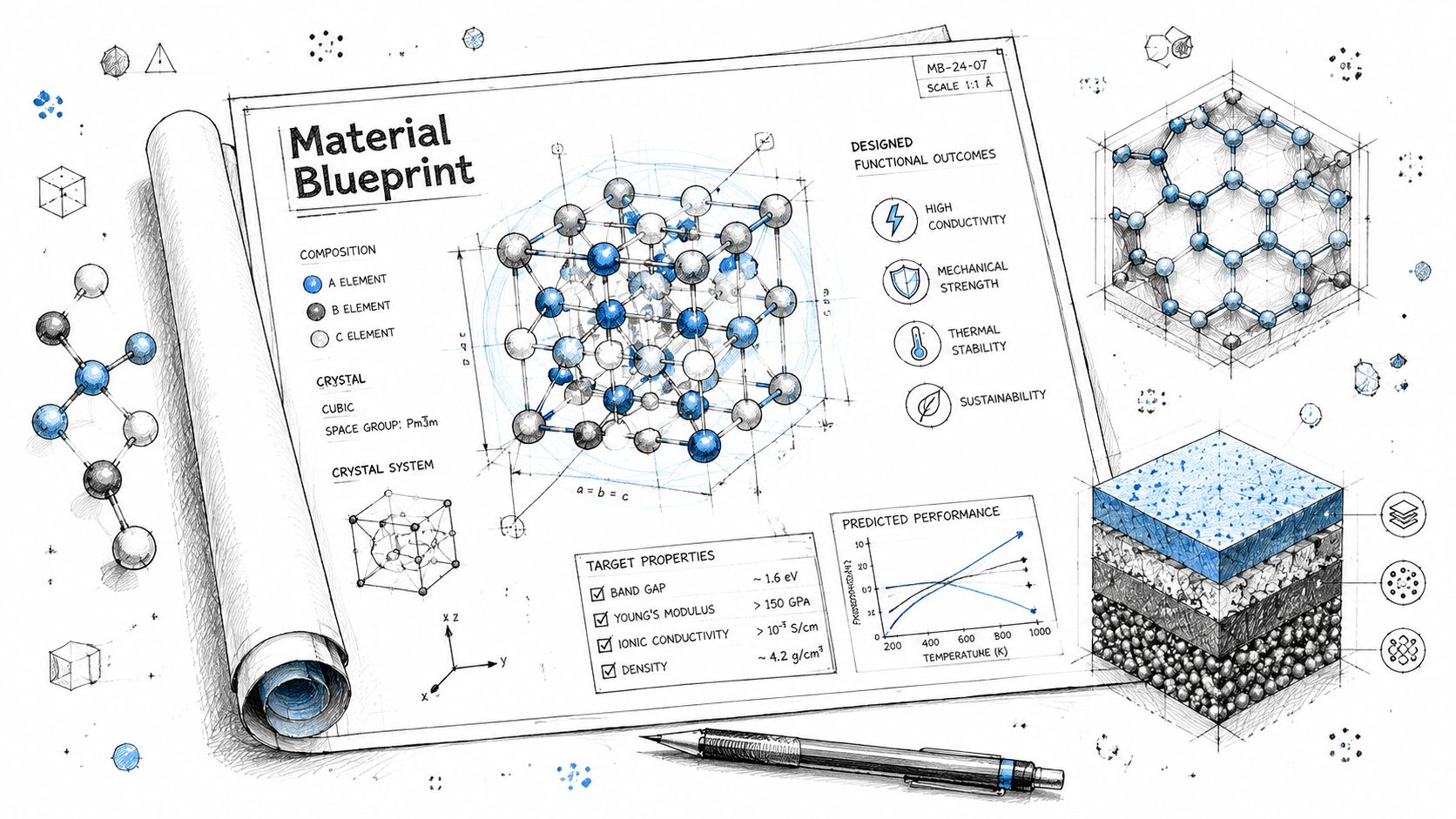
Computational materials design is the practice of designing, predicting, and validating materials digitally before committing fully to physical iteration. The easiest way to think about it is as an architectural blueprint for materials. Instead of drafting a building from walls and load paths, you're drafting a material from composition, structure, processing assumptions, and target performance.
That blueprint can include atomic interactions, phase behavior, microstructure evolution, and end-use properties. The level of detail depends on the problem. Sometimes the right starting point is electronic structure. Sometimes it's a phase diagram. Sometimes it's a property-prediction model trained on prior experiments.
What it includes in practice
Computational materials science spans multiple simulation motifs across scales, from electrons to components, with Density Functional Theory (DFT) used widely because it balances computational cost and predictive capability well. DFT is used to calculate the lowest energy state of a system and can simulate atomic motion by computing interatomic forces, while methods such as Monte Carlo, cellular automata, and CALPHAD support atomistic behavior, solidification modeling, and phase diagram generation for stability and process optimization, as described in the overview of computational materials science methods and CALPHAD.
For an R&D leader, the important point isn't memorizing every method. It's understanding that computational materials design gives your team a structured way to move from desired performance back to candidate material systems and process choices.
Why it changes the economics of discovery
The old workflow starts with what you can make and asks whether it works. The better workflow starts with what must work and asks what's worth making.
That inversion matters. It reduces broad, unguided screening and puts more pressure on model quality, data quality, and decision quality up front. According to MIT DMSE's overview of computation and design in materials research, data-driven computational design methods now support heterogeneous nano- and microstructural materials and complex multiscale metamaterial systems by using statistical inference and uncertainty quantification to surface causal drivers and reduce trial-and-error experimentation.
If your digital workflow can't tell a scientist which experiment to run next, it isn't yet a design system. It's just analysis.
What a digital twin means here
In materials R&D, a digital twin isn't a single perfect model. It's a working representation of material behavior built from physics, chemistry, empirical data, and uncertainty estimates. Some parts of that twin may be highly mechanistic. Other parts may be statistical.
The practical benefit is straightforward. Teams can evaluate feasibility earlier, identify likely failure modes sooner, and reserve expensive synthesis and testing for candidates that survive digital scrutiny.
The Two Engines Physics-Based and Data-Driven Methods
Most enterprise programs run on two engines. One engine explains. The other engine generalizes.
Physics-based methods give you mechanistic grounding. Data-driven methods help you move quickly across a larger design space. The strongest organizations don't argue about which camp is better. They learn how to combine them without pretending the trade-offs don't exist.
Physics-based methods when first principles matter
When the core question depends on atomic structure, bonding, or intrinsic properties, physics-based modeling is often the right anchor. DFT remains foundational because it can predict intrinsic properties such as elastic constants and optical absorption from atomic and chemical bond configurations with high fidelity, as described in the Nature review on computational materials design using DFT, multiscale frameworks, and machine learning.
That said, many industrial teams misuse physics-based simulation by applying it too broadly. DFT is powerful, but its computational cost limits direct use on large-scale systems. It's not a universal replacement for experimentation, and it won't solve workflow problems caused by poor metadata, inconsistent sample histories, or uncontrolled process variation.
Data-driven methods when search speed matters
AI and machine learning become valuable when your organization has accumulated enough relevant history to learn from past experiments, formulations, structures, and outcomes. These models are often better at ranking candidates, surfacing non-obvious relationships, and supporting decision-making under time pressure.
They're especially useful when the business problem is not “understand every electron interaction” but “identify the next narrow set of candidates worth testing.” In industry, that's often the higher-value question.
The right comparison
| Attribute | Physics-Based Models (e.g., DFT) | Data-Driven Models (e.g., AI/ML) |
|---|---|---|
| Primary strength | Mechanistic understanding grounded in physical laws | Fast pattern recognition across historical or simulated data |
| Best use case | Intrinsic property prediction, electronic structure, atomic-scale behavior | Candidate screening, property prediction, formulation ranking, experiment planning |
| Data requirement | Can start from first principles | Needs usable training data and consistent context |
| Computational profile | More computationally intensive | Faster at inference once trained |
| Failure mode | Too slow or too narrow for large industrial search spaces | Learns the wrong signal from biased, sparse, or noisy data |
| What leaders often miss | Scientific rigor doesn't guarantee operational relevance | Speed doesn't guarantee trust or transferability |
Where hybrid workflows win
In practice, the most effective pattern is hybrid. High-fidelity simulations generate reliable signals for critical parts of the design space, and ML surrogate models learn from those outputs to screen far more possibilities quickly. The Nature review notes that ML surrogate models trained on high-fidelity DFT datasets can achieve comparable accuracy with orders-of-magnitude speedup in screening complex material systems.
Use physics to anchor the problem. Use machine learning to scale the search.
That combination is what makes computational materials design operational rather than academic. It lets teams preserve scientific credibility while increasing throughput enough to matter to product timelines.
From Prediction to Product The End-to-End Workflow
Most organizations don't struggle with isolated technical capability. They struggle with orchestration. A useful computational materials design workflow has to connect data intake, model building, experimental execution, and scale-up decisions into one repeatable loop.
The operating model looks simple on a slide and messy in the lab. That's normal. The aim is not elegance. The aim is to create a system where each experiment improves the next decision.

Step one starts with the data backbone
The first job is to unify fragmented records across spreadsheets, ELNs, instrument outputs, and legacy repositories. If formulation details, processing parameters, and test outcomes aren't connected, your models won't be trustworthy enough to guide action.
Many programs stall when leaders approve AI work before the organization defines sample lineage, metadata standards, or property naming rules. The result is expensive confusion dressed up as innovation.
A practical setup also includes the physical lab environment. When teams redesign testing spaces, they often need infrastructure that can support changing instrumentation layouts, materials handling, and safer workflows. Resources on advanced lab furniture solutions can be useful when the computational workflow starts driving more deliberate, higher-throughput validation work in the lab.
Then move into selective prediction
Once the data foundation is usable, teams can apply predictive models to narrow the field. Some programs use multiscale frameworks that connect quantum mechanics, machine learning, thermodynamics, statistical physics, and continuum mechanics. In reported benchmark data, multiscale modeling has reduced experimental failure rates by up to 50% within three months by helping scientists plan targeted experiments based on simulation-driven insights, according to the review on multiscale materials modeling and AI-driven discovery.
That figure matters less as a promise than as a planning principle. The value comes from using models to decide what not to test, then choosing the next best experiment with discipline.
Here's the workflow that teams can run:
- Consolidate records: Bring composition, structure, process conditions, and property results into one searchable environment.
- Build candidate screens: Use simulation, ML, or both to rank materials against target performance.
- Run targeted synthesis: Validate a short list rather than a broad list.
- Capture outcomes cleanly: Feed every result back with enough context to make it reusable.
- Support transfer to production: Carry forward the model assumptions that matter to manufacturing and quality teams.
A short technical overview helps align teams on this loop before they operationalize it:
The loop matters more than any single model
A common mistake is treating prediction as the finish line. It isn't. The model's real job is to improve experimental sequencing, reveal failure modes earlier, and generate evidence that can survive contact with production constraints.
If the workflow stops at virtual screening, the organization learns very little. If it closes the loop between prediction, synthesis, validation, and process knowledge, the system gets sharper over time.
Overcoming Common Hurdles in Materials Innovation
Most computational materials design programs don't fail because the science is weak. They fail because the organization underestimates the friction in data, synthesis, and uncertainty.
That's good news. These are operational problems. They're hard, but they're fixable.

Messy data is normal
R&D leaders often assume they need pristine, complete data before they can start. They don't. What they need is a problem narrow enough that imperfect data can still support a useful decision.
A better entry point is one high-value question with enough historical depth to model. For example, that might be a recurring formulation stability issue, a coating performance trade-off, or a processing window that's expensive to explore experimentally.
Good early discipline includes:
- Define one target outcome: Pick a property or failure mode that matters commercially and scientifically.
- Limit the first data scope: Don't ingest every archive. Start with the datasets tied directly to that outcome.
- Track provenance carefully: Scientists must be able to see where a prediction came from and what assumptions shaped it.
The synthesis gap is real
A model can identify a stable material that nobody can reliably make. That's the synthesis gap, and it remains one of the least well-managed issues in digital materials programs.
Recent discussion around closing the synthesis gap in computational materials discovery argues that treating synthesizability as equivalent to thermodynamic stability is a mistake. The practical fix is to bring synthesis-route data, chemical heuristics, and multimodal signals into the workflow earlier rather than treating synthesis as a final downstream check.
A candidate isn't valuable because it's stable in theory. It's valuable when your team can make it, characterize it, and reproduce it.
Uncertainty has to be visible
Many materials properties depend on location, process path, and manufacturing variability. That's especially important in systems like additively manufactured parts, where local conditions can produce highly variable outcomes. Northwestern IDEAL highlights the need for data-driven computational tools that predict such variable properties while explicitly modeling uncertainty in processing conditions and material variability, as described in its work on design of emerging material systems.
That's a useful principle well beyond additive manufacturing. If your model gives a single answer without exposing confidence, sensitivity, or likely sources of variation, it's hard for scientists to trust and hard for managers to act on.
Scaling Innovation Enterprise Considerations for AI Adoption
A pilot can prove technical possibility. It doesn't prove organizational readiness.
Enterprise adoption starts when computational materials design becomes part of the way R&D prioritizes work, protects IP, and collaborates across science, engineering, and operations. That requires platform decisions, governance, and a realistic view of who will maintain the system after the pilot team moves on.
Build versus buy is really a control question
Some companies want to build everything internally because materials knowledge is strategic. That instinct is understandable. But many internal builds fail for predictable reasons. Data engineering takes longer than expected, model governance is underspecified, and the scientific team gets pulled into software decisions it doesn't want to own.
A platform approach often makes more sense when the need is to unify data, manage access, run explainable models, and support experimentation without turning the R&D function into a software company. One option is Polymerize, which is positioned as an AI-native system for materials R&D that unifies fragmented experimental data and supports property prediction and formulation optimization within enterprise controls.
Security and compliance are not side topics
For enterprise teams, security can't be bolted on after the workflow proves useful. The multiscale modeling review cited earlier also notes the use of AI-driven self-driving labs with ISO 27001 and SOC 2 compliance for IP protection in advanced materials workflows. That should sound familiar to any R&D leader managing proprietary formulations, supplier-sensitive data, or regulated collaboration environments.
Security questions should include:
- Who can access raw and derived data: Role-based controls matter when business units, external partners, and corporate research share infrastructure.
- How models are versioned: Scientists need to know which training data and assumptions produced a recommendation.
- Where explainability lives: A black-box prediction may be fast, but it's often hard to defend in technical reviews.
What ROI looks like in materials organizations
The wrong way to measure success is by counting how many models the team trained. The right way is to measure whether the organization runs better experiments, kills weak candidates earlier, and transfers knowledge more effectively into development and scale-up.
A useful scorecard usually includes:
| Decision area | What to measure qualitatively |
|---|---|
| Experiment planning | Whether scientists can identify the next best experiment with more confidence |
| Knowledge reuse | Whether prior failures and successes are becoming searchable and reusable |
| Scale-up readiness | Whether process-relevant variables are entering the design conversation earlier |
| Cross-team adoption | Whether modeling, lab, and manufacturing teams trust the same evidence base |
The technical direction is increasingly clear. Hybrid workflows where ML surrogate models learn from high-fidelity DFT data can deliver comparable accuracy with much faster screening in secure, enterprise-grade pipelines, according to the Nature review referenced earlier. The primary question for leadership is whether that capability becomes part of operating infrastructure or remains trapped in isolated specialist work.
Your Next Steps in AI-Driven Materials Design
Start smaller than your ambition.
The fastest way to lose support for computational materials design is to launch a broad transformation program before you've shown that the workflow can improve a real decision. Pick one problem where the business value is clear and the available data is good enough to support a pilot.
A practical sequence usually works best:
- Choose one narrow problem: Focus on a formulation, property target, or failure mode with clear commercial relevance.
- Assemble the minimum viable dataset: Bring together only the records needed to model that problem responsibly.
- Use a hybrid mindset: Combine physics, empirical knowledge, and data-driven prediction rather than forcing a single-method answer.
- Design the next best experiment: Use the model to narrow options, then validate in the lab quickly.
- Capture the learning loop: Record outcomes, assumptions, and uncertainty so the next cycle starts stronger.
Start where the data is usable, the scientists are motivated, and the cost of a bad decision is visible.
That's how enterprise adoption usually begins. Not with a grand platform rollout, but with one project that proves the organization can move from scattered evidence to targeted innovation. Once the team sees fewer dead-end experiments, better handoffs, and stronger technical confidence, broader adoption becomes much easier to justify.
If your organization is trying to connect fragmented lab data, predictive modeling, and real-world materials development, Polymerize is one platform to evaluate. It's designed for materials R&D teams that need a secure system to unify experimental data, support AI-guided property prediction, and turn computational insight into faster, more targeted experimentation.
Put your R&D data to work
See how materials teams use Polymerize to plan fewer experiments and reach target properties faster.