
At 9:07 on Monday morning, an auditor asks for the retraining history of a model used in formulation work. Your scientists have stored experimental records in separate ELNs, a shared drive contains three versions of the governing SOP, and the approval thread is buried in email. At the same time, legal wants evidence for a SOC 2 review and the plant engineer needs a batch release signed.
The problem isn't a lack of documents. It's that nobody can reconstruct the record quickly: what happened, which data supported it, which model version produced the result, who approved the change, and whether the approved procedure was followed. Compliance documentation must answer those questions as an evidence layer, not merely occupy a folder of PDFs.
That distinction matters in materials R&D, where experimental data, model outputs, instrument records, approvals, and change history move across teams and systems. This guide lays out a practical architecture for building records that remain defensible during human review and increasingly automated, AI-assisted audits.
Table of Contents
- How work is done
- What was done
- How the AI component operated
- How personal data was handled
- How governance operated
- How the chain of custody survived change
- Start with atomic records
- Apply semantic versioning consistently
- Separate authorship from approval
- Build end-to-end provenance
- Week one, inventory
- Week two, map controls
- Week three, remediate
- Week four, validate
- Week five, train
- Week six, freeze
The Audit Anxiety Every R&D Leader Knows
Auditors rarely begin by asking whether your organization has a policy. They ask for proof that the policy operated during a specific activity. In an R&D environment, that may mean producing the experiment record, raw instrument output, dataset version, model run, reviewer approval, and subsequent change history as one connected package.
A shared drive usually breaks that chain. An ELN may capture the experiment but not the model input derived from it. Email may show approval but not establish which file was approved. A PDF may carry a date but fail to prove that its contents stayed unchanged after sign-off. Each system contains a fragment, while the auditor needs a defensible timeline.
Practical rule: Every important artifact should point to a primary record, a responsible person, an approval event, and a version lineage.
Start by defining the primary record for each work product. For an experiment, that might be the immutable ELN entry and its raw data identifiers. For a model, it might be the training run, data manifest, evaluation record, and model artifact. For a controlled procedure, it should be the approved SOP version linked to the work performed under it.
Then capture evidence at the point of work. A scientist shouldn't have to recreate an approval trail from memory before an audit. A model card shouldn't be assembled months after training. The platform should record the relevant event, actor, timestamp, input, output, and change reason as the work happens.
The urgency is visible across regulated operations. A manufacturing facility may manage more than 150,000 active documents, while 67% of manufacturers still rely on paper-based document control systems, according to manufacturing document control analysis from Ademero. In the same dataset, 73% of quality issues were traced to inadequate documentation, document-related delays were estimated at $89 million annually, and document-control non-compliance was associated with $2.1 billion in yearly fines.
Those figures point to a hard conclusion: documentation isn't administrative decoration. It is part of the control system for quality, auditability, and financial risk. In 2026, the winning approach is to connect every artifact before anyone asks for it.
Frameworks That Actually Govern Materials R&D and AI Platforms
A materials R&D platform rarely operates under one clean framework. ISO 27001, SOC 2, and GDPR examine related evidence through different lenses, so a policy written for one purpose won't automatically satisfy the others.
ISO 27001 focuses on the information security management system and its risk-based control structure. Your documentation should show how risks were assessed, how treatment decisions were made, what controls were selected, and how those controls operate. The statement of applicability, risk treatment records, access evidence, incident records, and review outcomes should connect to the assets and processes they govern.
SOC 2 examines trust service criteria, especially security, availability, and confidentiality. Auditors need a policy library, defined control activities, control tests, and sampling evidence. For an AI-enabled R&D platform, that evidence may include access reviews, change approvals, backup or availability checks, logical access records, and security testing outputs.
GDPR addresses personal data processing. The documentation lens is different again. A team needs records of processing, documented lawful basis, data protection impact assessments, data subject workflows, and evidence that changes in data sources or processing purposes were reviewed.
Framework applicability at a glance
| Framework | Primary scope | Key documented controls required |
|---|---|---|
| ISO 27001 | Information security management and risk | Statement of applicability, risk treatment, control evidence, review records |
| SOC 2 | Trust service criteria | Policy library, control tests, sampling evidence, access and security records |
| GDPR | Personal data processing | Records of processing, DPIAs, lawful-basis records, data subject workflows |
These frameworks overlap around accountability, access, change management, and evidence, but they don't mean the same thing. ISO 27001 asks whether your risk methodology is coherent. SOC 2 asks whether operational controls were designed and tested. GDPR asks whether processing is lawful, necessary, and governed.
The efficient design is a multi-purpose artifact. One access-review record can support an ISO control, a SOC 2 test, and a GDPR security obligation if it identifies the system, reviewer, scope, date, exceptions, and resolution. One model-change record can support risk treatment, change control, and AI governance evidence.
For teams extending this work into AI-specific obligations, EU AI Act compliance with DilicheckRep offers a useful reference point for organizing governance questions alongside broader security and privacy controls. Don't treat it as a replacement for your applicable framework. Use it to identify evidence your existing architecture may be missing.
The Document Types an Auditor Will Ask For
Auditors ask for documents by control purpose, even when your internal teams organize them by department. Build the repository around the relationship between records, not around the way folders happen to look.
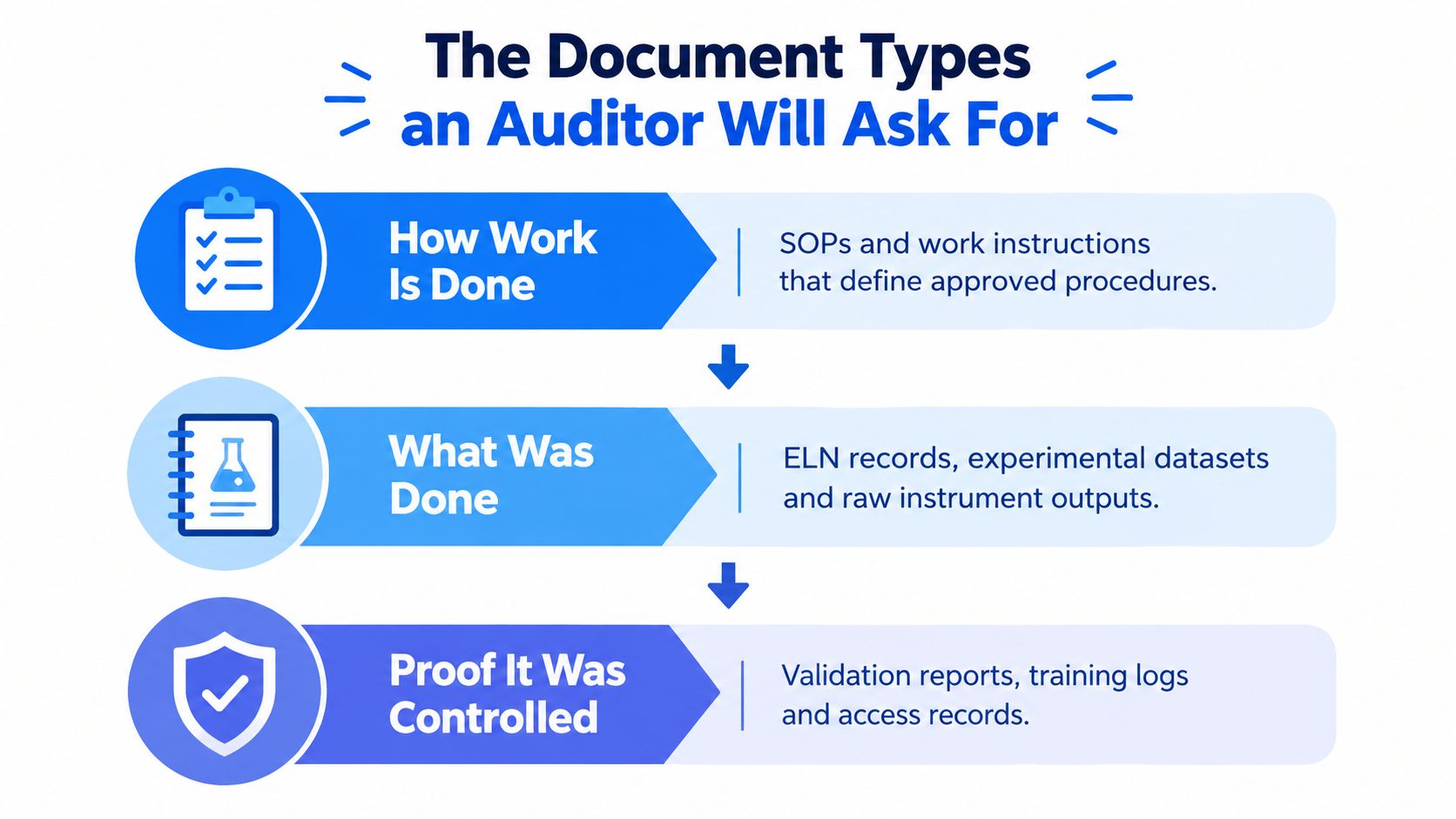
How work is done
SOPs and work instructions define the approved method. They should identify the owner, effective version, required inputs, acceptance criteria, exception route, training requirement, and approval history. An SOP without linked execution records proves intent, not operation.
What was done
ELN records, experimental datasets, and instrument logs establish the actual work. Preserve the experiment identifier, operator, timestamps, raw outputs, processing steps, deviations, and related approvals. If a derived dataset feeds a model, the record should point to the source experiments and transformation logic.
How the AI component operated
Model cards, training data manifests, and evaluation reports explain the model's purpose, scope, inputs, limitations, performance evaluation, and release decision. A model card that doesn't identify the dataset and model artifact it describes is incomplete by design.
How personal data was handled
DPIAs and records of processing document the purpose, data categories, lawful basis, risks, safeguards, retention logic, and data subject workflow. Refresh these records when the source, purpose, access pattern, or processing method changes.
How governance operated
Risk registers, CAPA logs, and management review minutes show that the organization identified issues, assigned owners, tracked remediation, and reviewed recurring risks. These records turn isolated findings into accountable governance.
How the chain of custody survived change
Change logs, version histories, and approval records connect the original state to the current state. They should show what changed, why it changed, who reviewed it, when it became effective, and what validation or training followed.
The artifacts interlock. An SOP governs an ELN entry. The ELN entry supplies data to a dataset manifest. The manifest supports a model run. The model card describes that model. A change record explains later modifications. Approval records show who authorized each transition.
The defensible record is a directed graph of artifacts, not a pile of files.
If an auditor can open one primary record and traverse the linked evidence without asking your team to search five systems, your documentation architecture is doing its job.
Versioning, Change Control, and Data Provenance in Practice
Retention answers how long you keep a record. Chain of custody answers whether the record can be trusted. A dated PDF may satisfy a retention folder, but it won't necessarily prove that the approved content is the same content used in an experiment or model run.
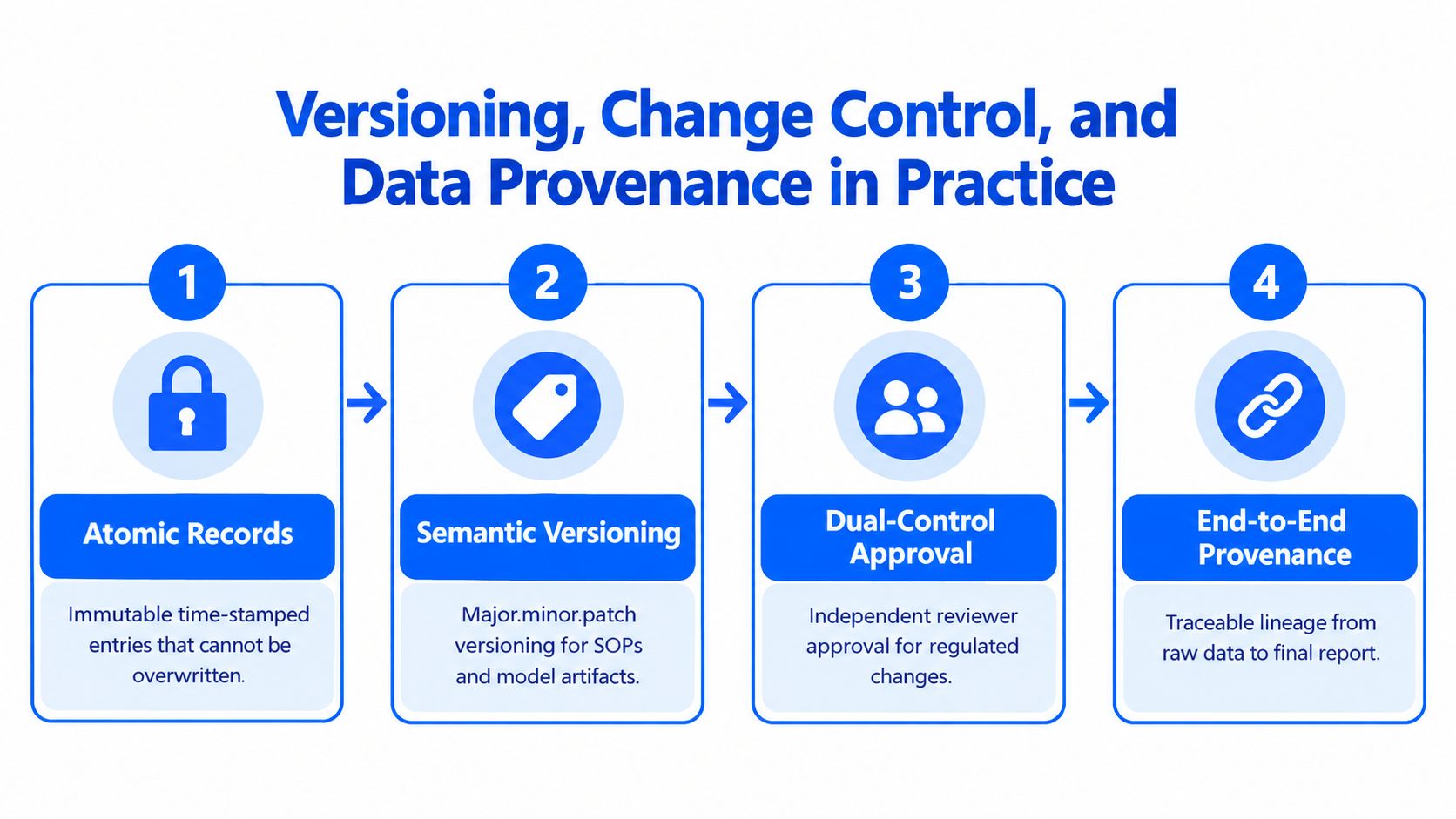
Start with atomic records
An atomic record captures one meaningful event or object without allowing silent overwrites. That may be an experiment entry, a measurement, a model-training run, an approval, or a permissions change. Use immutable timestamps, actor identity, record identifiers, and an audit history that preserves the prior state.
Hash-sealed entries provide stronger integrity evidence than exported documents because a later reviewer can verify that the stored object hasn't changed. The hash isn't the whole control. It must sit beside access restrictions, signature records, and a usable reconstruction of related events.
Apply semantic versioning consistently
Use major.minor.patch versioning for SOPs and model artifacts. A major version should represent a materially different approved method or model behavior. A minor version can represent an approved addition that doesn't alter the core intent. A patch should correct a controlled defect without obscuring the previous state.
The version label matters less than the rules behind it. Define which document classes require validation, retraining, impact assessment, or renewed training. Don't let a model artifact and its model card drift into separate version histories.
Separate authorship from approval
Regulated changes should use dual control. The person who creates or modifies a controlled artifact shouldn't be the only person who approves its release. Set approval thresholds by document class, risk, and operational impact. An editorial correction may need a different route from a change to a release criterion, training dataset, model input, or production-facing SOP.
Audit trail management from Doczen provides useful background for thinking about event history, accountability, and reviewability. The practical test is simple: can you show who changed what, why the change was permitted, and which downstream records were affected?
Build end-to-end provenance
Link raw experiment identifiers to cleaned data, derived datasets, model inputs, model outputs, reports, and approvals. Record the transformation, tool, actor, and release decision at each stage. Access logs should show who could see or modify sensitive records, not just who eventually signed a PDF.
The strongest provenance system makes model documentation an output of the training workflow. When an ELN signature, dataset manifest, and model card inherit the same lineage identifiers, the evidence remains coherent even when multiple teams contribute.
A short visual explanation of this sequence is useful for onboarding, but the control lives in the record relationships, not the diagram.
Fragmented Stacks Versus a Centralized Evidence Backbone
Fragmented systems feel cheaper because each team can adopt a familiar tool. Shared drives are easy to start, standalone ELNs preserve lab notes, email handles approvals, and paper notebooks remain common in plant environments. The cost appears later, when someone must reconcile conflicting versions and prove that separate records describe the same event.
A centralized evidence backbone doesn't eliminate integration work. It creates a common relationship layer across experiments, documents, models, signatures, access events, and changes. That makes evidence retrieval more predictable, but it also introduces migration effort, governance decisions, implementation cost, and potential vendor lock-in.
| Dimension | Fragmented Stack | Centralized Evidence Backbone |
|---|---|---|
| Record identity | Names and locations vary by system | Shared identifiers connect related artifacts |
| Version control | Copies can diverge | Controlled lineage preserves prior states |
| Approvals | Email threads and attachments | Structured signatures tied to the approved object |
| Provenance | Reconstructed manually | Linked from raw data to final output |
| Audit preparation | Search and reconciliation exercise | Evidence package can be assembled from relationships |
| Integration burden | Low at first, high during reviews | Higher upfront, lower reliance on manual reconstruction |
| Migration risk | Existing records remain scattered | Historical data needs mapping and quality review |
| Lock-in exposure | Spread across many tools | Concentrated in the selected platform and interfaces |
Don't centralize everything blindly. Keep specialized instruments and systems where they perform necessary functions, then require them to emit stable identifiers and event records into the evidence layer. A centralized architecture should be an integration backbone, not a demand that every scientist abandon productive tools on day one.
The decision should follow risk and retrieval frequency. Start with high-value workflows where an auditor, quality reviewer, or release decision depends on connecting multiple artifacts. If the team can't explain the lineage of a formulation decision, that workflow belongs near the center of the architecture.
Building an Audit-Ready Evidence Workflow Week by Week
A six-week preparation cadence works because it turns audit readiness into a controlled project rather than a last-minute document hunt. Consider a materials R&D group preparing for an ISO 27001 surveillance audit.
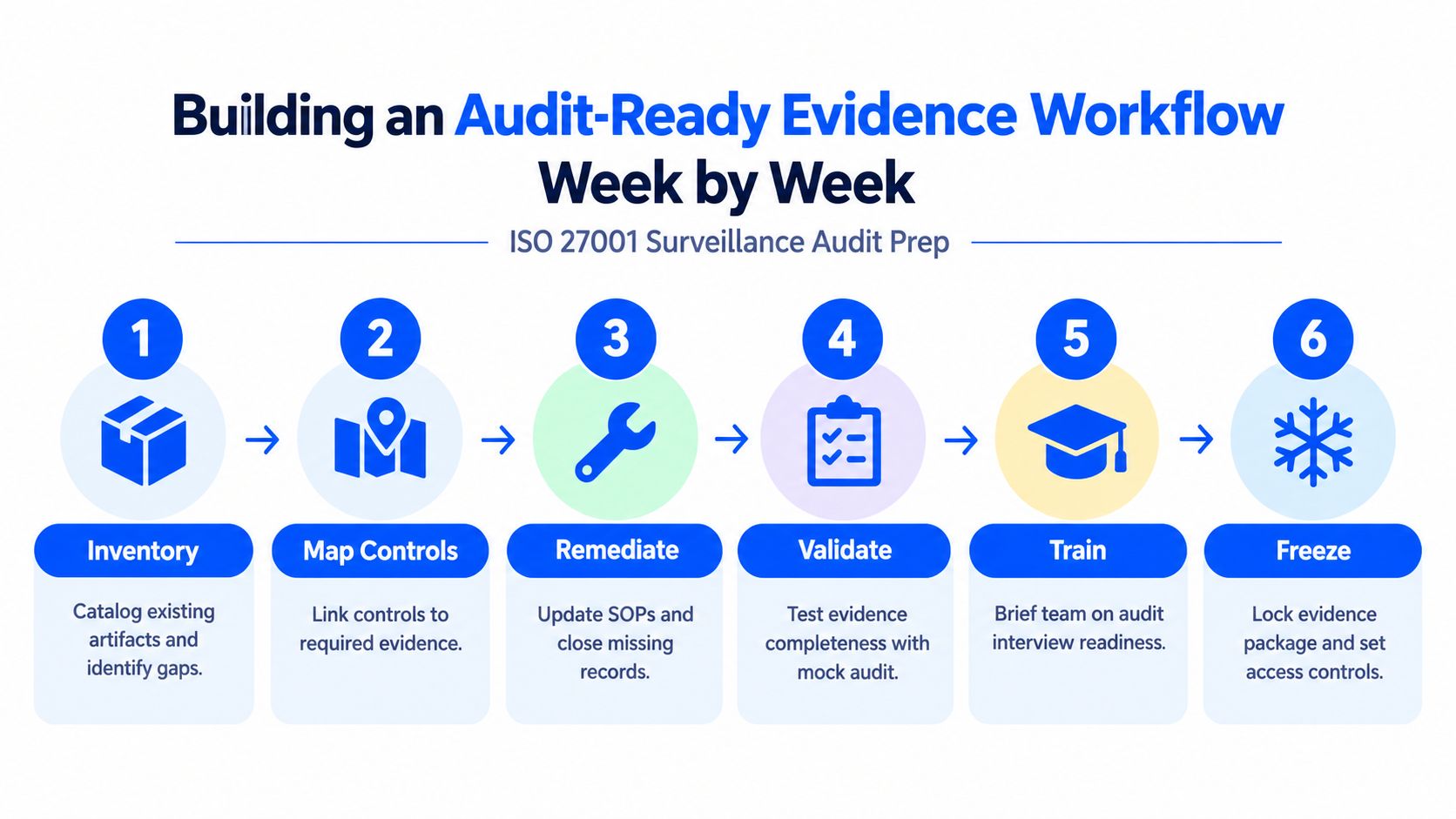
Week one, inventory
The team catalogs SOPs, ELN records, datasets, model cards, training logs, risk decisions, access reviews, and change records. Each artifact receives an owner, system location, version status, and gap label. The output is an inventory that distinguishes authoritative records from duplicates.
Week two, map controls
The compliance lead creates a control matrix linking each ISO control to its evidence sources. The team identifies where one artifact can support multiple objectives, then flags controls that rely on screenshots, email, or undocumented manual steps. The output is a mapped evidence register with accountable owners.
Week three, remediate
Owners update stale SOPs, close orphan change records, obtain missing sign-offs, and lock approved versions. The team creates a DPIA shell for relevant processing, completes model cards from training metadata, and adds ELN attestations where historical entries lack clear authorship or approval.
Week four, validate
Run a mock audit using short evidence requests: show the current SOP, the experiment performed under it, the dataset used for the model, and the approval for the resulting change. Record retrieval time, missing links, contradictory versions, and unanswered questions. Remediation isn't complete until another person can repeat the retrieval.
Week five, train
Brief scientists, engineers, platform administrators, and approvers on interview behavior and evidence handling. They should know where the authoritative record lives, how to explain exceptions, and how to distinguish a draft from an approved artifact. Test access logs and change-control routes under realistic scenarios.
Week six, freeze
Package the evidence set, lock the relevant versions, restrict unnecessary edits, and establish an exception process for urgent changes. The final checklist should include the control matrix, DPIA records, model cards, ELN attestations, access evidence, change history, open risks, and named interview owners.
The point isn't to stop operational work. It's to establish a controlled baseline so new events are captured without destabilizing the evidence package.
Common Documentation Pitfalls and How to Avoid Them
Recurring nonconformances are rarely exotic. Inspection summaries repeatedly identify missing or inconsistent records, unclear procedures, weak version control, and illegible or incomplete entries. In one clinical record-keeping audit, only 18 of 30 standards were met, a compliance rate of 60%, with illegible entries, missing clinician designations, and inconsistent abbreviations among the cited gaps, as documented in the clinical record-keeping audit.
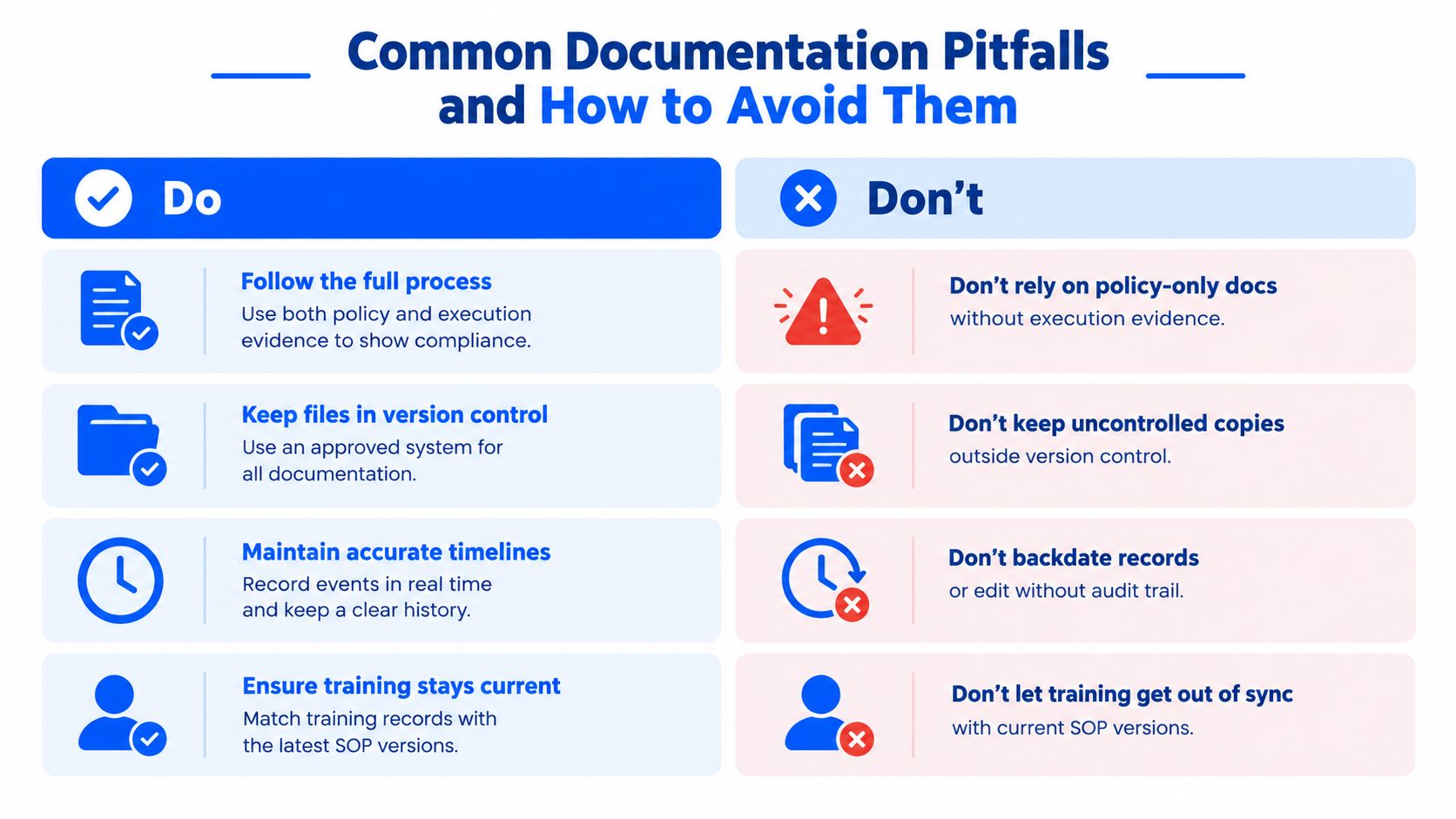
The desk-side checklist
- Don't rely on policy-only records: Link every SOP to an execution record, review event, or control test that demonstrates operation.
- Don't keep uncontrolled copies: Store the authoritative artifact in version control and mark exported or reference copies clearly.
- Don't backdate or edit without a record: Preserve the original entry, record the correction reason, and capture the approving actor.
- Don't let training drift: Tie training records to the exact SOP version each person was qualified to use.
- Don't separate model cards from datasets: Generate the model card from the training run and identify the source manifest.
- Don't leave DPIAs stale: Reassess them when data sources, purposes, access patterns, or processing methods change.
- Don't orphan change records: Link each change to affected experiments, models, procedures, validation, and training.
- Don't confuse retention with defensibility: Keeping raw data longer won't repair broken provenance or unclear custody.
For healthcare payment integrity, the relationship between record quality and compliance exposure is especially direct. The 2024 Medicare Fee-for-Service Supplemental Improper Payment Data report recorded a 92.3% national accuracy rate, implying 7.7% improper payments. Among identified improper payments, 59.9% involved insufficient documentation and 8.2% involved no documentation, according to AAPC's guidance on CMS documentation requirements.
The same logic applies to materials R&D. A policy may be approved, but an auditor still needs evidence that the team followed it, used the correct version, controlled the data, and reviewed the resulting output. In AI governance, the gap is sharper: recent reporting says programs may document effort but cannot prove impact, while another analysis reported 80% of regulated organizations had formal AI policies but only 29% had evidence controls showing how AI was used, what it produced, and whether governance was applied, as discussed in compliance and AI governance trends for 2026.
A durable evidence layer captures those details continuously. It connects operational work to control objectives, preserves the original state, and makes exceptions visible instead of hiding them in a last-minute audit package.
A related blind spot is distributed recordkeeping. Policies, approvals, trade records, delivery evidence, communications, and working files can sit across shared drives, spreadsheets, inboxes, and personal devices, forcing teams to reconstruct a timeline later, as described in guidance on exam-ready recordkeeping. Build the chain of custody at the point of work instead.
Polymerize provides a centralized materials R&D data backbone that connects experimental data across spreadsheets, ELNs, and silos, with role-based access and controls aligned to ISO 27001, SOC 2, and GDPR/CCPA requirements. Visit Polymerize to evaluate how an evidence-first platform can link experiments, model outputs, approvals, and change history before your next audit request.
Put your R&D data to work
See how materials teams use Polymerize to plan fewer experiments and reach target properties faster.