

A coatings team can spend weeks adjusting one formulation, waiting for cure, adhesion, durability, and rheology results before choosing the next experiment. The chemistry may be sound, but the workflow keeps the team moving through a narrow tunnel. Each new result answers one question while leaving the interactions between monomers, crosslinkers, additives, processing conditions, and test methods largely unexplored.
Combinatorial chemistry offers a different operating model. Instead of treating each formulation as an isolated project, the team creates a deliberately designed library, prepares candidates in parallel, measures them on matched property axes, and uses the results to select the next experiments. The advantage isn't just more automation. It comes from shortening the feedback loop between composition, processing, measurement, and decision-making.
For materials and polymer laboratories, the most useful question isn't how to make the largest possible library. It's how to create a library that produces reliable, interpretable learning. That distinction becomes decisive when combinatorial workflows are connected to structured data and AI-guided experiment selection.
Table of Contents
- Parallel synthesis creates the volume layer
- Solid-phase methods simplify handling
- Automation improves repeatability, not chemical judgment
- Screening supplies the decision signal
Why Materials R&D Teams Are Turning to Combinatorial Chemistry
A coatings team may have a resin, crosslinker, additive package, and cure schedule ready to test. Yet if each formulation moves through preparation, curing, characterization, and review separately, the team examines the composition-property space in narrow slices. Interactions remain difficult to see, even when scientists know they are present.
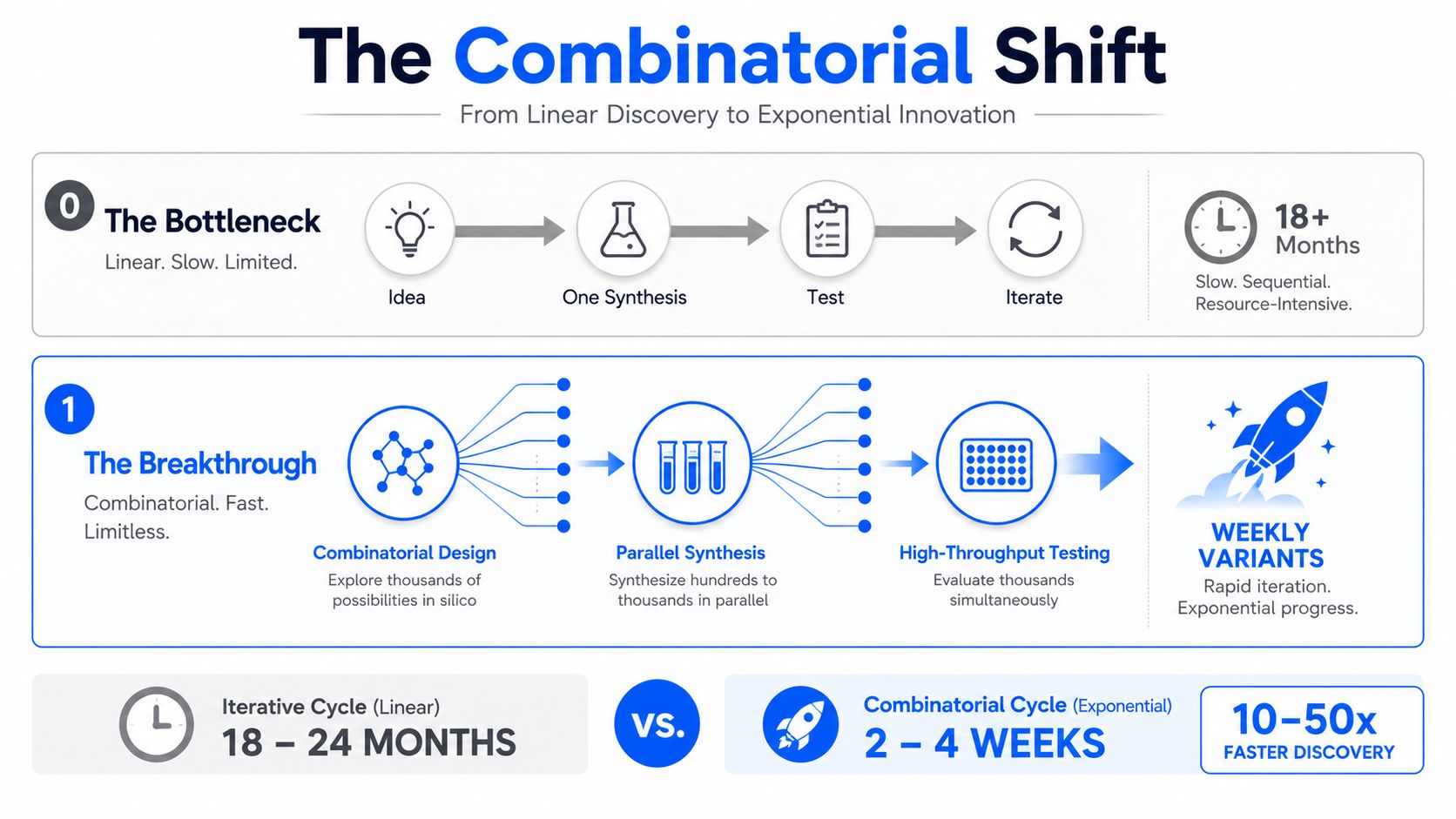
A combinatorial workflow places related formulations into a deliberately designed library. Several factors can change across the set, while preparation and screening follow matched protocols. The result resembles a map rather than a sequence of isolated points: composition, processing, and measured performance can be compared together. That view helps expose interactions that one-formulation-at-a-time testing may leave hidden.
For polymer and materials teams, library design should serve learning rather than brute-force enumeration. A smaller set with controlled variation, reliable measurements, and useful metadata can guide the next experiments better than a large collection of poorly comparable samples. Classical combinatorial methods provide the parallel structure, while AI-driven closed-loop systems can use each result to select more informative follow-up experiments.
The bottleneck is the loop
Automation alone does not make discovery faster. If synthesis outpaces characterization, samples accumulate. If measurements are quick but inconsistent, the dataset expands without supporting sound decisions. If composition and test results remain in separate spreadsheets, scientists still reconstruct the experiment before choosing what to run next.
A working campaign connects four capacities:
- Parallel preparation: Multiple formulations are dispensed and processed under controlled conditions.
- Matched characterization: Each library member receives the measurements needed for the decision.
- Structured data capture: Composition, processing, sample identity, and measurement context stay attached to the result.
- Iterative selection: The next experiments use current observations to refine the region being explored.
Practical rule: Increase synthesis capacity only after confirming that characterization and data capture can absorb the additional samples.
Existing materials infrastructure can support a gradual start. Teams may begin with plate preparation, automated dispensing, spectroscopy, rheology, microscopy, or mechanical testing already available in the laboratory. The larger change is experimental organization: define the variables, standardize the readout, track sources of variation, and make every result usable by the next decision. This setup creates the foundation for a closed loop in which models suggest experiments, experiments improve the models, and library design becomes progressively more selective.
What Combinatorial Chemistry Means
Combinatorial chemistry is a learning campaign that connects library design, parallel preparation, screening, and interpretation. Its unit of work is a coordinated set of related experiments, with each result positioned to inform the next decision. The approach applies to polymers, coatings, films, particles, and other materials as readily as to small molecules.
Consider a polymer campaign in a 96-well plate. Each well could contain an acrylate formulation with controlled changes in monomer ratio, crosslinker density, and UV initiator loading. The team might cure the wells under a common protocol, measure conversion or hardness, and compare those results with composition and processing metadata. Each well is a library member. Related members can form sublibraries focused on a monomer family, additive package, or crosslinking regime.
The terminology separates the parts of the workflow:
- Library: The complete set of candidates prepared for a campaign.
- Member: One formulation, compound, film, particle, or material sample within that set.
- Sublibrary: A structured subset that explores a narrower region or shared chemical motif.
- Parallel synthesis: Preparation of multiple members during a coordinated operation.
- High-throughput screening: Rapid measurement of a defined property across many members.
- Design of experiments: A statistical approach for choosing compositions that reveal factor effects and interactions efficiently.
Library size is not library value
A large library can look impressive while teaching very little. Randomly filling wells may leave important regions of composition space empty, place too many samples under similar conditions, or change several factors at once, making causal interpretation difficult.
A smaller, well-spaced design can provide stronger information when each member tests a meaningful hypothesis. For example, separating monomer ratio effects from crosslinker effects may be more useful than testing a larger set in which both variables change unpredictably. The strongest library creates contrasts that remain interpretable after screening.
This distinction matters because materials systems rarely optimize one isolated output. A coating may need acceptable adhesion, hardness, flexibility, cure behavior, and durability at the same time. The library should represent those trade-offs, rather than maximize formulation count without regard to decision quality.
A useful library doesn't just contain candidates. It contains contrasts that help you decide what to make next.
The same principle makes combinatorial chemistry different from running many experiments. Members require shared design logic, comparable preparation, and measurements that produce a coherent dataset. With that structure, statistical models and AI systems can select informative next experiments. Library design then becomes a learning problem, where each campaign reduces uncertainty instead of ranking the samples already tested.
How Combinatorial Chemistry Evolved Into a Materials Tool
Early combinatorial chemistry treated molecular discovery as a coordinated production problem. Peptide and small-molecule researchers developed parallel and solid-phase approaches that made families of related structures practical to prepare, instead of treating every candidate as a separate project. Split-and-pool logic expanded the number of possible combinations, while parallel formats kept individual members identifiable.
Materials scientists then applied the same framework to composition-property relationships. A catalyst library could vary composition across a spatially organized sample set. A thin-film library could produce gradients or arrays, followed by rapid structural and functional measurements. Electronic materials, phosphors, polymers, coatings, and biomaterials each presented systems where many related compositions could be compared under similar conditions.
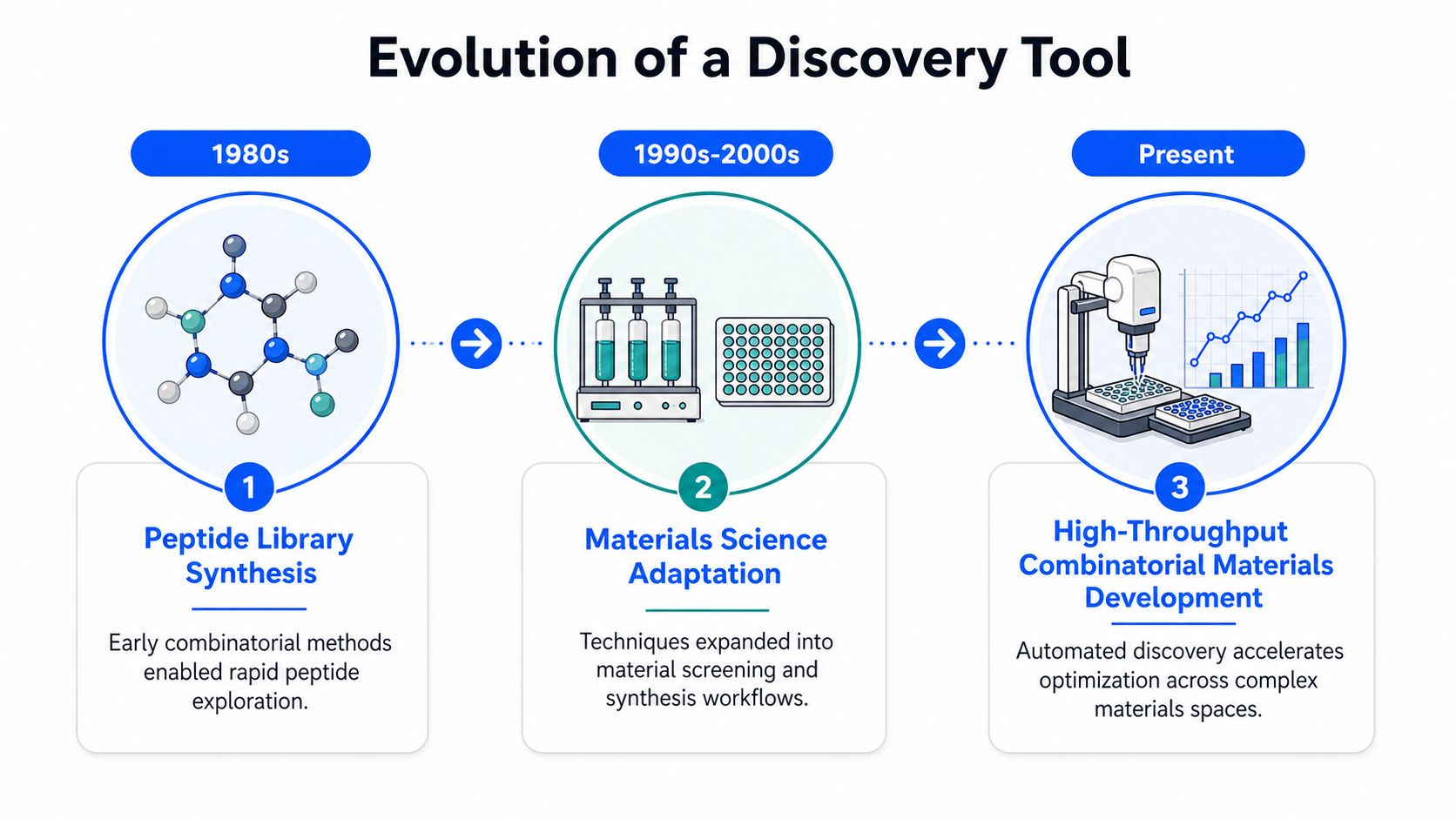
The key shift was coupling library generation with rapid characterization, rather than waiting for a particular instrument to arrive. This pairing made composition-property space experimentally accessible across areas such as catalysis, electronic and functional materials, industrial polymer coatings, sensing materials, and biomaterials.
From heroic demonstrations to routine campaigns
Early materials libraries often required specialized deposition, custom sample handling, or carefully designed characterization systems. Over time, automated liquid handlers, plate-based assays, imaging, spectroscopy, and materials databases made smaller-scale versions practical for ordinary R&D laboratories.
The practical question changed. Researchers could focus less on whether a laboratory could produce a library and more on which variables deserved parallelization, which readouts were reliable enough for comparison, and how to prevent automation from scaling weak experimental practice.
A library can now provide training data for a model, a validation set for a hypothesis, or a focused probe of uncertainty. In a closed loop, the model proposes candidates, the laboratory prepares and measures them, and the results guide the next selection. Combinatorial chemistry therefore becomes a method for acquiring information, not just a way to enumerate formulations.
The lasting evolution is from making many samples to choosing the next sample because its result will change the decision.
This perspective fits polymers and coatings especially well. Their formulation variables interact, and the most useful candidate may occupy a narrow region defined by several competing properties. Library design becomes a learning problem: classical synthesis supplies comparable samples, while characterization and models determine which experiment deserves the next run.
Core Methods That Power a Modern Combinatorial Workflow
A modern workflow works when synthesis, handling, screening, and analysis are designed as one connected system. Four methods provide the practical foundation.
Parallel synthesis creates the volume layer
Parallel synthesis uses arrays of vials, microtiter plates, reaction blocks, films, or printed spots to prepare related candidates together. Liquid dispensing can support discrete formulations, while inkjet or other spatial deposition methods can create composition gradients and localized libraries.
The failure mode is often cross-contamination. Shared reagent lines, poorly controlled aspiration, splashing, evaporation, and inconsistent mixing can create differences that look like chemistry but come from handling. Teams should use suitable line-cleaning procedures, verify dispense performance, and include controls that expose carryover.
Solid-phase methods simplify handling
Solid-phase synthesis anchors a growing molecule or reactive intermediate to a support, allowing reagents and byproducts to be separated through washing. Supported reagents can simplify isolation and make parallel operations easier to manage, particularly for compound libraries.
The trade-off is incomplete washing or uneven reagent access. A solid support can make purification more convenient, but it doesn't guarantee complete reaction or uniform mass transfer. In materials workflows, supported or immobilized chemistry must be judged against the final property assay, not only against apparent synthetic convenience.
Automation improves repeatability, not chemical judgment
Automated liquid handlers and reactor platforms reduce repetitive manual operations and can enforce consistent timing, volumes, and sequences. They also create an opportunity to connect preparation metadata directly to sample records.
Yet dead-volume carryover, air gaps, viscosity differences, and unsuitable consumables can undermine the expected reproducibility. A liquid handler calibrated for a low-viscosity solvent may not behave the same way with a concentrated polymer solution. Method development must include the actual formulation range, not just a convenient calibration liquid.
Screening supplies the decision signal
High-throughput screening is the readout layer. It may involve spectroscopy, thermal analysis, imaging, contact-angle measurements, adhesion tests, rheology, tensile testing, or accelerated durability assays. The correct readout depends on the material format and the decision the team needs to make.
A library without matched screening produces more samples for manual characterization. The most common failure is an assay-throughput mismatch. Preparation may generate candidates rapidly, while one slow or destructive test determines the campaign's real pace.
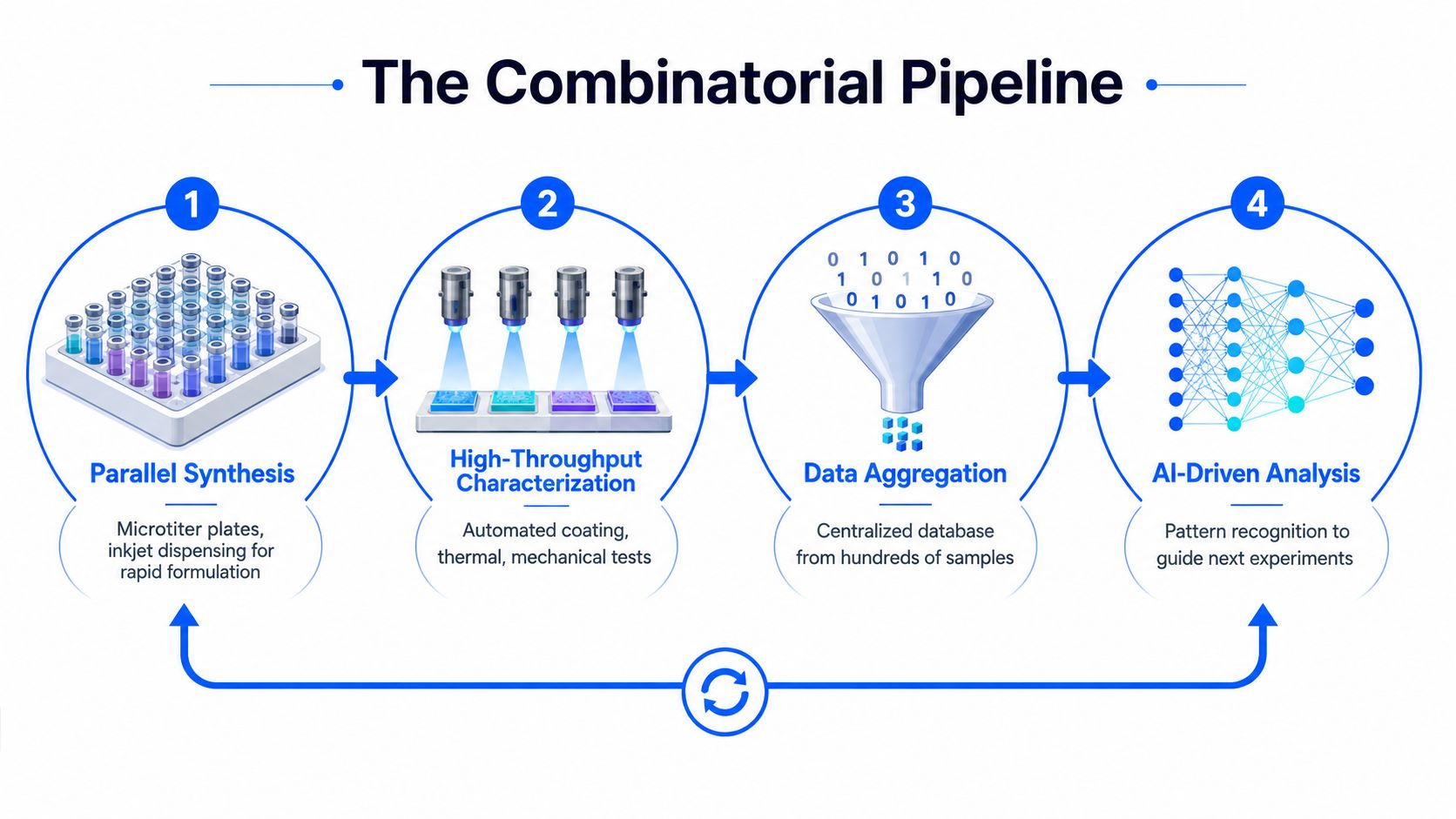
The loop becomes valuable when each stage passes traceable information to the next. Sample identity, formulation, processing history, measurement protocol, and uncertainty should remain connected from dispense through analysis.
Here is a visual overview of how these stages can connect in practice:
Designing a Combinatorial Experiment for Polymers and Coatings
A team interested in glass transition, adhesion, viscosity, UV durability, hardness, or a balanced combination of these outcomes should define those targets before choosing a plate format. The target sets the relevant variables and the measurement quality needed for comparing candidates.
For an acrylate or coating formulation, candidate factors may include monomer ratio, crosslinker loading, chain extender identity, additive package, catalyst level, solvent content, or cure condition. Begin with factors that have a credible chemical or process relationship to the target. Choose levels across a region the team can realistically manufacture, rather than varying every available factor at once.
Map the space deliberately
A full grid is easy to visualize, but it can spend wells on combinations that add little information. Use a grid when the factor count is small and each level has a clear interpretation. A Latin-hypercube design gives broader coverage when several continuous variables need exploration without enumerating every combination.
Treat composition constraints as part of the design. If resin fractions must sum to a fixed total, encode that relationship instead of treating each component as independent. Record both the intended composition and the dispensed mass or volume. That distinction allows later analysis to separate design intent from execution.
A useful library is a map of the manufacturable region, not merely a large collection of wells.
Match format to measurement
| Library Format | Property Readout | Throughput | Common Pitfall |
|---|---|---|---|
| Discrete resin samples | Rheology, tensile testing, thermal analysis | Moderate, depending on sample volume and instrument time | Preparing samples faster than the instrument can test them |
| Gradient film arrays | Automated spectroscopy, imaging, profilometry | High for spatially resolved measurements | Interpreting thickness or substrate variation as a composition effect |
| Microtiter-plate formulations | Cure response, hardness, optical measurements | High for plate-compatible assays | Edge effects, evaporation, and position-dependent curing |
| Printed or deposited spots | Optical, electrical, or surface-property screening | High when the readout is spatially automated | Poor registration between deposition coordinates and sample records |
Replicates should probe the uncertainty sources that affect the decision. Include repeated compositions, process controls, and position-aware blocking when humidity, plate location, substrate batch, or cure timing could confound the result. A model cannot separate chemistry from execution noise if the design contains no information about that distinction.
Capture bench variables during the first run. Sample ID, raw composition, dispensing sequence, mixing time, cure history, instrument method, operator, and failed measurements belong in the dataset from the start. Retrofitting metadata after screening often leaves gaps that no later analysis can reconstruct. These records also give an AI-driven closed loop usable feedback, so the next library can target uncertain or promising regions instead of repeating a brute-force enumeration.
Integrating Combinatorial Data With AI-Driven Platforms
AI adds value once the laboratory has created a trustworthy representation of each experiment, where composition, processing history, and measurement protocol travel together. A final property value needs this context to remain useful. The data backbone should preserve composition, synthesis conditions, processing history, measurement protocol, instrument metadata, sample identity, and uncertainty.
A practical schema gives each sample a central record with linked experimental details. One record describes what was made. Another records processing. A third stores the measurement, including method version, raw-file location, replicate relationship, and quality flags. Scientists can then ask which formulation performed well and whether its result came from a comparable preparation and a validated assay.
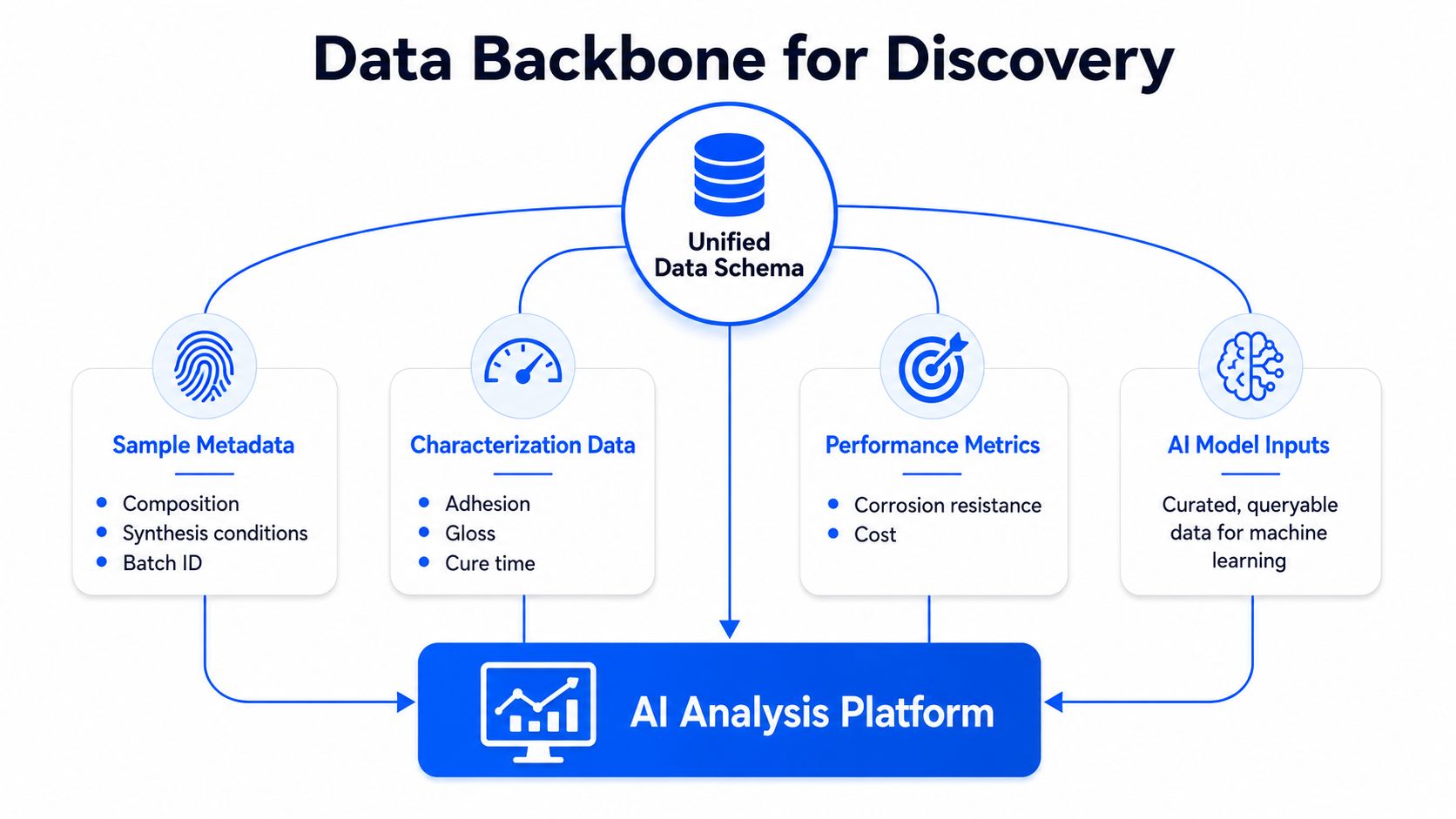
Two integration patterns
A centralized LIMS or electronic lab notebook can serve as the system of record. Structured exports then feed statistical models, optimization scripts, or machine-learning pipelines. This setup fits teams whose existing systems already manage identity, approvals, and instrument connections, provided field definitions remain consistent.
An orchestration layer can connect laboratory equipment, characterization systems, and models. It may schedule a campaign, send sample instructions to a liquid handler, collect instrument results, and return a ranked or uncertainty-aware set of next experiments. The architecture matters less than the handoffs. Systems must agree on identifiers, units, composition representation, and status.
Closed loop means more than prediction
A closed-loop experiment repeats a controlled sequence:
- The model selects candidates using predicted performance, uncertainty, or information value.
- The laboratory prepares them with versioned methods.
- Instruments measure the defined properties and return raw and processed results.
- The data system validates records and updates the model.
- Scientists review the recommendation and approve the next batch.
Campaigns often stall at system interfaces. Sample IDs can change between a plate map and an instrument export. Free-text conditions make similar experiments difficult to compare. Missing negative controls prevent the model from separating a meaningful chemical effect from assay drift.
Data handoff rule: If a scientist can't reconstruct how a sample was made and measured, the model shouldn't treat the result as equally trustworthy.
Polymerize is one example of an AI-native materials R&D platform. Its stated capabilities include unifying experimental data, supporting structured workflows, and applying explainable models to predict properties and guide formulation experiments (Polymerize materials R&D platform). Other teams can build a similar arrangement around an existing LIMS, ELN, data lake, or laboratory orchestration stack. The shared requirement is a queryable backbone that allows experimental results to influence the next experiment.
Why Bigger Libraries Are Not Always Better
The assumption that more library members automatically produce better discovery results breaks down in real materials work. A 2025 review of combinatorial chemistry describes a shift away from very large solid-phase libraries because single-bead quantitation is difficult, useful solid-phase reactions remain limited, encoding can be unreliable, and mix-and-split synthesis faces assay and encoding constraints (2025 review of combinatorial chemistry).
The practical lesson is broader than solid-phase chemistry. Library size can increase operational burden without increasing useful information. Correlated variables may create many nominally different samples that occupy nearly the same region of composition space. A noisy assay can then turn the larger dataset into a more confident-looking version of the same uncertainty.
Three ways scale can reduce learning
Redundancy occurs when the design repeatedly samples similar combinations. The library appears diverse by member count, but the measured outcomes add little new information.
Readout noise appears when preparation or characterization variability is comparable to the property differences the team wants to detect. Screening more samples doesn't fix a weak signal. It may bury the signal under additional data that the model cannot distinguish from chemistry.
Optimization myopia arises when a team sweeps a predetermined grid and misses a narrow region where several properties balance. An active-learning approach can direct experiments toward promising or uncertain regions instead of spending equal effort everywhere.
| Metric | Brute-Force Library | AI-Paired Library |
|---|---|---|
| Main design logic | Enumerate many combinations | Select members for performance and learning |
| Data burden | High, with greater screening and curation pressure | Concentrated on interpretable experiments |
| Handling of uncertainty | Often added after screening | Used to choose informative candidates |
| Human interpretation | Can become difficult as variables and records multiply | Easier when the design has explicit contrasts |
| Best use | Broad initial coverage when assays are robust | Sequential optimization and targeted exploration |
The 2025 review also points toward a more nuanced revival of combinatorial chemistry. Smaller, more interpretable libraries can be paired with stronger analytics and data-driven selection. Emerging work on multicomponent-reaction-based combinatorial chemistry calls for improved AI prediction and structure-function understanding, particularly for efficient screening and functional-material discovery (multicomponent-reaction review).
For materials scientists, this reframes the objective as information density per experiment. The valuable library is the one that improves the next decision, not necessarily the one that fills the most wells.
A Practical Case Study and Best Practices to Apply Next
A useful polyurethane dispersion campaign begins with a real decision: balance adhesion, hardness, and viscosity within a manufacturable formulation window. The team can define composition variables with design-of-experiments methods, prepare a coordinated library, run paired property assays, and route the results into a Bayesian optimization process.
The important discipline is not the number of samples in the campaign. It is the connection between each stage. The formulation map must encode constraints. Dispense and cure preparation must preserve sample identity. Adhesion, hardness, and viscosity results must enter a centralized record with method details and quality flags. The model's next-batch recommendation must then point back to compositions the laboratory can prepare.
A checklist for the next campaign
- Define the target first. Decide whether the campaign optimizes one property, a constraint set, or a trade-off. Library size should follow the decision and assay capacity.
- Choose the format around the readout. Use plate-compatible samples for plate assays. Use discrete resin quantities when rheology or tensile testing needs more material.
- Version every method. Store formulation definitions, dispense instructions, cure schedules, instrument methods, and analysis logic with explicit versions.
- Capture data at the bench. Don't rely on memory or end-of-day transcription. Link the sample ID to the plate position, raw file, operator, and processing conditions at the moment of execution.
- Budget characterization before synthesis. The slowest required assay sets the campaign pace, even if preparation is highly automated.
- Plan the model handoff before the first run. Define accepted inputs, missing-data rules, uncertainty fields, and approval steps before the results arrive.
Troubleshoot the interfaces
Misaligned replicates usually indicate a plate-map or sample-ID failure. Reconcile the design file, dispense log, physical plate, and instrument export before fitting a model.
Metadata drift occurs when operators change a solvent, cure time, instrument method, or naming convention without updating the record. Add validation rules for controlled fields and flag deviations rather than accepting them without notice.
Model retraining stalls when results arrive late, contain inconsistent units, or lack quality labels. Start with a small, reliable data slice, automate schema checks, and separate failed experiments from missing records. A failed formulation can be scientifically informative. An unidentified measurement is not.
For the next quarter, a program manager can assign one team to define the property target and factor space, one owner to validate the dispensing and assay chain, and one data steward to approve the schema and naming rules. The first campaign should prove traceability and feedback quality before expanding library scope. Once the loop operates reliably, the laboratory can let model-guided selection replace arbitrary grid expansion.
Use the next planning meeting to map your current formulation workflow, identify the slowest characterization handoff, and define the metadata your team loses today. Then visit Polymerize to see how its materials R&D platform can connect experimental data, formulation prediction, and AI-guided next experiments into a more deliberate combinatorial workflow.
Put your R&D data to work
See how materials teams use Polymerize to plan fewer experiments and reach target properties faster.