
You've run the same formulation several times, changed one or two inputs, and still can't explain why the result moved so little. The laboratory is producing data, but the next experiment is often chosen from memory, habit, or a fixed design created weeks earlier. That creates a familiar loop of testing, waiting, interpreting, and guessing again.
Closed loop optimization changes the decision point. Each experiment becomes evidence that updates a model, and that model helps select the next experiment. The approach doesn't remove scientific judgment. It gives scientists a disciplined way to direct that judgment toward the most informative and promising parts of a materials search.
Table of Contents
- Start with a decision-ready dataset
- Turn predictions into laboratory action
- Keep the scientist in control
The End of Trial and Error
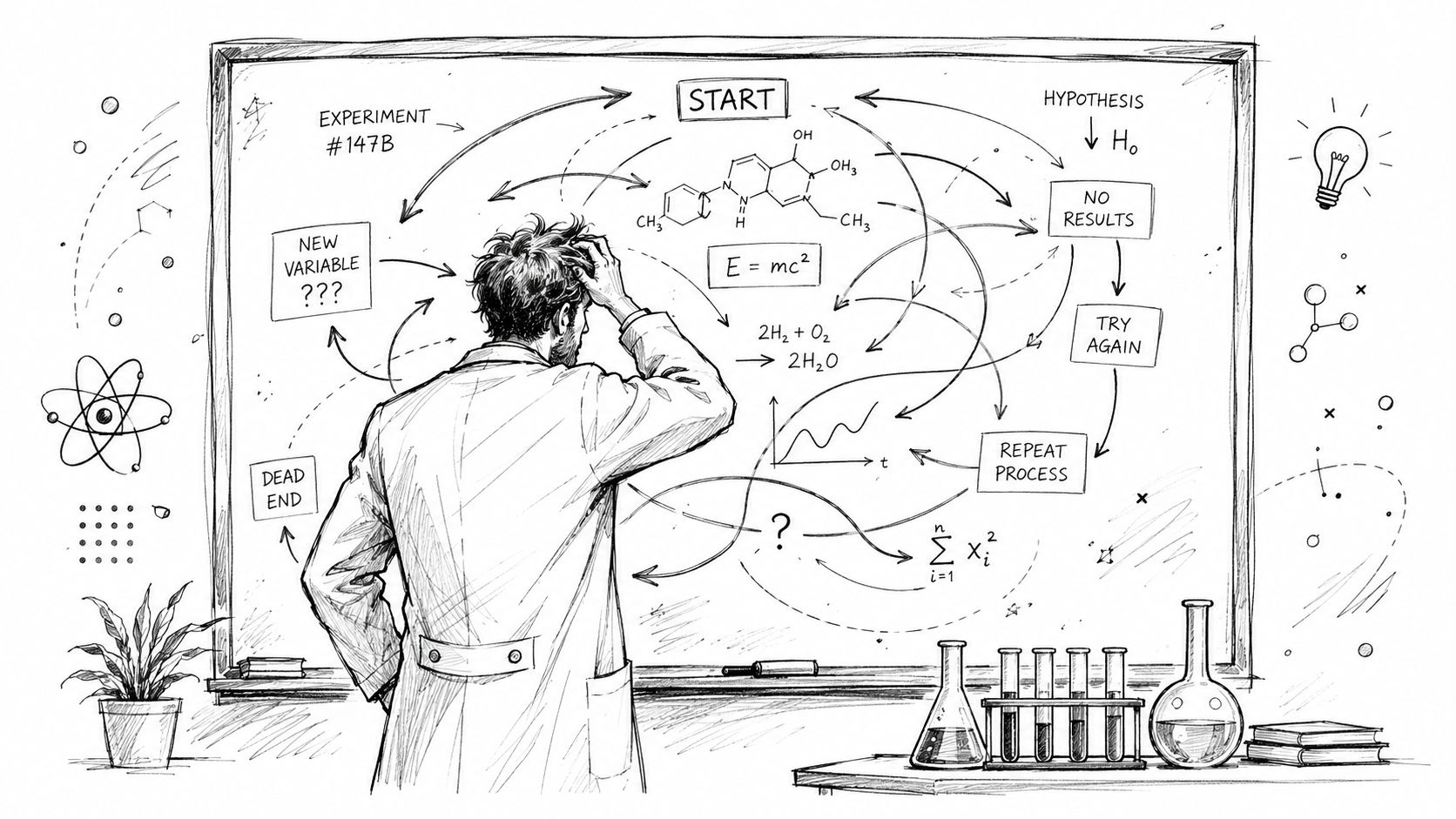
A formulation team may begin with a clear target, such as a polymer that balances flexibility, thermal resistance, and processability. Researchers choose candidate ingredients, run batches, measure properties, and compare the results with the target. When a batch misses, they adjust a ratio or processing condition and try again.
The difficulty appears after several rounds. Results can cluster around the same region, even when the team believes it's exploring broadly. A failed experiment may still contain useful information, but if nobody captures its context consistently, that information becomes difficult to use. The team remembers what happened, yet the next decision still depends heavily on intuition.
From fixed plans to responsive experiments
A sequential campaign usually starts with a batch of planned experiments. The scientist defines the variables, runs the list, and analyzes the complete dataset afterward. That approach can work when the system is well understood and every experiment is affordable. It becomes less attractive when experiments consume scarce raw materials, require long characterization cycles, or involve several competing objectives.
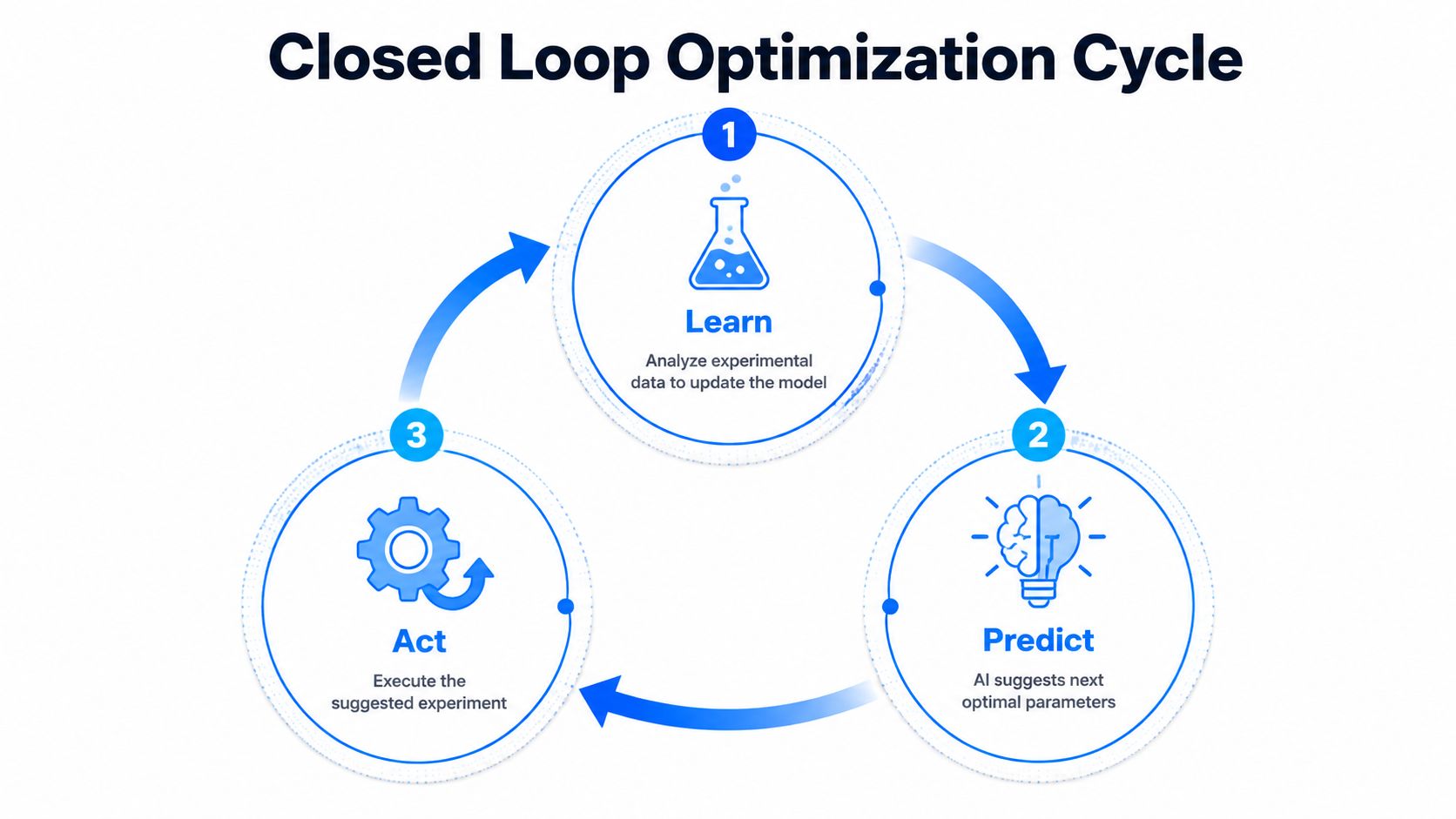
Closed loop optimization connects three activities:
- Learning: The system records experimental inputs, outcomes, uncertainty, and relevant context.
- Prediction: A model estimates which untested conditions may produce useful results.
- Action: The laboratory runs a selected experiment, then returns the result to the model.
The key change is timing. The team doesn't wait until the end of a campaign to use what it has learned. It uses early observations to shape later decisions.
What the loop can and can't do
The method is particularly useful when the search space is too large for exhaustive testing and the relationship between formulation and performance is difficult to express with a simple equation. A surrogate model can approximate that relationship, while an acquisition strategy weighs promising outcomes against uncertain regions that may reveal something new.
That doesn't mean the algorithm automatically understands chemistry. Scientists still define feasible ingredients, operating limits, measurement protocols, and success criteria. They also decide whether an unexpected result reflects a genuine phenomenon, a sample problem, or a measurement failure.
Practical rule: A closed loop is only as useful as the decision made from each result. Poor sample definitions and inconsistent measurements can make an automated workflow faster at learning the wrong lesson.
The industrial history of feedback control supports this operating philosophy. Closed-loop methods have been used for more than seven decades, and their value comes from repeatedly measuring performance and correcting action rather than relying on a one-time plan (industrial process control survey).
How the Feedback Loop Works
At its simplest, a closed loop contains a state of knowledge, a decision policy, and a physical experiment. The state of knowledge includes prior experiments and the quality of their measurements. The decision policy selects the next candidate. The physical experiment tests that candidate and produces new evidence.
Learn from the data you actually have
The first component is the experimental model. It may connect formulation variables, processing conditions, and measured properties. In many materials programs, the model isn't a detailed simulation of molecular behavior. It's a surrogate, meaning a statistical approximation that can estimate likely outcomes across the tested region.
A useful model should represent more than a single predicted value. It should also communicate uncertainty. A candidate with a high predicted performance and substantial uncertainty may deserve attention for a different reason than a candidate with a slightly lower prediction and strong supporting evidence.
The data record must include enough context to make each observation meaningful. Inputs might include ingredient identity, loading, mixing sequence, cure profile, and test conditions. Outputs might include mechanical, thermal, electrical, optical, or barrier properties. Metadata, failed runs, replicate status, and quality flags matter because the optimizer can't distinguish a surprising material response from a compromised measurement unless the workflow preserves that distinction.
Predict the next useful experiment
Design of experiments determines how the system spends its next opportunity. Bayesian optimization is one common strategy. It uses a surrogate model to balance exploitation, testing regions likely to perform well, with exploration, testing regions where uncertainty remains high.
The objective may be a single property, but real materials work often involves constraints and trade-offs. A formulation may need to meet a performance threshold while remaining processable, commercially available, and compatible with existing equipment. The best next experiment, therefore, isn't necessarily the one with the highest predicted value. It may be the one expected to improve the decision most while staying within laboratory and manufacturing limits.
Act, observe, and redesign
The laboratory executes the recommendation, collects the result, and updates the dataset. The model then changes its view of the search space. This cycle continues until the team reaches a satisfactory candidate, exhausts a practical resource, or decides that further learning no longer justifies the cost.
The controller and the optimizer shouldn't be treated as isolated software features. In manufacturing settings, the same feedback logic connects operating conditions with economic objectives. A practical overview of smart controllers for profitability can help teams think about that connection beyond the laboratory.
A closed loop also includes human review. Scientists may reject a recommendation because a reagent is unavailable, a vessel is occupied, a safety limit has changed, or a measurement would be invalid under the proposed conditions. That intervention isn't a failure of automation. It's part of the control policy.
Historical Success in Industry
Closed loop optimization has deep roots in industrial process control. A survey of the field describes how proportional-integral-derivative control expanded from a small number of pneumatic loops per process during the 1930s through the 1950s to hundreds or even thousands of digitally implemented loops in modern plants (survey of closed-loop performance assessment).
That history matters because it separates the method from the current excitement around artificial intelligence. Feedback-based optimization isn't an experimental add-on invented for today's software stack. Industrial organizations have used measurement, comparison, and corrective action to manage variable processes for decades.
Why PID is part of the story
PID control is deliberately simple compared with a modern machine-learning workflow. It measures deviation from a target and adjusts an input to reduce that deviation. Its durability comes from stability, consistency, and the ability to operate under disturbances. The same survey identifies Harris's 1989 work on closed-loop performance assessment as a milestone that formalized a metric for comparing actual variance with the best achievable variance under disturbances (closed-loop control history and Harris index).
Materials R&D uses a different layer of decision-making. Instead of adjusting a valve continuously to hold a process variable near a setpoint, the system chooses among possible experiments. Still, the underlying logic is related. Measure what happened, compare it with the objective, estimate what remains uncertain, and change the next action.
Economic value without wholesale hardware replacement
A landmark industrial result reported economic improvements of 5% to 10% of process value added for petroleum and chemical units using closed-loop real-time optimization (industrial closed-loop real-time optimization). The significance isn't limited to the figure. The work showed how online computation, automatic implementation of optimization results, and constrained multivariable control could create value without replacing the core process hardware.
Later manufacturing-focused literature has associated closed-loop AI deployments with 10% to 30% greater throughput and 30% to 50% less unplanned downtime (industrial closed-loop optimization benchmark). Those results shouldn't be transferred mechanically to every materials laboratory. They do show that feedback becomes economically meaningful when the organization connects models to real decisions and validates outcomes continuously.
The lesson for R&D leaders is practical. A closed loop earns credibility when it improves the quality of decisions, respects constraints, and creates a traceable link between data and action. The algorithm is only one part of that system.
Sequential vs. Iterative Optimization
Suppose a scientist wants to improve a coating formulation across several variables. A sequential plan might define a full matrix at the beginning, run every combination, and analyze the results after the final measurement arrives. That design can provide structured coverage, but it treats early results as information for the report rather than guidance for the next batch.
An iterative campaign changes course as evidence accumulates. If early results show that one region produces poor adhesion, later experiments can move away from it. If a surprising interaction appears between solvent content and cure temperature, the system can allocate new trials to understand that interaction before the team spends more material elsewhere.
| Feature | Sequential Approach | Iterative Closed-Loop |
|---|---|---|
| Experiment plan | Defined largely before testing begins | Updated after each informative result |
| Use of early data | Often postponed until the campaign ends | Directly influences the next recommendation |
| Resource allocation | Follows the original matrix | Shifts toward promising or uncertain regions |
| Handling constraints | Must be incorporated in advance | Can be reviewed and enforced at each cycle |
| Scientific review | Concentrated during design and final analysis | Distributed throughout the campaign |
| Failure response | May continue testing a weak region | Can stop, redirect, or investigate the region |
Why iteration reduces wasted effort
The advantage isn't just speed. Iteration changes the information value of each experiment. A trial can be selected because it may produce a better formulation, distinguish between competing model explanations, or clarify whether a constraint is binding.
That makes the campaign more economical in systems where experiments are expensive or slow. The team doesn't need to predict the entire response surface perfectly before starting. It needs a reliable process for improving the next decision as evidence arrives.
The strongest loop doesn't ask only, “Which candidate looks best?” It also asks, “Which experiment will make our next decision more reliable?”
Iteration also requires disciplined stopping rules. A team should define what counts as adequate performance, what uncertainty is acceptable, and when a candidate must move to confirmation or scale-up. Without those rules, an optimizer can continue searching after the scientific decision is already clear.
For readers moving from laboratory concepts toward plant execution, an overview of the implementation of process optimization offers useful context on connecting optimization logic with operational workflows. The same principle applies at both levels: recommendations must fit the process that will execute them.
Integrating with Polymerize
A closed loop breaks down when experimental data remain scattered across spreadsheets, ELNs, instruments, and personal notebooks. Before a model can recommend the next experiment, the organization must decide which records belong together, how variables are named, and whether measurements are comparable.
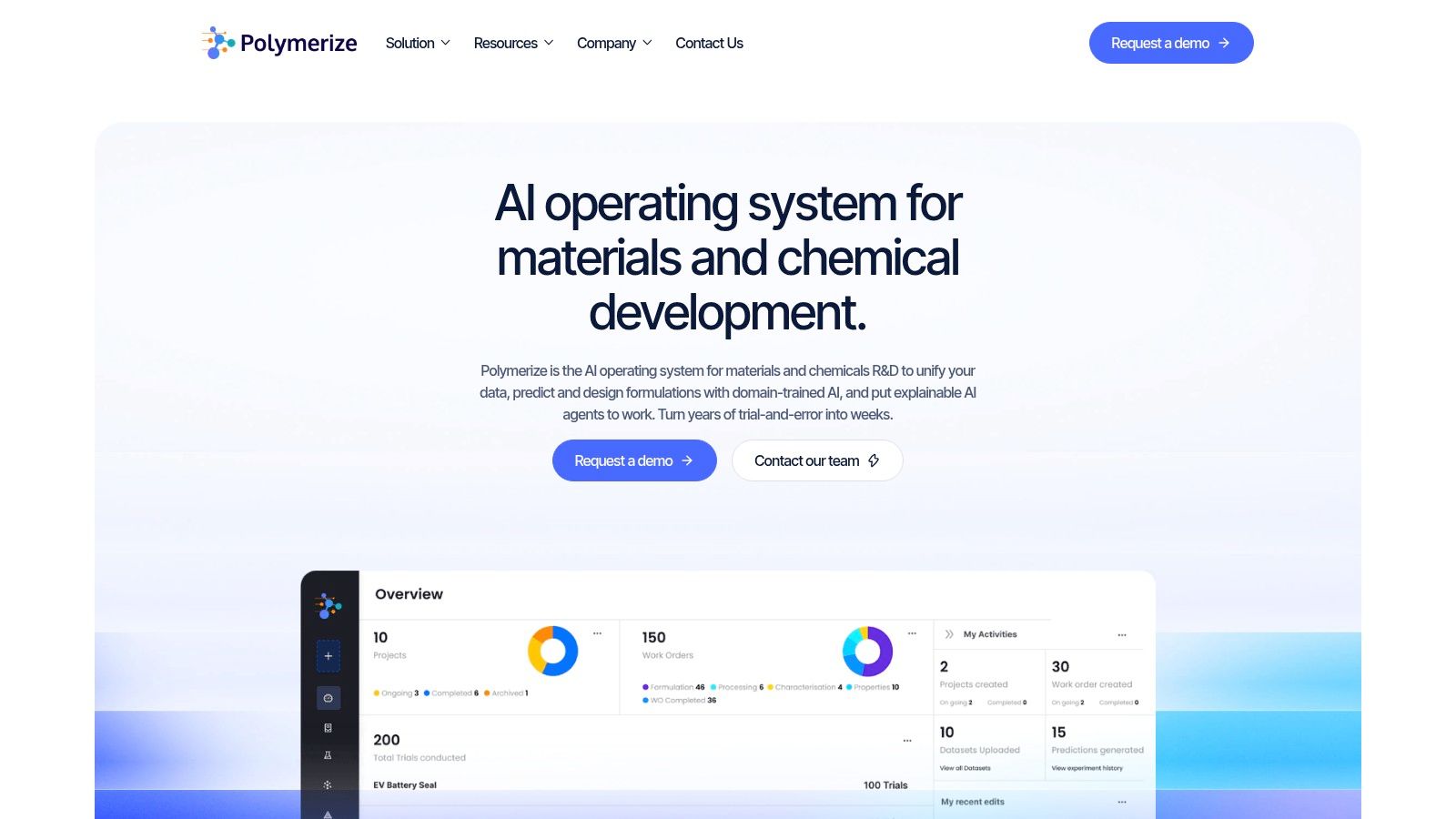
Polymerize provides one example of a materials R&D data backbone. Polymerize Connect is designed to unify fragmented experimental information into a centralized, secure foundation. That step matters because model quality depends on the consistency and traceability of the data entering the workflow.
Start with a decision-ready dataset
Begin by defining the decision object. In a formulation program, that might be a complete recipe plus processing conditions, not an isolated ingredient measurement. Attach the relevant properties, test methods, environmental conditions, and quality information to that object.
A practical preparation sequence looks like this:
- Standardize inputs: Use consistent names and units for materials, additives, processing steps, and test conditions.
- Preserve provenance: Record who created the sample, how it was prepared, and which instrument or method produced each result.
- Separate outcomes from quality flags: A low property value and an invalid test shouldn't enter the model as equivalent evidence.
- Define constraints: Mark limits involving composition, safety, availability, equipment, and scale-up.
- Choose the objective: State whether the campaign prioritizes one property, a trade-off, or a feasible region satisfying several requirements.
Turn predictions into laboratory action
Polymerize Labs adds predictive and formulation-focused model capabilities over the unified data. Its stated workflow includes property prediction, formulation optimization, explainable drivers, confidence information, and planning for the next experiment. In practice, scientists can use those outputs to compare candidates, inspect why a recommendation appears attractive, and decide whether the proposed trial is chemically and operationally sensible.
The explanation layer is important for adoption. A formulation chemist may accept a recommendation more readily when the system shows relevant historical precedents and the variables influencing the prediction. That evidence also helps identify data gaps, such as a property measured under incompatible conditions or a region with too little coverage.
Keep the scientist in control
Implementation should start with a bounded use case, such as optimizing one formulation family against a clearly defined property target. The team can then validate data capture, review recommendations, compare predicted and observed outcomes, and refine the workflow before expanding to more products or sites.
For organizations requiring broader execution support, Polymerize One combines the software workflow with expert assistance and prototyping networks. The important design principle remains the same: connect a trustworthy data record to a model, a feasible next experiment, and a documented result.
Overcoming Experiment Design Challenges
The hardest part of closed loop optimization often isn't choosing Bayesian optimization or selecting a machine-learning model. It's deciding what the system should regard as one sample and when that sample is ready for a decision.
A physical specimen may produce several signals. A fast assay can arrive soon after preparation, while a slower characterization method may take much longer. Quality-control information, instrument logs, and time-course measurements may arrive at different moments. If the optimizer treats each signal as a complete and independent sample, it can make recommendations before the relevant evidence is assembled.
Mixed streams need an explicit data contract
A campaign should define how asynchronous information joins the decision object. That contract might specify which measurements are preliminary, which are final, how missing values are represented, and what triggers model updates.
A useful structure distinguishes:
- Physical unit: The actual batch, film, pellet, coating, or specimen.
- Decision unit: The formulation and process conditions the optimizer is evaluating.
- Observation: A property measurement, assay result, log event, or time-course value.
- Validation state: Whether the observation is pending, accepted, repeated, or rejected.
This distinction is central to the practice-focused discussion of mixed streams and decision units in recent closed-loop experiment design guidance. It prevents a fast but incomplete signal from overriding a later, more informative measurement.
Automation needs boundaries
A robot can dispense, mix, cure, and test materials, but it can't independently determine whether an unusual result reflects a novel mechanism or a clogged line. Scientists still need to review outliers, approve constraint changes, and decide when a model has encountered a regime outside its reliable coverage.
Transferability creates another risk. A model that performs well near its sampled region may not generalize across the full search space. A Science study of heteroaryl Suzuki-Miyaura coupling addressed this concern through data-guided matrix down-selection, while broader benchmarking work has compared Bayesian optimization across diverse experimental materials datasets (Science study on closed-loop reaction optimization).
A black box hides uncertainty. A useful closed loop exposes uncertainty, records exceptions, and gives the scientist a reason to intervene.
Recent autonomous materials workflows are also moving toward robot-integrated, multi-agent architectures. One 2026 Matter study described a hierarchical system involving 19 LLM agents and 16 domain tools for end-to-end closed-loop discovery (autonomous materials discovery architecture). The direction is significant, but the laboratory data contract remains the foundation. More agents won't repair ambiguous samples or inconsistent measurements.
Accelerating Your Materials Development
Closed loop optimization changes materials development from a collection of isolated experiments into a managed learning system. The value comes from directing each new batch toward a better decision, while preserving the failures, constraints, and context that make future predictions more useful.
That shift can reduce repeated work, improve the path from laboratory formulation to scale-up, and make R&D data more valuable over time. It also gives leaders a clearer way to evaluate digital initiatives, because the workflow connects an observed result with a model update and a documented next action.
Start with one product family and one measurable objective. Audit the data needed to define a complete decision unit, establish how asynchronous results will be joined, and require scientists to review recommendations before execution. Once the loop produces trustworthy decisions, expand it to additional properties, formulations, and production constraints.
Polymerize offers a connected data foundation and AI-guided materials R&D workflows that help teams organize experimental evidence, predict properties, optimize formulations, and plan the next experiment. Visit Polymerize to see how your organization can turn fragmented laboratory data into a practical closed loop for materials development.
Put your R&D data to work
See how materials teams use Polymerize to plan fewer experiments and reach target properties faster.