

Your lab team has a promising formulation, a spreadsheet full of experiments, and a pilot run that refuses to reproduce the result. One scientist recorded temperature in Celsius, another copied a controller setpoint, and a third stored viscosity results in an ELN with no consistent sample identifier. The model built from that history may look precise, but it's learning from disconnected records rather than a controlled process.
That's the practical challenge in chemical process optimization. The work isn't finding a high-yield condition. It's creating a closed loop that connects business objectives, reliable data, experimental design, predictive models, pilot evidence, and controlled operations. The strongest systems optimize yield and material properties alongside throughput, energy intensity, emissions, safety, and reproducibility.
Table of Contents
- Identify what changes with scale
- Run a controlled closed loop
- Optimize several outcomes without hiding the conflict
Why Chemical Process Optimization Fails Without a System
A formulation can be “optimized” in the laboratory and still fail commercially. Mixing changes with vessel geometry, heat transfer shifts with scale, raw-material variability exposes hidden sensitivities, and a continuous process behaves differently from a batch experiment. If the team only preserves the final recipe, it loses the reasoning behind the recipe and the boundary conditions that made it work.
Fragmented information makes that problem worse. Spreadsheets hold experimental conditions, ELNs contain observations, historians store equipment signals, and quality systems record release results. Each system may be useful on its own, but disconnected records prevent scientists and engineers from tracing a result from feedstock and process settings to final properties.
A process engineer might see a throughput constraint that a formulation scientist never recorded. A materials scientist might know that a particular batch had unusual morphology, while the production record only shows an apparently acceptable temperature profile. Without shared identifiers, units, timestamps, and provenance, the organization returns to trial and error.
Optimization means managing a system of decisions
A useful operating model links five elements:
- Objectives: Define what “better” means for the product and the plant.
- Data: Capture conditions, measurements, deviations, and context in a usable structure.
- Experiments: Select the next run to resolve uncertainty or improve performance.
- Models: Predict outcomes while exposing confidence, assumptions, and influential variables.
- Validation: Test recommendations at relevant scale before changing production practice.
This framing also connects optimization with process safety. Teams working in major hazard environments need to understand how operating changes affect hazards, procedures, training, management of change, and incident prevention. The overview of PSM for major hazard facilities provides useful context for keeping optimization inside the broader safety-management system rather than treating it as an isolated analytics project.
The historical lesson still matters
Chemical manufacturing has optimized energy and operations long before modern AI. The ENERGY STAR petrochemical industry guidance reports that the total chemical industry improved energy efficiency by 25% between 1989 and 2000. It attributes 2% of that gain to improved energy management and good housekeeping, and 31% to debottlenecking and process-installation improvements.
The same source identifies process optimization as a standard efficiency lever, with a 15% improvement opportunity, alongside heat exchangers at 15% and motor applications at 10%. These figures don't mean every plant has the same opportunity. They do show why optimization has historically focused on producing the same output with lower energy intensity, fewer constraints, and better equipment integration.
A complete system therefore starts with measurable KPIs, not an algorithm. It then turns every experiment and pilot run into structured evidence, uses models to select the next action, and feeds production feedback back into the knowledge base.
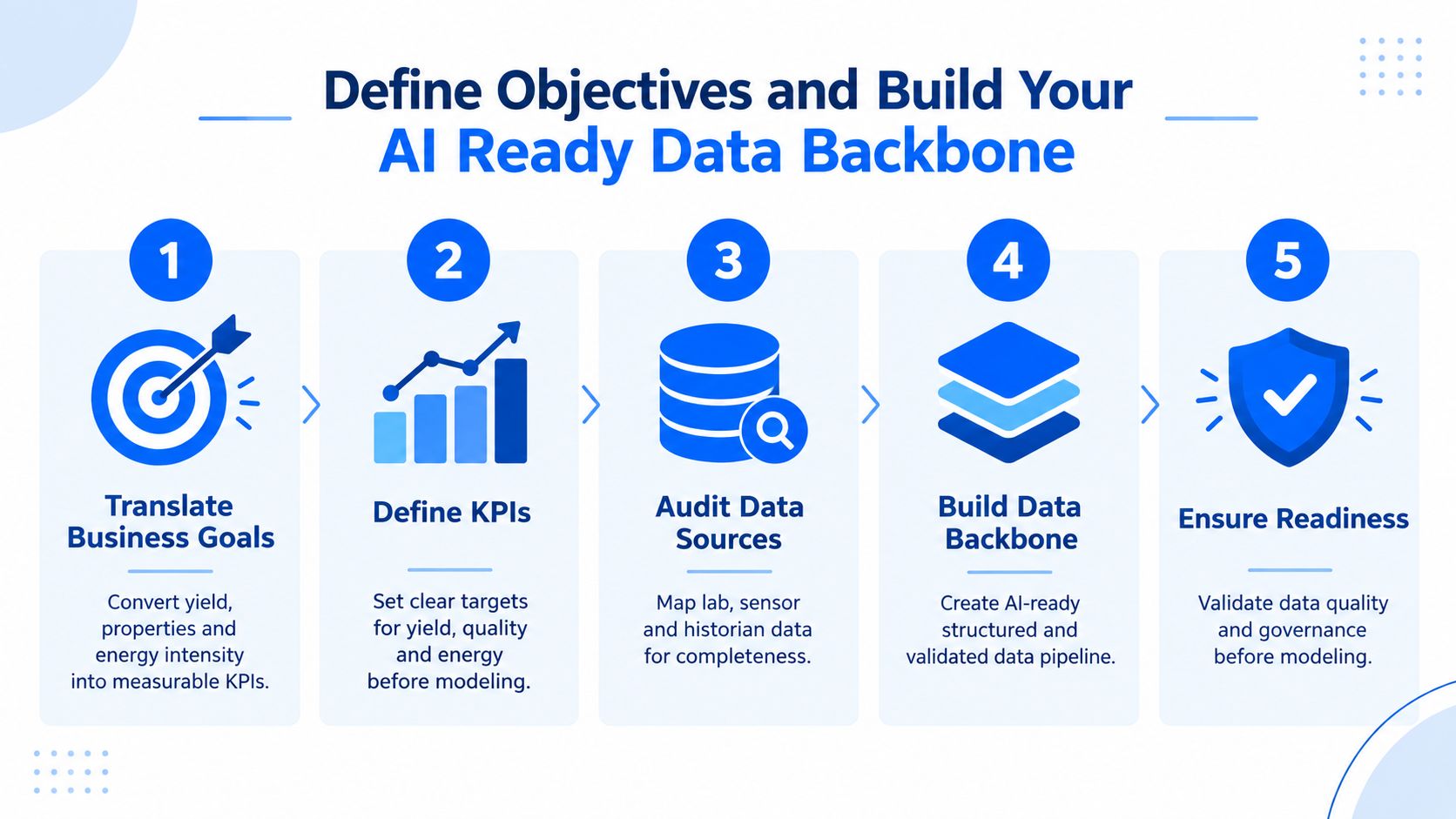
Define Objectives and Build Your AI Ready Data Backbone
Modeling should begin only after the team agrees on what it's optimizing. “Improve the process” is too vague to guide an experiment, resolve a trade-off, or approve a production change.
Start with the commercial and technical decision. For a polymer formulation, the objective might be to meet tensile strength and viscosity requirements while reducing cure time and energy intensity. For a specialty chemical, it might be to improve selectivity while controlling impurity formation, solvent use, and cycle time. For a continuous process, throughput may matter, but not if it creates unacceptable variability or emissions.
Translate goals into an objective hierarchy
Use a hierarchy rather than a long, unranked list of KPIs.
- Define hard constraints. Safety limits, regulatory specifications, equipment capacity, and customer requirements should be treated as boundaries, not optional preferences.
- Choose primary outcomes. Select the result that determines whether the process succeeds, such as yield, conversion, a critical material property, or acceptable batch release.
- Add secondary objectives. Energy intensity, waste, solvent consumption, cycle time, and raw-material cost can shape the preferred solution.
- Record trade-off rules. Decide whether a small yield gain is worth higher energy demand, or whether lower carbon intensity takes priority when quality remains within specification.
- Set a decision owner. A model can rank options, but a named scientist, engineer, or process owner should approve the action.
The IEA estimates that best available technologies for process heat and electricity could deliver 5–15% short- to medium-term energy savings globally in the chemical and petrochemical sector, including countries such as Brazil, Canada, France, Italy, Japan, and Taiwan. Its broader assessment places achievable primary energy savings from process heat and electricity optimization, process integration, recycling and energy recovery, and combined heat and power at 12.1 EJ per year. These estimates from the IEA chemical and petrochemical sector analysis support treating energy as a design variable, not a sustainability note added after yield optimization.
Make the data usable before making it intelligent
An AI-ready backbone needs more than a central folder. Consolidate experimental records, material identities, equipment settings, process measurements, analytical results, and operator notes around stable sample and batch identifiers. Preserve the original value, normalized value, unit, timestamp, instrument, and transformation history.
Set data-quality gates before training:
- Identity: Every sample, batch, formulation, and run has a persistent identifier.
- Units: Temperature, pressure, flow, concentration, time, and energy fields use controlled units with documented conversions.
- Conditions: Record ramp rates, hold times, mixing regimes, atmosphere, feed characteristics, and equipment context.
- Missingness: Distinguish “not measured,” “not applicable,” and “not recorded.”
- Traceability: Keep links between raw data, processed features, model versions, experiment plans, and approvals.
- Access: Restrict sensitive formulations and process knowledge by role, site, and project.
Centralization tools such as Polymerize Connect can serve as one approach for bringing fragmented materials R&D data into a structured foundation. The specific platform matters less than the discipline: scientists must be able to reproduce how a result was generated, and engineers must be able to identify whether a prediction applies to the equipment and operating region under consideration.
Design Smarter Experiments with DOE and Active Learning
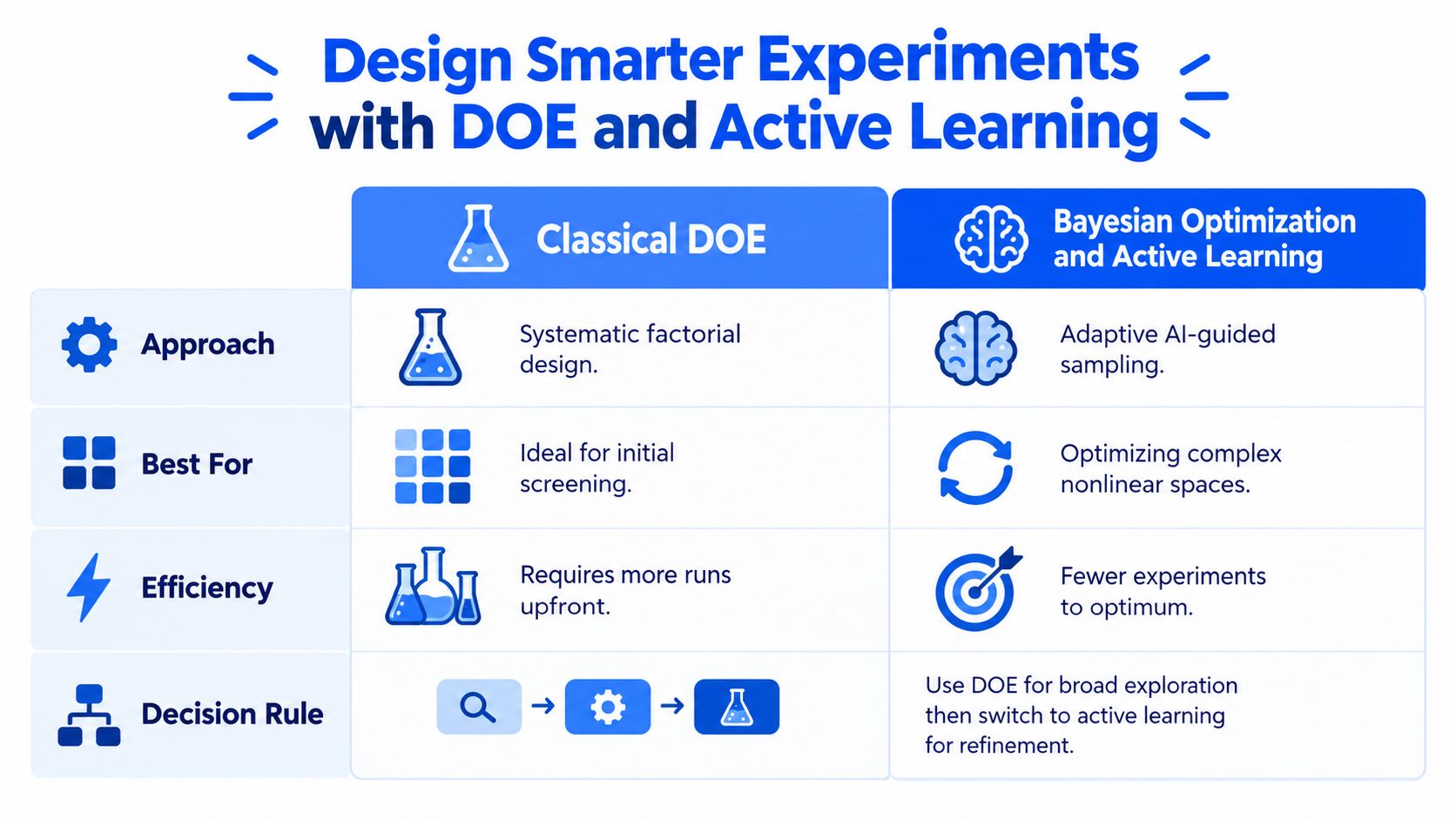
Classical DOE and Bayesian optimization solve different parts of the experimental problem. DOE is strong when the team needs structured coverage of a factor space and interpretable estimates of main effects and interactions. Bayesian optimization is attractive when experiments are expensive, the response surface is nonlinear, and each run should improve the choice of the next run.
Use DOE to learn the shape of the problem
A defensible DOE workflow is straightforward, but teams often skip the controls that make its conclusions reliable:
- Define the response. Specify how yield, conversion, viscosity, modulus, impurity, energy intensity, or another output will be measured.
- Choose factors and levels. Include process variables the team can control and define a tested operating region.
- Check measurement capability. Complete gauge R&R before trusting variation in the response.
- Randomize the run order. Reduce the risk that time, instrument drift, operator, or raw-material changes are mistaken for factor effects.
- Replicate center points. Estimate pure error and check for curvature.
- Fit and inspect the model. Use ANOVA and regression, but review effect size, residuals, interactions, and practical significance.
- Run confirmation experiments. Test the predicted optimum before approving a production change.
The State-Ease DOE guidance for starch milling highlights failure modes that translate directly to chemical and materials work. Too many factors in a low-resolution design can blur important interactions. Adding factors during the study compromises interpretation. Statistical significance without effect size can produce a technically detectable but commercially irrelevant recommendation. Extrapolating beyond the tested region can make the model appear more confident than the evidence supports.
Switch to adaptive search when every run costs
Bayesian optimization builds a surrogate model from existing observations and uses an acquisition strategy to balance exploration with exploitation. Active learning follows the same practical principle: select the next experiment because it is expected to improve the objective, reduce uncertainty, or clarify a disputed relationship.
A 2024 chemical optimization study reported that Bayesian optimization outperformed human decision-making in average optimization efficiency and consistency, measured through fewer experiments needed and lower variance in final performance. The result is reported in the RSC study on chemical optimization. It shouldn't be interpreted as permission to automate every decision. The study also sits within a wider methodological issue, namely that single-case demonstrations are difficult to compare, so chemically relevant benchmark suites are important for testing generalization.
A practical sequence is to use DOE for broad exploration, then active learning for refinement inside a safe, experimentally supported region. AI workflow tools can help coordinate data capture, experiment queues, approvals, and feedback, but they won't fix poor measurement systems or undefined objectives. Resources on AI workflow builders are useful when designing that orchestration layer.
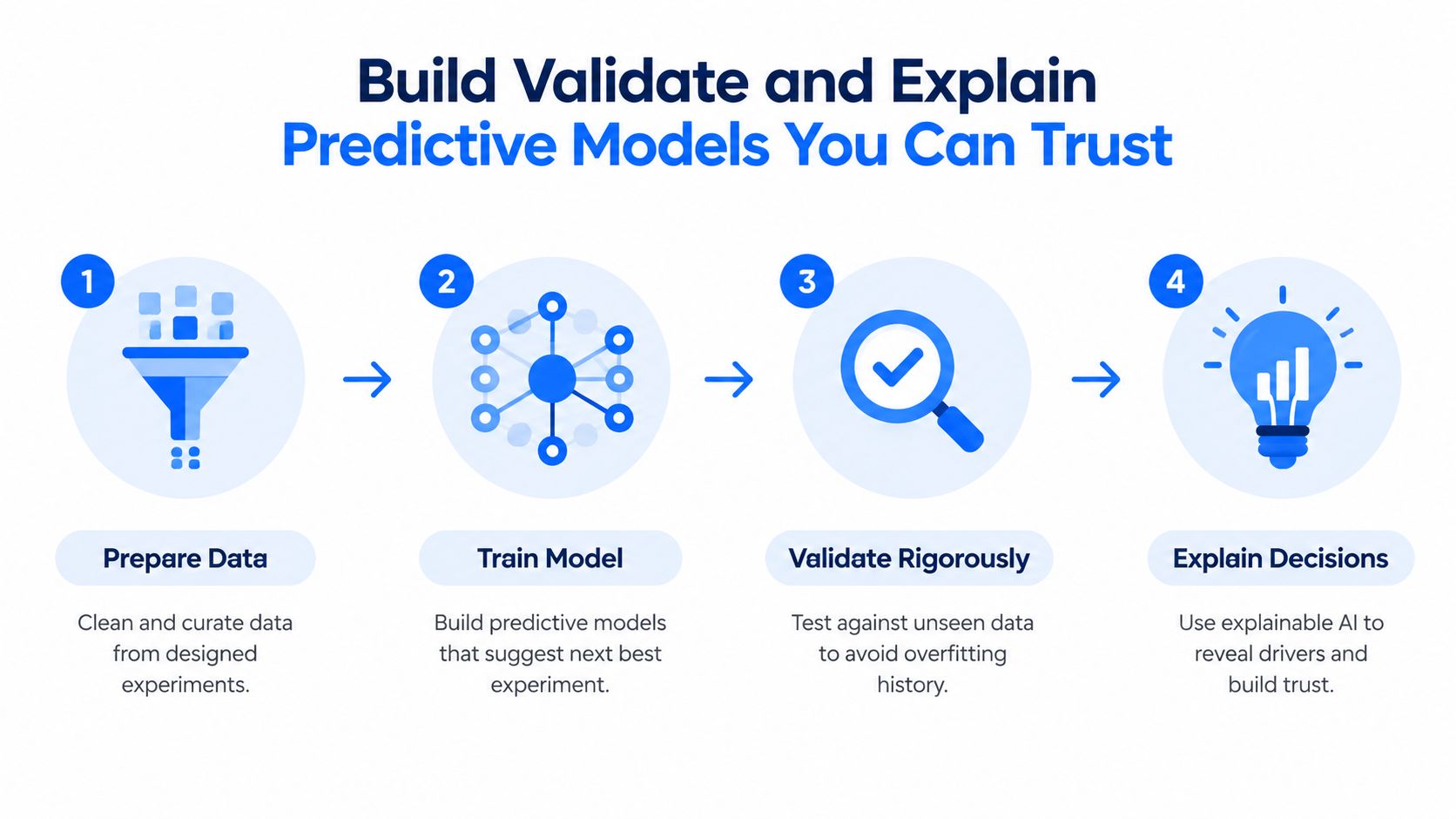
Build Validate and Explain Predictive Models You Can Trust
A model is useful only when it helps a scientist or engineer make a better next decision. High training accuracy doesn't prove that a formulation will work with a new resin lot, a different reactor, a changed mixing profile, or a continuous residence-time distribution.
Begin with the experimental question. Are you predicting a material property, ranking process conditions, identifying a bottleneck, estimating energy intensity, or choosing the next experiment? The target determines the data split, evaluation metric, and level of interpretability required.
Validate against the way the model will be used
Random train-test splits can hide leakage when related experiments appear in both sets. A stronger validation design separates runs by batch, campaign, time period, material family, equipment, or scale, depending on the deployment question.
Review each model through four lenses:
- Predictive error: Does it estimate unseen outcomes accurately enough for the decision?
- Calibration: Do confidence scores reflect actual uncertainty?
- Domain coverage: Is the recommendation inside the data-supported region?
- Operational usefulness: Does the suggested change respect safety, equipment, quality, and scheduling constraints?
Use historical precedents to show whether a recommendation resembles known successful or unsuccessful runs. Explainable AI should expose influential variables, interactions, and directionality where the evidence supports it. That explanation gives scientists a basis for challenging the model, not merely accepting a ranked list.
Test generalization before deployment
Benchmark suites matter because one reaction or formulation can flatter an algorithm. The RSC work on Bayesian chemical optimization emphasizes that benchmark studies help identify methods that generalize poorly and support post-verification before real experiments. That principle applies to predictive models as well. A model that works for one catalyst family may fail when the mechanism, feedstock, or measurement regime changes.
Hybrid physics and AI models become more valuable as processes become dynamic or data becomes sparse. Physics can constrain impossible states and encode conservation relationships, while machine learning can represent plant-specific behavior that a first-principles model misses. Digital twins can extend this approach by updating a process representation with real-time measurements, but they require sensor quality, time alignment, and a clear policy for handling drift.
Practical rule: Treat confidence as a reason to choose the next experiment, not as a substitute for one.
Model review should therefore include a failure register. Record where predictions were wrong, which variables were outside the training region, whether the measurement was reliable, and whether the process itself changed. Those records become training material for the next model version and evidence for governance.
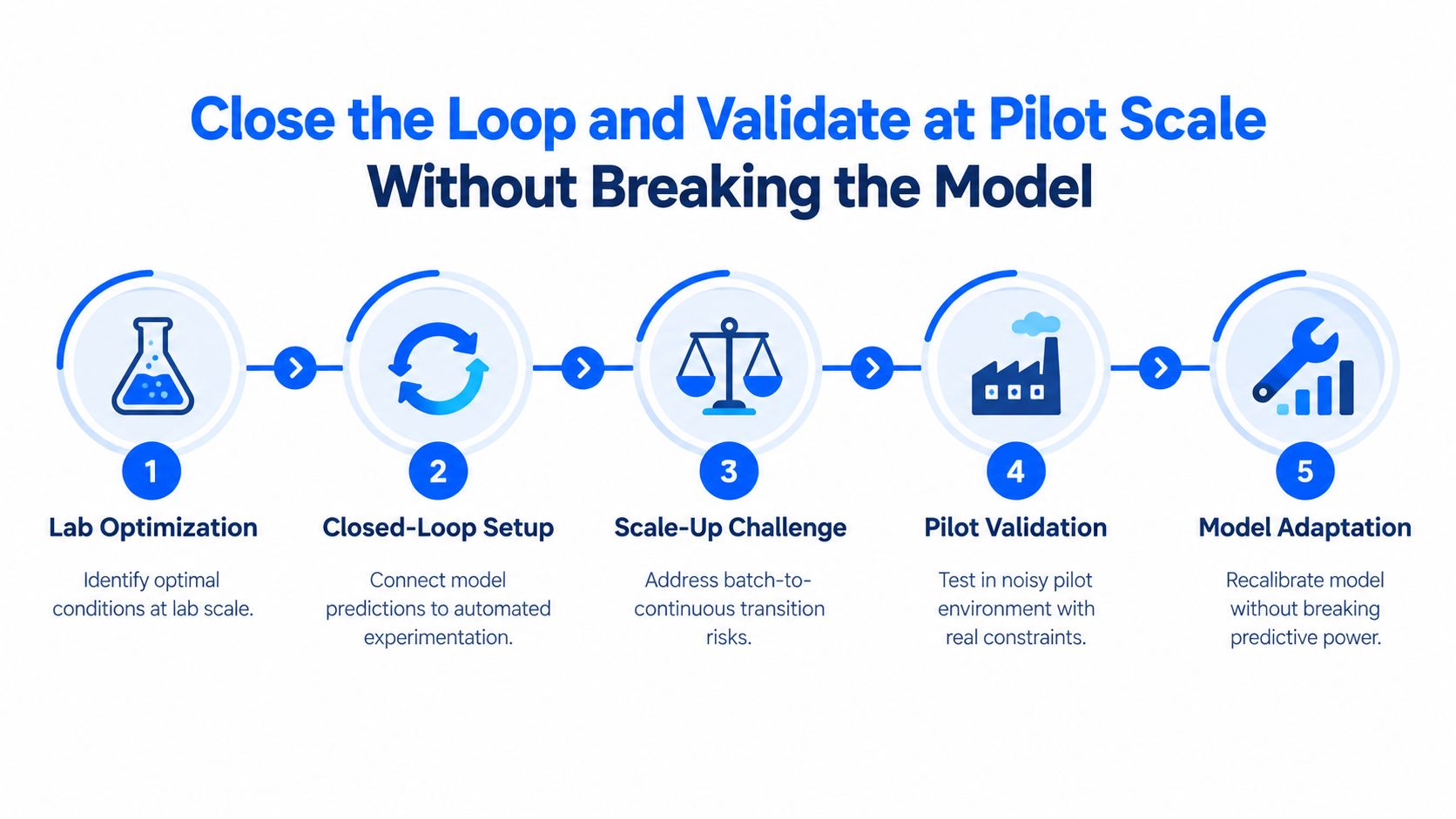
Close the Loop and Validate at Pilot Scale Without Breaking the Model
Scale-up fails when the model describes the laboratory more accurately than it describes the process. A condition that works in a small vessel may depend on mixing, heat removal, gas-liquid transfer, residence-time distribution, charging sequence, or operator timing that changes at pilot scale.
Batch-to-continuous transitions create another discontinuity. A batch experiment may summarize a trajectory with one final measurement, while a continuous process exposes startup behavior, spatial gradients, transient disturbances, and steady-state drift. Static DOE can still help characterize a region, but it won't capture every dynamic response.
Identify what changes with scale
Before transferring a laboratory optimum, create a scale-sensitivity map. Ask which variables represent chemistry and which represent equipment behavior.
- Mixing: Compare agitation, power input, blend time, and local concentration effects rather than copying an rpm value.
- Heat transfer: Track heating and cooling response, thermal gradients, and the ability to remove reaction heat.
- Mass transfer: Check gas dispersion, liquid-liquid contact, drying behavior, or crystallization conditions where relevant.
- Residence time: For continuous operation, characterize distribution and transient response, not only nominal residence time.
- Sampling: Confirm that pilot samples represent the material being produced and that analytical delays don't obscure drift.
- Raw materials: Preserve supplier, lot, moisture, particle, and composition context when those variables can alter behavior.
With sparse industrial data, avoid pretending that the model knows more than it does. Use conservative operating boundaries, uncertainty-aware experiment selection, and targeted pilot runs that distinguish scale effects from random noise.
Run a controlled closed loop
A reliable loop has four operating states:
- Plan: Select the next experiment based on objective value, uncertainty, scale risk, and safety constraints.
- Execute: Capture process settings, sensor streams, deviations, and analytical results with synchronized identifiers.
- Compare: Measure predicted versus observed performance and classify the error as data, model, equipment, or process drift.
- Adapt: Update the model only after reviewing the cause of the discrepancy and preserving the previous version.
Hybrid physics-AI models and digital twins are particularly useful when the process is dynamic or the pilot dataset is limited. The JASES discussion of AI-driven process optimization highlights the need for real-time data, hybrid models, and digital twins in situations where manual optimization and static DOE struggle with noisy behavior. It also reports that some optimization workflows have reduced experimental iterations by 71%, while stressing that such gains depend on data pipelines and explainability.
Optimize several outcomes without hiding the conflict
Yield, safety, energy, and emissions often point in different directions. Make the conflict visible through a Pareto view or explicit constraint hierarchy. Don't collapse every outcome into one score unless stakeholders agree on the weights and can explain them.
The pilot campaign should include confirmation runs at the proposed operating point, nearby conditions that test stability, and deliberate checks of scale-sensitive variables. Production changes then become controlled decisions supported by evidence, rather than optimistic transfers of a laboratory recipe.
Operationalize Continuous Improvement with Governance and Security
Optimization becomes valuable when it survives personnel changes, new campaigns, equipment modifications, and shifting business priorities. That requires an operating cadence that treats every run as both a production event and a learning opportunity.
Assign ownership across the workflow. Scientists own experimental intent and interpretation. Process engineers own equipment feasibility and operating envelopes. Quality teams approve analytical methods and release implications. Data and model owners manage versions, validation records, access, and retirement decisions.
Build governance into the workflow
A practical control model includes:
- Versioned records: Preserve datasets, feature definitions, experiment plans, models, and recommendations.
- Approval gates: Require review before a model recommendation changes a pilot or production condition.
- Audit trails: Record who changed a value, model, rule, or operating limit and why.
- Role-based access: Separate formulation IP, site data, supplier information, and production controls according to responsibility.
- Drift monitoring: Watch for changes in feedstocks, sensors, equipment, analytical methods, and outcome distributions.
- Rollback paths: Keep the prior model and approved operating window available when a new version performs poorly.
Enterprise deployment also needs security and privacy controls. Polymerize describes ISO 27001 and SOC 2 controls, role-based access, and GDPR and CCPA compliance as part of its platform approach. Those controls matter when organizations unify sensitive formulations and process records across sites, but the implementation still needs site-specific review by security, legal, quality, and operations teams.
Measure value through operating signals
ROI doesn't require a single headline number. Track whether the team is running fewer failed experiments, selecting more informative conditions, resolving scale-up issues earlier, reducing repeated data preparation, and moving validated formulations toward production faster. Pair those measures with energy intensity, waste, emissions, variability, and safety indicators so cost savings don't conceal a worse process outcome.
Start with one process family and an explicit decision loop. Clean the highest-value data first, document uncertainty instead of waiting for perfect records, and review model recommendations with the people who understand the equipment. Continuous improvement works when the organization treats learning as a governed production capability, not as another disconnected software project.
Polymerize helps materials R&D teams unify experimental and process data, use explainable domain-specific models to identify drivers and next experiments, and connect formulation work with scale-up decisions. Visit Polymerize to see how its AI-native platform can support a closed-loop chemical process optimization workflow from data foundation through pilot validation.
Put your R&D data to work
See how materials teams use Polymerize to plan fewer experiments and reach target properties faster.