

You're usually not reading about change management documentation because you're curious. You're reading because a scale-up is moving, a customer is asking for evidence, QA is chasing signatures, or an auditor has already picked a change and started pulling on the thread.
In materials R&D, that thread rarely starts with a system patch. It starts with a formulation revision, a catalyst substitution, a new raw material grade, a mixing parameter adjustment, or an SOP that changed after the lab found a better way to run the work. The problem usually isn't that the science was careless. The problem is that the record set around the science was incomplete, scattered, or impossible to reconstruct under pressure.
I've seen teams with sensible technical decisions fail review because the only formal artifact was a thin change ticket. No linked impact assessment. No controlled SOP revision. No explicit effective date. No rollback path that someone could execute. That's when change management documentation stops feeling administrative and starts looking like operational risk.
Table of Contents
- The eight records that matter
- Controlled record versus working note
- What modern audit expectations look for
- Mandatory fields and what they do
- Worked example for a polymer formulation change
- What auditors dislike immediately
- Use dimension-level scoring
- Worked example for catalyst substitution
- What makes an assessment credible
- Four components that make rollback usable
- Worked example from a 200-L pilot scale-up
- When rollback is mandatory and when it isn't
- What recent-change sampling is really testing
- Rules that prevent silent record drift
- Machine-readable discipline matters more now
- What a usable template set includes
- A complete change package checklist
- Example language for materials teams
Why Change Management Documentation Fails When It Matters Most
A customer auditor asks to see the rollback plan for last quarter's catalyst substitution in a pilot plant hydrogenation step. The team finds the change ticket quickly. It has the reason for the change, a brief approval note, and a completion date. What it doesn't have is the restoration sequence, the validation criteria for returning to the prior state, or the post-change review that shows the substituted catalyst behaved as expected.
That audit finding doesn't happen because people ignored change control. It happens because the organization treated change management documentation as a form instead of a governed record set.
Where the breakdown usually starts
In practice, the process is often stronger than the documentation. The chemist discussed the risk with process engineering. QA informally agreed on the test plan. Operations updated the batch instruction. Training happened on the floor. But each piece lived in a different place, under a different naming convention, with no reliable link back to the original change.
When the record chain breaks, three things follow:
- Auditors can't reconstruct intent. They can't tell what changed, why it changed, or whether the final state matched the approved scope.
- Scale-up teams lose context. A future transfer team inherits the new condition but not the rationale, assumptions, or constraints behind it.
- Rollback becomes guesswork. If the prior validated state isn't documented with restoration logic, people improvise during failure.
A 2024 auditing text on IT change management makes the underlying point clearly. Documentation should cover change requests, change plans, test results, implementation records, and post-implementation reports, and auditors may inspect documentation for 40 recent system changes to verify completeness, rationale, process, and testing outcomes in a consistent sample set (audit-ready guidance on change management documentation).
Practical rule: Auditors rarely judge your process by your policy alone. They judge it by whether a sequence of recent changes can be reconstructed from request to review.
That logic maps directly into materials organizations. If a formula, process, or product change can't be reconstructed from the record, it's hard to prove why it happened, how it was tested, and whether the outcome was acceptable.
The Core Document Types You Need to Govern
The fastest way to improve change management documentation is to stop asking, “Where is the form?” and start asking, “Where is the record set?” A single document can't carry the full control burden for a meaningful process, product, or documentation change.
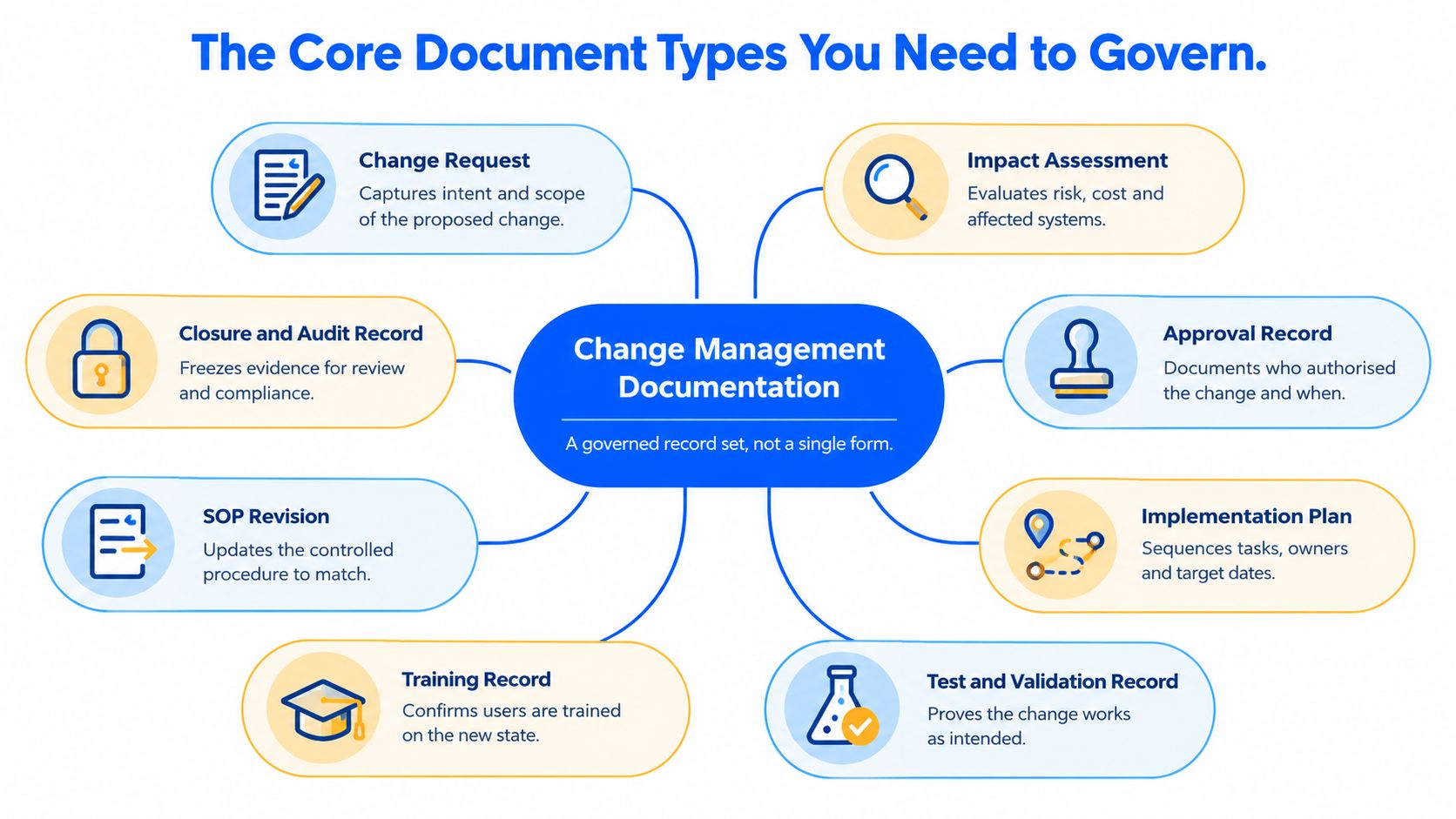
The eight records that matter
These are the core document types I'd govern in any materials R&D or pilot-scale environment:
- Change request. Captures the proposed change, intent, scope, and business or technical justification.
- Impact assessment. Tests the consequences across product, process, quality, regulatory, and EHS dimensions.
- Approval record. Shows who authorized the change, under what conditions, and when it becomes effective.
- SOP revision. Aligns the controlled procedure to the approved new state.
- Rollback plan. Defines how to restore the prior state, who can trigger it, and how restoration is verified.
- Change log or register. Provides the chronological index of in-scope changes for review and sampling.
- Post-implementation review. Confirms whether the change achieved the intended outcome and identifies deviations or lessons.
- Closure record. Freezes the package as complete, linked, and ready for retention.
Controlled record versus working note
Not every note, draft, or lab discussion belongs in the controlled record. Scientists need room to think, test, and discard ideas. But once a change enters formal control, the evidence package must follow retention, traceability, and signature rules.
That distinction matters because teams often drown the system with informal artifacts while still failing to preserve the few records that prove control. Good governance separates ephemeral working material from official evidence.
A useful parallel exists outside quality systems. The discipline behind HR document centre best practices is relevant here because it treats records as governed assets with ownership, access rules, and lifecycle controls rather than as miscellaneous files in a shared drive.
One missing link can invalidate five good records. A sound impact assessment that never connects to the revised SOP will still fail under review.
What modern audit expectations look for
A 2026 policy guide summarizing audit expectations states that each in-scope change should have a change log entry plus approval records, test results, deployment evidence, and rollback documentation when relevant. It also says the policy itself should be version-controlled, dated, and approved by a named leader (change management policy expectations).
That's the right operating model for materials work too. Not one form. A governed record set with traceable handoffs.
Anatomy of a Change Request and Its Required Fields
Weak change requests create strong downstream confusion. If the request doesn't identify the object being changed, the risk category, and the intended effective date, every later reviewer is forced to infer what should have been explicit.
Mandatory fields and what they do
The request form should separate required metadata from optional planning context.
| Field | Mandatory/Optional | Purpose |
|---|---|---|
| Unique change ID | Mandatory | Creates the traceable anchor for all downstream records |
| Requestor | Mandatory | Identifies origin and accountability |
| Date raised | Mandatory | Establishes chronology |
| Change category | Mandatory | Routes review by type such as formulation, process, equipment, document, or regulatory |
| Affected product or process reference | Mandatory | Ties the request to the exact formula, line, SOP, or asset |
| Proposed change description | Mandatory | States what is changing in concrete terms |
| Business justification | Mandatory | Explains why the change is necessary |
| Risk classification | Mandatory | Sets review depth and approval thresholds |
| Linked document references | Mandatory | Connects existing SOPs, specifications, methods, and records |
| Proposed effective date | Mandatory | Governs cutover timing |
| Estimated cost | Optional | Helps with planning and resource review |
| Resource impact | Optional | Flags workload and capability constraints |
| Communication plan | Optional | Identifies who must be informed before activation |
Worked example for a polymer formulation change
Take a coating resin change request: increase solids content from 18% to 22% in a polymer formulation intended for pilot-scale coating trials. That description is specific enough to trigger the right questions. Which viscosity spec is affected? Does mixing time change? Does the drying profile change? Are downstream customer test methods calibrated for the new range?
A good request would read like this in plain language:
- Change category: Formulation
- Affected reference: Coating Resin FRM-204 and associated pilot SOP
- Proposed change: Increase target solids from 18% to 22% by adjusting solvent ratio
- Justification: Improve line efficiency by reducing solvent load during coating
- Risk classification: Medium or high, depending on customer specification sensitivity
- Linked records: Current formula, viscosity method, coating trial protocol, stability method
- Proposed effective date: After approval and completion of pilot validation
What auditors dislike immediately
Three omissions trigger avoidable scrutiny:
- Vague descriptions. “Optimize resin composition” says nothing.
- Missing object references. If the product, process step, or document isn't precisely named, traceability breaks.
- Soft justifications. “Improvement” isn't a justification unless the change objective is defined in operational terms.
The request doesn't need to contain the entire science package. It does need to frame the change so everyone else can review the same thing, not their own interpretation of it.
Building an Impact Assessment That Holds Up Under Audit
An impact assessment is where many organizations either show control or expose fiction. If every change gets one generic score and a paragraph of boilerplate, the assessment won't survive sampling.
Use dimension-level scoring
I prefer a simple rubric across five dimensions: process, product, quality, regulatory, and EHS. Keep the scale consistent and define each level in operational language.
| Dimension | 1 - Negligible | 2 - Minor | 3 - Moderate | 4 - Major | 5 - Critical |
|---|---|---|---|---|---|
| Process | No meaningful effect on execution | Small adjustment within known range | Noticeable procedure change | Significant step redesign | Process may become unstable or uncontrolled |
| Product | No expected effect on performance | Localized effect with low customer sensitivity | Measurable effect requiring confirmation | Material property shift with broad implications | Product may no longer meet intended use |
| Quality | No change to acceptance logic | Minor documentation or sampling effect | Method or specification review needed | Validation or release approach affected | Quality disposition could be compromised |
| Regulatory | No regulatory relevance | Internal record update only | Label, filing, or controlled document review needed | External commitment or submission impact | Potential noncompliance if mishandled |
| EHS | No safety or environmental effect | Small handling or PPE adjustment | New hazard review required | Significant exposure or waste implications | High-consequence safety or environmental concern |
A single composite score hides what auditors need. A catalyst change with low process disruption but major EHS implications shouldn't disappear into an average.
Worked example for catalyst substitution
Consider replacing a palladium catalyst with a nickel variant in a hydrogenation step. The process team may like the supply or cost logic. The impact assessment still needs to ask harder questions.
- Process: reaction kinetics, mixing behavior, filtration burden
- Product: purity profile, residual metal profile, color, downstream stability
- Quality: revised test requirements, acceptance criteria, method suitability
- Regulatory: customer commitments, controlled formula status, dossier implications
- EHS: handling, exposure controls, waste stream implications
Then distinguish inherent risk from residual risk. Inherent risk is the exposure before controls. Residual risk is what remains after controls like pilot trials, analytical testing, revised PPE, or added QA hold points.
A residual-risk decision without attached evidence is just optimism in formal language.
What makes an assessment credible
Attach the evidence that supports the score. That can include prior development data, a planned validation protocol, customer-impact review, or EHS signoff. The signatories should match the dimensions assessed. If EHS is in scope, EHS signs. If customer specifications may shift, quality and commercial ownership shouldn't be absent.
Most failed assessments aren't weak because the team lacked expertise. They fail because the form suggests rigor that the attachments don't support.
Approvals, Effective Dates, and Emergency-Change Workflows
Approvals aren't just signatures. They're the control point where the organization decides whether the evidence is sufficient, whether the implementation window is acceptable, and when the new state becomes real.
Who signs and when
For most materials and quality systems, the approval path should be explicit by role, not by habit. A typical pattern looks like this:
- Change owner: accountable for the package completeness and implementation readiness
- QA: confirms documentation, validation, and procedural control
- Process engineering or technical lead: confirms technical feasibility and execution impact
- Regulatory or compliance lead: reviews filing or commitment implications where relevant
- EHS: approves hazard and environmental controls
- CAB or equivalent board: resolves cross-functional acceptance for higher-risk changes
The approval record should also define the effective date. That matters more than many teams realize. Approval authorizes the change. The effective date governs when the old controlled state stops applying.
Standard versus emergency path
| Change Type | Trigger Condition | Pre-Approved By | Implementation Window | Post-Implementation Review |
|---|---|---|---|---|
| Standard | Low-risk, repeatable, pre-defined activity | Function owner under approved procedure | Planned routine window | Brief confirmation against expected outcome |
| Normal | Non-routine change with assessed risk | Required functional approvers and board if needed | Scheduled after approvals complete | Formal review with evidence attachment |
| Emergency | Immediate action needed to address critical issue | Limited senior authority under emergency process | As soon as the defined emergency path allows | Mandatory retrospective review and ratification |
Emergency changes need a shorter chain, but not a looser memory. If a reactor control parameter must be adjusted immediately to protect product or equipment, log the deviation first, capture who authorized the action, and require retrospective board review once the situation is stable.
Effective-date governance is where confusion starts
Staged rollouts complicate document control. One site may adopt a revised SOP before another. One pilot line may be under the new method while the production line remains on the prior validated state. That isn't a problem if the records define the cutover clearly.
What doesn't work is approving a revision on Tuesday, training half the team on Thursday, and assuming the document is effective because “everyone knew.” Effective dates need explicit governance, especially when multiple systems, procedures, and people have to switch together.
SOP Revisions, Training Records, and Document Hierarchy
A change isn't controlled until the operating documents match the approved state. If the formula changed but the SOP didn't, the record says one thing while the shop floor does another.
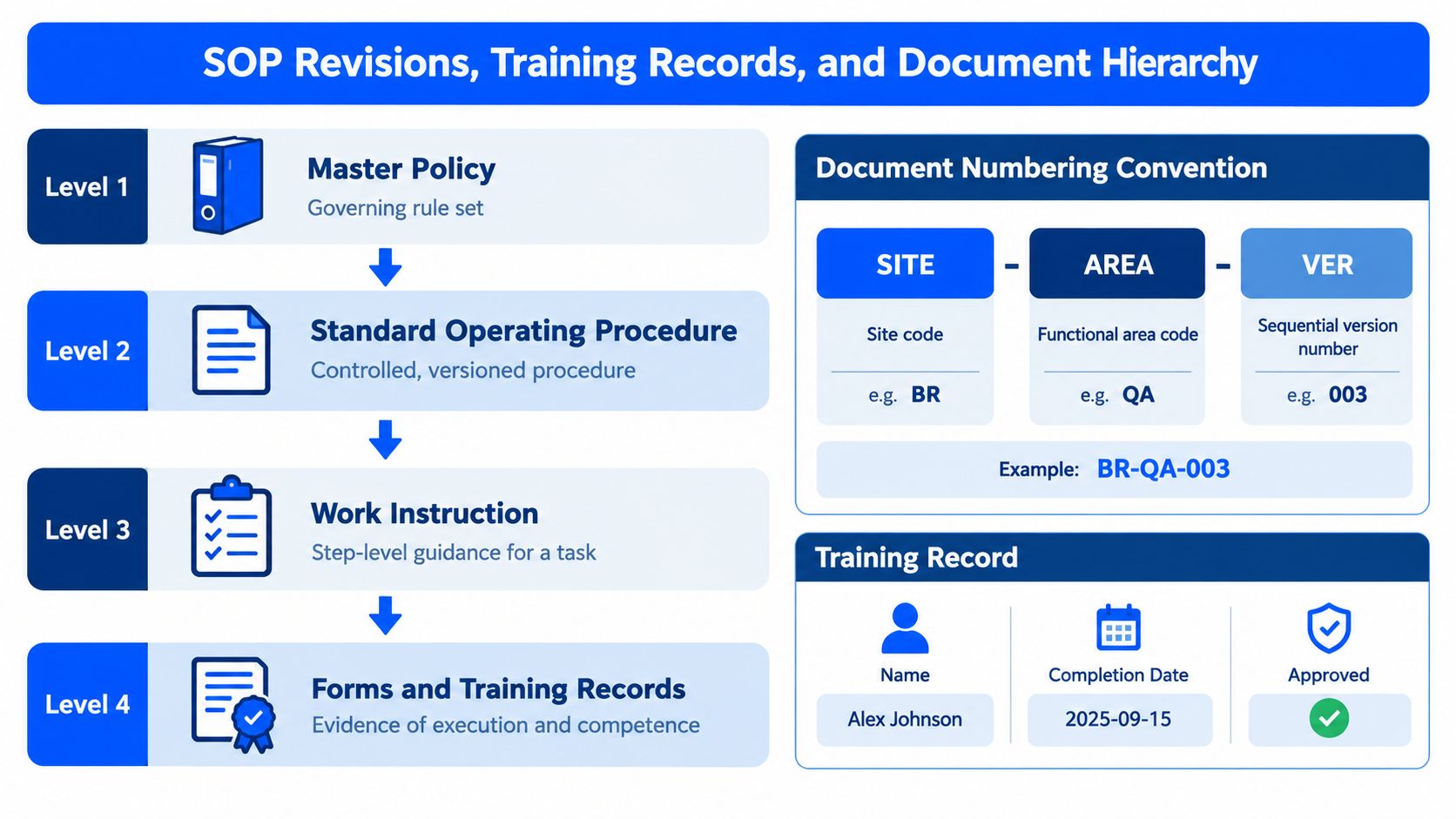
Keep the hierarchy obvious
The document stack should be easy to read:
- Policy sets the governing rule.
- SOP defines the controlled process.
- Work instruction describes task-level execution.
- Forms and training records prove the work and competence happened.
If teams can't tell whether a lab worksheet overrides a work instruction, your hierarchy already has a control problem.
Redline versus clean version
During drafting, keep both a redline and a clean version. The redline shows reviewers what changed. The clean version becomes the effective controlled copy once approved. Both belong in the audit trail, but only one should govern execution after release.
I also recommend a numbering convention that encodes site, function, and version in a stable pattern. It prevents duplicate identities when one group tracks SOPs in a QMS and another stores related methods in a local document repository.
Training records must link back to the change
Training is often documented, but not connected. Someone signs a read-and-understood log, yet the record doesn't identify which change triggered the training, which revised SOP they were trained against, or whether training occurred before the effective date.
ISO's implementation guidance for ISO 9001:2015 emphasizes planned change handling and recommends a change file with the specifics of the change, tasks, timeline, responsibilities, resources, communication, cross-functional review, training, effectiveness measurement, and lessons learned. It also aligns with the standard's expectation to retain documented information on review results, authorizing persons, and necessary actions (ISO 9001 change management implementation guidance).
When training records live as isolated artifacts, auditors treat them as attendance evidence, not proof that the controlled process changed correctly.
Scale-up and site transfer work expose hierarchy failures fast. A master procedure may be revised centrally while local work instructions stay stale. That mismatch is one of the most common ways a decent change package turns into inconsistent execution.
Rollback Plans That Actually Restore the Previous State
A rollback plan isn't a sentence that says “revert if issues occur.” It's a controlled restoration procedure tied to the same rigor as the forward change.
Four components that make rollback usable
| Component | Definition | Example from Scale-Up Failure |
|---|---|---|
| Trigger criteria | Measurable threshold that activates rollback consideration | In-process QC shows particle size distribution outside the approved pilot range |
| Decision authority | Named roles allowed to order rollback | Process owner and QA lead jointly authorize restoration |
| Restoration steps | Sequenced actions to return to prior validated state | Reapply prior validated recipe parameters in MES, restore prior mixing settings, quarantine affected lots |
| Re-validation evidence | Confirmation that the restored state is acceptable | Run confirmation batch checks and compare results to prior validated acceptance criteria |
Worked example from a 200-L pilot scale-up
A team changes a high-shear mixing parameter during a 200-L scale-up trial to improve dispersion time. Mid-run, in-process QC shows the particle size distribution moving off-spec. The rollback trigger is not “someone feels uneasy.” It is the defined QC threshold.
The decision authority matters next. If production can revert process settings without QA concurrence, the team may restore mechanics while missing disposition implications. In a controlled system, the process owner and QA lead decide together.
The restoration steps should be executable in order:
- Lock the current batch state so evidence isn't lost.
- Restore the prior validated recipe settings in the execution system or controlled batch instruction.
- Segregate affected material produced under the failed condition.
- Repeat critical setup checks before restart.
- Run requalification checks to confirm the restored state performs as expected.
When rollback is mandatory and when it isn't
Not every issue requires a full return to the prior state. Sometimes a bridging study is acceptable if the deviation is understood, contained, and scientifically justified. But that choice should be explicit in the plan. If the quality, safety, or compliance basis for the change collapses, rollback should not be optional.
What auditors want to see is simple. They want proof that restoration was preplanned, that the trigger was defined, and that the team verified the restored condition rather than assuming it.
Version Control and Audit-Trail Practices
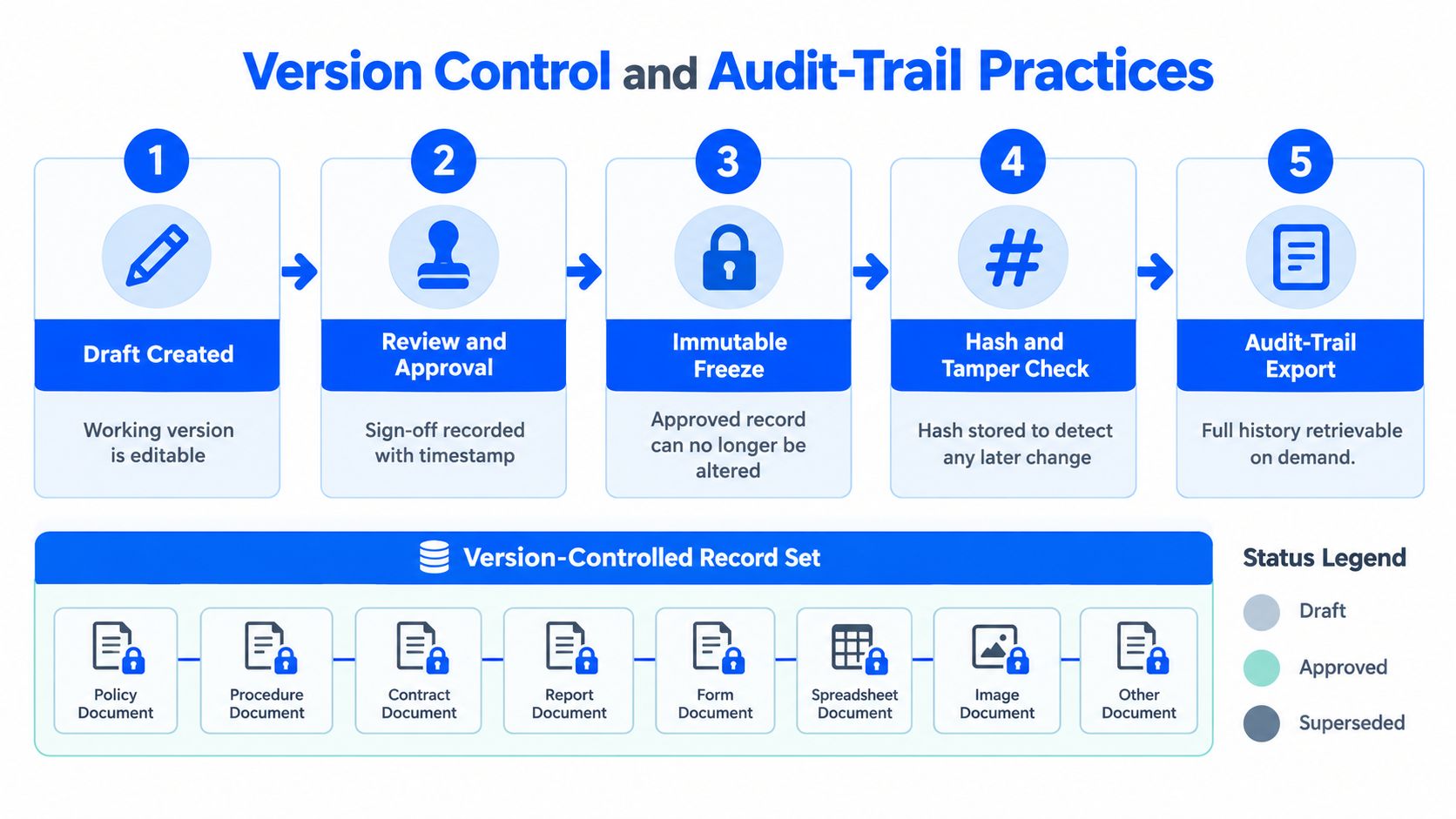
Version control is where the record set becomes defensible. Without it, change management documentation turns into a pile of files that may or may not reflect the approved truth.
What recent-change sampling is really testing
Auditors often start with recent activity because it shows whether the process is operating now, not whether it worked once during system design. The audit logic described earlier is blunt and useful. Review a body of recent changes and test whether the organization repeatedly captured rationale, approvals, implementation evidence, and results.
That's why version labels and status states need discipline. I prefer obvious statuses such as DRAFT, EFFECTIVE, and SUPERSEDED in both the file metadata and the visible document header.
Rules that prevent silent record drift
Three practices make a noticeable difference:
- Freeze approved records. Once approved, the record shouldn't remain editable in place.
- Link every artifact to the change ID. Requests, test records, SOP revisions, training evidence, and closure should all point to the same anchor.
- Preserve audit context. User deactivation, migration between systems, or exports to PDF shouldn't erase who did what and when.
For software-heavy teams, the mechanics of release discipline are often easier to recognize than in lab operations. A practical example is managing app updates with Capgo, which shows how version control and rollback logic can be structured around explicit release states rather than informal replacement of prior artifacts. The same principle applies to formulas, methods, and controlled procedures.
Machine-readable discipline matters more now
The 2025 State of the API Report found that 60% of teams version APIs, 57% use Git, and 26% use semantic versioning. The same report found 55% struggle with inconsistent documentation and 34% can't find existing APIs (Postman 2025 State of the API Report). The lesson for change management documentation is broader than software. Teams may track versions but still fail to communicate impact clearly.
That's where metadata quality starts to matter. Severity, compatibility, owner, effective date, and supersession status should be machine-readable wherever possible. In materials environments, that might sit in a QMS, ELN-connected workflow, or a governed data layer such as Polymerize Connect alongside other controlled R&D records.
Mapping Documentation to ISO, SOC 2, and GxP
Teams waste time when they build separate documentation habits for each framework. Most of the evidence overlaps. The useful question is which document proves which requirement, and where the frameworks diverge.
Clause-to-evidence mapping
| Document Type | ISO 9001 | ISO 27001:2022 | SOC 2 CC8 | GxP (21 CFR 11 / ICH Q9) |
|---|---|---|---|---|
| Change request | Planned change initiation and scope | Logged request within change process | Evidence of authorized change initiation | Proposed and evaluated change under quality risk management |
| Impact assessment | Review of consequences and necessary actions | Risk assessment before implementation | Risk consideration for system changes | Systematic evaluation of impact on validated state and product quality |
| Approval record | Authorized change and documented information retained | Documented approval within governed workflow | Management authorization and control evidence | Approval signatures, dates, and controlled authorization expectations |
| SOP revision | Controlled documented information reflecting new process | Operational procedure update after approved change | Evidence controls are implemented consistently | Revision control linked to approved effective state |
| Training record | Competence and controlled adoption of changed process | Personnel awareness of changed control | Evidence that changed procedures are followed | Read-and-understood or role-specific training tied to new controlled version |
| Rollback plan | Necessary action for unintended consequences | Reversible implementation planning where relevant | Change failure response evidence | Restoration control when validated state is at risk |
| Validation evidence | Results of review and effectiveness of change | Testing outcomes captured before and after change | Evidence that change operated as intended | Required proof that the change and resulting state are acceptable |
| Post-implementation review | Retained documented results | Review of implemented change outcomes | Monitoring of control effectiveness | Formal review after implementation under quality system expectations |
Where the overlap ends
ISO 9001 is direct about planned changes and retained documented information. FDA and ICH language pushes harder on the complete audit trail, approval signatures, affected documents, approval date, and effective date. FDA records guidance states that change records should include the description of the change, affected documents, approving signatures, approval date, and effective date within the broader change-management approach described by FDA and ICH (FDA records and change management guidance).
SOC 2 and ISO 27001 often care about authorization, evidence, and repeatability, but GxP environments add sharper expectations around validated state, signature compliance, and procedural consistency. That's why one lean record set can serve multiple audits, but only if it's designed to satisfy the strictest evidence need in your portfolio.
Templates and a Complete Change Package Checklist
Templates help only when they enforce judgment in the right places. Most bad templates either oversimplify the package into a single page or overengineer it until nobody uses it consistently.
What a usable template set includes
For each document type, define three things:
- Required fields that must be present before the record can advance
- Optional fields that add context without blocking flow
- Field validation rules that stop vague or incomplete entries
Examples of useful validation rules:
- Change description must reference the exact formula, process step, document, or equipment item
- Risk classification can't be selected without a rationale note
- Effective date can't be earlier than final approval date
- Training completion can't be logged against a superseded SOP version
A complete change package checklist
A closed package should typically contain:
- Approved change request
- Completed impact assessment with attachments
- Approval record and effective-date decision
- Implementation plan or task sequence
- Revised SOPs with redline and effective clean copies
- Training records linked to the change ID
- Validation or test evidence
- Rollback dossier
- Post-implementation review
- Closure record
Example language for materials teams
For a formulation change, the template language should fit lab reality. “Adjusted solvent ratio to achieve target solids increase while maintaining application viscosity within the controlled trial envelope” is better than “updated composition.”
For a scale-up change, use operational wording. “Transferred mixing sequence from bench protocol to pilot work instruction with revised hold times and sampling checkpoint” is the kind of text reviewers can assess.
Retire old templates carefully. If earlier changes were executed under prior forms, those templates remain part of the historical control environment until retention obligations expire. Replacing the active template doesn't erase the need to preserve the old one.
Implementing the Documentation System in 90 Days
Most teams don't need a giant transformation program to fix change management documentation. They need a narrow pilot, a stable template set, and enough operating discipline to prove the system works on live changes.
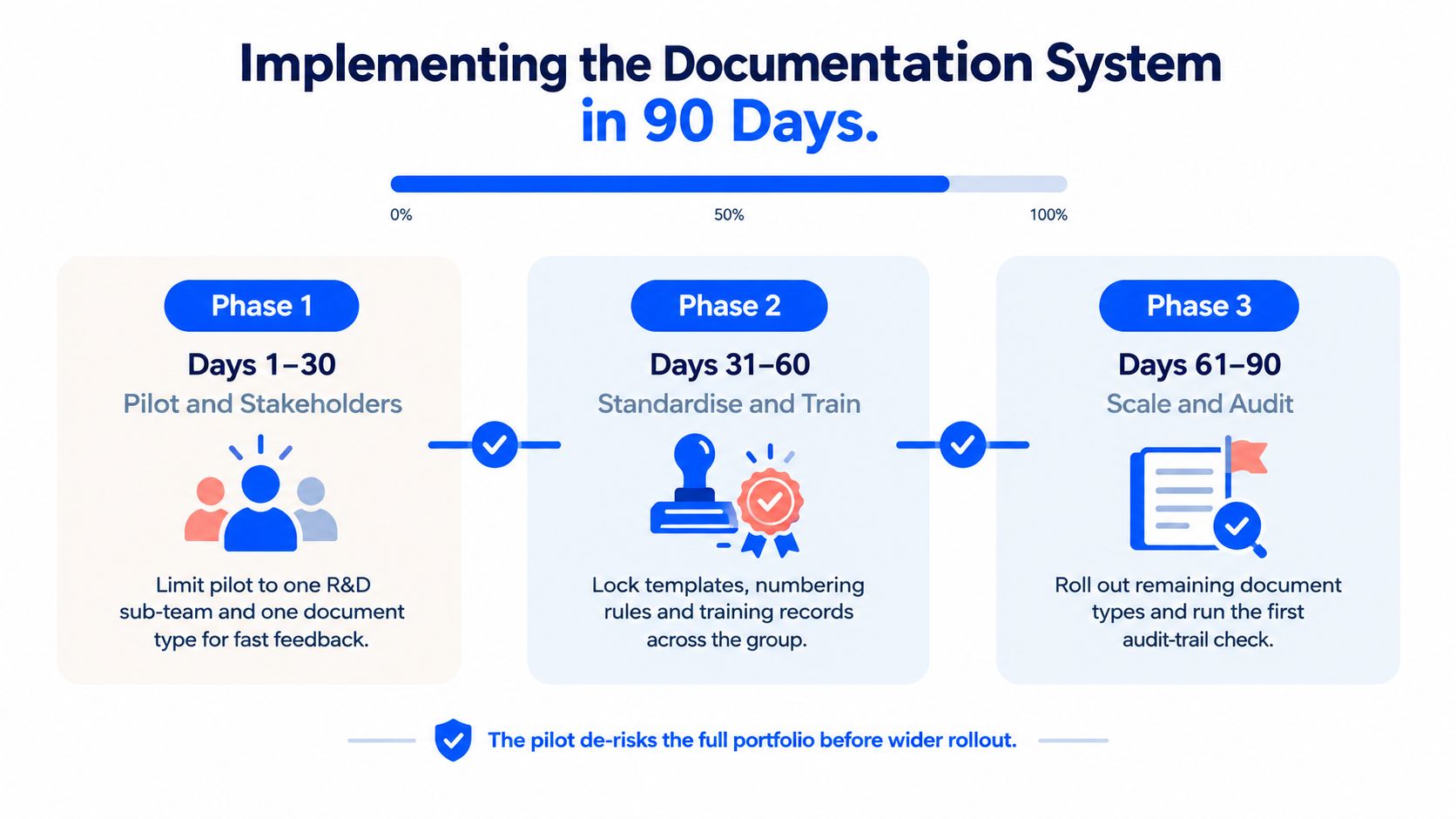
Days 1 to 30
Start with one R&D sub-team and one document type, usually the change request or impact assessment. Map how changes are currently raised, approved, recorded, and closed. Then decide whether the pilot will run in a QMS module, a controlled SharePoint space, Confluence with approval workflow, or another governed repository.
Focus on current-state reality, not policy fiction. Pull recent changes and see what exists.
Days 31 to 60
Build the minimum controlled set: templates, numbering rules, approval matrix, signature expectations, and training material. Then run a pilot on a small number of live changes and hold retrospective reviews after each one.
This is also a good point to socialize the operating logic with the wider group. The video below gives a useful practical lens on change process rollout and adoption in real teams.
Days 61 to 90
Expand to the remaining document types and run your first internal evidence check on closed pilot packages. Don't ask whether people liked the templates. Ask whether reviewers could reconstruct the change cleanly from request through closure.
ACMP's 2025 change-management discussion highlighted AI's growing role, M&A-driven transformation, and change saturation as major trends, which is a useful reminder that documentation systems now need to support faster, more distributed change cycles, not slower ones as noted in the earlier API-report section.
If the pilot proves the process but the tool still gets in the way, fix the tool. If the tool works but ownership remains fuzzy, fix governance first.
Leadership usually wants proof by the end of the quarter that control improved. The easiest demonstration isn't a dashboard. It's a small stack of recently closed changes that are complete, linked, signed, and easy to audit.
Quick-Reference Matrix for Every Document Type
When teams struggle, they usually don't need another presentation. They need a one-page operating reference that tells them who owns each record, what to retain, what clause it supports, and what commonly goes wrong.
Daily-use reference matrix
| Document Type | Owner | Retention | Governing Clause | Common Failure Mode |
|---|---|---|---|---|
| Change request | Change owner or requestor | Per applicable QMS, security, and contractual retention rules | Planned and authorized change initiation | Vague scope or missing affected object reference |
| Impact assessment | Cross-functional technical owner with QA input | Per applicable QMS, security, and contractual retention rules | Risk review before implementation | EHS or customer-impact review omitted |
| Approval record | QA or designated approval coordinator | Per applicable QMS, security, and contractual retention rules | Formal authorization and effective-date governance | Unsigned or undated approval package |
| SOP revision | Document control owner | Per document-control retention rules | Controlled documentation aligned to approved state | Old version remains in circulation |
| Training record | Line manager or training coordinator | Per competence and controlled-record retention rules | Evidence of adoption and awareness | Training detached from the triggering change ID |
| Validation evidence | Technical owner with QA oversight | Per validation and quality retention rules | Proof the changed state is acceptable | Evidence exists but isn't linked to the change package |
| Rollback plan | Change owner with QA and operations input | Retain with the parent change package | Restoration and unintended-consequence control | Trigger criteria too vague to execute |
| Post-implementation review | Change owner and approving function | Retain with the parent change package | Outcome review and closure evidence | Review skipped after successful implementation |
Retention needs careful local verification
Retention varies by framework and contract, so don't hard-code a rule into the matrix unless legal, quality, and compliance have agreed it. What matters operationally is that the matrix forces the ownership and evidence conversation before the audit does.
Print this matrix, pin it inside the QMS workspace, or place it beside the change board. The teams that use change control well make the expected record set visible every day, not only when an auditor arrives.
Polymerize helps materials R&D teams connect experimental records, controlled documents, and decision history so formulation changes, scale-up updates, and process revisions are easier to trace across one governed data backbone. If your group is trying to tighten change management documentation without slowing science, visit Polymerize to see how the platform supports secure, auditable R&D operations.
Put your R&D data to work
See how materials teams use Polymerize to plan fewer experiments and reach target properties faster.