


The most popular CCPA advice is incomplete: publish a privacy notice, add an opt-out link, and wait for requests. That approach treats privacy as a website exercise when enterprise compliance now depends on evidence. In a materials R&D organization, personal information moves through spreadsheets, ELNs, laboratory systems, procurement tools, collaboration platforms, vendors, and automated workflows. If your team can't show where that data came from, why it is used, who can access it, and how a request was handled, a polished notice won't protect the business.
The CCPA compliance requirements now demand an operating model. California's 2026 rules introduce risk-assessment duties for certain high-risk processing, require visible confirmation that opt-out requests were processed, and phase cybersecurity audits by revenue tier. The practical question for an R&D leadership team isn't just whether the company is covered. It's which obligations apply now, which arrive later, and whether your systems already produce the records needed to prove compliance.
Table of Contents
Who CCPA Applies To in 2026
CCPA coverage reaches beyond consumer-facing websites. A for-profit business doing business in California may fall within scope when it meets the applicable revenue threshold or conducts qualifying activities involving California residents' personal information. The current preceding-calendar-year revenue threshold is $26.625 million, as stated in the California CCPA statute and 2026 regulations.
Assess that threshold through an annual governance process, not by estimating from website traffic. A materials manufacturer may collect personal information through customer portals, technical support, recruiting, sales contacts, distributor relationships, plant access systems, and research collaborations. Business-to-business operations do not automatically exclude those records.
Scope is not a binary decision
The practical question is which duties apply now. For covered businesses conducting specified high-risk activities, risk-assessment obligations began on January 1, 2026. Covered activities include selling or sharing personal information, processing sensitive personal information, and certain automated decision-making uses. The California Attorney General's CCPA overview explains the relevant requirements.
Other duties are scheduled for later implementation. Cybersecurity audits are scheduled to begin by revenue tier, with initial deadlines of April 1, 2028 for businesses over $100 million, April 1, 2029 for businesses from $50 million to $100 million, and April 1, 2030 for businesses under $50 million, where the applicable processing-risk criteria are met. Review the analysis of the expanded 2026 requirements for the phased timeline.
Leadership decision: Treat CCPA as a recurring operational program. Assign an owner, maintain an obligation calendar, and review scope whenever revenue, data volume, vendors, or automated processing changes.
Document the scope determination and current high-risk processing now. Do not wait for a scheduled audit deadline to create evidence. Data inventories, role-based access records, request logs, risk assessments, audit trails, and vendor documentation support both current obligations and later cybersecurity review. For an R&D leadership team, the priority is a defensible record of what applies, who owns it, and which systems prove execution.
What Counts as Personal Information Under CCPA
CCPA personal information extends well beyond names and email addresses. It covers information that identifies, relates to, describes, or can reasonably be linked to a consumer or household. In an enterprise R&D environment, that may include a scientist's name and work email, a vendor contact's job title, an applicant's employment history, a customer account identifier, an IP address, a device identifier, or records tied to a person using a laboratory platform.
Context determines classification. A sample record may appear purely scientific in one system, yet a linked researcher ID, contributor name, instrument login, or collaboration history can connect it to an individual. A spreadsheet containing only initials may still become personal information when an ELN maps those initials to a named employee. Fragmentation across systems does not remove identifiability.

Build categories around real R&D flows
Start the inventory with actual data flows, not only customer databases. Review these environments:
- Identifiers: Researcher names, email addresses, account names, employee IDs, IP addresses, and device identifiers tied to platform activity.
- Professional information: Job titles, qualifications, work assignments, contractor details, performance-related records, and contact data for suppliers or collaborators.
- Commercial information: Customer purchase history, products considered, formulation requests, quotations, and technical service interactions connected to an individual.
- Network and activity data: Login events, portal browsing, application interactions, search activity, and records showing how a user operates a platform.
- Geolocation and sensory data: Location information from devices or facilities, plus audio or video captured through workplace, security, support, or research processes.
- Education information: Records connected to interns, students, research applicants, or education-related programs.
- Sensitive personal information: Credentials, precise geolocation, racial or ethnic origin, religious beliefs, genetic data, health information, and other applicable sensitive categories.
Test results, proprietary algorithms, and formulation records are not personal information solely because they are valuable intellectual property. They become relevant when they identify, or can reasonably be linked to, a person or household. Record the scientific asset and the personal-information relationships attached to it.
Tie the inventory to notice language
A notice at collection must identify the categories collected and the purposes for using each category. The California Attorney General's CCPA materials clarify the operational requirement: the notice must match actual collection and use.
A source-system spreadsheet will not meet that need if it omits purpose and control details. Connect each collection point to its processing purpose, retention logic, access roles, and downstream disclosures. Role-based access records should show who can view or modify linked data, while audit trails should show how that access is used.
A new vendor, instrument integration, or AI workflow can change the live data pipeline. Update the inventory and notice when that happens. Otherwise, the organization has a governance defect, not merely an outdated document.
The Four Consumer Rights Explained
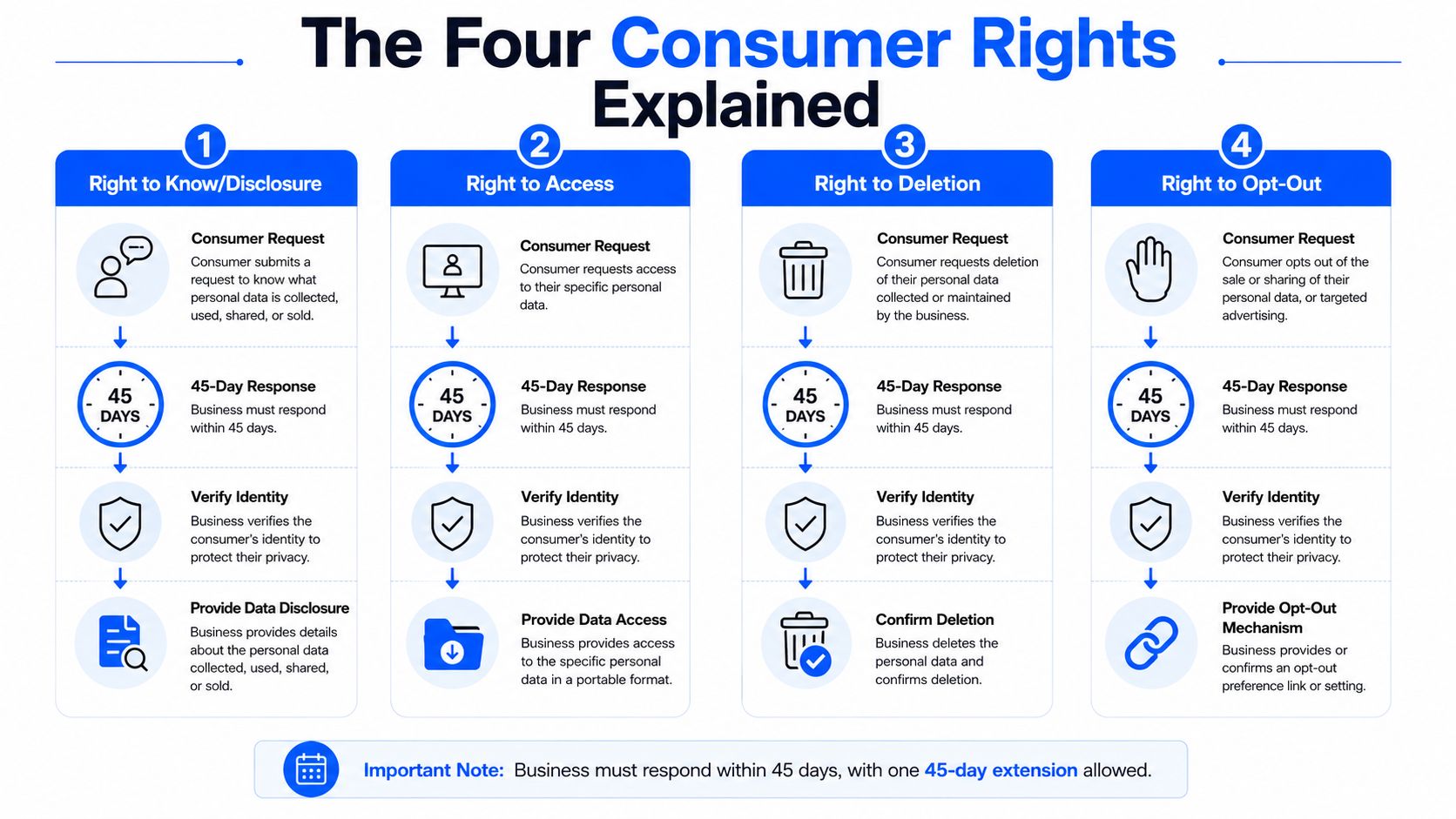
Consumer rights are engineering workflows, not legal inbox tasks. Each request needs intake, identity verification, system discovery, retrieval or deletion, downstream coordination, approval, response, and an evidence trail. Start the process when the request arrives. Verification does not stop the statutory clock.
Know and access
The right to know covers the categories, sources, purposes, disclosures, sales or sharing, and specific personal information associated with a consumer. The access lookback generally reaches 12 months when the business retains information beyond that period. For retained data, 2026 guidance extends access back to January 1, 2022, as noted in the discussion of expanded CCPA requirements.
Build retrieval across structured databases, document repositories, ELNs, spreadsheets, identity systems, collaboration tools, and relevant vendor environments. Preserve source context. Before disclosure, separate the requester's personal information from another person's confidential information and from protected trade secrets.
Delete
Deletion requires a controlled search for copies, derived records, applicable backups, vendor-held information, and exceptions that permit retention. In an R&D environment, the request may intersect with quality records, safety documentation, regulatory obligations, contractual duties, or intellectual-property controls.
Use a documented decision path. It should identify what can be deleted, what must be retained, who approved the exception, and which systems and vendors received the instruction. A manual profile deletion does not establish that the organization fulfilled the request.
Opt out and confirm
Consumers can opt out of the sale or sharing of their personal information. California's 2026 updates also require visible confirmation that an opt-out request was processed, including requests made through Global Privacy Control. Opt-out handling therefore needs a consumer-facing completion state, not only a hidden backend flag.
Every request should create an intake record, a verification or signal record where relevant, enforcement actions across connected tools, vendor instructions, and confirmation to the requester. Give marketing, analytics, advertising, and data-sharing integrations one suppression state. Otherwise, one system may honor the request while another continues the processing.
Run the clock centrally
A verifiable request must be answered within 45 days, with one extension of up to an additional 45 days when reasonably necessary and the consumer is notified within the initial period. Treat intake, authentication, retrieval, and response orchestration as time-critical engineering work.
Use one central case record with timestamps, assigned owners, verification status, systems queried, vendor actions, exceptions, approval decisions, response delivery, and confirmation. This record should connect to role-based access evidence and audit trails, so the organization can prove what it searched, who acted, and when each obligation was completed.
Business Obligations Beyond the Privacy Notice
A privacy notice is an output of governance, not the governance program itself. To publish an accurate notice at collection, the business must know what it collects, why it collects it, how long it keeps it, where it sends it, and which vendors process it. The notice exposes the quality of the underlying data map.
That makes CCPA compliance a data-governance problem. The California Privacy Protection Agency's 2025 annual report describes an enforcement environment focused on implementation and verifiable obligations, including risk assessments, opt-out confirmation, and automated decision-making controls.
Build the evidence layer
A mature program should produce artifacts continuously:
- Inventory records: Systems, tables, files, collection points, categories, purposes, owners, retention rules, and downstream recipients.
- Notice controls: Versioned notices linked to the processing activities they describe, with change approval and publication history.
- Access records: Role assignments, privileged access reviews, authentication events, and evidence that access follows purpose and job responsibility.
- Request files: Intake timestamps, verification decisions, searches, deletions, disclosures, exceptions, approvals, and final communications.
- Vendor evidence: Service-provider and contractor contracts, processing instructions, security commitments, subprocessors, and response obligations.
- Risk documentation: Assessment scope, stakeholders, identified risks, safeguards, decisions, approvals, and submission records where required.
- Audit trails: Immutable or access-controlled records showing who changed data, policy, permissions, request status, or processing configuration.
Control the relationships
Vendor contracts matter because an R&D platform rarely operates alone. Cloud storage, laboratory software, analytics tools, recruiting systems, customer portals, and specialist contractors may all touch records connected to California residents.
Contracts should define permitted purposes, prohibit unauthorized selling or sharing, restrict retention and reuse, require appropriate safeguards, address downstream processors, and establish how the vendor supports access, deletion, and opt-out requests. Procurement should not approve a data-processing vendor until the privacy owner confirms that the contract and technical behavior match.
Practical rule: If a control exists only in a policy document and produces no record, assume you won't be able to prove it worked.
Train the people who handle requests and operate personal-information workflows. Review the program whenever a new instrument, ELN, integration, model, vendor, or research collaboration changes the data path. Recurring review is the control that keeps the notice, inventory, and actual processing aligned.
Enforcement Penalties and Key Deadlines
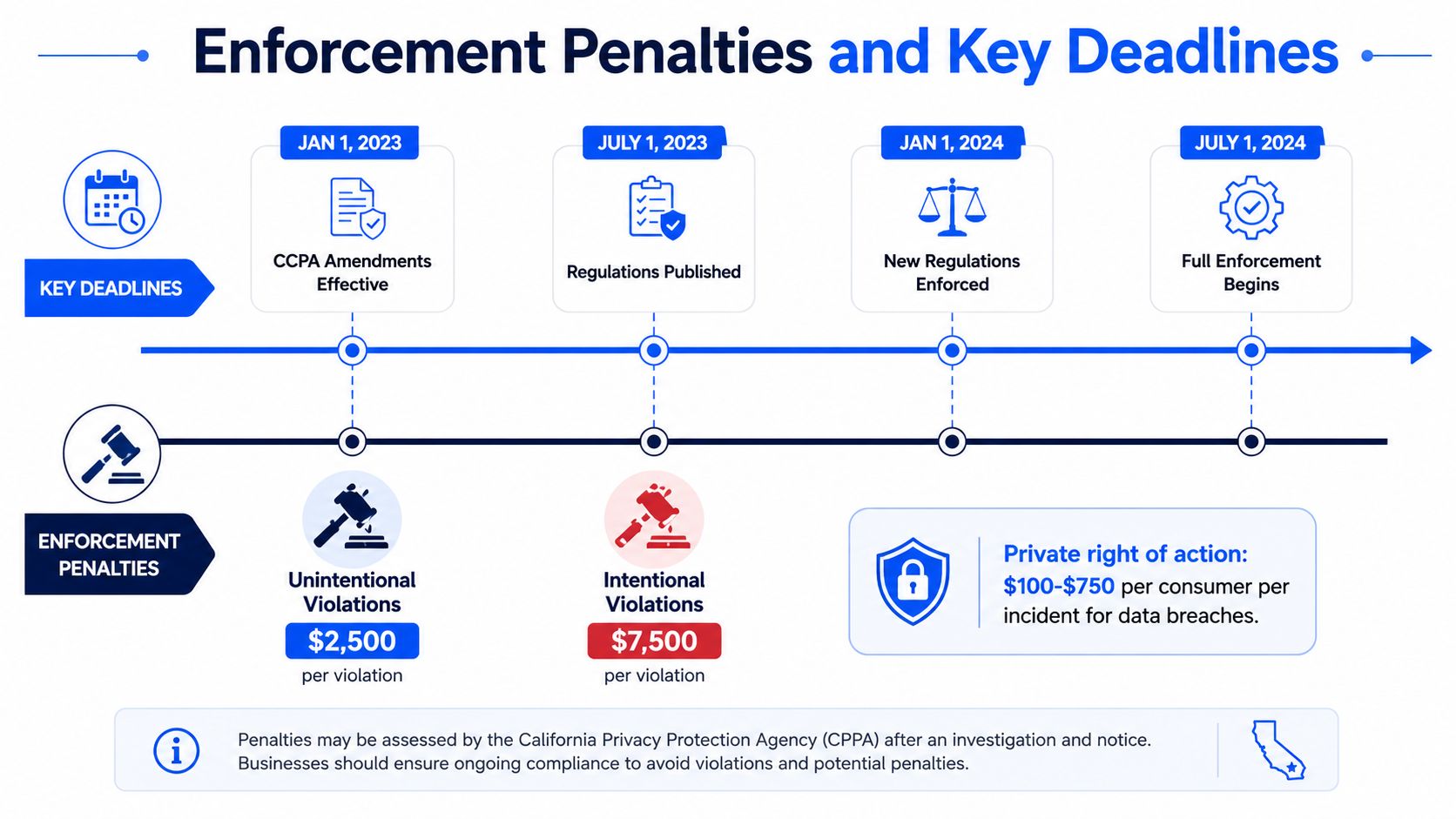
California's penalty structure makes scale a serious compliance risk. The framework allows penalties of up to $2,500 for each unintentional violation and up to $7,500 for each intentional violation or for violations involving consumers under 16, according to the Privacy Rights Clearinghouse overview of the CCPA enforcement framework.
The larger concern is repeatable operational failure. A broken opt-out workflow, inaccurate notice, or inaccessible request process can affect many records and consumers. For enterprises handling large datasets, every failed interaction can increase exposure. Leadership should therefore treat request logs, notice versions, access records, and remediation tickets as enforcement evidence, not administrative paperwork.
Put the 2026 duties on the calendar
Risk-assessment duties begin on January 1, 2026 for covered businesses conducting specified high-risk processing. The relevant activities include selling or sharing personal information, processing sensitive personal information, and certain automated decision-making uses, as set out in the applicable statutory requirements.
Businesses covered by those rules are scheduled to submit attestations and summaries to the CPPA by April 1, 2028. Treat that date as a reporting deadline, not the start of preparation. Assessment scope, approvals, safeguards, findings, and corrective actions should already exist in controlled records before submission becomes due.
Plan for audits by revenue tier
Cybersecurity audit obligations are scheduled to phase in according to revenue:
| Revenue tier | Initial audit deadline |
|---|---|
| More than $100 million | April 1, 2028 |
| $50 million to $100 million | April 1, 2029 |
| Under $50 million | April 1, 2030 |
These future deadlines apply where the business also meets the relevant processing-risk criteria. Revenue alone does not establish the full obligation. Legal, finance, security, and privacy owners should document the revenue determination alongside the processing analysis, then connect both to audit-ready evidence.
The practical priority is clear: build evidence-based controls before a deadline forces a scramble. A defensible record of decisions, safeguards, requests, and risk treatment gives enterprise R&D leadership a stronger basis for responding to regulators across jurisdictions.
CCPA Controls for Materials R&D Platforms
Generic compliance software often starts with policy questionnaires. Materials R&D needs a control architecture that follows information from collection through experimentation, collaboration, storage, analysis, and deletion.
A platform that consolidates fragmented experimental data can make the inventory more reliable, but centralization alone isn't compliance. The system must preserve role-based access, purpose context, vendor boundaries, change history, and request evidence. Security controls should protect confidential formulations and intellectual property while also limiting unnecessary exposure of personal information.
Map each requirement to an operational control
| CCPA Requirement | Platform Control | Evidence Produced |
|---|---|---|
| Maintain an accurate data inventory | Centralized data mapping across spreadsheets, ELNs, repositories, and connected systems | System register, data-category map, purpose records, ownership history |
| Support notice at collection | Link collection points to current categories and processing purposes | Notice version, approval record, collection-point mapping |
| Restrict access appropriately | Role-based access tied to job function, project, site, and data sensitivity | Access approvals, permission reviews, access logs |
| Protect personal information | Encryption, secure authentication, least-privilege administration, and controlled sharing | Security configuration records, review results, incident evidence |
| Handle access and deletion requests | Searchable identity and record relationships across experiments and workspaces | Search results, deletion actions, exception decisions, response package |
| Honor opt-out requests | Central suppression state propagated to connected sharing and analytics workflows | Request timestamp, processing status, downstream confirmations |
| Manage service providers | Contract register linked to data flows and vendor responsibilities | Executed agreement, processor inventory, vendor response evidence |
| Demonstrate accountability | Immutable or access-controlled audit trails for data and workflow changes | User, action, timestamp, object, approval, and outcome records |
| Assess high-risk processing | Workflow for documenting processing purpose, risks, safeguards, and approvals | Assessment report, stakeholder sign-off, mitigation record |
The distinction between a generic document repository and a compliance-ready R&D platform is traceability. A folder may show the current experiment, but it rarely shows who accessed a linked personal record, which downstream vendor received it, or whether a deletion request reached every relevant copy.
Tool selection should focus on evidence output, not marketing language. If you're comparing governance products, a practical Vanta pricing and features breakdown can help your team evaluate how a control platform handles monitoring, evidence collection, and audit preparation alongside the R&D system itself.
Polymerize is one example of an R&D platform that states it supports GDPR and CCPA compliance, with Polymerize Connect described as GDPR/CCPA ready. Evaluate that claim against your own data flows, contract requirements, access model, retention rules, and request-response testing before selecting any platform.
Your CCPA Compliance Checklist and Next Steps
Compliance work should follow risk and evidence, not the order in which a privacy policy was drafted. Use the checklist below as an operating sequence, and define “done” by the artifact your team can produce.
Start with scope and inventory
Confirm scope thresholds. Document the preceding-calendar-year revenue assessment and the business's California activities. Record the conclusion, reviewers, assumptions, and the obligations that apply now versus later.
Identify high-risk processing. List selling or sharing, sensitive personal-information processing, automated decision-making, and other activities that may require a risk assessment under the 2026 framework. Done means each activity has an owner, purpose, system list, risk decision, and review date.
Complete the data inventory. Trace personal information across spreadsheets, ELNs, identity systems, customer tools, vendor platforms, shared drives, and research collaborations. Done means you can answer what is collected, why, where it is stored, who receives it, who can access it, and how the record relates to a person.

Make consumer controls testable
Update notices at collection. Match every notice to the categories and purposes in the live inventory. Include downstream disclosure and retention information where required, and preserve approved versions with their effective dates.
Build the request workflow. Create a central intake process for know, access, deletion, correction, and opt-out requests. Start the response clock at intake, verify identity through a documented method, assign system owners, route vendor actions, and preserve the final response record.
Test the 45-day process. Run a controlled request through every relevant system. Confirm that verification, retrieval, review, redaction, deletion, approval, response delivery, and escalation are all timestamped. The California Attorney General's request-handling materials should remain part of the legal-operations reference set.
Implement opt-out confirmation. Process direct opt-outs and Global Privacy Control signals, then provide visible confirmation of status. Done means the request produces a record showing receipt, enforcement across connected systems, vendor notification where necessary, and confirmation to the consumer.
Refresh service-provider contracts. Link every vendor to the data it receives and the service it performs. Confirm restrictions on use, retention, disclosure, security, downstream processing, and assistance with consumer requests.
Review access and audit trails. Use role-based access for laboratory, project, vendor, and administrative functions. Confirm that changes to permissions, records, processing settings, and request outcomes generate reviewable logs.
Calendar the future deadlines. Record the risk-assessment milestones, the April 1, 2028 attestation and summary deadline, and the cybersecurity audit dates that correspond to the applicable revenue tier. Assign accountable executives and schedule evidence reviews before each deadline.
Train operational owners. Train privacy, security, HR, procurement, R&D platform administrators, customer support, and laboratory operations teams on intake routes, escalation rules, approved data uses, and evidence preservation.
Review continuously. Reassess after a new vendor, model, instrument integration, acquisition, data source, or major workflow change. A compliance program that isn't updated with the data architecture will drift out of alignment.
Close the governance gaps
The next week
This week, appoint one accountable owner and convene legal, security, IT, procurement, and R&D platform leadership. Next, create a first-pass system register and mark every location where personal information may be linked to an employee, applicant, vendor contact, customer, collaborator, or platform user. Finally, test one mock access request and one opt-out request, then document every missing timestamp, system connection, vendor dependency, and approval step.
Don't wait for an audit notice to discover that your evidence is scattered across email and spreadsheets. Build the inventory, request workflow, access controls, and audit trail while the program is still manageable.
Polymerize helps materials R&D teams unify experimental data across spreadsheets, ELNs, and silos through a centralized data backbone, with role-based access and stated GDPR/CCPA support that can contribute to a more evidence-ready operating model. Visit Polymerize to evaluate how its platform could support controlled data mapping, secure collaboration, and auditable materials development workflows.
Put your R&D data to work
See how materials teams use Polymerize to plan fewer experiments and reach target properties faster.