

A formulation has changed, but nobody can explain exactly when. A scientist remembers adjusting the resin ratio, an engineer has a newer spreadsheet, and the instrument export reflects a result that no longer matches the notebook. The experiment may still be useful, yet the team can't confidently reconstruct the path from the original recipe to the final result.
That uncertainty creates more than an administrative headache. It can weaken reproducibility, slow scale-up, complicate partner reviews, and make an intellectual property claim harder to defend. In materials R&D, where formulations, process parameters, test results, and interpretations evolve continuously, audit trail management is the trust layer behind scientific decisions.
A useful audit trail doesn't merely prove that someone opened a file. It shows who changed a value, what changed, when it changed, and how that change relates to the experiment. Managed properly, the history becomes searchable evidence for scientists, quality teams, IT administrators, and increasingly, AI systems that depend on reliable context.
This guide starts with the basic mental model, then connects audit trails to data integrity and IP, regulatory design, fragmented ELN and spreadsheet environments, scalable review practices, and practical measures of maturity.
Table of Contents
Introduction to Audit Trail Management in Modern Labs
Materials scientists rarely work in one system. A formulation may begin in an ELN, move into a spreadsheet for design-of-experiments work, generate results from an instrument application, and return to a report or shared folder for review. Each handoff creates an opportunity for context to disappear.
Consider a polymer formulation where a stabilizer level changes between two screening rounds. The final spreadsheet contains the latest value, but the earlier value was overwritten rather than versioned. The instrument result is intact, yet the analyst can't tell which recipe produced it. During a scale-up discussion, the team has to rely on memory, email attachments, and file timestamps. Nobody necessarily acted improperly, but the record no longer supports a confident reconstruction.
That's the central problem audit trail management addresses. It preserves the sequence of scientific work so a later reviewer can distinguish an intentional formulation change from a transcription error, a recalculation, or an unauthorized edit.
Practical rule: A result without its change history may be readable, but it isn't fully explainable.
The same principle applies to IP. If a team needs to establish when a formulation concept emerged, which contributors changed it, and how experimental evidence developed, a complete history is more persuasive than a final document alone. For guidance on preserving the broader movement of records and evidence across processes, a chain of custody documentation guide can help teams think beyond individual files.
Why this matters now
Labs are digitizing faster than their recordkeeping practices are maturing. Scientists often have better instruments, more connected tools, and richer datasets, but the history of decisions can still be scattered across local workbooks and application-specific logs. That fragmentation becomes especially problematic when teams want to use AI to identify causal drivers or recommend the next experiment.
AI can analyze a value, but it needs confidence in the value's provenance. If a model can't distinguish an original measurement from a corrected entry, or a validated formulation from an abandoned trial, its recommendations inherit that ambiguity.
The practical shift is to treat audit trails as innovation infrastructure, not paperwork. A trustworthy history helps scientists reproduce work, helps IT investigate access and changes, and gives quality teams evidence they can review without asking the original author to remember every detail.
What Audit Trail Management Really Means
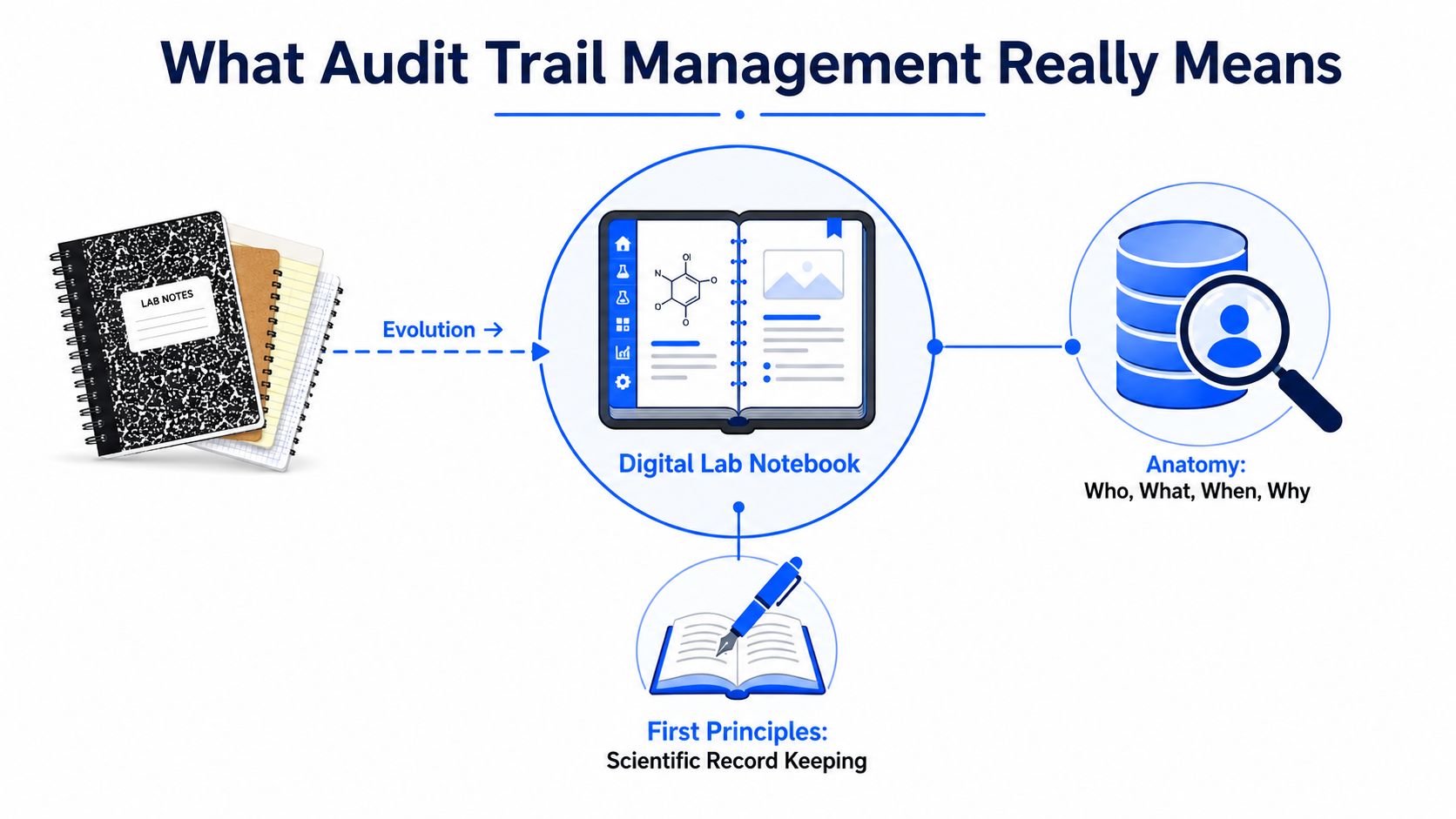
A scientist opens a spreadsheet and finds a value that no longer matches yesterday's report. The file shows that it changed, but not necessarily which cell was edited, what the earlier value was, or why the revision occurred. An audit trail supplies that missing history, much like a laboratory notebook that keeps the original entry visible while recording the correction.
In electronic systems, the trail should be captured automatically and consistently rather than reconstructed from memory. A useful record identifies:
- Who acted: The user, role, service account, or other accountable identity.
- What happened: The record created, viewed, modified, approved, or deleted.
- When it happened: A reliable date and time associated with the event.
- What changed: The previous value and the new value where data was modified.
- Why it matters: The experiment, workflow, approval, or business context connected to the action.
- How it remains trustworthy: Retention, access controls, and safeguards that keep the history visible and protected.
Logs are not the same as managed trails
A raw application log might report that a database update occurred. Audit trail management adds the operating discipline around that event. The organization defines which actions require capture, how records are standardized, where they are retained, who may review them, and how reviewers document their conclusions.
That distinction becomes practical in R&D. A spreadsheet's file history may show that a workbook changed without showing the affected cell or the value it replaced. An ELN may preserve a revised procedure while leaving a gap if an administrator changes the underlying database without an equivalent record. A connected data backbone, such as a Polymerize-style system, can capture activity across spreadsheets and ELNs in a searchable history, giving teams a common record that is easier to review and prepare for AI analysis.
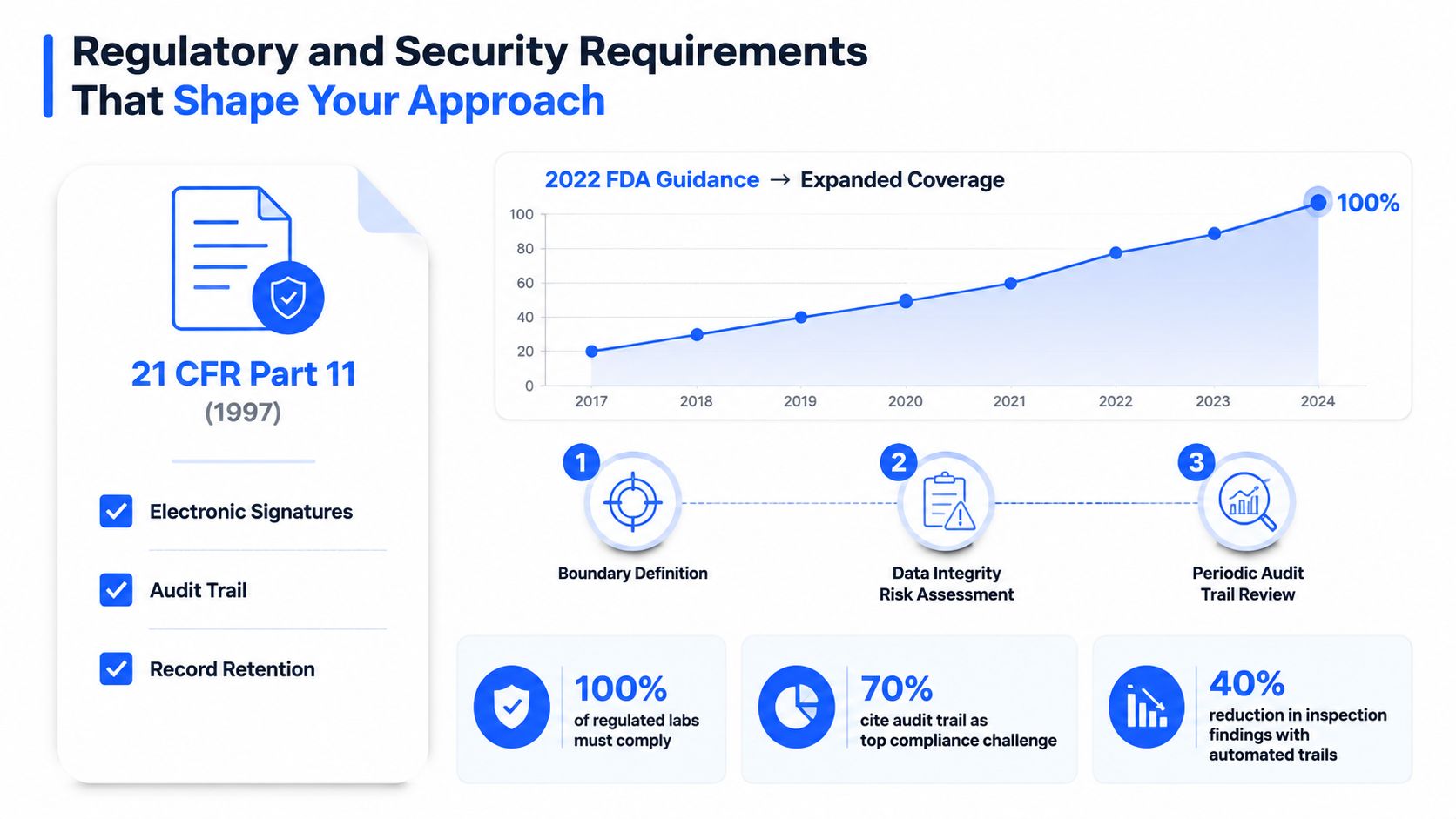
The FDA's description of electronic-record controls sets a clear expectation. Under FDA 21 CFR Part 11, secure, computer-generated, time-stamped audit trails must independently record operator entries and actions that create, modify, or delete electronic records. The documentation must remain available for agency review and copying, as summarized in the FDA 21 CFR Part 11 reference.
Good management turns scattered system events into a chronological, searchable account that someone who was not present can understand. That makes the trail a trust layer for R&D, not a checkbox added after the work is complete.
Why Audit Trail Management Matters for Data Integrity and IP
A final formulation answers only one question: what did the team end up with? A managed trail answers the questions that determine whether the result can be trusted: how did the formulation change, who made each decision, which evidence supported it, and which version produced the reported performance?
Suppose a coatings team changes a polymer molecular-weight target after an early viscosity result. If the original target, the revised target, the approving scientist, and the associated measurement all remain connected, another team can reproduce the reasoning. If only the final target survives, a later researcher may treat the changed value as the original design intent and draw the wrong conclusion.
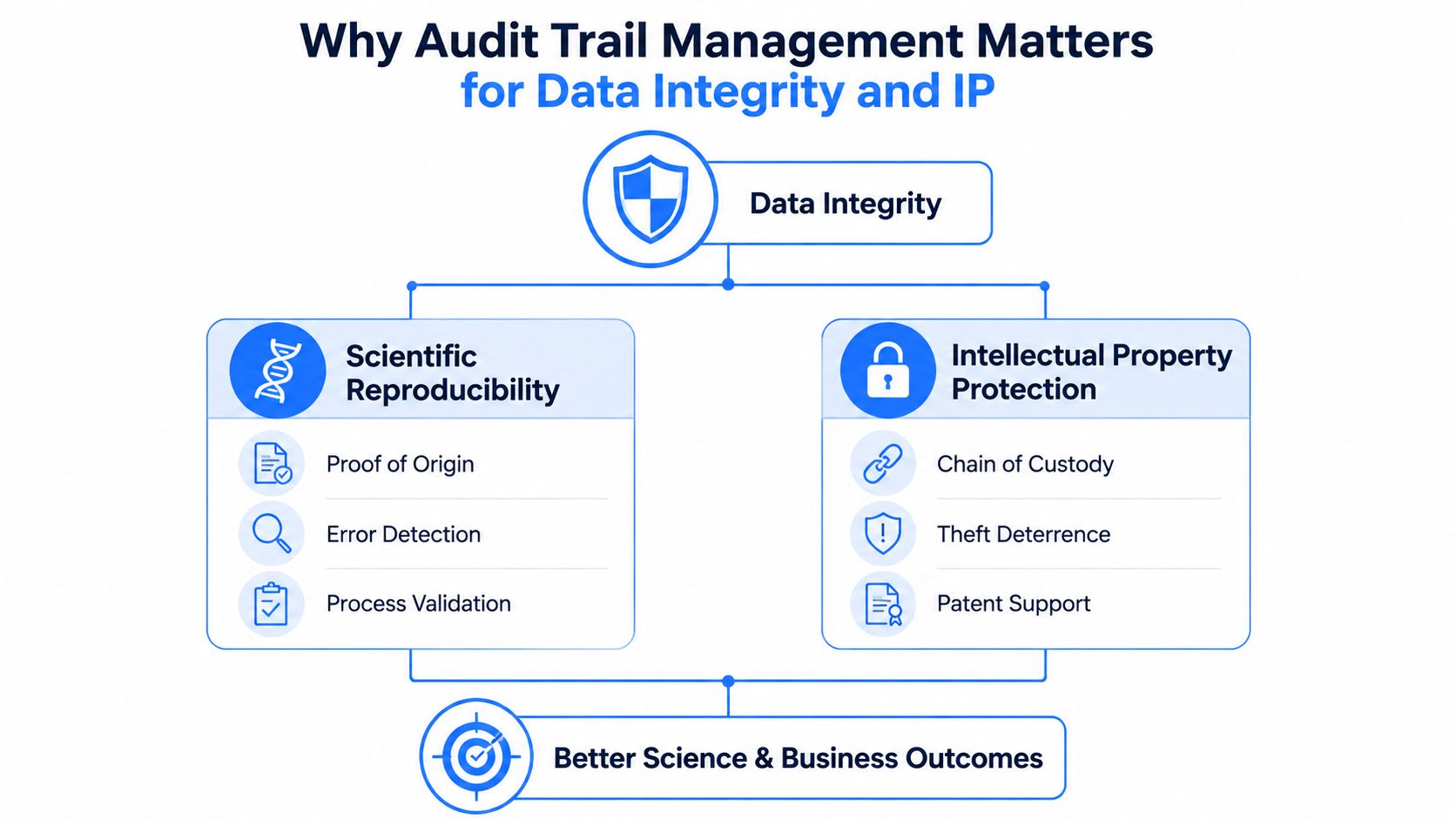
That connection between history and evidence supports three outcomes:
- Reproducibility: Scientists can reconstruct the conditions behind a result instead of copying only the final recipe.
- Error detection: Reviewers can identify unexpected edits, unit changes, or transcription differences before they influence downstream decisions.
- Process validation: Quality and manufacturing teams can compare the documented development path with the process that reached scale-up.
IP protection depends on chronology
Intellectual property teams often need more than a final report. They may need evidence showing when an idea appeared, how contributors developed it, and which experiments support the claimed result. A transparent history can help establish provenance and expose contradictions before they become expensive disputes.
This isn't the same as saying an audit trail automatically proves ownership. Ownership and inventorship involve legal analysis, agreements, contribution records, and other evidence. The trail provides a technical record that helps counsel and technical experts evaluate the sequence of events.
Partner trust also depends on this history. During a joint development or scale-up, one organization may ask why a parameter changed or whether a test result came from a controlled formulation. A searchable record allows the technical team to answer from evidence rather than memory. That reduces friction without forcing scientists to slow every experiment for manual documentation.
Teams building a wider integrity program may also find the digna data integrity platform useful as a reference point for thinking about controls across modern data environments.
The business case is straightforward. Data integrity, reproducibility, IP defensibility, and partner confidence reinforce one another when the same history connects people, values, decisions, and evidence. When that history is fragmented, every review becomes slower and every conclusion carries more uncertainty.
Regulatory and Security Requirements That Shape Your Approach
A scientist changes a formulation value, an administrator updates a workflow, and a reviewer later asks which version supported the reported result. The architecture determines whether that answer comes from evidence or reconstruction by memory. Regulations should therefore shape system design before tool selection, with one practical test: can an independent reviewer follow the record's lifecycle and understand what happened?
For regulated electronic records, FDA 21 CFR Part 11 defines expectations for secure, computer-generated, time-stamped audit trails. The trail should independently record when operators create, modify, or delete records, retain that history for at least as long as the underlying records, and make it available for agency review and copying FDA 21 CFR Part 11 reference.
The FDA's 2022 draft guidance identifies three useful fields for each audit trail event:
- Date and time of the change
- Individual making the change, such as user ID and role
- Old and new values
It also recommends keeping trails searchable and sortable where practical. In a materials laboratory, that means preserving more than a final report or exported PDF. Reviewers should be able to filter the underlying history by user, experiment, parameter, date, or record. A searchable data backbone makes this practical across spreadsheets and ELNs, while giving future analytical and AI workflows structured evidence instead of disconnected files.
Security adds the reconstruction requirement
Security teams ask a related question: can the organization reconstruct who did what and when, particularly if logs may become legal evidence? NIST guidance describes audit trails as important for that reconstruction NIST guidance on audit trails.
Retention policy must also support investigation. Keeping history has limited value if analysts cannot locate, interpret, or export the relevant events when an incident begins. For Polymerize-style systems, this is why protection, indexing, and consistent metadata belong in the data backbone rather than being treated as an afterthought.
For system design, ask:
- Can administrators alter or delete the trail without detection?
- Does the trail include privileged-user activity?
- Can reviewers export readable evidence?
- Does retention match the underlying record and applicable policy?
- Can the organization reconstruct a change across connected applications?
These questions turn compliance language into engineering requirements. They also reveal the difference between a trail that merely exists and one that supports trust. If history cannot be searched, interpreted, and protected throughout its retention period, it remains evidence in name only.
How Audit Trail Architecture Connects ELNs Spreadsheets and Data Backbones
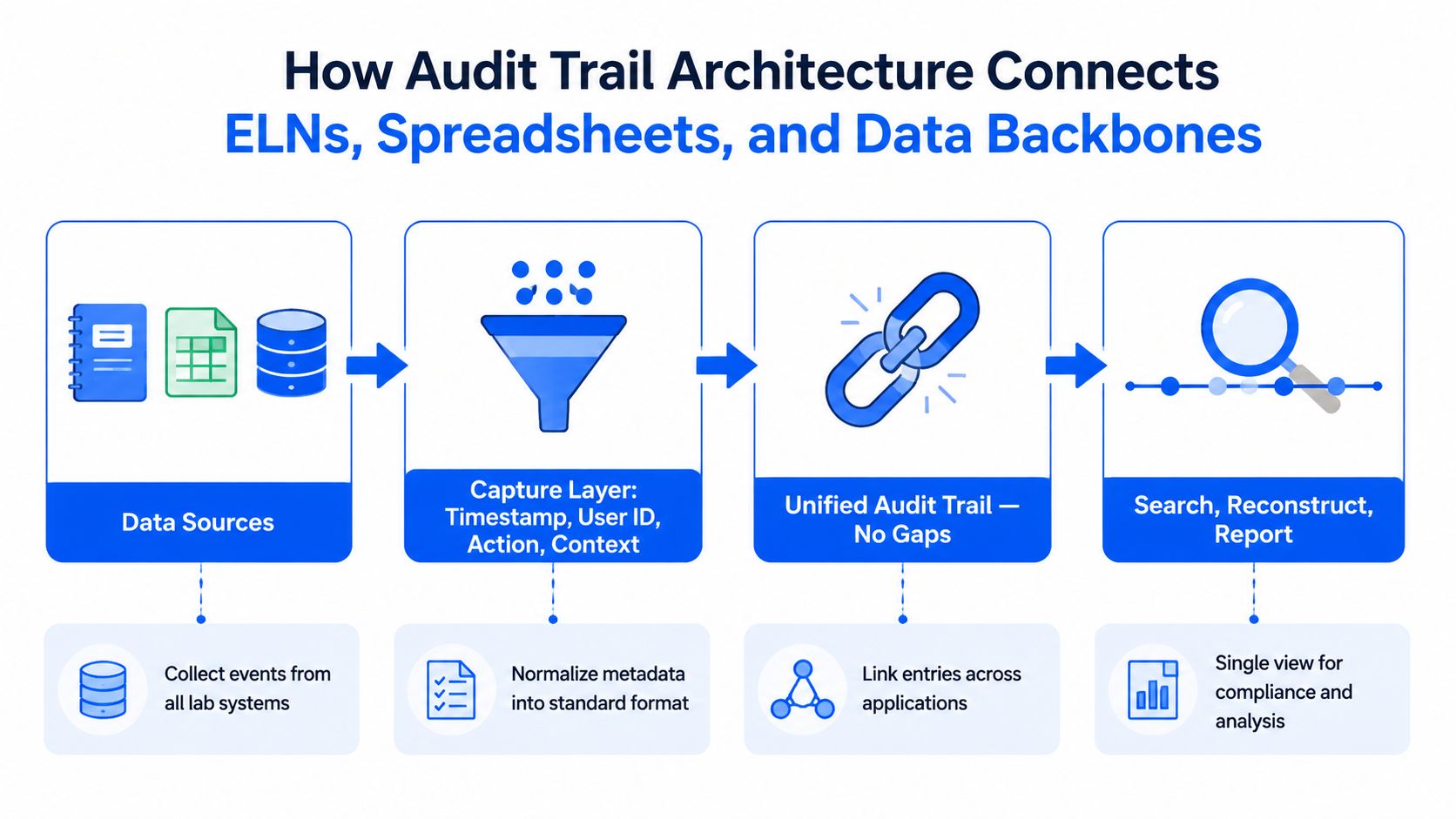
Most lab environments don't have a single source of truth. They have an ELN for experimental narratives, spreadsheets for calculations and formulation tables, instrument systems for measurements, databases for master data, and shared repositories for reports. Audit trail architecture must connect these sources without pretending they're identical.
The first layer captures events where they occur. For an ELN, that may include creation, revision, approval, attachment, and access events. For a spreadsheet workflow, it may include controlled uploads, cell-level or record-level changes where available, and the identity of the person submitting a revised dataset. For databases and applications, it includes changes to master records, configuration, and workflow state.
The backbone creates continuity
A secure data backbone acts as the connective tissue. It doesn't need to replace every specialist application. Instead, it receives relevant events, normalizes metadata, links records to experiments and materials, and gives authorized users a consistent way to search the history.
A practical event model might contain:
| Field | Lab meaning |
|---|---|
| User identity | Scientist, analyst, administrator, or service account |
| Timestamp | Time associated with the action |
| Source | ELN, spreadsheet workflow, instrument, database, or application |
| Action | Create, change, approve, access, export, or delete |
| Before and after | Previous and revised value where applicable |
| Context | Experiment, formulation, batch, method, or workflow |
| Integrity status | Evidence that the event was preserved and not silently altered |
This model matters because systems use different vocabularies. One application may call a formulation a “record,” another may call it a “sample,” and a spreadsheet may represent it as a row. Normalization lets reviewers follow the scientific object rather than the tool's internal terminology.
Where legacy systems create gaps
Legacy environments often capture the application user but not the database administrator. They may record a file upload but not the paper-to-electronic handoff that preceded it. A privileged operator might change a configuration that affects results without appearing in the scientist-facing history.
The architecture should therefore include all layers that can affect data meaning, including applications, databases, privileged accounts, integration services, and third-party reporting tools. Role-based access can limit who views or manages the history, while append-oriented or otherwise tamper-evident storage protects the record from quiet alteration.
Searchability also determines whether the trail is useful for AI. A model-ready history needs structured relationships between a formulation, its variables, test results, revisions, and outcomes. If the trail remains trapped in screenshots and disconnected files, an AI system can't reliably distinguish experimental intent from administrative noise.
Implementation Roadmap and Best Practices That Actually Scale
A sustainable program starts with scope, not software. List the data objects that influence scientific or business decisions, then trace where each object is created, changed, approved, copied, exported, and archived. For a formulation, that map might include composition, process conditions, test results, analytical methods, and scale-up instructions.
The review process should then move through deliberate phases.
Build the control boundary
Begin with a risk-ranked inventory. Identify which systems hold original observations, which hold derived calculations, and which merely distribute approved information. Mark every handoff between systems and between paper and electronic records.
Next, define the minimum event vocabulary. Don't let each application invent its own interpretation of “modified” or “approved.” Establish shared terms for identity, timestamp, action, previous value, new value, context, and review status.
A useful test: If a reviewer can't connect a changed value to the experiment and decision it affected, the trail is incomplete for that workflow.
Enable coverage at every meaningful layer
Enable trail features in applications, databases, integration tools, and administrative interfaces. Test the result with ordinary users and privileged users. A scientist-facing record can look complete while an administrator changes the underlying data through a path the scientist never sees.
Preserve the trail separately from the working record where appropriate, restrict access, and document retention. Search and export should be tested with realistic questions, such as “show every change to this formulation before the scale-up review” rather than only checking whether an audit-log screen opens.
Make review exception-based
Manual review of every event doesn't scale. The Medidata discussion of audit trail review identifies recurring obstacles including manual review overload, inconsistent documentation, lack of standardization, and cross-platform integration problems.
A better model prioritizes signals that deserve human attention:
- High-impact value changes: Composition, process limits, acceptance criteria, or reported results.
- Unexpected identity activity: Privileged access, shared accounts, or changes outside an approved role.
- Unusual timing: Edits after approval, during a review lock, or outside the expected workflow.
- Cross-system disagreement: A spreadsheet value that differs from the approved ELN record.
- Incomplete context: An event with no linked experiment, sample, batch, or reason.
Reviewers should record the disposition, evidence checked, decision reached, and follow-up owner. That creates a review trail around the audit trail, which prevents the organization from repeatedly reopening the same question.
Training completes the operating model. Scientists need to know how corrections, annotations, and handoffs should work. IT needs to understand which administrative actions affect scientific meaning. Quality teams need a common method for triaging exceptions rather than requesting broad exports that bury important events in noise.
Measuring Success and Avoiding Common Pitfalls
A mature audit trail program isn't measured by how many gigabytes of logs it stores. Storage volume can increase while scientific confidence declines. The more useful question is whether a team can answer a meaningful investigation question quickly, accurately, and with evidence that another reviewer can follow.
Track operational signals such as:
- Review coverage: Whether critical workflows and meaningful data layers generate the expected events.
- Reconstruction time: How long it takes to trace a result back through formulation, method, operator, and change history.
- Exception closure: Whether reviewers resolve prioritized events with documented conclusions.
- Context completeness: Whether events link to the relevant experiment, sample, batch, or approval.
- Audit readiness: Whether the team can produce readable, searchable evidence without rebuilding the record manually.
These measures are more informative than counting logins, dashboards, or raw events. A system that captures every access event but can't show the before-and-after value for a formulation change has strong activity monitoring and weak scientific traceability.
Common failure patterns
Recent inspection-oriented coverage highlights recurring findings: audit trail features may not be enabled at every layer, privileged-user actions may be missing, and preservation or tamper concerns may remain unresolved. The same review reported that 59% of analyzed companies had modified audit trail reporting in FY25 Maven Research review of GMP audit trail expectations. That finding reinforces a practical point, deficiencies aren't unusual edge cases that only affect immature organizations.
Watch for these warning signs:
- The trail begins at the application screen. Database changes, administrator actions, or integration events sit outside the visible history.
- The final value replaces the original. Reviewers can see what exists now but not what changed.
- The system records identity weakly. Shared accounts make accountability difficult.
- Exports lose context. A report contains events but not the experiment, material, or workflow they belong to.
- Reviewers inspect everything manually. Important exceptions disappear among routine activity.
- Retention exists only in policy. The organization hasn't tested whether old records remain readable and searchable.
The real maturity test: Ask a scientist who wasn't involved in the experiment to reconstruct one important result using only the managed records. Any missing link is a design issue, not a training issue.
The strongest programs make the trail automatic at the point of work, searchable across systems, protected from silent changes, and useful to both human reviewers and analytical tools. That approach turns audit trail management into a durable R&D trust layer, one that protects evidence without asking scientists to trade away the speed of experimentation.
Polymerize provides a centralized data backbone for materials R&D, connecting fragmented spreadsheets, ELNs, and other sources while supporting access monitoring and complete audit trails. Visit Polymerize to see how its connected data foundation can help your team preserve experimental history, improve traceability, and create an AI-ready record for faster, more trusted materials development.
Put your R&D data to work
See how materials teams use Polymerize to plan fewer experiments and reach target properties faster.