

Your team may already have an AI pilot, a large archive of experimental results, and a long list of candidate materials. Yet the lab still spends much of its time repeating failed formulations, reconciling spreadsheets, and asking whether a promising prediction can be made on existing equipment. That tension captures the current state of AI-driven materials discovery: generating candidates is becoming easier, while producing reliable, scalable materials remains difficult.
The practical question isn't whether a model can propose something novel. It's whether your scientists can trust the data behind the prediction, synthesize the candidate, reproduce the result, and move it through formulation and scale-up. This guide treats those constraints as the center of the decision, not as footnotes to a story about faster candidate generation.
Table of Contents
- What AI-Driven Materials Discovery Looks Like in Practice
- Data gives the system its memory
- Models turn records into decisions
- Workflow closes the loop
- Start with a data readiness audit
- Test the operational connections
- Treat security as a design decision
What AI-Driven Materials Discovery Looks Like in Practice
A polymer chemist has spent months screening formulations for a heat-resistant electrical insulator that also meets cost and processing requirements. The team has accumulated useful results, but the records sit across spreadsheets, lab notebooks, and an electronic laboratory notebook. Some measurements are missing conditions, some failed experiments have no consistent failure label, and the next experiment still depends heavily on individual judgment.
An AI system doesn't replace that judgment. It helps organize the evidence around it. The team defines the target properties and constraints, then gives a model access to historical formulations, synthesis conditions, measured outcomes, and relevant simulated data. The system ranks candidate experiments by expected usefulness, while chemists review whether each proposal makes chemical and operational sense.
The important change is guided exploration. Instead of treating every formulation as equally informative, the team chooses experiments that could improve the material, reduce uncertainty, or test an important assumption. After synthesis and characterization, the new results return to the dataset. The next recommendation reflects what the team has learned, including unsuccessful attempts.
Practical rule: AI should narrow the experimental queue, not remove scientists from the decision loop.
A useful implementation has several human checkpoints:
- Scientists define the target: They decide which properties matter, how to balance trade-offs, and which constraints are essential.
- Chemists review feasibility: They identify incompatible ingredients, difficult processing steps, purity concerns, and conditions the model hasn't represented.
- The lab validates predictions: Measurements become evidence, not just a final approval step.
- R&D leaders assess progress: They track whether the workflow improves time-to-spec, experiment quality, and scale-up confidence.
That distinction matters because a prediction is not a material. A model can estimate a property or suggest a composition, but laboratory work still has to establish synthesis, characterization, repeatability, safety, and manufacturability. The strongest teams use AI to make human expertise more selective and better informed.
The Core Concept Behind AI-Driven Materials Discovery
A simple way to explain the discipline to a colleague is to call it a recommendation engine for materials. A streaming service uses past choices and feedback to rank what you may want next. A materials system uses past formulations, synthesis outcomes, simulations, and property measurements to rank which experiment deserves attention next.
Three connected pillars make that possible.
Data gives the system its memory
Data can include chemical compositions, crystal structures, formulation ratios, process conditions, characterization results, failed attempts, and simulation outputs. It also includes context, such as instrument settings, sample preparation, units, operator notes, and the definition of each property.
The context isn't administrative detail. Without provenance and consistent terminology, a model may treat measurements from different methods as interchangeable when they aren't. Recent commentary on FAIR data and materials informatics highlights the importance of controlled vocabularies, explicit uncertainty, and provenance for data interoperability and reuse.
Models turn records into decisions
A regression model can estimate a continuous property, while a classification model can separate likely successes from likely failures. Generative models propose new structures or compositions, and active-learning methods choose the next experiment by balancing promising candidates with informative ones.
A model doesn't understand a material in the same way a chemist does. It identifies patterns in the representation and data it receives. If the training data omits a processing variable that controls morphology or cure behavior, a high-confidence output may still be misleading.
Workflow closes the loop
A model creates value only when its output changes what the lab does. The workflow connects target definition, data preparation, prediction, experiment selection, synthesis, characterization, and feedback.
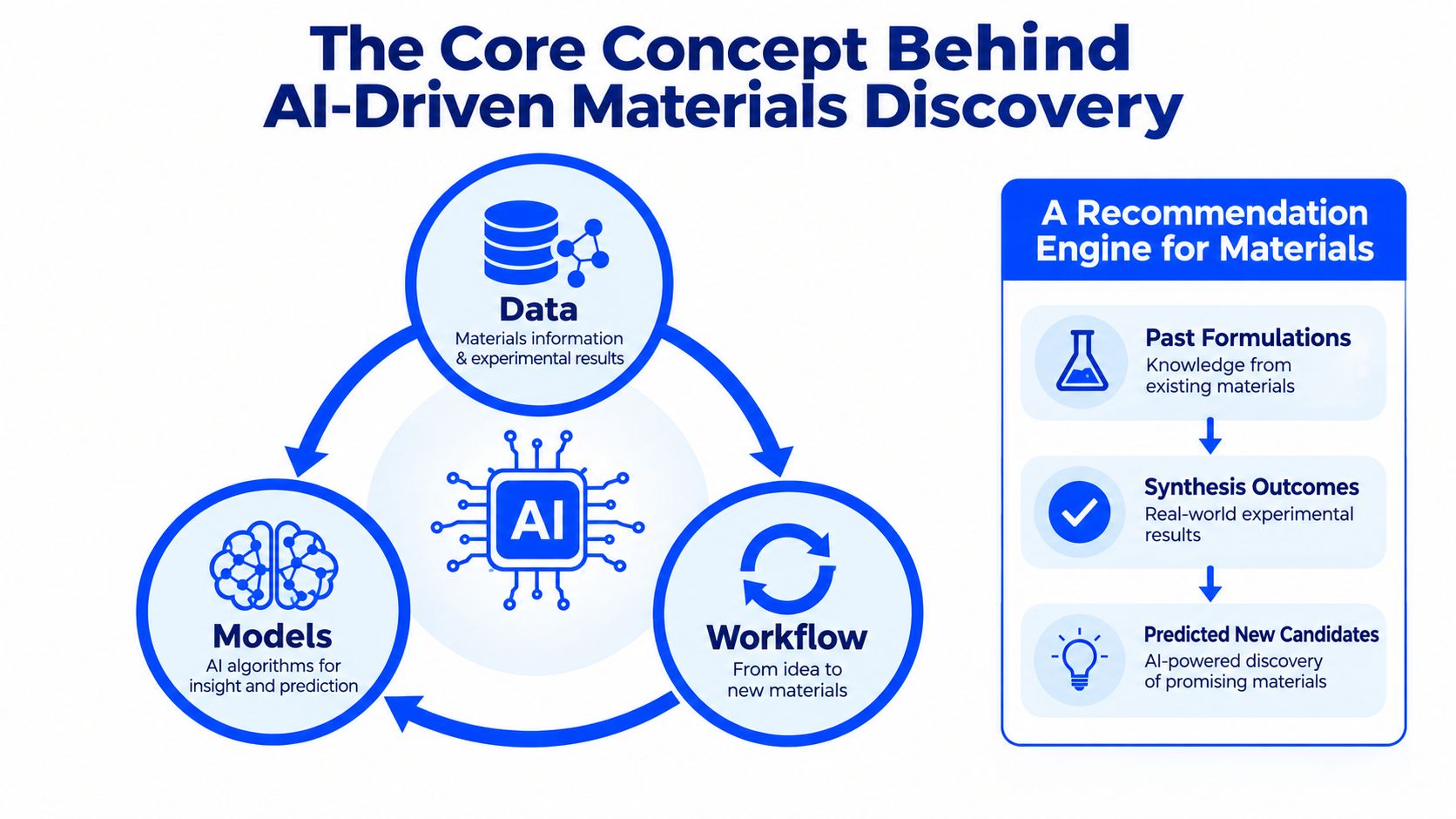
The relationship is reinforcing but unforgiving. Weak data limits the model, and a strong model without an operational workflow produces recommendations that nobody acts on. The system becomes useful when all three pillars work together, with scientists able to inspect the evidence and feed trustworthy results back into the process.
How the Workflow Actually Works
A closed-loop program starts with a decision, not a model. The team must specify the target property, acceptable trade-offs, and practical constraints before generating candidates. For a polymer, that might include thermal performance, dielectric behavior, viscosity, raw-material availability, and a formulation route compatible with current equipment.
From target to shortlist
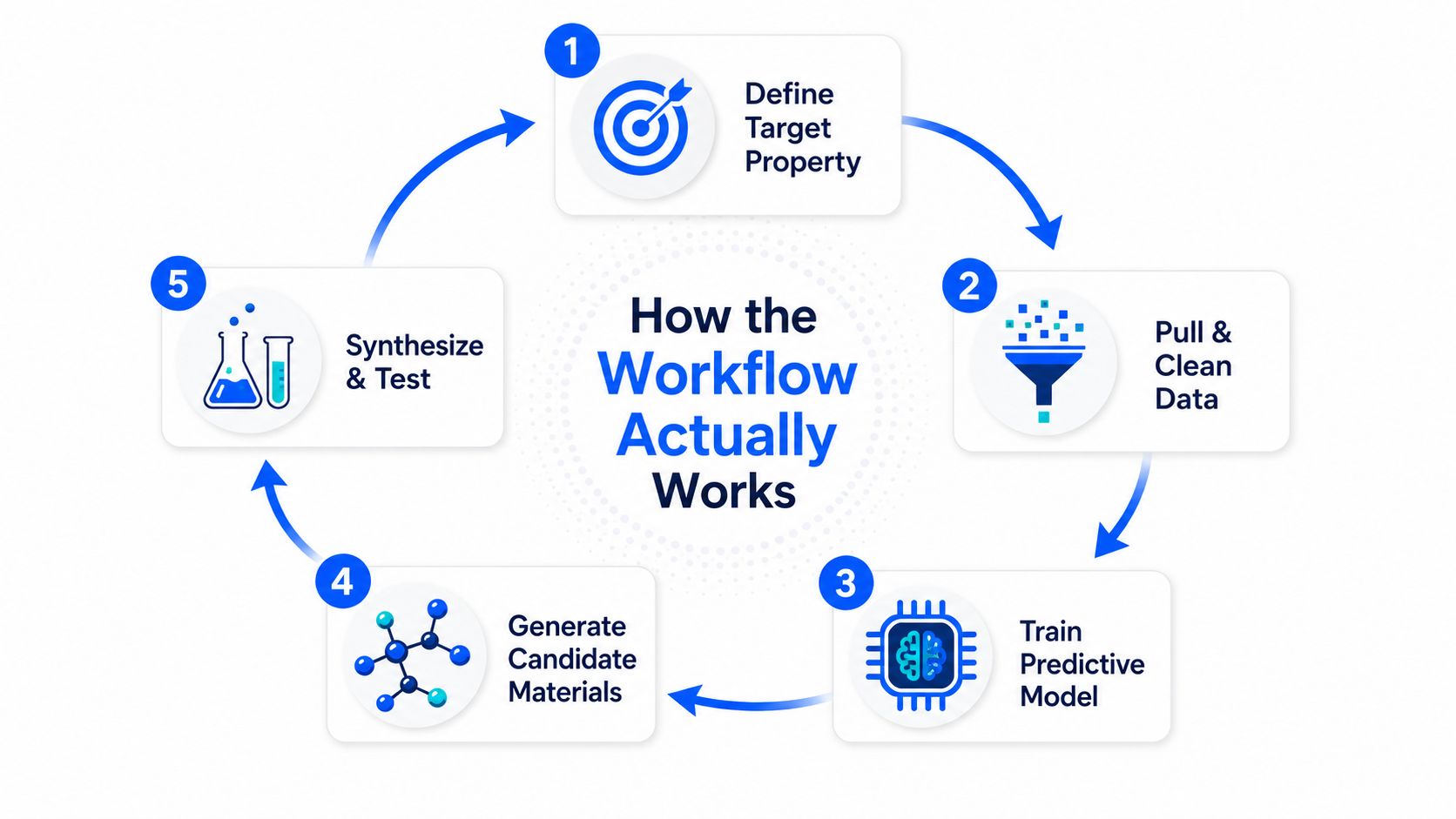
The working sequence usually looks like this:
- Define the target property. Translate a business or technical requirement into measurable variables, including acceptable ranges and exclusions.
- Pull and clean relevant data. Combine historical experiments with suitable simulations, standardize units, resolve duplicate records, and preserve failed results rather than deleting them.
- Train or adapt a model. Select a model family suited to the question. Regression predicts values, classification estimates categories, generative models propose candidates, and active learning selects informative experiments.
- Generate and rank candidates. Score proposals against target properties, uncertainty, novelty, cost, available ingredients, and synthesis constraints.
- Synthesize and test. Scientists review the shortlist, the lab runs selected experiments, and characterization results return to the system.
The model isn't the only decision-maker at the ranking stage. A technically attractive candidate may require a precursor the organization can't source, a temperature outside the equipment's operating window, or a purification route that makes production uneconomic. Scientists and process engineers should be able to override a recommendation and record why.
The feedback is the asset
The next cycle uses the new measurements, including failed synthesis, unexpected morphology, and results that contradict the prediction. That feedback can reveal data-quality issues, expose missing variables, or show that a model's apparent confidence isn't calibrated for the current material family.
Closed-loop performance therefore depends on sequential decision quality. The MADE benchmark framework treats discovery as a constrained oracle-budget problem and focuses on outcomes such as novel stable compounds found within a limited evaluation budget. For an enterprise team, that suggests evaluating hit rate, novelty, diversity, and useful decisions under a fixed experimental budget, rather than relying only on static error measures such as RMSE or MAE.
Business Benefits and ROI Materials Leaders Care About
A VP of R&D rarely approves an AI platform because a model has an impressive architecture. The business case usually rests on three questions: How many failed experiments can the team avoid? How quickly can it reach a specification? Can it reduce scale-up risk before production resources are committed?
Consider a hypothetical polymer screening program. The team evaluates 50,000 candidates computationally and validates 200 in the lab, as a planning example rather than a reported case study. The value isn't the size of the virtual screen by itself. It comes from using explicit constraints to decide which candidates merit physical work, then capturing the results in a form that improves later decisions.
Measure avoided work, not activity
A useful scorecard separates operational outcomes:
| Metric Category | What It Measures | Typical Target |
|---|---|---|
| Lab cost avoidance | Physical experiments, reagents, instrument time, and external testing avoided through better prioritization | Define against the current program baseline |
| Time-to-spec | Time required to reach a formulation or material that meets agreed requirements | Set a milestone tied to the product roadmap |
| Revenue protection | Ability to respond to customer, regulatory, or supply-chain changes without restarting discovery from scratch | Tie to strategic products and material dependencies |
| Scale-up readiness | Evidence that the candidate remains viable beyond benchtop conditions | Track process-window coverage and repeatability |
These targets are intentionally local. A platform shouldn't promise a universal return because the baseline differs across material classes, data quality, lab throughput, and process complexity. Leaders should compare the pilot with the team's existing way of working.
The benefits can compound when the system supports more than initial screening. A promising formulation may still fail during mixing, curing, coating, drying, or scale-up. Connecting prediction to downstream process data gives the team a better chance to identify those risks before a manufacturing trial.
The defensible ROI claim is not “AI found more candidates.” It is “the team made better decisions with the same scarce lab and process resources.”
A finance review should ask for a measurement plan before deployment. Define the baseline experiment queue, the time spent preparing data and selecting experiments, the cost of characterization, and the point at which a candidate becomes a credible scale-up option. Without those definitions, a pilot can generate activity without proving value.
The Synthesizability Gap Most Articles Skip
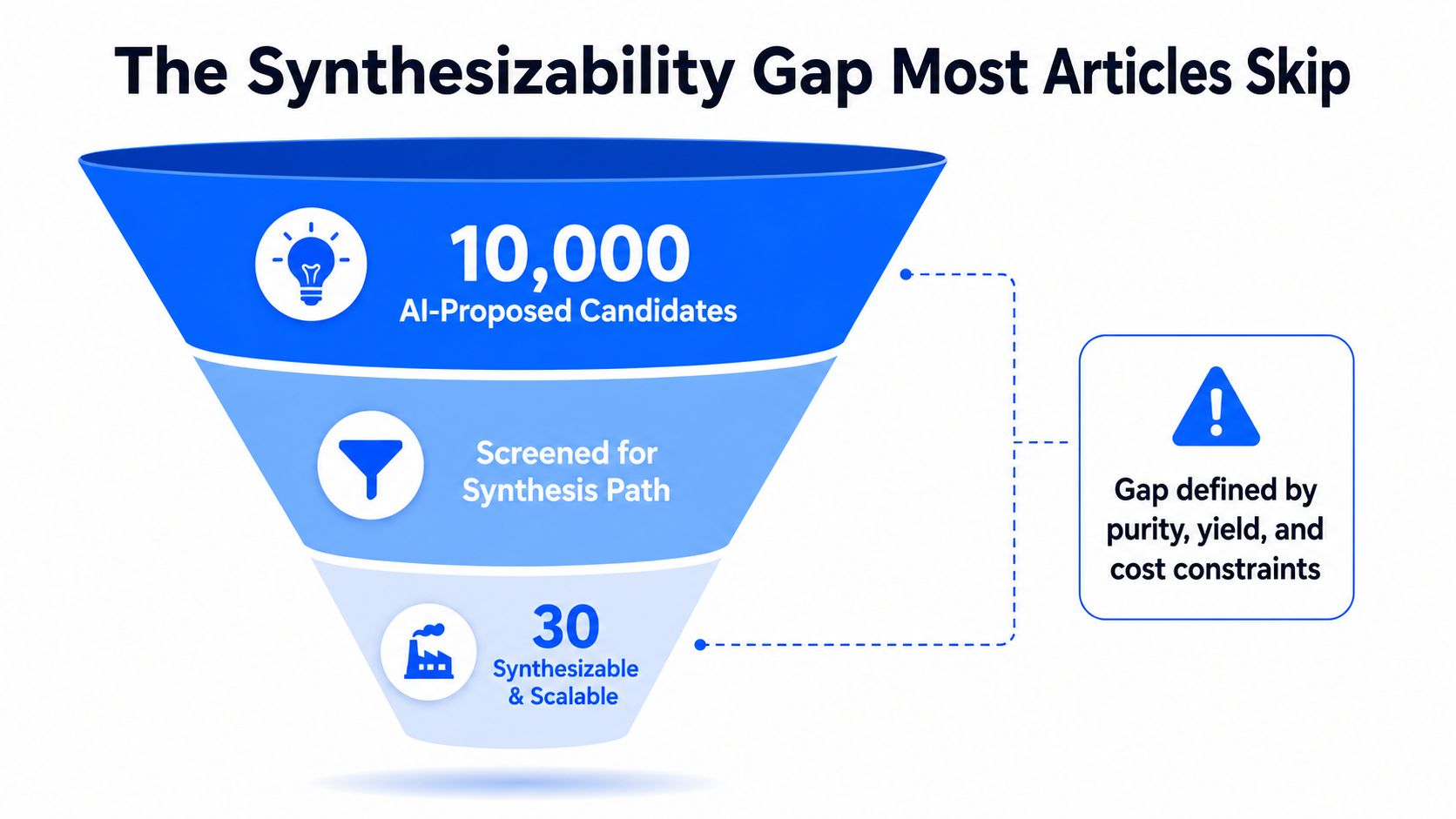
Candidate generation is the visible part of AI-driven materials discovery. Synthesizability is the conversion test. A proposed structure has value only when a chemist can translate it into a workable route, obtain the required purity, reproduce the result, and assess whether the economics and equipment remain plausible at a larger scale.
This distance between a predicted candidate and a practical recipe is the synthesizability gap. It explains why a system that generates more structures isn't automatically better. The recent perspective on the synthesizability gap describes a field that can produce candidates faster than experimental routes can validate them at laboratory or production scale.
Fewer useful candidates beat more unusable ones
The funnel below is a conceptual illustration, not a measured conversion rate. It shows how a large computational search might be reduced through synthesis-path analysis, purity requirements, yield expectations, cost limits, and scale-up constraints.
Teams can close the gap by combining several capabilities:
- Retrosynthesis planning: Identify plausible routes and required precursors before a candidate enters the experimental queue.
- Internal feasibility models: Learn from historical yields, failed reactions, impurity profiles, and equipment limits.
- Process-aware ranking: Penalize candidates that require unfamiliar conditions or expensive inputs.
- Lab integration: Return synthesis and characterization results automatically, reducing the delay between experiment and model update.
A vendor that only provides a virtual shortlist may leave the hardest work to the customer. A system that connects prediction with synthesis planning, laboratory execution, and process records can make the shortlist more useful, even if it produces fewer proposals.
The evaluation metric should move downstream. Ask how many candidates were verified, repeated, and advanced toward scale, not just how many structures the model generated. The strongest platform is often the one that produces a smaller set of makeable, testable, and economically relevant candidates.
Implementation Considerations Before You Buy
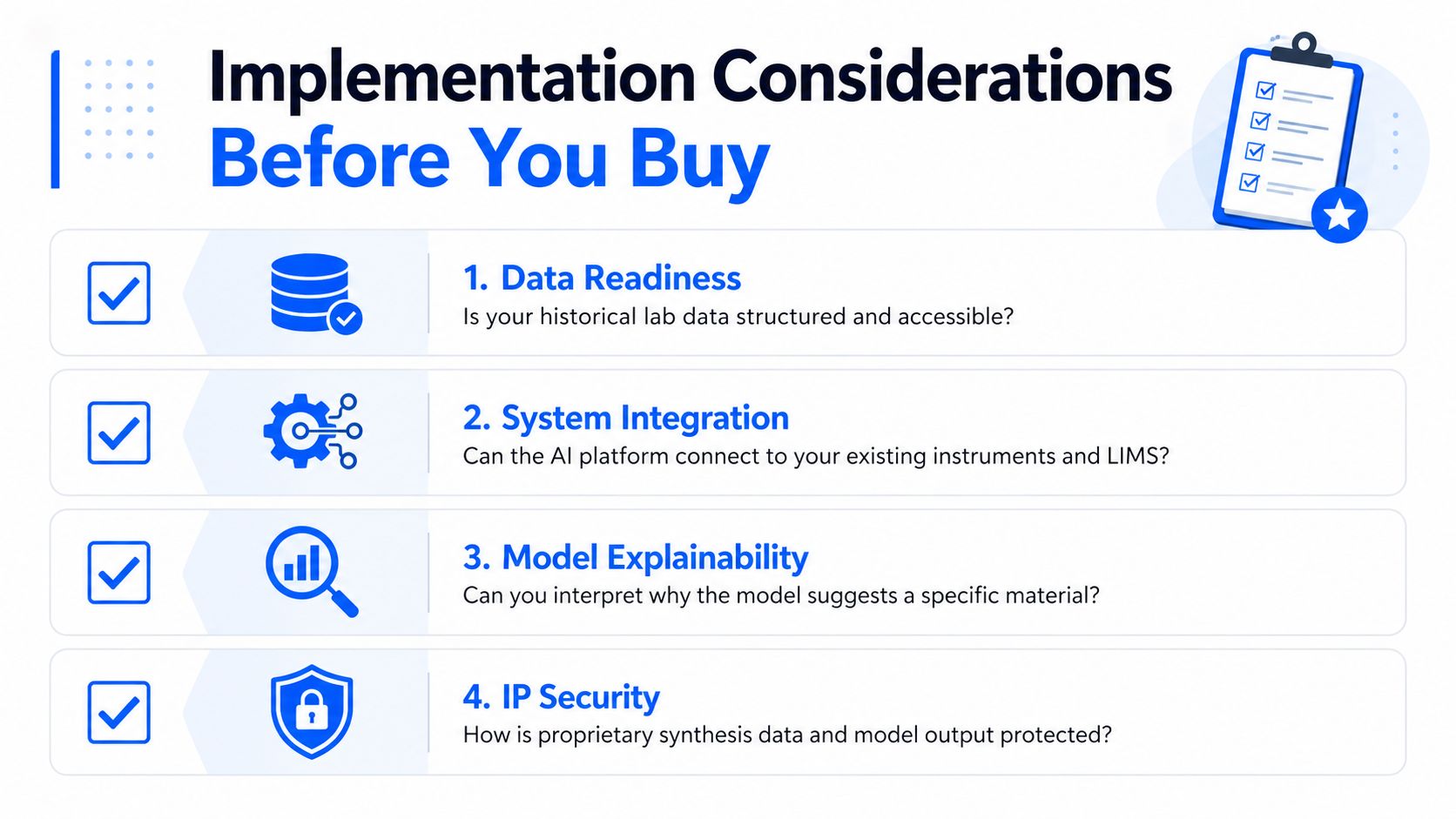
A platform demo can make data ingestion and prediction look simple. Deployment is different. Before buying, assess whether the organization can supply trustworthy data, connect the system to laboratory operations, explain recommendations to scientists, and protect proprietary material knowledge.
Start with a data readiness audit
Ask four basic questions:
- Location: Where do historical experiments live, including spreadsheets, ELNs, LIMS records, instrument exports, and reports?
- Ownership: Who can approve access, correct records, define terminology, and decide which data may leave the organization?
- Label quality: Does each result include the formulation, method, conditions, units, sample identity, and outcome?
- Failure coverage: Are unsuccessful experiments recorded with enough context to teach the system what to avoid?
Recent materials-informatics commentary emphasizes that useful datasets need more than volume. They need shared vocabularies, provenance, uncertainty, and structures that other systems can interpret. A platform that imports messy records without resolving those issues may create a polished interface over unreliable evidence.
Test the operational connections
API access isn't the same as a closed loop. Ask whether the platform can exchange data with the organization's ELN, LIMS, formulation tools, instruments, and automation layer. Confirm how it handles schema changes, sample identifiers, missing values, approvals, and results that arrive out of order.
Model explainability deserves the same practical treatment. Chemists may reject a recommendation if they can't see which ingredients, process conditions, historical precedents, or uncertainties influenced it. Feature importance, confidence intervals, comparable prior experiments, and uncertainty estimates can help, but only if the explanation matches the actual decision.
Treat security as a design decision
Clarify whether deployment can be cloud-based, on-premises, or hybrid, and identify applicable data-residency requirements. Review role-based access, audit trails, encryption, model-output ownership, retention policies, and whether a vendor uses experimental data to retrain shared models.
Buyer checkpoint: Ask the vendor to demonstrate one complete path from an approved historical record to a ranked experiment, with provenance and access controls visible at every stage.
How to Evaluate Platforms and Vendors
Vendor comparison becomes clearer when criteria reflect the actual failure points. A platform should earn credit for data model maturity, synthesis relevance, transparency, security, evidence from actual projects, and a commercial model that fits the organization's usage.
The weights below provide a starting framework. They are decision criteria, not industry-standard benchmarks, so a team should adjust them when a specific material class or regulatory environment changes the priorities.
| Criterion | Weight | What to Ask the Vendor | Red Flag |
|---|---|---|---|
| Data model maturity and ingestion tools | 20% | Can the system represent formulations, process conditions, failed experiments, provenance, and uncertainty? | The demo uses only a clean sample dataset |
| Synthesizability and lab integration | 20% | How does the system rank makeability and connect to ELNs, LIMS, instruments, or automation? | No evidence that proposed candidates reached practical validation |
| Model transparency and explainability | 15% | Can scientists inspect drivers, confidence, precedents, and uncertainty? | A single score is presented without supporting evidence |
| Security and deployment options | 15% | What are the cloud, on-premises, residency, access, and retraining policies? | The vendor can't clearly explain data use or ownership |
| Benchmark track record | 15% | What was measured, against which baseline, and with what validation protocol? | Methodology or baseline results are withheld |
| Ecosystem support and total cost | 15% | What implementation, training, integration, and usage costs apply? | Pricing is only per seat, with no clarity on compute or usage tiers |
During a demo, give every vendor the same historical dataset and the same target. Ask each team to show data preparation, candidate ranking, uncertainty, and the rationale for excluding proposals. A polished prediction without a transparent exclusion process is a weak signal.
Use a two-stage evaluation. First, run a sandbox trial on one internal dataset to test ingestion and scientific fit. Then run a paid pilot on one material class with a measurable KPI, such as validated hit rate, time-to-prototype, or the quality of scale-up recommendations.
For teams evaluating formulation and polymer workflows, Polymerize provides an example of a platform that unifies experimental data and applies domain-specific, explainable models to predict properties, optimize formulations, and surface causal drivers with confidence scores and historical precedents. It should be assessed against the same criteria as any other option, especially data governance, integration, and evidence on the team's own material system.
A 90-Day Plan and Where the Field Is Going Next
A practical launch doesn't require a company-wide transformation. It needs a narrow problem, reliable ownership, and a feedback loop that can be measured.
Days 1 through 14
Audit experimental records across spreadsheets, ELNs, LIMS, and shared drives. Document missing fields, inconsistent property definitions, duplicate samples, and access restrictions. At the same time, rank candidate projects by business impact, data availability, synthesis feasibility, and the ability to measure progress.
Days 15 through 42
Shortlist vendors and run a sandbox trial on one historical dataset. Require each platform to show how it handles failed experiments, uncertainty, provenance, and candidate exclusions. Select the option that supports a credible scientific workflow, not merely the most visually impressive model output.
Days 43 through 70
Run a paid pilot on one material class with a defined KPI. Keep the scope narrow enough that scientists can review every recommendation and record the reason for each experimental choice. Include synthesis constraints from the beginning, rather than adding manufacturability after candidate generation.
Days 71 through 90
Review the results with R&D, process engineering, IT, security, and finance. Decide whether to scale, revise the data model, change the target problem, or stop. A failed pilot can still be valuable if it reveals that the data, workflow, or feasibility assumptions weren't ready.
The field is moving toward closed-loop discovery, where prediction, synthesis, and characterization operate as a connected system. Generative models, foundation models, literature agents, autonomous experimentation, and process-scale integration may expand what teams can automate, but they won't remove the need for provenance, uncertainty, and practical synthesis evidence. The organizations that prepare now will build data infrastructure that supports those capabilities without losing scientific control.
The near-term advantage won't belong to the team with the largest candidate list. It will belong to the team that can turn fragmented records into trustworthy decisions and turn those decisions into repeatable materials.
Polymerize helps materials teams unify experimental data and use explainable AI to prioritize formulations, predict properties, and plan more targeted experiments. Visit Polymerize to see how its materials R&D platform can support the path from data readiness to validated, scalable innovation.
Put your R&D data to work
See how materials teams use Polymerize to plan fewer experiments and reach target properties faster.